Color Studies 3rd Edition Edith Anderson Feisner
download
https://ebookname.com/product/color-studies-3rd-edition-edith-
anderson-feisner/
Get Instant Ebook Downloads – Browse at https://ebookname.com
Instant digital products (PDF, ePub, MOBI) available
Download now and explore formats that suit you...
Color Appearance Models 3rd Edition Mark D. Fairchild
https://ebookname.com/product/color-appearance-models-3rd-
edition-mark-d-fairchild/
Technical shop mathematics 3rd ed Edition Anderson
https://ebookname.com/product/technical-shop-mathematics-3rd-ed-
edition-anderson/
The Sectional Anatomy Learning System 3rd Edition Edith
Ms Applegate Ms
https://ebookname.com/product/the-sectional-anatomy-learning-
system-3rd-edition-edith-ms-applegate-ms/
Applied symbolic dynamics and chaos Second Edition Hao
https://ebookname.com/product/applied-symbolic-dynamics-and-
chaos-second-edition-hao/
Aesthetics of Religion A Connective Concept 1st Edition
Alexandra K. Grieser
https://ebookname.com/product/aesthetics-of-religion-a-
connective-concept-1st-edition-alexandra-k-grieser/
Multiple Sclerosis Your Legal Rights 3rd edition Esq.
Lanny E. Perkins
https://ebookname.com/product/multiple-sclerosis-your-legal-
rights-3rd-edition-esq-lanny-e-perkins/
App Inventor 1st Edition David Wolber
https://ebookname.com/product/app-inventor-1st-edition-david-
wolber/
Goethe s Faust Eudo C. Mason
https://ebookname.com/product/goethe-s-faust-eudo-c-mason/
Pro T SQL 2012 Programmer 039 s Guide 3rd Edition
Edition Jay Natarajan
https://ebookname.com/product/pro-t-
sql-2012-programmer-039-s-guide-3rd-edition-edition-jay-
natarajan/
How to Land a Top Paying Federal Job Your Complete
Guide to Opportunities Internships Resumes and Cover
Letters Application Essays Lily Whiteman
https://ebookname.com/product/how-to-land-a-top-paying-federal-
job-your-complete-guide-to-opportunities-internships-resumes-and-
cover-letters-application-essays-lily-whiteman/
Color Foundations
Page Range: 1
Three basic elements are required for an appreciation of color: a light source, an object,
and a viewer. Part I begins with the fundamentals of color observation. We describe the
physiology of the eye and how light imparts color to objects, as well as the psychological
and cultural factors involved in perception. These factors in turn affect whether an artist
chooses to use local, optical, or arbitrary color. Next, we examine the different color
systems and “wheels,” along with their application to different media.
The science and psychology of color have had fascinated thinkers for centuries. On our
historical journey, we’ll meet such individuals as Leonardo da Vinci, Sir Isaac Newton,
Albert Munsell, and Josef Albers. Their influence on the discipline of color remains strong
today.
We will look at coloring agents— additive, subtractive, and partitive color mixing—as well
as pigments, dyes, binders, and grounds. Finally, we will explore the realms of modern
technology’s employment of color in the arts.
While we explore the various visual media available today, this text has been written not
to give “how-to” instructions for specific media, but rather to provide tenets of color
usage to all art media.
What is Color?
Page Range: 2–9
DOI: 10.5040/9781501303364.ch-001
Objectives
After reading this chapter, you will be able to:
Describe the process of light transmission and the anatomy of the eye in the
physiological process of how we see color.
Differentiate the various factors that affect our perception of color.
Compare and explain the differences between local, optical, and arbitrary color.
More than any other element of design, color has the ability to make us aware of what we
see, for nothing has meaning without color (here we extend the meaning of color to
include black and white). Try to describe the sky, for example, without referring to color—
it is very difficult.
Color defines our world and our emotions. It is usually seen before imagery. Our eyes are
attracted to color to such an extent that the color of an object is perceived before the
details imparted by its shapes and lines. At first glance we do not see the different species
of trees present in a summer woodland, but rather see the preponderance of green. The
artist, architect, and designer, however, are generally concerned with having color and
imagery perceived simultaneously. Upon entering a room, we first see the color or colors
used in the interior design and then discern the furnishings and artifacts contained within
the space. An artwork, be it fine or commercial, is aesthetically pleasing to the viewer
when its color usage allows the viewer to see the content of the piece (both color and
imagery) together. When this is accomplished, a work’s message is conveyed immediately,
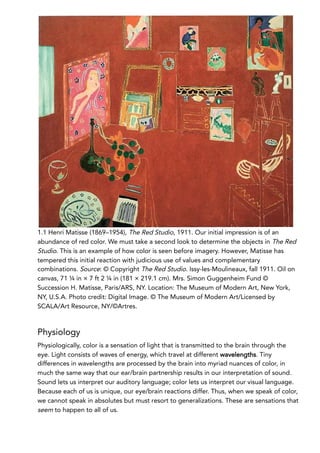
without a “second look” on the part of the viewer (Figure 1.1).
Color can also be described by two very different methods or points of view—objectively,
by referring to the laws of chemistry, physics, and physiology; and subjectively, by
referring to concepts of psychology. Similarly, our perception of objects depends both on
physical factors—such as their actual hues (i.e., the name of a color: red, yellow, blue,
etc.), or their lightness and darkness in relationship to surroundings (the value of a hue)—
and more psychological and cultural factors.
1.1 Henri Matisse (1869–1954), The Red Studio, 1911. Our initial impression is of an
abundance of red color. We must take a second look to determine the objects in The Red
Studio. This is an example of how color is seen before imagery. However, Matisse has
tempered this initial reaction with judicious use of values and complementary
combinations. Source: © Copyright The Red Studio. Issy-les-Moulineaux, fall 1911. Oil on
canvas, 71 ¼ in × 7 ft 2 ¼ in (181 × 219.1 cm). Mrs. Simon Guggenheim Fund ©
Succession H. Matisse, Paris/ARS, NY. Location: The Museum of Modern Art, New York,
NY, U.S.A. Photo credit: Digital Image. © The Museum of Modern Art/Licensed by
SCALA/Art Resource, NY/©Artres.
Physiology
Physiologically, color is a sensation of light that is transmitted to the brain through the
eye. Light consists of waves of energy, which travel at different wavelengths. Tiny
differences in wavelengths are processed by the brain into myriad nuances of color, in
much the same way that our ear/brain partnership results in our interpretation of sound.
Sound lets us interpret our auditory language; color lets us interpret our visual language.
Because each of us is unique, our eye/brain reactions differ. Thus, when we speak of color,
we cannot speak in absolutes but must resort to generalizations. These are sensations that
seem to happen to all of us.
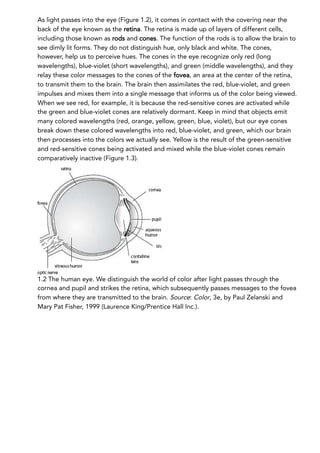
As light passes into the eye (Figure 1.2), it comes in contact with the covering near the
back of the eye known as the retina. The retina is made up of layers of different cells,
including those known as rods and cones. The function of the rods is to allow the brain to
see dimly lit forms. They do not distinguish hue, only black and white. The cones,
however, help us to perceive hues. The cones in the eye recognize only red (long
wavelengths), blue-violet (short wavelengths), and green (middle wavelengths), and they
relay these color messages to the cones of the fovea, an area at the center of the retina,
to transmit them to the brain. The brain then assimilates the red, blue-violet, and green
impulses and mixes them into a single message that informs us of the color being viewed.
When we see red, for example, it is because the red-sensitive cones are activated while
the green and blue-violet cones are relatively dormant. Keep in mind that objects emit
many colored wavelengths (red, orange, yellow, green, blue, violet), but our eye cones
break down these colored wavelengths into red, blue-violet, and green, which our brain
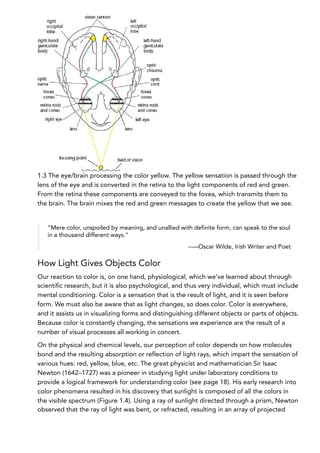
then processes into the colors we actually see. Yellow is the result of the green-sensitive
and red-sensitive cones being activated and mixed while the blue-violet cones remain
comparatively inactive (Figure 1.3).
1.2 The human eye. We distinguish the world of color after light passes through the
cornea and pupil and strikes the retina, which subsequently passes messages to the fovea
from where they are transmitted to the brain. Source: Color, 3e, by Paul Zelanski and
Mary Pat Fisher, 1999 (Laurence King/Prentice Hall Inc.).
1.3 The eye/brain processing the color yellow. The yellow sensation is passed through the
lens of the eye and is converted in the retina to the light components of red and green.
From the retina these components are conveyed to the fovea, which transmits them to
the brain. The brain mixes the red and green messages to create the yellow that we see.
“Mere color, unspoiled by meaning, and unallied with definite form, can speak to the soul
in a thousand different ways.”
--—Oscar Wilde, Irish Writer and Poet
How Light Gives Objects Color
Our reaction to color is, on one hand, physiological, which we’ve learned about through
scientific research, but it is also psychological, and thus very individual, which must include
mental conditioning. Color is a sensation that is the result of light, and it is seen before
form. We must also be aware that as light changes, so does color. Color is everywhere,
and it assists us in visualizing forms and distinguishing different objects or parts of objects.
Because color is constantly changing, the sensations we experience are the result of a
number of visual processes all working in concert.
On the physical and chemical levels, our perception of color depends on how molecules
bond and the resulting absorption or reflection of light rays, which impart the sensation of
various hues: red, yellow, blue, etc. The great physicist and mathematician Sir Isaac
Newton (1642–1727) was a pioneer in studying light under laboratory conditions to
provide a logical framework for understanding color (see page 18). His early research into
color phenomena resulted in his discovery that sunlight is composed of all the colors in
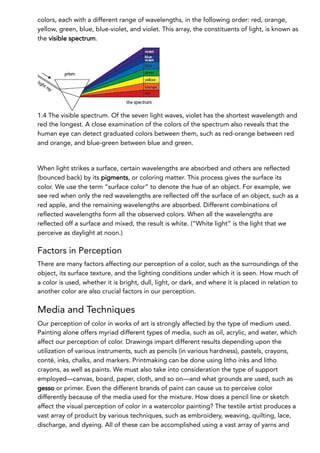
the visible spectrum (Figure 1.4). Using a ray of sunlight directed through a prism, Newton
observed that the ray of light was bent, or refracted, resulting in an array of projected
colors, each with a different range of wavelengths, in the following order: red, orange,
yellow, green, blue, blue-violet, and violet. This array, the constituents of light, is known as
the visible spectrum.
1.4 The visible spectrum. Of the seven light waves, violet has the shortest wavelength and
red the longest. A close examination of the colors of the spectrum also reveals that the
human eye can detect graduated colors between them, such as red-orange between red
and orange, and blue-green between blue and green.
When light strikes a surface, certain wavelengths are absorbed and others are reflected
(bounced back) by its pigments, or coloring matter. This process gives the surface its
color. We use the term “surface color” to denote the hue of an object. For example, we
see red when only the red wavelengths are reflected off the surface of an object, such as a
red apple, and the remaining wavelengths are absorbed. Different combinations of
reflected wavelengths form all the observed colors. When all the wavelengths are
reflected off a surface and mixed, the result is white. (“White light” is the light that we
perceive as daylight at noon.)
Factors in Perception
There are many factors affecting our perception of a color, such as the surroundings of the
object, its surface texture, and the lighting conditions under which it is seen. How much of
a color is used, whether it is bright, dull, light, or dark, and where it is placed in relation to
another color are also crucial factors in our perception.
Media and Techniques
Our perception of color in works of art is strongly affected by the type of medium used.
Painting alone offers myriad different types of media, such as oil, acrylic, and water, which
affect our perception of color. Drawings impart different results depending upon the
utilization of various instruments, such as pencils (in various hardness), pastels, crayons,
conté, inks, chalks, and markers. Printmaking can be done using litho inks and litho
crayons, as well as paints. We must also take into consideration the type of support
employed—canvas, board, paper, cloth, and so on—and what grounds are used, such as
gesso or primer. Even the different brands of paint can cause us to perceive color
differently because of the media used for the mixture. How does a pencil line or sketch
affect the visual perception of color in a watercolor painting? The textile artist produces a
vast array of product by various techniques, such as embroidery, weaving, quilting, lace,
discharge, and dyeing. All of these can be accomplished using a vast array of yarns and
fibers, each imparting its unique qualities of sheen and texture. Ceramic glazes can result
in an overlapping of colors that change our perception of the piece. We can also
experience the same types of color variations in printmaking. Consider also that interior
design and fashion combine many types of media and textures that can produce a
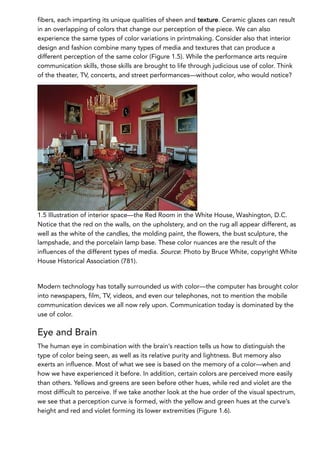
different perception of the same color (Figure 1.5). While the performance arts require
communication skills, those skills are brought to life through judicious use of color. Think
of the theater, TV, concerts, and street performances—without color, who would notice?
1.5 Illustration of interior space—the Red Room in the White House, Washington, D.C.
Notice that the red on the walls, on the upholstery, and on the rug all appear different, as
well as the white of the candles, the molding paint, the flowers, the bust sculpture, the
lampshade, and the porcelain lamp base. These color nuances are the result of the
influences of the different types of media. Source: Photo by Bruce White, copyright White
House Historical Association (781).
Modern technology has totally surrounded us with color—the computer has brought color
into newspapers, film, TV, videos, and even our telephones, not to mention the mobile
communication devices we all now rely upon. Communication today is dominated by the
use of color.
Eye and Brain
The human eye in combination with the brain’s reaction tells us how to distinguish the
type of color being seen, as well as its relative purity and lightness. But memory also
exerts an influence. Most of what we see is based on the memory of a color—when and
how we have experienced it before. In addition, certain colors are perceived more easily
than others. Yellows and greens are seen before other hues, while red and violet are the
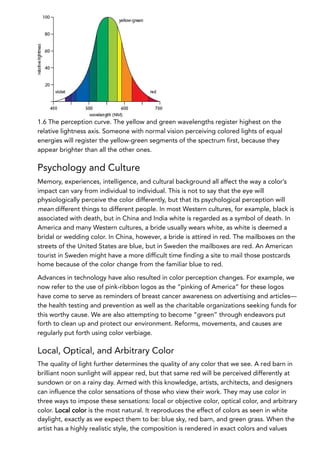
most difficult to perceive. If we take another look at the hue order of the visual spectrum,
we see that a perception curve is formed, with the yellow and green hues at the curve’s
height and red and violet forming its lower extremities (Figure 1.6).
1.6 The perception curve. The yellow and green wavelengths register highest on the
relative lightness axis. Someone with normal vision perceiving colored lights of equal
energies will register the yellow-green segments of the spectrum first, because they
appear brighter than all the other ones.
Psychology and Culture
Memory, experiences, intelligence, and cultural background all affect the way a color’s
impact can vary from individual to individual. This is not to say that the eye will
physiologically perceive the color differently, but that its psychological perception will
mean different things to different people. In most Western cultures, for example, black is
associated with death, but in China and India white is regarded as a symbol of death. In
America and many Western cultures, a bride usually wears white, as white is deemed a
bridal or wedding color. In China, however, a bride is attired in red. The mailboxes on the
streets of the United States are blue, but in Sweden the mailboxes are red. An American
tourist in Sweden might have a more difficult time finding a site to mail those postcards
home because of the color change from the familiar blue to red.
Advances in technology have also resulted in color perception changes. For example, we
now refer to the use of pink-ribbon logos as the “pinking of America” for these logos
have come to serve as reminders of breast cancer awareness on advertising and articles—
the health testing and prevention as well as the charitable organizations seeking funds for
this worthy cause. We are also attempting to become “green” through endeavors put
forth to clean up and protect our environment. Reforms, movements, and causes are
regularly put forth using color verbiage.
Local, Optical, and Arbitrary Color
The quality of light further determines the quality of any color that we see. A red barn in
brilliant noon sunlight will appear red, but that same red will be perceived differently at
sundown or on a rainy day. Armed with this knowledge, artists, architects, and designers
can influence the color sensations of those who view their work. They may use color in
three ways to impose these sensations: local or objective color, optical color, and arbitrary
color. Local color is the most natural. It reproduces the effect of colors as seen in white
daylight, exactly as we expect them to be: blue sky, red barn, and green grass. When the
artist has a highly realistic style, the composition is rendered in exact colors and values
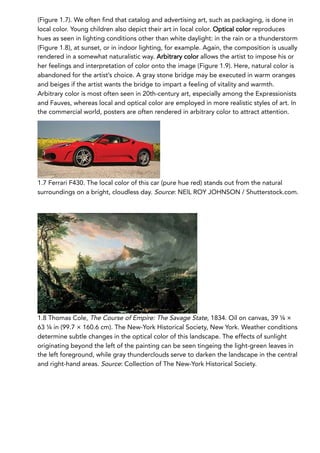
(Figure 1.7). We often find that catalog and advertising art, such as packaging, is done in
local color. Young children also depict their art in local color. Optical color reproduces
hues as seen in lighting conditions other than white daylight: in the rain or a thunderstorm
(Figure 1.8), at sunset, or in indoor lighting, for example. Again, the composition is usually
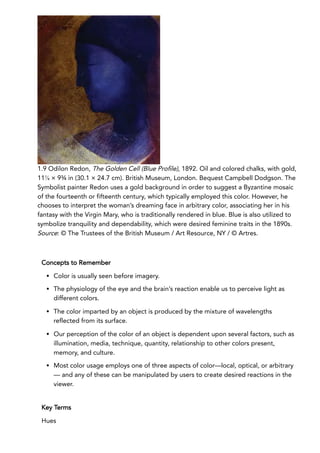
rendered in a somewhat naturalistic way. Arbitrary color allows the artist to impose his or
her feelings and interpretation of color onto the image (Figure 1.9). Here, natural color is
abandoned for the artist’s choice. A gray stone bridge may be executed in warm oranges
and beiges if the artist wants the bridge to impart a feeling of vitality and warmth.
Arbitrary color is most often seen in 20th-century art, especially among the Expressionists
and Fauves, whereas local and optical color are employed in more realistic styles of art. In
the commercial world, posters are often rendered in arbitrary color to attract attention.
1.7 Ferrari F430. The local color of this car (pure hue red) stands out from the natural
surroundings on a bright, cloudless day. Source: NEIL ROY JOHNSON / Shutterstock.com.
1.8 Thomas Cole, The Course of Empire: The Savage State, 1834. Oil on canvas, 39 ¼ ×
63 ¼ in (99.7 × 160.6 cm). The New-York Historical Society, New York. Weather conditions
determine subtle changes in the optical color of this landscape. The effects of sunlight
originating beyond the left of the painting can be seen tingeing the light-green leaves in
the left foreground, while gray thunderclouds serve to darken the landscape in the central
and right-hand areas. Source: Collection of The New-York Historical Society.
1.9 Odilon Redon, The Golden Cell (Blue Profile), 1892. Oil and colored chalks, with gold,
11⅞ × 9¾ in (30.1 × 24.7 cm). British Museum, London. Bequest Campbell Dodgson. The
Symbolist painter Redon uses a gold background in order to suggest a Byzantine mosaic
of the fourteenth or fifteenth century, which typically employed this color. However, he
chooses to interpret the woman’s dreaming face in arbitrary color, associating her in his
fantasy with the Virgin Mary, who is traditionally rendered in blue. Blue is also utilized to
symbolize tranquility and dependability, which were desired feminine traits in the 1890s.
Source: © The Trustees of the British Museum / Art Resource, NY / © Artres.
Concepts to Remember
Color is usually seen before imagery.
The physiology of the eye and the brain’s reaction enable us to perceive light as
different colors.
The color imparted by an object is produced by the mixture of wavelengths
reflected from its surface.
Our perception of the color of an object is dependent upon several factors, such as
illumination, media, technique, quantity, relationship to other colors present,
memory, and culture.
Most color usage employs one of three aspects of color—local, optical, or arbitrary
— and any of these can be manipulated by users to create desired reactions in the
viewer.
Key Terms
Hues
Value
Wavelengths
Retina
Rods
Cones
Fovea
Visible spectrum
Pigments
Gesso
Texture
Local color
Optical color
Arbitrary color
Exercises
1. Observe an object under different lighting conditions and, if you can, take some
color photographs. How do the different conditions affect the object’s color?
2. Collect and label pictures (magazine photographs are good) showing local, optical,
and arbitrary color.
3. Using a drawing of the same object, render it in the media of your choice in local,
optical, and arbitrary color.
Color Systems and Color Wheels
Page Range: 10–15
DOI: 10.5040/9781501303364.ch-002
Objectives
After reading this chapter, you will be able to:
Describe the three color systems—subtractive, additive, and partitive—and explain
how each is unique in our perception of color.
Distinguish and compare the differences between the four basic color wheels that
utilize the three color systems.
Identify and state the primary, secondary, and tertiary colors within each of the four
basic color wheels, why they are unique to each wheel, and how they are created.
Over the centuries, colors have been mixed according to three different systems.
Subtractive color is the process of mixing pigments together, such as we see in painting.
As we learned in Chapter 1, the pigments in an object enable it to absorb some light
waves and reflect others Figure 2.1). When these pigments are blended, more light is
absorbed and less is reflected—hence the term “subtractive.” By contrast, the colors in
light are additive—the more they are mixed with other colors, the lighter they become.
Additive color is the process of mixing colored light, such as in theatrical lighting or
television. The partitive color system is based on the viewer’s reaction to colors when they
are placed next to one another. Bear in mind that all colors are seen in relation to other
colors, rather than in isolation. Color wheels are color arrangements or structures that
enable us to organize and predict such color reactions and interactions. As you will see,
just one wheel or system may not satisfy all our needs. For example, the painter uses
subtractive color (to create various colors of paint) and partitive color (to create color
reactions according to where the paint colors are placed). The photographer uses additive
color (to create the colors or values—lightness or darkness—within the photograph) and
partitive color (to impart reactions and interactions between the photographic imagery).
The textile artist uses subtractive color (to create colors of yarn and textiles by dyeing)
and partitive color (to impart reactions and interactions that occur from color placement).
It becomes obvious that all art media use partitive color, and that the specific materials
employed within each medium can be either additive or subtractive. Each artist must
determine which wheel or wheels best satisfy the needs at hand.
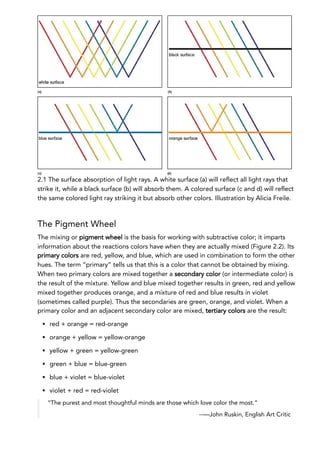
2.1 The surface absorption of light rays. A white surface (a) will reflect all light rays that
strike it, while a black surface (b) will absorb them. A colored surface (c and d) will reflect
the same colored light ray striking it but absorb other colors. Illustration by Alicia Freile.
The Pigment Wheel
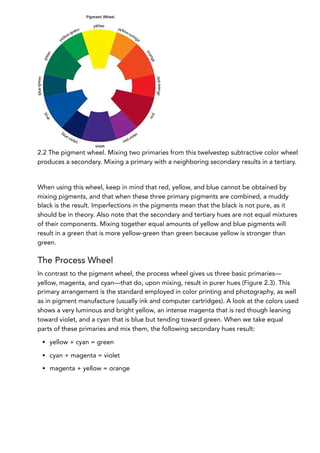
The mixing or pigment wheel is the basis for working with subtractive color; it imparts
information about the reactions colors have when they are actually mixed (Figure 2.2). Its
primary colors are red, yellow, and blue, which are used in combination to form the other
hues. The term “primary” tells us that this is a color that cannot be obtained by mixing.
When two primary colors are mixed together a secondary color (or intermediate color) is
the result of the mixture. Yellow and blue mixed together results in green, red and yellow
mixed together produces orange, and a mixture of red and blue results in violet
(sometimes called purple). Thus the secondaries are green, orange, and violet. When a
primary color and an adjacent secondary color are mixed, tertiary colors are the result:
red + orange = red-orange
orange + yellow = yellow-orange
yellow + green = yellow-green
green + blue = blue-green
blue + violet = blue-violet
violet + red = red-violet
“The purest and most thoughtful minds are those which love color the most.”
--—John Ruskin, English Art Critic
2.2 The pigment wheel. Mixing two primaries from this twelvestep subtractive color wheel
produces a secondary. Mixing a primary with a neighboring secondary results in a tertiary.
When using this wheel, keep in mind that red, yellow, and blue cannot be obtained by
mixing pigments, and that when these three primary pigments are combined, a muddy
black is the result. Imperfections in the pigments mean that the black is not pure, as it
should be in theory. Also note that the secondary and tertiary hues are not equal mixtures
of their components. Mixing together equal amounts of yellow and blue pigments will
result in a green that is more yellow-green than green because yellow is stronger than
green.
The Process Wheel
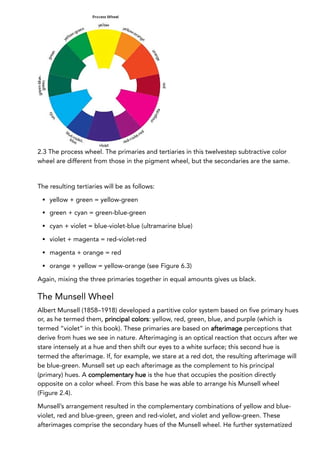
In contrast to the pigment wheel, the process wheel gives us three basic primaries—
yellow, magenta, and cyan—that do, upon mixing, result in purer hues (Figure 2.3). This
primary arrangement is the standard employed in color printing and photography, as well
as in pigment manufacture (usually ink and computer cartridges). A look at the colors used
shows a very luminous and bright yellow, an intense magenta that is red though leaning
toward violet, and a cyan that is blue but tending toward green. When we take equal
parts of these primaries and mix them, the following secondary hues result:
yellow + cyan = green
cyan + magenta = violet
magenta + yellow = orange
2.3 The process wheel. The primaries and tertiaries in this twelvestep subtractive color
wheel are different from those in the pigment wheel, but the secondaries are the same.
The resulting tertiaries will be as follows:
yellow + green = yellow-green
green + cyan = green-blue-green
cyan + violet = blue-violet-blue (ultramarine blue)
violet + magenta = red-violet-red
magenta + orange = red
orange + yellow = yellow-orange (see Figure 6.3)
Again, mixing the three primaries together in equal amounts gives us black.
The Munsell Wheel
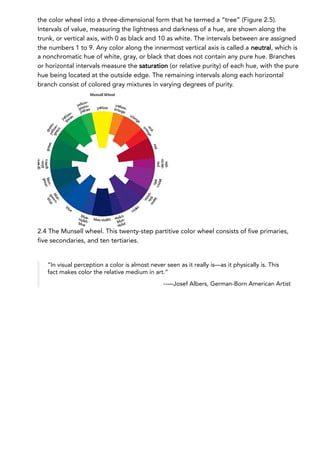
Albert Munsell (1858–1918) developed a partitive color system based on five primary hues
or, as he termed them, principal colors: yellow, red, green, blue, and purple (which is
termed “violet” in this book). These primaries are based on afterimage perceptions that
derive from hues we see in nature. Afterimaging is an optical reaction that occurs after we
stare intensely at a hue and then shift our eyes to a white surface; this second hue is
termed the afterimage. If, for example, we stare at a red dot, the resulting afterimage will
be blue-green. Munsell set up each afterimage as the complement to his principal
(primary) hues. A complementary hue is the hue that occupies the position directly
opposite on a color wheel. From this base he was able to arrange his Munsell wheel
(Figure 2.4).
Munsell’s arrangement resulted in the complementary combinations of yellow and blue-
violet, red and blue-green, green and red-violet, and violet and yellow-green. These
afterimages comprise the secondary hues of the Munsell wheel. He further systematized
the color wheel into a three-dimensional form that he termed a “tree” (Figure 2.5).
Intervals of value, measuring the lightness and darkness of a hue, are shown along the
trunk, or vertical axis, with 0 as black and 10 as white. The intervals between are assigned
the numbers 1 to 9. Any color along the innermost vertical axis is called a neutral, which is
a nonchromatic hue of white, gray, or black that does not contain any pure hue. Branches
or horizontal intervals measure the saturation (or relative purity) of each hue, with the pure
hue being located at the outside edge. The remaining intervals along each horizontal
branch consist of colored gray mixtures in varying degrees of purity.
2.4 The Munsell wheel. This twenty-step partitive color wheel consists of five primaries,
five secondaries, and ten tertiaries.
“In visual perception a color is almost never seen as it really is—as it physically is. This
fact makes color the relative medium in art.”
--—Josef Albers, German-Born American Artist
2.5 The Munsell color tree. There are ten vanes to this tree, corresponding to the five
primaries and five secondaries of the Munsell wheel (see Figure 2.4). In this view, the
complementary primaries of yellow and blue-violet can be seen across from each other.
Courtesy of X-Rite, Inc.
We will explore Munsell’s system further in the section on color theorists (see pages 22–
24). It is used by dye manufacturers for yarn and fabric coloration, as well as in interior
design and in the production of cosmetics, computer hardware, and paint. For example,
Liquitex acrylic paints carry Munsell color notations on their tube labels. Partitive color
usage often relies on the interactions resulting from afterimaging. Because the Munsell
wheel is the wheel based on afterimaging, we will base all our information concerning
color on this wheel unless otherwise noted.
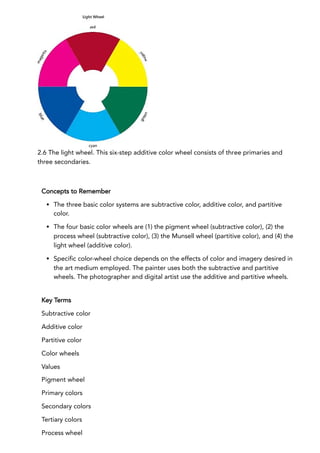
The Light Wheel
The light wheel is based on the additive color system and provides information
concerning light rays and transparent color. Here the primary colors that form the other
hues are red, green, and blue. The secondaries are as follows:
red + green = yellow
green + blue = cyan
blue + red = magenta
As these are combinations of colored light, when all the primaries are combined, white
results. The total absence of light results in black. Because light is being added to light,
the more that color rays are mixed or fused with other color rays, the lighter they become.
The light wheel is used for theatrical lighting and projection (Figure 2.6) and is now the
basis for video, computer graphics, and electronic media.
2.6 The light wheel. This six-step additive color wheel consists of three primaries and
three secondaries.
Concepts to Remember
The three basic color systems are subtractive color, additive color, and partitive
color.
The four basic color wheels are (1) the pigment wheel (subtractive color), (2) the
process wheel (subtractive color), (3) the Munsell wheel (partitive color), and (4) the
light wheel (additive color).
Specific color-wheel choice depends on the effects of color and imagery desired in
the art medium employed. The painter uses both the subtractive and partitive
wheels. The photographer and digital artist use the additive and partitive wheels.
Key Terms
Subtractive color
Additive color
Partitive color
Color wheels
Values
Pigment wheel
Primary colors
Secondary colors
Tertiary colors
Process wheel
Principal colors
Afterimage
Complementary hue
Munsell wheel
Neutral
Saturation
Light wheel
Exercises
1. Make a list of various art media (painting, sculpture, printmaking, etc.), crafts
(weaving, batik, ceramics, jewelry, etc.), and commercial visual media (interior
design, architecture, advertising, photography, etc.). Note which color systems
(subtractive, additive, or partitive) and color wheels (pigment, process, Munsell, or
light) would be used by each.
2. Create two compositions of identically spaced stripes in an art medium of your
choice. Within the first, choose a complementary pair of hues from the pigment
wheel, and within the second, a complementary pair from the Munsell wheel.
3. Using any desired medium—watercolor, colored pencil, colored paper, fabric, etc.—
develop a twelve-step color wheel consisting of primary, secondary, and tertiary
colors. Pay attention to the visual mixing of colors with the chosen medium in
achieving the correct hues. Use the examples in this chapter for the template of the
wheel or create a unique composition. Consider a small, portable size for your color
wheel, created on sturdy cardstock paper that can be kept for future use and
reference in upcoming exercises. The final color wheel can be laminated for
protection and longevity.
Color Theorists
Page Range: 16–31
DOI: 10.5040/9781501303364.ch-003
Objectives
After reading this chapter, you will be able to:
List those individuals who were significant in the development of color theories.
Describe the unique and specific contributions each theorist has made toward the
study of color.
Analyze and compare the differences among each theorist’s approach to describing
and exploring our understanding of color.
Relate how one or more of the theories can be directly applied to specific disciplines
—fine art, interior design, architecture, graphic design, fashion design, photography,
digital art, etc.—and critique the advantages or disadvantages of each.
In trying to understand the important influence of color on our lives, color theorists have
from ancient times to the present attempted to explain both scientifically and
psychologically how we react to color. In doing so, they have devised systematic
frameworks and rules for our dealings with color. Although color is a sensation, and as
such its reactions cannot be neatly categorized, our awareness of the work of color
theorists does help us in understanding color. Color usage is complex, and knowledge of
how color theory has evolved lets us utilize these various theories, where appropriate, in
working with color.
Color Theory in the Ancient World
The first hint of color theory was formulated by the ancient Greek philosopher
Empedocles (492–431 b.c.e.).
Empedocles’s observations of his surroundings led him to the conclusion that the eye of
the observer perceives color; color is not a property of the object being observed.
Democritus (460–370 b.c.e.) developed the first atomic theory. He stated that the world
was composed of atoms and that color was the result of atomic arrangements. Here were
the first bare bones of color theory evolving from a combination of speculation and
observation. According to the great Greek teacher and philosopher Plato (427–347
b.c.e.), perception was a property of the individual perceiver—the problem, therefore,
was how to distinguish between reality and appearance. Color is a sensation that allows
us to describe what we see. Plato described or identified the hues as black, white, red,
and yellow.
In De Coloribus (the first known book about color), the Greek philosopher Aristotle (384–
322 b.c.e.) attempted to explain the composition of colors and how they were related.
Aristotle assumed that all colors were derived from the blending of sunlight, fire, light,
and lack of light in varying degrees.
Reds varied as the amounts of these components changed. Sunset reds were a definite
mixture of sunlight, night darkness, and the smoke coloring the atmosphere. Aristotle felt
that blue was the result of night darkness, smoke, and very little sunlight. His hue
identification included white, black, red, yellow, brown, violet, green, and blue, and he
proposed that mixing varying amounts of black and white with these other hues resulted
in the formation of all the perceived colors. Strangely enough, he saw the rainbow as
being a tricolored phenomenon of red, yellow, and green.
Leonardo Da Vinci
The Renaissance artist and scientist Leonardo da Vinci (1452–1519) set out his beliefs on
color theory in his Treatise on Painting, which was not published until 1651. He wrote that
black and white were indeed colors and assigned white, yellow, green, blue, red, and
black as the simple or primary colors. This was the first appearance of the four primaries
of the visual wheel, even though da Vinci did not arrange them in a circular configuration.
Working by observation from his own optical reactions, da Vinci concluded that certain
responses took place when colors were placed next to one another; this was later to
become known as simultaneous contrast. Essentially he discovered that when placed side
by side, complementary colors (or, as he termed them, “direct contraries”) intensify each
other.
The visual wheel grew out of work done by Leonardo da Vinci on complementary colors,
and it greatly influenced Renaissance painting. This wheel was the forerunner to the
concept of partitive color theory and was used in a partitive as well as a subtractive
manner. The visual wheel was then superseded by the Munsell wheel, which was more
scientifically accurate.
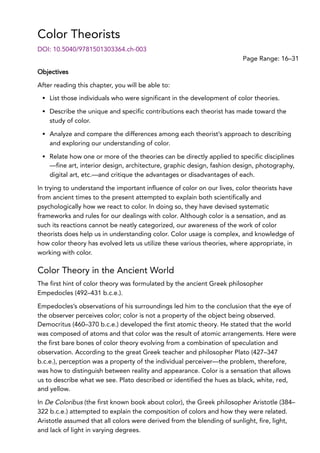
The primary colors of the visual wheel are red, yellow, green, and blue (Figure 3.1). The
secondaries are as follows:
red + yellow = orange
yellow + green = yellow-green
green + blue = blue-green
blue + red = violet
The visual wheel is arranged so that the complementary combinations are yellow and
blue, orange and blue-green, red and green, and violet and yellowgreen. When these
primaries are combined, the result to the human eye is gray.
Da Vinci also determined his importance of colors, which relied on physical aspects of the
environment, suggesting that white was the simplest of colors (representing light), second
was yellow (earth), third was green (water), fourth was blue (air), fifth was red (fire), and
sixth was black (total darkness).
Da Vinci was also extremely interested in developing what we now know as atmospheric
perspective. This describes the tendency of forms seen at great distance to become
uniform in hue and value. He recorded the sky changes and their effect on colors of
objects both near-at-hand and in the distance, writing, “colors will appear what they are
not, according to the ground which surrounds them.”
3.1 The visual wheel. This sixteen-step partitive (and subtractive) color wheel consists of
four primaries, four secondaries, and scientifically accurate. eight tertiaries.
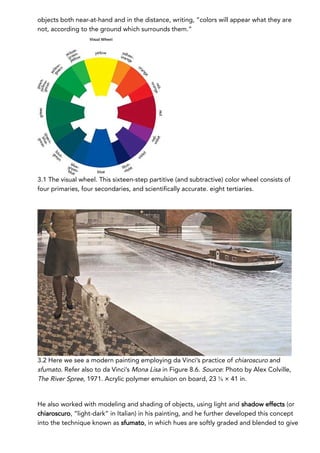
3.2 Here we see a modern painting employing da Vinci’s practice of chiaroscuro and
sfumato. Refer also to da Vinci’s Mona Lisa in Figure 8.6. Source: Photo by Alex Colville,
The River Spree, 1971. Acrylic polymer emulsion on board, 23 ⅝ × 41 in.
He also worked with modeling and shading of objects, using light and shadow effects (or
chiaroscuro, “light-dark” in Italian) in his painting, and he further developed this concept
into the technique known as sfumato, in which hues are softly graded and blended to give
a hazy, blurred effect (Figure 3.2). Sfumato can be accomplished by close grading of
values of colors, blending of colors, and glazing of colors.
Sir Isaac Newton
The English physicist Sir Isaac Newton (1642–1727) was interested purely in the physics of
color, rather than in perception. He discovered that as a ray of white light passes and is
bent, or refracted, through a prism, it is broken into an array of colors, or spectral hues—
red, orange, yellow, green, blue, indigo, and violet (see Figure 1.4). He noted that white
light is a mixture of all the spectral hues. He took this “array” and turned it into a two-
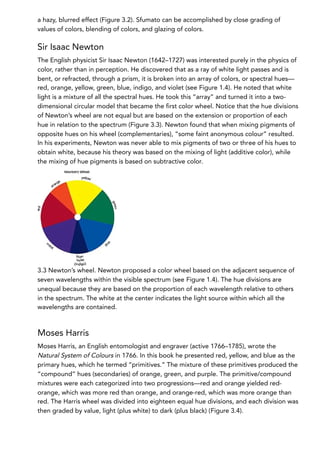
dimensional circular model that became the first color wheel. Notice that the hue divisions
of Newton’s wheel are not equal but are based on the extension or proportion of each
hue in relation to the spectrum (Figure 3.3). Newton found that when mixing pigments of
opposite hues on his wheel (complementaries), “some faint anonymous colour” resulted.
In his experiments, Newton was never able to mix pigments of two or three of his hues to
obtain white, because his theory was based on the mixing of light (additive color), while
the mixing of hue pigments is based on subtractive color.
3.3 Newton’s wheel. Newton proposed a color wheel based on the adjacent sequence of
seven wavelengths within the visible spectrum (see Figure 1.4). The hue divisions are
unequal because they are based on the proportion of each wavelength relative to others
in the spectrum. The white at the center indicates the light source within which all the
wavelengths are contained.
Moses Harris
Moses Harris, an English entomologist and engraver (active 1766–1785), wrote the
Natural System of Colours in 1766. In this book he presented red, yellow, and blue as the
primary hues, which he termed “primitives.” The mixture of these primitives produced the
“compound” hues (secondaries) of orange, green, and purple. The primitive/compound
mixtures were each categorized into two progressions—red and orange yielded red-
orange, which was more red than orange, and orange-red, which was more orange than
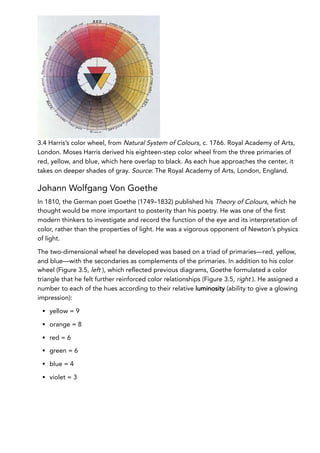
red. The Harris wheel was divided into eighteen equal hue divisions, and each division was
then graded by value, light (plus white) to dark (plus black) (Figure 3.4).
3.4 Harris’s color wheel, from Natural System of Colours, c. 1766. Royal Academy of Arts,
London. Moses Harris derived his eighteen-step color wheel from the three primaries of
red, yellow, and blue, which here overlap to black. As each hue approaches the center, it
takes on deeper shades of gray. Source: The Royal Academy of Arts, London, England.
Johann Wolfgang Von Goethe
In 1810, the German poet Goethe (1749–1832) published his Theory of Colours, which he
thought would be more important to posterity than his poetry. He was one of the first
modern thinkers to investigate and record the function of the eye and its interpretation of
color, rather than the properties of light. He was a vigorous opponent of Newton’s physics
of light.
The two-dimensional wheel he developed was based on a triad of primaries—red, yellow,
and blue—with the secondaries as complements of the primaries. In addition to his color
wheel (Figure 3.5, left ), which reflected previous diagrams, Goethe formulated a color
triangle that he felt further reinforced color relationships (Figure 3.5, right ). He assigned a
number to each of the hues according to their relative luminosity (ability to give a glowing
impression):
yellow = 9
orange = 8
red = 6
green = 6
blue = 4
violet = 3
Exploring the Variety of Random
Documents with Different Content
“Why did you tell the signorina it was an unlucky day?”
“Eh-h-h-h-h-h!” Nina’s “eh” began on the fourth line, and
ran down chromatically. Taken with outspread hands and
raised shoulders it implied, “How can the signora ask, when
she knows as well as I?” What she said was, “Did not the
eccellenza lose her purse?”
“But I have had a much bigger one sent to me,” said Teresa
gravely.
“Then, eccellenza, it is probable that after the priest you
met a hunchback, and she might counteract. Besides—” she
hesitated—“there is always that unfortunate Cesare.”
The marchesa was not surprised, Nina having an
extraordinary knack of knowing whatever went on. But she
was vexed at her thoughts being flung back upon a subject
which gave her a miserable impression of having behaved ill
without intending it.
“What do you know about Cesare?”
Nina screwed her eyes together, and nodded her rough
head.
“See here, eccellenza, I should not mind knowing less.
When one meets such in the street it is best to shut one’s
eyes and walk on. If he has a temper or not! That poor
Camilla! She was a butterfly, yes, and foolish, yes—but to
be shot all in a minute, without a priest! What a brother!”
“They say he loved her.”
“Eh-h-h-h-h—h! So they say. They came from Sicily alone,
these two, without parents, and he was strict with her, poor
little baby, and so—! It was not a love I should have liked,
but as for stealing! No, no, no, that is not Cesare.”
“Why did not the guardie say so, then?” demanded Teresa
impatiently.
“See, eccellenza, they are afraid, and they do not like him.
He is hand and glove with the fiercest men in Rome, men
who would overthrow anything, everything, king or pope,
what you will! Since Camilla died it is as if an evil spirit had
entered into him—he keeps with those men, he never hears
mass, he is like a lost soul. What took him into San Martino,
I wonder? At any rate I wish the eccellenza had had nothing
to do with him,” Nina ended, uneasily.
And Teresa wished the same thing with all her heart. The
young violent face, the passion of the eyes, haunted her.
Her grandmother and sister were taken up with delight and
wonderment over her good fortune. She tried to fling
herself into it with them, but while she planned, with all the
generosity of her nature, which but yesterday would have
leapt to feel certain galling chains removed, her thoughts
wandered away to the police station, and to Cesare in the
lock-up, with a board for his bed, and the smart of an
unjust accusation goading him to yet more furious rebellion
against his fate.
Chapter Three.
If Wilbraham were certain of one thing, it was that Donna
Teresa ought not to be encouraged to go to the police office.
He already called himself an idiot for having let her do so,
but as he had never been known seriously to take himself
for an idiot, this was probably no more than a figure of
speech. It meant, however, that he disapproved of her
conduct, and especially of her sympathy for Cesare, for
even the knowledge that the last accusation was untrue had
not changed his opinion of the accused. Perhaps, if
anything, the annoyance had accentuated it.
Yet, the next morning, when he ran over what lay before
him, he was not unwilling to admit that he should be early
at Via Porta Pinciana, so as to make sure that Donna Teresa
did not start on any fool’s errand without him. And with
disapproval so active, he might have been more gratified
than he was to hear from Mrs Brodrick that an absolutely
disabling headache obliged the marchesa to leave
everything in his hands.
“Please pay the fine, whatever it is, and see that he is
released.”
“Better she should keep out of it,” said Wilbraham grimly.
“But she wants the man’s address.”
“Don’t let her have it,” he said unadvisedly, and then
flushed, suddenly aware that he had spoken too warmly.
“The marchesa is young,” he said hurriedly, “and there are
bad parts in Rome, where she really ought not to go.”
“No doubt,” returned Mrs Brodrick, smiling. “But I never
interfere with Teresa’s liberty, and she would like the
address.”
“Certainly,” said Wilbraham, stiffening. He knew that he had
gone farther than his acquaintance justified, and no one
hated a false position more than he. Sylvia came into the
room at this awkward moment, looking so pretty that her
little froth of chatter seemed only part of the prettiness,
particularly when she greeted him warmly.
“Isn’t it tiresome for Teresa? But I told her I was sure you
would manage everything perfectly. I don’t see that she
need be so very unhappy, because if he was not a
pickpocket he might have been one, of course; it was only a
mistake, and you will set everything right, won’t you?”
“I’ll do my best,” he said gravely, but secretly pleased. Mrs
Brodrick turned away her eyes, and knitted impassively.
She was conscious of wrong feelings when her youngest
grandchild chattered, and there were times when irritation
got the upper hand, and she said something scathing, the
only thing which Teresa ever resented. For Teresa upheld
Sylvia through thick and thin, and would cheerfully efface
herself for her sister.
Wilbraham walked towards the Trevi with his temper still
ruffled, so that he scarcely glanced at the great fountain
dashing its wealth of waters into the sea at its base. Passing
it, he plunged into a network of narrow streets leading to
the questura. He did not notice two or three men, who,
standing at the door of the Avanti printing office, pointed
him out to each other with scarcely perceptible gestures.
Reaching his destination he found official feeling running
high against Cesare, who, informed of the marchesa’s
gracious intention, had returned passionately that he would
not accept it, he preferred prison. Until the marchesa’s
expected arrival he had been remanded in confinement, and
the officer was urgent that he might be left there.
“He is dangerous,” he repeated more than once.
Wilbraham was a prejudiced young man, but his English
instincts for fair play rose up promptly.
“That won’t do,” he said. “You can’t lay him by the heels
unless he does something to deserve it.”
The official looked at this stubborn Englishman, and
wondered whether he could influence him to leave well
alone by suggesting a personal danger.
“He is not unlikely to stab—some one,” he remarked.
“Then some one must look out for himself,” said Wilbraham
indifferently. He understood the hint, and it amused him.
“How much is the fine?” Reading continued unwillingness,
he added—“A little more would be paid to ensure his being
let out at once. He can’t keep his lodgings here against your
will, I imagine?”
As it would have been a pity not to allow a mad foreigner
the chance of getting rid of his money, the official named
the sum with an added ten lire, and Wilbraham paid it with
some contempt for its smallness. He was assured that
Cesare would be immediately released; and then
conscientiously and unwillingly obtained his address. After
lingering to gain a few statistics as to crime in Rome, he
went on to a watchmaker’s in the Piazza Venezia, and was
returning when he met his man face to face. There was no
mistaking the young passionate features or the burning
eyes, and evidently Cesare recognised him as quickly. For
an instant he paused, came on, held him with his gaze, and
muttered “Curse you!” as he passed. Wilbraham only smiled
at what seemed to him a melodramatic incident, but it
made him a little more angry with Teresa for insisting upon
following up so violent a character, certain to reject her
good offices. He scribbled a few lines on a card, left it at the
house in Porta Pinciana, and went away towards his hotel in
the higher and newer part of Rome.
He was his own master, and often came to Italy, which
pleased him, and where he felt himself free from certain
annoyances which are apt to attach themselves to only
sons, and are also occasionally imagined when they do not
exist. Lady Wilbraham blamed herself now for having early
uttered warnings which he had taken too dutifully to heart.
He sniffed danger afar, and retired so effectually from
matchmaking mothers, that it seemed likely he would never
possess a mother-in-law at all. The instant it flashed upon
him what might be at the root of any expressed feminine
interest, no terrified mollusc could have snapped his shell
more effectually. In vain they wandered round, seeking for
a glimpse, in vain dinners were got up, possible meetings
sought for; so resolved was he not to present the smallest
loophole to the supposed attack, that he even fell into the
unpardonable error of confusing his pursuers with those
who had never flung a glance beyond friendliness in his
direction, and of stoutly barricading himself against some
who had not so much as dreamed of a siege. That is a crime
which a woman never forgives. So that here, in this ultra-
sensitive dread of giving himself away, lay a weakness, the
more dangerous to his character because it was apt to
deceive him into imagining it strength.
Lady Wilbraham was a keen-sighted woman, even where
her affections were concerned, but this was not a matter in
which she could offer advice, though she often bore the
blame of his—what shall we call it?—dislike of becoming the
prey of tongues? coldness, pride? fear of where he might
unwittingly land himself? Whatever it was, it was apt to
hold him in bonds, and to alienate friends, for the nice
women were those who were naturally the most indignant
and who scourged him with their ridicule. Yet surely his
object was exemplary, since above all things he desired to
avoid raising false hopes. But he was also too much afraid
of himself, too much afraid of becoming interested; too
much afraid of going a step beyond the point from which
retreat was not only possible but natural; too much afraid
of, by some mischance, getting out of hand and allowing
himself to be cajoled into a road where, he was certain, the
demon of vain regret would instantly bestride his shoulders.
So far his heart had invariably had pride for its master, and
although there were those who prophesied rebellion, the
reaction was not to be counted on, since hearts may be
starved into powerlessness, or paralysed by want of use.
Yet it was not marriage itself of which he disliked the idea.
He was two-and-thirty, a barrister with sufficient practice,
and the owner of a country seat where his mother had lived
since his father’s death. He intended in a year or two to
give up law, live at the Court, and stand for Parliament.
Marriage entered into all these contemplations. It was the
woman, not the state which he dreaded, for that vague and
shadowy. She, however charming in dreams, became a
terror, a warning beacon, whenever she touched reality or
appeared in actual form. There was always a something to
warn him off, a mother a little indiscreet, a bore of a
brother, a girl who failed, by as little as you please, to reach
his standard of perfection.
Of course the reason was not far to seek. He was critical,
because never having been in love, he was apt to doubt
whether his heart could be stirred like the hearts of other
people, and certainly it had never yet been strong enough
to carry him where he did not wish to go. The question as
to whether it ever would be strong enough remained
unanswered. And the reason and the question left one
certain thing to his credit, that unless he owned that inner
force he would not have the courage to marry.
Donna Teresa passed before his mental vision more than
once as he walked away from the Porta Pinciana, but he
dismissed her image almost angrily. Sylvia, however,
Sylvia? She was pretty, and somehow or other he felt
grateful to Sylvia. If she were not very wise, it just crossed
his mind that he had wisdom enough for two. His shadowy
She had never been extraordinarily wise.
Chapter Four.
The misery, want, and degradation of Rome have this
advantage over that of other cities, that they are lodged
almost sumptuously in what should have been palaces.
Those huge and hideous blocks of building which rear
themselves in what are called the new quarters are no
tumble-down age-stricken rabbit-warrens; they have marble
staircases, airy rooms, balconies, ornamental ironwork,
lofty doorways. Built for riches, they have never
represented anything beyond rags, dirt, loathsome
crowding, and, for their owners, bankruptcy; but they are
better than dark cellars and fetid streets; and air, light, and
sun, at least, visit their inhabitants. Moreover, blots as they
are upon the old beauty of Rome, it is noticeable already
from distant points, such as the front of Sant’ Onofrio, or
farther along the Janiculum drive, where form is scarcely to
be distinguished, that in colour, at least, they begin to
harmonise better with their surroundings, and that the sun,
the great alchemist of the South, is turning raw whites and
greys into tawny gold and amber, and that soft
indescribable tone which is at once the joy and the despair
of the painter.
Seen more closely, however, their aggressive ugliness is
appalling, and Teresa, as she walked along certain streets
which lay below the ascent to San Pietro in Montorio,
glanced at the overgrown blocks with extreme distaste. She
could see something of the emptiness and dirt of the
houses, the strings of ragged clothes fluttering from
balconies, the evil-looking old hags stretching out skinny
hands and muttering curses on her as she passed, the
children with pinched and hungry faces, bare-footed,
scantily clothed, with touzled hair and a smile which
belongs to Italy, and Italy only. “Un soldo, signorina, un
soldo! Ho fame!” Heaven help them; it was probably true;
but Teresa, though she had soup tickets in her pocket,
dared not give them yet, because she knew the word would
pass from street to street, and that when she reappeared
she would be surrounded, almost torn to pieces, by
struggling claimants.
She found the number she was looking for, and picked her
way up a broad staircase thick with accumulations of dirt. A
ragged boy guided her to a door, at which she knocked.
Another boy opened it, small, sickly, and lame. The two
children stared at Donna Teresa, and she looked into the
room with interest. It was fairly clean, miserably bare, and
empty as to the man she wanted. In answer to her
question, the lame boy shook his head. Cesare was his
brother, he was out, he did not know when he would return.
Teresa was unconsciously annoyed by a whine in his voice
of the same kind as that which she had just passed
through. She sent away the first boy, who peeped and
listened from round a corner, and asked questions, getting,
oddly enough, exactly the answers she expected. Cesare
was long absent. Angelino, his brother, was often hungry—
oh, often, and his back hurt him, but, certainly, that often,
too. With easiest flexibility of conscience he was prepared to
admit all suggested evils and to invent any others which
might affect this signora in a benevolent direction, so soon
as he caught a hint of what would best serve his purpose.
Teresa was shrewd enough at last to find this out, and it
changed her plan. Without giving a name she told the
cripple that she would write to his brother, presented him
with a lira for his own amusement, and fled. On her way
home she reflected, with the result that in the evening a
letter went to Cesare Bandinelli, enclosing five hundred lire
and a few words: “Will you remember that I owe you a
reparation, and accept this for Angelo.—T. di Sant’ E.”
She drew a sigh of relief when it was out of the house.
The next day was yet early when Nina, dumb but
expressive, brought her a packet, which she recognised
with a sinking heart. The money and her own letter were
crammed into an envelope, as if thrust there by trembling
and furious fingers. Not a word came with them, and
Teresa’s face tingled as if she had been struck. After she
had thought about it all day, she felt there was nothing to
do except to accept defeat and to tell Wilbraham, hating the
telling as we hate to repeat an insult, but forcing herself,
under the impression that the incident counted better for
Cesare than for herself.
“I ought not to have done it,” she owned.
“No, you ought not,” assented Wilbraham coldly. “He’s an
ungrateful hound.”
Teresa fired.
“I can’t see where ingratitude comes in! Do you expect him
to be grateful for my mistake?”
“How was he the worse for it?”
“How? Hasn’t he suffered?”
“Suffered! A night in a police cell!” said Wilbraham with a
smile, which she thought insufferable. “My dear Donna
Teresa, he has probably made acquaintance with such
quarters before—or, at any rate, I will engage to find you
fifty men who, for a hundredth part of what you offer, would
occupy them with all the goodwill in the world.”
It is the truth in our opponent’s arguments which we find
annoying. Teresa knew that Wilbraham spoke like a man of
experience, and was angry. She flung up her head.
“You seem to forget that I said the money had been
returned. Perhaps you will find fifty men to do that?”
“It would require sifting of my scoundrels,” laughed
Wilbraham. “I grant you that only the cleverest would
remain.” He sat forward, and began to drive in his truths.
“Don’t you see that the fellow is shrewd enough to read
your thoughts and trade upon them?”
The air in the room had grown heated. Mrs Brodrick’s eyes
rested anxiously for an instant upon the young marchesa’s
displeased face. Teresa did not speak. Wilbraham went on—
“You may be sure he hopes to get more out of you than
even your prodigal five hundred lire. He proposes to work
upon your—what shall I call it?—sensitiveness.”
Teresa was sitting upright, and her eyes were very bright.
“Is that the best you have yet found in human nature?” she
said quietly.
“It is what I have most often found,” returned Wilbraham
with a little surprise.
She glanced at him so strangely that he felt an odd desire
to excuse himself, almost a new sensation, but before he
could speak, Sylvia broke in with the appealing timidity
which he recognised as a pleasant contrast to her sister’s
impetuosity.
“I am sure you have done everything you could think of,
Teresa, and so has Mr Wilbraham. I daresay it will all come
right by-and-by, when Cesare understands that it was only
a mistake. Everybody makes mistakes now and then, of
course.”
It was these platitudes, announced as discoveries, which
were apt to irritate Mrs Brodrick. But she owned that
occasionally they had their uses. Wilbraham now turned to
Sylvia with an air of interest, while Teresa’s face softened.
“Come,” she cried more gaily, “let us talk of something else.
Talk of to-morrow. Thank goodness, that must always be a
new subject. What shall we do, good people? Shall we drive
to Ostia?”
Sylvia opened her eyes. She was opening her mouth as
well, when her grandmother spoke.
“If you do, I think I’ll go with you.”
“That settles it,” said Teresa happily. She had recovered
herself so completely that even Mrs Brodrick wondered at
the swift change, especially when she turned kindly to
Wilbraham. “You’ll come, too, won’t you? I’ll undertake to
keep off dangerous subjects, and then I shan’t be cross.”
“I’ll come if I may.”
His tone was still a little stiff, and Teresa, glancing at him,
saw that he was looking at Sylvia.
Except for the Tiber—and that can often be as grim as its
history—the road to Ostia begins wearyingly. Farther on it
grows rapidly in interest, till, when you reach Ostia itself,
you think no more about beauty or interest, or your own
passing sensations—it is too great. Sad, even in clearest
sunshine, with rifled temples, ruined splendour, and the
melancholy of its deserted gods, the sombre weight of
centuries broods over it. The Tiber—no mere river here, but
the symbol of a lost empire—swirls sullenly by, and as the
sun sets and Vulcan’s shrine crimsons in its glow, fever
creeps shivering from misty pools and clutches its victims.
Those who go to Ostia should not linger too long.
But this day, on which Teresa brought her there, the
sadness was but delicately suggestive and not oppressive.
The air was warm, yet fresh and invigorating, and Teresa
herself was in high spirits.
“Come,” she cried breathlessly, when she had climbed a
steep bank, and stood looking out at the Tiber, now faintly
yellow and grey, “come, Sylvia, and let us be foolish by
ourselves.”
“Foolish!” repeated Sylvia startled.
Mrs Brodrick, had she been near enough, would have
smiled, but Teresa nodded gaily.
“As foolish as we like. Mr Wilbraham can look after granny
and improve her, while we enjoy our ignorance. It’s much
better fun to imagine things than to know them. Let us run
down there to begin with, and peep behind those columns.
Who knows what might not be hiding there! Come, Sylvia!”
And she held out her hand.
But the girl looked round her doubtfully. She did not like
foolishness when she heard of it, and her sister’s
imagination was apt to make her uncomfortable. Slow doubt
crept into her voice.
“If you like—if you’re sure it’s safe.” She added more
quickly, “It’s so very lonely there, isn’t it?”
Teresa instantly yielded.
“Let us sit where we are then. Nothing can be more
charming,” she went on, dropping on the short turf and
clasping her knees, while Sylvia took elaborate precautions
against the damp she dreaded. “Oh, Sylvia!” sighed Teresa,
“to think that I should really be sitting here and talking to
you, after that life!”
“At Florence, do you mean? I suppose the old marchesa was
very unkind, for you to have disliked it so much?”
The other did not answer at once.
“Unkind? Well, no, she did not mean to be unkind. Do you
know, I believe you would have got on very well with her.
I’m sometimes so dreadfully difficult! But we won’t talk
about Florence. We are here, here, at Ostia, you, and
granny, and I!”
“And Mr Wilbraham,” put in Sylvia conscientiously.
“Yes, Mr Wilbraham. You mustn’t remind me of him when he
is off our hands.” And Teresa shot a small grimace in his
direction. “Let us talk of something nice. What shall we do
with all our money? I shall get a dog. What will you have?”
“Do you really mean I can choose something?”
“Oh, silly! Of course you may. What’s the good of it
otherwise?”
“A new hat—”
“Hat, frock, umbrella. Oh, you do want a new umbrella,
Sylvia! Yours is in holes. We’ll make a list. Have you got a
watch?”
“No,” said Sylvia, in amazement.
Her mouth remained open, while Teresa dragged out a card
and jotted down thing after thing.
“We must find out the best watchmaker,” she said
thoughtfully. “We must ask.”
“Mr Wilbraham,” suggested Sylvia.
“Mr Wilbraham! He doesn’t know everything.”
“Oh, no, I didn’t mean that he did.” Sylvia was often
prosaically explanatory, desiring what thoughts she had to
be distinctly outlined. “I meant that he was a man, and
heard of things more than we could; granny said so.”
“Well, if it satisfies you, we’ll ask him. He will be so
pleased!”
“Why?”
“Why?” The young marchesa laughed. “He likes to stand on
a pedestal, that’s why, my child.” Seeing Sylvia’s puzzled
face she dropped the subject. “Let us go on. The last thing
was a watch. Now, what next? Ivory brushes?”
“Teresa! Don’t get me anything more.”
“Then we’ll take the other side of the paper for granny. I’m
afraid she’s going to be disappointing,” said Teresa gloomily.
“I intend to order a carriage by the month, of course, but
when I ask her about other things she doesn’t seem to care.
She says habits are nicer than anything else when you’re
old. She likes to be frugal, because she’s had to be all her
life.”
“She loves books about Rome,” hazarded the younger girl.
“Oh, so she does! She shall have them, she shall have them
all,” said the marchesa with a fine spread of imagination.
“How clever of you! Now the next thing is to find out about
them.”
“Mr Wilbraham would know,” said Sylvia, and Teresa,
turning upon her with an impatient laugh, was struck
suddenly dumb by catching a wistful glance flung towards
the spot a little way off where Wilbraham stood patiently
pointing out the intricacies of a ruined columned court. It
seemed to her as if, in the shock of the surprise, her heart
stopped beating. Most women have intuitions which are not
unlike another sense, for they are as sure and as
inexplicable; and hers swept the past days and took in the
result in an instant. She had not thought of Sylvia marrying,
because of that intangible want, of which she was conscious
herself, while she resented the consciousness in Mrs
Brodrick. Yet, after all, what was it? Sylvia was not quite
clever—might sometimes be thought a little tiresome. A
man might condone all that for a look in her face.
“Shall we go back to the others?” she said hesitatingly.
“Oh, yes!” cried the girl, springing up.
The marchesa, suddenly observant, began to think there
was no doubt as to Sylvia’s feelings. But what of his?
“I must find out,” she said to herself gravely.
Her grandmother greeted them with a smile.
“We were coming,” she said, “but I have been reading my
book, and you have skipped all the improving pages.”
“Do you mean Murray?” asked Sylvia innocently.
“Sylvia knows that my grandmother and her Murray are
inseparable,” hastily interposed Teresa. She need not have
minded. Wilbraham was looking at the girl with a pleased
satisfaction. He thought that women were much alike,
except that some were prettier than others. Mrs Brodrick
laughed, and did not resent her granddaughter’s
explanation, but her eyes were grave and looked as if she,
too, were observing. Teresa saw this, and saw that another
had hit upon her discovery. She was very swift in carrying
out her impulses, and she made up her mind that if Sylvia
really liked this man her part must be to smooth matters for
her happiness. The thought she flung at Wilbraham was
tinged with a slight wonder, but his action was his own
affair. She would do what seemed best for her sister.
“You are right, granny,” she said, “we have wasted our time
disgracefully. It was my fault. Sylvia wanted to come and be
informed. So now!”
“Now we will have our food. All that I have heard has made
me hungry.” She spoke lightly, but her old eyes were still
grave, and Teresa could see that what had come to them
both was troubling her grandmother. The consciousness of
this roused a reckless spirit in herself. Wilbraham, who was
not a keen-witted man where women were concerned, knew
nothing more than that this luncheon of theirs, taken on a
grassy hillock with the river close beneath the bank, and
red ruins lying in sunlight, was pleasanter than anything he
had experienced of late. He connected it with Sylvia, who
sat beside him, and chirruped cheerful truisms. Mrs
Brodrick, who knew better, watched Teresa.
They strolled about afterwards, and went back through the
ruins to fetch a young guide, who came out to them pale
with ague. Teresa contrived that Wilbraham and Sylvia
should be much together, but never alone. She fastened all
her attention upon her sister, many times interposing with
some guiding remark, only to slip again easily out of the
conversation. They went into the little temple of Mithras,
which interested Wilbraham immensely.
“Sylvia never heard of Mithras,” reflected Teresa uneasily,
and, while the younger girl opened an inquiring mouth,
struck in with an intentionally ignorant question. Wilbraham
answered, and Sylvia drank in his words without in the least
understanding them. But Wilbraham was one of those men
with whom attention is prized beyond intelligence, or
perhaps supposed to represent the same quality.
Then they talked of the leading impression which touches us
in such places as Ostia, where a far past reigns.
“Sylvia and I are vague,” said Teresa boldly.
“Isn’t it a wonder that man should so quickly go, and his
works so long outlive him?” asked Wilbraham.
“Isn’t it a conviction that that is impossible?” put in Mrs
Brodrick.
“Perhaps,” said Wilbraham gravely, and glancing at Sylvia.
He was not a very religious man himself, but he would wish
his wife to be religious. And then he hastily put aside the
thought as ridiculous.
Chapter Five.
“Teresa!”
“Granny!”
The young marchesa, who was moving about the room,
touching her flowers, and musing as to an improved angle
for a tall bamboo which had arrived that morning to fill a
lonely corner, turned with a shade of defiance in voice and
manner.
“Do you know what you are doing?”
There was a momentary hesitation before the answer came.
“Who does?”
The defiance was already tinged with uneasiness, and facing
the keen old eyes Teresa dropped her own.
“Then I will tell you,” said Mrs Brodrick gravely. “You are
playing a very dangerous game.”
“Everything that is worth anything has its dangers,” said
Teresa, trying to speak lightly.
“But we have no right to push other people into them.”
“Push!” Now the marchesa laughed outright. “Push! Oh, be
just. Do you pretend to say it would be possible to push Mr
Wilbraham into any position he hadn’t deliberately chosen?
You know better. He will walk round and round, and look at
it closely from every side, and advance only when he is
convinced it is eminently desirable and safe. He’s a hundred
years old if he’s a day.”
“That’s as you like. He is a good man.”
Teresa, imagining—perhaps with truth—that she detected a
shade of regret in the tone, fired up promptly.
“Not too good for my Sylvia.”
“Not too good. But too clever, too exacting.”
“You are never quite fair to Sylvia.”
“Nor,” said Mrs Brodrick with a quick smile, “are you.”
Teresa moved uneasily.
“She is very pretty.”
“Very.”
“And very good-tempered.”
“Very.”
Then they paused.
“Well, isn’t that enough for any man?” Teresa asked, with a
show of conviction.
“It will not be enough for Mr Wilbraham.”
“That’s for him to judge. Why do you scold me? I’m doing
nothing.”
“I should have said you were spending your energies in
making ways smooth and pleasant,” her grandmother added
after a momentary hesitation. “Well?”
“Well, I have a theory that Love cuts his own paths when he
wants them.”
“Oh, granny,” protested Teresa, “but you—you are so
romantic! Things have changed.”
“No, no, they are eternally the same,” said Mrs Brodrick,
with a smile at her own failure.
After all, Teresa was not doing her justice, for her fears
chiefly centred on Sylvia. Wilbraham, she agreed in her
mind, could take care of himself, but if Sylvia suffered an
acute sorrow, was her character strong enough to keep its
equilibrium? She doubted. And she only faintly hoped that
what she had said might influence Teresa, for, though it cost
her something to offer advice she had very little belief in its
being taken.
She began to wish they were out of Rome.
A month had passed since the day at Ostia; Wilbraham
lingered, and had even arrived at the point of
acknowledging to himself that he was lingering, which is a
long step for a cautious man. It was true that other friends
of his and of Mrs Brodrick’s had arrived, and were in a hotel
not far from the Porta Pinciana. Their advent seemed to
fling him yet more comfortably with his first acquaintances,
for a second man put him at his ease. Moreover, Colonel
and Mrs Maxwell wanted to see everything, since, although
she had been born in Italy, he had never been in Rome.
Teresa made herself his guide, and Sylvia fell naturally to
Wilbraham. Teresa was still on the watch to cover blunders,
but they had passed the stage in which she had been afraid
to leave her alone with him. She even doubted whether he
were alive to the difference in the conversation between
Sylvia and Mrs Maxwell, who could talk brilliantly. There she
was mistaken. He saw, and, on the whole, thought he
preferred simplicity to brilliancy in a woman. He would have
resented anything which made him ridiculous; short of that,
the girl he married would require few mental gifts.
There had been talk of the marchesa finding a larger
apartment.
“There is all this money to be spent,” she said with a laugh,
“and honestly I don’t quite know how.”
“Do you want to go?” asked her grandmother cheerfully.
“Not I.”
“Nina hopes, if you do,” remarked Sylvia, looking up from
knitting a sock, “that you will be very careful to take
another crooked room; it’s lucky, she says.”
“I’ll have nothing more to do with Nina’s lucky theories,”
said Teresa.
“Imagine, Mary,” she went on to Mrs Maxwell, who was
lazily skimming an Italian newspaper, “on All Saints’ Day
she brought us horrible biscuits made like cross-bones, and
expected us to eat them! Biscuits of the dead, she called
the dreadful things, and groaned all day over my want of
devout feeling, when I couldn’t look at them.”
“I wish you hadn’t minded,” said Sylvia again, with some
uneasiness.
Mrs Brodrick fidgeted.
“And the other day, instead of our Italian paper, she brought
word that the man had sold his out, but that he assured me
it didn’t matter, because there was nothing in it.”
“Your Nina sounds a hundred times more entertaining than
my Peppina,” remarked Mrs Maxwell. “She knows nothing,
and breaks everything. But then she is in love, and when
she looks in my face with her beautiful eyes, and mentions
that fact as a reason for all my misfortunes, what am I to
do?”
“Is her lover in Rome?” asked Mrs Brodrick, rather from
politeness than interest.
“Yes. Every now and then he swoops down upon her, and
she insists upon going out with him. I point out the
inconvenience, and she cries, but goes. Then she comes
back, and breaks more things. I wish he weren’t quite such
a strong character.”
“What is his occupation?” said Teresa, amused.
“So far as I can make out, it is pulling down the kingdom.
This keeps him exceedingly busy. He has no money to
speak of, and a lame little brother to support.”
“Oh!” cried the marchesa, suddenly intent.
“What is that?” inquired her grandmother, as keenly.
“Why this stir?” said Mrs Maxwell, opening her blue eyes.
“Are you two by any chance in the conspiracy?”
“Does he live under S. Pietro in Montorio? Is he called
Cesare Bandinelli? And has he a history?” Teresa questioned
breathlessly. Then she jumped up and closed the window to
shut out the noise of the electric tram and of the men who
were crying “O-olive—go-o-omberi!” with broad intonations.
She came back exclaiming—“This is extraordinarily
interesting. I know that Cesare, poor fellow!”
“I don’t think you ought to call him poor fellow, Teresa,”
corrected Sylvia. “Mr Wilbraham thinks him a very
dangerous man.”
“Oh, he’s dangerous, he’s dangerous, I daresay,” agreed her
sister, “but in our affair I was the sinner. Listen, Mary.” And
she told her story, ending oracularly, “So you see!”
Mrs Maxwell was looking at her queerly.
“Yes, I see,” she said at last. “I’m beginning to put things
together. And,” she went on, recovering herself with a
laugh, “that always happens after I hear about Cesare.”
Teresa was too much interested and excited to notice
anything unusual in Mary Maxwell’s manner. Mrs Brodrick,
more experienced, watched her without asking questions.
“Perhaps we might manage to do something for the boy
through Peppina?” Teresa suggested eagerly. “I needn’t
show.”
“I think you had better leave it alone,” Mrs Maxwell replied
slowly. “But I’ll ask my husband,” she added, noticing the
young marchesa’s disappointment.
“Oh, he’ll say the same. Men do. Please remember, Mary,
that it would take a weight off my mind.”
“I’ll remember. I’ll do all I can.” Mrs Maxwell promised so
lavishly that Mrs Brodrick was certain nothing was meant to
come of it. And she was right, for nothing came of it,
though Mrs Maxwell kept her promise to remember.
“I don’t like it,” she said to her husband in the evening
when they were alone, and he was admiring a cleverly
blackened and altogether worthless picture, which he had
picked up as a great bargain that day, at ten times its actual
value.
“You know nothing about it,” he returned in an affronted
tone. “The light and shade—”
“Light and shade? Oh! I didn’t mean the picture, I meant
Cesare, Peppina’s lover. Now do you understand? It must be
our Mr Wilbraham whom he is vowing vengeance against.”
Colonel Maxwell’s ideas of Italian life were borrowed from
the stage.
“Rum chaps. Always vowing vengeance, aren’t they?” he
said indifferently. “I wouldn’t bother about Wilbraham. He
can take care of himself.”
“Well I don’t like it,” repeated his wife.
“If the fellow’s a brute, get rid of Peppina.”
“That is absurd.” Mrs Maxwell was not accustomed to have
her affairs interfered with so trenchantly, and she spoke
with indignation. “That is so like a man. Peppina—when she
isn’t breaking things—is the comfort of my life. The one
comfort,” she added emphatically.
“All right.” He stepped back to gaze rapturously at his
picture. “Now I wonder who’s the best man here to trust
with this sort of thing. I shouldn’t be a bit surprised if it
turned out a Pinturicchio.”
Mrs Maxwell, who knew much better, held revenge in her
hand, and yet somehow could not use it. It would have
been too downright, too brutal. She looked at him pityingly.
“You had better not trust it to anybody,” she said sweetly.
“They might steal it. If I were you I should keep to soap
and water. And,” she added, quite inconsequently, as he
thought, “Jim, you’re a dear old donkey!”
That ended it.
Mrs Brodrick was restless; Teresa, who could not, or would
not, understand why, chose to insist that her grandmother
wanted change of air, and suggested many manner of
places, but places where they might all go together.
“It would be such a pity to break us up,” she said.
For a moment Mrs Brodrick was silent.
“Where are we to go?” she asked a little wearily.
“Oh, darling,” cried Teresa, flying to kiss her, “don’t say it in
such a tone. Don’t be so tragically sorry! Everything is
arranging itself so prettily! And I’ll tell you where we’ll go,”
she hurried on, much as if she wished to block argument.
“Let us have a day or two at Perugia, so as to see Assisi.”
“All?”
“How could we leave any one out?” asked Teresa
reproachfully. “You and Sylvia and I, of course.”
“Of course.”
“And the Maxwells, of course.”
“Of course.”
“And Mr Wilbraham, of course.”
But Mrs Brodrick was obstinately silent again.
The drag up to Assisi is long and dusty, yet with Assisi itself
lying always splendidly as a goal in front, it is possible to
forget both heat and dust. Olive groves straggle all about,
chicory and blue thistles fringe the side of the road; a
personality which the world has not yet forgotten makes
itself curiously felt when you come in sight of his fields, his
mountains, his wide skies, and look back at the dome of
Saint Mary of the Angels bathed in soft mist. A Miss
Sandiland, one of the many single women who go about the
world alone, was of the party which was to spend a night at
the Subisio. Hence they, at once, pursued by clamorous
beggars, climbed the stony streets to the broad arcaded
spaces before the great church, Lombard and Gothic, with
its square and round towers and vast magnificent porch.
Then from the clear sunlight they turned into darkness—but
what darkness! Darkness out of which colours glow, colours
laid on by Cimabue and Giotto, darkness shrouding in
mystery those strange grave impassible faces looking down
into a world which does not touch them. Teresa stood silent,
squeezing her hands; Sylvia asked many questions, and
Wilbraham answered them; a monk came forward and
pointed out this, that, and the other; another monk
arranged hideous imitation flowers on the central altar.
Presently Wilbraham came back to where Teresa stood.
“The others are gone,” he said.
“Will you come?”
“Gone, gone where?” she said, starting and looking round,
“gone away?”
“No, no,” he said indulgently, remembering that she was
always scatterbrained, “oh no. But have you forgotten that
there’s an upper church?”
“Yes,” returned Teresa briefly, “I had forgotten.”
“May I show you the way?”
She followed silently up the stone staircase, and when they
reached the top, he did not see that she again paused and
left him to join the others.
After the gloom of the lower, the almost joyous gaiety of the
upper church contrasts with it so amazingly that the effect
must have been counted upon. Everything is in light
delicate harmony. Slender columns of alternate pink and
grey; bays roofed with ultramarine dividing others in which
Cimabue’s frescoes gleam with strange greens and yellows;
choir-stalls with shell-like canopies, lined with blue and
gold, surmounting grave tarsia work of saints and angels.
There is a small apse with an arcaded gallery, the shafts of
pink and grey, and at the back great angels stand on guard.
An exquisite small stone pulpit is placed against the wall by
the high altar, the column is cut away to give it room, and
where it begins again is supported by a grasping hand.
Under foot all is pink stone, and round the altar finest
cosmatesque mosaic. The lower part of the wall is painted
in soft reds and golds to represent looped hangings, and
above this, on loveliest blue-green backgrounds, are the
Giottos. Noble figures of Cimabue’s look down from the
roof; stately angels with red wings tipped with light visit
Abraham: the saints’ nimbuses are worked out in raised
plaster, the great Ambrose, Jerome, Augustine, Gregory,
talk with monks in their cells; all is light, colour, glory; and
the windows are large, with delicately stained glass, or, like
that at the west, white.
Teresa came up to the others abruptly, and only Mrs
Brodrick noticed that her eyes were wet.
“It’s too much,” she said with a quick motion of her hand.
“What did they mean? Earth and heaven?—struggle and
victory?—the church militant and triumphant?”
“Don’t you like it, Teresa?” asked Sylvia anxiously. “Mr
Wilbraham has been telling me so much about it. Did you
know that Giotto was a shepherd boy—”
“Was he?” and Teresa, who knew all there is to know about
Giotto, shot down from the heights to come to her sister’s
help.
“And Cimabue was his master,” went on Sylvia, marshalling
her little facts with pride.
“It makes it much more interesting to know about them,
doesn’t it?” said the young marchesa, smiling at her, but
glancing also at Wilbraham. She need not have feared. His
eyes were on Sylvia, he was seeing the young fair face, with
its innocent expression, with lips just parted, and reading
more than there was, and yet less. What did he care that
she should not have Italian painters at her fingers’ ends? He
knew them himself, and the knowledge did not seem very
valuable. Determination suddenly fired him, and Teresa
seeing the look smiled again, this time triumphantly, and
turned away.
When they came forth into the piazza, Colonel Maxwell’s
fever for “picking up” things broke out.
“It’s absurd to think one can’t find something in a place like
this,” he remarked argumentatively. “I shall have a look at
some of the side streets. I don’t want to drag any of you,
you know.”
“I must go with him,” sighed Mary Maxwell, gathering her
dress round her with the air of a martyr,—“in self-defence. I
don’t know otherwise what awful things he may bring to me
to pack. Don’t anybody else come.”
“I am coming. I like experiences,” said Miss Sandiland.
So these three went away, and the others set themselves to
climb the steep broken streets towards the ruined Porta S.
Giovanni.
“One is rather breathless, but after all it is not such a long
step back to the Middle Ages as I thought,” said Mrs
Brodrick, as they passed between the rough grey stone
houses, and turned to look at the sunset. There before
them stretched the great plain, encompassed with hills of
full blue-grey. A few small clouds, edged dazzlingly with
gold, barred the sun, and hung over the mountains; above
these a clear green Perugino sky melted overhead into the
tenderest blue, and, lying across the seas of light, stretched
clouds of most exquisite form and colour, their edges bright
rosy red. Then they set themselves again to climb steep
streets, past broad, striding arches, low and dark, houses
flinging out vast sheltering eaves, green doors, carnations
hanging from windows, birdcages, squalor, vivid colour,
women with their waterpots.
“Where are the others?” said Mrs Brodrick suddenly, as they
came out on the ruined gate.
“Never mind, granny,” answered Teresa, smiling softly, “I
think they are doing very well.”
“You are like other women,” said her grandmother, shaking
her head; “you will only see as much as you want to see.”
“At any rate it’s too late now to see more.”
“How do you know?”
“I don’t know. I’m only convinced. Really and truly I’m
delighted,” she went on triumphantly, “and so you ought to
be. What could you wish for better? We know all about Mr
Wilbraham—except—no, I don’t know his Christian name.
Has he one?”
Mrs Brodrick refused to laugh. Teresa gazed at her with
mock anxiety.
“Granny, I shall be really relieved when this affair is
finished, I don’t quite like you over it,” she sighed. “Do you
dream of anything dark in the background? Or if I dislike it
ever so much, do you suppose it could be stopped now?”
“No,” admitted her grandmother. She added whimsically:
“But isn’t that rather like starting a rock down hill, and
asking whether you can be expected to stop it?”
“Perhaps,” Teresa said. “I don’t think your simile pretty, all
the same,” she went on. “Nobody is going to be crushed;
and I believe you’ll see that this being loved is just what
Sylvia wanted to give her confidence. She’ll develop.”
Mrs Brodrick wanted to ask what would develop, and didn’t
dare. She thought of Sylvia as a pretty face and a sweet
nature masking an absolutely empty mind, and doubted.
The young marchesa could not be always at hand to turn a
stupid remark into something which did not seem so stupid
after all, and she did not believe that Sylvia could stand on
her own feet. She had done her best to stop what was
happening and had failed. Age is tolerant, and there was
nothing for it now save to accept failure.
“You and I,” said Teresa, with a caressing hand, “will always
live together.”
“Always,” said Mrs Brodrick bravely, a smile covering the
pain in her heart.
And she turned to go down.
When they reached the piazza the sky had changed. All the
gold had gone. In its stead a long red line stretched across
the mountainous horizon; above it, light deepened into
blue, masses of clouds had suddenly trooped up from the
south. Sylvia and Wilbraham came out quite unexpectedly
from the shadow of the great church. Sylvia flew to her
sister and caught her hand.
“Teresa, Teresa!” she cried under her breath.
Chapter Six.
Late into the night, facing the window, and the broad starlit
sky stretching over the plain, Teresa sat with Sylvia’s hands
in hers, listening. She said little, she was trying to gather
what were the girl’s sensations—whether, as she
unconsciously expected, things were awakening under this
new touch. What perhaps surprised her most, though
nothing would have induced her to own it, was Sylvia’s own
want of surprise. She, who was generally so timid, so
scrupulous, seemed to take all as a matter of course. Teresa
reflected that Wilbraham’s wooing must have been
amazingly effective, for Sylvia no longer seemed to have a
doubt about anything. She talked of “we,” she alluded to
plans with innocent egoism, she repeated some of the
pretty things he had said. Once she jumped up and ran to
the funny little looking-glass stuck against the wall, and
came back smiling.
“He thinks my eyes charming,” she said frankly. “You never
said much about them?”
“One waits for lovers to do that,” laughed Teresa.
“I don’t see why. Did the marchese admire yours?”
“How could he!” Teresa spoke with sharp pain, the pain of
remembrance. “I was never pretty, like you, child.”
“No,” said Sylvia, looking at her with her head on one side,
“I suppose not. Walter said you were not.”
“Oh, Walter. That’s his name, is it?”
Welcome to our website – the ideal destination for book lovers and
knowledge seekers. With a mission to inspire endlessly, we offer a
vast collection of books, ranging from classic literary works to
specialized publications, self-development books, and children's
literature. Each book is a new journey of discovery, expanding
knowledge and enriching the soul of the reade
Our website is not just a platform for buying books, but a bridge
connecting readers to the timeless values of culture and wisdom. With
an elegant, user-friendly interface and an intelligent search system,
we are committed to providing a quick and convenient shopping
experience. Additionally, our special promotions and home delivery
services ensure that you save time and fully enjoy the joy of reading.
Let us accompany you on the journey of exploring knowledge and
personal growth!
ebookname.com

Color Studies 3rd Edition Edith Anderson Feisner

  • 1.
    Color Studies 3rdEdition Edith Anderson Feisner download https://ebookname.com/product/color-studies-3rd-edition-edith- anderson-feisner/ Get Instant Ebook Downloads – Browse at https://ebookname.com
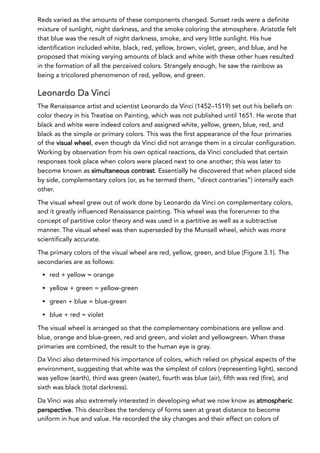
  • 2.
    Instant digital products(PDF, ePub, MOBI) available Download now and explore formats that suit you... Color Appearance Models 3rd Edition Mark D. Fairchild https://ebookname.com/product/color-appearance-models-3rd- edition-mark-d-fairchild/ Technical shop mathematics 3rd ed Edition Anderson https://ebookname.com/product/technical-shop-mathematics-3rd-ed- edition-anderson/ The Sectional Anatomy Learning System 3rd Edition Edith Ms Applegate Ms https://ebookname.com/product/the-sectional-anatomy-learning- system-3rd-edition-edith-ms-applegate-ms/ Applied symbolic dynamics and chaos Second Edition Hao https://ebookname.com/product/applied-symbolic-dynamics-and- chaos-second-edition-hao/
  • 3.
    Aesthetics of ReligionA Connective Concept 1st Edition Alexandra K. Grieser https://ebookname.com/product/aesthetics-of-religion-a- connective-concept-1st-edition-alexandra-k-grieser/ Multiple Sclerosis Your Legal Rights 3rd edition Esq. Lanny E. Perkins https://ebookname.com/product/multiple-sclerosis-your-legal- rights-3rd-edition-esq-lanny-e-perkins/ App Inventor 1st Edition David Wolber https://ebookname.com/product/app-inventor-1st-edition-david- wolber/ Goethe s Faust Eudo C. Mason https://ebookname.com/product/goethe-s-faust-eudo-c-mason/ Pro T SQL 2012 Programmer 039 s Guide 3rd Edition Edition Jay Natarajan https://ebookname.com/product/pro-t- sql-2012-programmer-039-s-guide-3rd-edition-edition-jay- natarajan/
  • 4.
    How to Landa Top Paying Federal Job Your Complete Guide to Opportunities Internships Resumes and Cover Letters Application Essays Lily Whiteman https://ebookname.com/product/how-to-land-a-top-paying-federal- job-your-complete-guide-to-opportunities-internships-resumes-and- cover-letters-application-essays-lily-whiteman/
  • 6.
    Color Foundations Page Range:1 Three basic elements are required for an appreciation of color: a light source, an object, and a viewer. Part I begins with the fundamentals of color observation. We describe the physiology of the eye and how light imparts color to objects, as well as the psychological and cultural factors involved in perception. These factors in turn affect whether an artist chooses to use local, optical, or arbitrary color. Next, we examine the different color systems and “wheels,” along with their application to different media. The science and psychology of color have had fascinated thinkers for centuries. On our historical journey, we’ll meet such individuals as Leonardo da Vinci, Sir Isaac Newton, Albert Munsell, and Josef Albers. Their influence on the discipline of color remains strong today. We will look at coloring agents— additive, subtractive, and partitive color mixing—as well as pigments, dyes, binders, and grounds. Finally, we will explore the realms of modern technology’s employment of color in the arts. While we explore the various visual media available today, this text has been written not to give “how-to” instructions for specific media, but rather to provide tenets of color usage to all art media.
  • 7.
    What is Color? PageRange: 2–9 DOI: 10.5040/9781501303364.ch-001 Objectives After reading this chapter, you will be able to: Describe the process of light transmission and the anatomy of the eye in the physiological process of how we see color. Differentiate the various factors that affect our perception of color. Compare and explain the differences between local, optical, and arbitrary color. More than any other element of design, color has the ability to make us aware of what we see, for nothing has meaning without color (here we extend the meaning of color to include black and white). Try to describe the sky, for example, without referring to color— it is very difficult. Color defines our world and our emotions. It is usually seen before imagery. Our eyes are attracted to color to such an extent that the color of an object is perceived before the details imparted by its shapes and lines. At first glance we do not see the different species of trees present in a summer woodland, but rather see the preponderance of green. The artist, architect, and designer, however, are generally concerned with having color and imagery perceived simultaneously. Upon entering a room, we first see the color or colors used in the interior design and then discern the furnishings and artifacts contained within the space. An artwork, be it fine or commercial, is aesthetically pleasing to the viewer when its color usage allows the viewer to see the content of the piece (both color and imagery) together. When this is accomplished, a work’s message is conveyed immediately, without a “second look” on the part of the viewer (Figure 1.1). Color can also be described by two very different methods or points of view—objectively, by referring to the laws of chemistry, physics, and physiology; and subjectively, by referring to concepts of psychology. Similarly, our perception of objects depends both on physical factors—such as their actual hues (i.e., the name of a color: red, yellow, blue, etc.), or their lightness and darkness in relationship to surroundings (the value of a hue)— and more psychological and cultural factors.
  • 8.
    1.1 Henri Matisse(1869–1954), The Red Studio, 1911. Our initial impression is of an abundance of red color. We must take a second look to determine the objects in The Red Studio. This is an example of how color is seen before imagery. However, Matisse has tempered this initial reaction with judicious use of values and complementary combinations. Source: © Copyright The Red Studio. Issy-les-Moulineaux, fall 1911. Oil on canvas, 71 ¼ in × 7 ft 2 ¼ in (181 × 219.1 cm). Mrs. Simon Guggenheim Fund © Succession H. Matisse, Paris/ARS, NY. Location: The Museum of Modern Art, New York, NY, U.S.A. Photo credit: Digital Image. © The Museum of Modern Art/Licensed by SCALA/Art Resource, NY/©Artres. Physiology Physiologically, color is a sensation of light that is transmitted to the brain through the eye. Light consists of waves of energy, which travel at different wavelengths. Tiny differences in wavelengths are processed by the brain into myriad nuances of color, in much the same way that our ear/brain partnership results in our interpretation of sound. Sound lets us interpret our auditory language; color lets us interpret our visual language. Because each of us is unique, our eye/brain reactions differ. Thus, when we speak of color, we cannot speak in absolutes but must resort to generalizations. These are sensations that seem to happen to all of us.
  • 9.
    As light passesinto the eye (Figure 1.2), it comes in contact with the covering near the back of the eye known as the retina. The retina is made up of layers of different cells, including those known as rods and cones. The function of the rods is to allow the brain to see dimly lit forms. They do not distinguish hue, only black and white. The cones, however, help us to perceive hues. The cones in the eye recognize only red (long wavelengths), blue-violet (short wavelengths), and green (middle wavelengths), and they relay these color messages to the cones of the fovea, an area at the center of the retina, to transmit them to the brain. The brain then assimilates the red, blue-violet, and green impulses and mixes them into a single message that informs us of the color being viewed. When we see red, for example, it is because the red-sensitive cones are activated while the green and blue-violet cones are relatively dormant. Keep in mind that objects emit many colored wavelengths (red, orange, yellow, green, blue, violet), but our eye cones break down these colored wavelengths into red, blue-violet, and green, which our brain then processes into the colors we actually see. Yellow is the result of the green-sensitive and red-sensitive cones being activated and mixed while the blue-violet cones remain comparatively inactive (Figure 1.3). 1.2 The human eye. We distinguish the world of color after light passes through the cornea and pupil and strikes the retina, which subsequently passes messages to the fovea from where they are transmitted to the brain. Source: Color, 3e, by Paul Zelanski and Mary Pat Fisher, 1999 (Laurence King/Prentice Hall Inc.).
  • 10.
    1.3 The eye/brainprocessing the color yellow. The yellow sensation is passed through the lens of the eye and is converted in the retina to the light components of red and green. From the retina these components are conveyed to the fovea, which transmits them to the brain. The brain mixes the red and green messages to create the yellow that we see. “Mere color, unspoiled by meaning, and unallied with definite form, can speak to the soul in a thousand different ways.” --—Oscar Wilde, Irish Writer and Poet How Light Gives Objects Color Our reaction to color is, on one hand, physiological, which we’ve learned about through scientific research, but it is also psychological, and thus very individual, which must include mental conditioning. Color is a sensation that is the result of light, and it is seen before form. We must also be aware that as light changes, so does color. Color is everywhere, and it assists us in visualizing forms and distinguishing different objects or parts of objects. Because color is constantly changing, the sensations we experience are the result of a number of visual processes all working in concert. On the physical and chemical levels, our perception of color depends on how molecules bond and the resulting absorption or reflection of light rays, which impart the sensation of various hues: red, yellow, blue, etc. The great physicist and mathematician Sir Isaac Newton (1642–1727) was a pioneer in studying light under laboratory conditions to provide a logical framework for understanding color (see page 18). His early research into color phenomena resulted in his discovery that sunlight is composed of all the colors in the visible spectrum (Figure 1.4). Using a ray of sunlight directed through a prism, Newton observed that the ray of light was bent, or refracted, resulting in an array of projected
  • 11.
    colors, each witha different range of wavelengths, in the following order: red, orange, yellow, green, blue, blue-violet, and violet. This array, the constituents of light, is known as the visible spectrum. 1.4 The visible spectrum. Of the seven light waves, violet has the shortest wavelength and red the longest. A close examination of the colors of the spectrum also reveals that the human eye can detect graduated colors between them, such as red-orange between red and orange, and blue-green between blue and green. When light strikes a surface, certain wavelengths are absorbed and others are reflected (bounced back) by its pigments, or coloring matter. This process gives the surface its color. We use the term “surface color” to denote the hue of an object. For example, we see red when only the red wavelengths are reflected off the surface of an object, such as a red apple, and the remaining wavelengths are absorbed. Different combinations of reflected wavelengths form all the observed colors. When all the wavelengths are reflected off a surface and mixed, the result is white. (“White light” is the light that we perceive as daylight at noon.) Factors in Perception There are many factors affecting our perception of a color, such as the surroundings of the object, its surface texture, and the lighting conditions under which it is seen. How much of a color is used, whether it is bright, dull, light, or dark, and where it is placed in relation to another color are also crucial factors in our perception. Media and Techniques Our perception of color in works of art is strongly affected by the type of medium used. Painting alone offers myriad different types of media, such as oil, acrylic, and water, which affect our perception of color. Drawings impart different results depending upon the utilization of various instruments, such as pencils (in various hardness), pastels, crayons, conté, inks, chalks, and markers. Printmaking can be done using litho inks and litho crayons, as well as paints. We must also take into consideration the type of support employed—canvas, board, paper, cloth, and so on—and what grounds are used, such as gesso or primer. Even the different brands of paint can cause us to perceive color differently because of the media used for the mixture. How does a pencil line or sketch affect the visual perception of color in a watercolor painting? The textile artist produces a vast array of product by various techniques, such as embroidery, weaving, quilting, lace, discharge, and dyeing. All of these can be accomplished using a vast array of yarns and
  • 12.
    fibers, each impartingits unique qualities of sheen and texture. Ceramic glazes can result in an overlapping of colors that change our perception of the piece. We can also experience the same types of color variations in printmaking. Consider also that interior design and fashion combine many types of media and textures that can produce a different perception of the same color (Figure 1.5). While the performance arts require communication skills, those skills are brought to life through judicious use of color. Think of the theater, TV, concerts, and street performances—without color, who would notice? 1.5 Illustration of interior space—the Red Room in the White House, Washington, D.C. Notice that the red on the walls, on the upholstery, and on the rug all appear different, as well as the white of the candles, the molding paint, the flowers, the bust sculpture, the lampshade, and the porcelain lamp base. These color nuances are the result of the influences of the different types of media. Source: Photo by Bruce White, copyright White House Historical Association (781). Modern technology has totally surrounded us with color—the computer has brought color into newspapers, film, TV, videos, and even our telephones, not to mention the mobile communication devices we all now rely upon. Communication today is dominated by the use of color. Eye and Brain The human eye in combination with the brain’s reaction tells us how to distinguish the type of color being seen, as well as its relative purity and lightness. But memory also exerts an influence. Most of what we see is based on the memory of a color—when and how we have experienced it before. In addition, certain colors are perceived more easily than others. Yellows and greens are seen before other hues, while red and violet are the most difficult to perceive. If we take another look at the hue order of the visual spectrum, we see that a perception curve is formed, with the yellow and green hues at the curve’s height and red and violet forming its lower extremities (Figure 1.6).
  • 13.
    1.6 The perceptioncurve. The yellow and green wavelengths register highest on the relative lightness axis. Someone with normal vision perceiving colored lights of equal energies will register the yellow-green segments of the spectrum first, because they appear brighter than all the other ones. Psychology and Culture Memory, experiences, intelligence, and cultural background all affect the way a color’s impact can vary from individual to individual. This is not to say that the eye will physiologically perceive the color differently, but that its psychological perception will mean different things to different people. In most Western cultures, for example, black is associated with death, but in China and India white is regarded as a symbol of death. In America and many Western cultures, a bride usually wears white, as white is deemed a bridal or wedding color. In China, however, a bride is attired in red. The mailboxes on the streets of the United States are blue, but in Sweden the mailboxes are red. An American tourist in Sweden might have a more difficult time finding a site to mail those postcards home because of the color change from the familiar blue to red. Advances in technology have also resulted in color perception changes. For example, we now refer to the use of pink-ribbon logos as the “pinking of America” for these logos have come to serve as reminders of breast cancer awareness on advertising and articles— the health testing and prevention as well as the charitable organizations seeking funds for this worthy cause. We are also attempting to become “green” through endeavors put forth to clean up and protect our environment. Reforms, movements, and causes are regularly put forth using color verbiage. Local, Optical, and Arbitrary Color The quality of light further determines the quality of any color that we see. A red barn in brilliant noon sunlight will appear red, but that same red will be perceived differently at sundown or on a rainy day. Armed with this knowledge, artists, architects, and designers can influence the color sensations of those who view their work. They may use color in three ways to impose these sensations: local or objective color, optical color, and arbitrary color. Local color is the most natural. It reproduces the effect of colors as seen in white daylight, exactly as we expect them to be: blue sky, red barn, and green grass. When the artist has a highly realistic style, the composition is rendered in exact colors and values
  • 14.
    (Figure 1.7). Weoften find that catalog and advertising art, such as packaging, is done in local color. Young children also depict their art in local color. Optical color reproduces hues as seen in lighting conditions other than white daylight: in the rain or a thunderstorm (Figure 1.8), at sunset, or in indoor lighting, for example. Again, the composition is usually rendered in a somewhat naturalistic way. Arbitrary color allows the artist to impose his or her feelings and interpretation of color onto the image (Figure 1.9). Here, natural color is abandoned for the artist’s choice. A gray stone bridge may be executed in warm oranges and beiges if the artist wants the bridge to impart a feeling of vitality and warmth. Arbitrary color is most often seen in 20th-century art, especially among the Expressionists and Fauves, whereas local and optical color are employed in more realistic styles of art. In the commercial world, posters are often rendered in arbitrary color to attract attention. 1.7 Ferrari F430. The local color of this car (pure hue red) stands out from the natural surroundings on a bright, cloudless day. Source: NEIL ROY JOHNSON / Shutterstock.com. 1.8 Thomas Cole, The Course of Empire: The Savage State, 1834. Oil on canvas, 39 ¼ × 63 ¼ in (99.7 × 160.6 cm). The New-York Historical Society, New York. Weather conditions determine subtle changes in the optical color of this landscape. The effects of sunlight originating beyond the left of the painting can be seen tingeing the light-green leaves in the left foreground, while gray thunderclouds serve to darken the landscape in the central and right-hand areas. Source: Collection of The New-York Historical Society.
  • 15.
    1.9 Odilon Redon,The Golden Cell (Blue Profile), 1892. Oil and colored chalks, with gold, 11⅞ × 9¾ in (30.1 × 24.7 cm). British Museum, London. Bequest Campbell Dodgson. The Symbolist painter Redon uses a gold background in order to suggest a Byzantine mosaic of the fourteenth or fifteenth century, which typically employed this color. However, he chooses to interpret the woman’s dreaming face in arbitrary color, associating her in his fantasy with the Virgin Mary, who is traditionally rendered in blue. Blue is also utilized to symbolize tranquility and dependability, which were desired feminine traits in the 1890s. Source: © The Trustees of the British Museum / Art Resource, NY / © Artres. Concepts to Remember Color is usually seen before imagery. The physiology of the eye and the brain’s reaction enable us to perceive light as different colors. The color imparted by an object is produced by the mixture of wavelengths reflected from its surface. Our perception of the color of an object is dependent upon several factors, such as illumination, media, technique, quantity, relationship to other colors present, memory, and culture. Most color usage employs one of three aspects of color—local, optical, or arbitrary — and any of these can be manipulated by users to create desired reactions in the viewer. Key Terms Hues
  • 16.
    Value Wavelengths Retina Rods Cones Fovea Visible spectrum Pigments Gesso Texture Local color Opticalcolor Arbitrary color Exercises 1. Observe an object under different lighting conditions and, if you can, take some color photographs. How do the different conditions affect the object’s color? 2. Collect and label pictures (magazine photographs are good) showing local, optical, and arbitrary color. 3. Using a drawing of the same object, render it in the media of your choice in local, optical, and arbitrary color.
  • 17.
    Color Systems andColor Wheels Page Range: 10–15 DOI: 10.5040/9781501303364.ch-002 Objectives After reading this chapter, you will be able to: Describe the three color systems—subtractive, additive, and partitive—and explain how each is unique in our perception of color. Distinguish and compare the differences between the four basic color wheels that utilize the three color systems. Identify and state the primary, secondary, and tertiary colors within each of the four basic color wheels, why they are unique to each wheel, and how they are created. Over the centuries, colors have been mixed according to three different systems. Subtractive color is the process of mixing pigments together, such as we see in painting. As we learned in Chapter 1, the pigments in an object enable it to absorb some light waves and reflect others Figure 2.1). When these pigments are blended, more light is absorbed and less is reflected—hence the term “subtractive.” By contrast, the colors in light are additive—the more they are mixed with other colors, the lighter they become. Additive color is the process of mixing colored light, such as in theatrical lighting or television. The partitive color system is based on the viewer’s reaction to colors when they are placed next to one another. Bear in mind that all colors are seen in relation to other colors, rather than in isolation. Color wheels are color arrangements or structures that enable us to organize and predict such color reactions and interactions. As you will see, just one wheel or system may not satisfy all our needs. For example, the painter uses subtractive color (to create various colors of paint) and partitive color (to create color reactions according to where the paint colors are placed). The photographer uses additive color (to create the colors or values—lightness or darkness—within the photograph) and partitive color (to impart reactions and interactions between the photographic imagery). The textile artist uses subtractive color (to create colors of yarn and textiles by dyeing) and partitive color (to impart reactions and interactions that occur from color placement). It becomes obvious that all art media use partitive color, and that the specific materials employed within each medium can be either additive or subtractive. Each artist must determine which wheel or wheels best satisfy the needs at hand.
  • 18.
    2.1 The surfaceabsorption of light rays. A white surface (a) will reflect all light rays that strike it, while a black surface (b) will absorb them. A colored surface (c and d) will reflect the same colored light ray striking it but absorb other colors. Illustration by Alicia Freile. The Pigment Wheel The mixing or pigment wheel is the basis for working with subtractive color; it imparts information about the reactions colors have when they are actually mixed (Figure 2.2). Its primary colors are red, yellow, and blue, which are used in combination to form the other hues. The term “primary” tells us that this is a color that cannot be obtained by mixing. When two primary colors are mixed together a secondary color (or intermediate color) is the result of the mixture. Yellow and blue mixed together results in green, red and yellow mixed together produces orange, and a mixture of red and blue results in violet (sometimes called purple). Thus the secondaries are green, orange, and violet. When a primary color and an adjacent secondary color are mixed, tertiary colors are the result: red + orange = red-orange orange + yellow = yellow-orange yellow + green = yellow-green green + blue = blue-green blue + violet = blue-violet violet + red = red-violet “The purest and most thoughtful minds are those which love color the most.” --—John Ruskin, English Art Critic
  • 19.
    2.2 The pigmentwheel. Mixing two primaries from this twelvestep subtractive color wheel produces a secondary. Mixing a primary with a neighboring secondary results in a tertiary. When using this wheel, keep in mind that red, yellow, and blue cannot be obtained by mixing pigments, and that when these three primary pigments are combined, a muddy black is the result. Imperfections in the pigments mean that the black is not pure, as it should be in theory. Also note that the secondary and tertiary hues are not equal mixtures of their components. Mixing together equal amounts of yellow and blue pigments will result in a green that is more yellow-green than green because yellow is stronger than green. The Process Wheel In contrast to the pigment wheel, the process wheel gives us three basic primaries— yellow, magenta, and cyan—that do, upon mixing, result in purer hues (Figure 2.3). This primary arrangement is the standard employed in color printing and photography, as well as in pigment manufacture (usually ink and computer cartridges). A look at the colors used shows a very luminous and bright yellow, an intense magenta that is red though leaning toward violet, and a cyan that is blue but tending toward green. When we take equal parts of these primaries and mix them, the following secondary hues result: yellow + cyan = green cyan + magenta = violet magenta + yellow = orange
  • 20.
    2.3 The processwheel. The primaries and tertiaries in this twelvestep subtractive color wheel are different from those in the pigment wheel, but the secondaries are the same. The resulting tertiaries will be as follows: yellow + green = yellow-green green + cyan = green-blue-green cyan + violet = blue-violet-blue (ultramarine blue) violet + magenta = red-violet-red magenta + orange = red orange + yellow = yellow-orange (see Figure 6.3) Again, mixing the three primaries together in equal amounts gives us black. The Munsell Wheel Albert Munsell (1858–1918) developed a partitive color system based on five primary hues or, as he termed them, principal colors: yellow, red, green, blue, and purple (which is termed “violet” in this book). These primaries are based on afterimage perceptions that derive from hues we see in nature. Afterimaging is an optical reaction that occurs after we stare intensely at a hue and then shift our eyes to a white surface; this second hue is termed the afterimage. If, for example, we stare at a red dot, the resulting afterimage will be blue-green. Munsell set up each afterimage as the complement to his principal (primary) hues. A complementary hue is the hue that occupies the position directly opposite on a color wheel. From this base he was able to arrange his Munsell wheel (Figure 2.4). Munsell’s arrangement resulted in the complementary combinations of yellow and blue- violet, red and blue-green, green and red-violet, and violet and yellow-green. These afterimages comprise the secondary hues of the Munsell wheel. He further systematized
  • 21.
    the color wheelinto a three-dimensional form that he termed a “tree” (Figure 2.5). Intervals of value, measuring the lightness and darkness of a hue, are shown along the trunk, or vertical axis, with 0 as black and 10 as white. The intervals between are assigned the numbers 1 to 9. Any color along the innermost vertical axis is called a neutral, which is a nonchromatic hue of white, gray, or black that does not contain any pure hue. Branches or horizontal intervals measure the saturation (or relative purity) of each hue, with the pure hue being located at the outside edge. The remaining intervals along each horizontal branch consist of colored gray mixtures in varying degrees of purity. 2.4 The Munsell wheel. This twenty-step partitive color wheel consists of five primaries, five secondaries, and ten tertiaries. “In visual perception a color is almost never seen as it really is—as it physically is. This fact makes color the relative medium in art.” --—Josef Albers, German-Born American Artist
  • 22.
    2.5 The Munsellcolor tree. There are ten vanes to this tree, corresponding to the five primaries and five secondaries of the Munsell wheel (see Figure 2.4). In this view, the complementary primaries of yellow and blue-violet can be seen across from each other. Courtesy of X-Rite, Inc. We will explore Munsell’s system further in the section on color theorists (see pages 22– 24). It is used by dye manufacturers for yarn and fabric coloration, as well as in interior design and in the production of cosmetics, computer hardware, and paint. For example, Liquitex acrylic paints carry Munsell color notations on their tube labels. Partitive color usage often relies on the interactions resulting from afterimaging. Because the Munsell wheel is the wheel based on afterimaging, we will base all our information concerning color on this wheel unless otherwise noted. The Light Wheel The light wheel is based on the additive color system and provides information concerning light rays and transparent color. Here the primary colors that form the other hues are red, green, and blue. The secondaries are as follows: red + green = yellow green + blue = cyan blue + red = magenta As these are combinations of colored light, when all the primaries are combined, white results. The total absence of light results in black. Because light is being added to light, the more that color rays are mixed or fused with other color rays, the lighter they become. The light wheel is used for theatrical lighting and projection (Figure 2.6) and is now the basis for video, computer graphics, and electronic media.
  • 23.
    2.6 The lightwheel. This six-step additive color wheel consists of three primaries and three secondaries. Concepts to Remember The three basic color systems are subtractive color, additive color, and partitive color. The four basic color wheels are (1) the pigment wheel (subtractive color), (2) the process wheel (subtractive color), (3) the Munsell wheel (partitive color), and (4) the light wheel (additive color). Specific color-wheel choice depends on the effects of color and imagery desired in the art medium employed. The painter uses both the subtractive and partitive wheels. The photographer and digital artist use the additive and partitive wheels. Key Terms Subtractive color Additive color Partitive color Color wheels Values Pigment wheel Primary colors Secondary colors Tertiary colors Process wheel
  • 24.
    Principal colors Afterimage Complementary hue Munsellwheel Neutral Saturation Light wheel Exercises 1. Make a list of various art media (painting, sculpture, printmaking, etc.), crafts (weaving, batik, ceramics, jewelry, etc.), and commercial visual media (interior design, architecture, advertising, photography, etc.). Note which color systems (subtractive, additive, or partitive) and color wheels (pigment, process, Munsell, or light) would be used by each. 2. Create two compositions of identically spaced stripes in an art medium of your choice. Within the first, choose a complementary pair of hues from the pigment wheel, and within the second, a complementary pair from the Munsell wheel. 3. Using any desired medium—watercolor, colored pencil, colored paper, fabric, etc.— develop a twelve-step color wheel consisting of primary, secondary, and tertiary colors. Pay attention to the visual mixing of colors with the chosen medium in achieving the correct hues. Use the examples in this chapter for the template of the wheel or create a unique composition. Consider a small, portable size for your color wheel, created on sturdy cardstock paper that can be kept for future use and reference in upcoming exercises. The final color wheel can be laminated for protection and longevity.
  • 25.
    Color Theorists Page Range:16–31 DOI: 10.5040/9781501303364.ch-003 Objectives After reading this chapter, you will be able to: List those individuals who were significant in the development of color theories. Describe the unique and specific contributions each theorist has made toward the study of color. Analyze and compare the differences among each theorist’s approach to describing and exploring our understanding of color. Relate how one or more of the theories can be directly applied to specific disciplines —fine art, interior design, architecture, graphic design, fashion design, photography, digital art, etc.—and critique the advantages or disadvantages of each. In trying to understand the important influence of color on our lives, color theorists have from ancient times to the present attempted to explain both scientifically and psychologically how we react to color. In doing so, they have devised systematic frameworks and rules for our dealings with color. Although color is a sensation, and as such its reactions cannot be neatly categorized, our awareness of the work of color theorists does help us in understanding color. Color usage is complex, and knowledge of how color theory has evolved lets us utilize these various theories, where appropriate, in working with color. Color Theory in the Ancient World The first hint of color theory was formulated by the ancient Greek philosopher Empedocles (492–431 b.c.e.). Empedocles’s observations of his surroundings led him to the conclusion that the eye of the observer perceives color; color is not a property of the object being observed. Democritus (460–370 b.c.e.) developed the first atomic theory. He stated that the world was composed of atoms and that color was the result of atomic arrangements. Here were the first bare bones of color theory evolving from a combination of speculation and observation. According to the great Greek teacher and philosopher Plato (427–347 b.c.e.), perception was a property of the individual perceiver—the problem, therefore, was how to distinguish between reality and appearance. Color is a sensation that allows us to describe what we see. Plato described or identified the hues as black, white, red, and yellow. In De Coloribus (the first known book about color), the Greek philosopher Aristotle (384– 322 b.c.e.) attempted to explain the composition of colors and how they were related. Aristotle assumed that all colors were derived from the blending of sunlight, fire, light, and lack of light in varying degrees.
  • 26.
    Reds varied asthe amounts of these components changed. Sunset reds were a definite mixture of sunlight, night darkness, and the smoke coloring the atmosphere. Aristotle felt that blue was the result of night darkness, smoke, and very little sunlight. His hue identification included white, black, red, yellow, brown, violet, green, and blue, and he proposed that mixing varying amounts of black and white with these other hues resulted in the formation of all the perceived colors. Strangely enough, he saw the rainbow as being a tricolored phenomenon of red, yellow, and green. Leonardo Da Vinci The Renaissance artist and scientist Leonardo da Vinci (1452–1519) set out his beliefs on color theory in his Treatise on Painting, which was not published until 1651. He wrote that black and white were indeed colors and assigned white, yellow, green, blue, red, and black as the simple or primary colors. This was the first appearance of the four primaries of the visual wheel, even though da Vinci did not arrange them in a circular configuration. Working by observation from his own optical reactions, da Vinci concluded that certain responses took place when colors were placed next to one another; this was later to become known as simultaneous contrast. Essentially he discovered that when placed side by side, complementary colors (or, as he termed them, “direct contraries”) intensify each other. The visual wheel grew out of work done by Leonardo da Vinci on complementary colors, and it greatly influenced Renaissance painting. This wheel was the forerunner to the concept of partitive color theory and was used in a partitive as well as a subtractive manner. The visual wheel was then superseded by the Munsell wheel, which was more scientifically accurate. The primary colors of the visual wheel are red, yellow, green, and blue (Figure 3.1). The secondaries are as follows: red + yellow = orange yellow + green = yellow-green green + blue = blue-green blue + red = violet The visual wheel is arranged so that the complementary combinations are yellow and blue, orange and blue-green, red and green, and violet and yellowgreen. When these primaries are combined, the result to the human eye is gray. Da Vinci also determined his importance of colors, which relied on physical aspects of the environment, suggesting that white was the simplest of colors (representing light), second was yellow (earth), third was green (water), fourth was blue (air), fifth was red (fire), and sixth was black (total darkness). Da Vinci was also extremely interested in developing what we now know as atmospheric perspective. This describes the tendency of forms seen at great distance to become uniform in hue and value. He recorded the sky changes and their effect on colors of
  • 27.
    objects both near-at-handand in the distance, writing, “colors will appear what they are not, according to the ground which surrounds them.” 3.1 The visual wheel. This sixteen-step partitive (and subtractive) color wheel consists of four primaries, four secondaries, and scientifically accurate. eight tertiaries. 3.2 Here we see a modern painting employing da Vinci’s practice of chiaroscuro and sfumato. Refer also to da Vinci’s Mona Lisa in Figure 8.6. Source: Photo by Alex Colville, The River Spree, 1971. Acrylic polymer emulsion on board, 23 ⅝ × 41 in. He also worked with modeling and shading of objects, using light and shadow effects (or chiaroscuro, “light-dark” in Italian) in his painting, and he further developed this concept into the technique known as sfumato, in which hues are softly graded and blended to give
  • 28.
    a hazy, blurredeffect (Figure 3.2). Sfumato can be accomplished by close grading of values of colors, blending of colors, and glazing of colors. Sir Isaac Newton The English physicist Sir Isaac Newton (1642–1727) was interested purely in the physics of color, rather than in perception. He discovered that as a ray of white light passes and is bent, or refracted, through a prism, it is broken into an array of colors, or spectral hues— red, orange, yellow, green, blue, indigo, and violet (see Figure 1.4). He noted that white light is a mixture of all the spectral hues. He took this “array” and turned it into a two- dimensional circular model that became the first color wheel. Notice that the hue divisions of Newton’s wheel are not equal but are based on the extension or proportion of each hue in relation to the spectrum (Figure 3.3). Newton found that when mixing pigments of opposite hues on his wheel (complementaries), “some faint anonymous colour” resulted. In his experiments, Newton was never able to mix pigments of two or three of his hues to obtain white, because his theory was based on the mixing of light (additive color), while the mixing of hue pigments is based on subtractive color. 3.3 Newton’s wheel. Newton proposed a color wheel based on the adjacent sequence of seven wavelengths within the visible spectrum (see Figure 1.4). The hue divisions are unequal because they are based on the proportion of each wavelength relative to others in the spectrum. The white at the center indicates the light source within which all the wavelengths are contained. Moses Harris Moses Harris, an English entomologist and engraver (active 1766–1785), wrote the Natural System of Colours in 1766. In this book he presented red, yellow, and blue as the primary hues, which he termed “primitives.” The mixture of these primitives produced the “compound” hues (secondaries) of orange, green, and purple. The primitive/compound mixtures were each categorized into two progressions—red and orange yielded red- orange, which was more red than orange, and orange-red, which was more orange than red. The Harris wheel was divided into eighteen equal hue divisions, and each division was then graded by value, light (plus white) to dark (plus black) (Figure 3.4).
  • 29.
    3.4 Harris’s colorwheel, from Natural System of Colours, c. 1766. Royal Academy of Arts, London. Moses Harris derived his eighteen-step color wheel from the three primaries of red, yellow, and blue, which here overlap to black. As each hue approaches the center, it takes on deeper shades of gray. Source: The Royal Academy of Arts, London, England. Johann Wolfgang Von Goethe In 1810, the German poet Goethe (1749–1832) published his Theory of Colours, which he thought would be more important to posterity than his poetry. He was one of the first modern thinkers to investigate and record the function of the eye and its interpretation of color, rather than the properties of light. He was a vigorous opponent of Newton’s physics of light. The two-dimensional wheel he developed was based on a triad of primaries—red, yellow, and blue—with the secondaries as complements of the primaries. In addition to his color wheel (Figure 3.5, left ), which reflected previous diagrams, Goethe formulated a color triangle that he felt further reinforced color relationships (Figure 3.5, right ). He assigned a number to each of the hues according to their relative luminosity (ability to give a glowing impression): yellow = 9 orange = 8 red = 6 green = 6 blue = 4 violet = 3
  • 30.
    Exploring the Varietyof Random Documents with Different Content
  • 31.
    “Why did youtell the signorina it was an unlucky day?” “Eh-h-h-h-h-h!” Nina’s “eh” began on the fourth line, and ran down chromatically. Taken with outspread hands and raised shoulders it implied, “How can the signora ask, when she knows as well as I?” What she said was, “Did not the eccellenza lose her purse?” “But I have had a much bigger one sent to me,” said Teresa gravely. “Then, eccellenza, it is probable that after the priest you met a hunchback, and she might counteract. Besides—” she hesitated—“there is always that unfortunate Cesare.” The marchesa was not surprised, Nina having an extraordinary knack of knowing whatever went on. But she was vexed at her thoughts being flung back upon a subject which gave her a miserable impression of having behaved ill without intending it. “What do you know about Cesare?” Nina screwed her eyes together, and nodded her rough head. “See here, eccellenza, I should not mind knowing less. When one meets such in the street it is best to shut one’s eyes and walk on. If he has a temper or not! That poor Camilla! She was a butterfly, yes, and foolish, yes—but to be shot all in a minute, without a priest! What a brother!” “They say he loved her.” “Eh-h-h-h-h—h! So they say. They came from Sicily alone, these two, without parents, and he was strict with her, poor
  • 32.
    little baby, andso—! It was not a love I should have liked, but as for stealing! No, no, no, that is not Cesare.” “Why did not the guardie say so, then?” demanded Teresa impatiently. “See, eccellenza, they are afraid, and they do not like him. He is hand and glove with the fiercest men in Rome, men who would overthrow anything, everything, king or pope, what you will! Since Camilla died it is as if an evil spirit had entered into him—he keeps with those men, he never hears mass, he is like a lost soul. What took him into San Martino, I wonder? At any rate I wish the eccellenza had had nothing to do with him,” Nina ended, uneasily. And Teresa wished the same thing with all her heart. The young violent face, the passion of the eyes, haunted her. Her grandmother and sister were taken up with delight and wonderment over her good fortune. She tried to fling herself into it with them, but while she planned, with all the generosity of her nature, which but yesterday would have leapt to feel certain galling chains removed, her thoughts wandered away to the police station, and to Cesare in the lock-up, with a board for his bed, and the smart of an unjust accusation goading him to yet more furious rebellion against his fate.
  • 33.
    Chapter Three. If Wilbrahamwere certain of one thing, it was that Donna Teresa ought not to be encouraged to go to the police office. He already called himself an idiot for having let her do so, but as he had never been known seriously to take himself for an idiot, this was probably no more than a figure of speech. It meant, however, that he disapproved of her conduct, and especially of her sympathy for Cesare, for even the knowledge that the last accusation was untrue had not changed his opinion of the accused. Perhaps, if anything, the annoyance had accentuated it. Yet, the next morning, when he ran over what lay before him, he was not unwilling to admit that he should be early at Via Porta Pinciana, so as to make sure that Donna Teresa did not start on any fool’s errand without him. And with disapproval so active, he might have been more gratified than he was to hear from Mrs Brodrick that an absolutely disabling headache obliged the marchesa to leave everything in his hands. “Please pay the fine, whatever it is, and see that he is released.” “Better she should keep out of it,” said Wilbraham grimly. “But she wants the man’s address.” “Don’t let her have it,” he said unadvisedly, and then flushed, suddenly aware that he had spoken too warmly. “The marchesa is young,” he said hurriedly, “and there are bad parts in Rome, where she really ought not to go.”
  • 34.
    “No doubt,” returnedMrs Brodrick, smiling. “But I never interfere with Teresa’s liberty, and she would like the address.” “Certainly,” said Wilbraham, stiffening. He knew that he had gone farther than his acquaintance justified, and no one hated a false position more than he. Sylvia came into the room at this awkward moment, looking so pretty that her little froth of chatter seemed only part of the prettiness, particularly when she greeted him warmly. “Isn’t it tiresome for Teresa? But I told her I was sure you would manage everything perfectly. I don’t see that she need be so very unhappy, because if he was not a pickpocket he might have been one, of course; it was only a mistake, and you will set everything right, won’t you?” “I’ll do my best,” he said gravely, but secretly pleased. Mrs Brodrick turned away her eyes, and knitted impassively. She was conscious of wrong feelings when her youngest grandchild chattered, and there were times when irritation got the upper hand, and she said something scathing, the only thing which Teresa ever resented. For Teresa upheld Sylvia through thick and thin, and would cheerfully efface herself for her sister. Wilbraham walked towards the Trevi with his temper still ruffled, so that he scarcely glanced at the great fountain dashing its wealth of waters into the sea at its base. Passing it, he plunged into a network of narrow streets leading to the questura. He did not notice two or three men, who, standing at the door of the Avanti printing office, pointed him out to each other with scarcely perceptible gestures. Reaching his destination he found official feeling running high against Cesare, who, informed of the marchesa’s gracious intention, had returned passionately that he would
  • 35.
    not accept it,he preferred prison. Until the marchesa’s expected arrival he had been remanded in confinement, and the officer was urgent that he might be left there. “He is dangerous,” he repeated more than once. Wilbraham was a prejudiced young man, but his English instincts for fair play rose up promptly. “That won’t do,” he said. “You can’t lay him by the heels unless he does something to deserve it.” The official looked at this stubborn Englishman, and wondered whether he could influence him to leave well alone by suggesting a personal danger. “He is not unlikely to stab—some one,” he remarked. “Then some one must look out for himself,” said Wilbraham indifferently. He understood the hint, and it amused him. “How much is the fine?” Reading continued unwillingness, he added—“A little more would be paid to ensure his being let out at once. He can’t keep his lodgings here against your will, I imagine?” As it would have been a pity not to allow a mad foreigner the chance of getting rid of his money, the official named the sum with an added ten lire, and Wilbraham paid it with some contempt for its smallness. He was assured that Cesare would be immediately released; and then conscientiously and unwillingly obtained his address. After lingering to gain a few statistics as to crime in Rome, he went on to a watchmaker’s in the Piazza Venezia, and was returning when he met his man face to face. There was no mistaking the young passionate features or the burning eyes, and evidently Cesare recognised him as quickly. For an instant he paused, came on, held him with his gaze, and
  • 36.
    muttered “Curse you!”as he passed. Wilbraham only smiled at what seemed to him a melodramatic incident, but it made him a little more angry with Teresa for insisting upon following up so violent a character, certain to reject her good offices. He scribbled a few lines on a card, left it at the house in Porta Pinciana, and went away towards his hotel in the higher and newer part of Rome. He was his own master, and often came to Italy, which pleased him, and where he felt himself free from certain annoyances which are apt to attach themselves to only sons, and are also occasionally imagined when they do not exist. Lady Wilbraham blamed herself now for having early uttered warnings which he had taken too dutifully to heart. He sniffed danger afar, and retired so effectually from matchmaking mothers, that it seemed likely he would never possess a mother-in-law at all. The instant it flashed upon him what might be at the root of any expressed feminine interest, no terrified mollusc could have snapped his shell more effectually. In vain they wandered round, seeking for a glimpse, in vain dinners were got up, possible meetings sought for; so resolved was he not to present the smallest loophole to the supposed attack, that he even fell into the unpardonable error of confusing his pursuers with those who had never flung a glance beyond friendliness in his direction, and of stoutly barricading himself against some who had not so much as dreamed of a siege. That is a crime which a woman never forgives. So that here, in this ultra- sensitive dread of giving himself away, lay a weakness, the more dangerous to his character because it was apt to deceive him into imagining it strength. Lady Wilbraham was a keen-sighted woman, even where her affections were concerned, but this was not a matter in which she could offer advice, though she often bore the blame of his—what shall we call it?—dislike of becoming the
  • 37.
    prey of tongues?coldness, pride? fear of where he might unwittingly land himself? Whatever it was, it was apt to hold him in bonds, and to alienate friends, for the nice women were those who were naturally the most indignant and who scourged him with their ridicule. Yet surely his object was exemplary, since above all things he desired to avoid raising false hopes. But he was also too much afraid of himself, too much afraid of becoming interested; too much afraid of going a step beyond the point from which retreat was not only possible but natural; too much afraid of, by some mischance, getting out of hand and allowing himself to be cajoled into a road where, he was certain, the demon of vain regret would instantly bestride his shoulders. So far his heart had invariably had pride for its master, and although there were those who prophesied rebellion, the reaction was not to be counted on, since hearts may be starved into powerlessness, or paralysed by want of use. Yet it was not marriage itself of which he disliked the idea. He was two-and-thirty, a barrister with sufficient practice, and the owner of a country seat where his mother had lived since his father’s death. He intended in a year or two to give up law, live at the Court, and stand for Parliament. Marriage entered into all these contemplations. It was the woman, not the state which he dreaded, for that vague and shadowy. She, however charming in dreams, became a terror, a warning beacon, whenever she touched reality or appeared in actual form. There was always a something to warn him off, a mother a little indiscreet, a bore of a brother, a girl who failed, by as little as you please, to reach his standard of perfection. Of course the reason was not far to seek. He was critical, because never having been in love, he was apt to doubt whether his heart could be stirred like the hearts of other people, and certainly it had never yet been strong enough
  • 38.
    to carry himwhere he did not wish to go. The question as to whether it ever would be strong enough remained unanswered. And the reason and the question left one certain thing to his credit, that unless he owned that inner force he would not have the courage to marry. Donna Teresa passed before his mental vision more than once as he walked away from the Porta Pinciana, but he dismissed her image almost angrily. Sylvia, however, Sylvia? She was pretty, and somehow or other he felt grateful to Sylvia. If she were not very wise, it just crossed his mind that he had wisdom enough for two. His shadowy She had never been extraordinarily wise.
  • 39.
    Chapter Four. The misery,want, and degradation of Rome have this advantage over that of other cities, that they are lodged almost sumptuously in what should have been palaces. Those huge and hideous blocks of building which rear themselves in what are called the new quarters are no tumble-down age-stricken rabbit-warrens; they have marble staircases, airy rooms, balconies, ornamental ironwork, lofty doorways. Built for riches, they have never represented anything beyond rags, dirt, loathsome crowding, and, for their owners, bankruptcy; but they are better than dark cellars and fetid streets; and air, light, and sun, at least, visit their inhabitants. Moreover, blots as they are upon the old beauty of Rome, it is noticeable already from distant points, such as the front of Sant’ Onofrio, or farther along the Janiculum drive, where form is scarcely to be distinguished, that in colour, at least, they begin to harmonise better with their surroundings, and that the sun, the great alchemist of the South, is turning raw whites and greys into tawny gold and amber, and that soft indescribable tone which is at once the joy and the despair of the painter. Seen more closely, however, their aggressive ugliness is appalling, and Teresa, as she walked along certain streets which lay below the ascent to San Pietro in Montorio, glanced at the overgrown blocks with extreme distaste. She could see something of the emptiness and dirt of the houses, the strings of ragged clothes fluttering from balconies, the evil-looking old hags stretching out skinny hands and muttering curses on her as she passed, the children with pinched and hungry faces, bare-footed, scantily clothed, with touzled hair and a smile which
  • 40.
    belongs to Italy,and Italy only. “Un soldo, signorina, un soldo! Ho fame!” Heaven help them; it was probably true; but Teresa, though she had soup tickets in her pocket, dared not give them yet, because she knew the word would pass from street to street, and that when she reappeared she would be surrounded, almost torn to pieces, by struggling claimants. She found the number she was looking for, and picked her way up a broad staircase thick with accumulations of dirt. A ragged boy guided her to a door, at which she knocked. Another boy opened it, small, sickly, and lame. The two children stared at Donna Teresa, and she looked into the room with interest. It was fairly clean, miserably bare, and empty as to the man she wanted. In answer to her question, the lame boy shook his head. Cesare was his brother, he was out, he did not know when he would return. Teresa was unconsciously annoyed by a whine in his voice of the same kind as that which she had just passed through. She sent away the first boy, who peeped and listened from round a corner, and asked questions, getting, oddly enough, exactly the answers she expected. Cesare was long absent. Angelino, his brother, was often hungry— oh, often, and his back hurt him, but, certainly, that often, too. With easiest flexibility of conscience he was prepared to admit all suggested evils and to invent any others which might affect this signora in a benevolent direction, so soon as he caught a hint of what would best serve his purpose. Teresa was shrewd enough at last to find this out, and it changed her plan. Without giving a name she told the cripple that she would write to his brother, presented him with a lira for his own amusement, and fled. On her way home she reflected, with the result that in the evening a letter went to Cesare Bandinelli, enclosing five hundred lire and a few words: “Will you remember that I owe you a reparation, and accept this for Angelo.—T. di Sant’ E.”
  • 41.
    She drew asigh of relief when it was out of the house. The next day was yet early when Nina, dumb but expressive, brought her a packet, which she recognised with a sinking heart. The money and her own letter were crammed into an envelope, as if thrust there by trembling and furious fingers. Not a word came with them, and Teresa’s face tingled as if she had been struck. After she had thought about it all day, she felt there was nothing to do except to accept defeat and to tell Wilbraham, hating the telling as we hate to repeat an insult, but forcing herself, under the impression that the incident counted better for Cesare than for herself. “I ought not to have done it,” she owned. “No, you ought not,” assented Wilbraham coldly. “He’s an ungrateful hound.” Teresa fired. “I can’t see where ingratitude comes in! Do you expect him to be grateful for my mistake?” “How was he the worse for it?” “How? Hasn’t he suffered?” “Suffered! A night in a police cell!” said Wilbraham with a smile, which she thought insufferable. “My dear Donna Teresa, he has probably made acquaintance with such quarters before—or, at any rate, I will engage to find you fifty men who, for a hundredth part of what you offer, would occupy them with all the goodwill in the world.” It is the truth in our opponent’s arguments which we find annoying. Teresa knew that Wilbraham spoke like a man of
  • 42.
    experience, and wasangry. She flung up her head. “You seem to forget that I said the money had been returned. Perhaps you will find fifty men to do that?” “It would require sifting of my scoundrels,” laughed Wilbraham. “I grant you that only the cleverest would remain.” He sat forward, and began to drive in his truths. “Don’t you see that the fellow is shrewd enough to read your thoughts and trade upon them?” The air in the room had grown heated. Mrs Brodrick’s eyes rested anxiously for an instant upon the young marchesa’s displeased face. Teresa did not speak. Wilbraham went on— “You may be sure he hopes to get more out of you than even your prodigal five hundred lire. He proposes to work upon your—what shall I call it?—sensitiveness.” Teresa was sitting upright, and her eyes were very bright. “Is that the best you have yet found in human nature?” she said quietly. “It is what I have most often found,” returned Wilbraham with a little surprise. She glanced at him so strangely that he felt an odd desire to excuse himself, almost a new sensation, but before he could speak, Sylvia broke in with the appealing timidity which he recognised as a pleasant contrast to her sister’s impetuosity. “I am sure you have done everything you could think of, Teresa, and so has Mr Wilbraham. I daresay it will all come right by-and-by, when Cesare understands that it was only
  • 43.
    a mistake. Everybodymakes mistakes now and then, of course.” It was these platitudes, announced as discoveries, which were apt to irritate Mrs Brodrick. But she owned that occasionally they had their uses. Wilbraham now turned to Sylvia with an air of interest, while Teresa’s face softened. “Come,” she cried more gaily, “let us talk of something else. Talk of to-morrow. Thank goodness, that must always be a new subject. What shall we do, good people? Shall we drive to Ostia?” Sylvia opened her eyes. She was opening her mouth as well, when her grandmother spoke. “If you do, I think I’ll go with you.” “That settles it,” said Teresa happily. She had recovered herself so completely that even Mrs Brodrick wondered at the swift change, especially when she turned kindly to Wilbraham. “You’ll come, too, won’t you? I’ll undertake to keep off dangerous subjects, and then I shan’t be cross.” “I’ll come if I may.” His tone was still a little stiff, and Teresa, glancing at him, saw that he was looking at Sylvia. Except for the Tiber—and that can often be as grim as its history—the road to Ostia begins wearyingly. Farther on it grows rapidly in interest, till, when you reach Ostia itself, you think no more about beauty or interest, or your own passing sensations—it is too great. Sad, even in clearest sunshine, with rifled temples, ruined splendour, and the melancholy of its deserted gods, the sombre weight of centuries broods over it. The Tiber—no mere river here, but
  • 44.
    the symbol ofa lost empire—swirls sullenly by, and as the sun sets and Vulcan’s shrine crimsons in its glow, fever creeps shivering from misty pools and clutches its victims. Those who go to Ostia should not linger too long. But this day, on which Teresa brought her there, the sadness was but delicately suggestive and not oppressive. The air was warm, yet fresh and invigorating, and Teresa herself was in high spirits. “Come,” she cried breathlessly, when she had climbed a steep bank, and stood looking out at the Tiber, now faintly yellow and grey, “come, Sylvia, and let us be foolish by ourselves.” “Foolish!” repeated Sylvia startled. Mrs Brodrick, had she been near enough, would have smiled, but Teresa nodded gaily. “As foolish as we like. Mr Wilbraham can look after granny and improve her, while we enjoy our ignorance. It’s much better fun to imagine things than to know them. Let us run down there to begin with, and peep behind those columns. Who knows what might not be hiding there! Come, Sylvia!” And she held out her hand. But the girl looked round her doubtfully. She did not like foolishness when she heard of it, and her sister’s imagination was apt to make her uncomfortable. Slow doubt crept into her voice. “If you like—if you’re sure it’s safe.” She added more quickly, “It’s so very lonely there, isn’t it?” Teresa instantly yielded.
  • 45.
    “Let us sitwhere we are then. Nothing can be more charming,” she went on, dropping on the short turf and clasping her knees, while Sylvia took elaborate precautions against the damp she dreaded. “Oh, Sylvia!” sighed Teresa, “to think that I should really be sitting here and talking to you, after that life!” “At Florence, do you mean? I suppose the old marchesa was very unkind, for you to have disliked it so much?” The other did not answer at once. “Unkind? Well, no, she did not mean to be unkind. Do you know, I believe you would have got on very well with her. I’m sometimes so dreadfully difficult! But we won’t talk about Florence. We are here, here, at Ostia, you, and granny, and I!” “And Mr Wilbraham,” put in Sylvia conscientiously. “Yes, Mr Wilbraham. You mustn’t remind me of him when he is off our hands.” And Teresa shot a small grimace in his direction. “Let us talk of something nice. What shall we do with all our money? I shall get a dog. What will you have?” “Do you really mean I can choose something?” “Oh, silly! Of course you may. What’s the good of it otherwise?” “A new hat—” “Hat, frock, umbrella. Oh, you do want a new umbrella, Sylvia! Yours is in holes. We’ll make a list. Have you got a watch?” “No,” said Sylvia, in amazement.
  • 46.
    Her mouth remainedopen, while Teresa dragged out a card and jotted down thing after thing. “We must find out the best watchmaker,” she said thoughtfully. “We must ask.” “Mr Wilbraham,” suggested Sylvia. “Mr Wilbraham! He doesn’t know everything.” “Oh, no, I didn’t mean that he did.” Sylvia was often prosaically explanatory, desiring what thoughts she had to be distinctly outlined. “I meant that he was a man, and heard of things more than we could; granny said so.” “Well, if it satisfies you, we’ll ask him. He will be so pleased!” “Why?” “Why?” The young marchesa laughed. “He likes to stand on a pedestal, that’s why, my child.” Seeing Sylvia’s puzzled face she dropped the subject. “Let us go on. The last thing was a watch. Now, what next? Ivory brushes?” “Teresa! Don’t get me anything more.” “Then we’ll take the other side of the paper for granny. I’m afraid she’s going to be disappointing,” said Teresa gloomily. “I intend to order a carriage by the month, of course, but when I ask her about other things she doesn’t seem to care. She says habits are nicer than anything else when you’re old. She likes to be frugal, because she’s had to be all her life.” “She loves books about Rome,” hazarded the younger girl.
  • 47.
    “Oh, so shedoes! She shall have them, she shall have them all,” said the marchesa with a fine spread of imagination. “How clever of you! Now the next thing is to find out about them.” “Mr Wilbraham would know,” said Sylvia, and Teresa, turning upon her with an impatient laugh, was struck suddenly dumb by catching a wistful glance flung towards the spot a little way off where Wilbraham stood patiently pointing out the intricacies of a ruined columned court. It seemed to her as if, in the shock of the surprise, her heart stopped beating. Most women have intuitions which are not unlike another sense, for they are as sure and as inexplicable; and hers swept the past days and took in the result in an instant. She had not thought of Sylvia marrying, because of that intangible want, of which she was conscious herself, while she resented the consciousness in Mrs Brodrick. Yet, after all, what was it? Sylvia was not quite clever—might sometimes be thought a little tiresome. A man might condone all that for a look in her face. “Shall we go back to the others?” she said hesitatingly. “Oh, yes!” cried the girl, springing up. The marchesa, suddenly observant, began to think there was no doubt as to Sylvia’s feelings. But what of his? “I must find out,” she said to herself gravely. Her grandmother greeted them with a smile. “We were coming,” she said, “but I have been reading my book, and you have skipped all the improving pages.” “Do you mean Murray?” asked Sylvia innocently.
  • 48.
    “Sylvia knows thatmy grandmother and her Murray are inseparable,” hastily interposed Teresa. She need not have minded. Wilbraham was looking at the girl with a pleased satisfaction. He thought that women were much alike, except that some were prettier than others. Mrs Brodrick laughed, and did not resent her granddaughter’s explanation, but her eyes were grave and looked as if she, too, were observing. Teresa saw this, and saw that another had hit upon her discovery. She was very swift in carrying out her impulses, and she made up her mind that if Sylvia really liked this man her part must be to smooth matters for her happiness. The thought she flung at Wilbraham was tinged with a slight wonder, but his action was his own affair. She would do what seemed best for her sister. “You are right, granny,” she said, “we have wasted our time disgracefully. It was my fault. Sylvia wanted to come and be informed. So now!” “Now we will have our food. All that I have heard has made me hungry.” She spoke lightly, but her old eyes were still grave, and Teresa could see that what had come to them both was troubling her grandmother. The consciousness of this roused a reckless spirit in herself. Wilbraham, who was not a keen-witted man where women were concerned, knew nothing more than that this luncheon of theirs, taken on a grassy hillock with the river close beneath the bank, and red ruins lying in sunlight, was pleasanter than anything he had experienced of late. He connected it with Sylvia, who sat beside him, and chirruped cheerful truisms. Mrs Brodrick, who knew better, watched Teresa. They strolled about afterwards, and went back through the ruins to fetch a young guide, who came out to them pale with ague. Teresa contrived that Wilbraham and Sylvia should be much together, but never alone. She fastened all
  • 49.
    her attention uponher sister, many times interposing with some guiding remark, only to slip again easily out of the conversation. They went into the little temple of Mithras, which interested Wilbraham immensely. “Sylvia never heard of Mithras,” reflected Teresa uneasily, and, while the younger girl opened an inquiring mouth, struck in with an intentionally ignorant question. Wilbraham answered, and Sylvia drank in his words without in the least understanding them. But Wilbraham was one of those men with whom attention is prized beyond intelligence, or perhaps supposed to represent the same quality. Then they talked of the leading impression which touches us in such places as Ostia, where a far past reigns. “Sylvia and I are vague,” said Teresa boldly. “Isn’t it a wonder that man should so quickly go, and his works so long outlive him?” asked Wilbraham. “Isn’t it a conviction that that is impossible?” put in Mrs Brodrick. “Perhaps,” said Wilbraham gravely, and glancing at Sylvia. He was not a very religious man himself, but he would wish his wife to be religious. And then he hastily put aside the thought as ridiculous.
  • 50.
    Chapter Five. “Teresa!” “Granny!” The youngmarchesa, who was moving about the room, touching her flowers, and musing as to an improved angle for a tall bamboo which had arrived that morning to fill a lonely corner, turned with a shade of defiance in voice and manner. “Do you know what you are doing?” There was a momentary hesitation before the answer came. “Who does?” The defiance was already tinged with uneasiness, and facing the keen old eyes Teresa dropped her own. “Then I will tell you,” said Mrs Brodrick gravely. “You are playing a very dangerous game.” “Everything that is worth anything has its dangers,” said Teresa, trying to speak lightly. “But we have no right to push other people into them.” “Push!” Now the marchesa laughed outright. “Push! Oh, be just. Do you pretend to say it would be possible to push Mr Wilbraham into any position he hadn’t deliberately chosen? You know better. He will walk round and round, and look at it closely from every side, and advance only when he is convinced it is eminently desirable and safe. He’s a hundred years old if he’s a day.”
  • 51.
    “That’s as youlike. He is a good man.” Teresa, imagining—perhaps with truth—that she detected a shade of regret in the tone, fired up promptly. “Not too good for my Sylvia.” “Not too good. But too clever, too exacting.” “You are never quite fair to Sylvia.” “Nor,” said Mrs Brodrick with a quick smile, “are you.” Teresa moved uneasily. “She is very pretty.” “Very.” “And very good-tempered.” “Very.” Then they paused. “Well, isn’t that enough for any man?” Teresa asked, with a show of conviction. “It will not be enough for Mr Wilbraham.” “That’s for him to judge. Why do you scold me? I’m doing nothing.” “I should have said you were spending your energies in making ways smooth and pleasant,” her grandmother added after a momentary hesitation. “Well?”
  • 52.
    “Well, I havea theory that Love cuts his own paths when he wants them.” “Oh, granny,” protested Teresa, “but you—you are so romantic! Things have changed.” “No, no, they are eternally the same,” said Mrs Brodrick, with a smile at her own failure. After all, Teresa was not doing her justice, for her fears chiefly centred on Sylvia. Wilbraham, she agreed in her mind, could take care of himself, but if Sylvia suffered an acute sorrow, was her character strong enough to keep its equilibrium? She doubted. And she only faintly hoped that what she had said might influence Teresa, for, though it cost her something to offer advice she had very little belief in its being taken. She began to wish they were out of Rome. A month had passed since the day at Ostia; Wilbraham lingered, and had even arrived at the point of acknowledging to himself that he was lingering, which is a long step for a cautious man. It was true that other friends of his and of Mrs Brodrick’s had arrived, and were in a hotel not far from the Porta Pinciana. Their advent seemed to fling him yet more comfortably with his first acquaintances, for a second man put him at his ease. Moreover, Colonel and Mrs Maxwell wanted to see everything, since, although she had been born in Italy, he had never been in Rome. Teresa made herself his guide, and Sylvia fell naturally to Wilbraham. Teresa was still on the watch to cover blunders, but they had passed the stage in which she had been afraid to leave her alone with him. She even doubted whether he were alive to the difference in the conversation between Sylvia and Mrs Maxwell, who could talk brilliantly. There she
  • 53.
    was mistaken. Hesaw, and, on the whole, thought he preferred simplicity to brilliancy in a woman. He would have resented anything which made him ridiculous; short of that, the girl he married would require few mental gifts. There had been talk of the marchesa finding a larger apartment. “There is all this money to be spent,” she said with a laugh, “and honestly I don’t quite know how.” “Do you want to go?” asked her grandmother cheerfully. “Not I.” “Nina hopes, if you do,” remarked Sylvia, looking up from knitting a sock, “that you will be very careful to take another crooked room; it’s lucky, she says.” “I’ll have nothing more to do with Nina’s lucky theories,” said Teresa. “Imagine, Mary,” she went on to Mrs Maxwell, who was lazily skimming an Italian newspaper, “on All Saints’ Day she brought us horrible biscuits made like cross-bones, and expected us to eat them! Biscuits of the dead, she called the dreadful things, and groaned all day over my want of devout feeling, when I couldn’t look at them.” “I wish you hadn’t minded,” said Sylvia again, with some uneasiness. Mrs Brodrick fidgeted. “And the other day, instead of our Italian paper, she brought word that the man had sold his out, but that he assured me it didn’t matter, because there was nothing in it.”
  • 54.
    “Your Nina soundsa hundred times more entertaining than my Peppina,” remarked Mrs Maxwell. “She knows nothing, and breaks everything. But then she is in love, and when she looks in my face with her beautiful eyes, and mentions that fact as a reason for all my misfortunes, what am I to do?” “Is her lover in Rome?” asked Mrs Brodrick, rather from politeness than interest. “Yes. Every now and then he swoops down upon her, and she insists upon going out with him. I point out the inconvenience, and she cries, but goes. Then she comes back, and breaks more things. I wish he weren’t quite such a strong character.” “What is his occupation?” said Teresa, amused. “So far as I can make out, it is pulling down the kingdom. This keeps him exceedingly busy. He has no money to speak of, and a lame little brother to support.” “Oh!” cried the marchesa, suddenly intent. “What is that?” inquired her grandmother, as keenly. “Why this stir?” said Mrs Maxwell, opening her blue eyes. “Are you two by any chance in the conspiracy?” “Does he live under S. Pietro in Montorio? Is he called Cesare Bandinelli? And has he a history?” Teresa questioned breathlessly. Then she jumped up and closed the window to shut out the noise of the electric tram and of the men who were crying “O-olive—go-o-omberi!” with broad intonations. She came back exclaiming—“This is extraordinarily interesting. I know that Cesare, poor fellow!”
  • 55.
    “I don’t thinkyou ought to call him poor fellow, Teresa,” corrected Sylvia. “Mr Wilbraham thinks him a very dangerous man.” “Oh, he’s dangerous, he’s dangerous, I daresay,” agreed her sister, “but in our affair I was the sinner. Listen, Mary.” And she told her story, ending oracularly, “So you see!” Mrs Maxwell was looking at her queerly. “Yes, I see,” she said at last. “I’m beginning to put things together. And,” she went on, recovering herself with a laugh, “that always happens after I hear about Cesare.” Teresa was too much interested and excited to notice anything unusual in Mary Maxwell’s manner. Mrs Brodrick, more experienced, watched her without asking questions. “Perhaps we might manage to do something for the boy through Peppina?” Teresa suggested eagerly. “I needn’t show.” “I think you had better leave it alone,” Mrs Maxwell replied slowly. “But I’ll ask my husband,” she added, noticing the young marchesa’s disappointment. “Oh, he’ll say the same. Men do. Please remember, Mary, that it would take a weight off my mind.” “I’ll remember. I’ll do all I can.” Mrs Maxwell promised so lavishly that Mrs Brodrick was certain nothing was meant to come of it. And she was right, for nothing came of it, though Mrs Maxwell kept her promise to remember. “I don’t like it,” she said to her husband in the evening when they were alone, and he was admiring a cleverly blackened and altogether worthless picture, which he had
  • 56.
    picked up asa great bargain that day, at ten times its actual value. “You know nothing about it,” he returned in an affronted tone. “The light and shade—” “Light and shade? Oh! I didn’t mean the picture, I meant Cesare, Peppina’s lover. Now do you understand? It must be our Mr Wilbraham whom he is vowing vengeance against.” Colonel Maxwell’s ideas of Italian life were borrowed from the stage. “Rum chaps. Always vowing vengeance, aren’t they?” he said indifferently. “I wouldn’t bother about Wilbraham. He can take care of himself.” “Well I don’t like it,” repeated his wife. “If the fellow’s a brute, get rid of Peppina.” “That is absurd.” Mrs Maxwell was not accustomed to have her affairs interfered with so trenchantly, and she spoke with indignation. “That is so like a man. Peppina—when she isn’t breaking things—is the comfort of my life. The one comfort,” she added emphatically. “All right.” He stepped back to gaze rapturously at his picture. “Now I wonder who’s the best man here to trust with this sort of thing. I shouldn’t be a bit surprised if it turned out a Pinturicchio.” Mrs Maxwell, who knew much better, held revenge in her hand, and yet somehow could not use it. It would have been too downright, too brutal. She looked at him pityingly.
  • 57.
    “You had betternot trust it to anybody,” she said sweetly. “They might steal it. If I were you I should keep to soap and water. And,” she added, quite inconsequently, as he thought, “Jim, you’re a dear old donkey!” That ended it. Mrs Brodrick was restless; Teresa, who could not, or would not, understand why, chose to insist that her grandmother wanted change of air, and suggested many manner of places, but places where they might all go together. “It would be such a pity to break us up,” she said. For a moment Mrs Brodrick was silent. “Where are we to go?” she asked a little wearily. “Oh, darling,” cried Teresa, flying to kiss her, “don’t say it in such a tone. Don’t be so tragically sorry! Everything is arranging itself so prettily! And I’ll tell you where we’ll go,” she hurried on, much as if she wished to block argument. “Let us have a day or two at Perugia, so as to see Assisi.” “All?” “How could we leave any one out?” asked Teresa reproachfully. “You and Sylvia and I, of course.” “Of course.” “And the Maxwells, of course.” “Of course.” “And Mr Wilbraham, of course.” But Mrs Brodrick was obstinately silent again.
  • 58.
    The drag upto Assisi is long and dusty, yet with Assisi itself lying always splendidly as a goal in front, it is possible to forget both heat and dust. Olive groves straggle all about, chicory and blue thistles fringe the side of the road; a personality which the world has not yet forgotten makes itself curiously felt when you come in sight of his fields, his mountains, his wide skies, and look back at the dome of Saint Mary of the Angels bathed in soft mist. A Miss Sandiland, one of the many single women who go about the world alone, was of the party which was to spend a night at the Subisio. Hence they, at once, pursued by clamorous beggars, climbed the stony streets to the broad arcaded spaces before the great church, Lombard and Gothic, with its square and round towers and vast magnificent porch. Then from the clear sunlight they turned into darkness—but what darkness! Darkness out of which colours glow, colours laid on by Cimabue and Giotto, darkness shrouding in mystery those strange grave impassible faces looking down into a world which does not touch them. Teresa stood silent, squeezing her hands; Sylvia asked many questions, and Wilbraham answered them; a monk came forward and pointed out this, that, and the other; another monk arranged hideous imitation flowers on the central altar. Presently Wilbraham came back to where Teresa stood. “The others are gone,” he said. “Will you come?” “Gone, gone where?” she said, starting and looking round, “gone away?” “No, no,” he said indulgently, remembering that she was always scatterbrained, “oh no. But have you forgotten that there’s an upper church?”
  • 59.
    “Yes,” returned Teresabriefly, “I had forgotten.” “May I show you the way?” She followed silently up the stone staircase, and when they reached the top, he did not see that she again paused and left him to join the others. After the gloom of the lower, the almost joyous gaiety of the upper church contrasts with it so amazingly that the effect must have been counted upon. Everything is in light delicate harmony. Slender columns of alternate pink and grey; bays roofed with ultramarine dividing others in which Cimabue’s frescoes gleam with strange greens and yellows; choir-stalls with shell-like canopies, lined with blue and gold, surmounting grave tarsia work of saints and angels. There is a small apse with an arcaded gallery, the shafts of pink and grey, and at the back great angels stand on guard. An exquisite small stone pulpit is placed against the wall by the high altar, the column is cut away to give it room, and where it begins again is supported by a grasping hand. Under foot all is pink stone, and round the altar finest cosmatesque mosaic. The lower part of the wall is painted in soft reds and golds to represent looped hangings, and above this, on loveliest blue-green backgrounds, are the Giottos. Noble figures of Cimabue’s look down from the roof; stately angels with red wings tipped with light visit Abraham: the saints’ nimbuses are worked out in raised plaster, the great Ambrose, Jerome, Augustine, Gregory, talk with monks in their cells; all is light, colour, glory; and the windows are large, with delicately stained glass, or, like that at the west, white. Teresa came up to the others abruptly, and only Mrs Brodrick noticed that her eyes were wet.
  • 60.
    “It’s too much,”she said with a quick motion of her hand. “What did they mean? Earth and heaven?—struggle and victory?—the church militant and triumphant?” “Don’t you like it, Teresa?” asked Sylvia anxiously. “Mr Wilbraham has been telling me so much about it. Did you know that Giotto was a shepherd boy—” “Was he?” and Teresa, who knew all there is to know about Giotto, shot down from the heights to come to her sister’s help. “And Cimabue was his master,” went on Sylvia, marshalling her little facts with pride. “It makes it much more interesting to know about them, doesn’t it?” said the young marchesa, smiling at her, but glancing also at Wilbraham. She need not have feared. His eyes were on Sylvia, he was seeing the young fair face, with its innocent expression, with lips just parted, and reading more than there was, and yet less. What did he care that she should not have Italian painters at her fingers’ ends? He knew them himself, and the knowledge did not seem very valuable. Determination suddenly fired him, and Teresa seeing the look smiled again, this time triumphantly, and turned away. When they came forth into the piazza, Colonel Maxwell’s fever for “picking up” things broke out. “It’s absurd to think one can’t find something in a place like this,” he remarked argumentatively. “I shall have a look at some of the side streets. I don’t want to drag any of you, you know.” “I must go with him,” sighed Mary Maxwell, gathering her dress round her with the air of a martyr,—“in self-defence. I
  • 61.
    don’t know otherwisewhat awful things he may bring to me to pack. Don’t anybody else come.” “I am coming. I like experiences,” said Miss Sandiland. So these three went away, and the others set themselves to climb the steep broken streets towards the ruined Porta S. Giovanni. “One is rather breathless, but after all it is not such a long step back to the Middle Ages as I thought,” said Mrs Brodrick, as they passed between the rough grey stone houses, and turned to look at the sunset. There before them stretched the great plain, encompassed with hills of full blue-grey. A few small clouds, edged dazzlingly with gold, barred the sun, and hung over the mountains; above these a clear green Perugino sky melted overhead into the tenderest blue, and, lying across the seas of light, stretched clouds of most exquisite form and colour, their edges bright rosy red. Then they set themselves again to climb steep streets, past broad, striding arches, low and dark, houses flinging out vast sheltering eaves, green doors, carnations hanging from windows, birdcages, squalor, vivid colour, women with their waterpots. “Where are the others?” said Mrs Brodrick suddenly, as they came out on the ruined gate. “Never mind, granny,” answered Teresa, smiling softly, “I think they are doing very well.” “You are like other women,” said her grandmother, shaking her head; “you will only see as much as you want to see.” “At any rate it’s too late now to see more.” “How do you know?”
  • 62.
    “I don’t know.I’m only convinced. Really and truly I’m delighted,” she went on triumphantly, “and so you ought to be. What could you wish for better? We know all about Mr Wilbraham—except—no, I don’t know his Christian name. Has he one?” Mrs Brodrick refused to laugh. Teresa gazed at her with mock anxiety. “Granny, I shall be really relieved when this affair is finished, I don’t quite like you over it,” she sighed. “Do you dream of anything dark in the background? Or if I dislike it ever so much, do you suppose it could be stopped now?” “No,” admitted her grandmother. She added whimsically: “But isn’t that rather like starting a rock down hill, and asking whether you can be expected to stop it?” “Perhaps,” Teresa said. “I don’t think your simile pretty, all the same,” she went on. “Nobody is going to be crushed; and I believe you’ll see that this being loved is just what Sylvia wanted to give her confidence. She’ll develop.” Mrs Brodrick wanted to ask what would develop, and didn’t dare. She thought of Sylvia as a pretty face and a sweet nature masking an absolutely empty mind, and doubted. The young marchesa could not be always at hand to turn a stupid remark into something which did not seem so stupid after all, and she did not believe that Sylvia could stand on her own feet. She had done her best to stop what was happening and had failed. Age is tolerant, and there was nothing for it now save to accept failure. “You and I,” said Teresa, with a caressing hand, “will always live together.”
  • 63.
    “Always,” said MrsBrodrick bravely, a smile covering the pain in her heart. And she turned to go down. When they reached the piazza the sky had changed. All the gold had gone. In its stead a long red line stretched across the mountainous horizon; above it, light deepened into blue, masses of clouds had suddenly trooped up from the south. Sylvia and Wilbraham came out quite unexpectedly from the shadow of the great church. Sylvia flew to her sister and caught her hand. “Teresa, Teresa!” she cried under her breath.
  • 64.
    Chapter Six. Late intothe night, facing the window, and the broad starlit sky stretching over the plain, Teresa sat with Sylvia’s hands in hers, listening. She said little, she was trying to gather what were the girl’s sensations—whether, as she unconsciously expected, things were awakening under this new touch. What perhaps surprised her most, though nothing would have induced her to own it, was Sylvia’s own want of surprise. She, who was generally so timid, so scrupulous, seemed to take all as a matter of course. Teresa reflected that Wilbraham’s wooing must have been amazingly effective, for Sylvia no longer seemed to have a doubt about anything. She talked of “we,” she alluded to plans with innocent egoism, she repeated some of the pretty things he had said. Once she jumped up and ran to the funny little looking-glass stuck against the wall, and came back smiling. “He thinks my eyes charming,” she said frankly. “You never said much about them?” “One waits for lovers to do that,” laughed Teresa. “I don’t see why. Did the marchese admire yours?” “How could he!” Teresa spoke with sharp pain, the pain of remembrance. “I was never pretty, like you, child.” “No,” said Sylvia, looking at her with her head on one side, “I suppose not. Walter said you were not.” “Oh, Walter. That’s his name, is it?”
  • 65.
    Welcome to ourwebsite – the ideal destination for book lovers and knowledge seekers. With a mission to inspire endlessly, we offer a vast collection of books, ranging from classic literary works to specialized publications, self-development books, and children's literature. Each book is a new journey of discovery, expanding knowledge and enriching the soul of the reade Our website is not just a platform for buying books, but a bridge connecting readers to the timeless values of culture and wisdom. With an elegant, user-friendly interface and an intelligent search system, we are committed to providing a quick and convenient shopping experience. Additionally, our special promotions and home delivery services ensure that you save time and fully enjoy the joy of reading. Let us accompany you on the journey of exploring knowledge and personal growth! ebookname.com