Color Vision Theory
Learning Objectives
Point out primary, secondary and tertiary colors
Describe the anatomy of color identification
Narrate the theories of color vision
At the end of the session the trainee will be able to:
Colors
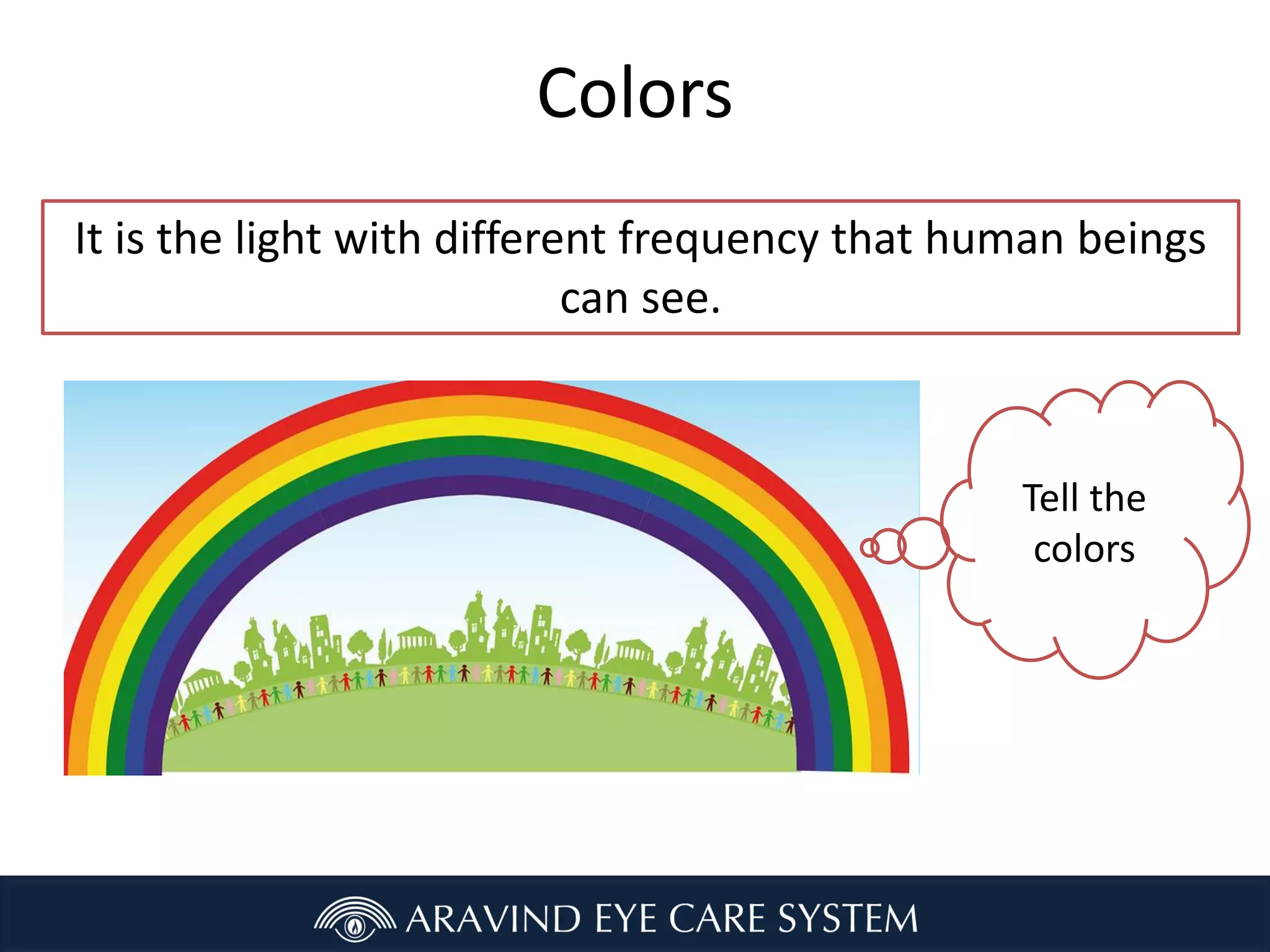
It is the light with different frequency that human beings
can see.
Tell the
colors
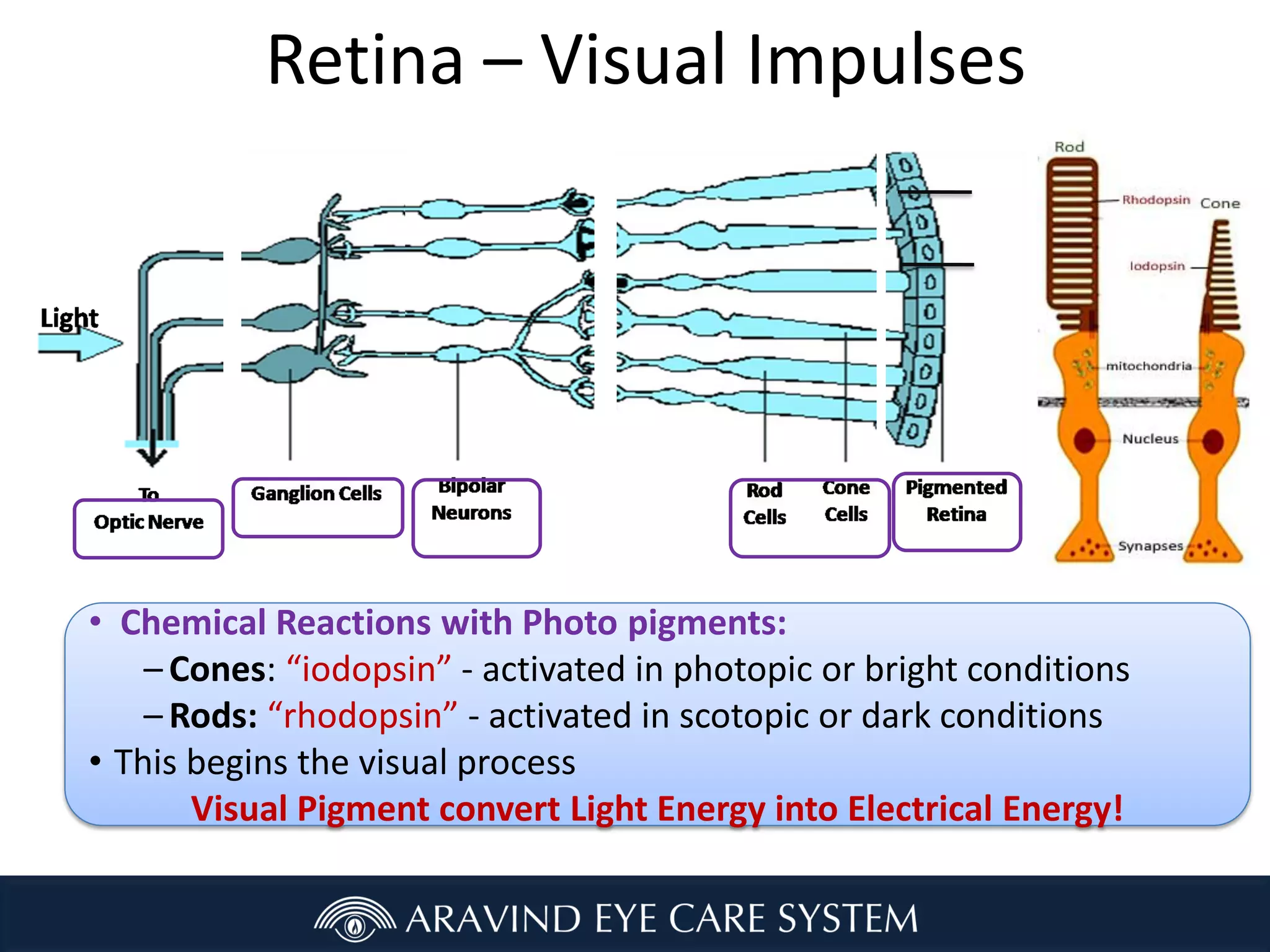
Retina – Visual Impulses
• Chemical Reactions with Photo pigments:
– Cones: “iodopsin” - activated in photopic or bright conditions
– Rods: “rhodopsin” - activated in scotopic or dark conditions
• This begins the visual process
Visual Pigment convert Light Energy into Electrical Energy!
Retina – Visual Impulses
Rods and
cones
Bipolar
cells
Ganglion
cells
Optic
Nerve
Brain
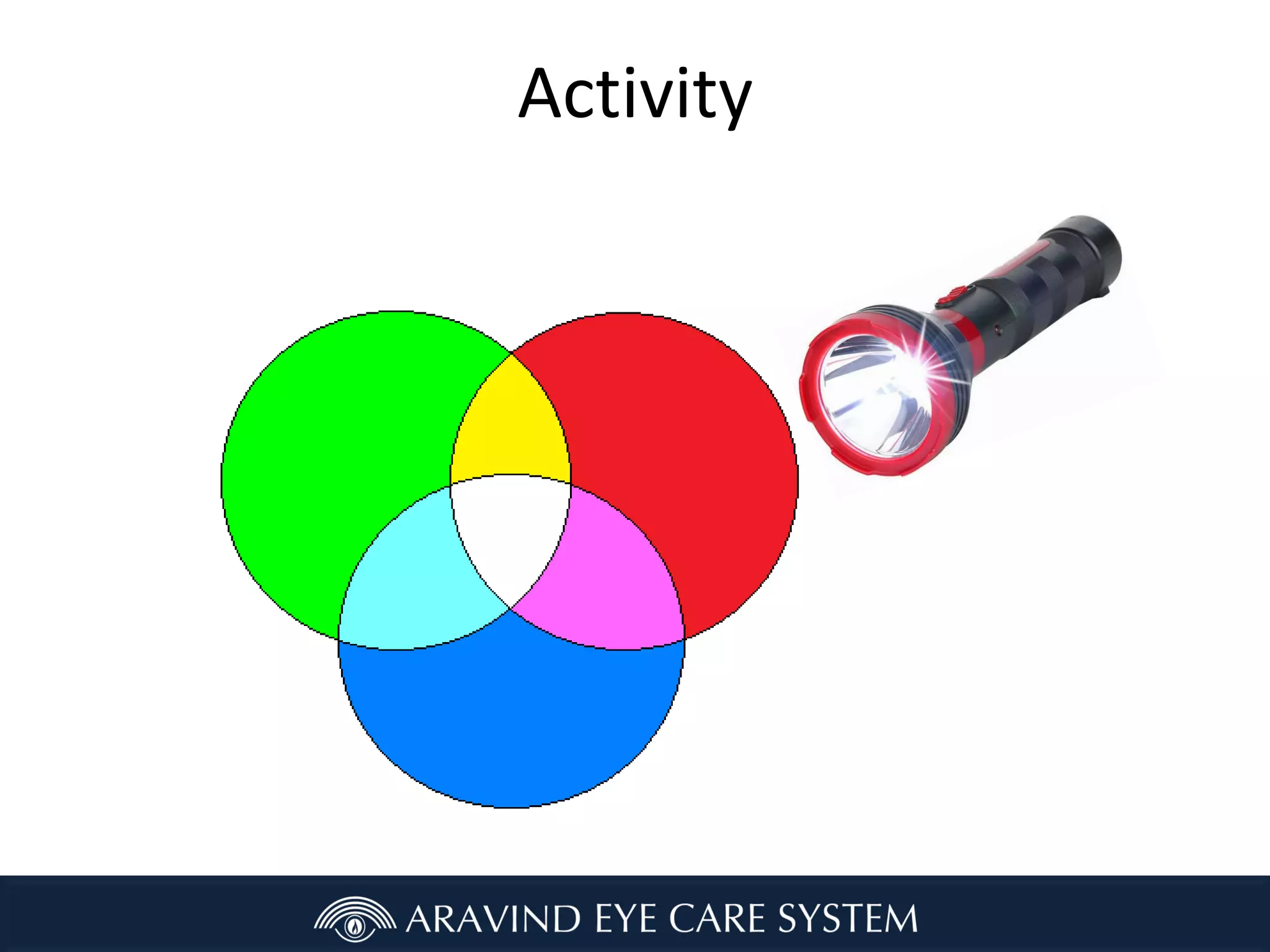
Activity
Color and Light frequency
High frequency
wave length is
Blue / Violet.
Low frequency is
Red
In between
frequency is
green,
yellow,orange,
etc.
Radio Micro
wave
Infrared Visible Ultra
violet
X-Ray Gamma
Ray
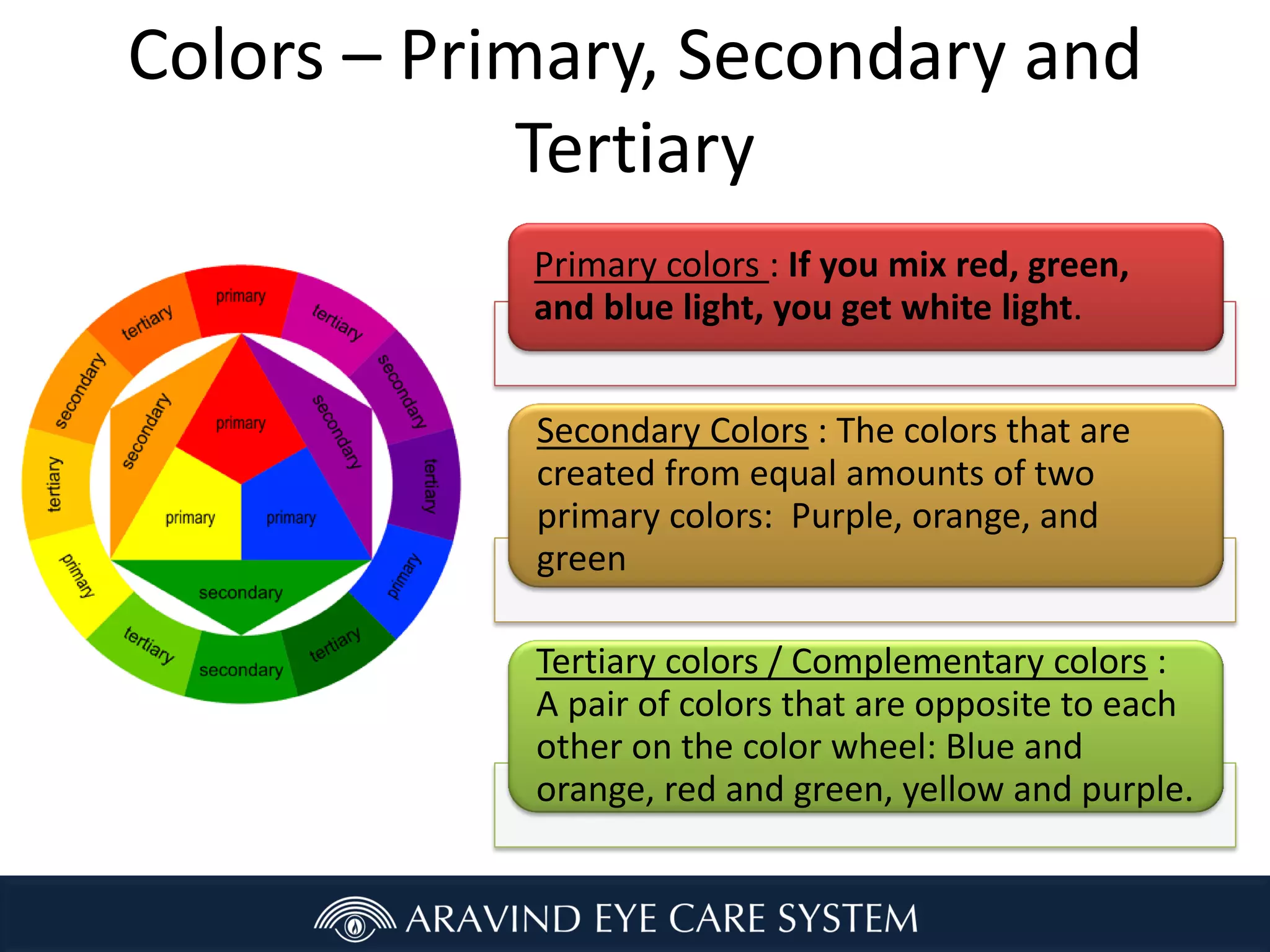
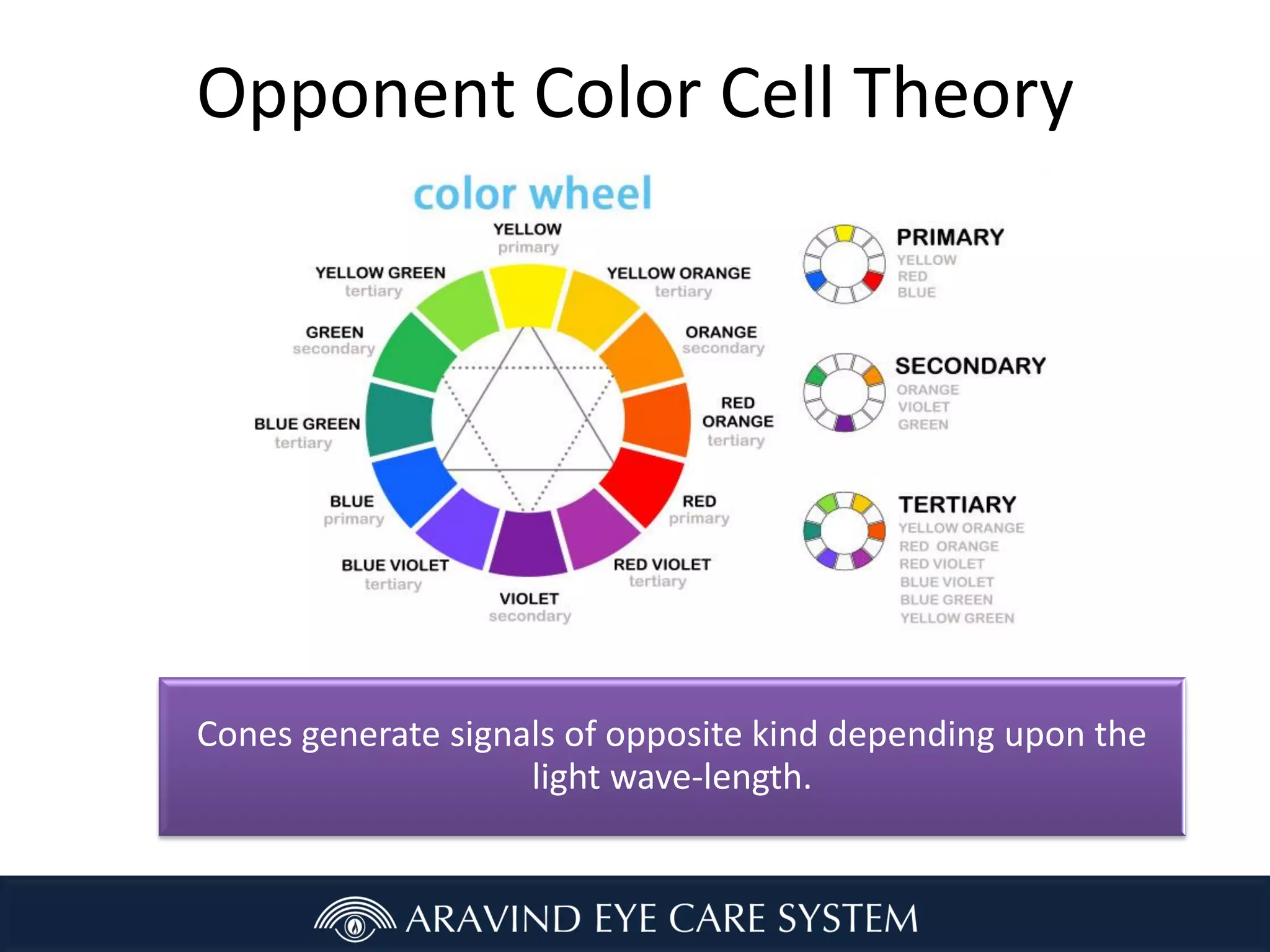
Colors – Primary, Secondary and
Tertiary
Primary colors : If you mix red, green,
and blue light, you get white light.
Secondary Colors : The colors that are
created from equal amounts of two
primary colors: Purple, orange, and
green
Tertiary colors / Complementary colors :
A pair of colors that are opposite to each
other on the color wheel: Blue and
orange, red and green, yellow and purple.
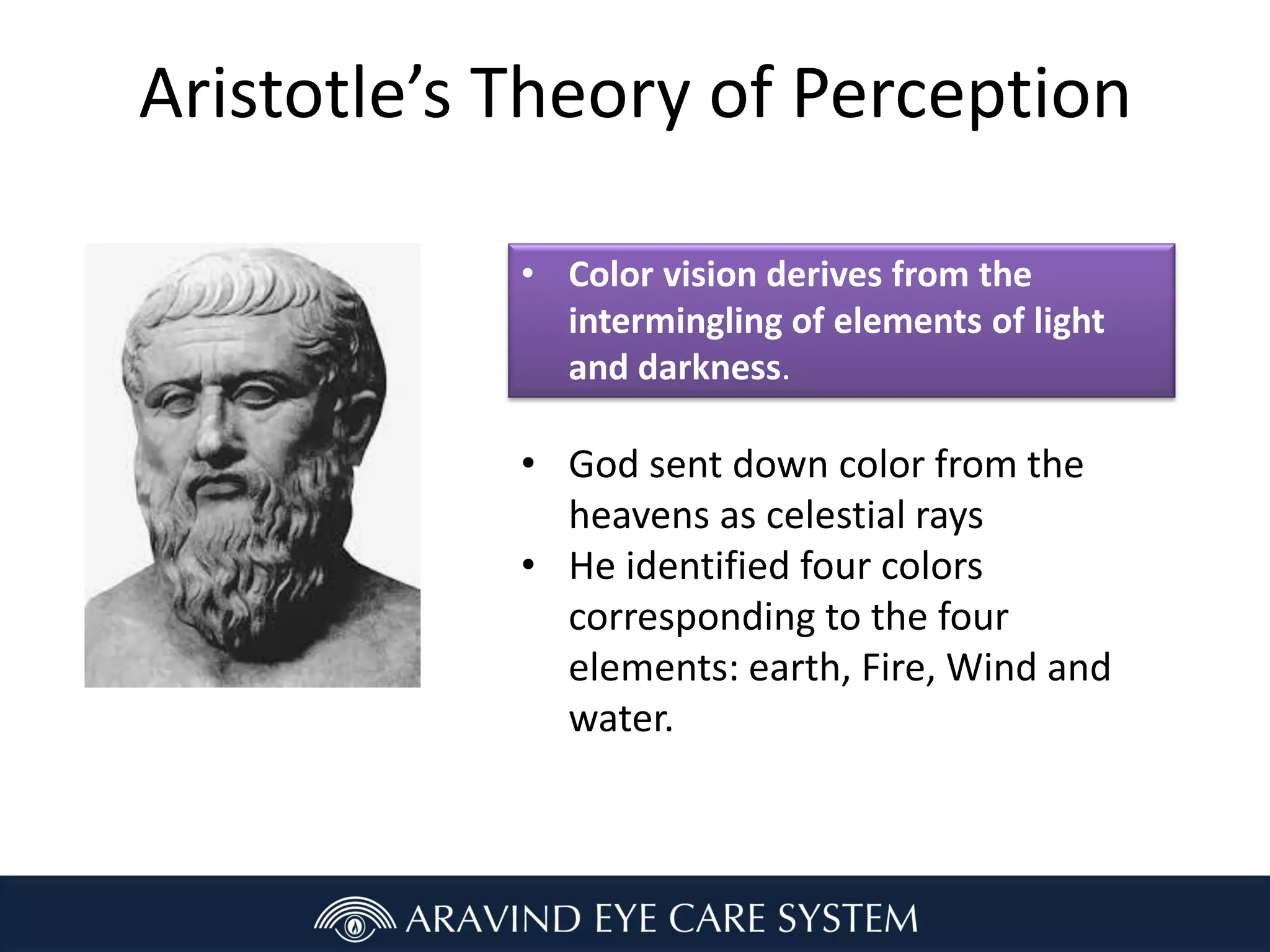
Aristotle’s Theory of Perception
• God sent down color from the
heavens as celestial rays
• He identified four colors
corresponding to the four
elements: earth, Fire, Wind and
water.
• Color vision derives from the
intermingling of elements of light
and darkness.
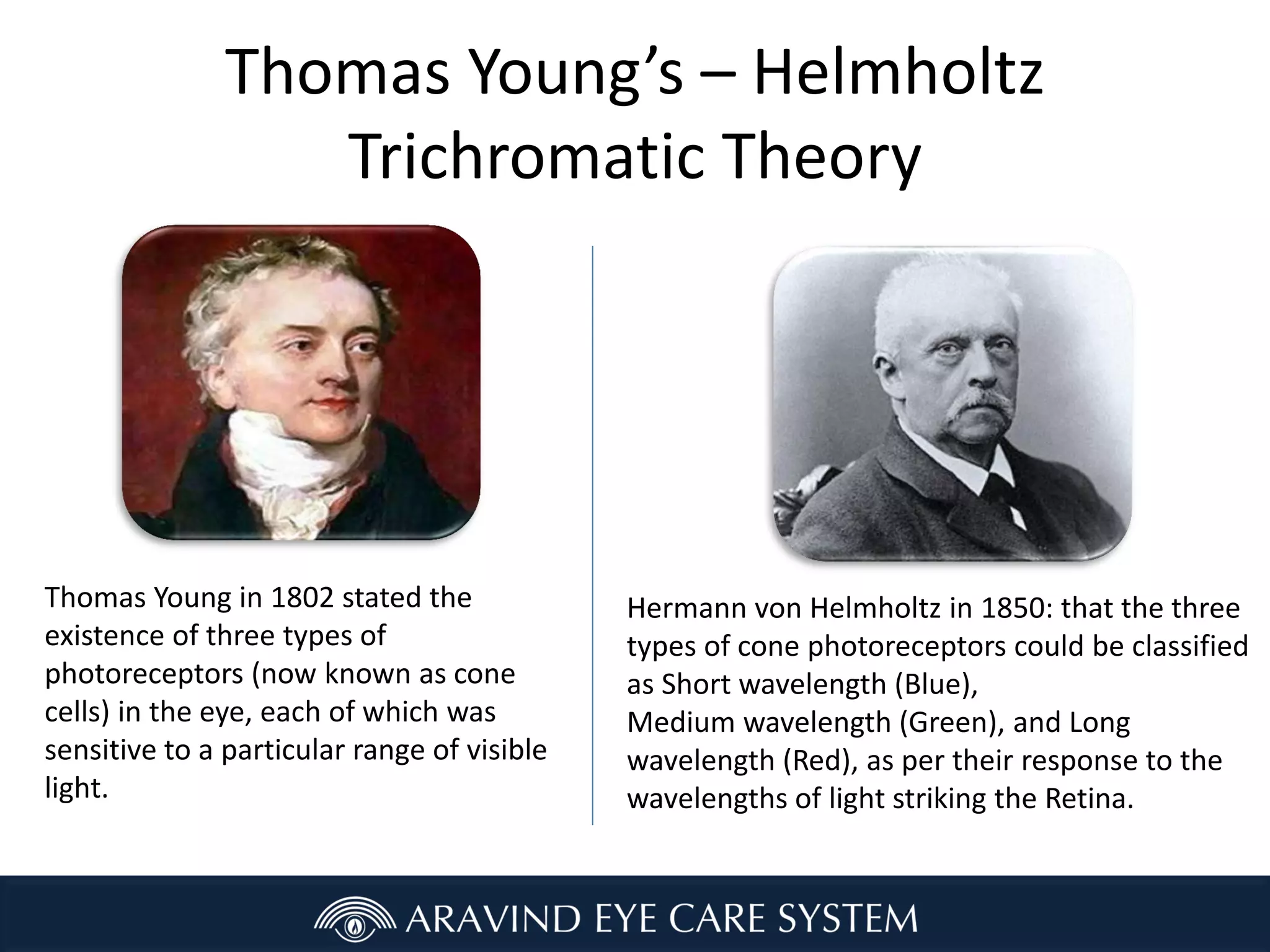
Thomas Young’s – Helmholtz
Trichromatic Theory
Thomas Young in 1802 stated the
existence of three types of
photoreceptors (now known as cone
cells) in the eye, each of which was
sensitive to a particular range of visible
light.
Hermann von Helmholtz in 1850: that the three
types of cone photoreceptors could be classified
as Short wavelength (Blue),
Medium wavelength (Green), and Long
wavelength (Red), as per their response to the
wavelengths of light striking the Retina.
Color Vision Concept - Video
Color Vision Concept
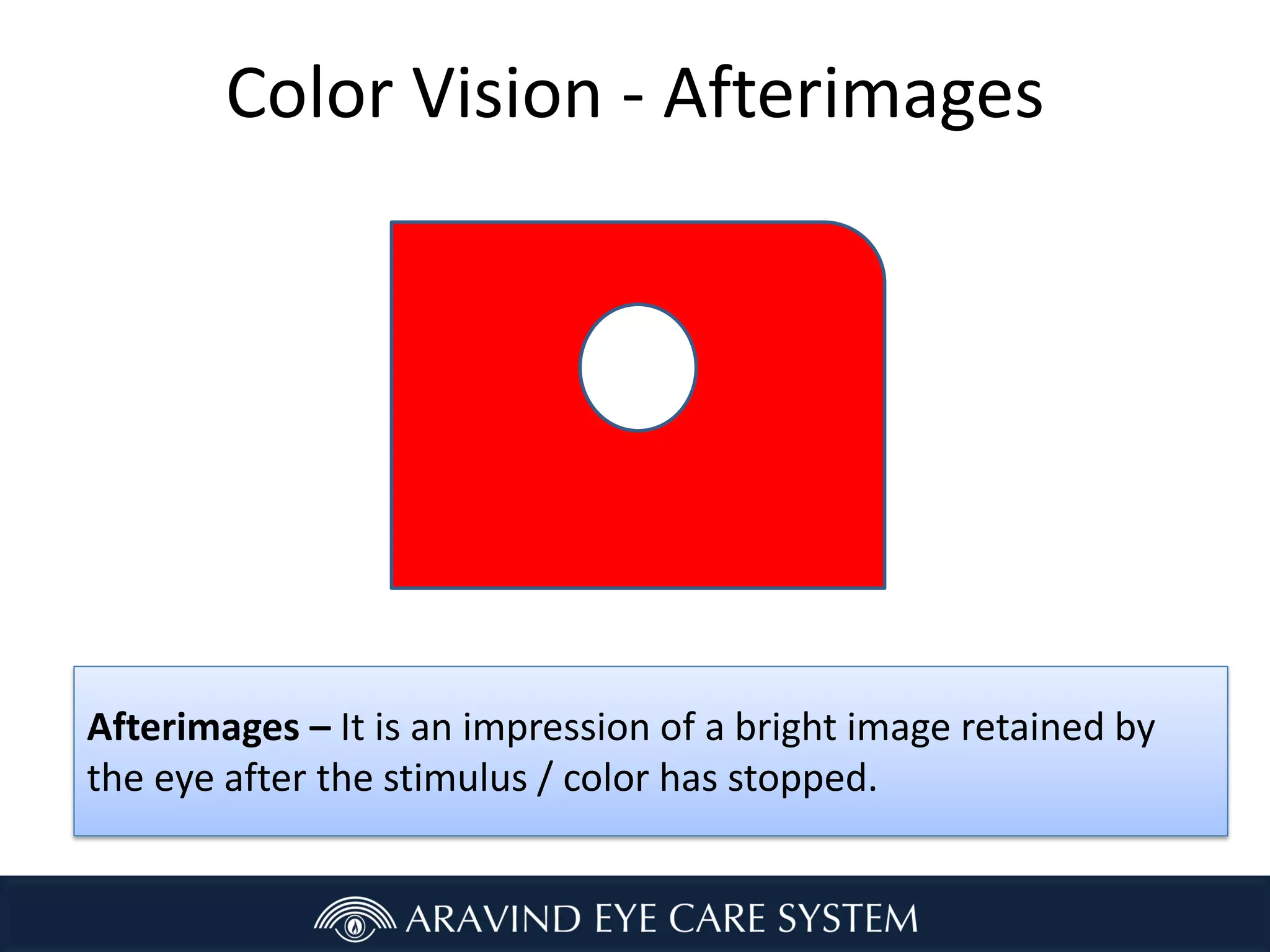
Color Vision - Afterimages
Afterimages – It is an impression of a bright image retained by
the eye after the stimulus / color has stopped.
Opponent process Colour Cell
Theory -Hering’s Theory
Karl Ewald Konstantin Hering in 1892
Three photo chemical substances
in the retina can be broken down
by white, red or yellow light and
will then initiate sensation of
appropriate colors
Opponent Color Cell Theory
Cones generate signals of opposite kind depending upon the
light wave-length.
Medical meaning
• Protanope – Protan meaning Red sensation missing
• Deutranope – deutan meaning second green
sensation missing
• Tritanope – Tritan meaning blue sensation missing
• Achromatic – free of color / white color

Color-Vision-theory.pdf

  • 2.
  • 3.
    Learning Objectives Point outprimary, secondary and tertiary colors Describe the anatomy of color identification Narrate the theories of color vision At the end of the session the trainee will be able to:
  • 4.
    Colors It is thelight with different frequency that human beings can see. Tell the colors
  • 5.
    Retina – VisualImpulses • Chemical Reactions with Photo pigments: – Cones: “iodopsin” - activated in photopic or bright conditions – Rods: “rhodopsin” - activated in scotopic or dark conditions • This begins the visual process Visual Pigment convert Light Energy into Electrical Energy!
  • 6.
    Retina – VisualImpulses Rods and cones Bipolar cells Ganglion cells Optic Nerve Brain
  • 7.
  • 8.
    Color and Lightfrequency High frequency wave length is Blue / Violet. Low frequency is Red In between frequency is green, yellow,orange, etc. Radio Micro wave Infrared Visible Ultra violet X-Ray Gamma Ray
  • 9.
    Colors – Primary,Secondary and Tertiary Primary colors : If you mix red, green, and blue light, you get white light. Secondary Colors : The colors that are created from equal amounts of two primary colors: Purple, orange, and green Tertiary colors / Complementary colors : A pair of colors that are opposite to each other on the color wheel: Blue and orange, red and green, yellow and purple.
  • 10.
    Aristotle’s Theory ofPerception • God sent down color from the heavens as celestial rays • He identified four colors corresponding to the four elements: earth, Fire, Wind and water. • Color vision derives from the intermingling of elements of light and darkness.
  • 11.
    Thomas Young’s –Helmholtz Trichromatic Theory Thomas Young in 1802 stated the existence of three types of photoreceptors (now known as cone cells) in the eye, each of which was sensitive to a particular range of visible light. Hermann von Helmholtz in 1850: that the three types of cone photoreceptors could be classified as Short wavelength (Blue), Medium wavelength (Green), and Long wavelength (Red), as per their response to the wavelengths of light striking the Retina.
  • 12.
    Color Vision Concept- Video Color Vision Concept
  • 13.
    Color Vision -Afterimages Afterimages – It is an impression of a bright image retained by the eye after the stimulus / color has stopped.
  • 14.
    Opponent process ColourCell Theory -Hering’s Theory Karl Ewald Konstantin Hering in 1892 Three photo chemical substances in the retina can be broken down by white, red or yellow light and will then initiate sensation of appropriate colors
  • 15.
    Opponent Color CellTheory Cones generate signals of opposite kind depending upon the light wave-length.
  • 16.
    Medical meaning • Protanope– Protan meaning Red sensation missing • Deutranope – deutan meaning second green sensation missing • Tritanope – Tritan meaning blue sensation missing • Achromatic – free of color / white color