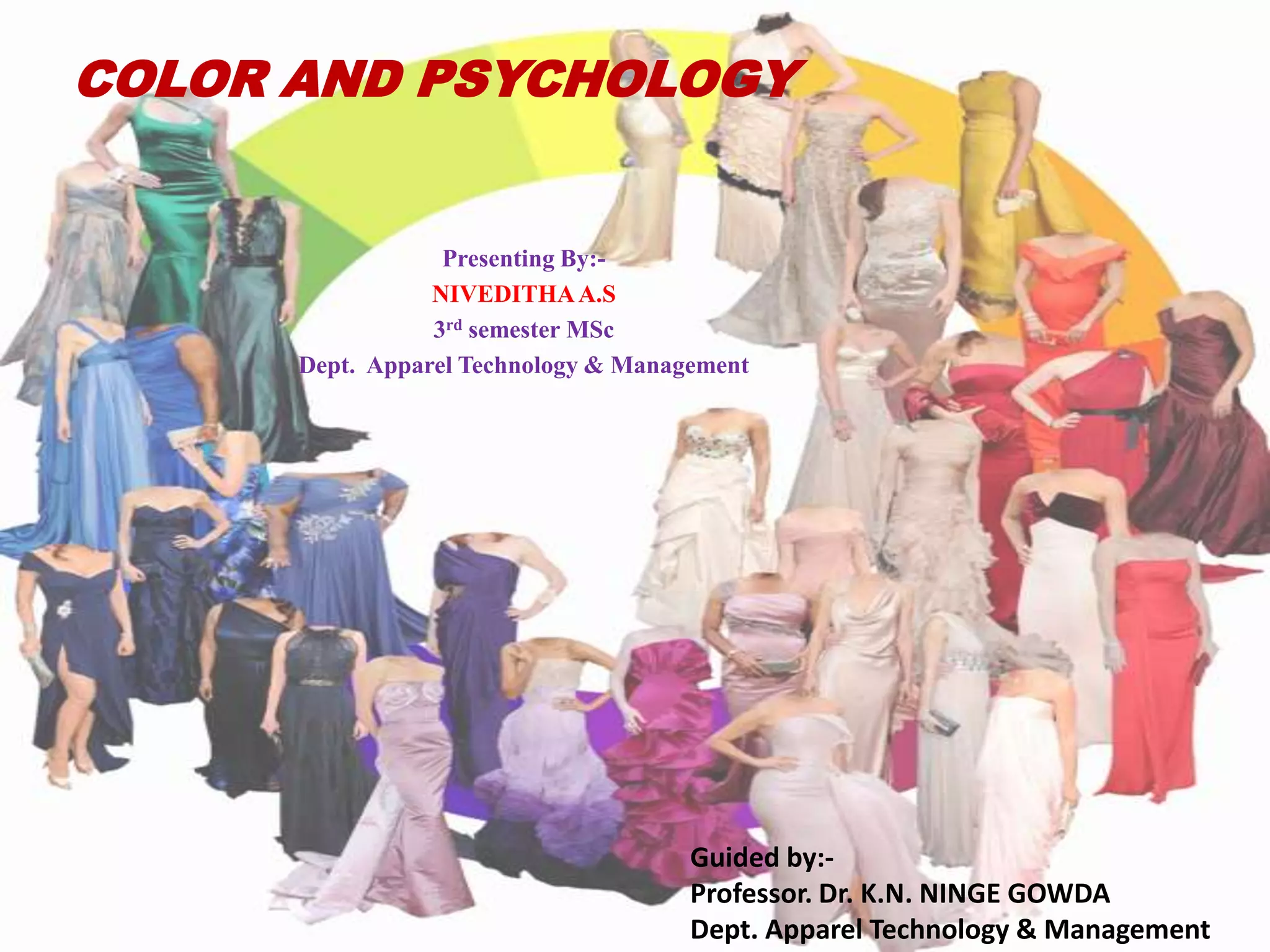

COLOR AND PSYCHOLOGY


                  Presenting By:-
                 NIVEDITHA A.S
                 3rd semester MSc
      Dept. Apparel Technology & Management


                                      Guided by:-
                                      Professor. Dr. K.N. NINGE GOWDA
                                      Dept. Apparel Technology & Management
INTRODUCTION
• Color is the visual perceptual property corresponding in
  humans to the categories called red, green, blue, and others.

• Psychology is the science of the mind. The human mind is the
  most complex machine on earth. It is the source of all thought
  and behavior.

• Color psychology is the study of the effect that colors
  have on human behavior particularly the natural
  instinctive feelings that each color evokes.

• colors can have both positive and negative effects on our
  moods and feelings..
• color psychology is relatively
  old    area    of    scientific
  research, ancient civilizations
  believed in the influence of
  color on humans. The ancient
  Chinese Egyptians and Indians
  believed in chromotherapy or
  healing with colors.
UNDERSTAND OF COLOR FROM
       DIFFERENT DOMAINS
•   Fashion Designer:- Identity and Quality
•   Psychologist:- Psychology of each color
•   Artist:- Experimentation
•   Gemologist:- Astro –Planetary
•   Scientist:- reflective property and wave Length
REVIEW OF LITERATURE

• According to Johnson (2007), color does affect
  mood by producing certain chemicals and
  stimulating different feelings such as hunger.

• writer, Wollard, (2000) opinions to think that
  color can affect one’s mood, but the effect also
  can depend on one’s culture and what one’s
  personal reflection
REVIEW OF LITERATURE
• Eric, John, and Paraag’s (2007) main point
  about color psychology is that color has both a
  physiological and psychological effect.

• by Airey (2006), is that color is energy, and it
  can have a physical, mental, spiritual, and/or
  emotional affect on people.
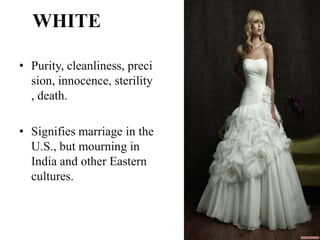
WHITE

• Purity, cleanliness, preci
  sion, innocence, sterility
  , death.

• Signifies marriage in the
  U.S., but mourning in
  India and other Eastern
  cultures.
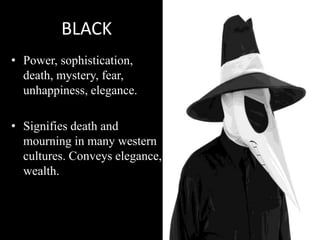
BLACK
• Power, sophistication,
  death, mystery, fear,
  unhappiness, elegance.

• Signifies death and
  mourning in many western
  cultures. Conveys elegance,
  wealth.
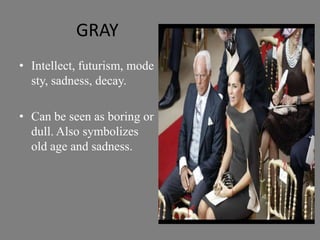
GRAY
• Intellect, futurism, mode
  sty, sadness, decay.

• Can be seen as boring or
  dull. Also symbolizes
  old age and sadness.
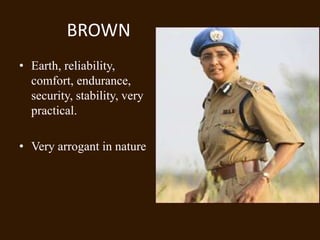
BROWN
• Earth, reliability,
  comfort, endurance,
  security, stability, very
  practical.

• Very arrogant in nature
RED
• Passion, danger, heat, ad
  venture, optimism, pow
  er, energy.

• Can be seen as
  aggressive, it can be
  overpowering and may
  cause headaches.
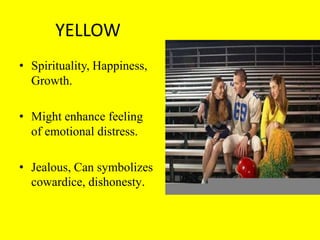
YELLOW
• Spirituality, Happiness,
  Growth.

• Might enhance feeling
  of emotional distress.

• Jealous, Can symbolizes
  cowardice, dishonesty.
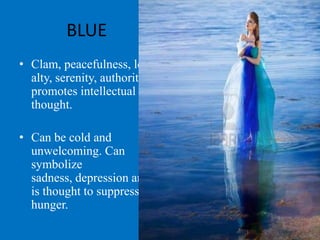
BLUE
• Clam, peacefulness, loy
  alty, serenity, authority,
  promotes intellectual
  thought.

• Can be cold and
  unwelcoming. Can
  symbolize
  sadness, depression and
  is thought to suppress
  hunger.
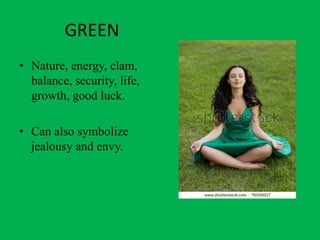
GREEN
• Nature, energy, clam,
  balance, security, life,
  growth, good luck.

• Can also symbolize
  jealousy and envy.
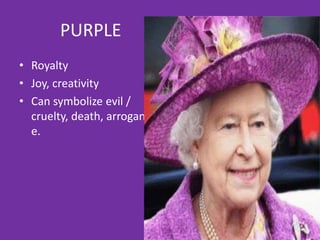
PURPLE
• Royalty
• Joy, creativity
• Can symbolize evil /
  cruelty, death, arroganc
  e.
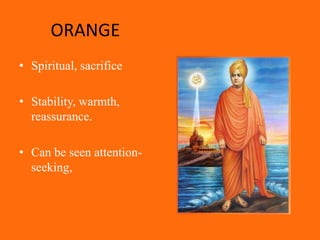
ORANGE
• Spiritual, sacrifice

• Stability, warmth,
  reassurance.

• Can be seen attention-
  seeking,
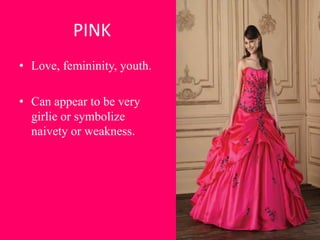
PINK
• Love, femininity, youth.

• Can appear to be very
  girlie or symbolize
  naivety or weakness.
COLOR THROUGH AGE DEVELOPMENT


• There is a cycle changing colors that affects
  our mind and body through the different
  stages of life. These are reflected in our
  changing color preferences. Children have
  color likes and dislikes according to
  individual character and stage of
  development
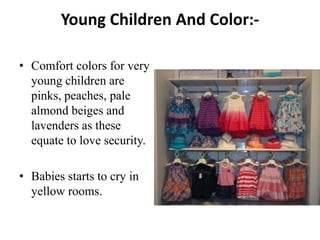
Young Children And Color:-

• Comfort colors for very
  young children are
  pinks, peaches, pale
  almond beiges and
  lavenders as these
  equate to love security.

• Babies starts to cry in
  yellow rooms.
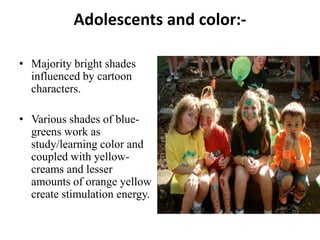
Adolescents and color:-

• Majority bright shades
  influenced by cartoon
  characters.

• Various shades of blue-
  greens work as
  study/learning color and
  coupled with yellow-
  creams and lesser
  amounts of orange yellow
  create stimulation energy.
Teenagers and color:-

• Teenagers go through an identity crisis and often use black.

• Using small amounts of fluoro brights will lift the young person
  away from the feeling of isolation or withdrawal from the world.

• Red is a favorite bright for this age group.

•    Bold blues and citrus greens also provide some tranquility and
    release of tension.

• Purple is usually embraced when the mind develops social
  awareness and outward thoughts-
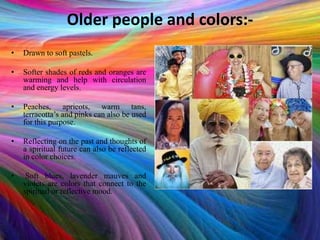
Older people and colors:-
•   Drawn to soft pastels.

•   Softer shades of reds and oranges are
    warming and help with circulation
    and energy levels.

•   Peaches, apricots, warm tans,
    terracotta’s and pinks can also be used
    for this purpose.

•   Reflecting on the past and thoughts of
    a spiritual future can also be reflected
    in color choices.

•    Soft blues, lavender mauves and
    violets are colors that connect to the
    spiritual or reflective mood.
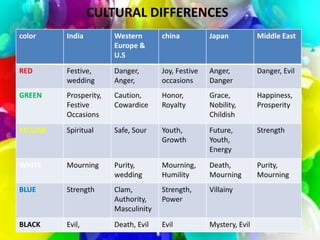
CULTURAL DIFFERENCES
color    India         Western       china          Japan           Middle East
                       Europe &
                       U.S
RED      Festive,      Danger,       Joy, Festive   Anger,          Danger, Evil
         wedding       Anger,        occasions      Danger
GREEN    Prosperity,   Caution,      Honor,         Grace,          Happiness,
         Festive       Cowardice     Royalty        Nobility,       Prosperity
         Occasions                                  Childish
YELLOW   Spiritual     Safe, Sour    Youth,         Future,         Strength
                                     Growth         Youth,
                                                    Energy
WHITE    Mourning      Purity,       Mourning,      Death,          Purity,
                       wedding       Humility       Mourning        Mourning
BLUE     Strength      Clam,         Strength,      Villainy
                       Authority,    Power
                       Masculinity
BLACK    Evil,         Death, Evil   Evil           Mystery, Evil
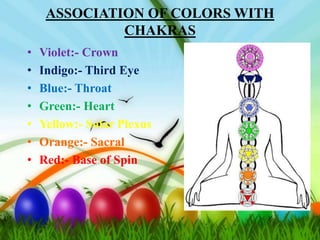
ASSOCIATION OF COLORS WITH
              CHAKRAS
•   Violet:- Crown
•   Indigo:- Third Eye
•   Blue:- Throat
•   Green:- Heart
•   Yellow:- Solar Plexus
•   Orange:- Sacral
•   Red:- Base of Spin
CHROMOTHERAPY
•   Red is used to stimulate the body and mind and to increase blood circulation.


•   Yellow is thought to stimulate the nerves and purify the body.


•   Orange is used to heal the lungs and to increase energy levels.


•   Blue is believed to soothe illnesses and treat pain.


•   Indigo shades were thought to alleviate skin problems.

•   Green effects on Blood Pressure, cures hormonal imbalance.
CONCLUSION
• The psychological and physiological effects of color are apparent in
  everyday life.

• It is extremely important to understand how these colors affect us,
  and the careful attention that must be paid when designing garment.

• However, it is also important to note that certain colors should not
  be overused simply for their calming or exciting effects.

• It was also suggested that the environmental color (e.g., color
   lighting) and the object’s color (e.g., color of one’s clothing) would
  be different in ways they exhibit psychological effects on us.

• These colors benefit our mental and physical welfare.
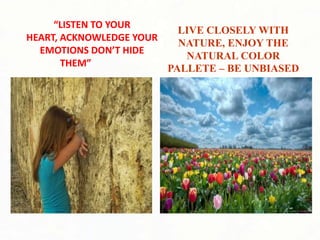
“LISTEN TO YOUR
                            LIVE CLOSELY WITH
HEART, ACKNOWLEDGE YOUR
                            NATURE, ENJOY THE
  EMOTIONS DON’T HIDE
                             NATURAL COLOR
       THEM”
                          PALLETE – BE UNBIASED
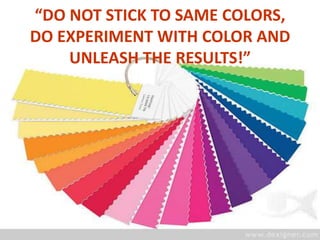
“DO NOT STICK TO SAME COLORS,
DO EXPERIMENT WITH COLOR AND
    UNLEASH THE RESULTS!”
Color and psychology

Color and psychology

  • 1.
    COLOR AND PSYCHOLOGY Presenting By:- NIVEDITHA A.S 3rd semester MSc Dept. Apparel Technology & Management Guided by:- Professor. Dr. K.N. NINGE GOWDA Dept. Apparel Technology & Management
  • 2.
    INTRODUCTION • Color isthe visual perceptual property corresponding in humans to the categories called red, green, blue, and others. • Psychology is the science of the mind. The human mind is the most complex machine on earth. It is the source of all thought and behavior. • Color psychology is the study of the effect that colors have on human behavior particularly the natural instinctive feelings that each color evokes. • colors can have both positive and negative effects on our moods and feelings..
  • 3.
    • color psychologyis relatively old area of scientific research, ancient civilizations believed in the influence of color on humans. The ancient Chinese Egyptians and Indians believed in chromotherapy or healing with colors.
  • 4.
    UNDERSTAND OF COLORFROM DIFFERENT DOMAINS • Fashion Designer:- Identity and Quality • Psychologist:- Psychology of each color • Artist:- Experimentation • Gemologist:- Astro –Planetary • Scientist:- reflective property and wave Length
  • 5.
    REVIEW OF LITERATURE •According to Johnson (2007), color does affect mood by producing certain chemicals and stimulating different feelings such as hunger. • writer, Wollard, (2000) opinions to think that color can affect one’s mood, but the effect also can depend on one’s culture and what one’s personal reflection
  • 6.
    REVIEW OF LITERATURE •Eric, John, and Paraag’s (2007) main point about color psychology is that color has both a physiological and psychological effect. • by Airey (2006), is that color is energy, and it can have a physical, mental, spiritual, and/or emotional affect on people.
  • 7.
    WHITE • Purity, cleanliness,preci sion, innocence, sterility , death. • Signifies marriage in the U.S., but mourning in India and other Eastern cultures.
  • 8.
    BLACK • Power, sophistication, death, mystery, fear, unhappiness, elegance. • Signifies death and mourning in many western cultures. Conveys elegance, wealth.
  • 9.
    GRAY • Intellect, futurism,mode sty, sadness, decay. • Can be seen as boring or dull. Also symbolizes old age and sadness.
  • 10.
    BROWN • Earth, reliability, comfort, endurance, security, stability, very practical. • Very arrogant in nature
  • 11.
    RED • Passion, danger,heat, ad venture, optimism, pow er, energy. • Can be seen as aggressive, it can be overpowering and may cause headaches.
  • 12.
    YELLOW • Spirituality, Happiness, Growth. • Might enhance feeling of emotional distress. • Jealous, Can symbolizes cowardice, dishonesty.
  • 13.
    BLUE • Clam, peacefulness,loy alty, serenity, authority, promotes intellectual thought. • Can be cold and unwelcoming. Can symbolize sadness, depression and is thought to suppress hunger.
  • 14.
    GREEN • Nature, energy,clam, balance, security, life, growth, good luck. • Can also symbolize jealousy and envy.
  • 15.
    PURPLE • Royalty • Joy,creativity • Can symbolize evil / cruelty, death, arroganc e.
  • 16.
    ORANGE • Spiritual, sacrifice •Stability, warmth, reassurance. • Can be seen attention- seeking,
  • 17.
    PINK • Love, femininity,youth. • Can appear to be very girlie or symbolize naivety or weakness.
  • 18.
    COLOR THROUGH AGEDEVELOPMENT • There is a cycle changing colors that affects our mind and body through the different stages of life. These are reflected in our changing color preferences. Children have color likes and dislikes according to individual character and stage of development
  • 19.
    Young Children AndColor:- • Comfort colors for very young children are pinks, peaches, pale almond beiges and lavenders as these equate to love security. • Babies starts to cry in yellow rooms.
  • 20.
    Adolescents and color:- •Majority bright shades influenced by cartoon characters. • Various shades of blue- greens work as study/learning color and coupled with yellow- creams and lesser amounts of orange yellow create stimulation energy.
  • 21.
    Teenagers and color:- •Teenagers go through an identity crisis and often use black. • Using small amounts of fluoro brights will lift the young person away from the feeling of isolation or withdrawal from the world. • Red is a favorite bright for this age group. • Bold blues and citrus greens also provide some tranquility and release of tension. • Purple is usually embraced when the mind develops social awareness and outward thoughts-
  • 22.
    Older people andcolors:- • Drawn to soft pastels. • Softer shades of reds and oranges are warming and help with circulation and energy levels. • Peaches, apricots, warm tans, terracotta’s and pinks can also be used for this purpose. • Reflecting on the past and thoughts of a spiritual future can also be reflected in color choices. • Soft blues, lavender mauves and violets are colors that connect to the spiritual or reflective mood.
  • 23.
    CULTURAL DIFFERENCES color India Western china Japan Middle East Europe & U.S RED Festive, Danger, Joy, Festive Anger, Danger, Evil wedding Anger, occasions Danger GREEN Prosperity, Caution, Honor, Grace, Happiness, Festive Cowardice Royalty Nobility, Prosperity Occasions Childish YELLOW Spiritual Safe, Sour Youth, Future, Strength Growth Youth, Energy WHITE Mourning Purity, Mourning, Death, Purity, wedding Humility Mourning Mourning BLUE Strength Clam, Strength, Villainy Authority, Power Masculinity BLACK Evil, Death, Evil Evil Mystery, Evil
  • 24.
    ASSOCIATION OF COLORSWITH CHAKRAS • Violet:- Crown • Indigo:- Third Eye • Blue:- Throat • Green:- Heart • Yellow:- Solar Plexus • Orange:- Sacral • Red:- Base of Spin
  • 25.
    CHROMOTHERAPY • Red is used to stimulate the body and mind and to increase blood circulation. • Yellow is thought to stimulate the nerves and purify the body. • Orange is used to heal the lungs and to increase energy levels. • Blue is believed to soothe illnesses and treat pain. • Indigo shades were thought to alleviate skin problems. • Green effects on Blood Pressure, cures hormonal imbalance.
  • 26.
    CONCLUSION • The psychologicaland physiological effects of color are apparent in everyday life. • It is extremely important to understand how these colors affect us, and the careful attention that must be paid when designing garment. • However, it is also important to note that certain colors should not be overused simply for their calming or exciting effects. • It was also suggested that the environmental color (e.g., color lighting) and the object’s color (e.g., color of one’s clothing) would be different in ways they exhibit psychological effects on us. • These colors benefit our mental and physical welfare.
  • 27.
    “LISTEN TO YOUR LIVE CLOSELY WITH HEART, ACKNOWLEDGE YOUR NATURE, ENJOY THE EMOTIONS DON’T HIDE NATURAL COLOR THEM” PALLETE – BE UNBIASED
  • 28.
    “DO NOT STICKTO SAME COLORS, DO EXPERIMENT WITH COLOR AND UNLEASH THE RESULTS!”