
COLLECTION OF DATA
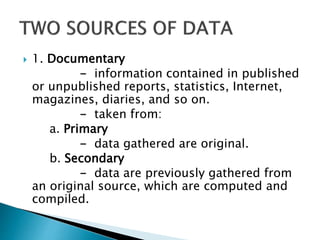
 1. Documentary
- information contained in published
or unpublished reports, statistics, Internet,
magazines, diaries, and so on.
- taken from:
a. Primary
- data gathered are original.
b. Secondary
- data are previously gathered from
an original source, which are computed and
compiled.
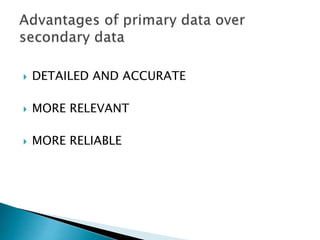
 DETAILED AND ACCURATE
 MORE RELEVANT
 MORE RELIABLE
 2. Field Sources
- include individuals who have
sufficient knowledge and experience
regarding the study under the investigation.
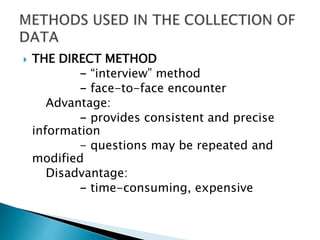
 THE DIRECT METHOD
- “interview” method
- face-to-face encounter
Advantage:
- provides consistent and precise
information
- questions may be repeated and
modified
Disadvantage:
- time-consuming, expensive
 THE INDIRECT METHOD
- “questionnaire method”
- done by giving prepared relevant
questionnaires to the respondents of the
study
QUESTIONNAIRE
- list of questions which are
intended to elicit answers to the problems
under investigation.
Advantage:
- may be mailed or hand-held.
- inexpensive and can cover a wide
area in a shorter period of time.
Disadvantage:
- strong probability of no response
- questions not easily understood
will also probably not be answered.
 THE REGISTRATION METHOD
- method of utilizing the existing data
or fact or information, which is kept
systematized by the office concerned
Ex. Registration of births, death, motor,
vehicles, marriages and licenses.
 THE OBSERVATION METHOD
- used to collect data pertaining
attitudes, behavior, values and cultural
patterns of the samples under investigation.
- may be taken individually or
collectively
 THE EXPERIMENT METHOD
- used to determine the cause and
effect relationship of certain phenomena
under investigation.
- used in making scientific inquiry.
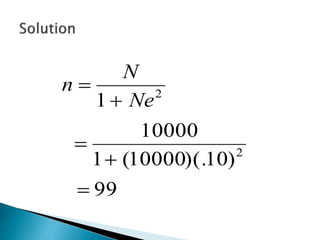
where n = sample size
N = population size
e = margin of error
2
1 Ne
N
n


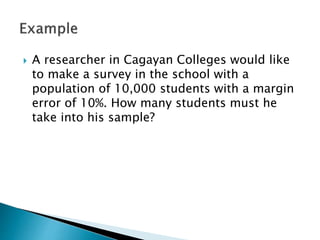
 A researcher in Cagayan Colleges would like
to make a survey in the school with a
population of 10,000 students with a margin
error of 10%. How many students must he
take into his sample?
99
)10)(.10000(1
10000
1
2
2





Ne
N
n
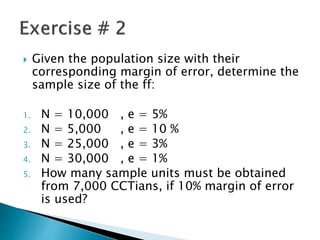
 Given the population size with their
corresponding margin of error, determine the
sample size of the ff:
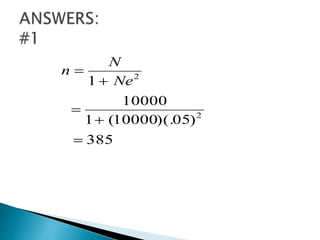
1. N = 10,000 , e = 5%
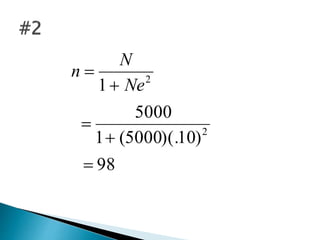
2. N = 5,000 , e = 10 %
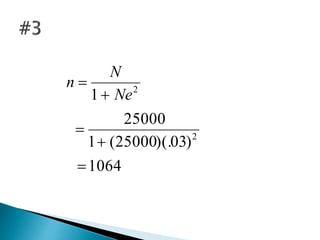
3. N = 25,000 , e = 3%
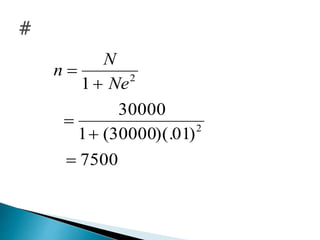
4. N = 30,000 , e = 1%
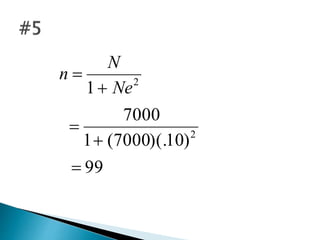
5. How many sample units must be obtained
from 7,000 CCTians, if 10% margin of error
is used?
385
)05)(.10000(1
10000
1
2
2





Ne
N
n
98
)10)(.5000(1
5000
1
2
2





Ne
N
n
1064
)03)(.25000(1
25000
1
2
2





Ne
N
n
7500
)01)(.30000(1
30000
1
2
2





Ne
N
n
99
)10)(.7000(1
7000
1
2
2





Ne
N
n

Collection of data