Descriptive statistics
WELCOME
1
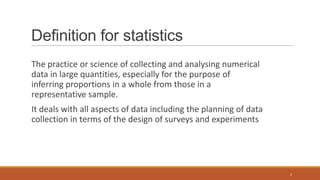
Definition for statistics
The practice or science of collecting and analysing numerical
data in large quantities, especially for the purpose of
inferring proportions in a whole from those in a
representative sample.
It deals with all aspects of data including the planning of data
collection in terms of the design of surveys and experiments
2
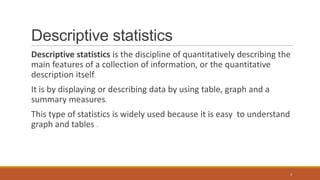
Descriptive statistics
Descriptive statistics is the discipline of quantitatively describing the
main features of a collection of information, or the quantitative
description itself.
It is by displaying or describing data by using table, graph and a
summary measures.
This type of statistics is widely used because it is easy to understand
graph and tables .
3
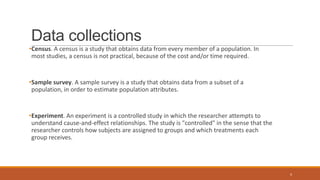
Data collections
•Census. A census is a study that obtains data from every member of a population. In
most studies, a census is not practical, because of the cost and/or time required.
•Sample survey. A sample survey is a study that obtains data from a subset of a
population, in order to estimate population attributes.
•Experiment. An experiment is a controlled study in which the researcher attempts to
understand cause-and-effect relationships. The study is "controlled" in the sense that the
researcher controls how subjects are assigned to groups and which treatments each
group receives.
4
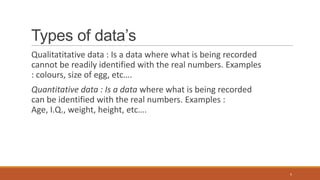
Types of data’s
Qualitatitative data : Is a data where what is being recorded
cannot be readily identified with the real numbers. Examples
: colours, size of egg, etc….
Quantitative data : Is a data where what is being recorded
can be identified with the real numbers. Examples :
Age, I.Q., weight, height, etc….
5
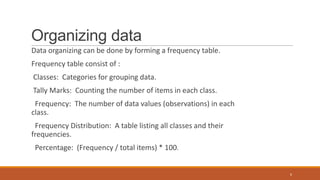
Organizing data
Data organizing can be done by forming a frequency table.
Frequency table consist of :
Classes: Categories for grouping data.
Tally Marks: Counting the number of items in each class.
Frequency: The number of data values (observations) in each
class.
Frequency Distribution: A table listing all classes and their
frequencies.
Percentage: (Frequency / total items) * 100.
6
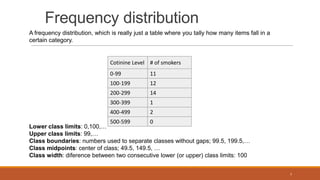
Frequency distribution
Cotinine Level # of smokers
0-99 11
100-199 12
200-299 14
300-399 1
400-499 2
500-599 0
7
A frequency distribution, which is really just a table where you tally how many items fall in a
certain category.
Lower class limits: 0,100,…
Upper class limits: 99,…
Class boundaries: numbers used to separate classes without gaps; 99.5, 199.5,…
Class midpoints: center of class; 49.5, 149.5, …
Class width: diference between two consecutive lower (or upper) class limits: 100
Thank you
By
Giritharan, 10dm10.
Kamesh, 11dm23.
Abdul suban, 12dm01.
Abdul kader, 12dm02.
8

Descriptive statistics

  • 1.
  • 2.
    Definition for statistics Thepractice or science of collecting and analysing numerical data in large quantities, especially for the purpose of inferring proportions in a whole from those in a representative sample. It deals with all aspects of data including the planning of data collection in terms of the design of surveys and experiments 2
  • 3.
    Descriptive statistics Descriptive statisticsis the discipline of quantitatively describing the main features of a collection of information, or the quantitative description itself. It is by displaying or describing data by using table, graph and a summary measures. This type of statistics is widely used because it is easy to understand graph and tables . 3
  • 4.
    Data collections •Census. Acensus is a study that obtains data from every member of a population. In most studies, a census is not practical, because of the cost and/or time required. •Sample survey. A sample survey is a study that obtains data from a subset of a population, in order to estimate population attributes. •Experiment. An experiment is a controlled study in which the researcher attempts to understand cause-and-effect relationships. The study is "controlled" in the sense that the researcher controls how subjects are assigned to groups and which treatments each group receives. 4
  • 5.
    Types of data’s Qualitatitativedata : Is a data where what is being recorded cannot be readily identified with the real numbers. Examples : colours, size of egg, etc…. Quantitative data : Is a data where what is being recorded can be identified with the real numbers. Examples : Age, I.Q., weight, height, etc…. 5
  • 6.
    Organizing data Data organizingcan be done by forming a frequency table. Frequency table consist of : Classes: Categories for grouping data. Tally Marks: Counting the number of items in each class. Frequency: The number of data values (observations) in each class. Frequency Distribution: A table listing all classes and their frequencies. Percentage: (Frequency / total items) * 100. 6
  • 7.
    Frequency distribution Cotinine Level# of smokers 0-99 11 100-199 12 200-299 14 300-399 1 400-499 2 500-599 0 7 A frequency distribution, which is really just a table where you tally how many items fall in a certain category. Lower class limits: 0,100,… Upper class limits: 99,… Class boundaries: numbers used to separate classes without gaps; 99.5, 199.5,… Class midpoints: center of class; 49.5, 149.5, … Class width: diference between two consecutive lower (or upper) class limits: 100
  • 8.
    Thank you By Giritharan, 10dm10. Kamesh,11dm23. Abdul suban, 12dm01. Abdul kader, 12dm02. 8