DOCUMENTARY:
QUESTIONNAIRE
ANALYSIS
PRE-PRODUCTION
OVERVIEW
• To evaluate the expectations and desires of my target audience, I
constructed a questionnaire in order to gather information that I
can base the structure/content of my documentary on.
• The questionnaire contained 18 questions: 8 questions
addressed the structure of the documentary, whilst 8 addressed
the sporting content within the film. The remaining 2 established
gender and age.
• The questionnaire was answered by 27 people, which is a good
sized sample for a documentary of this scale.
• The questionnaire used mostly closed questions, which had
multiple options in order to gain a range of opinions. The
questions also contained instruction and help text, to fully clarify
and explain aspects of the question in order to record accurate
and reliable results.
• One question was an open question, in order to gain a broader
range of data in the words of the subject.
Q1/2. ARE YOU MALE OR
FEMALE? HOW OLD ARE YOU?
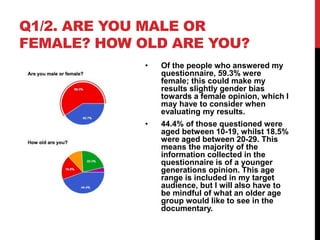
• Of the people who answered my
questionnaire, 59.3% were
female; this could make my
results slightly gender bias
towards a female opinion, which I
may have to consider when
evaluating my results.
• 44.4% of those questioned were
aged between 10-19, whilst 18.5%
were aged between 20-29. This
means the majority of the
information collected in the
questionnaire is of a younger
generations opinion. This age
range is included in my target
audience, but I will also have to
be mindful of what an older age
group would like to see in the
documentary.
Q3.HOW MANY HOURS OF DOCUMENTARY
FILM DO YOU TEND TO WATCH IN A WEEK?
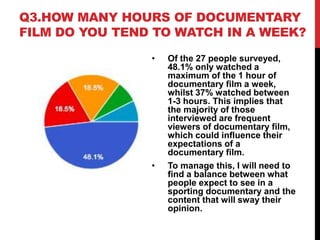
• Of the 27 people surveyed,
48.1% only watched a
maximum of the 1 hour of
documentary film a week,
whilst 37% watched between
1-3 hours. This implies that
the majority of those
interviewed are frequent
viewers of documentary film,
which could influence their
expectations of a
documentary film.
• To manage this, I will need to
find a balance between what
people expect to see in a
sporting documentary and the
content that will sway their
opinion.
Q4.WHAT KIND OF DOCUMENTARY FILM
DO YOU LIKE TO WATCH IN YOUR SPARE
TIME?
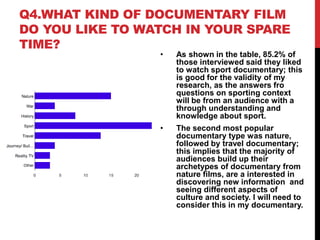
• As shown in the table, 85.2% of
those interviewed said they liked
to watch sport documentary; this
is good for the validity of my
research, as the answers fro
questions on sporting context
will be from an audience with a
through understanding and
knowledge about sport.
• The second most popular
documentary type was nature,
followed by travel documentary;
this implies that the majority of
audiences build up their
archetypes of documentary from
nature films, are a interested in
discovering new information and
seeing different aspects of
culture and society. I will need to
consider this in my documentary.
Q5. AS A VIEWER, WHAT DO YOU
LIKE/EXPECT TO SEE IN A
DOCUMENTARY?
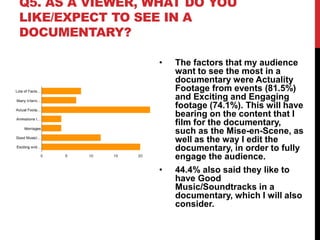
• The factors that my audience
want to see the most in a
documentary were Actuality
Footage from events (81.5%)
and Exciting and Engaging
footage (74.1%). This will have
bearing on the content that I
film for the documentary,
such as the Mise-en-Scene, as
well as the way I edit the
documentary, in order to fully
engage the audience.
• 44.4% also said they like to
have Good
Music/Soundtracks in a
documentary, which I will also
consider.
Q6. IN DOCUMENTARY DO YOU LIKE TO BE ABLE
TO SEE A NARRATOR/PRESENTER INVOLVED IN
THE FILM?
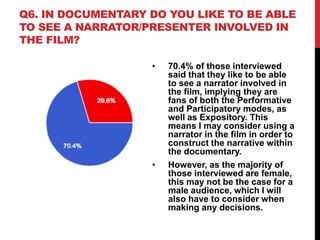
• 70.4% of those interviewed
said that they like to be able
to see a narrator involved in
the film, implying they are
fans of both the Performative
and Participatory modes, as
well as Expository. This
means I may consider using a
narrator in the film in order to
construct the narrative within
the documentary.
• However, as the majority of
those interviewed are female,
this may not be the case for a
male audience, which I will
also have to consider when
making any decisions.
Q7.IN YOUR VIEW, WHAT IS MORE IMPORTANT:
THE TRUTH OR ENTERTAINMENT?
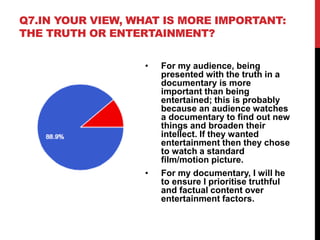
• For my audience, being
presented with the truth in a
documentary is more
important than being
entertained; this is probably
because an audience watches
a documentary to find out new
things and broaden their
intellect. If they wanted
entertainment then they chose
to watch a standard
film/motion picture.
• For my documentary, I will he
to ensure I prioritise truthful
and factual content over
entertainment factors.
Q8. DO YOU LIKE THE USE OF
ANIMATIONS IN A DOCUMENTARY?
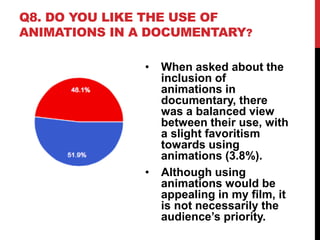
• When asked about the
inclusion of
animations in
documentary, there
was a balanced view
between their use, with
a slight favoritism
towards using
animations (3.8%).
• Although using
animations would be
appealing in my film, it
is not necessarily the
audience’s priority.
Q9. DO YOU ENJOY MONTAGE ELEMENTS
IN A FILM?
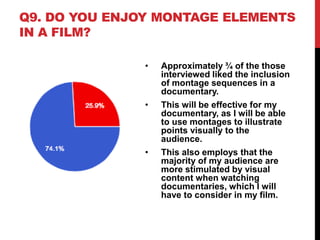
• Approximately ¾ of the those
interviewed liked the inclusion
of montage sequences in a
documentary.
• This will be effective for my
documentary, as I will be able
to use montages to illustrate
points visually to the
audience.
• This also employs that the
majority of my audience are
more stimulated by visual
content when watching
documentaries, which I will
have to consider in my film.
Q10. IN A DOCUMENTARY, WHAT DO YOU
THINK MAKES A GOOD INTERVIEW?
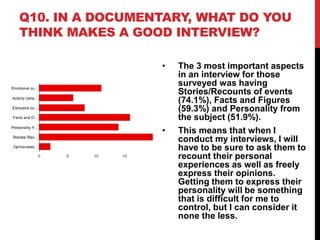
• The 3 most important aspects
in an interview for those
surveyed was having
Stories/Recounts of events
(74.1%), Facts and Figures
(59.3%) and Personality from
the subject (51.9%).
• This means that when I
conduct my interviews, I will
have to be sure to ask them to
recount their personal
experiences as well as freely
express their opinions.
Getting them to express their
personality will be something
that is difficult for me to
control, but I can consider it
none the less.
Q11. WHAT WOULD YOU CONSIDER YOUR
ROLE IN SPORT?
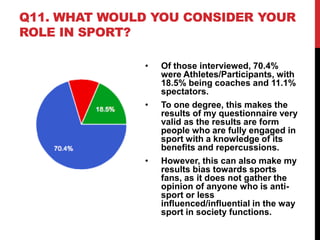
• Of those interviewed, 70.4%
were Athletes/Participants, with
18.5% being coaches and 11.1%
spectators.
• To one degree, this makes the
results of my questionnaire very
valid as the results are form
people who are fully engaged in
sport with a knowledge of its
benefits and repercussions.
• However, this can also make my
results bias towards sports
fans, as it does not gather the
opinion of anyone who is anti-
sport or less
influenced/influential in the way
sport in society functions.
Q12. WHAT SPORTS HAVE YOU BEEN
INVOLVED DURING YOUR LIFE?
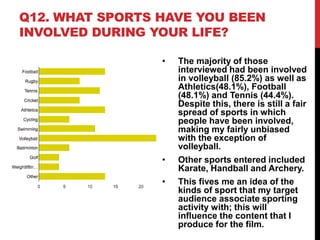
• The majority of those
interviewed had been involved
in volleyball (85.2%) as well as
Athletics(48.1%), Football
(48.1%) and Tennis (44.4%).
Despite this, there is still a fair
spread of sports in which
people have been involved,
making my fairly unbiased
with the exception of
volleyball.
• Other sports entered included
Karate, Handball and Archery.
• This fives me an idea of the
kinds of sport that my target
audience associate sporting
activity with; this will
influence the content that I
produce for the film.
Q13. OUT OF THE FOLLOWING, WHICH DO YOU
THINK IS THE MOST IMPORTANT ISSUE WHEN
ADDRESSING SPORT IN SOCIETY?
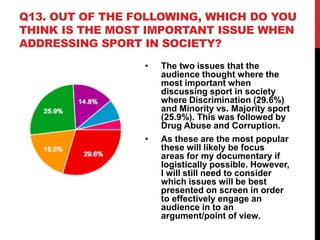
• The two issues that the
audience thought where the
most important when
discussing sport in society
where Discrimination (29.6%)
and Minority vs. Majority sport
(25.9%). This was followed by
Drug Abuse and Corruption.
• As these are the most popular
these will likely be focus
areas for my documentary if
logistically possible. However,
I will still need to consider
which issues will be best
presented on screen in order
to effectively engage an
audience in to an
argument/point of view.
Q14. WHO DO YOU THINK ARE MOST
KNOWLEDGEABLE FIGURES WHEN DISCUSSING
SPORT IN SOCIETY?
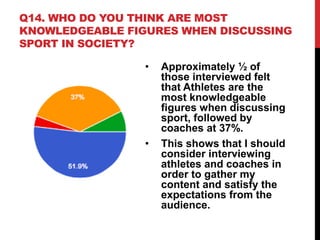
• Approximately ½ of
those interviewed felt
that Athletes are the
most knowledgeable
figures when discussing
sport, followed by
coaches at 37%.
• This shows that I should
consider interviewing
athletes and coaches in
order to gather my
content and satisfy the
expectations from the
audience.
Q15/16. IN YOUR OPINION, IS THE IMPORTANCE
OF SPORT OVERRATED? WHAT IS THE REASON
YOU CARRY THIS VIEW?
• 96.3% of those interviewed felt as if the importance of sport is not overated.
• When asked to support this opinion, responses followed similar themes about
the benefits it brings to society, as well as health and fitness and the
development of individuals. For example:
• “There are so many things that can be explored when a person engages in sport... It can never be
overrated because of it's impact on you directly both from a physical and mental and environment
side that will influence how you will live your life.”
• “It is key to healthy lifestyle and can grow many skills that are key through life.”
• “Sport plays an important role in society along with other pastimes in bringing people together and
generating friendships and understanding between different groups of people.”
• “Sport has incredible benefits for the development and well-being of its individual participants, namely
youth. It has also helped to elevate non-sporting efforts and bring communities together.”
• This has provided me with a baseline idea about people’s predetermined
opinions about sport in society. This provides me with two options; To provide
the audience with evidence that supports these idea, or provide evidence that
counters this idea in order to sway their opinion. This could dictate the mode of
documentary that I create.
• The general opinion is that sport best benefits everyday society by improving
health and fitness and allowing social interactions; I can cover these issues as
well as the issues raised by professional sport in my documentary.
Q17. WHAT DO YOU ENJOY THE MOST
ABOUT SPORT WHEN WATCHING IT ON
TV?
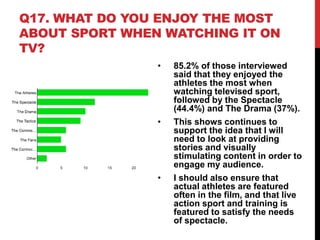
• 85.2% of those interviewed
said that they enjoyed the
athletes the most when
watching televised sport,
followed by the Spectacle
(44.4%) and The Drama (37%).
• This shows continues to
support the idea that I will
need to look at providing
stories and visually
stimulating content in order to
engage my audience.
• I should also ensure that
actual athletes are featured
often in the film, and that live
action sport and training is
featured to satisfy the needs
of spectacle.
Q18. TO WHAT EXTENT DO YOU THINK
BRANDING AND SPONSORSHIP HAS
INFLUENCED SPORT TODAY?
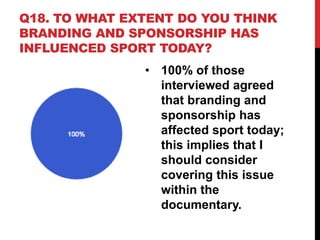
• 100% of those
interviewed agreed
that branding and
sponsorship has
affected sport today;
this implies that I
should consider
covering this issue
within the
documentary.

Questionnaire Analysis-Documentary

  • 1.
  • 2.
    OVERVIEW • To evaluatethe expectations and desires of my target audience, I constructed a questionnaire in order to gather information that I can base the structure/content of my documentary on. • The questionnaire contained 18 questions: 8 questions addressed the structure of the documentary, whilst 8 addressed the sporting content within the film. The remaining 2 established gender and age. • The questionnaire was answered by 27 people, which is a good sized sample for a documentary of this scale. • The questionnaire used mostly closed questions, which had multiple options in order to gain a range of opinions. The questions also contained instruction and help text, to fully clarify and explain aspects of the question in order to record accurate and reliable results. • One question was an open question, in order to gain a broader range of data in the words of the subject.
  • 3.
    Q1/2. ARE YOUMALE OR FEMALE? HOW OLD ARE YOU? • Of the people who answered my questionnaire, 59.3% were female; this could make my results slightly gender bias towards a female opinion, which I may have to consider when evaluating my results. • 44.4% of those questioned were aged between 10-19, whilst 18.5% were aged between 20-29. This means the majority of the information collected in the questionnaire is of a younger generations opinion. This age range is included in my target audience, but I will also have to be mindful of what an older age group would like to see in the documentary.
  • 4.
    Q3.HOW MANY HOURSOF DOCUMENTARY FILM DO YOU TEND TO WATCH IN A WEEK? • Of the 27 people surveyed, 48.1% only watched a maximum of the 1 hour of documentary film a week, whilst 37% watched between 1-3 hours. This implies that the majority of those interviewed are frequent viewers of documentary film, which could influence their expectations of a documentary film. • To manage this, I will need to find a balance between what people expect to see in a sporting documentary and the content that will sway their opinion.
  • 5.
    Q4.WHAT KIND OFDOCUMENTARY FILM DO YOU LIKE TO WATCH IN YOUR SPARE TIME? • As shown in the table, 85.2% of those interviewed said they liked to watch sport documentary; this is good for the validity of my research, as the answers fro questions on sporting context will be from an audience with a through understanding and knowledge about sport. • The second most popular documentary type was nature, followed by travel documentary; this implies that the majority of audiences build up their archetypes of documentary from nature films, are a interested in discovering new information and seeing different aspects of culture and society. I will need to consider this in my documentary.
  • 6.
    Q5. AS AVIEWER, WHAT DO YOU LIKE/EXPECT TO SEE IN A DOCUMENTARY? • The factors that my audience want to see the most in a documentary were Actuality Footage from events (81.5%) and Exciting and Engaging footage (74.1%). This will have bearing on the content that I film for the documentary, such as the Mise-en-Scene, as well as the way I edit the documentary, in order to fully engage the audience. • 44.4% also said they like to have Good Music/Soundtracks in a documentary, which I will also consider.
  • 7.
    Q6. IN DOCUMENTARYDO YOU LIKE TO BE ABLE TO SEE A NARRATOR/PRESENTER INVOLVED IN THE FILM? • 70.4% of those interviewed said that they like to be able to see a narrator involved in the film, implying they are fans of both the Performative and Participatory modes, as well as Expository. This means I may consider using a narrator in the film in order to construct the narrative within the documentary. • However, as the majority of those interviewed are female, this may not be the case for a male audience, which I will also have to consider when making any decisions.
  • 8.
    Q7.IN YOUR VIEW,WHAT IS MORE IMPORTANT: THE TRUTH OR ENTERTAINMENT? • For my audience, being presented with the truth in a documentary is more important than being entertained; this is probably because an audience watches a documentary to find out new things and broaden their intellect. If they wanted entertainment then they chose to watch a standard film/motion picture. • For my documentary, I will he to ensure I prioritise truthful and factual content over entertainment factors.
  • 9.
    Q8. DO YOULIKE THE USE OF ANIMATIONS IN A DOCUMENTARY? • When asked about the inclusion of animations in documentary, there was a balanced view between their use, with a slight favoritism towards using animations (3.8%). • Although using animations would be appealing in my film, it is not necessarily the audience’s priority.
  • 10.
    Q9. DO YOUENJOY MONTAGE ELEMENTS IN A FILM? • Approximately ¾ of the those interviewed liked the inclusion of montage sequences in a documentary. • This will be effective for my documentary, as I will be able to use montages to illustrate points visually to the audience. • This also employs that the majority of my audience are more stimulated by visual content when watching documentaries, which I will have to consider in my film.
  • 11.
    Q10. IN ADOCUMENTARY, WHAT DO YOU THINK MAKES A GOOD INTERVIEW? • The 3 most important aspects in an interview for those surveyed was having Stories/Recounts of events (74.1%), Facts and Figures (59.3%) and Personality from the subject (51.9%). • This means that when I conduct my interviews, I will have to be sure to ask them to recount their personal experiences as well as freely express their opinions. Getting them to express their personality will be something that is difficult for me to control, but I can consider it none the less.
  • 12.
    Q11. WHAT WOULDYOU CONSIDER YOUR ROLE IN SPORT? • Of those interviewed, 70.4% were Athletes/Participants, with 18.5% being coaches and 11.1% spectators. • To one degree, this makes the results of my questionnaire very valid as the results are form people who are fully engaged in sport with a knowledge of its benefits and repercussions. • However, this can also make my results bias towards sports fans, as it does not gather the opinion of anyone who is anti- sport or less influenced/influential in the way sport in society functions.
  • 13.
    Q12. WHAT SPORTSHAVE YOU BEEN INVOLVED DURING YOUR LIFE? • The majority of those interviewed had been involved in volleyball (85.2%) as well as Athletics(48.1%), Football (48.1%) and Tennis (44.4%). Despite this, there is still a fair spread of sports in which people have been involved, making my fairly unbiased with the exception of volleyball. • Other sports entered included Karate, Handball and Archery. • This fives me an idea of the kinds of sport that my target audience associate sporting activity with; this will influence the content that I produce for the film.
  • 14.
    Q13. OUT OFTHE FOLLOWING, WHICH DO YOU THINK IS THE MOST IMPORTANT ISSUE WHEN ADDRESSING SPORT IN SOCIETY? • The two issues that the audience thought where the most important when discussing sport in society where Discrimination (29.6%) and Minority vs. Majority sport (25.9%). This was followed by Drug Abuse and Corruption. • As these are the most popular these will likely be focus areas for my documentary if logistically possible. However, I will still need to consider which issues will be best presented on screen in order to effectively engage an audience in to an argument/point of view.
  • 15.
    Q14. WHO DOYOU THINK ARE MOST KNOWLEDGEABLE FIGURES WHEN DISCUSSING SPORT IN SOCIETY? • Approximately ½ of those interviewed felt that Athletes are the most knowledgeable figures when discussing sport, followed by coaches at 37%. • This shows that I should consider interviewing athletes and coaches in order to gather my content and satisfy the expectations from the audience.
  • 16.
    Q15/16. IN YOUROPINION, IS THE IMPORTANCE OF SPORT OVERRATED? WHAT IS THE REASON YOU CARRY THIS VIEW? • 96.3% of those interviewed felt as if the importance of sport is not overated. • When asked to support this opinion, responses followed similar themes about the benefits it brings to society, as well as health and fitness and the development of individuals. For example: • “There are so many things that can be explored when a person engages in sport... It can never be overrated because of it's impact on you directly both from a physical and mental and environment side that will influence how you will live your life.” • “It is key to healthy lifestyle and can grow many skills that are key through life.” • “Sport plays an important role in society along with other pastimes in bringing people together and generating friendships and understanding between different groups of people.” • “Sport has incredible benefits for the development and well-being of its individual participants, namely youth. It has also helped to elevate non-sporting efforts and bring communities together.” • This has provided me with a baseline idea about people’s predetermined opinions about sport in society. This provides me with two options; To provide the audience with evidence that supports these idea, or provide evidence that counters this idea in order to sway their opinion. This could dictate the mode of documentary that I create. • The general opinion is that sport best benefits everyday society by improving health and fitness and allowing social interactions; I can cover these issues as well as the issues raised by professional sport in my documentary.
  • 17.
    Q17. WHAT DOYOU ENJOY THE MOST ABOUT SPORT WHEN WATCHING IT ON TV? • 85.2% of those interviewed said that they enjoyed the athletes the most when watching televised sport, followed by the Spectacle (44.4%) and The Drama (37%). • This shows continues to support the idea that I will need to look at providing stories and visually stimulating content in order to engage my audience. • I should also ensure that actual athletes are featured often in the film, and that live action sport and training is featured to satisfy the needs of spectacle.
  • 18.
    Q18. TO WHATEXTENT DO YOU THINK BRANDING AND SPONSORSHIP HAS INFLUENCED SPORT TODAY? • 100% of those interviewed agreed that branding and sponsorship has affected sport today; this implies that I should consider covering this issue within the documentary.