What is Collection Development?
Originally created by
Dr. Judi Repman
Revised by
Dr. Kathi Vanderbilt
1.15.12
Edited and Narrated by
Dr. Stephanie A. Jones
FRIT 7332 The School LibraryLiteracy Environment
1
 Information and Knowledge
 Candidates support flexible, open access for
library services. Candidates demonstrate their
ability to develop solutions for addressing
physical, social and intellectual barriers to
equitable access to resources and services.
Candidates facilitate access to information in print,
non-print, and digital formats. Candidates model
and communicate the legal and ethical codes of
the profession.
 2010 ALA/AASL Standards for Initial Preparation of School Librarians,
Standard 3, Program Management and Administration: Element 3.2.
2
Standard requirements
3
Standard requirements
Program Management and Administration
Candidates evaluate and select print, non-
print, and digital resources using professional
selection tools and evaluation criteria to
develop and manage a quality collection
designed to meet the diverse curricular,
personal, and professional needs of students,
teachers, and administrators.
 2010 ALA/AASL Standards for Initial Preparation of School
Librarians, Standard 5, Program Management and Administration:
Element 5.1, p. 17.
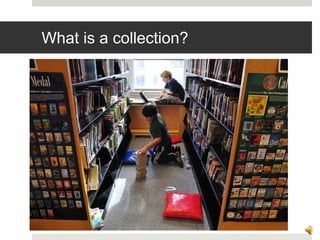
What is a collection?
4
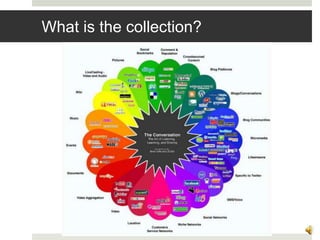
What is the collection?
5
Learner Centered
Collection Development
 Media specialist becomes the guide, not the expert
 Learner characteristics and needs are primary
 Resources are central to teaching and learning
 Students, teachers, and others create knowledge
6
Collection Development as a
Process
 Policy Development
 (Scales, Appendix B)
 ALA Workbook for Selection Policy Writing
 Collection evaluation
 Collection mapping
 Collection analysis
 Weeding
 CREW – continuous review evaluation weeding
 De-selection criteria
 Identifying resources
 Select resource in accordance with selection policy
 Balance new selections with needs of learners & community
7
Components of a
Selection Policy
 Objectives - what is the district or school trying to accomplish?
 Overarching goal
 Usually a broad statement and may be tied to school improvement
plan or goals, for example developing critical thinking and decision
making
 Emphasis on development of informed, productive citizens in a
democratic society
 Specific goals
8
Components of a
Selection Policy
 Responsibilities for selection
 Ultimate authority is school board, delegated to building level
personnel
 Mention of role of media committee in selection
 Committee should have an advisory role
 Mention of district personnel & their responsibilities
9
Components of a
Selection Policy
 Selection Criteria
 Aligned with school’s goal and/or mission
 Supports the curriculum
 Use of reviews or other respected evaluative tools
 Appropriate for learners
 Age
 Development level
 Special needs
10
Components of a
Selection Policy
 Typical Selection Criteria
 Accuracy
 Free of bias
 Represent diverse points of view and different cultures
 Currency and durability of information
 Format
 Value/Quality
 Accuracy
 Free of bias
 Represent diverse points of view and different cultures
 Currency and durability of information
 Format
 Value/Quality
11
Components of a
Selection Policy
 Selecting Controversial Materials
 Refer to statements from the American Library Association (ALA)
regarding the selection of controversial materials
ALA Policy Suggestions
 Include a statement on intellectual freedom
 Reconsideration
 Specific procedures for handling challenged materials
12
Selection Policy
Other Considerations
 Gifts, and/or free materials
 Policy should state that same criteria apply; may address use of
commercial materials
 Textbooks and required class materials
 Computer software
 Electronic resources
 Cooperative agreements / networking
 Internet filtering (or selection of items for media center web page)
13
References
 Bishop, K. (2007). The collection program in schools. Westport,
CT: Libraries Unlimited.
 Downs, E. (2010). Media specialist’s policy & procedure writer.
New York: Neal-Schuman.
 Martin, B. S., and Zannier, M. (2009). Fundamentals of school
library media management. New York: Neal-Schuman
14
Image Sources
 Library photo on slide 2
 http://www.flickr.com/photos/specialkrb/4248775088/sizes/z/in/phot
ostream/
 Graphic organizer on slide 3
 http://www.slideshare.net/edvibesproducer/visual-definitions-of-
web-20-1446578
15

Introduction to Collection Development

  • 1.
    What is CollectionDevelopment? Originally created by Dr. Judi Repman Revised by Dr. Kathi Vanderbilt 1.15.12 Edited and Narrated by Dr. Stephanie A. Jones FRIT 7332 The School LibraryLiteracy Environment 1
  • 2.
     Information andKnowledge  Candidates support flexible, open access for library services. Candidates demonstrate their ability to develop solutions for addressing physical, social and intellectual barriers to equitable access to resources and services. Candidates facilitate access to information in print, non-print, and digital formats. Candidates model and communicate the legal and ethical codes of the profession.  2010 ALA/AASL Standards for Initial Preparation of School Librarians, Standard 3, Program Management and Administration: Element 3.2. 2 Standard requirements
  • 3.
    3 Standard requirements Program Managementand Administration Candidates evaluate and select print, non- print, and digital resources using professional selection tools and evaluation criteria to develop and manage a quality collection designed to meet the diverse curricular, personal, and professional needs of students, teachers, and administrators.  2010 ALA/AASL Standards for Initial Preparation of School Librarians, Standard 5, Program Management and Administration: Element 5.1, p. 17.
  • 4.
    What is acollection? 4
  • 5.
    What is thecollection? 5
  • 6.
    Learner Centered Collection Development Media specialist becomes the guide, not the expert  Learner characteristics and needs are primary  Resources are central to teaching and learning  Students, teachers, and others create knowledge 6
  • 7.
    Collection Development asa Process  Policy Development  (Scales, Appendix B)  ALA Workbook for Selection Policy Writing  Collection evaluation  Collection mapping  Collection analysis  Weeding  CREW – continuous review evaluation weeding  De-selection criteria  Identifying resources  Select resource in accordance with selection policy  Balance new selections with needs of learners & community 7
  • 8.
    Components of a SelectionPolicy  Objectives - what is the district or school trying to accomplish?  Overarching goal  Usually a broad statement and may be tied to school improvement plan or goals, for example developing critical thinking and decision making  Emphasis on development of informed, productive citizens in a democratic society  Specific goals 8
  • 9.
    Components of a SelectionPolicy  Responsibilities for selection  Ultimate authority is school board, delegated to building level personnel  Mention of role of media committee in selection  Committee should have an advisory role  Mention of district personnel & their responsibilities 9
  • 10.
    Components of a SelectionPolicy  Selection Criteria  Aligned with school’s goal and/or mission  Supports the curriculum  Use of reviews or other respected evaluative tools  Appropriate for learners  Age  Development level  Special needs 10
  • 11.
    Components of a SelectionPolicy  Typical Selection Criteria  Accuracy  Free of bias  Represent diverse points of view and different cultures  Currency and durability of information  Format  Value/Quality  Accuracy  Free of bias  Represent diverse points of view and different cultures  Currency and durability of information  Format  Value/Quality 11
  • 12.
    Components of a SelectionPolicy  Selecting Controversial Materials  Refer to statements from the American Library Association (ALA) regarding the selection of controversial materials ALA Policy Suggestions  Include a statement on intellectual freedom  Reconsideration  Specific procedures for handling challenged materials 12
  • 13.
    Selection Policy Other Considerations Gifts, and/or free materials  Policy should state that same criteria apply; may address use of commercial materials  Textbooks and required class materials  Computer software  Electronic resources  Cooperative agreements / networking  Internet filtering (or selection of items for media center web page) 13
  • 14.
    References  Bishop, K.(2007). The collection program in schools. Westport, CT: Libraries Unlimited.  Downs, E. (2010). Media specialist’s policy & procedure writer. New York: Neal-Schuman.  Martin, B. S., and Zannier, M. (2009). Fundamentals of school library media management. New York: Neal-Schuman 14
  • 15.
    Image Sources  Libraryphoto on slide 2  http://www.flickr.com/photos/specialkrb/4248775088/sizes/z/in/phot ostream/  Graphic organizer on slide 3  http://www.slideshare.net/edvibesproducer/visual-definitions-of- web-20-1446578 15

Editor's Notes

  • #3 As information specialist, the school library media specialist (SLMS) provides leadership and expertise in the selection, acquisition, evaluation, and organization of information resources and technologies in all formats, as well as expertise in the ethical use of information. As program administrator, the school library media specialist (SLMS) works collaboratively with members of the learning community to define the policies of the library media program and to guide and direct all activities related to it.
  • #5 A collection is a set of resources brought together for a particular audience or to serve a specific function. Local collection. These are materials that are physically located in the library media center. In addition to traditional items, materials may include portable devices such as Leapfrogs learning games and electronic keyboards. The following items are often found in a local collection: books magazines newspapers visual resources realia maps and globes models kits and games portable electronics (i.e., learning games, electronic keyboards) DVDs CDs Ebooks and ereaders electronic databases computer software equipment
  • #6 Virtual collection. Today your collection isn't restricted to items that you own. In other words, your collection may contain Internet resources, links to electronic subscription services, and connections with public libraries. Items from other buildings in your district, classroom libraries, and district class sets may be accessible through your network.
  • #8 Collection development (also known as collection management, materials management, or information resources management) involves the identification, selection, acquisition, maintenance, and evaluation of library resources (e.g., print materials, audiovisual materials, and electronic resources) which meets the expressed current and potential needs of the people it is intended to serve for a community of users Collection development is a cycle that involves a number of phases that are repeated over time including establishing an area of need through some formal or information community and collection analysis, examining the existing collection for materials, developing a selection policy containing specific criteria, and recommending a set of materials that would address the need.