Deselection:
        To Weed or Not to Weed?
• Library collections must reflect changes in the
  community, sciences, the world and in the
  library/school/divisional goals
• Essential and difficult part of collection
  development
• Periodic or continual evaluation of resources
• Creates space for new resources
• Ensures that
  resources are
  useful and accessible
Obstacles to Weeding
•    Procrastination
•    Reluctance to admit selection mistakes
•    Staff/parental resistance
•    Time consuming
•    Fear


(http://www.tsl.state.tx.us/ld/consulting/cemanager/crew.ppt)
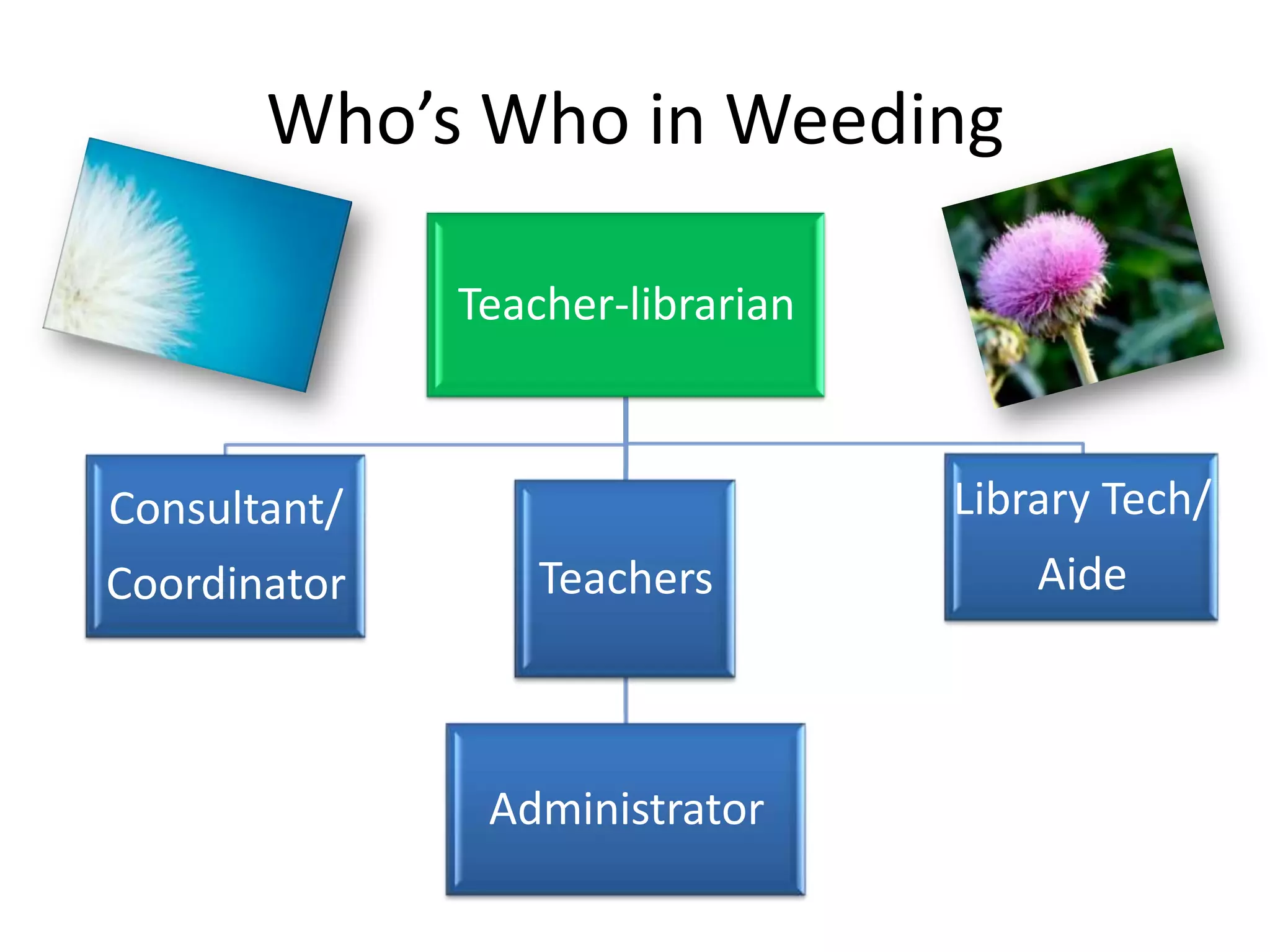
Who’s Who in Weeding

              Teacher-librarian


Consultant/                       Library Tech/
Coordinator       Teachers            Aide


               Administrator
Why Weed?
•   Sexist, racist, outdated and inaccurate materials
•   More appealing collection
•   Patron accessibility
•   More reliable information
•   Save space
•   Enhance library reputation
•   Check for needed repairs
•   Identify strengths & weaknesses
•   Present a better case for a budget increase
(http://www.iema-ia.org/IEMA209.html) (http://www.doug-johnson.com/dougwri/weed.html
When to Weed
According to Information Power
• Ongoing process
• Not recommended for brand new TLs
• Part of the inventory process
• Implemented as part of a three-year cycle
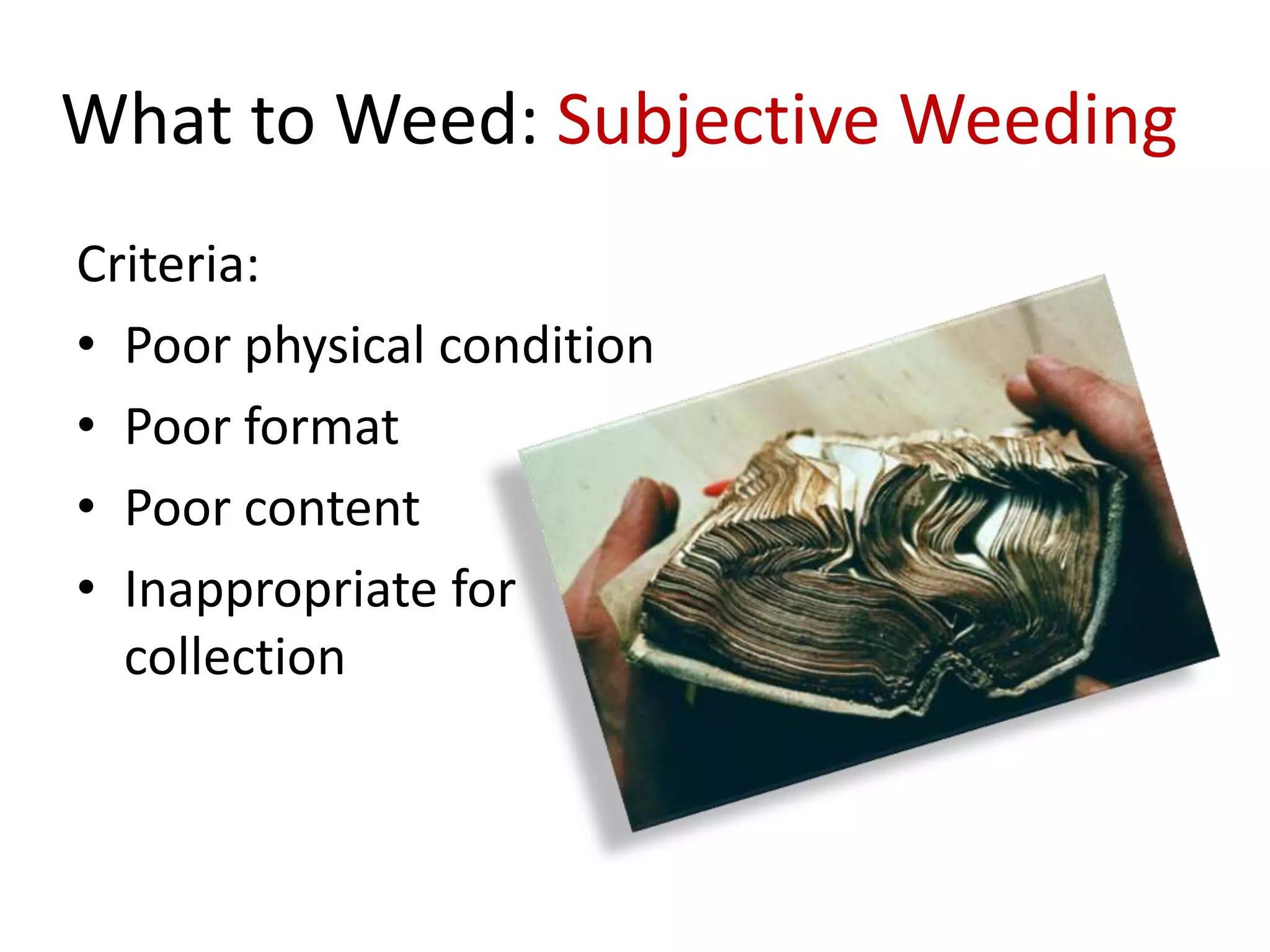
What to Weed: Subjective Weeding
Criteria:
• Poor physical condition
• Poor format
• Poor content
• Inappropriate for
  collection
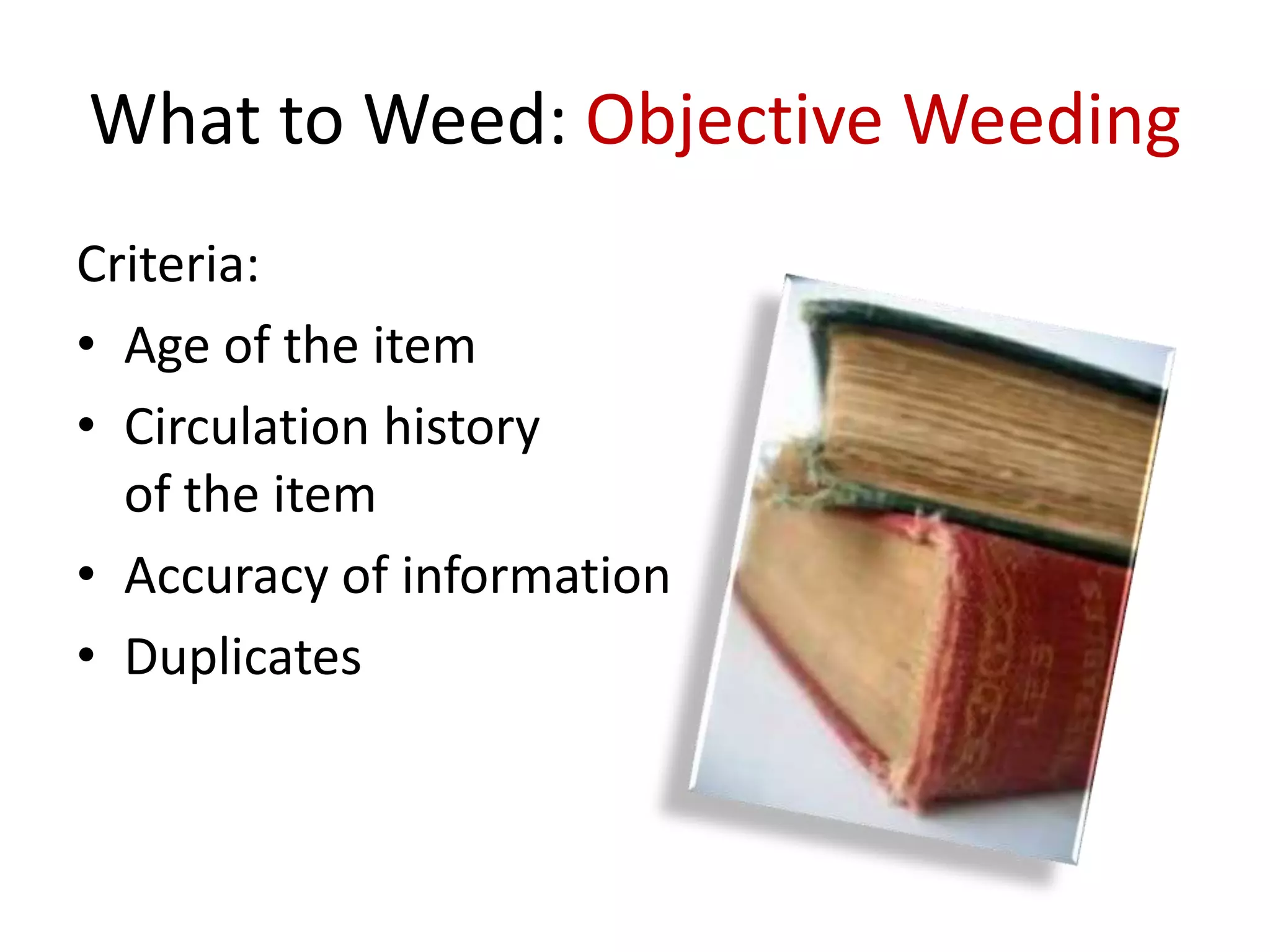
What to Weed: Objective Weeding
Criteria:
• Age of the item
• Circulation history
  of the item
• Accuracy of information
• Duplicates
MUSTY
Acronym for guidance in weeding books: MUSTY
  M -misleading (factually inaccurate)
  U -ugly (beyond repair)
  S -superseded (newer edition or better title)
  T -trivial (no merit)
  Y -your collection has no use
     for it (irrelevant)
Weeding Websites
Helpful websites in determining what to weed:
• The CREW Guidelines for Weeding Your
  Collection
• PTSD Cycle of Service
What Not to Weed
• Local history / authors
• Unusual illustrations/well known
  artists
• Special merit/award books
• Annuals/yearbooks
• Items that may circulate under
  different classification
• Reference materials not
  outdated by other materials
• Out of print but still useful
De-processing
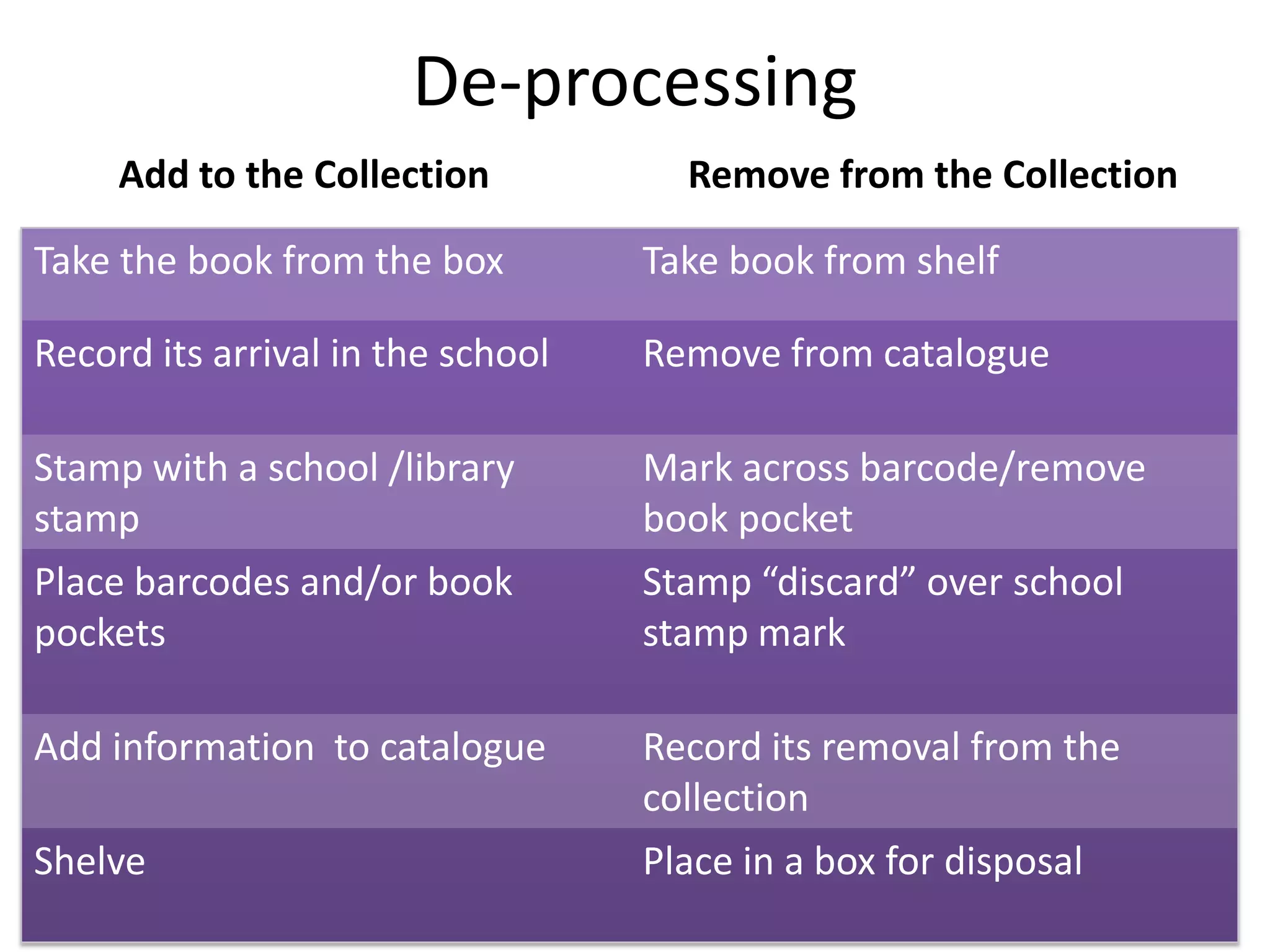
     Add to the Collection           Remove from the Collection

Take the book from the box         Take book from shelf

Record its arrival in the school   Remove from catalogue

Stamp with a school /library       Mark across barcode/remove
stamp                              book pocket
Place barcodes and/or book         Stamp “discard” over school
pockets                            stamp mark

Add information to catalogue       Record its removal from the
                                   collection
Shelve                             Place in a box for disposal
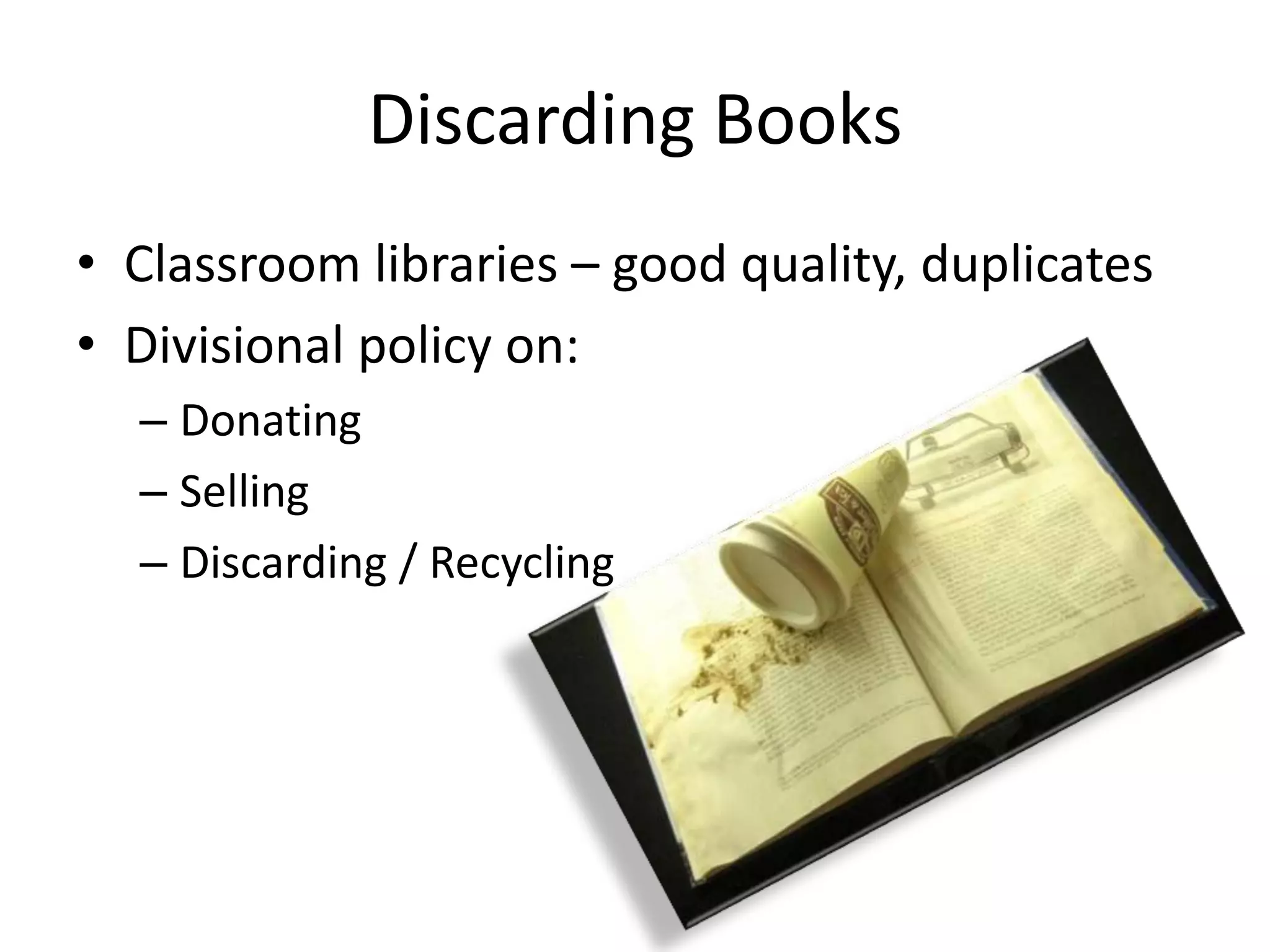
Discarding Books
• Classroom libraries – good quality, duplicates
• Divisional policy on:
  – Donating
  – Selling
  – Discarding / Recycling
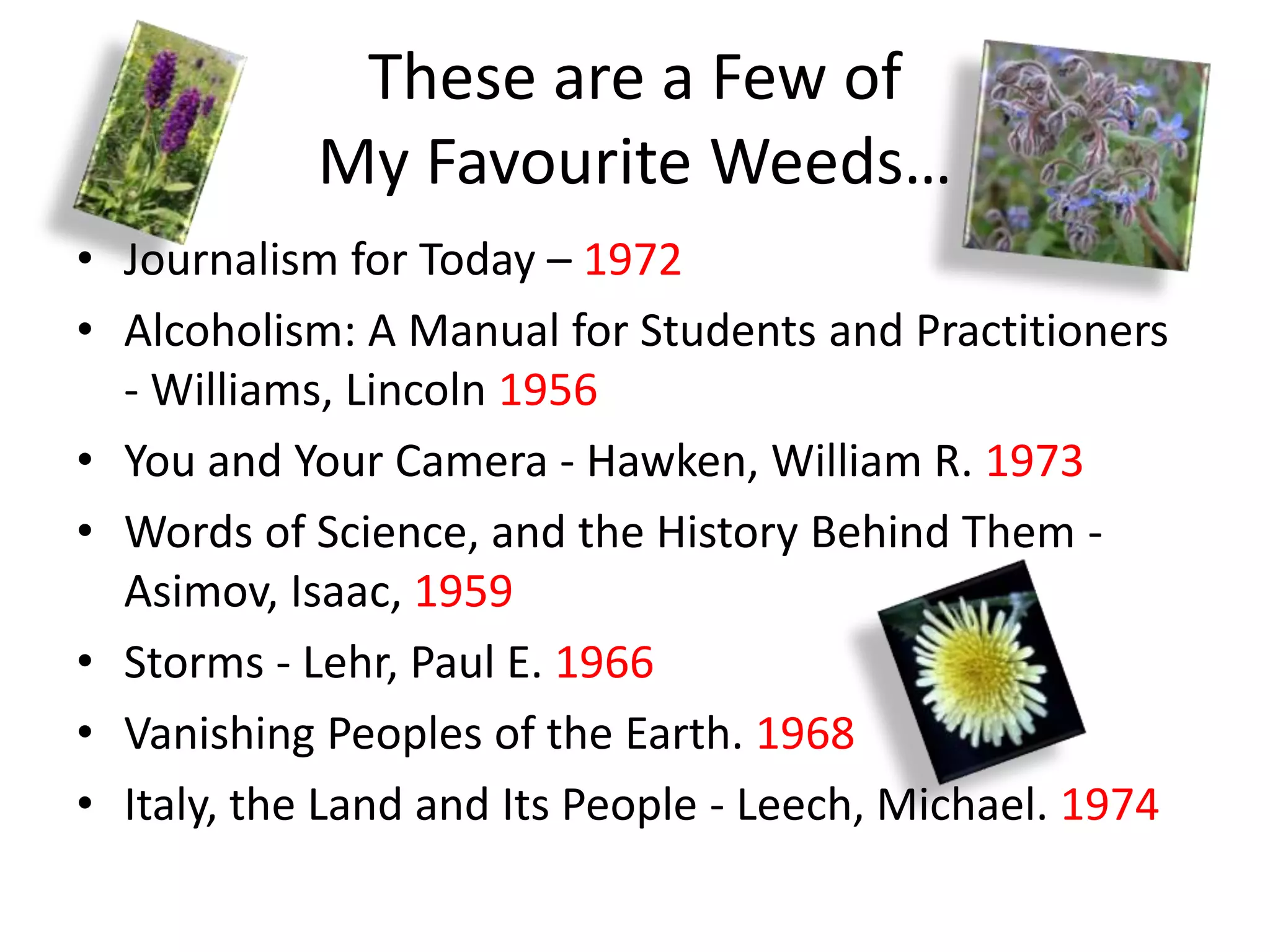
These are a Few of
            My Favourite Weeds…
• Journalism for Today – 1972
• Alcoholism: A Manual for Students and Practitioners
  - Williams, Lincoln 1956
• You and Your Camera - Hawken, William R. 1973
• Words of Science, and the History Behind Them -
  Asimov, Isaac, 1959
• Storms - Lehr, Paul E. 1966
• Vanishing Peoples of the Earth. 1968
• Italy, the Land and Its People - Leech, Michael. 1974

Weeding Not Just for Gardens

  • 3.
    Deselection: To Weed or Not to Weed? • Library collections must reflect changes in the community, sciences, the world and in the library/school/divisional goals • Essential and difficult part of collection development • Periodic or continual evaluation of resources • Creates space for new resources • Ensures that resources are useful and accessible
  • 4.
    Obstacles to Weeding • Procrastination • Reluctance to admit selection mistakes • Staff/parental resistance • Time consuming • Fear (http://www.tsl.state.tx.us/ld/consulting/cemanager/crew.ppt)
  • 5.
    Who’s Who inWeeding Teacher-librarian Consultant/ Library Tech/ Coordinator Teachers Aide Administrator
  • 6.
    Why Weed? • Sexist, racist, outdated and inaccurate materials • More appealing collection • Patron accessibility • More reliable information • Save space • Enhance library reputation • Check for needed repairs • Identify strengths & weaknesses • Present a better case for a budget increase (http://www.iema-ia.org/IEMA209.html) (http://www.doug-johnson.com/dougwri/weed.html
  • 7.
    When to Weed Accordingto Information Power • Ongoing process • Not recommended for brand new TLs • Part of the inventory process • Implemented as part of a three-year cycle
  • 8.
    What to Weed:Subjective Weeding Criteria: • Poor physical condition • Poor format • Poor content • Inappropriate for collection
  • 9.
    What to Weed:Objective Weeding Criteria: • Age of the item • Circulation history of the item • Accuracy of information • Duplicates
  • 10.
    MUSTY Acronym for guidancein weeding books: MUSTY M -misleading (factually inaccurate) U -ugly (beyond repair) S -superseded (newer edition or better title) T -trivial (no merit) Y -your collection has no use for it (irrelevant)
  • 11.
    Weeding Websites Helpful websitesin determining what to weed: • The CREW Guidelines for Weeding Your Collection • PTSD Cycle of Service
  • 12.
    What Not toWeed • Local history / authors • Unusual illustrations/well known artists • Special merit/award books • Annuals/yearbooks • Items that may circulate under different classification • Reference materials not outdated by other materials • Out of print but still useful
  • 13.
    De-processing Add to the Collection Remove from the Collection Take the book from the box Take book from shelf Record its arrival in the school Remove from catalogue Stamp with a school /library Mark across barcode/remove stamp book pocket Place barcodes and/or book Stamp “discard” over school pockets stamp mark Add information to catalogue Record its removal from the collection Shelve Place in a box for disposal
  • 14.
    Discarding Books • Classroomlibraries – good quality, duplicates • Divisional policy on: – Donating – Selling – Discarding / Recycling
  • 15.
    These are aFew of My Favourite Weeds… • Journalism for Today – 1972 • Alcoholism: A Manual for Students and Practitioners - Williams, Lincoln 1956 • You and Your Camera - Hawken, William R. 1973 • Words of Science, and the History Behind Them - Asimov, Isaac, 1959 • Storms - Lehr, Paul E. 1966 • Vanishing Peoples of the Earth. 1968 • Italy, the Land and Its People - Leech, Michael. 1974

Editor's Notes

  • #4 1. Weeding (also known as deselection) is an essential, though difficult, element of collection developmentEvery library’s print collection is limited by the space available to house it, and collections should change over time to reflect changes in the community, sciences, and world and in the library’s goalsWeeding is a periodic or continual evaluation of resources intended to remove items that are no longer useful from the collection
  • #8 time should be spent learning the school’s curriculum so that useful books are not discarded – seek help from teachers, consultant
  • #9 Subjective weeding- the librarian knows what is in the collection, the needs of the patrons (curriculum and interests), and the uses of the materials
  • #10 Objective Weeding - the librarian follows specific guidelines for weeding.
  • #12 Continuous Review, Evaluation and Weeding
  • #15 Be discrete!Typically, when materials are weeded to maintain a healthy library collection, the materials are not usually worth keeping anywhere in the school. Most weeded materials should be destroyed. Sometimes they are recycled or sold. In any of these instances, you should act discreetly. Your weeding may be perceived as wasteful by the public so be prepared to defend your decisions.Avoid problems by Sending information home first