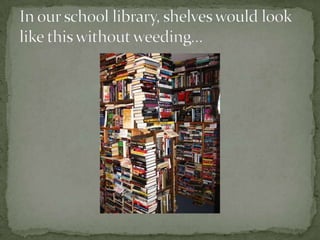
Weeding the Groeschel Elementary School

             By: Alicia Groeschel
“Shelves need to look pleasant and inviting
to the patrons. Patrons need to believe
that they will find what they are looking
for on the shelves. They do not want to
have to search for what they want.”
Weeding allows librarians:
 To evaluate their collection , to see what
  they truly have .
 To eliminate irrelevant information and
  copies of materials that are falling apart.
 To see whether the collection has all of the
  titles it needs to fulfill the needs of the
  patrons.
Milwaukee Public Libraries use a 5-year No
Circulation List. This gives libraries a
starting point. The list is distributed twice
a year and librarians must examine each of
these titles to see if they are worth
keeping.
“Some materials are easier than others to
weed. Diets and exercise materials go
through fads. It’s easy to discard the
outdated materials. However, Yoga has and
always will stay the same.”
“We are not throwing away information.
We are just recycling the paper. Through
weeding, we are giving way for the most
current thought and information.”
Create a Collection Development Policy that allows for
systematic review of collections. The policy should
state a list of criteria with which the library staff can
use as a guide to weed the collection from.
CREW:
Continuous
Review, Evaluation, and Weeding
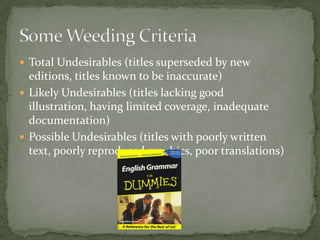
 Total Undesirables (titles superseded by new
  editions, titles known to be inaccurate)
 Likely Undesirables (titles lacking good
  illustration, having limited coverage, inadequate
  documentation)
 Possible Undesirables (titles with poorly written
  text, poorly reproduced graphics, poor translations)
 Duplicates;
 Unsolicited and unwanted gifts;
 Obsolete books, especially science;
 Superseded editions;
 Books that are infested, dirty, shabby, worn
  out, juvenile;
 Books with small print, brittle paper, and missing
  pages;
 Unused, unneeded volumes of sets; and
 Periodicals with no indexes
 Lack of time;
 Procrastination;
 Fear of making a mistake;
 Fear of adverse or embarrassing publicity; and
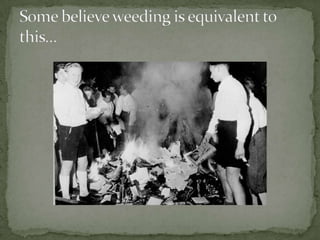
 Fear of being called a “book burner.”
 To save space;
 To improve access;
 To save money; and
 To make room for new materials
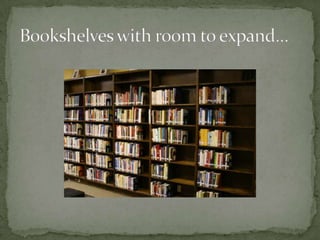
 Simple, easy to use shelves;
 The most current and up-to-date information;
 Well-kept and/or newer copies of books;


      All make for happy, satisfied patrons!
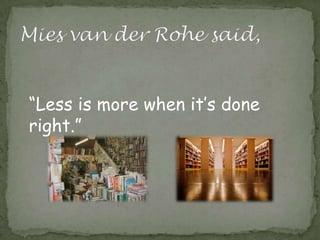
“Less is more when it’s done
right.”

Weeding the Groeschel Elementary School Library

  • 1.
    Weeding the GroeschelElementary School By: Alicia Groeschel
  • 5.
    “Shelves need tolook pleasant and inviting to the patrons. Patrons need to believe that they will find what they are looking for on the shelves. They do not want to have to search for what they want.”
  • 6.
    Weeding allows librarians: To evaluate their collection , to see what they truly have .  To eliminate irrelevant information and copies of materials that are falling apart.  To see whether the collection has all of the titles it needs to fulfill the needs of the patrons.
  • 7.
    Milwaukee Public Librariesuse a 5-year No Circulation List. This gives libraries a starting point. The list is distributed twice a year and librarians must examine each of these titles to see if they are worth keeping.
  • 8.
    “Some materials areeasier than others to weed. Diets and exercise materials go through fads. It’s easy to discard the outdated materials. However, Yoga has and always will stay the same.”
  • 9.
    “We are notthrowing away information. We are just recycling the paper. Through weeding, we are giving way for the most current thought and information.”
  • 12.
    Create a CollectionDevelopment Policy that allows for systematic review of collections. The policy should state a list of criteria with which the library staff can use as a guide to weed the collection from.
  • 13.
  • 14.
     Total Undesirables(titles superseded by new editions, titles known to be inaccurate)  Likely Undesirables (titles lacking good illustration, having limited coverage, inadequate documentation)  Possible Undesirables (titles with poorly written text, poorly reproduced graphics, poor translations)
  • 15.
     Duplicates;  Unsolicitedand unwanted gifts;  Obsolete books, especially science;  Superseded editions;  Books that are infested, dirty, shabby, worn out, juvenile;  Books with small print, brittle paper, and missing pages;  Unused, unneeded volumes of sets; and  Periodicals with no indexes
  • 16.
     Lack oftime;  Procrastination;  Fear of making a mistake;  Fear of adverse or embarrassing publicity; and  Fear of being called a “book burner.”
  • 17.
     To savespace;  To improve access;  To save money; and  To make room for new materials
  • 18.
     Simple, easyto use shelves;  The most current and up-to-date information;  Well-kept and/or newer copies of books; All make for happy, satisfied patrons!
  • 19.
    “Less is morewhen it’s done right.”