 Also known as deselection or selection-in-reverse
 The periodic or continual evaluation of resources
intended to remove items that are no longer useful
from the collection.
 It is an essential, though difficult, element of
collection development that ensures that the
collection on the shelves is useful and accessible.
 Weeding helps the library provide customers with an
inviting space full of interesting, relevant and
intriguing materials.
 For the librarian, weeding has additional advantages.
It helps you to find gaps in your collection so that you
can make new purchases with confidence, and it
creates space for those materials.
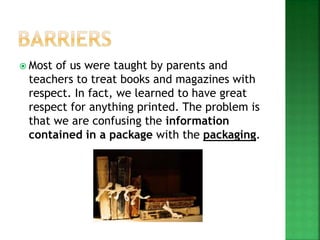
 Most of us were taught by parents and
teachers to treat books and magazines with
respect. In fact, we learned to have great
respect for anything printed. The problem is
that we are confusing the information
contained in a package with the packaging.
 I bought this book.
 It’s an award-winning title!
 Someone might need it—someday.
 The mayor donated it.
 I loved this book!
 People should read the classics.
 We need to have (number) books in the library.
 I have no budget to buy new books.
 If someone in the community sees me throwing
away books…
 Weeding is on my list…but not at the top.
 Save Space
 Shelves should never be more than 85% full (75%
is better)
 Shelf space costs money
 It costs to purchase more shelving
 Employees spend time shifting
 Patrons get frustrated
 Save Time
 Busy patrons don’t want to sift through old,
inaccurate materials
 Reader’s Advisory is easier
 Appeal
 Patrons are attracted to new material
 Circulation will increase after weeding
 Enhance your library’s reputation
 Reliability
 Currency
 Trust that you have “good” material
 Constant Feedback
 Identify holes in the collection
 Prepare a wish list
 Familiarity with what is on the shelf
 Physical Condition
 Copyright Date
 Author
 Circulation Stats
 Relevance
 Format
 Illustrations
 Visual Appeal
 Publisher
 Duplicates
 Expense to
Replace
 Similar Resources
 Reading Level
 Current Interest
 School Curricula
CREW Method of Weeding
Continuous
Review
Evaluation
Weeding
https://www.tsl.texas.gov/ld/pubs/crew/index.html
 Weed a little bit every day.
 Look for shabby and outdated material when
checking items in.
 Identify unused duplicates while shelving.
 Check “shelf-sitters.”
 Unattractive covers
 One-book wonder
 Simplified or abridged classics
 Cataloged incorrectly
 Check Dewey number
 Check Subject headings
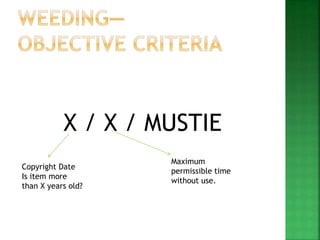
X / X / MUSTIE
Copyright Date
Is item more
than X years old?
Maximum
permissible time
without use.
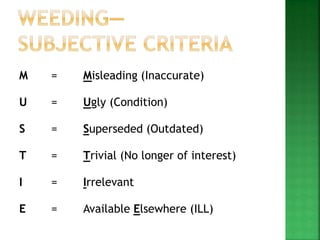
M = Misleading (Inaccurate)
U = Ugly (Condition)
S = Superseded (Outdated)
T = Trivial (No longer of interest)
I = Irrelevant
E = Available Elsewhere (ILL)
 Gather usage statistics.
 Inventory report and/or Circulation statistics.
 Gather weeding tools.
 Slips, shelf marker, book truck, pencil, CREW manual.
 Examine the section item by item.
 Check standard indexes. (Available from NLC)
 Fiction Core Collection
 Children’s Core Collection
 Public Library Core Collection - Nonfiction
 Treat books removed according to slips.
 Bindery, Mending, Discard, Replace, Recycle.
 Display low-circulating, high-quality items.
 Place your next weeding project on your
calendar.
A rule of thumb held by many library
professionals is that about 5% of the collection
be weeded every year. This allows for turnover
of the collection every twenty years. While this
doesn’t literally mean that no book that exists
in the collection in the year 2000 will still be
there in 2020, even classic literature and
perennially useful materials will generally
become worn and tattered after twenty years
of use and need to be replaced with a fresh
copy.
Questions to ask yourself when weeding.
 Would I be embarrassed if the library didn’t own
it?
 Does the book fit the needs of my community?
 Does it have local interest?
 Is the author still living and writing?
 If I put this on display, would it go out?
 Local History
 Unless the item is beyond repair
 Works by Local Authors
 Especially during the author’s lifetime
 Works with Local Settings
 Unless they have not circulated in 5 years
 Genealogy Material
 Reference Works Augmented by Later
Editions
 Quotation Books
 Unless they are in poor condition
 Sell them
 Friends Book Sale
 Annual Sale
 Ongoing Rack Sale
 Used Book Dealer
 Better World Books
 Thrift Books
 Donate them
 Hospital
 Nursing Home
 Correctional Facility
 Charity
 Recycle them
 Paperback books can be put in recycling bin
 Hardback books must have covers cut off before
the pages can be recycled
 Destroy them
 Should be reserved for materials in worst
physical condition
 Unavoidable
 Should be done discreetly
 Wasting tax dollars
 Throwing “good” books in the trash
 “Book burning”
 Bad PR
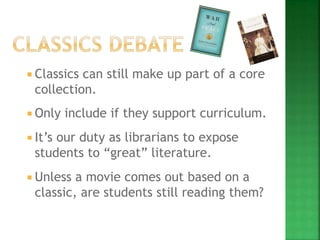
 Classics can still make up part of a core
collection.
 Only include if they support curriculum.
 It’s our duty as librarians to expose
students to “great” literature.
 Unless a movie comes out based on a
classic, are students still reading them?
Keep library staff informed so they can
alleviate patron anxieties.
Never complain to patrons about “bad”
material.
Explain that you are making room for new
materials, making the shelves easier to
navigate, and replacing outdated information
with the latest current information.
(Rebecca Vnuk, Booklist Online, February 15, 2012)
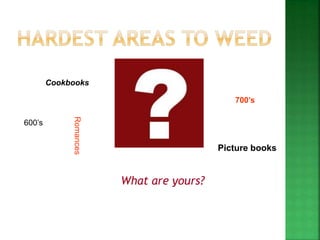
What are yours?
600’s
700’s
Cookbooks
Picture books
Romances
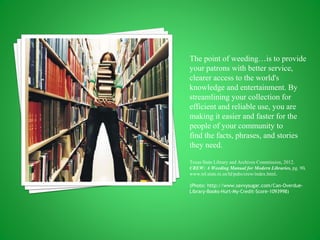
The point of weeding…is to provide
your patrons with better service,
clearer access to the world's
knowledge and entertainment. By
streamlining your collection for
efficient and reliable use, you are
making it easier and faster for the
people of your community to
find the facts, phrases, and stories
they need.
Texas State Library and Archives Commission, 2012.
CREW: A Weeding Manual for Modern Libraries, pg. 90.
www.tsl.state.tx.us/ld/pubs/crew/index.html.
(Photo: http://www.savvysugar.com/Can-Overdue-
Library-Books-Hurt-My-Credit-Score-1093998)

NCompass Live: Weeding Your Library Collection

  • 2.
     Also knownas deselection or selection-in-reverse  The periodic or continual evaluation of resources intended to remove items that are no longer useful from the collection.  It is an essential, though difficult, element of collection development that ensures that the collection on the shelves is useful and accessible.  Weeding helps the library provide customers with an inviting space full of interesting, relevant and intriguing materials.  For the librarian, weeding has additional advantages. It helps you to find gaps in your collection so that you can make new purchases with confidence, and it creates space for those materials.
  • 3.
     Most ofus were taught by parents and teachers to treat books and magazines with respect. In fact, we learned to have great respect for anything printed. The problem is that we are confusing the information contained in a package with the packaging.
  • 4.
     I boughtthis book.  It’s an award-winning title!  Someone might need it—someday.  The mayor donated it.  I loved this book!  People should read the classics.  We need to have (number) books in the library.  I have no budget to buy new books.  If someone in the community sees me throwing away books…  Weeding is on my list…but not at the top.
  • 5.
     Save Space Shelves should never be more than 85% full (75% is better)  Shelf space costs money  It costs to purchase more shelving  Employees spend time shifting  Patrons get frustrated  Save Time  Busy patrons don’t want to sift through old, inaccurate materials  Reader’s Advisory is easier
  • 6.
     Appeal  Patronsare attracted to new material  Circulation will increase after weeding  Enhance your library’s reputation  Reliability  Currency  Trust that you have “good” material  Constant Feedback  Identify holes in the collection  Prepare a wish list  Familiarity with what is on the shelf
  • 7.
     Physical Condition Copyright Date  Author  Circulation Stats  Relevance  Format  Illustrations  Visual Appeal  Publisher  Duplicates  Expense to Replace  Similar Resources  Reading Level  Current Interest  School Curricula
  • 8.
    CREW Method ofWeeding Continuous Review Evaluation Weeding https://www.tsl.texas.gov/ld/pubs/crew/index.html
  • 9.
     Weed alittle bit every day.  Look for shabby and outdated material when checking items in.  Identify unused duplicates while shelving.  Check “shelf-sitters.”  Unattractive covers  One-book wonder  Simplified or abridged classics  Cataloged incorrectly  Check Dewey number  Check Subject headings
  • 10.
    X / X/ MUSTIE Copyright Date Is item more than X years old? Maximum permissible time without use.
  • 11.
    M = Misleading(Inaccurate) U = Ugly (Condition) S = Superseded (Outdated) T = Trivial (No longer of interest) I = Irrelevant E = Available Elsewhere (ILL)
  • 12.
     Gather usagestatistics.  Inventory report and/or Circulation statistics.  Gather weeding tools.  Slips, shelf marker, book truck, pencil, CREW manual.  Examine the section item by item.  Check standard indexes. (Available from NLC)  Fiction Core Collection  Children’s Core Collection  Public Library Core Collection - Nonfiction  Treat books removed according to slips.  Bindery, Mending, Discard, Replace, Recycle.  Display low-circulating, high-quality items.  Place your next weeding project on your calendar.
  • 13.
    A rule ofthumb held by many library professionals is that about 5% of the collection be weeded every year. This allows for turnover of the collection every twenty years. While this doesn’t literally mean that no book that exists in the collection in the year 2000 will still be there in 2020, even classic literature and perennially useful materials will generally become worn and tattered after twenty years of use and need to be replaced with a fresh copy.
  • 14.
    Questions to askyourself when weeding.  Would I be embarrassed if the library didn’t own it?  Does the book fit the needs of my community?  Does it have local interest?  Is the author still living and writing?  If I put this on display, would it go out?
  • 15.
     Local History Unless the item is beyond repair  Works by Local Authors  Especially during the author’s lifetime  Works with Local Settings  Unless they have not circulated in 5 years  Genealogy Material  Reference Works Augmented by Later Editions  Quotation Books  Unless they are in poor condition
  • 16.
     Sell them Friends Book Sale  Annual Sale  Ongoing Rack Sale  Used Book Dealer  Better World Books  Thrift Books  Donate them  Hospital  Nursing Home  Correctional Facility  Charity
  • 17.
     Recycle them Paperback books can be put in recycling bin  Hardback books must have covers cut off before the pages can be recycled  Destroy them  Should be reserved for materials in worst physical condition  Unavoidable  Should be done discreetly
  • 18.
     Wasting taxdollars  Throwing “good” books in the trash  “Book burning”  Bad PR
  • 19.
     Classics canstill make up part of a core collection.  Only include if they support curriculum.  It’s our duty as librarians to expose students to “great” literature.  Unless a movie comes out based on a classic, are students still reading them?
  • 20.
    Keep library staffinformed so they can alleviate patron anxieties. Never complain to patrons about “bad” material. Explain that you are making room for new materials, making the shelves easier to navigate, and replacing outdated information with the latest current information. (Rebecca Vnuk, Booklist Online, February 15, 2012)
  • 21.
  • 22.
    The point ofweeding…is to provide your patrons with better service, clearer access to the world's knowledge and entertainment. By streamlining your collection for efficient and reliable use, you are making it easier and faster for the people of your community to find the facts, phrases, and stories they need. Texas State Library and Archives Commission, 2012. CREW: A Weeding Manual for Modern Libraries, pg. 90. www.tsl.state.tx.us/ld/pubs/crew/index.html. (Photo: http://www.savvysugar.com/Can-Overdue- Library-Books-Hurt-My-Credit-Score-1093998)

Editor's Notes

  • #5 I bought this book—Think of your personal responsibility to the collection as a whole. Someone might need it, someday.—We’d be happy to ILL it for him or her. That’s taxpayer money!—It’s more of a waste of taxpayer dollars to keep outdated or nasty books on the shelf. Time is money, too—your patrons shouldn’t have to waste their time searching through your outdated collections. Books are valuable!—There is no value in dangerously outdated material or soiled items. Sometimes nothing is better than junk! It will look bad to have empty shelves.—Keep your community informed about what’s happening when you weed, and remember that replacement is a key component of weeding as well.
  • #7  Changing to a new automation system? Pay per record—weeding saves money. http://awfullibrarybooks.net/
  • #8 So many things to consider. Gets confusing. Make weeding simple with the CREW method.
  • #9 Texas State Library Free to download I recommend printing. However, it is 108 pages.
  • #11 Look at chart of CREW Formulas. No hard and fast, just a GUIDELINE
  • #12 Triviality implies that the material included in the item was popular for a brief period of time but interest has largely waned. Books are published, often seemingly overnight, when there is a new fad, or when a new celebrity hits the scene. Biographies of pop culture performers, games and consumer products, television shows, diets, and fiction series come and go very quickly. The interest may last a few years but usually fades fast. Many of the books are published in paperback to hit the market while the iron is hot, but when interest cools, library shelves are left full of books that hold little appeal for anyone. Even if a fad returns, as happened after two decades with the Teenage Mutant Ninja Turtles, the lapse between periods of intense popularity means that the books from the original fad are outdated. Trivial books can also be published immediately following a major event, such as the death of Princess Diana. For topics that have lasting interest, better written books come out a year or so later and the ‘instant’ books that may trivialize the subject can be discarded.
  • #14 The Nebraska Library Commission’s Accreditation standard is a minimum of 3%.
  • #17 Ethical issue donating weeded non-fiction books. Were weeded because they contained outdated information. Why would other organizations want information that is not “good enough” for the library. Items weeded because of condition—same problem. Donate to a child care center or museum. Shipping books is very expensive. Are they useful to the organizations that receive them? Rosebud Reservation? Use them in “altered books” crafts.
  • #18 Could prepare a “Cart of Shame” with those items that should have been long gone. Examples: The Mongoloid Child: Recognition and Care Hand out the case study.
  • #21 Transparency is key If staff is not on board with weeding, the public will never be. One exception to this is using the “Cart of Shame.” Weeding isn’t always about ridding the shelves—sometimes it’s about getting fresh new copies of the exact same titles.