



Weeding: Why is it so difficult and what can we do about it?
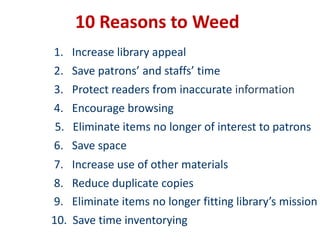
10 Reasons to Weed1.   Increase library appeal 2.   Save patrons’ and staffs’ time 3.   Protect readers from inaccurate information4.   Encourage browsing5.   Eliminate items no longer of interest to patrons6.   Save space7.   Increase use of other materials8.   Reduce duplicate copies9.   Eliminate items no longer fitting library’s mission10.  Save time inventorying
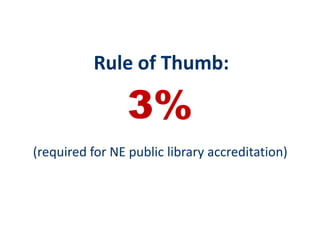
Rule of Thumb:3%(required for NE public library accreditation)
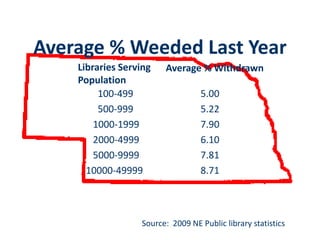
Average % Weeded Last YearAverage % WithdrawnLibraries ServingPopulation     100-499     500-999   1000-1999   2000-4999   5000-999910000-499995.005.227.906.107.818.71Source:  2009 NE Public library statistics
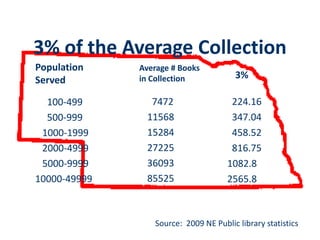
3% of the Average CollectionPopulation ServedAverage # Books in Collection3%  74721156815284272253609385525  224.16  347.04  458.52  816.751082.82565.8     100-499     500-999   1000-1999   2000-4999   5000-999910000-49999Source:  2009 NE Public library statistics
What are the reasons that weeding doesn’t get done?
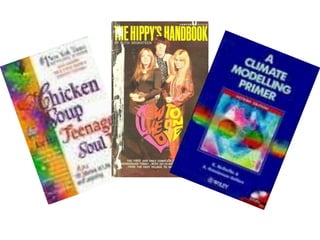
1.“There’s no such thing as a bad book.
(The wrong) something is not better than nothing.
"Librarians have a responsibility for discarding unsound books of yesteryear. In the eyes of the public, the fact that they are on the shelves confers upon them an endorsement.“--Clarke, G. E. "Propaganda." Library World, 42:62-63, October 1939
2.“Someone might need them”
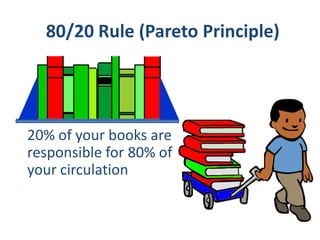
80/20 Rule (Pareto Principle)20% of your books are responsible for 80% of your circulation
When Loriene Roy weeded 10% of three Illinois public libraries in 1985,  only one percent of the weeded books were requested over the following eight months. - Source: “Weeding without tears” by Loriene Roy, Collection Management Vol. 12, #1 and 2, 1990, pp. 83-93, p. 91.
The best predictor of future circulation?Past circulationSource: Weeding Library Collections, by Stanley J. Slote, 1989, p. 64.3.“We haven’t gotten all the good out of it yet.”OR“It’s not worn out.”
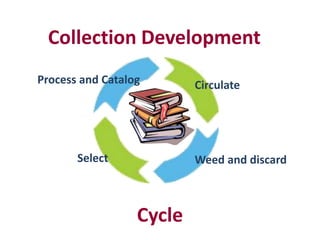
Collection DevelopmentProcess and Catalog CirculateSelectWeed and discardCycle
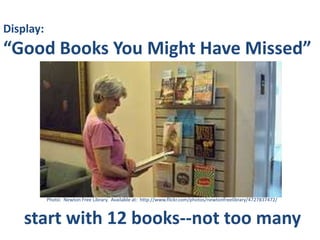
Display:“Good Books You Might Have Missed”Photo:  Newton Free Library.  Available at:  http://www.flickr.com/photos/newtonfreelibrary/4727837472/start with 12 books--not too many
4.“I don’t want to admit I made a poor selection.”
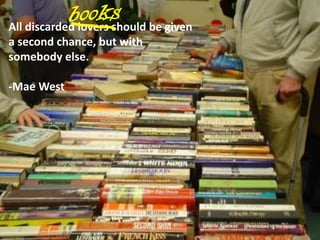
booksAll discarded lovers should be given a second chance, but with somebody else.                                                                  -                   -Mae West
5.“It might be valuable”
http://www.abebooks.com/books/RareBooks/
6.“What will people say?”
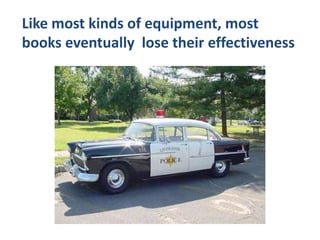
Like most kinds of equipment, most books eventually  lose their effectiveness
7.“We won’t have anything left”
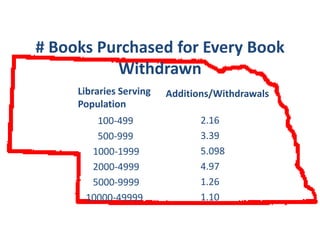
# Books Purchased for Every Book Withdrawn Additions/WithdrawalsLibraries ServingPopulation2.163.395.0984.971.261.10     100-499     500-999   1000-1999   2000-4999   5000-999910000-49999Source:  2009 NE Public Library Statistics
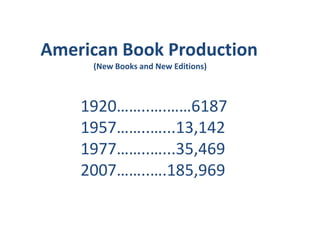
American Book Production(New Books and New Editions)1920……..….……61871957……..…...13,1421977……..…...35,4692007……..….185,969--Bowker Annual, 1959, 1978, 2009
8.The library looks fine/ there’s plenty of room
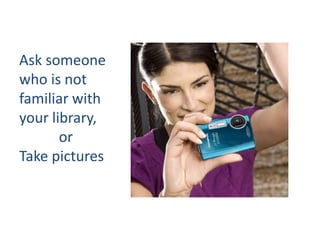
Ask someone who is not familiar with your library,            or Take pictures
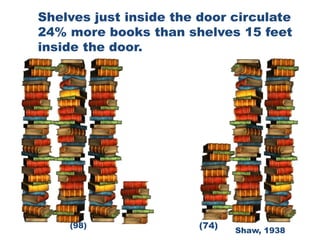
Shelves just inside the door circulate 24% more books than shelves 15 feet inside the door.(74)(98)Shaw, 1938
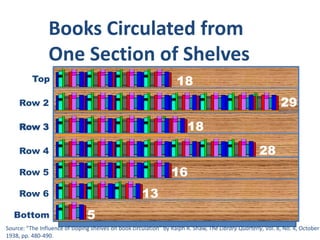
Books Circulated from One Section of Shelves18Top29Row 2 18Row 3 28Row 4 16Row 5 13Row 6 5BottomSource: “The Influence of sloping shelves on book circulation” by Ralph R. Shaw, The Library Quarterly, Vol. 8, No. 4, October 1938, pp. 480-490.
In 1973, when Stanley Slote weeded 20% of fiction, six months later circulation increased 106.2%, 20 months later the increase was 121.2%.- Source: Weeding Library Collections by Stanley J. Slote, 1989, p. 65.
9.There isn’t time
Make everyone (staff and volunteers) part of the Weeding Team
TipsWeed as you go—when an item is in handSet small daily or weekly goalsHave a contestForm a support group – “Reluctant Weeders”Make a chart of the stacks and color in  where you’ve weededHave your weeding kit ready to go
10.“I don’t know where to start.”
CREW
Download at:http://www.tsl.state.tx.us/ld/pubs/crew/
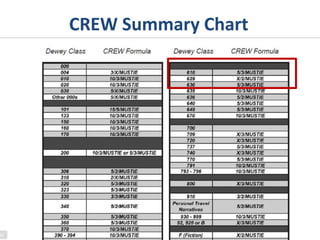
CREW Summary Chart
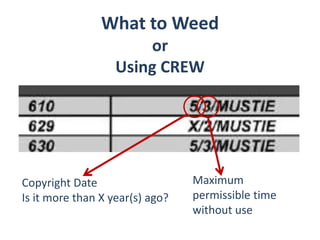
What to WeedorUsing CREWMaximum permissible time without useCopyright DateIs it more than X year(s) ago?
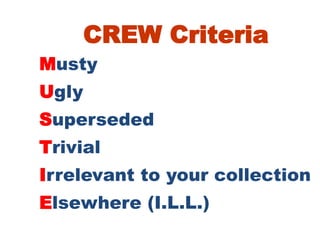
CREW CriteriaMustyUglySupersededTrivialIrrelevant to your collectionElsewhere (I.L.L.)
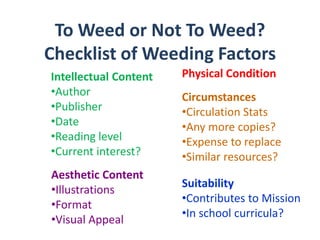
To Weed or Not To Weed? Checklist of Weeding FactorsPhysical ConditionIntellectual ContentAuthor
Publisher
Date
Reading level
Current interest?CircumstancesCirculation Stats
Any more copies?
Expense to replace
Similar resources?Aesthetic ContentIllustrations
Format
Visual AppealSuitabilityContributes to Mission
In school curricula?Your Library Selection PolicyIncludes :De-selection criteria
Weeding schedule
Disposal methodsSample Policy LanguageEach item, through its quality, reliability, current usefulness andappearance, must earn its place on the shelf, and contribute to the reliability, reputation and attractiveness of the Library.http://www.infopeople.org/training/past/2007/weeding/WMRLS_sample_weed_policy.pdf
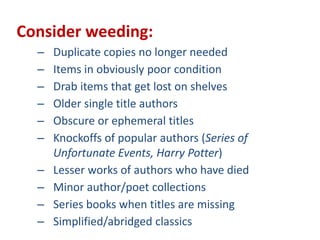
Quick & DirtyConsider weeding:Duplicate copies no longer neededItems in obviously poor conditionDrab items that get lost on shelvesOlder single title authorsObscure or ephemeral titlesKnockoffs of popular authors (Series of Unfortunate Events, Harry Potter)Lesser works of authors who have diedMinor author/poet collectionsSeries books when titles are missingSimplified/abridged classicsJeanette Larson, Small Library Mgt. Training Program, Collection Development Course
Steps to WeedingGather usage statisticsMaintain a weeding kitStudy the area you will be weedingWeedDouble check  in indexes & bibliographies Dispose of weeded materials—discard, recycle, sell, donateOrder  replacements or put on a wish list to reorder when funds are availableMerchandise low circulating, high-quality items
Swiffer Duster Couponhttp://www.swiffer.com/en_US/home.do
Advice for Specific Sections:  Picture BooksThink boutique (high-quality, current selection)Be aware of ephemeral interestsBoard books should be replaced more often since they get the most abuseReplace worn copies of perennial faves (multiples)
Advice for Specific Sections: YA FictionBe ruthless in this sectionCurrency is keyPaperbacks>5 years, remove if not circulating well
Advice for Specific Sections:  C&YA Non-FictionAnything is not better than nothing Be aware of online resources Better to not have books that have bad information Use CREW Guidelines by Dewey Class as in adult sections
Other C&YA Issues	Abridged classics (often poor quality)Series books (often poor quality, replace if titles don’t stand alone and collect for various reading levels)Older titles – beware of dated look, torn pages, shabby bindingsWorn classics should be replaced (Don’t be sentimental!)Geography titles older than 5 years – tossScience, medicine, inventions – rapid changes so update every 5 yearsTextbooks – gauge by demand in community and homeschool population
Advice for Specific Sections:  ReferenceOlder editions may be weeded when superseded Materials should be periodically evaluated, (not as often as circulating collection and not as continuous) Different replacement schedules (new editions may not be as frequent) Keep websites and databases in mind Consider integrating reference materials into the circulating collection, especially if usage is poor
Advice for Specific Sections:  PeriodicalsCurrent use – use declines drastically 5 years after publication date Interest in circulating older issues – do you allow back issues to circulate? Full-text availability Space
Advice for Specific Sections:  MediaSubjective CriteriaWorn outOut-of-dateRarely usedSupplied elsewhere Trivial or faddish
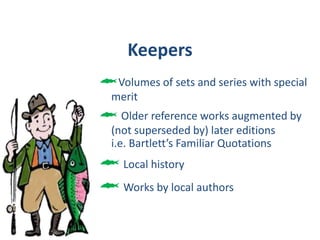
KeepersVolumes of sets and series with special meritOlder reference works augmented by (not superseded by) later editionsi.e. Bartlett’s Familiar QuotationsLocal historyWorks by local authors

NCompass Live: Weeding: Why is it so difficult and what can we do about it?

  • 1.
    Weeding: Why isit so difficult and what can we do about it?
  • 2.
    10 Reasons toWeed1. Increase library appeal 2. Save patrons’ and staffs’ time 3. Protect readers from inaccurate information4. Encourage browsing5. Eliminate items no longer of interest to patrons6. Save space7. Increase use of other materials8. Reduce duplicate copies9. Eliminate items no longer fitting library’s mission10. Save time inventorying
  • 3.
    Rule of Thumb:3%(requiredfor NE public library accreditation)
  • 4.
    Average % WeededLast YearAverage % WithdrawnLibraries ServingPopulation 100-499 500-999 1000-1999 2000-4999 5000-999910000-499995.005.227.906.107.818.71Source: 2009 NE Public library statistics
  • 5.
    3% of theAverage CollectionPopulation ServedAverage # Books in Collection3% 74721156815284272253609385525 224.16 347.04 458.52 816.751082.82565.8 100-499 500-999 1000-1999 2000-4999 5000-999910000-49999Source: 2009 NE Public library statistics
  • 6.
    What are thereasons that weeding doesn’t get done?
  • 7.
    1.“There’s no suchthing as a bad book.
  • 9.
    (The wrong) somethingis not better than nothing.
  • 10.
    "Librarians have aresponsibility for discarding unsound books of yesteryear. In the eyes of the public, the fact that they are on the shelves confers upon them an endorsement.“--Clarke, G. E. "Propaganda." Library World, 42:62-63, October 1939
  • 11.
  • 12.
    80/20 Rule (ParetoPrinciple)20% of your books are responsible for 80% of your circulation
  • 13.
    When Loriene Royweeded 10% of three Illinois public libraries in 1985, only one percent of the weeded books were requested over the following eight months. - Source: “Weeding without tears” by Loriene Roy, Collection Management Vol. 12, #1 and 2, 1990, pp. 83-93, p. 91.
  • 14.
    The best predictorof future circulation?Past circulationSource: Weeding Library Collections, by Stanley J. Slote, 1989, p. 64.3.“We haven’t gotten all the good out of it yet.”OR“It’s not worn out.”
  • 15.
    Collection DevelopmentProcess andCatalog CirculateSelectWeed and discardCycle
  • 16.
    Display:“Good Books YouMight Have Missed”Photo: Newton Free Library. Available at: http://www.flickr.com/photos/newtonfreelibrary/4727837472/start with 12 books--not too many
  • 17.
    4.“I don’t wantto admit I made a poor selection.”
  • 18.
    booksAll discarded loversshould be given a second chance, but with somebody else. - -Mae West
  • 19.
    5.“It might bevaluable”
  • 20.
  • 21.
  • 22.
    Like most kindsof equipment, most books eventually lose their effectiveness
  • 23.
    7.“We won’t haveanything left”
  • 24.
    # Books Purchasedfor Every Book Withdrawn Additions/WithdrawalsLibraries ServingPopulation2.163.395.0984.971.261.10 100-499 500-999 1000-1999 2000-4999 5000-999910000-49999Source: 2009 NE Public Library Statistics
  • 25.
    American Book Production(NewBooks and New Editions)1920……..….……61871957……..…...13,1421977……..…...35,4692007……..….185,969--Bowker Annual, 1959, 1978, 2009
  • 26.
    8.The library looksfine/ there’s plenty of room
  • 27.
    Ask someone whois not familiar with your library, or Take pictures
  • 28.
    Shelves just insidethe door circulate 24% more books than shelves 15 feet inside the door.(74)(98)Shaw, 1938
  • 29.
    Books Circulated fromOne Section of Shelves18Top29Row 2 18Row 3 28Row 4 16Row 5 13Row 6 5BottomSource: “The Influence of sloping shelves on book circulation” by Ralph R. Shaw, The Library Quarterly, Vol. 8, No. 4, October 1938, pp. 480-490.
  • 30.
    In 1973, whenStanley Slote weeded 20% of fiction, six months later circulation increased 106.2%, 20 months later the increase was 121.2%.- Source: Weeding Library Collections by Stanley J. Slote, 1989, p. 65.
  • 31.
  • 32.
    Make everyone (staffand volunteers) part of the Weeding Team
  • 33.
    TipsWeed as yougo—when an item is in handSet small daily or weekly goalsHave a contestForm a support group – “Reluctant Weeders”Make a chart of the stacks and color in where you’ve weededHave your weeding kit ready to go
  • 34.
    10.“I don’t knowwhere to start.”
  • 35.
  • 36.
  • 37.
  • 38.
    What to WeedorUsingCREWMaximum permissible time without useCopyright DateIs it more than X year(s) ago?
  • 39.
  • 40.
    To Weed orNot To Weed? Checklist of Weeding FactorsPhysical ConditionIntellectual ContentAuthor
  • 41.
  • 42.
  • 43.
  • 44.
  • 45.
  • 46.
  • 47.
  • 48.
  • 49.
  • 50.
    In school curricula?YourLibrary Selection PolicyIncludes :De-selection criteria
  • 51.
  • 52.
    Disposal methodsSample PolicyLanguageEach item, through its quality, reliability, current usefulness andappearance, must earn its place on the shelf, and contribute to the reliability, reputation and attractiveness of the Library.http://www.infopeople.org/training/past/2007/weeding/WMRLS_sample_weed_policy.pdf
  • 53.
    Quick & DirtyConsiderweeding:Duplicate copies no longer neededItems in obviously poor conditionDrab items that get lost on shelvesOlder single title authorsObscure or ephemeral titlesKnockoffs of popular authors (Series of Unfortunate Events, Harry Potter)Lesser works of authors who have diedMinor author/poet collectionsSeries books when titles are missingSimplified/abridged classicsJeanette Larson, Small Library Mgt. Training Program, Collection Development Course
  • 54.
    Steps to WeedingGatherusage statisticsMaintain a weeding kitStudy the area you will be weedingWeedDouble check in indexes & bibliographies Dispose of weeded materials—discard, recycle, sell, donateOrder replacements or put on a wish list to reorder when funds are availableMerchandise low circulating, high-quality items
  • 55.
  • 56.
    Advice for SpecificSections: Picture BooksThink boutique (high-quality, current selection)Be aware of ephemeral interestsBoard books should be replaced more often since they get the most abuseReplace worn copies of perennial faves (multiples)
  • 57.
    Advice for SpecificSections: YA FictionBe ruthless in this sectionCurrency is keyPaperbacks>5 years, remove if not circulating well
  • 58.
    Advice for SpecificSections: C&YA Non-FictionAnything is not better than nothing Be aware of online resources Better to not have books that have bad information Use CREW Guidelines by Dewey Class as in adult sections
  • 59.
    Other C&YA Issues Abridgedclassics (often poor quality)Series books (often poor quality, replace if titles don’t stand alone and collect for various reading levels)Older titles – beware of dated look, torn pages, shabby bindingsWorn classics should be replaced (Don’t be sentimental!)Geography titles older than 5 years – tossScience, medicine, inventions – rapid changes so update every 5 yearsTextbooks – gauge by demand in community and homeschool population
  • 60.
    Advice for SpecificSections: ReferenceOlder editions may be weeded when superseded Materials should be periodically evaluated, (not as often as circulating collection and not as continuous) Different replacement schedules (new editions may not be as frequent) Keep websites and databases in mind Consider integrating reference materials into the circulating collection, especially if usage is poor
  • 61.
    Advice for SpecificSections: PeriodicalsCurrent use – use declines drastically 5 years after publication date Interest in circulating older issues – do you allow back issues to circulate? Full-text availability Space
  • 62.
    Advice for SpecificSections: MediaSubjective CriteriaWorn outOut-of-dateRarely usedSupplied elsewhere Trivial or faddish
  • 63.
    KeepersVolumes of setsand series with special meritOlder reference works augmented by (not superseded by) later editionsi.e. Bartlett’s Familiar QuotationsLocal historyWorks by local authors

Editor's Notes

  • #30 One of the most inspiring ideas in librarianship is S. R. Ranganathan’s Five Laws of Library Science. The third law is”Every book, its reader.” This law, in Ranganathan’s words, "urge[s] that an appropriate reader should be found for every book.” Robert Shaw’s 1938 experiment with library shelving proved that library shelves do not allow all books equal chance to be seen by patrons. The graphs in this slide reveal the difference in circulation caused by differences in exposure to patrons. Books on lower shelves are harder to see and reach than books on upper shelves. Shelves further back in libraries are less likely to be browsed than shelves in the front of the library. Look at the circulation pattern of the shelves in the top graph. I have seen this exact same pattern on each section of a whole range of shelves weeded in Great Bend Public Library. The one exception from this pattern was the section with Danielle Steel books shelved on the lowest shelves. Weeding based on past circulation is a measure of circulation. If you see this pattern when you weed, then about 45% of the books you are weeding from the lowest shelves are being removed because they are shelved on the lower shelves, not because they are unwanted by patrons. At least 24% of the books you are removing from the back shelves is because they are on the back shelves and not because they are unwanted. Weeding books because of their location is unethical. Fortunately, there are two things you can do to correct this injustice. First, your book displays should be stocked with books from the lower shelves and the back of the library. Second, weeded books should be displayed before they are completely removed from the library.