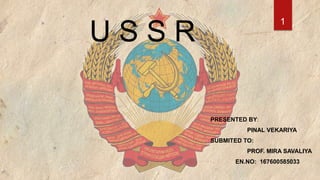

U S S R
PRESENTED BY:
PINAL VEKARIYA
SUBMITED TO:
PROF. MIRA SAVALIYA
EN.NO: 167600585033
1
WHAT WAS?
 The Union of Soviet Socialist Republics (USSR) was a
constitutionally socialist state that existed in Eurasia from
1922 to 1991. The common short name is Soviet Union.
 The “The Union of Soviet Socialist Republics”
 Russian revolution of 1917
 Formally established in 1922
2
CON..
 15 sub national soviets
 Centralised economy and planning
 One party rule
3
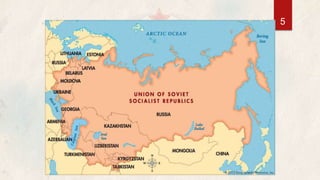
Countries in the Soviet Union
1. Russian Federation
2. Kazakhstan
3. Ukraine
4. Turkmenistan
5. Uzbekistan
6. Belarus
7. Kyrgyzstan
8. Tajikistan
9. Azerbaijan
10. Georgia
11. Lithuania
12. Latvia
13. Estonia
14. Moldova
15. Armenia
4
5
Why the USSR Collapsed..
 Beginnings of the Soviet Command Economy
 Initial Period of Rapid Growth
 Slowing Growth and the Beginning of Reforms
 Perestroika and Collapse
6
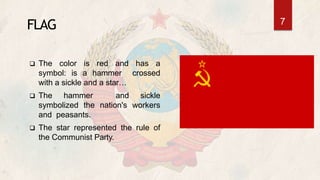
FLAG
 The color is red and has a
symbol: is a hammer crossed
with a sickle and a star…
 The hammer and sickle
symbolized the nation's workers
and peasants.
 The star represented the rule of
the Communist Party.
7
Dis-Integration of
Soviet States
8
SPACE RACE
Billions Spends to compete with USA
Firsts –
o Satellite
o Animal in space
o Cosmonaut
o Women in space
9
ARMS RACE
 Nuclear arsenal largest in word
 Billions spent on huge army
 Mutually assured destruction
10
COLD WAR
 To increase communist influence, support to Cuba, north
Korea, Vietnam, Laos, china, and many others communist
nations .
 Material and technology spent on these nation cost a lost of
money.
11
AFGHAN WAR
► 1979-1989
► 15000 soldiers killed
► 50000+ wounded
► Draining vital resources
12
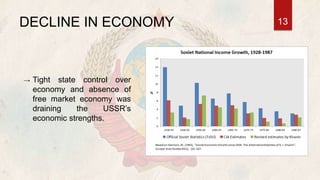
DECLINE IN ECONOMY
→ Tight state control over
economy and absence of
free market economy was
draining the USSR’s
economic strengths.
13
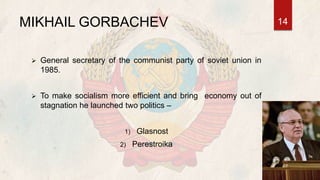
MIKHAIL GORBACHEV
 General secretary of the communist party of soviet union in
1985.
 To make socialism more efficient and bring economy out of
stagnation he launched two politics –
1) Glasnost
2) Perestroika
14
GLASNOST
 Openness
 “freedom of speech”
 Easing of media censorship.
 Earlier records declassified
15
PERESTROIKA
 “RESTRUCTURING” “REFORMATION”
 Soviet political and economic structure
 Election , foreign investment , privately owned business..
16
EASTERN EUROPE
 Relaxed policies lead to demand of sovereignty and
independence in eastern and central Europe and also in the
15 sub national soviets.
17
1989-year of Revaluations
 From summer of 1989 till 1991 Revaluation in Poland hungry
east Germany Czechoslovakia Bulgaria Romania Yugoslavia.
 Nationalist movements to gain independence from USSR
influence and communist puppet governments.
 Gorbachev did not send army to suppress any of the protests
or movements.
18
 Berlin wall fell in November of 1989
 December 1989-bush Sr. announces end of cold war
19
DOMMINO EFFECT
 Starting from 1987 these soviets declared sovereignty or
independence .
o Estonia
o Latvia
o ALithuania
 were is first ones
20
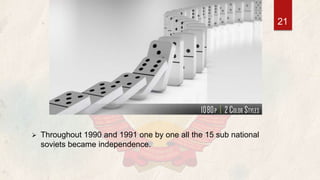
 Throughout 1990 and 1991 one by one all the 15 sub national
soviets became independence.
21
AUGUST COUP
 On 19 Aug 1991, a group of senior party leaders attempted a
coup by placing Gorbachev under house arrest and
demanding the restoration of USSR.
 Failed as the people in cities rose against it and the majority
of red army refused to support the coup leaders.
22
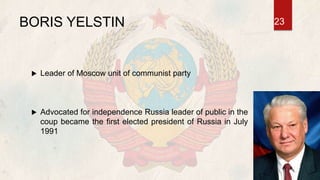
BORIS YELSTIN
 Leader of Moscow unit of communist party
 Advocated for independence Russia leader of public in the
coup became the first elected president of Russia in July
1991
23
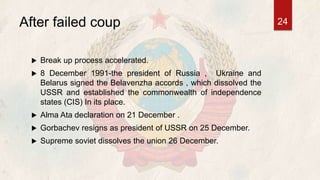
After failed coup
 Break up process accelerated.
 8 December 1991-the president of Russia , Ukraine and
Belarus signed the Belavenzha accords , which dissolved the
USSR and established the commonwealth of independence
states (CIS) In its place.
 Alma Ata declaration on 21 December .
 Gorbachev resigns as president of USSR on 25 December.
 Supreme soviet dissolves the union 26 December.
24
CON..
 Severe economics contraction and catastrophic fall in living
standard in post-soviet stats.
 Increase in poverty, crime, corruption, unemployment, disease
and income inequality.
 Decrease in life expectancy, adult literacy, an income.
25
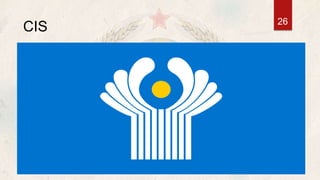
CIS 26
THE MOTTO WAS: 27
ADVANTAGES..
 Effective Industrialization.
 Free Education
 Effective Recycling Program
28
CRITICISM
 Personal freedom.
 Deficiency of life choice
29
Thank you…
30

Ussr.ppt

  • 1.
    U S SR PRESENTED BY: PINAL VEKARIYA SUBMITED TO: PROF. MIRA SAVALIYA EN.NO: 167600585033 1
  • 2.
    WHAT WAS?  TheUnion of Soviet Socialist Republics (USSR) was a constitutionally socialist state that existed in Eurasia from 1922 to 1991. The common short name is Soviet Union.  The “The Union of Soviet Socialist Republics”  Russian revolution of 1917  Formally established in 1922 2
  • 3.
    CON..  15 subnational soviets  Centralised economy and planning  One party rule 3
  • 4.
    Countries in theSoviet Union 1. Russian Federation 2. Kazakhstan 3. Ukraine 4. Turkmenistan 5. Uzbekistan 6. Belarus 7. Kyrgyzstan 8. Tajikistan 9. Azerbaijan 10. Georgia 11. Lithuania 12. Latvia 13. Estonia 14. Moldova 15. Armenia 4
  • 5.
  • 6.
    Why the USSRCollapsed..  Beginnings of the Soviet Command Economy  Initial Period of Rapid Growth  Slowing Growth and the Beginning of Reforms  Perestroika and Collapse 6
  • 7.
    FLAG  The coloris red and has a symbol: is a hammer crossed with a sickle and a star…  The hammer and sickle symbolized the nation's workers and peasants.  The star represented the rule of the Communist Party. 7
  • 8.
  • 9.
    SPACE RACE Billions Spendsto compete with USA Firsts – o Satellite o Animal in space o Cosmonaut o Women in space 9
  • 10.
    ARMS RACE  Nucleararsenal largest in word  Billions spent on huge army  Mutually assured destruction 10
  • 11.
    COLD WAR  Toincrease communist influence, support to Cuba, north Korea, Vietnam, Laos, china, and many others communist nations .  Material and technology spent on these nation cost a lost of money. 11
  • 12.
    AFGHAN WAR ► 1979-1989 ►15000 soldiers killed ► 50000+ wounded ► Draining vital resources 12
  • 13.
    DECLINE IN ECONOMY →Tight state control over economy and absence of free market economy was draining the USSR’s economic strengths. 13
  • 14.
    MIKHAIL GORBACHEV  Generalsecretary of the communist party of soviet union in 1985.  To make socialism more efficient and bring economy out of stagnation he launched two politics – 1) Glasnost 2) Perestroika 14
  • 15.
    GLASNOST  Openness  “freedomof speech”  Easing of media censorship.  Earlier records declassified 15
  • 16.
    PERESTROIKA  “RESTRUCTURING” “REFORMATION” Soviet political and economic structure  Election , foreign investment , privately owned business.. 16
  • 17.
    EASTERN EUROPE  Relaxedpolicies lead to demand of sovereignty and independence in eastern and central Europe and also in the 15 sub national soviets. 17
  • 18.
    1989-year of Revaluations From summer of 1989 till 1991 Revaluation in Poland hungry east Germany Czechoslovakia Bulgaria Romania Yugoslavia.  Nationalist movements to gain independence from USSR influence and communist puppet governments.  Gorbachev did not send army to suppress any of the protests or movements. 18
  • 19.
     Berlin wallfell in November of 1989  December 1989-bush Sr. announces end of cold war 19
  • 20.
    DOMMINO EFFECT  Startingfrom 1987 these soviets declared sovereignty or independence . o Estonia o Latvia o ALithuania  were is first ones 20
  • 21.
     Throughout 1990and 1991 one by one all the 15 sub national soviets became independence. 21
  • 22.
    AUGUST COUP  On19 Aug 1991, a group of senior party leaders attempted a coup by placing Gorbachev under house arrest and demanding the restoration of USSR.  Failed as the people in cities rose against it and the majority of red army refused to support the coup leaders. 22
  • 23.
    BORIS YELSTIN  Leaderof Moscow unit of communist party  Advocated for independence Russia leader of public in the coup became the first elected president of Russia in July 1991 23
  • 24.
    After failed coup Break up process accelerated.  8 December 1991-the president of Russia , Ukraine and Belarus signed the Belavenzha accords , which dissolved the USSR and established the commonwealth of independence states (CIS) In its place.  Alma Ata declaration on 21 December .  Gorbachev resigns as president of USSR on 25 December.  Supreme soviet dissolves the union 26 December. 24
  • 25.
    CON..  Severe economicscontraction and catastrophic fall in living standard in post-soviet stats.  Increase in poverty, crime, corruption, unemployment, disease and income inequality.  Decrease in life expectancy, adult literacy, an income. 25
  • 26.
  • 27.
  • 28.
    ADVANTAGES..  Effective Industrialization. Free Education  Effective Recycling Program 28
  • 29.
    CRITICISM  Personal freedom. Deficiency of life choice 29
  • 30.