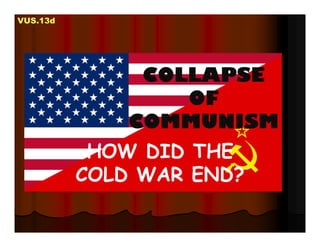
COLLAPSE
OF
COMMUNISM
HOW DID THE
COLD WAR END?
VUS.13d
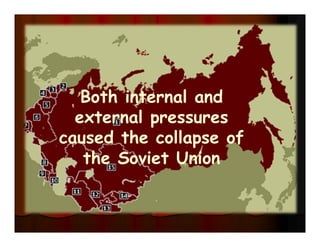
Both internal and
external pressures
caused the collapse of
the Soviet Union
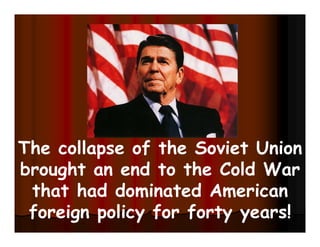
The collapse of the Soviet Union
brought an end to the Cold War
that had dominated American
foreign policy for forty years!
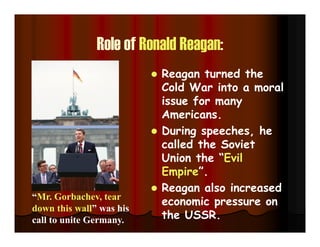
Role of Ronald Reagan:
 Reagan turned the
Cold War into a moral
issue for many
Americans.
 During speeches, he
called the Soviet
Union the “Evil
Empire”.
 Reagan also increased
economic pressure on
the USSR.
“Mr. Gorbachev, tear
down this wall” was his
call to unite Germany.
Role of Ronald Reagan
• Reagan’s defense
buildup forced the
Soviet Union to try
to compete,
hastening
(quickening) its
internal collapse
and the end of the
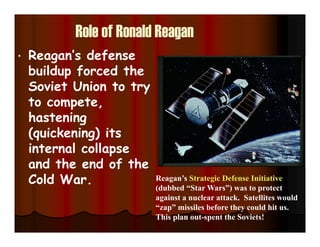
Cold War. Reagan’s Strategic Defense Initiative
(dubbed “Star Wars”) was to protect
against a nuclear attack. Satellites would
“zap” missiles before they could hit us.
This plan out-spent the Soviets!
Internal problems of the
Soviet Union
Communism as an
economic policy
failed!
Reasons for Soviet Collapse
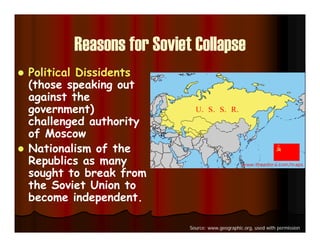
 Political Dissidents
(those speaking out
against the
government)
challenged authority
of Moscow
 Nationalism of the
Republics as many
sought to break from
the Soviet Union to
become independent.
Source: www.geographic.org, used with permission
Internal Problems of the Soviet Union
 Economic inefficiency; there
were too many layers of
bureaucracy
 Government mismanagement;
economic planners could not
keep up with needs.
 Corruption at all levels of
government
 End of the “Stalinites”
(those loyal to Stalin died
off)- and a birth of
reformers
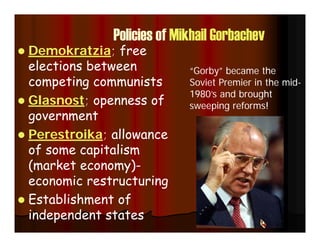
Policies of Mikhail Gorbachev
 Demokratzia; free
elections between
competing communists
 Glasnost; openness of
government
 Perestroika; allowance
of some capitalism
(market economy)-
economic restructuring
 Establishment of
independent states
“Gorby” became the
Soviet Premier in the mid-
1980’s and brought
sweeping reforms!
PARALLEL TRENDS/ EVENTS
 Soviets stopped influence
in Eastern Europe- the
Warsaw Pact dissolved
 Non-totalitarian
governments were
established in Eastern
Europe
 Fall of Berlin Wall (1989)
meant the Re-unification
of Germany
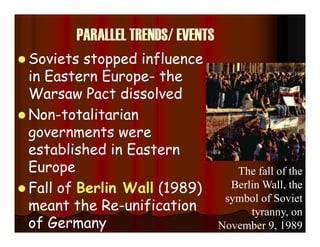
The fall of the
Berlin Wall, the
symbol of Soviet
tyranny, on
November 9, 1989
The
End?
 As the Soviet
Union split apart,
the
Commonwealth of
Independent
States was
created.
 The collapse of
the Soviet Union
opened the door
for many more
new problems!
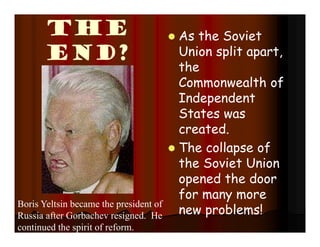
Boris Yeltsin became the president of
Russia after Gorbachev resigned. He
continued the spirit of reform.
As the sole superpower, the
U.S. struggles to establish a
consistent policy in a rapidly
changing and increasingly
interdependent world.
Forces for global
disunity
Ethnic and religious factionalism…
Economic disparity…
Nuclear Proliferation…
Terrorism...
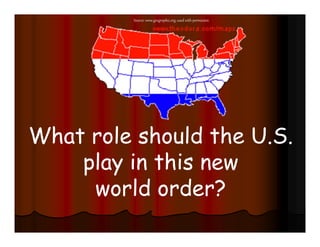
What role should the U.S.
play in this new
world order?
Source: www.geographic.org, used with permission

2008vus13d sovietcollapse

  • 1.
  • 2.
    Both internal and externalpressures caused the collapse of the Soviet Union
  • 3.
    The collapse ofthe Soviet Union brought an end to the Cold War that had dominated American foreign policy for forty years!
  • 4.
    Role of RonaldReagan:  Reagan turned the Cold War into a moral issue for many Americans.  During speeches, he called the Soviet Union the “Evil Empire”.  Reagan also increased economic pressure on the USSR. “Mr. Gorbachev, tear down this wall” was his call to unite Germany.
  • 5.
    Role of RonaldReagan • Reagan’s defense buildup forced the Soviet Union to try to compete, hastening (quickening) its internal collapse and the end of the Cold War. Reagan’s Strategic Defense Initiative (dubbed “Star Wars”) was to protect against a nuclear attack. Satellites would “zap” missiles before they could hit us. This plan out-spent the Soviets!
  • 6.
    Internal problems ofthe Soviet Union Communism as an economic policy failed!
  • 7.
    Reasons for SovietCollapse  Political Dissidents (those speaking out against the government) challenged authority of Moscow  Nationalism of the Republics as many sought to break from the Soviet Union to become independent. Source: www.geographic.org, used with permission
  • 8.
    Internal Problems ofthe Soviet Union  Economic inefficiency; there were too many layers of bureaucracy  Government mismanagement; economic planners could not keep up with needs.  Corruption at all levels of government  End of the “Stalinites” (those loyal to Stalin died off)- and a birth of reformers
  • 9.
    Policies of MikhailGorbachev  Demokratzia; free elections between competing communists  Glasnost; openness of government  Perestroika; allowance of some capitalism (market economy)- economic restructuring  Establishment of independent states “Gorby” became the Soviet Premier in the mid- 1980’s and brought sweeping reforms!
  • 10.
    PARALLEL TRENDS/ EVENTS Soviets stopped influence in Eastern Europe- the Warsaw Pact dissolved  Non-totalitarian governments were established in Eastern Europe  Fall of Berlin Wall (1989) meant the Re-unification of Germany The fall of the Berlin Wall, the symbol of Soviet tyranny, on November 9, 1989
  • 11.
    The End?  As theSoviet Union split apart, the Commonwealth of Independent States was created.  The collapse of the Soviet Union opened the door for many more new problems! Boris Yeltsin became the president of Russia after Gorbachev resigned. He continued the spirit of reform.
  • 12.
    As the solesuperpower, the U.S. struggles to establish a consistent policy in a rapidly changing and increasingly interdependent world.
  • 13.
  • 14.
    What role shouldthe U.S. play in this new world order? Source: www.geographic.org, used with permission