Collaborative learning and MOOCs
Workshop: MOOCs. Development for
Tourism and Hospitality Curriculum
Oriol Miralbell
Open University of Catalonia, Barcelona, Spain

ENTER 2014 Research Track

Slide Number 1
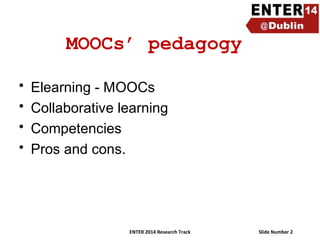
MOOCs’ pedagogy
•
•
•
•

Elearning - MOOCs
Collaborative learning
Competencies
Pros and cons.

ENTER 2014 Research Track

Slide Number 2
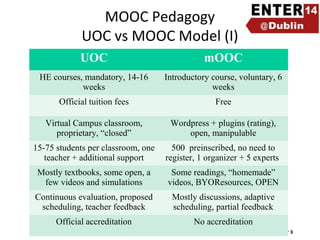
MOOC Pedagogy
UOC vs MOOC Model (I)
UOC

mOOC

HE courses, mandatory, 14-16
weeks

Introductory course, voluntary, 6
weeks

Official tuition fees

Free

Virtual Campus classroom,
proprietary, “closed”

Wordpress + plugins (rating),
open, manipulable

15-75 students per classroom, one
teacher + additional support

500 preinscribed, no need to
register, 1 organizer + 5 experts

Mostly textbooks, some open, a
few videos and simulations

Some readings, “homemade”
videos, BYOResources, OPEN

Continuous evaluation, proposed
scheduling, teacher feedback

Mostly discussions, adaptive
scheduling, partial feedback

Official accreditation

No accreditation

ENTER 2014 Research Track

Slide Number 3
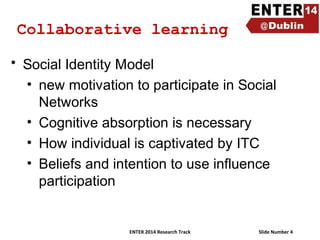
Collaborative learning
• Social Identity Model
• new motivation to participate in Social
Networks
• Cognitive absorption is necessary
• How individual is captivated by ITC
• Beliefs and intention to use influence
participation

ENTER 2014 Research Track

Slide Number 4
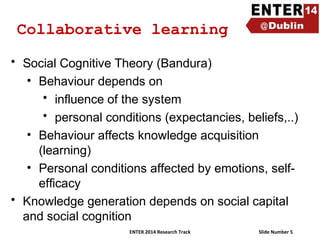
Collaborative learning
• Social Cognitive Theory (Bandura)
• Behaviour depends on
• influence of the system
• personal conditions (expectancies, beliefs,..)
• Behaviour affects knowledge acquisition
(learning)
• Personal conditions affected by emotions, selfefficacy
• Knowledge generation depends on social capital
and social cognition
ENTER 2014 Research Track

Slide Number 5
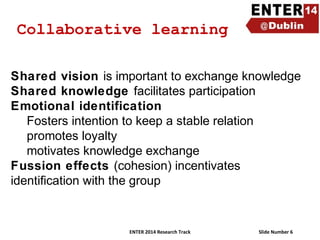
Collaborative learning
Shared vision is important to exchange knowledge
Shared knowledge facilitates participation
Emotional identification
Fosters intention to keep a stable relation
promotes loyalty
motivates knowledge exchange
Fussion effects (cohesion) incentivates
identification with the group

ENTER 2014 Research Track

Slide Number 6
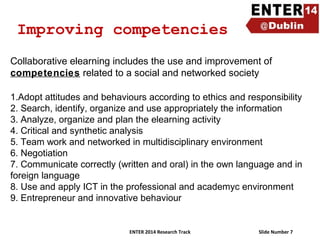
Improving competencies
Collaborative elearning includes the use and improvement of
competencies related to a social and networked society
1.Adopt attitudes and behaviours according to ethics and responsibility
2. Search, identify, organize and use appropriately the information
3. Analyze, organize and plan the elearning activity
4. Critical and synthetic analysis
5. Team work and networked in multidisciplinary environment
6. Negotiation
7. Communicate correctly (written and oral) in the own language and in
foreign language
8. Use and apply ICT in the professional and academyc environment
9. Entrepreneur and innovative behaviour

ENTER 2014 Research Track

Slide Number 7
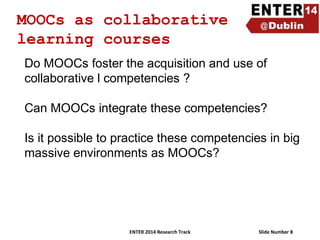
MOOCs as collaborative
learning courses
Do MOOCs foster the acquisition and use of
collaborative l competencies ?
Can MOOCs integrate these competencies?
Is it possible to practice these competencies in big
massive environments as MOOCs?

ENTER 2014 Research Track

Slide Number 8
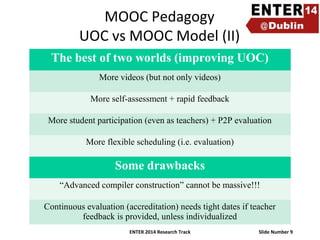
MOOC Pedagogy
UOC vs MOOC Model (II)
The best of two worlds (improving UOC)
More videos (but not only videos)
More self-assessment + rapid feedback
More student participation (even as teachers) + P2P evaluation
More flexible scheduling (i.e. evaluation)

Some drawbacks
“Advanced compiler construction” cannot be massive!!!
Continuous evaluation (accreditation) needs tight dates if teacher
feedback is provided, unless individualized
ENTER 2014 Research Track

Slide Number 9
Thank you!
Oriol Miralbell
jmiralbell@uoc.edu

ENTER 2014 Research Track

Slide Number 10

Collaborative learning and MOOCs

  • 1.
    Collaborative learning andMOOCs Workshop: MOOCs. Development for Tourism and Hospitality Curriculum Oriol Miralbell Open University of Catalonia, Barcelona, Spain ENTER 2014 Research Track Slide Number 1
  • 2.
    MOOCs’ pedagogy • • • • Elearning -MOOCs Collaborative learning Competencies Pros and cons. ENTER 2014 Research Track Slide Number 2
  • 3.
    MOOC Pedagogy UOC vsMOOC Model (I) UOC mOOC HE courses, mandatory, 14-16 weeks Introductory course, voluntary, 6 weeks Official tuition fees Free Virtual Campus classroom, proprietary, “closed” Wordpress + plugins (rating), open, manipulable 15-75 students per classroom, one teacher + additional support 500 preinscribed, no need to register, 1 organizer + 5 experts Mostly textbooks, some open, a few videos and simulations Some readings, “homemade” videos, BYOResources, OPEN Continuous evaluation, proposed scheduling, teacher feedback Mostly discussions, adaptive scheduling, partial feedback Official accreditation No accreditation ENTER 2014 Research Track Slide Number 3
  • 4.
    Collaborative learning • SocialIdentity Model • new motivation to participate in Social Networks • Cognitive absorption is necessary • How individual is captivated by ITC • Beliefs and intention to use influence participation ENTER 2014 Research Track Slide Number 4
  • 5.
    Collaborative learning • SocialCognitive Theory (Bandura) • Behaviour depends on • influence of the system • personal conditions (expectancies, beliefs,..) • Behaviour affects knowledge acquisition (learning) • Personal conditions affected by emotions, selfefficacy • Knowledge generation depends on social capital and social cognition ENTER 2014 Research Track Slide Number 5
  • 6.
    Collaborative learning Shared visionis important to exchange knowledge Shared knowledge facilitates participation Emotional identification Fosters intention to keep a stable relation promotes loyalty motivates knowledge exchange Fussion effects (cohesion) incentivates identification with the group ENTER 2014 Research Track Slide Number 6
  • 7.
    Improving competencies Collaborative elearningincludes the use and improvement of competencies related to a social and networked society 1.Adopt attitudes and behaviours according to ethics and responsibility 2. Search, identify, organize and use appropriately the information 3. Analyze, organize and plan the elearning activity 4. Critical and synthetic analysis 5. Team work and networked in multidisciplinary environment 6. Negotiation 7. Communicate correctly (written and oral) in the own language and in foreign language 8. Use and apply ICT in the professional and academyc environment 9. Entrepreneur and innovative behaviour ENTER 2014 Research Track Slide Number 7
  • 8.
    MOOCs as collaborative learningcourses Do MOOCs foster the acquisition and use of collaborative l competencies ? Can MOOCs integrate these competencies? Is it possible to practice these competencies in big massive environments as MOOCs? ENTER 2014 Research Track Slide Number 8
  • 9.
    MOOC Pedagogy UOC vsMOOC Model (II) The best of two worlds (improving UOC) More videos (but not only videos) More self-assessment + rapid feedback More student participation (even as teachers) + P2P evaluation More flexible scheduling (i.e. evaluation) Some drawbacks “Advanced compiler construction” cannot be massive!!! Continuous evaluation (accreditation) needs tight dates if teacher feedback is provided, unless individualized ENTER 2014 Research Track Slide Number 9
  • 10.
    Thank you! Oriol Miralbell jmiralbell@uoc.edu ENTER2014 Research Track Slide Number 10