Cold Chain Management
{Food product going in cold chain, their temperature and humidity requirement,
packaging needs and their compatibility In cold chain.}
by……..
Ganesh S. Raut
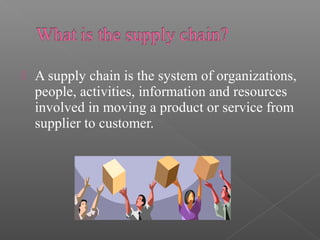
 A supply chain is the system of organizations,
people, activities, information and resources
involved in moving a product or service from
supplier to customer.
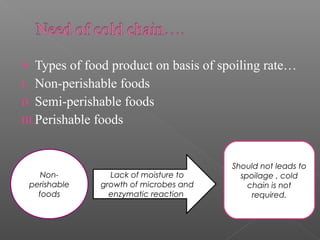
 Types of food product on basis of spoiling rate…
I. Non-perishable foods
II. Semi-perishable foods
III.Perishable foods
Non-
perishable
foods
Lack of moisture to
growth of microbes and
enzymatic reaction
Should not leads to
spoilage , cold
chain is not
required.
Semi –
perishable
foods
Perishable
foods
Moderate moisture leads
to growth of microbes
and enzymatic reaction
Resulting in
spoilage , need
to preserve at
low
temperature.
High moisture leads to
rapidly growth of microbes
and increase rate of
enzymatic reaction.
Spoilage , need of
cold chain to
suppress the
growth of microbes
and reduce the
rate of enzymatic
reaction.
Cold
chain
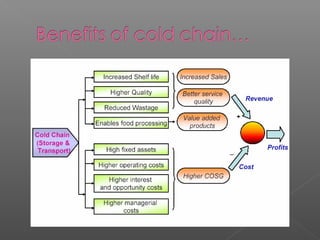
Increases the shelf
life of product , avoid
the changes in
sensory quality , keep
it product as fresh.
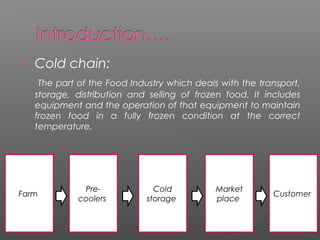
 Cold chain:
The part of the Food Industry which deals with the transport,
storage, distribution and selling of frozen food. It includes
equipment and the operation of that equipment to maintain
frozen food in a fully frozen condition at the correct
temperature.
Farm
Pre-
coolers
Cold
storage
Market
place
Customer
 Organisms required optimal temperature and Rh to
grow.
 The lower the temperature, the slower will be
chemical reactions, enzyme action. And microbial
growth; a low enough temperature will prevent the
growth of any microorganisms.
 The growth and metabolic reactions of
microorganisms depend on enzymes reaction is
directly affected by temperature.
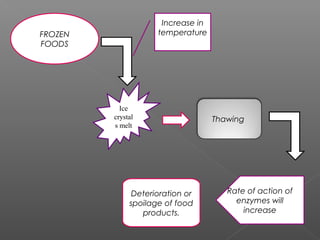
FROZEN
FOODS
Increase in
temperature
Ice
crystal
s melt
Thawing
Rate of action of
enzymes will
increase
Deterioration or
spoilage of food
products.
 Food freezes at different temperatures, often below
0o
C.
 Any increase in the temperature of the environment
in which the product is held, above –18o
C, will have
an adverse effect on the temperature of the product.
After being held for only a few minutes in warmer
air the product will start to thaw even though the
product may still appear frozen. When it is again
subjected to the correct environment temperature the
product will only freeze slowly because the
equipment in the Cold Chain is designed to maintain
product at –18o
C and not freeze product down to –
18o
C.
-18o
C
Class Bacteria species Minimum growth
temperature (oC)
Mesophilic Salmonella
Staphylococcus aureus
5.1to 8.7
9.5 to 10.4(for growth)
Psychrotrophic
Escherichia coli
Listeria monocytogenes
Yersinia enterocolitica
Aeromonas hydrophilia
14.3(for toxin production)
7.1
-0.1 to +1.2
-0.9 to –1.3
-0.1 to +1.2
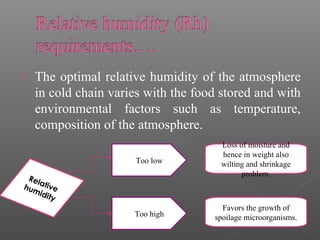
 The optimal relative humidity of the atmosphere
in cold chain varies with the food stored and with
environmental factors such as temperature,
composition of the atmosphere.
Relativehumidity
Too low
Too high
Loss of moisture and
hence in weight also
wilting and shrinkage
problem.
Favors the growth of
spoilage microorganisms.
Product Temperature(°C) Relative humidity %
Apples – 1 to 0 85-90
Bananas 14.5 95
Butter 0 to 4.4 80-85
Milk pasteurized 0.5 --
Eggs -1.5 to -0.5 80-85
Fish ,fresh 0.5 to 1.5 90-96
frozen -23.5 to -18 90-95
Grapes -0.5 85-90
Beef ,fresh 0-1 88-92
frozen -23.5 to -18 90-95
Mangos 10 85-90
Potatoes 3 to 4.5 85-90
Tomatoes , green 14 to 21 85-90
Ripe 7 to 10 85-90
 PPP (product-process-package)
 TTT (time-temperature-tolerance)
 The PPP factors are:
Product process package
Raw material quality.
Quality and suitability of ingredients
 The speed and effectiveness of the
chilling operation.
The use of additional processes
quality cannot be
gained from
processing, but it
certainly can be
lost.
ordinary packaging,‟
offering physical, chemical
and barriers.
advanced packaging ,‟
including Modified
Atmosphere Packaging.
 Packaging plays a key role in protecting the
product from contamination by external sources
and from damage during its passage from the
food producer to the consumer.
 Protect the food from ingress of gas, light, and
water vapor, each of which can result in the
deterioration of colors, oxidation of lipids and
unsaturated fats, denaturation of proteins and a
general loss of characteristic sensory qualities.
Packaging material Relative permeability
oxygen
Relative permeability
water vapor
Ethylene vinyl acetate
(EVOH)
<50(barrier) <10 (barrier)
Polycarbonate (PC) <50(barrier) variable
Polyester (PET) 200-5000(medium
barrier)
100-200(high)
Polyethylene (PE) 50-200(semi barrier) 10-30(semi barrier)
High density (HDPE) 200-5000(medium
barrier)
<10(barrier)
Low density (LDPE) 5000-10000(high) 10-30(semi barrier)
Polypropylene (PP) 200-5000(medium
barrier)
10-30(semi barrier)
 Freezing can preserve the taste, texture and nutritional value
of foods better than most other preservation methods.
 With the advancement of industrialization, people are living
far away from the food production areas; and are thickly
populated into the industrial areas. This dislocation of
population requires proper means for food preservation and
distribution without its spoilage. Cold chain play an important
role to distribute foods with freshness.
 Cold chain preserve the foods for longer time without
changing its physico-chemical properties during
transportation and distribution.
Thank
you!!!

Cold chain management

  • 1.
    Cold Chain Management {Foodproduct going in cold chain, their temperature and humidity requirement, packaging needs and their compatibility In cold chain.} by…….. Ganesh S. Raut
  • 2.
     A supplychain is the system of organizations, people, activities, information and resources involved in moving a product or service from supplier to customer.
  • 3.
     Types offood product on basis of spoiling rate… I. Non-perishable foods II. Semi-perishable foods III.Perishable foods Non- perishable foods Lack of moisture to growth of microbes and enzymatic reaction Should not leads to spoilage , cold chain is not required.
  • 4.
    Semi – perishable foods Perishable foods Moderate moistureleads to growth of microbes and enzymatic reaction Resulting in spoilage , need to preserve at low temperature. High moisture leads to rapidly growth of microbes and increase rate of enzymatic reaction. Spoilage , need of cold chain to suppress the growth of microbes and reduce the rate of enzymatic reaction. Cold chain Increases the shelf life of product , avoid the changes in sensory quality , keep it product as fresh.
  • 5.
     Cold chain: Thepart of the Food Industry which deals with the transport, storage, distribution and selling of frozen food. It includes equipment and the operation of that equipment to maintain frozen food in a fully frozen condition at the correct temperature. Farm Pre- coolers Cold storage Market place Customer
  • 7.
     Organisms requiredoptimal temperature and Rh to grow.  The lower the temperature, the slower will be chemical reactions, enzyme action. And microbial growth; a low enough temperature will prevent the growth of any microorganisms.  The growth and metabolic reactions of microorganisms depend on enzymes reaction is directly affected by temperature.
  • 8.
    FROZEN FOODS Increase in temperature Ice crystal s melt Thawing Rateof action of enzymes will increase Deterioration or spoilage of food products.
  • 9.
     Food freezesat different temperatures, often below 0o C.  Any increase in the temperature of the environment in which the product is held, above –18o C, will have an adverse effect on the temperature of the product. After being held for only a few minutes in warmer air the product will start to thaw even though the product may still appear frozen. When it is again subjected to the correct environment temperature the product will only freeze slowly because the equipment in the Cold Chain is designed to maintain product at –18o C and not freeze product down to – 18o C. -18o C
  • 10.
    Class Bacteria speciesMinimum growth temperature (oC) Mesophilic Salmonella Staphylococcus aureus 5.1to 8.7 9.5 to 10.4(for growth) Psychrotrophic Escherichia coli Listeria monocytogenes Yersinia enterocolitica Aeromonas hydrophilia 14.3(for toxin production) 7.1 -0.1 to +1.2 -0.9 to –1.3 -0.1 to +1.2
  • 11.
     The optimalrelative humidity of the atmosphere in cold chain varies with the food stored and with environmental factors such as temperature, composition of the atmosphere. Relativehumidity Too low Too high Loss of moisture and hence in weight also wilting and shrinkage problem. Favors the growth of spoilage microorganisms.
  • 12.
    Product Temperature(°C) Relativehumidity % Apples – 1 to 0 85-90 Bananas 14.5 95 Butter 0 to 4.4 80-85 Milk pasteurized 0.5 -- Eggs -1.5 to -0.5 80-85 Fish ,fresh 0.5 to 1.5 90-96 frozen -23.5 to -18 90-95 Grapes -0.5 85-90 Beef ,fresh 0-1 88-92 frozen -23.5 to -18 90-95 Mangos 10 85-90 Potatoes 3 to 4.5 85-90 Tomatoes , green 14 to 21 85-90 Ripe 7 to 10 85-90
  • 13.
     PPP (product-process-package) TTT (time-temperature-tolerance)  The PPP factors are: Product process package Raw material quality. Quality and suitability of ingredients  The speed and effectiveness of the chilling operation. The use of additional processes quality cannot be gained from processing, but it certainly can be lost. ordinary packaging,‟ offering physical, chemical and barriers. advanced packaging ,‟ including Modified Atmosphere Packaging.
  • 14.
     Packaging playsa key role in protecting the product from contamination by external sources and from damage during its passage from the food producer to the consumer.  Protect the food from ingress of gas, light, and water vapor, each of which can result in the deterioration of colors, oxidation of lipids and unsaturated fats, denaturation of proteins and a general loss of characteristic sensory qualities.
  • 15.
    Packaging material Relativepermeability oxygen Relative permeability water vapor Ethylene vinyl acetate (EVOH) <50(barrier) <10 (barrier) Polycarbonate (PC) <50(barrier) variable Polyester (PET) 200-5000(medium barrier) 100-200(high) Polyethylene (PE) 50-200(semi barrier) 10-30(semi barrier) High density (HDPE) 200-5000(medium barrier) <10(barrier) Low density (LDPE) 5000-10000(high) 10-30(semi barrier) Polypropylene (PP) 200-5000(medium barrier) 10-30(semi barrier)
  • 16.
     Freezing canpreserve the taste, texture and nutritional value of foods better than most other preservation methods.  With the advancement of industrialization, people are living far away from the food production areas; and are thickly populated into the industrial areas. This dislocation of population requires proper means for food preservation and distribution without its spoilage. Cold chain play an important role to distribute foods with freshness.  Cold chain preserve the foods for longer time without changing its physico-chemical properties during transportation and distribution.
  • 17.