PRESENTED BY GROUP 10:
AKANKSHA VERMA 20DM014
AMAN AGARWAL 20DM023
AMIT KUMAR HOODA 20DM028
ANAND VIJAY SONI 20DM030
CHITRANSH 20DM067
LEELA KRISHNA CHINNAREDDI 20DM112
RADHA GUPTA 20DM164
• Alphabet was created through a restructuring process
• Several subsidiaries faced problems after restructuring
• Timeline
INTRODUCTION
1995
2004
Expansion
1998
Incorporation
2000
Largest search engine
1997
Domain Registration
2015
INVESTOR RELATIONS
• IPO
• Approach to Corporate Governance
• Class C shares
INNOVATION AT GOOGLE
• 20% time
• Casual collision
• Embracing failure
INVESTING OUTSIDE THE CORE
Android - 2005
DoubleClick - 2007
YouTube - 2006
Moonshots
RESTRUCTURING
Announced on Aug-2015
Segment reporting was
introduced
Existing share of google were
converted
• On the new policy, Investors reacted
in a positive way.
• Which also showed in increase of
Google shares.
• Performances of Alphabet is very
promising and encouraging.
• By Feb 2016, alphabet share raised
by 50% compared to summer of
2015.
• 70-20-10 approach
• Organization structure, which
allows Alphabet to be
Innovative and stay ahead of
the time.
• Increase in Revenue compared to
last quarter 4 and also from
previous quarter.
• Found in 2011 by ex-Apple
employees.
• Google acquired it in 2014 for $3.2
billion.
• Niantic Labs as an Independent entity
in August, 2015.
• Bloomberg also part ways in 2015.
• 90% of revenue generated from
search engine and advertising
services.
CREDITS: This presentation template was created by Slidesgo,
including icons by Flaticon, and infographics & images by
Freepik and illustrations by Stories
Q1. Why does alphabet own widely different
subsidiaries under the same corporate structure? What
are the benefits of this choice? And the costs?
• Creates more value for the
company. For example,
YouTube.
• Giant corporation and hence
gets revenues.
• More expensive to have more
corporations.
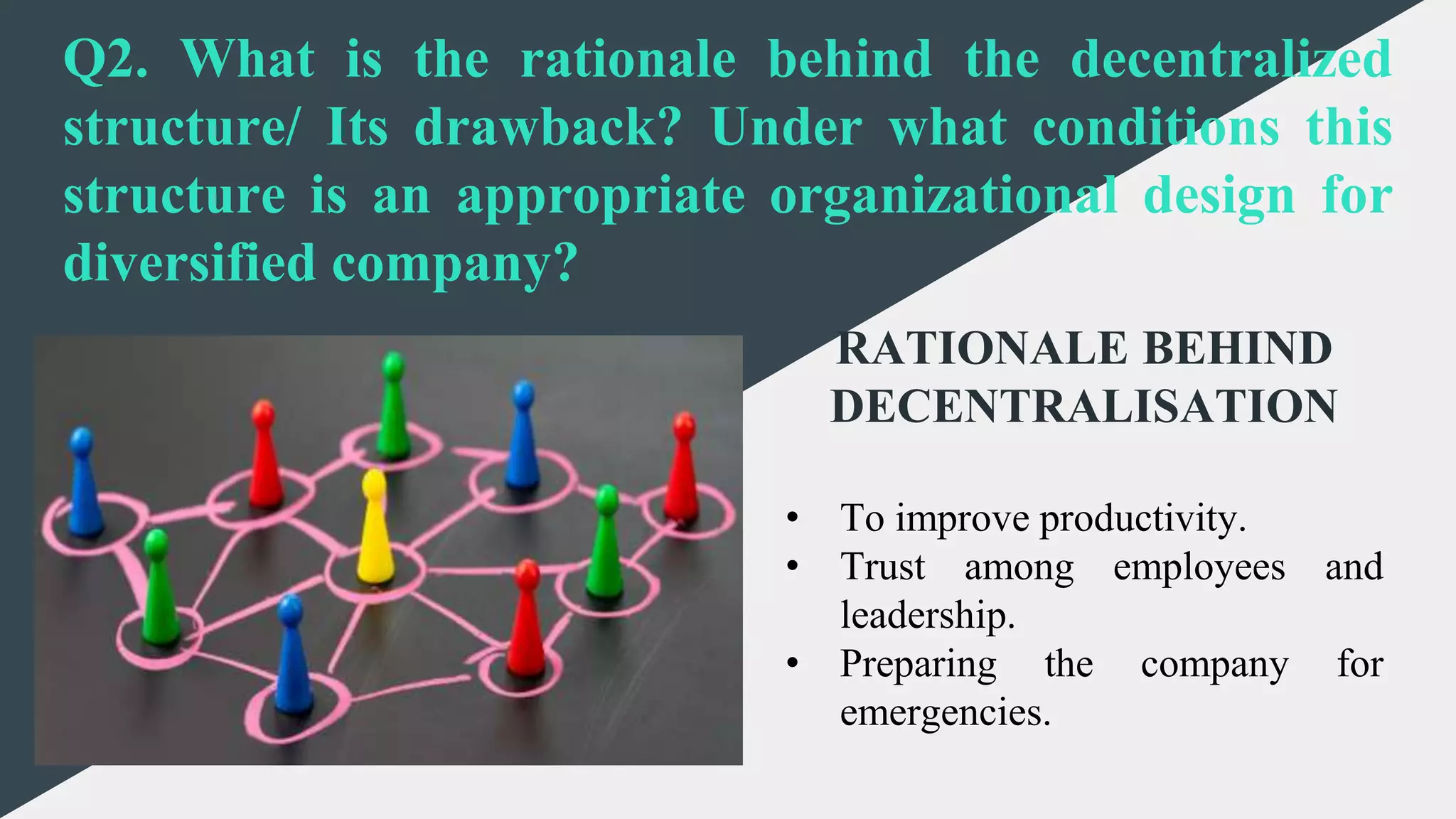
Q2. What is the rationale behind the decentralized
structure/ Its drawback? Under what conditions this
structure is an appropriate organizational design for
diversified company?
RATIONALE BEHIND
DECENTRALISATION
• To improve productivity.
• Trust among employees and
leadership.
• Preparing the company for
emergencies.
CREDITS: This presentation template was created by Slidesgo,
including icons by Flaticon, and infographics & images by
Freepik and illustrations by Stories
CONDITIONS FOR
DECENTRALISED STRUCTURE
IN A DIVERSIFIED COMPANY
• In case of expansion because of diversified
portfolios.
• In order to reduce burden from the top
executives.
• Opportunity for greater diversification of
product lines.
DRAWBACKS
• Lose control of day-to-day activities.
• Different agendas of managers in the same organisation.
Q3. Is Alphabet’s corporate governance (and in particular
the presence of dual class shares) appropriate for the
organization? What are the benefits? And the costs?
CORPORATE GOVERNANCE
Corporate governance is the
combination of rules, processes or laws
by which businesses are operated,
regulated or controlled.
Reasons of low Corporate Governance
rating of Alphabet:
• Restructuring issues
• Management style of Nest
• Composition of Board of Directors
• Presence of Dual Class Shares
CREDITS: This presentation template was created by Slidesgo,
including icons by Flaticon, and infographics & images by
Freepik and illustrations by Stories
• In August 2014, when Google
became public, the demand was
lower than expected.
• Also inconvenient was the dual
structure where Class A shares have
the right for one vote, and Class B
was reserved for google insiders only
and had the right for ten votes.
• This is not seen right because people
didn’t want to invest because they
didn’t have the right to vote.
Benefits:
• Company can take risky bets on new
technology
• Protects entrepreneurial management
from demands of ordinary shareholders
• Ensures loyal investors even during
rough patches
Costs:
• Create an inferior class of shareholders
• Ensures reins remain firmly in the hands
of promoters
• Allows management to make bad
decisions with few consequences
Alphabet Eyes New Frontiers

Alphabet Eyes New Frontiers

  • 1.
    PRESENTED BY GROUP10: AKANKSHA VERMA 20DM014 AMAN AGARWAL 20DM023 AMIT KUMAR HOODA 20DM028 ANAND VIJAY SONI 20DM030 CHITRANSH 20DM067 LEELA KRISHNA CHINNAREDDI 20DM112 RADHA GUPTA 20DM164
  • 2.
    • Alphabet wascreated through a restructuring process • Several subsidiaries faced problems after restructuring • Timeline INTRODUCTION 1995 2004 Expansion 1998 Incorporation 2000 Largest search engine 1997 Domain Registration 2015
  • 3.
    INVESTOR RELATIONS • IPO •Approach to Corporate Governance • Class C shares INNOVATION AT GOOGLE • 20% time • Casual collision • Embracing failure
  • 4.
    INVESTING OUTSIDE THECORE Android - 2005 DoubleClick - 2007 YouTube - 2006 Moonshots
  • 5.
    RESTRUCTURING Announced on Aug-2015 Segmentreporting was introduced Existing share of google were converted
  • 6.
    • On thenew policy, Investors reacted in a positive way. • Which also showed in increase of Google shares. • Performances of Alphabet is very promising and encouraging. • By Feb 2016, alphabet share raised by 50% compared to summer of 2015.
  • 7.
    • 70-20-10 approach •Organization structure, which allows Alphabet to be Innovative and stay ahead of the time. • Increase in Revenue compared to last quarter 4 and also from previous quarter. • Found in 2011 by ex-Apple employees. • Google acquired it in 2014 for $3.2 billion.
  • 8.
    • Niantic Labsas an Independent entity in August, 2015. • Bloomberg also part ways in 2015. • 90% of revenue generated from search engine and advertising services.
  • 9.
    CREDITS: This presentationtemplate was created by Slidesgo, including icons by Flaticon, and infographics & images by Freepik and illustrations by Stories Q1. Why does alphabet own widely different subsidiaries under the same corporate structure? What are the benefits of this choice? And the costs? • Creates more value for the company. For example, YouTube. • Giant corporation and hence gets revenues. • More expensive to have more corporations.
  • 10.
    Q2. What isthe rationale behind the decentralized structure/ Its drawback? Under what conditions this structure is an appropriate organizational design for diversified company? RATIONALE BEHIND DECENTRALISATION • To improve productivity. • Trust among employees and leadership. • Preparing the company for emergencies.
  • 11.
    CREDITS: This presentationtemplate was created by Slidesgo, including icons by Flaticon, and infographics & images by Freepik and illustrations by Stories CONDITIONS FOR DECENTRALISED STRUCTURE IN A DIVERSIFIED COMPANY • In case of expansion because of diversified portfolios. • In order to reduce burden from the top executives. • Opportunity for greater diversification of product lines. DRAWBACKS • Lose control of day-to-day activities. • Different agendas of managers in the same organisation.
  • 12.
    Q3. Is Alphabet’scorporate governance (and in particular the presence of dual class shares) appropriate for the organization? What are the benefits? And the costs? CORPORATE GOVERNANCE Corporate governance is the combination of rules, processes or laws by which businesses are operated, regulated or controlled. Reasons of low Corporate Governance rating of Alphabet: • Restructuring issues • Management style of Nest • Composition of Board of Directors • Presence of Dual Class Shares
  • 13.
    CREDITS: This presentationtemplate was created by Slidesgo, including icons by Flaticon, and infographics & images by Freepik and illustrations by Stories • In August 2014, when Google became public, the demand was lower than expected. • Also inconvenient was the dual structure where Class A shares have the right for one vote, and Class B was reserved for google insiders only and had the right for ten votes. • This is not seen right because people didn’t want to invest because they didn’t have the right to vote.
  • 14.
    Benefits: • Company cantake risky bets on new technology • Protects entrepreneurial management from demands of ordinary shareholders • Ensures loyal investors even during rough patches Costs: • Create an inferior class of shareholders • Ensures reins remain firmly in the hands of promoters • Allows management to make bad decisions with few consequences