Mayank Agrawal – E004
Arushi Kalara – E022
Prasad Nambiar – E036
Akriti Rastogi – E043
Prathamesh Shetty E052
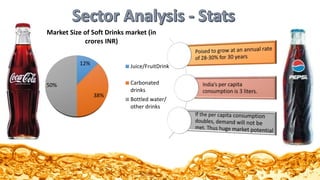
12%
38%
50%
Market Size of Soft Drinks market (in
crores INR)
Juice/FruitDrink
Carbonated
drinks
Bottled water/
other drinks
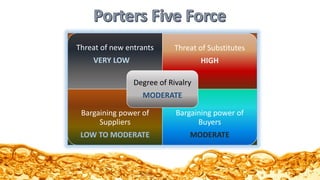
Threat of new entrants
VERY LOW
Threat of Substitutes
HIGH
Bargaining power of
Suppliers
LOW TO MODERATE
Bargaining power of
Buyers
MODERATE
Degree of Rivalry
MODERATE
Get new customers
• Who can use but do not use
• Who have never used or lives elsewhere
Find avenues for more usage
• Increase amount of usage
• Increase frequency of usage
Proactive marketing
• Through product and services
• Through process efficiency and cost saving
Defensive Marketing
• Position Defense
• Flanking Defense
• Pre-emptive Defense
• Counter Offensive Defense
• Mobile Defense
• Contraction Defense
Calorie conscious and diabetic people
refrain from drinking carbonated soft
drinks. Pepsi found the solution:
• PepsiCo introduced Patio Diet Cola in
1963 using aspartame as alternate
sweetener. Finally launched as Diet
Pepsi in 1964.
• Coca Cola launched Tab. Tab was
relaunched as Diet Coke in 1984.
• Royal crown came up with Diet Rite
Soda in the 1960s and 1970s.
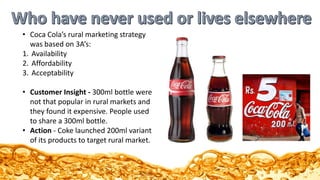
• Coca Cola’s rural marketing strategy
was based on 3A’s:
1. Availability
2. Affordability
3. Acceptability
• Customer Insight - 300ml bottle were
not that popular in rural markets and
they found it expensive. People used
to share a 300ml bottle.
• Action - Coke launched 200ml variant
of its products to target rural market.
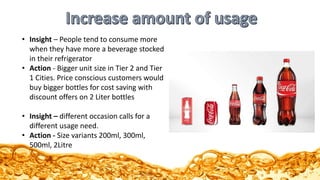
• Insight – People tend to consume more
when they have more a beverage stocked
in their refrigerator
• Action - Bigger unit size in Tier 2 and Tier
1 Cities. Price conscious customers would
buy bigger bottles for cost saving with
discount offers on 2 Liter bottles
• Insight – different occasion calls for a
different usage need.
• Action - Size variants 200ml, 300ml,
500ml, 2Litre
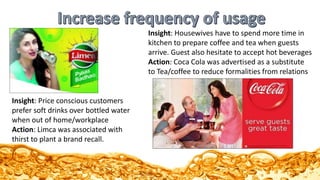
Insight: Price conscious customers
prefer soft drinks over bottled water
when out of home/workplace
Action: Limca was associated with
thirst to plant a brand recall.
Insight: Housewives have to spend more time in
kitchen to prepare coffee and tea when guests
arrive. Guest also hesitate to accept hot beverages
Action: Coca Cola was advertised as a substitute
to Tea/coffee to reduce formalities from relations
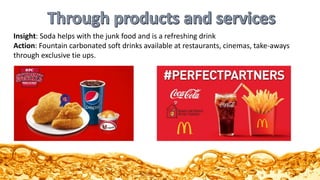
Insight: Soda helps with the junk food and is a refreshing drink
Action: Fountain carbonated soft drinks available at restaurants, cinemas, take-aways
through exclusive tie ups.
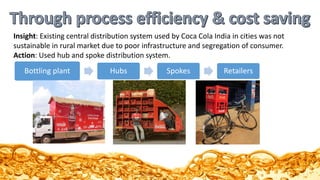
Insight: Existing central distribution system used by Coca Cola India in cities was not
sustainable in rural market due to poor infrastructure and segregation of consumer.
Action: Used hub and spoke distribution system.
Bottling plant Hubs Spokes Retailers
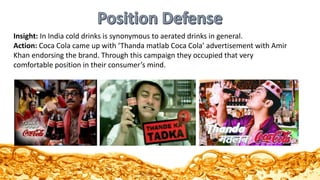
Insight: In India cold drinks is synonymous to aerated drinks in general.
Action: Coca Cola came up with ‘Thanda matlab Coca Cola’ advertisement with Amir
Khan endorsing the brand. Through this campaign they occupied that very
comfortable position in their consumer’s mind.
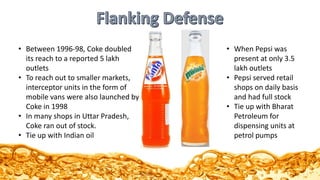
• Between 1996-98, Coke doubled
its reach to a reported 5 lakh
outlets
• To reach out to smaller markets,
interceptor units in the form of
mobile vans were also launched by
Coke in 1998
• In many shops in Uttar Pradesh,
Coke ran out of stock.
• Tie up with Indian oil
• When Pepsi was
present at only 3.5
lakh outlets
• Pepsi served retail
shops on daily basis
and had full stock
• Tie up with Bharat
Petroleum for
dispensing units at
petrol pumps
• Bottling was the biggest area of conflict between PepsiCo and Coca Cola
• Bottling operations held the key to distribution
• Coca cola had conflict with Ramesh Chauhan of Parle
• Pepsi made a bid to gain from the feud
• Pepsi won over Goa bottling company and others
• Also, Pepsi beat coca cola in diet cola segment by launching Diet Pepsi much before
• Coke had entered the Indian soft drinks market way back in the 1970s.
• The company was the market leader till 1977, when it had to exit the country
following policy changes regarding MNCs operating in India.
• Over the next few years, a host of local brands emerged such as Campa Cola,
Thumps Up, Gold Spot and Limca etc.
• With the entry of Pepsi and Coke in the 1990s, almost the entire market went
under their control.
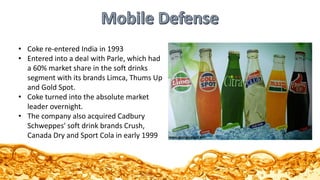
• Coke re-entered India in 1993
• Entered into a deal with Parle, which had
a 60% market share in the soft drinks
segment with its brands Limca, Thums Up
and Gold Spot.
• Coke turned into the absolute market
leader overnight.
• The company also acquired Cadbury
Schweppes' soft drink brands Crush,
Canada Dry and Sport Cola in early 1999
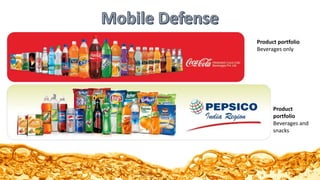
Product portfolio
Beverages only
Product
portfolio
Beverages and
snacks
Competitive Strategies - Aerated beverages

Competitive Strategies - Aerated beverages

  • 1.
    Mayank Agrawal –E004 Arushi Kalara – E022 Prasad Nambiar – E036 Akriti Rastogi – E043 Prathamesh Shetty E052
  • 3.
    12% 38% 50% Market Size ofSoft Drinks market (in crores INR) Juice/FruitDrink Carbonated drinks Bottled water/ other drinks
  • 4.
    Threat of newentrants VERY LOW Threat of Substitutes HIGH Bargaining power of Suppliers LOW TO MODERATE Bargaining power of Buyers MODERATE Degree of Rivalry MODERATE
  • 5.
    Get new customers •Who can use but do not use • Who have never used or lives elsewhere Find avenues for more usage • Increase amount of usage • Increase frequency of usage Proactive marketing • Through product and services • Through process efficiency and cost saving Defensive Marketing • Position Defense • Flanking Defense • Pre-emptive Defense • Counter Offensive Defense • Mobile Defense • Contraction Defense
  • 6.
    Calorie conscious anddiabetic people refrain from drinking carbonated soft drinks. Pepsi found the solution: • PepsiCo introduced Patio Diet Cola in 1963 using aspartame as alternate sweetener. Finally launched as Diet Pepsi in 1964. • Coca Cola launched Tab. Tab was relaunched as Diet Coke in 1984. • Royal crown came up with Diet Rite Soda in the 1960s and 1970s.
  • 7.
    • Coca Cola’srural marketing strategy was based on 3A’s: 1. Availability 2. Affordability 3. Acceptability • Customer Insight - 300ml bottle were not that popular in rural markets and they found it expensive. People used to share a 300ml bottle. • Action - Coke launched 200ml variant of its products to target rural market.
  • 8.
    • Insight –People tend to consume more when they have more a beverage stocked in their refrigerator • Action - Bigger unit size in Tier 2 and Tier 1 Cities. Price conscious customers would buy bigger bottles for cost saving with discount offers on 2 Liter bottles • Insight – different occasion calls for a different usage need. • Action - Size variants 200ml, 300ml, 500ml, 2Litre
  • 9.
    Insight: Price consciouscustomers prefer soft drinks over bottled water when out of home/workplace Action: Limca was associated with thirst to plant a brand recall. Insight: Housewives have to spend more time in kitchen to prepare coffee and tea when guests arrive. Guest also hesitate to accept hot beverages Action: Coca Cola was advertised as a substitute to Tea/coffee to reduce formalities from relations
  • 10.
    Insight: Soda helpswith the junk food and is a refreshing drink Action: Fountain carbonated soft drinks available at restaurants, cinemas, take-aways through exclusive tie ups.
  • 11.
    Insight: Existing centraldistribution system used by Coca Cola India in cities was not sustainable in rural market due to poor infrastructure and segregation of consumer. Action: Used hub and spoke distribution system. Bottling plant Hubs Spokes Retailers
  • 12.
    Insight: In Indiacold drinks is synonymous to aerated drinks in general. Action: Coca Cola came up with ‘Thanda matlab Coca Cola’ advertisement with Amir Khan endorsing the brand. Through this campaign they occupied that very comfortable position in their consumer’s mind.
  • 13.
    • Between 1996-98,Coke doubled its reach to a reported 5 lakh outlets • To reach out to smaller markets, interceptor units in the form of mobile vans were also launched by Coke in 1998 • In many shops in Uttar Pradesh, Coke ran out of stock. • Tie up with Indian oil • When Pepsi was present at only 3.5 lakh outlets • Pepsi served retail shops on daily basis and had full stock • Tie up with Bharat Petroleum for dispensing units at petrol pumps
  • 14.
    • Bottling wasthe biggest area of conflict between PepsiCo and Coca Cola • Bottling operations held the key to distribution • Coca cola had conflict with Ramesh Chauhan of Parle • Pepsi made a bid to gain from the feud • Pepsi won over Goa bottling company and others • Also, Pepsi beat coca cola in diet cola segment by launching Diet Pepsi much before
  • 15.
    • Coke hadentered the Indian soft drinks market way back in the 1970s. • The company was the market leader till 1977, when it had to exit the country following policy changes regarding MNCs operating in India. • Over the next few years, a host of local brands emerged such as Campa Cola, Thumps Up, Gold Spot and Limca etc. • With the entry of Pepsi and Coke in the 1990s, almost the entire market went under their control.
  • 16.
    • Coke re-enteredIndia in 1993 • Entered into a deal with Parle, which had a 60% market share in the soft drinks segment with its brands Limca, Thums Up and Gold Spot. • Coke turned into the absolute market leader overnight. • The company also acquired Cadbury Schweppes' soft drink brands Crush, Canada Dry and Sport Cola in early 1999
  • 17.