1
Clinical Research Basics
Mohamed Fahmy Doheim
M.B.B.Ch Candidate
Previous lecture
Previous lecture
Study Designs
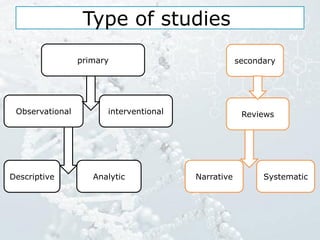
Type of studies
primary secondary
Observational interventional
AnalyticDescriptive
Reviews
Narrative Systematic
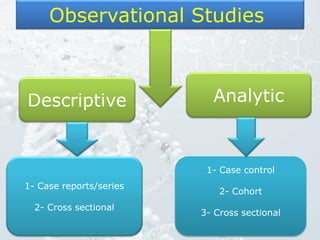
Observational Studies
Descriptive Analytic
1- Case reports/series
2- Cross sectional
1- Case control
2- Cohort
3- Cross sectional
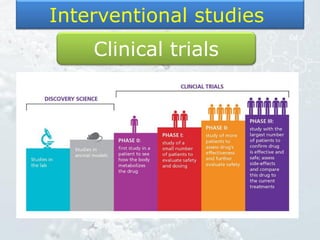
Interventional studies
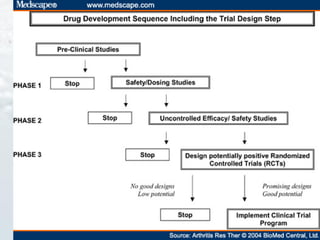
Clinical trials
 Randomized controlled trials
are the standards of excellence for
clinical trials.
 Other types:
• Uncontrolled trials.
• Non randomized trials
According to the study design
Randomization
• Allocation of treatments to participants is
carried out using a chance mechanism so
that neither the patient nor the physician
know in advance which therapy will be
assigned
• Simplest Case: each patient has the same
chance of receiving any of the treatments
under study
• We can not ensure comparability but
Randomization helps to balance all factors
between treatment groups
• If randomization “works” then groups will be
similar in all aspects except for the treatment
received
Blinding
• Masking the identity of the assigned
interventions
• Main goal: avoid potential bias caused by
conscious or subconscious factors
• Open-label.
• Single blind: patient is blinded
• Double blind: patient and assessing
investigator are blinded
• Triple blind: e.g. Statistician is also blinded
General Study Designs
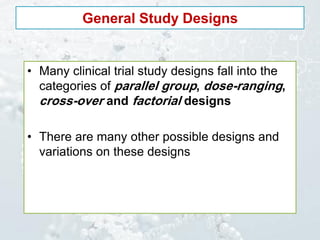
• Many clinical trial study designs fall into the
categories of parallel group, dose-ranging,
cross-over and factorial designs
• There are many other possible designs and
variations on these designs
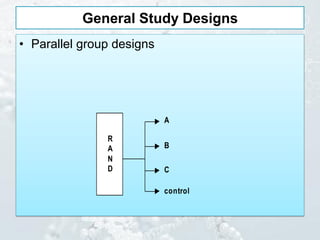
General Study Designs
• Parallel group designs
R
A
N
D
A
B
C
control
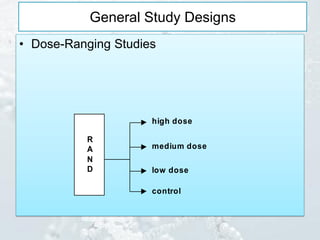
General Study Designs
• Dose-Ranging Studies
R
A
N
D
high dose
medium dose
low dose
control
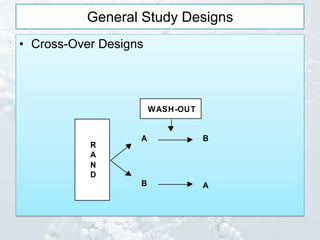
General Study Designs
• Cross-Over Designs
R
A
N
D
A
B
B
A
WASH-OUT
General Study Designs
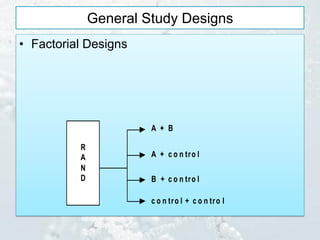
• Factorial Designs
R
A
N
D
A + B
A + c o n tro l
B + c o n tro l
c o n tro l + c o n tro l
Factorial Designs
• Example: Physician’s Health Study
• Physicians randomized to:
aspirin (to prevent cardiovascular disease)
beta-carotene (to prevent cancer)
aspirin and beta-carotene
neither (placebo)
Stampfer, Buring, Willett, Rosner, Eberlein and Hennekens
(1985) The 2x2 factorial design: it’s application to a randomized
trial of aspirin and carotene in U.S. physicians. Stat. in Med.
9:111-116.
Observational Designs
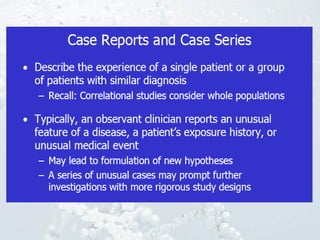
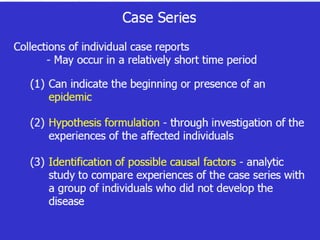
• Descriptive: used to formulate a
certain hypothesis: small / large scale.
Examples: case report,case-series;
correlation studies, cross-sectional
studies
• Analytical: used to test hypotheses:
small / large scale. Examples: case-
control, cross-sectional, cohort.
Cross-sectional studies
(Prevalence studies)
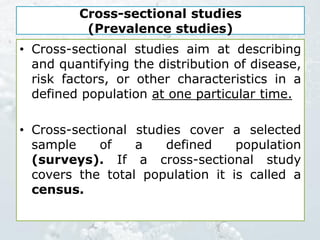
• Cross-sectional studies aim at describing
and quantifying the distribution of disease,
risk factors, or other characteristics in a
defined population at one particular time.
• Cross-sectional studies cover a selected
sample of a defined population
(surveys). If a cross-sectional study
covers the total population it is called a
census.
Cross-sectional studies
(Prevalence studies)
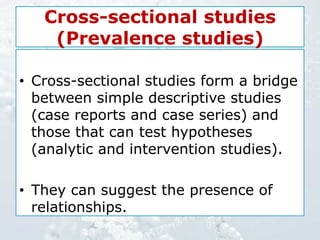
• Cross-sectional studies form a bridge
between simple descriptive studies
(case reports and case series) and
those that can test hypotheses
(analytic and intervention studies).
• They can suggest the presence of
relationships.
ANALYTICAL STUDIES
• Describe associations (between
exposure & outcome) and analyze
them for possible cause and effect.
• Attempt to establish causes or risk
factors for certain problems.
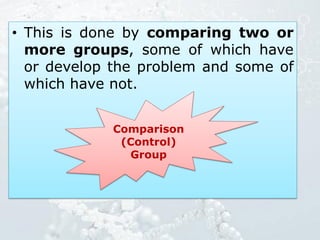
• This is done by comparing two or
more groups, some of which have
or develop the problem and some of
which have not.
Comparison
(Control)
Group
Types of analytical studies
• Case-control studies
• Cohort studies
•Cross sectional study
Case-control studies
• In a CASE-CONTROL STUDY the investigator
compares one group among whom the problem
that he wishes to investigate is present (e.g.
malnutrition) and another group called a control
or comparison group, where the problem is
absent, in order to find out what factors have
contributed to the problem.
Cohort studies
• In a COHORT STUDY, a group of individuals that
is exposed to a risk factor (study group) is
compared to a group of individuals not
exposed to the risk factor (control group).
• The researcher follows both groups over time and
compares the occurrence of the problem that
he expects to be related to the risk factor in the
two groups to determine whether a greater
proportion of those with the risk factor are indeed
affected.
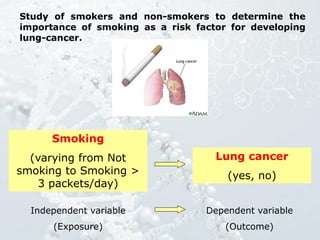
Smoking
(varying from Not
smoking to Smoking >
3 packets/day)
Lung cancer
(yes, no)
Independent variable
(Exposure)
Dependent variable
(Outcome)
Study of smokers and non-smokers to determine the
importance of smoking as a risk factor for developing
lung-cancer.
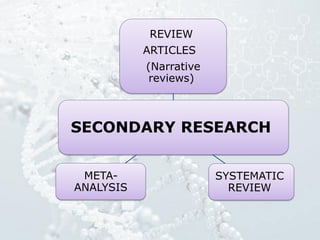
SECONDARY RESEARCH
REVIEW
ARTICLES
(Narrative
reviews)
SYSTEMATIC
REVIEW
META-
ANALYSIS
REVIEW ARTICLES
(Narrative reviews)
Health care professionals have always used review articles as
a source of summarized evidence on a particular topic.
Review articles in the medical literature have traditionally
been in the form of ‘‘narrative reviews’’ where experts in a
particular field provide what is supposed to be a ‘‘summary of
evidence’’ in that field.
Narrative reviews, although still very common in the medical
field, have been criticized because of the high risk of bias,
and ‘‘systematic reviews’’ are preferred.
Systematic reviews apply scientific strategies in ways that
limit bias to the assembly, a critical appraisal, and
synthesis of relevant studies that address a specific
clinical question.
Systematic review & Meta-
analysis
• A systematic review is a comprehensive survey of a topic
in which all of the primary studies of the highest level of
evidence have been systematically identified, appraised
and then summarized according to an explicit and
reproducible methodology.
• A meta-analysis is a survey in which the results of all of
the included studies are similar enough statistically that
the results are combined and analyzed as if they
were one study.
In general, a good systematic review or meta-analysis will
be a better guide to practice than an individual article.
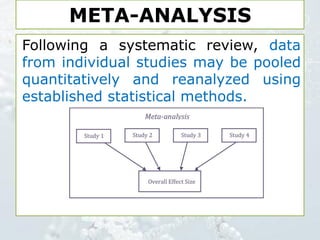
META-ANALYSIS
Following a systematic review, data
from individual studies may be pooled
quantitatively and reanalyzed using
established statistical methods.
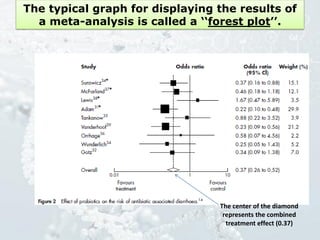
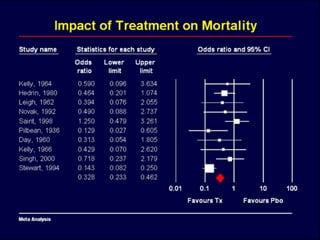
The typical graph for displaying the results of
a meta-analysis is called a ‘‘forest plot’’.
The center of the diamond
represents the combined
treatment effect (0.37)
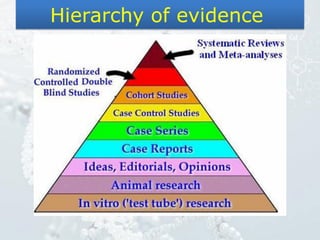
Hierarchy of evidence
Clinical research  (study designs)

Clinical research (study designs)

  • 1.
    1 Clinical Research Basics MohamedFahmy Doheim M.B.B.Ch Candidate
  • 2.
  • 3.
  • 4.
  • 5.
    Type of studies primarysecondary Observational interventional AnalyticDescriptive Reviews Narrative Systematic
  • 6.
    Observational Studies Descriptive Analytic 1-Case reports/series 2- Cross sectional 1- Case control 2- Cohort 3- Cross sectional
  • 7.
  • 9.
     Randomized controlledtrials are the standards of excellence for clinical trials.  Other types: • Uncontrolled trials. • Non randomized trials According to the study design
  • 10.
    Randomization • Allocation oftreatments to participants is carried out using a chance mechanism so that neither the patient nor the physician know in advance which therapy will be assigned • Simplest Case: each patient has the same chance of receiving any of the treatments under study
  • 11.
    • We cannot ensure comparability but Randomization helps to balance all factors between treatment groups • If randomization “works” then groups will be similar in all aspects except for the treatment received
  • 12.
    Blinding • Masking theidentity of the assigned interventions • Main goal: avoid potential bias caused by conscious or subconscious factors • Open-label. • Single blind: patient is blinded • Double blind: patient and assessing investigator are blinded • Triple blind: e.g. Statistician is also blinded
  • 13.
    General Study Designs •Many clinical trial study designs fall into the categories of parallel group, dose-ranging, cross-over and factorial designs • There are many other possible designs and variations on these designs
  • 14.
    General Study Designs •Parallel group designs R A N D A B C control
  • 15.
    General Study Designs •Dose-Ranging Studies R A N D high dose medium dose low dose control
  • 16.
    General Study Designs •Cross-Over Designs R A N D A B B A WASH-OUT
  • 17.
    General Study Designs •Factorial Designs R A N D A + B A + c o n tro l B + c o n tro l c o n tro l + c o n tro l
  • 18.
    Factorial Designs • Example:Physician’s Health Study • Physicians randomized to: aspirin (to prevent cardiovascular disease) beta-carotene (to prevent cancer) aspirin and beta-carotene neither (placebo) Stampfer, Buring, Willett, Rosner, Eberlein and Hennekens (1985) The 2x2 factorial design: it’s application to a randomized trial of aspirin and carotene in U.S. physicians. Stat. in Med. 9:111-116.
  • 20.
    Observational Designs • Descriptive:used to formulate a certain hypothesis: small / large scale. Examples: case report,case-series; correlation studies, cross-sectional studies • Analytical: used to test hypotheses: small / large scale. Examples: case- control, cross-sectional, cohort.
  • 23.
    Cross-sectional studies (Prevalence studies) •Cross-sectional studies aim at describing and quantifying the distribution of disease, risk factors, or other characteristics in a defined population at one particular time. • Cross-sectional studies cover a selected sample of a defined population (surveys). If a cross-sectional study covers the total population it is called a census.
  • 24.
    Cross-sectional studies (Prevalence studies) •Cross-sectional studies form a bridge between simple descriptive studies (case reports and case series) and those that can test hypotheses (analytic and intervention studies). • They can suggest the presence of relationships.
  • 25.
    ANALYTICAL STUDIES • Describeassociations (between exposure & outcome) and analyze them for possible cause and effect. • Attempt to establish causes or risk factors for certain problems.
  • 26.
    • This isdone by comparing two or more groups, some of which have or develop the problem and some of which have not. Comparison (Control) Group
  • 27.
    Types of analyticalstudies • Case-control studies • Cohort studies •Cross sectional study
  • 28.
    Case-control studies • Ina CASE-CONTROL STUDY the investigator compares one group among whom the problem that he wishes to investigate is present (e.g. malnutrition) and another group called a control or comparison group, where the problem is absent, in order to find out what factors have contributed to the problem.
  • 29.
    Cohort studies • Ina COHORT STUDY, a group of individuals that is exposed to a risk factor (study group) is compared to a group of individuals not exposed to the risk factor (control group). • The researcher follows both groups over time and compares the occurrence of the problem that he expects to be related to the risk factor in the two groups to determine whether a greater proportion of those with the risk factor are indeed affected.
  • 30.
    Smoking (varying from Not smokingto Smoking > 3 packets/day) Lung cancer (yes, no) Independent variable (Exposure) Dependent variable (Outcome) Study of smokers and non-smokers to determine the importance of smoking as a risk factor for developing lung-cancer.
  • 31.
  • 32.
    REVIEW ARTICLES (Narrative reviews) Healthcare professionals have always used review articles as a source of summarized evidence on a particular topic. Review articles in the medical literature have traditionally been in the form of ‘‘narrative reviews’’ where experts in a particular field provide what is supposed to be a ‘‘summary of evidence’’ in that field. Narrative reviews, although still very common in the medical field, have been criticized because of the high risk of bias, and ‘‘systematic reviews’’ are preferred. Systematic reviews apply scientific strategies in ways that limit bias to the assembly, a critical appraisal, and synthesis of relevant studies that address a specific clinical question.
  • 33.
    Systematic review &Meta- analysis • A systematic review is a comprehensive survey of a topic in which all of the primary studies of the highest level of evidence have been systematically identified, appraised and then summarized according to an explicit and reproducible methodology. • A meta-analysis is a survey in which the results of all of the included studies are similar enough statistically that the results are combined and analyzed as if they were one study. In general, a good systematic review or meta-analysis will be a better guide to practice than an individual article.
  • 35.
    META-ANALYSIS Following a systematicreview, data from individual studies may be pooled quantitatively and reanalyzed using established statistical methods.
  • 36.
    The typical graphfor displaying the results of a meta-analysis is called a ‘‘forest plot’’. The center of the diamond represents the combined treatment effect (0.37)
  • 38.