Cognitive
DissonanceTheory
Presented By-
Kondru Alvin Lucas_08
Aliva Kujur_18
Kakoli Bhakat_29
Subhashree Panda_39
Dikshya Sharma_50
Manpreet Nayak_61
Vikash Tripathi_72
Introduction
Cognitive - Includes thinking, knowing,
remembering, judging and problem solving.
Dissonance – Refers to a situation involving
conflicting attitudes, beliefs or behaviours.
Cognitive Dissonance Theory
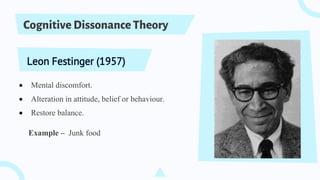
Leon Festinger (1957)
 Mental discomfort.
 Alteration in attitude, belief or behaviour.
 Restore balance.
Example – Junk food
Howitcametobe?
 Observation – cult and fringe people.
 Earth destroyed by flood.
 How dissonance avoid?
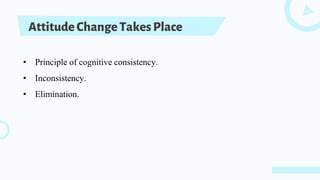
AttitudeChangeTakesPlace
• Principle of cognitive consistency.
• Inconsistency.
• Elimination.
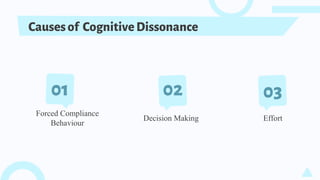
Forced Compliance
Behaviour
Decision Making Effort
Causesof CognitiveDissonance
01 02 03
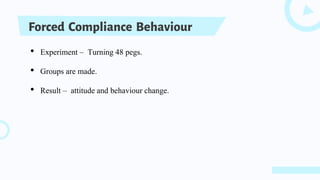
Forced Compliance Behaviour
• Experiment – Turning 48 pegs.
• Groups are made.
• Result – attitude and behaviour change.
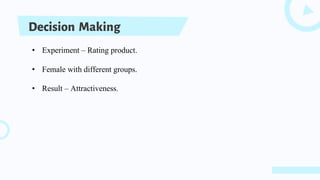
Decision Making
• Experiment – Rating product.
• Female with different groups.
• Result – Attractiveness.
Effort
• Experiment – Discussion
• Discussion on topic
• Result – Positive attitude
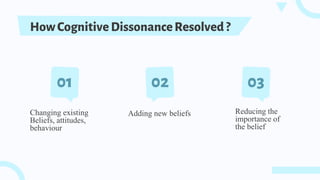
HowCognitiveDissonanceResolved?
Changing existing
Beliefs, attitudes,
behaviour
Adding new beliefs Reducing the
importance of
the belief
01 02 03
ChangingExistingBeliefs,Attitudes, Behaviour
• Dissonant elements behaviour, change or eliminate behaviour.
• Difficult to change behaviour.
• Eg. Giving up smoking
AddingNewBeliefs
• For example, thinking smoking causes lung cancer.
• New information added to belief.
ReducingtheImportanceofTheBelief
• A person convince themselves .
• Also could tell reason.
• Decreasing importance.
• Motivational drive reduce dissonance.
• Common in work place.
• Increase self-awareness.
Conclusion
cognitive dissonance theory

cognitive dissonance theory