Consumer Behaviour
Motivation
• Motivation is one’s willingness to pushup efforts
to accomplish some specific goals. It is an inner
state of mind that activates and directs our
behaviour.
• It can be defined as “Motivation is a process that
starts with a psychological or physiological
deficiency or need that activated behaviour or a
drive that is aimed at a goal or incentive”
- Fred Luthans
Significance of Motivation
• On the basis of above definitions, the following observations can be made
regarding motivation:
▫ Motivation is an inner psychological force, which activates and compels
the person to behave in a particular manner.
▫ The motivation process is influenced by personality traits, learning
abilities, perception and competence of an individual.
▫ A highly motivated employee works more efficiently and his level of
production tends to be higher than others.
▫ Motivation originates from the-needs and wants of an individual. It is a
tension of lacking something in his mind, which forces him to work more
efficiently.
▫ Motivation is also a process of stimulating and channelising the energy of
an individual for achieving set goals.
▫ Motivation also plays a crucial role in determining the level of
performance. Highly motivated employees get higher satisfaction, which
may lead to higher efficiency.
Significance of Motivation
▫ The process of Motivation helps the manager in analysing and
understanding human behavior and finding but how an
individual can be inspired to produce desirable working behavior.
▫ Motivation may be positive as well as negative. Positive
motivation includes incentives, rewards and other benefits while
negative motivation implies some punishment, fear, use of force
etc.
▫ The motivation procedure contributes to and boosts up the
morale of the employees. A high degree of motivation may lead to
high morale.
IMPORTANCE OF MOTIVATION
• Motivation is an important part of managing process. A team of highly qualified
and motivated employees is necessary for achieving objectives of an organization
because of the following reasons:
• Motivated employees make optimum use of available resources for achieving
objectives.
• Motivation is directly related to the level of efficiency of employees.
• Motivated employees make full use of their energy and other abilities to raise the
existing level of efficiency.
• Motivated employees make goal-directed efforts. They are more committed and
cooperative for achieving organizational objectives.
• Motivated employees are more loyal and sincere to an organization. These factors
help reduce absenteeism and labor turnover.
• Motivation is considered as a backbone of good industrial relations.
• Effectively motivated employees get more job satisfaction and possess high
morale.
• Motivation also helps in improving the image of an organization.
Theories of Motivation
• NEED-BASED THEORIES TO
MOTIVATION
▫ Need-based theories try to answer the question,
"what factor(s) motivate people to choose certain
behaviors?“
• PROCESS-BASED THEORIES TO
MOTIVATION
▫ Process-based theories to motivation are
concerned with how motivation occurs
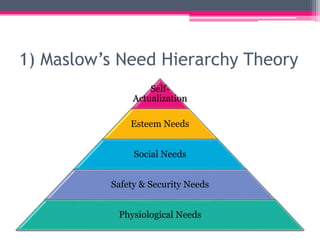
1) Maslow’s Need Hierarchy Theory
Self-
Actualization
Esteem Needs
Social Needs
Safety & Security Needs
Physiological Needs
Maslow’s Need Hierarchy Theory
• Maslow suggested that the five levels of needs are arranged in
accordance with their importance, starting from the bottom of the
hierarchy.
• An individual is motivated first and foremost to satisfy physiological
needs.
• When these needs are satisfied, he is motivated and 'moves up' the
hierarchy to satisfy security needs.
• This 'moving up process continues until the individual reaches the self-
actualization level.
 Physiological needs represent the basic issues of survival such as food,
water and air. In organizational settings, most physiological needs are
satisfied by adequate wages and by the work environment itself, which
provides employees with rest rooms, adequate lighting, comfortable
temperatures and ventilation.
Maslow’s Need Hierarchy Theory
o Security or safety needs refer to the requirements for a secure physical
and emotional environment. Examples include the desire for adequate
housing and clothing, the need to be free from worry about money and
job security and the desire for safe working conditions. Security needs
are satisfied for people in the work place by job continuity, a grievance
resolving system and an adequate insurance and retirement benefit
package.
• Belonging or social needs are related to the, social aspect of human life.
They include the need for love and affection and the need to be
accepted by one's peers. For most people these needs are satisfied by a
combination of family and community relationships and friendships on
the job. Managers can help ensure the 'satisfaction of these important
needs by allowing social interaction and by making employees feel like
part of a team or work group.
Maslow’s Need Hierarchy Theory
• Esteem needs actually comprise of two different sets of needs:
▫ The need for a positive self-image and self-respect.
▫ The need for recognition and respect from others.
• Organizations can help address esteem needs by providing a variety of
external symbols of accomplishment such as job titles and spacious offices.
• At a more fundamental level, organizations can also help satisfy esteem
needs by providing employees with challenging job assignments that can
induce a sense of accomplishment.
• At the top of the hierarchy are those needs, which Maslow defines the self-
actualization needs. These needs involve realizing one's potential for
continued: growth and individual development.
• Since these needs are highly individualized and personal, self-actualization
needs are perhaps the most difficult for managers to address. Therefore, an
employee should try to meet these needs on his own end.
Maslow’s Need Hierarchy Theory
• However, an organization can help his employee by creating a climate
for fulfillment of self-actualization needs.
• For instance, an organization can help in fulfillment of these needs by
encouraging employee’s participation in decision-making process and by
providing them with an opportunity to learn new things about their jobs
and organization.
• This process of contributing to actual organizational performance helps
employees experience personal growth and development associated with
self-actualizing.
• Maslow's concept of the need hierarchy possesses a certain intuitive
logic and has been accepted universally by managers. But research has
revealed several shortcomings of the theory such as some research has
found that five levels of needs are not always present and that the order
of the levels is not always the same as assumed by Maslow. Moreover, it
is difficult for organizations to use the need hierarchy to enhance
employee motivation.
3) ERG Theory
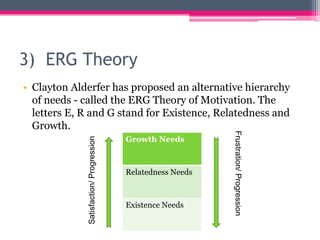
• Clayton Alderfer has proposed an alternative hierarchy
of needs - called the ERG Theory of Motivation. The
letters E, R and G stand for Existence, Relatedness and
Growth.
Growth Needs
Relatedness Needs
Existence Needs
Satisfaction/Progression
Frustration/Progression
ERG Theory
• ERG Theory the need hierarchy developed by Maslow into three 9.2. The existence needs in
this theory refers to the physiological and security needs of Maslow. Relatedness needs
refers to belongingness and esteem needs. Growth needs refers to both self-esteem and self-
actualization needs.
•
• Although ERG Theory assumes that motivated behavior follows a hierarchy in somewhat the
same fashion as suggested by Maslow, there are two important differences.
• Firstly, ERG theory suggests that more than one kind of need might motivate a person at the
same time. For example, it allows for the possibility that people can be motivated by a desire
for money (existence); friendship (relatedness), and an opportunity to learn new skills
(growth) all at the same time.
• Secondly, ERG theory has an element of frustrations-regression that is missing from
Maslow's need hierarchy. Maslow maintained that one heed must be satisfied before an
individual can progress to needs at a higher level, for example, from security needs to
belongingness. This is termed as satisfaction—progression process.
ERG Theory
• Although the ERG theory includes this process, it also suggests that if needs
remain unsatisfied at some higher level, the individual will become
frustrated, regress to a lower level and will begin to pursue low level needs
again.
• For" example, a worker previously motivated by money (existence needs) is
awarded a pay rise to satisfy this needs. Then he attempts to establish more
friendship to satisfy relatedness needs. If for some reason an employee
finds that it is impossible to become better friends with others in the work
place, he may eventually become frustrated and regress to being motivated
to earn even more money. This is termed as ‘frustration-regression' process.
• The ERG theory emphasis on the following key points regarding needs:
▫ Some needs may be more important than others.
▫ People may change their behavior after any particular set of needs has
been satisfied.
5) McClelland’s Needs Theory Of
Motivation
• David C. McClelland and his associate Atkinson have contributed to an
understanding of motivation by identifying three types of basic motivating
needs. These needs have been classified as:
▫ Need for Power
▫ Need for Affiliation
▫ Need for Achievement : :
• Need for Power
• According to this theory the need for power, which might be defined as the
desire to be influential in a group and to control one's environment is an
important motivation factor. Research suggests that people with a strong
need for power, are likely to be superior performers and occupy
supervisory positions. Such types of individuals generally look for
positions of leadership, they act effectively, are outspoken, have a
stubborn character and exert authority.
McClelland’s Needs Theory Of
Motivation
• Need for Affiliation
• The need for affiliation means the desire for human companionship and
acceptance. Those with a high need for affiliation often behave the way they think
other people want them to, in an effort to maintain friendship. They prefer a job
that entails a good deal of social interaction and offers opportunities to make
friends. The principal characteristics of such peoples' traits are as follows:
▫ Desire to like and be liked.
▫ Enjoy company and friendship.
▫ Prefer cooperative situation.
▫ Excel in group task.
▫ Star attraction in gathering.
▫ Leadership qualities.
• This need is closely associated with the "social-type” of personality, who are
sociable, friendly, cooperative and understanding. Persons with high motivation
for power and affiliation have better chances of becoming good managers.
McClelland’s Needs Theory Of
Motivation
• Need for Achievement
• People with a high need for achievement, always feel ambitious to be
successful; are ever prepared to face challenging situations and set
arduous goals .for themselves.
• They are prone to take calculated risks; and possess a high sense of
personal responsibility in getting jobs done.
• These people are concerned with their progress, and feel inclined to
put in longer hours of work" Failures never dishearten them and
they are always ready to put in their best efforts for excellent
performance.
PROCESS-BASED THEORIES TO MOTIVATION
• The field of consumer behavior has generally moved a way from the needs
theories of motivation.
• Needs theories are content-oriented - that is, they explain what are the causes
leading to motivated behaviors. They do not explain why or how motivated
behavior occurs.
• These questions relate to behaviors or actions, goals and feelings of
satisfaction., These concepts are addressed by various process-based theories to
motivation.
• Process-based theories to motivation are concerned with how motivation
occurs.
• They focus on why people choose to enact certain behavioral options to fulfill
their needs and how they evaluate their satisfaction after they have attained
these goals.
• Two of the most useful process-based approaches to motivation arc expectancy
theory and equity theory.
PROCESS-BASED THEORIES TO MOTIVATION
PROCESS-BASED THEORIES TO
MOTIVATION
• (a) Expectancy Theory of Motivation
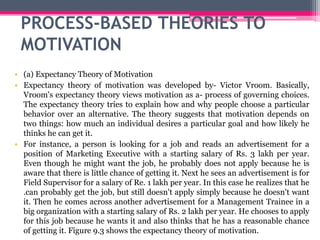
• Expectancy theory of motivation was developed by- Victor Vroom. Basically,
Vroom's expectancy theory views motivation as a- process of governing choices.
The expectancy theory tries to explain how and why people choose a particular
behavior over an alternative. The theory suggests that motivation depends on
two things: how much an individual desires a particular goal and how likely he
thinks he can get it.
• For instance, a person is looking for a job and reads an advertisement for a
position of Marketing Executive with a starting salary of Rs. 3 lakh per year.
Even though he might want the job, he probably does not apply because he is
aware that there is little chance of getting it. Next he sees an advertisement is for
Field Supervisor for a salary of Re. 1 lakh per year. In this case he realizes that he
.can probably get the job, but still doesn't apply simply because he doesn't want
it. Then he comes across another advertisement for a Management Trainee in a
big organization with a starting salary of Rs. 2 lakh per year. He chooses to apply
for this job because he wants it and also thinks that he has a reasonable chance
of getting it. Figure 9.3 shows the expectancy theory of motivation.
PROCESS-BASED THEORIES TO
MOTIVATION
• Equity Theory
▫ J. Stacy Adams developed equity theory of motivation.
The equity theory argues that motivations arise out of
simple desire to be treated fairly. Equity can be
defined as an individual's belief that he is being treated
fairly relative to the treatment of others.
PROCESS-BASED THEORIES TO
MOTIVATION
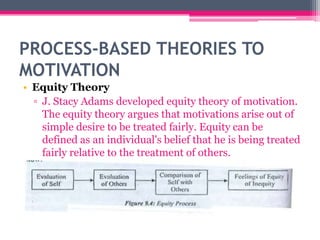
• A person's perception of equity develops through a four-
step process as shown below:
• First an individual evaluates the way he is being treated
by an organization.
• The next step is for an individual to choose a co-worker
who seems to be in a roughly similar situation and to
observe how an organization treats him.
• In the crucial step of equity theory an individual
'compares' the two treatments.
• In the fourth step he evaluate a sense of equity to see if
the two treatments seem similar or if the are different.

CONSUMER BEHAVIOUR

  • 1.
  • 2.
    Motivation • Motivation isone’s willingness to pushup efforts to accomplish some specific goals. It is an inner state of mind that activates and directs our behaviour. • It can be defined as “Motivation is a process that starts with a psychological or physiological deficiency or need that activated behaviour or a drive that is aimed at a goal or incentive” - Fred Luthans
  • 3.
    Significance of Motivation •On the basis of above definitions, the following observations can be made regarding motivation: ▫ Motivation is an inner psychological force, which activates and compels the person to behave in a particular manner. ▫ The motivation process is influenced by personality traits, learning abilities, perception and competence of an individual. ▫ A highly motivated employee works more efficiently and his level of production tends to be higher than others. ▫ Motivation originates from the-needs and wants of an individual. It is a tension of lacking something in his mind, which forces him to work more efficiently. ▫ Motivation is also a process of stimulating and channelising the energy of an individual for achieving set goals. ▫ Motivation also plays a crucial role in determining the level of performance. Highly motivated employees get higher satisfaction, which may lead to higher efficiency.
  • 4.
    Significance of Motivation ▫The process of Motivation helps the manager in analysing and understanding human behavior and finding but how an individual can be inspired to produce desirable working behavior. ▫ Motivation may be positive as well as negative. Positive motivation includes incentives, rewards and other benefits while negative motivation implies some punishment, fear, use of force etc. ▫ The motivation procedure contributes to and boosts up the morale of the employees. A high degree of motivation may lead to high morale.
  • 5.
    IMPORTANCE OF MOTIVATION •Motivation is an important part of managing process. A team of highly qualified and motivated employees is necessary for achieving objectives of an organization because of the following reasons: • Motivated employees make optimum use of available resources for achieving objectives. • Motivation is directly related to the level of efficiency of employees. • Motivated employees make full use of their energy and other abilities to raise the existing level of efficiency. • Motivated employees make goal-directed efforts. They are more committed and cooperative for achieving organizational objectives. • Motivated employees are more loyal and sincere to an organization. These factors help reduce absenteeism and labor turnover. • Motivation is considered as a backbone of good industrial relations. • Effectively motivated employees get more job satisfaction and possess high morale. • Motivation also helps in improving the image of an organization.
  • 6.
    Theories of Motivation •NEED-BASED THEORIES TO MOTIVATION ▫ Need-based theories try to answer the question, "what factor(s) motivate people to choose certain behaviors?“ • PROCESS-BASED THEORIES TO MOTIVATION ▫ Process-based theories to motivation are concerned with how motivation occurs
  • 7.
    1) Maslow’s NeedHierarchy Theory Self- Actualization Esteem Needs Social Needs Safety & Security Needs Physiological Needs
  • 8.
    Maslow’s Need HierarchyTheory • Maslow suggested that the five levels of needs are arranged in accordance with their importance, starting from the bottom of the hierarchy. • An individual is motivated first and foremost to satisfy physiological needs. • When these needs are satisfied, he is motivated and 'moves up' the hierarchy to satisfy security needs. • This 'moving up process continues until the individual reaches the self- actualization level.  Physiological needs represent the basic issues of survival such as food, water and air. In organizational settings, most physiological needs are satisfied by adequate wages and by the work environment itself, which provides employees with rest rooms, adequate lighting, comfortable temperatures and ventilation.
  • 9.
    Maslow’s Need HierarchyTheory o Security or safety needs refer to the requirements for a secure physical and emotional environment. Examples include the desire for adequate housing and clothing, the need to be free from worry about money and job security and the desire for safe working conditions. Security needs are satisfied for people in the work place by job continuity, a grievance resolving system and an adequate insurance and retirement benefit package. • Belonging or social needs are related to the, social aspect of human life. They include the need for love and affection and the need to be accepted by one's peers. For most people these needs are satisfied by a combination of family and community relationships and friendships on the job. Managers can help ensure the 'satisfaction of these important needs by allowing social interaction and by making employees feel like part of a team or work group.
  • 10.
    Maslow’s Need HierarchyTheory • Esteem needs actually comprise of two different sets of needs: ▫ The need for a positive self-image and self-respect. ▫ The need for recognition and respect from others. • Organizations can help address esteem needs by providing a variety of external symbols of accomplishment such as job titles and spacious offices. • At a more fundamental level, organizations can also help satisfy esteem needs by providing employees with challenging job assignments that can induce a sense of accomplishment. • At the top of the hierarchy are those needs, which Maslow defines the self- actualization needs. These needs involve realizing one's potential for continued: growth and individual development. • Since these needs are highly individualized and personal, self-actualization needs are perhaps the most difficult for managers to address. Therefore, an employee should try to meet these needs on his own end.
  • 11.
    Maslow’s Need HierarchyTheory • However, an organization can help his employee by creating a climate for fulfillment of self-actualization needs. • For instance, an organization can help in fulfillment of these needs by encouraging employee’s participation in decision-making process and by providing them with an opportunity to learn new things about their jobs and organization. • This process of contributing to actual organizational performance helps employees experience personal growth and development associated with self-actualizing. • Maslow's concept of the need hierarchy possesses a certain intuitive logic and has been accepted universally by managers. But research has revealed several shortcomings of the theory such as some research has found that five levels of needs are not always present and that the order of the levels is not always the same as assumed by Maslow. Moreover, it is difficult for organizations to use the need hierarchy to enhance employee motivation.
  • 12.
    3) ERG Theory •Clayton Alderfer has proposed an alternative hierarchy of needs - called the ERG Theory of Motivation. The letters E, R and G stand for Existence, Relatedness and Growth. Growth Needs Relatedness Needs Existence Needs Satisfaction/Progression Frustration/Progression
  • 13.
    ERG Theory • ERGTheory the need hierarchy developed by Maslow into three 9.2. The existence needs in this theory refers to the physiological and security needs of Maslow. Relatedness needs refers to belongingness and esteem needs. Growth needs refers to both self-esteem and self- actualization needs. • • Although ERG Theory assumes that motivated behavior follows a hierarchy in somewhat the same fashion as suggested by Maslow, there are two important differences. • Firstly, ERG theory suggests that more than one kind of need might motivate a person at the same time. For example, it allows for the possibility that people can be motivated by a desire for money (existence); friendship (relatedness), and an opportunity to learn new skills (growth) all at the same time. • Secondly, ERG theory has an element of frustrations-regression that is missing from Maslow's need hierarchy. Maslow maintained that one heed must be satisfied before an individual can progress to needs at a higher level, for example, from security needs to belongingness. This is termed as satisfaction—progression process.
  • 14.
    ERG Theory • Althoughthe ERG theory includes this process, it also suggests that if needs remain unsatisfied at some higher level, the individual will become frustrated, regress to a lower level and will begin to pursue low level needs again. • For" example, a worker previously motivated by money (existence needs) is awarded a pay rise to satisfy this needs. Then he attempts to establish more friendship to satisfy relatedness needs. If for some reason an employee finds that it is impossible to become better friends with others in the work place, he may eventually become frustrated and regress to being motivated to earn even more money. This is termed as ‘frustration-regression' process. • The ERG theory emphasis on the following key points regarding needs: ▫ Some needs may be more important than others. ▫ People may change their behavior after any particular set of needs has been satisfied.
  • 15.
    5) McClelland’s NeedsTheory Of Motivation • David C. McClelland and his associate Atkinson have contributed to an understanding of motivation by identifying three types of basic motivating needs. These needs have been classified as: ▫ Need for Power ▫ Need for Affiliation ▫ Need for Achievement : : • Need for Power • According to this theory the need for power, which might be defined as the desire to be influential in a group and to control one's environment is an important motivation factor. Research suggests that people with a strong need for power, are likely to be superior performers and occupy supervisory positions. Such types of individuals generally look for positions of leadership, they act effectively, are outspoken, have a stubborn character and exert authority.
  • 16.
    McClelland’s Needs TheoryOf Motivation • Need for Affiliation • The need for affiliation means the desire for human companionship and acceptance. Those with a high need for affiliation often behave the way they think other people want them to, in an effort to maintain friendship. They prefer a job that entails a good deal of social interaction and offers opportunities to make friends. The principal characteristics of such peoples' traits are as follows: ▫ Desire to like and be liked. ▫ Enjoy company and friendship. ▫ Prefer cooperative situation. ▫ Excel in group task. ▫ Star attraction in gathering. ▫ Leadership qualities. • This need is closely associated with the "social-type” of personality, who are sociable, friendly, cooperative and understanding. Persons with high motivation for power and affiliation have better chances of becoming good managers.
  • 17.
    McClelland’s Needs TheoryOf Motivation • Need for Achievement • People with a high need for achievement, always feel ambitious to be successful; are ever prepared to face challenging situations and set arduous goals .for themselves. • They are prone to take calculated risks; and possess a high sense of personal responsibility in getting jobs done. • These people are concerned with their progress, and feel inclined to put in longer hours of work" Failures never dishearten them and they are always ready to put in their best efforts for excellent performance.
  • 18.
    PROCESS-BASED THEORIES TOMOTIVATION • The field of consumer behavior has generally moved a way from the needs theories of motivation. • Needs theories are content-oriented - that is, they explain what are the causes leading to motivated behaviors. They do not explain why or how motivated behavior occurs. • These questions relate to behaviors or actions, goals and feelings of satisfaction., These concepts are addressed by various process-based theories to motivation. • Process-based theories to motivation are concerned with how motivation occurs. • They focus on why people choose to enact certain behavioral options to fulfill their needs and how they evaluate their satisfaction after they have attained these goals. • Two of the most useful process-based approaches to motivation arc expectancy theory and equity theory.
  • 19.
  • 20.
    PROCESS-BASED THEORIES TO MOTIVATION •(a) Expectancy Theory of Motivation • Expectancy theory of motivation was developed by- Victor Vroom. Basically, Vroom's expectancy theory views motivation as a- process of governing choices. The expectancy theory tries to explain how and why people choose a particular behavior over an alternative. The theory suggests that motivation depends on two things: how much an individual desires a particular goal and how likely he thinks he can get it. • For instance, a person is looking for a job and reads an advertisement for a position of Marketing Executive with a starting salary of Rs. 3 lakh per year. Even though he might want the job, he probably does not apply because he is aware that there is little chance of getting it. Next he sees an advertisement is for Field Supervisor for a salary of Re. 1 lakh per year. In this case he realizes that he .can probably get the job, but still doesn't apply simply because he doesn't want it. Then he comes across another advertisement for a Management Trainee in a big organization with a starting salary of Rs. 2 lakh per year. He chooses to apply for this job because he wants it and also thinks that he has a reasonable chance of getting it. Figure 9.3 shows the expectancy theory of motivation.
  • 21.
    PROCESS-BASED THEORIES TO MOTIVATION •Equity Theory ▫ J. Stacy Adams developed equity theory of motivation. The equity theory argues that motivations arise out of simple desire to be treated fairly. Equity can be defined as an individual's belief that he is being treated fairly relative to the treatment of others.
  • 22.
    PROCESS-BASED THEORIES TO MOTIVATION •A person's perception of equity develops through a four- step process as shown below: • First an individual evaluates the way he is being treated by an organization. • The next step is for an individual to choose a co-worker who seems to be in a roughly similar situation and to observe how an organization treats him. • In the crucial step of equity theory an individual 'compares' the two treatments. • In the fourth step he evaluate a sense of equity to see if the two treatments seem similar or if the are different.