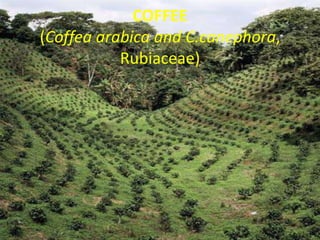
COFFEE
(Coffea arabica and C.canephora,
Rubiaceae)
Introduction
• Coffee production in India is dominated in the hill tracts of South
Indian states, with Karnataka accounting for 71%, followed
by Kerala with 21% and Tamil Nadu (5% of overall production with
8,200 tonnes).
• Indian coffee is said to be the finest coffee grown in the shade
rather than direct sunlight anywhere in the world.
• There are about 250,000 coffee growers in the country; 98% of
them are small growers.
• As of 2009, Indian coffee made up just 4.5% of the global
production.
• Almost 80% of Indian coffee is exported; 70% is bound for Germany,
Russia, Spain, Belgium, Slovenia, United States, Japan, Greece,
Netherlands and France.
• Italy accounts for 29% of the exports. Most of the export is shipped
through the Suez Canal (Egypt).
Growing areas in India
• Coffee is grown in three regions of India with
Karnataka, Kerala and Tamil Nadu forming the
traditional coffee growing region, followed by the
new areas developed in the non-traditional areas
of Andhra Pradesh and Orissa in the eastern coast
of the country and with a third region comprising
the states of Assam, Manipur, Meghalaya,
Mizoram, Tripura, Nagaland and Arunachal
Pradesh of Northeastern India, popularly known
as “Seven Sister States of India".
• Indian coffee, grown mostly in southern states under
monsoon rainfall conditions, is also termed as “Indian
monsooned coffee".
• Its flavour is defined as: "The best Indian coffee
reaches the flavour characteristics of Pacific coffees,
but at its worst it is simply bland and uninspiring”.
• The two well known species of coffee grown are
the Arabica and Robusta.
• The first variety that was introduced in the Baba Budan
Giri hill ranges of Karnataka in the 17th century was
marketed over the years under the brand names of
Kent and S.795.
History of coffee cultivation
• First attributed to Ethiopia and then to Arabia (Yemen).
• In india, coffee growing was started by an Indian Muslim saint (Baba
Budan)- brought coffee beans (7) while returning from Mecca
hiding in his beard to Mysore.
• Planted on Chandragiri Hills in Chikkamangaluru district.
• Against the rule
• Initially Arabica coffee was popular, but due to coffee rust infection
Robusta and hybrid (liberica x Arabica) became popular.
• Coffee VII Act of 1942 Coffee Board of India
• There was a time when coffee plantation was replaced by tea
plantations.
• In the 1940s, Indian filter coffee, a sweet milky coffee made from
dark roasted coffee beans (70%–80%) and chicory (20%–30%)
became a commercial success. It was especially popular in the
southern states of Andhra Pradesh, Karnataka, Kerala and Tamil
Nadu.
Growing conditions
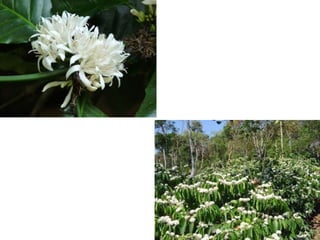
• In shade and commonly with 2 tiers of shade.
• Intercropped with spices such
as cardamom, cinnamon, clove, and nutmeg.
• Growing altitudes range between 1,000 m (3,300 ft) to
1,500 m (4,900 ft) above sea level for Arabica (premier
coffee), and 500 m (1,600 ft) to 1,000 m (3,300 ft)
for Robusta.
• India's coffees tend to be moderately acidic which can
lead to either a balanced and sweet taste, or a listless
and inert one.
• Slopes of Arabica tend to be gentle to moderate,
while Robusta slopes are gentle to fairly level.
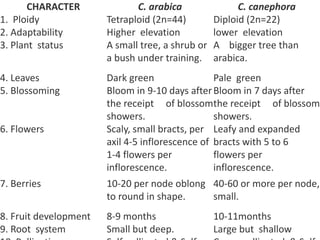
• Though the genus Coffea consists of about
70 species, only 3 species are of economic
importance. They are 1) C. arabica (Arabica
coffee), 2) C. canephora (Robusta coffee) and
3) C. liberica (Tree coffee). The first two
species are extensively cultivated. The
important differences among these two
species are:
CHARACTER C. arabica C. canephora
1. Ploidy Tetraploid (2n=44) Diploid (2n=22)
2. Adaptability Higher elevation lower elevation
3. Plant status A small tree, a shrub or
a bush under training.
A bigger tree than
arabica.
4. Leaves Dark green Pale green
5. Blossoming Bloom in 9-10 days after
the receipt of blossom
showers.
Bloom in 7 days after
the receipt of blossom
showers.
6. Flowers Scaly, small bracts, per
axil 4-5 inflorescence of
1-4 flowers per
inflorescence.
Leafy and expanded
bracts with 5 to 6
flowers per
inflorescence.
7. Berries 10-20 per node oblong
to round in shape.
40-60 or more per node,
small.
8. Fruit development 8-9 months 10-11months
9. Root system Small but deep. Large but shallow
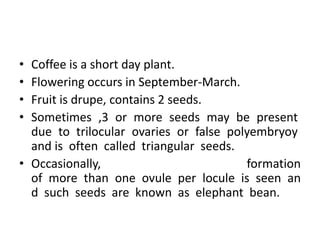
• Coffee is a short day plant.
• Flowering occurs in September-March.
• Fruit is drupe, contains 2 seeds.
• Sometimes ,3 or more seeds may be present
due to trilocular ovaries or false polyembryoy
and is often called triangular seeds.
• Occasionally, formation
of more than one ovule per locule is seen an
d such seeds are known as elephant bean.
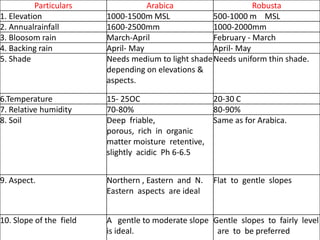
Particulars Arabica Robusta
1. Elevation 1000-1500m MSL 500-1000 m MSL
2. Annualrainfall 1600-2500mm 1000-2000mm
3. Bloosom rain March-April February - March
4. Backing rain April- May April- May
5. Shade Needs medium to light shade
depending on elevations &
aspects.
Needs uniform thin shade.
6.Temperature 15- 25OC 20-30 C
7. Relative humidity 70-80% 80-90%
8. Soil Deep friable,
porous, rich in organic
matter moisture retentive,
slightly acidic Ph 6-6.5
Same as for Arabica.
9. Aspect. Northern , Eastern and N.
Eastern aspects are ideal
Flat to gentle slopes
10. Slope of the field A gentle to moderate slope
is ideal.
Gentle slopes to fairly level
are to be preferred
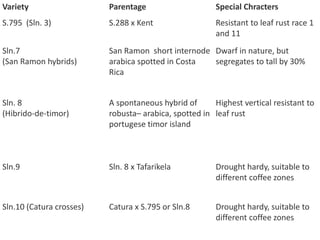
Variety Parentage Special Chracters
S.795 (Sln. 3) S.288 x Kent Resistant to leaf rust race 1
and 11
Sln.7
(San Ramon hybrids)
San Ramon short internode
arabica spotted in Costa
Rica
Dwarf in nature, but
segregates to tall by 30%
Sln. 8
(Hibrido-de-timor)
A spontaneous hybrid of
robusta– arabica, spotted in
portugese timor island
Highest vertical resistant to
leaf rust
Sln.9 Sln. 8 x Tafarikela Drought hardy, suitable to
different coffee zones
Sln.10 (Catura crosses) Catura x S.795 or Sln.8 Drought hardy, suitable to
different coffee zones
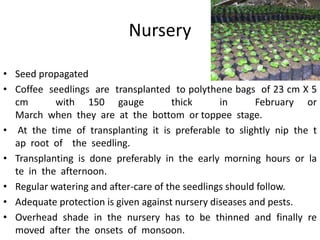
Nursery
• Seed propagated
• Coffee seedlings are transplanted to polythene bags of 23 cm X 5
cm with 150 gauge thick in February or
March when they are at the bottom or toppee stage.
• At the time of transplanting it is preferable to slightly nip the t
ap root of the seedling.
• Transplanting is done preferably in the early morning hours or la
te in the afternoon.
• Regular watering and after-care of the seedlings should follow.
• Adequate protection is given against nursery diseases and pests.
• Overhead shade in the nursery has to be thinned and finally re
moved after the onsets of monsoon.
Spacing
• 1.5-2 m x 1.5-2 m
• seedlings of 16 to 18 months
old are planted during June or September –
October.
• Variety: Cauvery, Kent, Selection-9
Training and pruning
• Training of the bush is necessary to have a strong frame
work which promotes production of bearing wood.
Coffee is trained in two systems viz
• Single stem system
• When the plant reaches a height of 75 cm in Arabica or 110 to 120
cm in robusta, it is topped. This helps to restrict vertical growth,
facilitate lateral spreading and increase the bearing area.
In this system, a second tier is also allowed sometimes
depending upon the soil fertility and plant’ s vigour.
• Multiple stem system
• It is common in Kenya, Tanzania, is not practiced in India.
Pruning in coffee is generally done immediately after
harvest and till the onset of monsoon.
It is essentially a thinning process and is done
mainly to divert the vigour of the plants to certain parts by
pruning the other parts. Pruning involves a) Centering b)
Desuckering c) Handling
Soil Management
• Digging: In the new clearing, the field is given a thorough digging
to a depth of about 35-45 cm towards the end of the monsoon. All weeds
and vegetative debris are completely turned under and buried
in the soil while the stumps are removed. Once the coffee plants have closed
in, annual digging is not done.
• Scuffling or Soil stirring: In established coffee fields, scuffling or soil stirring
is done towards the beginning of the dry period . It controls weeds and also
conserves soil moisture.
• Mulching
• Trenching: Trenches and pits are dug or renovated in a staggered manner
between rows of coffee along the contour during August-October when the soil is
fairly easy to work.
• Weed control
• Irrigation: Springer irrigation is mainly used as an insurance against failure of good
blossom or backing showers.
• Soil acidity and liming: The heavy rainfall in coffee growing zones of South
India brings about leaching in calcium and magnesium leading to soil acidity.
Besides, continuous use of acid forming fertilizers like ammonium sulphate also
makes the soil acidic. Agricultural lime and dolomite lime are the most commonly
used liming materials.
Shade and its management
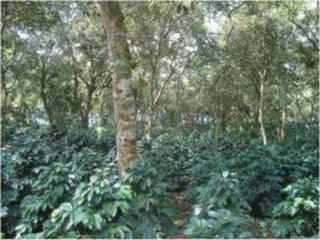
• Under the climatic conditions existing in India. Coffee is
being cultivated under shade. It comprises of two
canopies lower or temporary and upper or permanent.
• Dadap is used as a lower canopy shade in India. Next to
dadap,silver oak is the most commonly used tree for t
emporary shade.
• The most popular permanent shade trees found in south
India. Albizzia lebbec, A.odoratissima, A.moluccana,
Artocarpus integrifolia, etc., Permanent shade trees are
generally planted about 12 to 14 m apart. The most
convenient time to regulate shade is after pruning and
liming.
Processing of Coffee
• Coffee is processed in two ways a) wet processing to prepare
plantation or parchment coffee and b) dry method by which cherry
coffee is prepared.
I. Preparation of parchment coffee:
1. Pulping
This method requires equipment and adequate supply of clean
water. Fruits should be pulped on the same day to avoid
fermentation before pulping. Fruits may be fed to the pulper
through siphon arrangement to ensure uniform feeding and to
separate lights and floats from sound fruits. The pulped
parchment should be sieved to eliminate any unpulped fruits and
fruits skin. The skins are separated by pulping should be let away
from the vats into collection pits so that microbial decomposition
of the skin will not affect the bean quality when it gets mixed up
with the bean.
• 2) Demucilaging and washing
The mucilage on the parchment skin can be removed by
A) Natural fermentation
The mucilage breaks down in the process of fermentation and it takes 24-36
hours for arabica and 72 hours for robusta. Cool weather delays the process of
fermentation. Under fermented or over fermented beans affect quality.
When correctly fermented the mucilage comes off easily and the parchment
does not stick to the hand after washing and the beans feel rough and gritty
when squeezed by hand. When the mucilage breakdown is complete, clean
water is let in and the parchment washed pebble clean with three to four
changes of water.
B) Treatment with alkali
Removal of mucilage by treatment with alkali takes about one hour for arabica
and one and a half to two hours for robusta. The beans obtained after pulping
are drained off excess water and spread out in the wax uniformly and
furrowed with wooden ladles with a long handles. A 10% solution of caustic
soda (NaOH) is evenly applied into the furrows using a water can.10 litres of
alkali is sufficient to treat 25-30 forlits (1 forlit = 40 litres) of parchment. The
parchment is agitated thoroughly by the ladles so as to make the alkali to
come into contact with the parchment and trampled by feet for about half an
hour. When the parchment is no longer slimy and makes a rattling noise, clean
water is let in and the parchment washed clean with 3 or 4 changes of water.
• C) Removal of mucilage by friction
There are machines, which pulp and demucilage the beans in one
operation. However, a number of naked and bruised beans may result in the
parchment. It is, therefore, necessary to adjust the machines carefully to
obtain uniform pulping and demucilaging. Cup-test results have indicated
that there is no difference in cup quality coffee processed by different
method.
3. Drying
The next stage is drying the parchment in the sun until the moisture
content is sufficiently reduced to permit storage of beans till they are
dispatched to curing works. Under dried parchment turns mouldy and gets
bleached storage and subsequent curing operations.
Stirring and turning over coffee, at least once an hour, is necessary to
facilitate uniform drying. The parchment should be heaped up and covered
in the evening until next morning. Sun drying may take about 7 to 10 days
under bright weather conditions. Drying is complete when a sample of
coffee records the same weight for two days consecutively. When coffee is
being a dried, all naked bean, pulper nipped and bruised beans, blacks,
greens and other defective beans are sorted out and dispatched to curing
works separately.
• II. Preparation of cherry
For preparation of cherry coffee fruits should be
picked, as and when they ripe. Green and under-ripe
should be sorted out and dried separately.
• The fruits should be spread evenly to a thickness of
about 8 cm on clean drying ground in which the
cherries are stirred and ridged atleast once every hour.
• The cherry is dry when a fistful of the drying cherry
produces a rattling sound when shaken and a sample
records the same weight on two consecutive days. The
cherry should be fully dry at the end of 12 to 15 days
under bright weather conditions.
https://www.youtube.com/watch?v=mkbSZWc7NBc
https://www.youtube.com/watch?v=FdfwlMuXZQc
coffee tea.pptx
coffee tea.pptx

coffee tea.pptx

  • 1.
    COFFEE (Coffea arabica andC.canephora, Rubiaceae)
  • 2.
    Introduction • Coffee productionin India is dominated in the hill tracts of South Indian states, with Karnataka accounting for 71%, followed by Kerala with 21% and Tamil Nadu (5% of overall production with 8,200 tonnes). • Indian coffee is said to be the finest coffee grown in the shade rather than direct sunlight anywhere in the world. • There are about 250,000 coffee growers in the country; 98% of them are small growers. • As of 2009, Indian coffee made up just 4.5% of the global production. • Almost 80% of Indian coffee is exported; 70% is bound for Germany, Russia, Spain, Belgium, Slovenia, United States, Japan, Greece, Netherlands and France. • Italy accounts for 29% of the exports. Most of the export is shipped through the Suez Canal (Egypt).
  • 3.
    Growing areas inIndia • Coffee is grown in three regions of India with Karnataka, Kerala and Tamil Nadu forming the traditional coffee growing region, followed by the new areas developed in the non-traditional areas of Andhra Pradesh and Orissa in the eastern coast of the country and with a third region comprising the states of Assam, Manipur, Meghalaya, Mizoram, Tripura, Nagaland and Arunachal Pradesh of Northeastern India, popularly known as “Seven Sister States of India".
  • 4.
    • Indian coffee,grown mostly in southern states under monsoon rainfall conditions, is also termed as “Indian monsooned coffee". • Its flavour is defined as: "The best Indian coffee reaches the flavour characteristics of Pacific coffees, but at its worst it is simply bland and uninspiring”. • The two well known species of coffee grown are the Arabica and Robusta. • The first variety that was introduced in the Baba Budan Giri hill ranges of Karnataka in the 17th century was marketed over the years under the brand names of Kent and S.795.
  • 5.
    History of coffeecultivation • First attributed to Ethiopia and then to Arabia (Yemen). • In india, coffee growing was started by an Indian Muslim saint (Baba Budan)- brought coffee beans (7) while returning from Mecca hiding in his beard to Mysore. • Planted on Chandragiri Hills in Chikkamangaluru district. • Against the rule • Initially Arabica coffee was popular, but due to coffee rust infection Robusta and hybrid (liberica x Arabica) became popular. • Coffee VII Act of 1942 Coffee Board of India • There was a time when coffee plantation was replaced by tea plantations. • In the 1940s, Indian filter coffee, a sweet milky coffee made from dark roasted coffee beans (70%–80%) and chicory (20%–30%) became a commercial success. It was especially popular in the southern states of Andhra Pradesh, Karnataka, Kerala and Tamil Nadu.
  • 6.
    Growing conditions • Inshade and commonly with 2 tiers of shade. • Intercropped with spices such as cardamom, cinnamon, clove, and nutmeg. • Growing altitudes range between 1,000 m (3,300 ft) to 1,500 m (4,900 ft) above sea level for Arabica (premier coffee), and 500 m (1,600 ft) to 1,000 m (3,300 ft) for Robusta. • India's coffees tend to be moderately acidic which can lead to either a balanced and sweet taste, or a listless and inert one. • Slopes of Arabica tend to be gentle to moderate, while Robusta slopes are gentle to fairly level.
  • 8.
    • Though thegenus Coffea consists of about 70 species, only 3 species are of economic importance. They are 1) C. arabica (Arabica coffee), 2) C. canephora (Robusta coffee) and 3) C. liberica (Tree coffee). The first two species are extensively cultivated. The important differences among these two species are:
  • 9.
    CHARACTER C. arabicaC. canephora 1. Ploidy Tetraploid (2n=44) Diploid (2n=22) 2. Adaptability Higher elevation lower elevation 3. Plant status A small tree, a shrub or a bush under training. A bigger tree than arabica. 4. Leaves Dark green Pale green 5. Blossoming Bloom in 9-10 days after the receipt of blossom showers. Bloom in 7 days after the receipt of blossom showers. 6. Flowers Scaly, small bracts, per axil 4-5 inflorescence of 1-4 flowers per inflorescence. Leafy and expanded bracts with 5 to 6 flowers per inflorescence. 7. Berries 10-20 per node oblong to round in shape. 40-60 or more per node, small. 8. Fruit development 8-9 months 10-11months 9. Root system Small but deep. Large but shallow
  • 10.
    • Coffee isa short day plant. • Flowering occurs in September-March. • Fruit is drupe, contains 2 seeds. • Sometimes ,3 or more seeds may be present due to trilocular ovaries or false polyembryoy and is often called triangular seeds. • Occasionally, formation of more than one ovule per locule is seen an d such seeds are known as elephant bean.
  • 11.
    Particulars Arabica Robusta 1.Elevation 1000-1500m MSL 500-1000 m MSL 2. Annualrainfall 1600-2500mm 1000-2000mm 3. Bloosom rain March-April February - March 4. Backing rain April- May April- May 5. Shade Needs medium to light shade depending on elevations & aspects. Needs uniform thin shade. 6.Temperature 15- 25OC 20-30 C 7. Relative humidity 70-80% 80-90% 8. Soil Deep friable, porous, rich in organic matter moisture retentive, slightly acidic Ph 6-6.5 Same as for Arabica. 9. Aspect. Northern , Eastern and N. Eastern aspects are ideal Flat to gentle slopes 10. Slope of the field A gentle to moderate slope is ideal. Gentle slopes to fairly level are to be preferred
  • 12.
    Variety Parentage SpecialChracters S.795 (Sln. 3) S.288 x Kent Resistant to leaf rust race 1 and 11 Sln.7 (San Ramon hybrids) San Ramon short internode arabica spotted in Costa Rica Dwarf in nature, but segregates to tall by 30% Sln. 8 (Hibrido-de-timor) A spontaneous hybrid of robusta– arabica, spotted in portugese timor island Highest vertical resistant to leaf rust Sln.9 Sln. 8 x Tafarikela Drought hardy, suitable to different coffee zones Sln.10 (Catura crosses) Catura x S.795 or Sln.8 Drought hardy, suitable to different coffee zones
  • 13.
    Nursery • Seed propagated •Coffee seedlings are transplanted to polythene bags of 23 cm X 5 cm with 150 gauge thick in February or March when they are at the bottom or toppee stage. • At the time of transplanting it is preferable to slightly nip the t ap root of the seedling. • Transplanting is done preferably in the early morning hours or la te in the afternoon. • Regular watering and after-care of the seedlings should follow. • Adequate protection is given against nursery diseases and pests. • Overhead shade in the nursery has to be thinned and finally re moved after the onsets of monsoon.
  • 14.
    Spacing • 1.5-2 mx 1.5-2 m • seedlings of 16 to 18 months old are planted during June or September – October. • Variety: Cauvery, Kent, Selection-9
  • 15.
    Training and pruning •Training of the bush is necessary to have a strong frame work which promotes production of bearing wood. Coffee is trained in two systems viz • Single stem system • When the plant reaches a height of 75 cm in Arabica or 110 to 120 cm in robusta, it is topped. This helps to restrict vertical growth, facilitate lateral spreading and increase the bearing area. In this system, a second tier is also allowed sometimes depending upon the soil fertility and plant’ s vigour. • Multiple stem system • It is common in Kenya, Tanzania, is not practiced in India. Pruning in coffee is generally done immediately after harvest and till the onset of monsoon. It is essentially a thinning process and is done mainly to divert the vigour of the plants to certain parts by pruning the other parts. Pruning involves a) Centering b) Desuckering c) Handling
  • 16.
    Soil Management • Digging:In the new clearing, the field is given a thorough digging to a depth of about 35-45 cm towards the end of the monsoon. All weeds and vegetative debris are completely turned under and buried in the soil while the stumps are removed. Once the coffee plants have closed in, annual digging is not done. • Scuffling or Soil stirring: In established coffee fields, scuffling or soil stirring is done towards the beginning of the dry period . It controls weeds and also conserves soil moisture. • Mulching • Trenching: Trenches and pits are dug or renovated in a staggered manner between rows of coffee along the contour during August-October when the soil is fairly easy to work. • Weed control • Irrigation: Springer irrigation is mainly used as an insurance against failure of good blossom or backing showers. • Soil acidity and liming: The heavy rainfall in coffee growing zones of South India brings about leaching in calcium and magnesium leading to soil acidity. Besides, continuous use of acid forming fertilizers like ammonium sulphate also makes the soil acidic. Agricultural lime and dolomite lime are the most commonly used liming materials.
  • 18.
    Shade and itsmanagement • Under the climatic conditions existing in India. Coffee is being cultivated under shade. It comprises of two canopies lower or temporary and upper or permanent. • Dadap is used as a lower canopy shade in India. Next to dadap,silver oak is the most commonly used tree for t emporary shade. • The most popular permanent shade trees found in south India. Albizzia lebbec, A.odoratissima, A.moluccana, Artocarpus integrifolia, etc., Permanent shade trees are generally planted about 12 to 14 m apart. The most convenient time to regulate shade is after pruning and liming.
  • 19.
    Processing of Coffee •Coffee is processed in two ways a) wet processing to prepare plantation or parchment coffee and b) dry method by which cherry coffee is prepared. I. Preparation of parchment coffee: 1. Pulping This method requires equipment and adequate supply of clean water. Fruits should be pulped on the same day to avoid fermentation before pulping. Fruits may be fed to the pulper through siphon arrangement to ensure uniform feeding and to separate lights and floats from sound fruits. The pulped parchment should be sieved to eliminate any unpulped fruits and fruits skin. The skins are separated by pulping should be let away from the vats into collection pits so that microbial decomposition of the skin will not affect the bean quality when it gets mixed up with the bean.
  • 20.
    • 2) Demucilagingand washing The mucilage on the parchment skin can be removed by A) Natural fermentation The mucilage breaks down in the process of fermentation and it takes 24-36 hours for arabica and 72 hours for robusta. Cool weather delays the process of fermentation. Under fermented or over fermented beans affect quality. When correctly fermented the mucilage comes off easily and the parchment does not stick to the hand after washing and the beans feel rough and gritty when squeezed by hand. When the mucilage breakdown is complete, clean water is let in and the parchment washed pebble clean with three to four changes of water. B) Treatment with alkali Removal of mucilage by treatment with alkali takes about one hour for arabica and one and a half to two hours for robusta. The beans obtained after pulping are drained off excess water and spread out in the wax uniformly and furrowed with wooden ladles with a long handles. A 10% solution of caustic soda (NaOH) is evenly applied into the furrows using a water can.10 litres of alkali is sufficient to treat 25-30 forlits (1 forlit = 40 litres) of parchment. The parchment is agitated thoroughly by the ladles so as to make the alkali to come into contact with the parchment and trampled by feet for about half an hour. When the parchment is no longer slimy and makes a rattling noise, clean water is let in and the parchment washed clean with 3 or 4 changes of water.
  • 21.
    • C) Removalof mucilage by friction There are machines, which pulp and demucilage the beans in one operation. However, a number of naked and bruised beans may result in the parchment. It is, therefore, necessary to adjust the machines carefully to obtain uniform pulping and demucilaging. Cup-test results have indicated that there is no difference in cup quality coffee processed by different method. 3. Drying The next stage is drying the parchment in the sun until the moisture content is sufficiently reduced to permit storage of beans till they are dispatched to curing works. Under dried parchment turns mouldy and gets bleached storage and subsequent curing operations. Stirring and turning over coffee, at least once an hour, is necessary to facilitate uniform drying. The parchment should be heaped up and covered in the evening until next morning. Sun drying may take about 7 to 10 days under bright weather conditions. Drying is complete when a sample of coffee records the same weight for two days consecutively. When coffee is being a dried, all naked bean, pulper nipped and bruised beans, blacks, greens and other defective beans are sorted out and dispatched to curing works separately.
  • 22.
    • II. Preparationof cherry For preparation of cherry coffee fruits should be picked, as and when they ripe. Green and under-ripe should be sorted out and dried separately. • The fruits should be spread evenly to a thickness of about 8 cm on clean drying ground in which the cherries are stirred and ridged atleast once every hour. • The cherry is dry when a fistful of the drying cherry produces a rattling sound when shaken and a sample records the same weight on two consecutive days. The cherry should be fully dry at the end of 12 to 15 days under bright weather conditions. https://www.youtube.com/watch?v=mkbSZWc7NBc https://www.youtube.com/watch?v=FdfwlMuXZQc