Media Studies
Codes and
Conventions
Media Key Concept
 GRANITE
 Every media text belongs to a Genre (e.g. a horror film, dance
track, teen magazine)
 Within that text, a person, place or object is being Represented in
some way, shape or form.
 The Audience for that media text will make sense of it using their
personal and shared experiences.
 The text also contains a Narrative, be it a photograph of war or
some bad gangsta lyrics about pimping your uncle
 The text is constructed by the Ideology embedded within the text.
 It was produced using some Technology, be it a Desk Top
Publishing software or hardware
 The Evidence is the product itself which you can then reference
against other Experiences you've had with similar Media
Genre
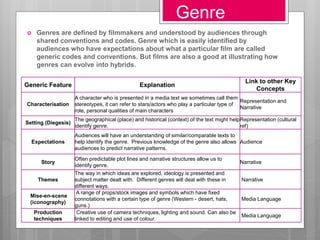
 Genres are defined by filmmakers and understood by audiences through
shared conventions and codes. Genre which is easily identified by
audiences who have expectations about what a particular film are called
generic codes and conventions. But films are also a good at illustrating how
genres can evolve into hybrids.
Generic Feature Explanation
Link to other Key
Concepts
Characterisation
A character who is presented in a media text we sometimes call them
stereotypes, it can refer to stars/actors who play a particular type of
role, personal qualities of main characters
Representation and
Narrative
Setting (Diegesis)
The geographical (place) and historical (context) of the text might help
identify genre.
Representation (cultural
ref)
Expectations
Audiences will have an understanding of similar/comparable texts to
help identify the genre. Previous knowledge of the genre also allows
audiences to predict narrative patterns.
Audience
Story
Often predictable plot lines and narrative structures allow us to
identify genre.
Narrative
Themes
The way in which ideas are explored, ideology is presented and
subject matter dealt with. Different genres will deal with these in
different ways.
Narrative
Mise-en-scene
(iconography)
A range of props/stock images and symbols which have fixed
connotations with a certain type of genre (Western - desert, hats,
guns.)
Media Language
Production
techniques
Creative use of camera techniques, lighting and sound. Can also be
linked to editing and use of colour.
Media Language
Representation
 This is when an idea is re-presented by the media
texts
 Despite the media being false or true, we still accept it
 Common factors that represent media: Age, Ethnicity,
Gender,& Disability
We need to think about:
 Who produced it?
 What/who is represented in the text?
 How is that thing represented?
 Why was this particular representation selected?
 What might the alternatives have been?
 What frame of reference does the audience use when
understanding the representation?
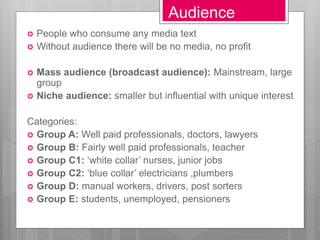
Audience
 People who consume any media text
 Without audience there will be no media, no profit
 Mass audience (broadcast audience): Mainstream, large
group
 Niche audience: smaller but influential with unique interest
Categories:
 Group A: Well paid professionals, doctors, lawyers
 Group B: Fairly well paid professionals, teacher
 Group C1: ‘white collar’ nurses, junior jobs
 Group C2: ‘blue collar’ electricians ,plumbers
 Group D: manual workers, drivers, post sorters
 Group E: students, unemployed, pensioners
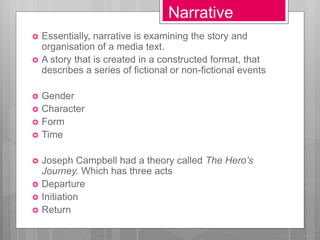
Narrative
 Essentially, narrative is examining the story and
organisation of a media text.
 A story that is created in a constructed format, that
describes a series of fictional or non-fictional events
 Gender
 Character
 Form
 Time
 Joseph Campbell had a theory called The Hero’s
Journey. Which has three acts
 Departure
 Initiation
 Return
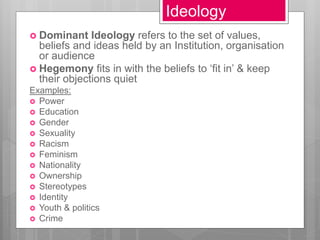
Ideology
 Dominant Ideology refers to the set of values,
beliefs and ideas held by an Institution, organisation
or audience
 Hegemony fits in with the beliefs to ‘fit in’ & keep
their objections quiet
Examples:
 Power
 Education
 Gender
 Sexuality
 Racism
 Feminism
 Nationality
 Ownership
 Stereotypes
 Identity
 Youth & politics
 Crime
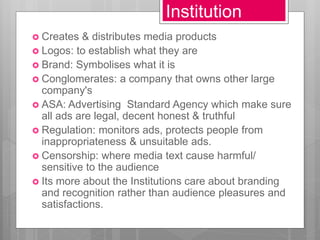
Institution
 Creates & distributes media products
 Logos: to establish what they are
 Brand: Symbolises what it is
 Conglomerates: a company that owns other large
company's
 ASA: Advertising Standard Agency which make sure
all ads are legal, decent honest & truthful
 Regulation: monitors ads, protects people from
inappropriateness & unsuitable ads.
 Censorship: where media text cause harmful/
sensitive to the audience
 Its more about the Institutions care about branding
and recognition rather than audience pleasures and
satisfactions.
Technology
 Technology has changed the way that we
consume traditional media products and it is
worth examining for ideas and inspiration.
 TV is now being produced in HD and films are
experimenting with new technologies all the
time, driving industries forward.
 Audiences also drive demand for new
technologies, and this illustrates the reliance
upon audience and producer co-working
together to satisfy demands.
 The olden Titanic is now being released in 3D!
Audio Codes
 Sound
 Diegetic
 Non-Diegetic
 Diegetic Sound – sound that can be heard by the
characters within a scene
 Non-diegetic Sound – sound that the characters
cannot hear and is not part of the imaginary world of
the story
 Score – The musical component of a programme’s
soundtrack
 Sound Effects – sounds that are added to a film
during the post-production stage.
Sound
Technical Codes
 Camera Angles
 Lighting
 Editing
 Editing: sound and images are organised into an overall narrative
 Continuity Editing: create a sense of reality and time moving forward
 Jump Cut: cut between two similar shots
 Credits: the information at the beginning and end of a film, which gives details of cast and
crew
 Cross Cutting: the editing technique of altering one narrative with another usually in
different locations or places
 Cutaways: a shot that interrupts a scene & goes back
 Freeze Frame: stopping a film in order to focus in on one event
 Eye-line Match: shot of what the character has been looking at
 Flashback: an event that happened earlier in the film’s narrative.
 Graphic Match: two different objects of the same shape are dissolved from one into the
other
 Juxtaposition: the placement of images on either side of an edit
 Linear Narrative: a style of storytelling in which events happen chronologically.
 Montage Editing: the juxtaposition of seemingly unconnected images in order to create
meaning.
 Parallel Editing: two locations are cut together
 Visual Effects: alter previously-filmed elements by adding, removing or enhancing objects
 Match on Action: A shot that emphasises continuity of space and time by matching the
action of the preceding shot with the continuation of the action
Editing
Other Terms
 Artificial Light: A source of light created by lighting
equipment, rather than from natural sources
 Convention: a frequently used element which becomes
standard
 Disequilibrium: the period of instability and insecurity in a
film’s narrative
 Enigma: the question or mystery that is posed within a
film’s narrative.
 Equilibrium: a state of peace and calm, which often exists
at the beginning of a film’s narrative
 Framing: the selection of elements such as characters,
setting and iconography that appear within a shot
 Genre: a film identification
 Iconography: the objects within a film that are used to
evoke particular meanings
 Intertextuality: reference within a film to another film,
media product, work of literature or piece of artwork
Camera Shot
 Ariel Shot: shot taken from an overhead position
 Close Up: object is shown on a large scale
 Extreme Close Up: frame the scale very large, to show
part of body
 Medium Shot: scale of object is in moderate size, waist
up
 Two Shot: shot of 2 characters, usually to establish a sort
of relationship
 POV Shot: camera placed in the characters eyes
 Over the Shoulder Shot: looking behind a characters
shoulder
 Overhead Shot: over the head shot
 Reaction Shot: a shot that cuts away from main scene to
show the reaction
Camera Angles
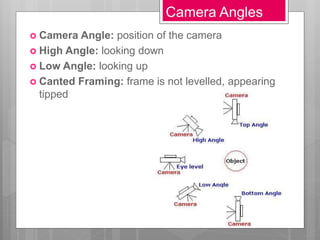
 Camera Angle: position of the camera
 High Angle: looking down
 Low Angle: looking up
 Canted Framing: frame is not levelled, appearing
tipped
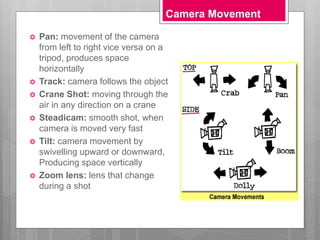
Camera Movement
 Pan: movement of the camera
from left to right vice versa on a
tripod, produces space
horizontally
 Track: camera follows the object
 Crane Shot: moving through the
air in any direction on a crane
 Steadicam: smooth shot, when
camera is moved very fast
 Tilt: camera movement by
swivelling upward or downward,
Producing space vertically
 Zoom lens: lens that change
during a shot
Visual Codes
 Mise-En-Scene
 Colour
 Connotations
Denotation/Connotation
 Denotation refers to the literal meaning of a
word, the "dictionary definition.“
For example, if you look up the word snake in a
dictionary, you will discover that it means "any of
numerous scaly, legless, sometimes venomous."
 Connotation, on the other hand, refers to the
associations or the emotional suggestions
related to that word.
The connotations for the word snake could include
evil or danger.
 Mise en scene: put into the frame
 Props: object used
 Costume: colour & style can have an impact on the
character
 Lighting: the harshness or softness represents the
mood
 Makeup: this can refer to masks, prosthetics and
special effects.
Mise-En-Scene
Colour Psychology
 Black
 Authority, power & overpowering
 Makes people appear thinner & stylish
 Black also implies submission & Evil
 White
 Innocence, purity, light, summer & neutral
 Doctors and nurses wear white to imply sterility
 Red
 Emotionally intense colour, love, noticeable,
 Red cars are popular targets for thieves
 Furniture gets attention
 Pink
 Romantic & girly
 Blue
 Popular & loyalty
 Opposite reaction as red.
 Peaceful, calm &productive
 Cold &depressing.
 Good in gyms
 Green
 Improve vision
 Nature, calming, refreshing
 Dark green is masculine, conservative, and
implies wealth
 Could bring bad luck for fashion
 Yellow
 Cheerful, attention, optimistic
 Overpowering if overused
 Concentration, metabolism
 Purple
 Royalty, luxury, wealth & sophistication
 Feminine & romantic
 Appear artificial
 Brown
 Solid, reliable ,earth
 Light brown implies genuineness
 dark brown wood or leather.
 Sad, wistful
Audience Theory
 The Hypodermic Needle Model: From the 1920s this theory explained how the mass
audience react to mass media. Suggesting that the audience receive information without
attempting to challenge the data. Governments have found ways to persuade audience and
produced propaganda to try & change the way people think
 The Two Step Flow: In 1940 it was suggested that the reaction from the media comes from
an ‘Opinion Leader’ and then onto the individual following that leader.
 The Use & Gratification has been developed where in 1948 Lasswell suggested
Surveillance, Correlation, Entertainment & Cultural transmission where the functions for
an individual reacting towards media. Where Blumler & Katz expanded this theory in 1974
stating that the audience may use these the purpose:
 Diversion: escape from everyday routine/problem
 Personal Relationships: emotional use/ subbing a character for yourself
 Personal Identity: reflecting yourself/ learning behaviours & values
 Surveillance: information that could be useful
 Reception Theory: The audiences circumstance (gender, class, age, ethnicity), When text is
encoded by the producer & decoded by the reader , where Stuart Hall had a theory of 3
where:
 Dominant: audience agree with the values
 Negotiated: Audience agree with the values but disagree with certain aspects
 Oppositional: audience disagree with the values
Genres in films
 Action: high energy, big-budget physical stunts & chase,
rescues, battles, escapes, destruction, rhythm & pace
Sub-Genre: Disaster film e.g. Space Alien Invaders Attack Los
Angeles: Battle Los Angeles 2011
 Adventure: exciting, historical searches, expeditions, lost
continents
 Comedies: light hearted, amuse, exaggerated
 Crime: criminals, bank robbers, underworld, law
 Dramas: serious, plot, realistic, life stories
 Epics: historical, imagined event, mythic, legendary
 Horror: frighten, worst fears. Supernatural & fantasy
 Musicals: song & dance routines
 Sci-Fi: imaginative, heroes, aliens, planets, futuristic
 War: heartbreak of war, fight on land or sea
Has many Subs
 Westerns: American film industry, recognisable plot
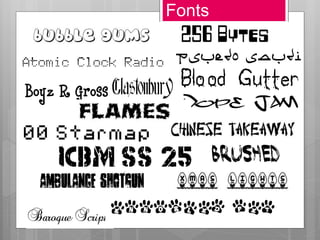
Fonts
Institution & Audience
 Issues are raised by media ownerships
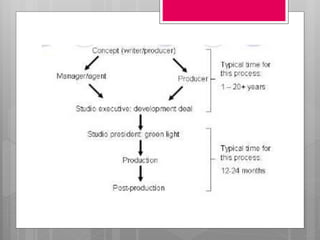
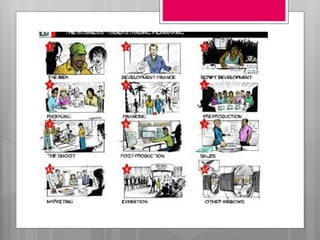
 Importance in media goes across production,
distribution & marketing
 Technologies have been introduced at the level of
production, distribution, marketing & exchange
 The audience are changing
 Translations: old practises are kept intact
 Localization: take advantage of the technology,
making things more efficient
Film Industry
Codes and conventions

Codes and conventions

  • 1.
  • 2.
    Media Key Concept GRANITE  Every media text belongs to a Genre (e.g. a horror film, dance track, teen magazine)  Within that text, a person, place or object is being Represented in some way, shape or form.  The Audience for that media text will make sense of it using their personal and shared experiences.  The text also contains a Narrative, be it a photograph of war or some bad gangsta lyrics about pimping your uncle  The text is constructed by the Ideology embedded within the text.  It was produced using some Technology, be it a Desk Top Publishing software or hardware  The Evidence is the product itself which you can then reference against other Experiences you've had with similar Media
  • 3.
    Genre  Genres aredefined by filmmakers and understood by audiences through shared conventions and codes. Genre which is easily identified by audiences who have expectations about what a particular film are called generic codes and conventions. But films are also a good at illustrating how genres can evolve into hybrids. Generic Feature Explanation Link to other Key Concepts Characterisation A character who is presented in a media text we sometimes call them stereotypes, it can refer to stars/actors who play a particular type of role, personal qualities of main characters Representation and Narrative Setting (Diegesis) The geographical (place) and historical (context) of the text might help identify genre. Representation (cultural ref) Expectations Audiences will have an understanding of similar/comparable texts to help identify the genre. Previous knowledge of the genre also allows audiences to predict narrative patterns. Audience Story Often predictable plot lines and narrative structures allow us to identify genre. Narrative Themes The way in which ideas are explored, ideology is presented and subject matter dealt with. Different genres will deal with these in different ways. Narrative Mise-en-scene (iconography) A range of props/stock images and symbols which have fixed connotations with a certain type of genre (Western - desert, hats, guns.) Media Language Production techniques Creative use of camera techniques, lighting and sound. Can also be linked to editing and use of colour. Media Language
  • 4.
    Representation  This iswhen an idea is re-presented by the media texts  Despite the media being false or true, we still accept it  Common factors that represent media: Age, Ethnicity, Gender,& Disability We need to think about:  Who produced it?  What/who is represented in the text?  How is that thing represented?  Why was this particular representation selected?  What might the alternatives have been?  What frame of reference does the audience use when understanding the representation?
  • 5.
    Audience  People whoconsume any media text  Without audience there will be no media, no profit  Mass audience (broadcast audience): Mainstream, large group  Niche audience: smaller but influential with unique interest Categories:  Group A: Well paid professionals, doctors, lawyers  Group B: Fairly well paid professionals, teacher  Group C1: ‘white collar’ nurses, junior jobs  Group C2: ‘blue collar’ electricians ,plumbers  Group D: manual workers, drivers, post sorters  Group E: students, unemployed, pensioners
  • 6.
    Narrative  Essentially, narrativeis examining the story and organisation of a media text.  A story that is created in a constructed format, that describes a series of fictional or non-fictional events  Gender  Character  Form  Time  Joseph Campbell had a theory called The Hero’s Journey. Which has three acts  Departure  Initiation  Return
  • 7.
    Ideology  Dominant Ideologyrefers to the set of values, beliefs and ideas held by an Institution, organisation or audience  Hegemony fits in with the beliefs to ‘fit in’ & keep their objections quiet Examples:  Power  Education  Gender  Sexuality  Racism  Feminism  Nationality  Ownership  Stereotypes  Identity  Youth & politics  Crime
  • 8.
    Institution  Creates &distributes media products  Logos: to establish what they are  Brand: Symbolises what it is  Conglomerates: a company that owns other large company's  ASA: Advertising Standard Agency which make sure all ads are legal, decent honest & truthful  Regulation: monitors ads, protects people from inappropriateness & unsuitable ads.  Censorship: where media text cause harmful/ sensitive to the audience  Its more about the Institutions care about branding and recognition rather than audience pleasures and satisfactions.
  • 9.
    Technology  Technology haschanged the way that we consume traditional media products and it is worth examining for ideas and inspiration.  TV is now being produced in HD and films are experimenting with new technologies all the time, driving industries forward.  Audiences also drive demand for new technologies, and this illustrates the reliance upon audience and producer co-working together to satisfy demands.  The olden Titanic is now being released in 3D!
  • 10.
    Audio Codes  Sound Diegetic  Non-Diegetic
  • 11.
     Diegetic Sound– sound that can be heard by the characters within a scene  Non-diegetic Sound – sound that the characters cannot hear and is not part of the imaginary world of the story  Score – The musical component of a programme’s soundtrack  Sound Effects – sounds that are added to a film during the post-production stage. Sound
  • 12.
    Technical Codes  CameraAngles  Lighting  Editing
  • 13.
     Editing: soundand images are organised into an overall narrative  Continuity Editing: create a sense of reality and time moving forward  Jump Cut: cut between two similar shots  Credits: the information at the beginning and end of a film, which gives details of cast and crew  Cross Cutting: the editing technique of altering one narrative with another usually in different locations or places  Cutaways: a shot that interrupts a scene & goes back  Freeze Frame: stopping a film in order to focus in on one event  Eye-line Match: shot of what the character has been looking at  Flashback: an event that happened earlier in the film’s narrative.  Graphic Match: two different objects of the same shape are dissolved from one into the other  Juxtaposition: the placement of images on either side of an edit  Linear Narrative: a style of storytelling in which events happen chronologically.  Montage Editing: the juxtaposition of seemingly unconnected images in order to create meaning.  Parallel Editing: two locations are cut together  Visual Effects: alter previously-filmed elements by adding, removing or enhancing objects  Match on Action: A shot that emphasises continuity of space and time by matching the action of the preceding shot with the continuation of the action Editing
  • 14.
    Other Terms  ArtificialLight: A source of light created by lighting equipment, rather than from natural sources  Convention: a frequently used element which becomes standard  Disequilibrium: the period of instability and insecurity in a film’s narrative  Enigma: the question or mystery that is posed within a film’s narrative.  Equilibrium: a state of peace and calm, which often exists at the beginning of a film’s narrative  Framing: the selection of elements such as characters, setting and iconography that appear within a shot  Genre: a film identification  Iconography: the objects within a film that are used to evoke particular meanings  Intertextuality: reference within a film to another film, media product, work of literature or piece of artwork
  • 15.
    Camera Shot  ArielShot: shot taken from an overhead position  Close Up: object is shown on a large scale  Extreme Close Up: frame the scale very large, to show part of body  Medium Shot: scale of object is in moderate size, waist up  Two Shot: shot of 2 characters, usually to establish a sort of relationship  POV Shot: camera placed in the characters eyes  Over the Shoulder Shot: looking behind a characters shoulder  Overhead Shot: over the head shot  Reaction Shot: a shot that cuts away from main scene to show the reaction
  • 16.
    Camera Angles  CameraAngle: position of the camera  High Angle: looking down  Low Angle: looking up  Canted Framing: frame is not levelled, appearing tipped
  • 17.
    Camera Movement  Pan:movement of the camera from left to right vice versa on a tripod, produces space horizontally  Track: camera follows the object  Crane Shot: moving through the air in any direction on a crane  Steadicam: smooth shot, when camera is moved very fast  Tilt: camera movement by swivelling upward or downward, Producing space vertically  Zoom lens: lens that change during a shot
  • 18.
    Visual Codes  Mise-En-Scene Colour  Connotations
  • 19.
    Denotation/Connotation  Denotation refersto the literal meaning of a word, the "dictionary definition.“ For example, if you look up the word snake in a dictionary, you will discover that it means "any of numerous scaly, legless, sometimes venomous."  Connotation, on the other hand, refers to the associations or the emotional suggestions related to that word. The connotations for the word snake could include evil or danger.
  • 20.
     Mise enscene: put into the frame  Props: object used  Costume: colour & style can have an impact on the character  Lighting: the harshness or softness represents the mood  Makeup: this can refer to masks, prosthetics and special effects. Mise-En-Scene
  • 21.
    Colour Psychology  Black Authority, power & overpowering  Makes people appear thinner & stylish  Black also implies submission & Evil  White  Innocence, purity, light, summer & neutral  Doctors and nurses wear white to imply sterility  Red  Emotionally intense colour, love, noticeable,  Red cars are popular targets for thieves  Furniture gets attention  Pink  Romantic & girly  Blue  Popular & loyalty  Opposite reaction as red.  Peaceful, calm &productive  Cold &depressing.  Good in gyms  Green  Improve vision  Nature, calming, refreshing  Dark green is masculine, conservative, and implies wealth  Could bring bad luck for fashion  Yellow  Cheerful, attention, optimistic  Overpowering if overused  Concentration, metabolism  Purple  Royalty, luxury, wealth & sophistication  Feminine & romantic  Appear artificial  Brown  Solid, reliable ,earth  Light brown implies genuineness  dark brown wood or leather.  Sad, wistful
  • 22.
    Audience Theory  TheHypodermic Needle Model: From the 1920s this theory explained how the mass audience react to mass media. Suggesting that the audience receive information without attempting to challenge the data. Governments have found ways to persuade audience and produced propaganda to try & change the way people think  The Two Step Flow: In 1940 it was suggested that the reaction from the media comes from an ‘Opinion Leader’ and then onto the individual following that leader.  The Use & Gratification has been developed where in 1948 Lasswell suggested Surveillance, Correlation, Entertainment & Cultural transmission where the functions for an individual reacting towards media. Where Blumler & Katz expanded this theory in 1974 stating that the audience may use these the purpose:  Diversion: escape from everyday routine/problem  Personal Relationships: emotional use/ subbing a character for yourself  Personal Identity: reflecting yourself/ learning behaviours & values  Surveillance: information that could be useful  Reception Theory: The audiences circumstance (gender, class, age, ethnicity), When text is encoded by the producer & decoded by the reader , where Stuart Hall had a theory of 3 where:  Dominant: audience agree with the values  Negotiated: Audience agree with the values but disagree with certain aspects  Oppositional: audience disagree with the values
  • 23.
    Genres in films Action: high energy, big-budget physical stunts & chase, rescues, battles, escapes, destruction, rhythm & pace Sub-Genre: Disaster film e.g. Space Alien Invaders Attack Los Angeles: Battle Los Angeles 2011  Adventure: exciting, historical searches, expeditions, lost continents  Comedies: light hearted, amuse, exaggerated  Crime: criminals, bank robbers, underworld, law  Dramas: serious, plot, realistic, life stories  Epics: historical, imagined event, mythic, legendary  Horror: frighten, worst fears. Supernatural & fantasy  Musicals: song & dance routines  Sci-Fi: imaginative, heroes, aliens, planets, futuristic  War: heartbreak of war, fight on land or sea Has many Subs  Westerns: American film industry, recognisable plot
  • 24.
  • 25.
    Institution & Audience Issues are raised by media ownerships  Importance in media goes across production, distribution & marketing  Technologies have been introduced at the level of production, distribution, marketing & exchange  The audience are changing  Translations: old practises are kept intact  Localization: take advantage of the technology, making things more efficient Film Industry