The Creative Process
SCRIPTWRITING – Seymour B. Sanchez
The Scriptwriter
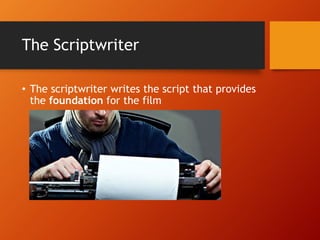
• The scriptwriter writes the script that provides
the foundation for the film
Why Write?
• No script, no film
• Good directors are once/also good writers.
• A very accessible discipline
• Very fulfilling
• Some circles consider it as equally important
as the Director
• Yes, it can make you rich.
Film and Television
• Both are VISUAL media.
• Each has a story to tell (whether logical or
illogical).
• Every film and TV program falls under a
specific GENRE (comedy, action, drama or
horror, etc.).
• Genres sell the tickets. Producers buy genres
and the approach at each genre.
Producers Buy Genres
• Current trends in film:
- Horror
- Romance
- Comedy
- Fantasy
Stereotypical Genres
Romance
Mystery
Disaster
Thriller/ Psychological
Thriller
Fantasy/ Adventure
Horror
Sci-fi
Melodrama/
Drama
Action
Comedy
Sample Sub-Genres
• Boy Meets Girl
• Rite of Passage
• Coming of Age
• Unrequited Love
• Dysfunctional Family
• Gay and Lesbian
• Road Trip
• Swashbuckling hero
Genre Elements
• Romance – Boy Meets Girl, Boy Loses Girl, Boy
Gets Girl, Misunderstanding alienates Boy and
Girl, Rival for Girl throws out Misinformation,
Last Minute Reveal of the Truth leading to
Joyful Reunion
• Horror Story – Series of Grizzly and Inventive
Murders, The Evil Gradually Closes in on the
Heroes, Scary Isolated Location, Massive
Rainstorm with Lightning and Thunder
Plot-driven or Character-driven
• Each progresses via the story (plot-driven,
2012) or the characters (character-driven, The
Queen, Hannibal)
• Everything starts with a script; every script
starts with a concept
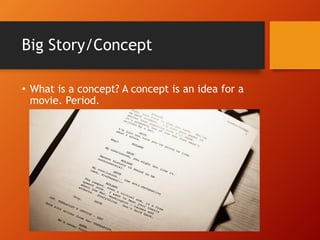
Big Story/Concept
• What is a concept? A concept is an idea for a
movie. Period.
Sample Concepts
• A superhero creature who has all the strengths
of a vampire and none of its weaknesses,
except for the thirst for blood
• What if a boy wishes that for a whole day, his
father wouldn’t tell a lie
• A bride rises from coma and embarks on a
roaring rampage of revenge
• Husband and wife. Man is an assassin, and so
is the wife. But they do not know each other’s
secret identity
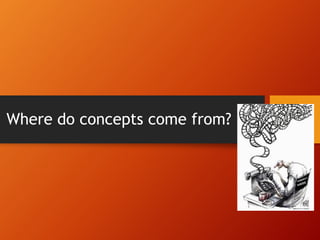
Where do concepts come from?
Concepts come from:
• Another movie
• News item/court case
• Someone’s story/real life
• Memoir/diary
• Comics/graphic novel
• Book/novel
• Neighbor’s problems
• A dream
• An experience/MRT ride to Cubao
• From one’s own creative impulses
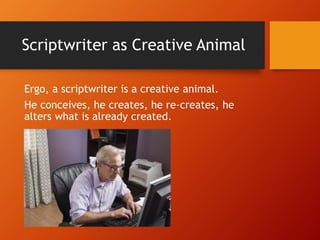
Scriptwriter as Creative Animal
Ergo, a scriptwriter is a creative animal.
He conceives, he creates, he re-creates, he
alters what is already created.
Creativity
• Can it be taught? Yes.
• Can it be acquired? Yes, why not?
• Creativity, like a third eye, is present in all
living, rational beings.
Creativity
• In scriptwriting, it is simply telling a story that
is previously non-existent. He starts from a
germ of an idea, and ends up with a larger
than life story.
A detective. A pet detective
An alien. An alien for a stepmother.
A robot. A robot with scissors instead
of hands
Creative Exercise: What if?
• Create a cinematic character from a common
person/ object/ other worldly things
• A nun. A nun with hidden tattoos.
• A postman. A postman who can’t read
nor write
• An angel.
• A neighbor.
• A stewardess.
Creativity
• In scriptwriting, it is when you
rationalize/justify something that is previously
unheard of, unacceptable or objectionable
Translating the Big Story Idea
into a Workable Story
What Makes a Good Story?
What makes a good story?
• Stories with characters that you are passionate
about, whether heroes (love them) or villains
(hate them)
What makes a good story?
There is something at stake
• Something someone wants (the car in
Dude, Where’s my Car?)
• Something someone wants for the good
of mankind (nuke, the asteroid in
Armageddon)
• Something desired by many characters
(the One Ring in the Lord of the Rings)
What makes a good story?
There are always obstacles:
CONFLICT – the heart of drama
Someone wants something and people and
things keep getting in the way. It can be
physical or emotional
Premise
• The “What If?” of a story
• The beginning, the building block
Plot
• A scheme, plan, or method to execute the
premise
• The execution of the story
• It is how we get from the beginning, through
the middle, and on to the end
Sample Plot Patterns
• Rags to Riches/Cinderella Story
• Journey movie
• Revenge/Vengeance Story
• Road movie
• Rites of passage
• Ugly duckling
• Triangle Story
• Boy meets boy/girl, boy gets boy/girl, or vice versa
• Romeo and Juliet
• Ship of fools
• Whodunit
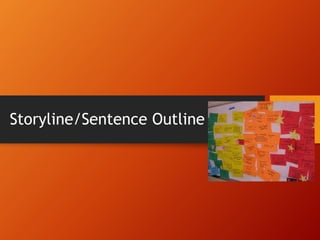
Storyline/Sentence Outline
• A sequence by sequence account of the entire
story/script
Why Write the Outline
• It provides you with an overview of the script
• It gives you a good grasp on the structure
• It enables you to develop and improve the
story
Take these into consideration:
• Number of scenes/locations
• The running time
• The number of characters and size of each
character
• Commercials (for TV)
• Film structure (three-act or four-act)

The Creative Process

  • 1.
    The Creative Process SCRIPTWRITING– Seymour B. Sanchez
  • 2.
    The Scriptwriter • Thescriptwriter writes the script that provides the foundation for the film
  • 3.
    Why Write? • Noscript, no film • Good directors are once/also good writers. • A very accessible discipline • Very fulfilling • Some circles consider it as equally important as the Director • Yes, it can make you rich.
  • 4.
    Film and Television •Both are VISUAL media. • Each has a story to tell (whether logical or illogical). • Every film and TV program falls under a specific GENRE (comedy, action, drama or horror, etc.). • Genres sell the tickets. Producers buy genres and the approach at each genre.
  • 5.
    Producers Buy Genres •Current trends in film: - Horror - Romance - Comedy - Fantasy
  • 6.
  • 7.
    Sample Sub-Genres • BoyMeets Girl • Rite of Passage • Coming of Age • Unrequited Love • Dysfunctional Family • Gay and Lesbian • Road Trip • Swashbuckling hero
  • 8.
    Genre Elements • Romance– Boy Meets Girl, Boy Loses Girl, Boy Gets Girl, Misunderstanding alienates Boy and Girl, Rival for Girl throws out Misinformation, Last Minute Reveal of the Truth leading to Joyful Reunion • Horror Story – Series of Grizzly and Inventive Murders, The Evil Gradually Closes in on the Heroes, Scary Isolated Location, Massive Rainstorm with Lightning and Thunder
  • 9.
    Plot-driven or Character-driven •Each progresses via the story (plot-driven, 2012) or the characters (character-driven, The Queen, Hannibal) • Everything starts with a script; every script starts with a concept
  • 10.
    Big Story/Concept • Whatis a concept? A concept is an idea for a movie. Period.
  • 11.
    Sample Concepts • Asuperhero creature who has all the strengths of a vampire and none of its weaknesses, except for the thirst for blood • What if a boy wishes that for a whole day, his father wouldn’t tell a lie • A bride rises from coma and embarks on a roaring rampage of revenge • Husband and wife. Man is an assassin, and so is the wife. But they do not know each other’s secret identity
  • 12.
  • 13.
    Concepts come from: •Another movie • News item/court case • Someone’s story/real life • Memoir/diary • Comics/graphic novel • Book/novel • Neighbor’s problems • A dream • An experience/MRT ride to Cubao • From one’s own creative impulses
  • 14.
    Scriptwriter as CreativeAnimal Ergo, a scriptwriter is a creative animal. He conceives, he creates, he re-creates, he alters what is already created.
  • 15.
    Creativity • Can itbe taught? Yes. • Can it be acquired? Yes, why not? • Creativity, like a third eye, is present in all living, rational beings.
  • 16.
    Creativity • In scriptwriting,it is simply telling a story that is previously non-existent. He starts from a germ of an idea, and ends up with a larger than life story. A detective. A pet detective An alien. An alien for a stepmother. A robot. A robot with scissors instead of hands
  • 17.
    Creative Exercise: Whatif? • Create a cinematic character from a common person/ object/ other worldly things • A nun. A nun with hidden tattoos. • A postman. A postman who can’t read nor write • An angel. • A neighbor. • A stewardess.
  • 18.
    Creativity • In scriptwriting,it is when you rationalize/justify something that is previously unheard of, unacceptable or objectionable
  • 19.
    Translating the BigStory Idea into a Workable Story
  • 20.
    What Makes aGood Story?
  • 21.
    What makes agood story? • Stories with characters that you are passionate about, whether heroes (love them) or villains (hate them)
  • 22.
    What makes agood story? There is something at stake • Something someone wants (the car in Dude, Where’s my Car?) • Something someone wants for the good of mankind (nuke, the asteroid in Armageddon) • Something desired by many characters (the One Ring in the Lord of the Rings)
  • 23.
    What makes agood story? There are always obstacles: CONFLICT – the heart of drama Someone wants something and people and things keep getting in the way. It can be physical or emotional
  • 24.
    Premise • The “WhatIf?” of a story • The beginning, the building block
  • 25.
    Plot • A scheme,plan, or method to execute the premise • The execution of the story • It is how we get from the beginning, through the middle, and on to the end
  • 26.
    Sample Plot Patterns •Rags to Riches/Cinderella Story • Journey movie • Revenge/Vengeance Story • Road movie • Rites of passage • Ugly duckling • Triangle Story • Boy meets boy/girl, boy gets boy/girl, or vice versa • Romeo and Juliet • Ship of fools • Whodunit
  • 27.
  • 28.
    Storyline/Sentence Outline • Asequence by sequence account of the entire story/script
  • 29.
    Why Write theOutline • It provides you with an overview of the script • It gives you a good grasp on the structure • It enables you to develop and improve the story
  • 30.
    Take these intoconsideration: • Number of scenes/locations • The running time • The number of characters and size of each character • Commercials (for TV) • Film structure (three-act or four-act)