CAMERA SHOTS In this lesson we’ll be learning about the main camera shots and camera angles that are used during filming.   You need to write down these terms and definitions, as there will be a vocabulary quiz at the end of the lesson.   **Do not copy word for word**   TAKE NOTES!!!
A.  Camera Shots There are 3 main types of shots that describe how near or how far the camera is from the subject: Any of these shots can show one subject or more at the same time. Long shot. Medium shot. Close-up shot.
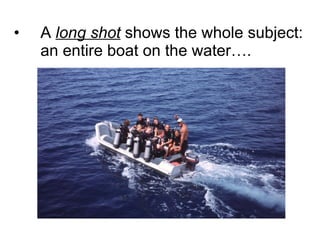
A  long shot  shows the whole subject:  an entire boat on the water….
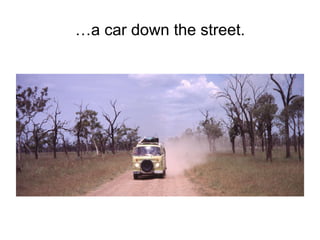
… a car down the street.
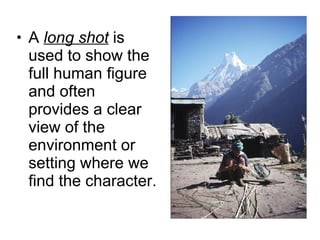
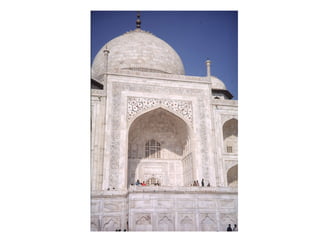
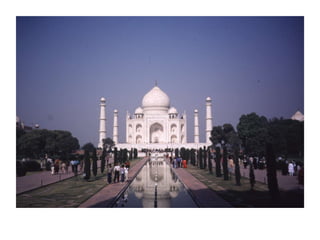
A  long shot  is used to show the full human figure and often provides a clear view of the environment or setting where we find the character.
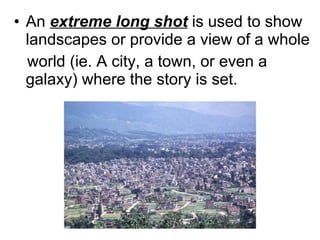
An  extreme long shot  is used to show landscapes or provide a view of a whole  world (ie. A city, a town, or even a galaxy) where the story is set.
 
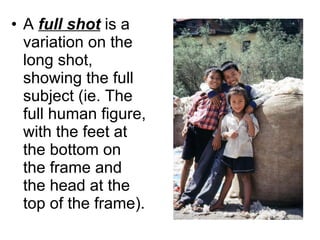
A  full shot  is a variation on the long shot, showing the full subject (ie. The full human figure, with the feet at the bottom on the frame and the head at the top of the frame).
 
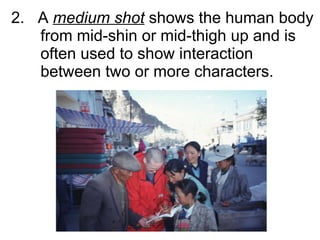
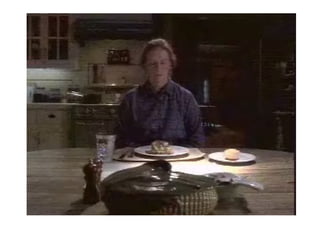
2.  A  medium shot  shows the human body from mid-shin or mid-thigh up and is  often used to show interaction between two or more characters.
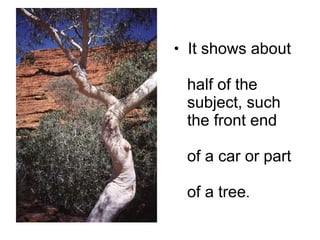
It shows about    half of the    subject, such    the front end    of a car or part    of a tree .
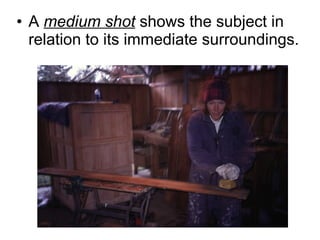
A  medium shot  shows the subject in  relation to its immediate surroundings.
 
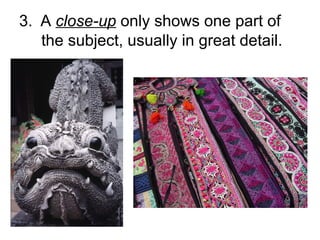
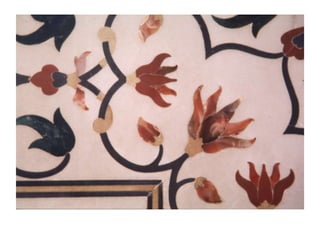
3.   A  close-up  only shows one part of    the subject, usually in great detail.
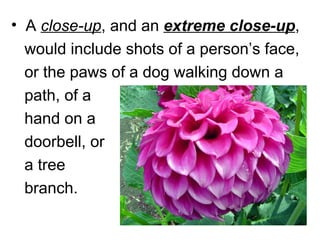
A  close-up , and an  extreme close-up ,  would include shots of a person’s face,  or the paws of a dog walking down a  path, of a  hand on a  doorbell, or  a tree  branch.
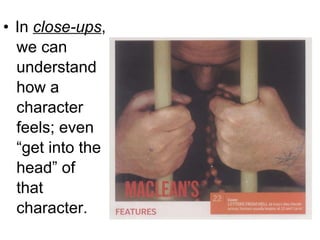
In  close-ups ,  we can  understand  how a  character  feels; even  “ get into the  head” of  that  character.
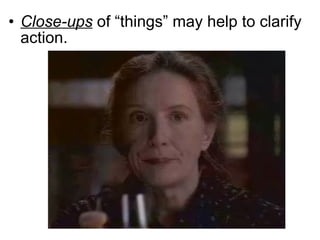
Close-ups  of “things” may help to clarify action.
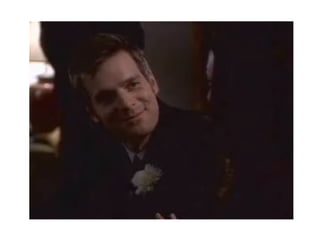
How might these shots be used in a movie or television show? An  establishing shot  at the beginning of a scene tells viewers where they are. For example, a long shot of a car driving up to a hotel, or a close-up of a restaurant sign.
 
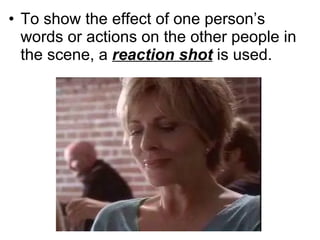
To show the effect of one person’s words or actions on the other people in the scene, a  reaction shot  is used.
B.  Camera Angles In addition to camera shots, the camera angle is also important.  The angle from which a shot is taken is another way to give variety as well as information. High Angle  Eye-level Low Angle Reverse Angle Oblique Angle
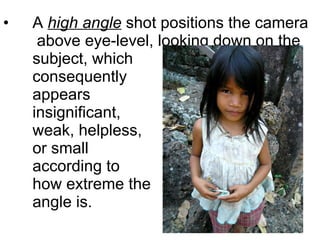
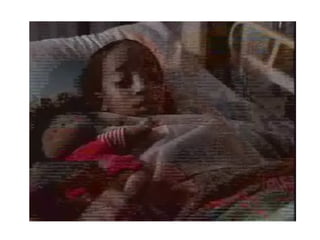
A  high angle  shot positions the camera  above eye-level, looking down on the subject, which  consequently  appears  insignificant,  weak, helpless,  or small  according to  how extreme the  angle is.
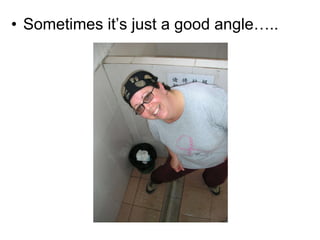
Sometimes it’s just a good angle…..
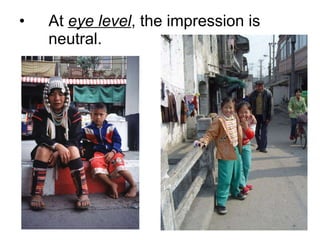
At  eye level , the impression is  neutral.
 
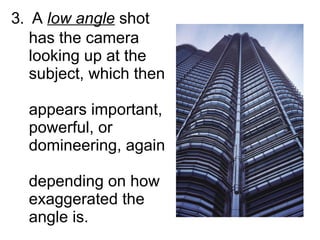
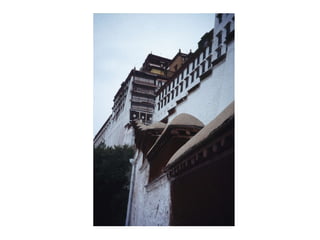
3 .  A  low angle  shot    has the camera    looking up at the    subject, which then    appears important,    powerful, or    domineering, again    depending on how    exaggerated the    angle is.
 
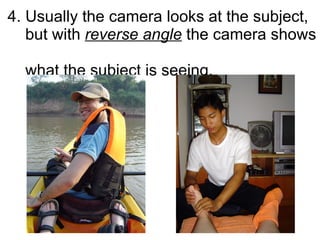
4. Usually the camera looks at the subject,    but with  reverse angle  the camera shows    what the subject is seeing.
 
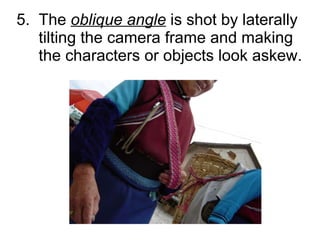
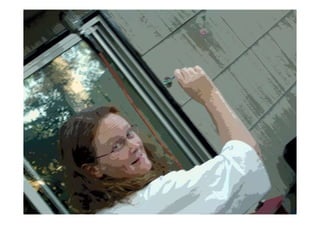
5.  The  oblique angle  is shot by laterally    tilting the camera frame and making    the characters or objects look askew.
 
Another way to give television programs and films variety is for the camera to move. C.  More…. Panning Tracking Elevating Dollying Tilting Zooming In/Out
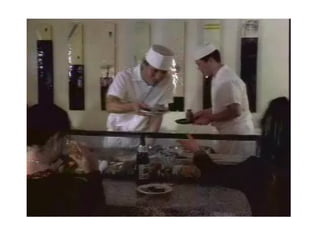
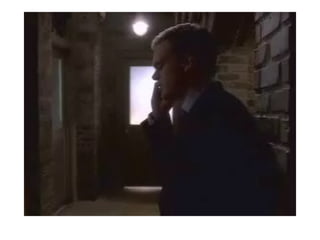
1.  Panning   -  When the camera    stays in the same    position but turns left    or right. 2.  Tracking  -  When the camera    changes its position    by moving left or right.
 
 
3.  Elevating  -  when the camera    changes its position    by moving up or down. 4.  Dollying   -  Changing the camera’s    position by moving it    forward or backward.
 
5.  Tilting   -  When the camera stays in    the same position but    turns up or down. 6.  Zooming In/Out   -  Even when the    camera is    stationary it can appear to move    closer to, or further from, its    subject by using a special ring or    lever on the lens.


Camera shots power point

  • 1.
    CAMERA SHOTS Inthis lesson we’ll be learning about the main camera shots and camera angles that are used during filming. You need to write down these terms and definitions, as there will be a vocabulary quiz at the end of the lesson. **Do not copy word for word** TAKE NOTES!!!
  • 2.
    A. CameraShots There are 3 main types of shots that describe how near or how far the camera is from the subject: Any of these shots can show one subject or more at the same time. Long shot. Medium shot. Close-up shot.
  • 3.
    A longshot shows the whole subject: an entire boat on the water….
  • 4.
    … a cardown the street.
  • 5.
    A longshot is used to show the full human figure and often provides a clear view of the environment or setting where we find the character.
  • 6.
    An extremelong shot is used to show landscapes or provide a view of a whole world (ie. A city, a town, or even a galaxy) where the story is set.
  • 7.
  • 8.
    A fullshot is a variation on the long shot, showing the full subject (ie. The full human figure, with the feet at the bottom on the frame and the head at the top of the frame).
  • 9.
  • 10.
    2. A medium shot shows the human body from mid-shin or mid-thigh up and is often used to show interaction between two or more characters.
  • 11.
    It shows about half of the subject, such the front end of a car or part of a tree .
  • 12.
    A mediumshot shows the subject in relation to its immediate surroundings.
  • 13.
  • 14.
    3. A close-up only shows one part of the subject, usually in great detail.
  • 15.
    A close-up, and an extreme close-up , would include shots of a person’s face, or the paws of a dog walking down a path, of a hand on a doorbell, or a tree branch.
  • 16.
    In close-ups, we can understand how a character feels; even “ get into the head” of that character.
  • 17.
    Close-ups of“things” may help to clarify action.
  • 18.
    How might theseshots be used in a movie or television show? An establishing shot at the beginning of a scene tells viewers where they are. For example, a long shot of a car driving up to a hotel, or a close-up of a restaurant sign.
  • 19.
  • 20.
    To show theeffect of one person’s words or actions on the other people in the scene, a reaction shot is used.
  • 21.
    B. CameraAngles In addition to camera shots, the camera angle is also important. The angle from which a shot is taken is another way to give variety as well as information. High Angle Eye-level Low Angle Reverse Angle Oblique Angle
  • 22.
    A highangle shot positions the camera above eye-level, looking down on the subject, which consequently appears insignificant, weak, helpless, or small according to how extreme the angle is.
  • 23.
    Sometimes it’s justa good angle…..
  • 24.
    At eyelevel , the impression is neutral.
  • 25.
  • 26.
    3 . A low angle shot has the camera looking up at the subject, which then appears important, powerful, or domineering, again depending on how exaggerated the angle is.
  • 27.
  • 28.
    4. Usually thecamera looks at the subject, but with reverse angle the camera shows what the subject is seeing.
  • 29.
  • 30.
    5. The oblique angle is shot by laterally tilting the camera frame and making the characters or objects look askew.
  • 31.
  • 32.
    Another way togive television programs and films variety is for the camera to move. C. More…. Panning Tracking Elevating Dollying Tilting Zooming In/Out
  • 33.
    1. Panning - When the camera stays in the same position but turns left or right. 2. Tracking - When the camera changes its position by moving left or right.
  • 34.
  • 35.
  • 36.
    3. Elevating - when the camera changes its position by moving up or down. 4. Dollying - Changing the camera’s position by moving it forward or backward.
  • 37.
  • 38.
    5. Tilting - When the camera stays in the same position but turns up or down. 6. Zooming In/Out - Even when the camera is stationary it can appear to move closer to, or further from, its subject by using a special ring or lever on the lens.
  • 39.
  • 40.
  • 41.
  • 42.
  • 43.