Dr. Sunita ChandraDr. Sunita Chandra
M.D.M.D.
Director, Morpheus Lucknow Fertility CentreDirector, Morpheus Lucknow Fertility Centre
Director, Rajendra Nagar Hospital & IVF CentreDirector, Rajendra Nagar Hospital & IVF Centre
Fellowship IVF,GermanyFellowship IVF,Germany
UTERINE FIBROIDS &
INFERTILITY
UTERINE FIBROIDS &
INFERTILITY
20-40% OF WOMEN OF REPRODUCTIVE AGE
ASSOCIATED WITH INFERTILITY : 5-10%
ONLY CAUSE OF INFERTILITY: 2-3%
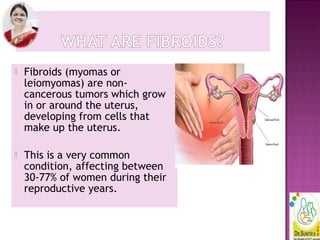
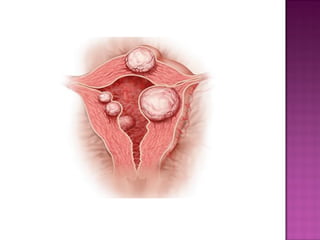
 Fibroids (myomas or
leiomyomas) are non-
cancerous tumors which grow
in or around the uterus,
developing from cells that
make up the uterus.
 This is a very common
condition, affecting between
30-77% of women during their
reproductive years.
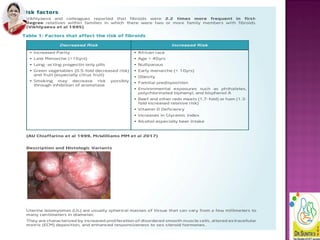
•Exact cause is unknown.
•Fibroid growth is affected by the reproductive hormones estrogen and
progesterone.
•Genetic predisposition
•Myometrial and leiomyoma stem cell have been identified that transform and
grow into fibroids under the influence of hormones
•Fibroids have higher concentrations of estradiol, aromatase,progesterone
receptor ER α
•However it is progesterone that influences the proliferation of fibroids
ABNORMAL UTERINE BLEEDING
BULK RELATED SYMPTOMS
ACUTE PAIN
INFERTILITY/ REPRODUCTIVE DYSFUCTION
DEPRESSION
BLOATING
FREQUENT URINATION, CONSTIPATION
 Most fibroids do not affect a woman’s fertility.
 They are mostly found as incidental findings
during an ultrasound scan and the vast majority
have no effect and do not need any treatment.
 The critical aspect is whether the fibroid is
distorting the lining of the uterus, which most
do not.
• Where the fibroid is very large distorting the
lining of the uterus
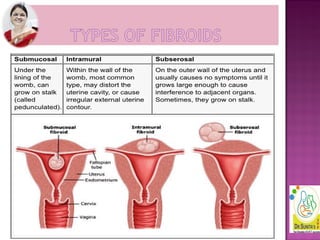
• Where the fibroid is located inside the uterus
itself (called a sub mucous fibroid).
In these two situations, surgery to remove the fibroid may be
needed.
However, most fibroids do not need any treatment at all.
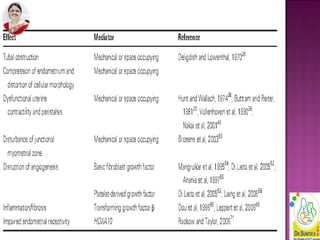
Effect on fertilization Effect on implantation
Anatomic distortion of the
cervix
Altered endometrial development
Altered uterine contractility Prevention of efflux of discharge or
blood
Deformity of the endometrial
cavity
Distortion of the shape of the
endometrium
Obstruction of tubal ostia
MECHANISMS BY WHICH FIBROIDS
AFFECT REPRODUCTIVE FUNCTION
SUBMUCOSAL FIBROIDES ALSO LEADS TO LOWER PREGNANCY
IMPLANTATION AND DELIVERY RATES
(Cook H et al 2010)
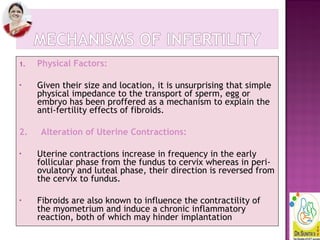
1. Physical Factors:
• Given their size and location, it is unsurprising that simple
physical impedance to the transport of sperm, egg or
embryo has been proffered as a mechanism to explain the
anti-fertility effects of fibroids.
2. Alteration of Uterine Contractions:
• Uterine contractions increase in frequency in the early
follicular phase from the fundus to cervix whereas in peri-
ovulatory and luteal phase, their direction is reversed from
the cervix to fundus.
• Fibroids are also known to influence the contractility of
the myometrium and induce a chronic inflammatory
reaction, both of which may hinder implantation
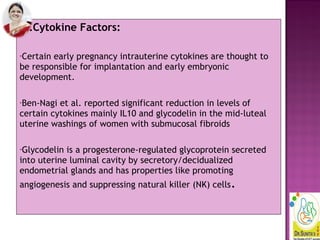
3.Cytokine Factors:
•Certain early pregnancy intrauterine cytokines are thought to
be responsible for implantation and early embryonic
development.
•Ben-Nagi et al. reported significant reduction in levels of
certain cytokines mainly IL10 and glycodelin in the mid-luteal
uterine washings of women with submucosal fibroids
•Glycodelin is a progesterone-regulated glycoprotein secreted
into uterine luminal cavity by secretory/decidualized
endometrial glands and has properties like promoting
angiogenesis and suppressing natural killer (NK) cells.
4.Genetic:
•Endometrial HOXA10, HOXA11 and BTEB1 gene
expression has been shown to modulate
endometrial receptivity.
•The reduction or absence of HOXA10 in the
uterine endometrium leads to infertility due to
the inability of the embryo to implant.
•The downregulation of endometrial HOXA 1 gene
expression results in defective decidualization
possibly mediated via secretion of transforming
growth factor beta3 (TGF-β3).
Alterations in the Endo-myometrial Junctional
(EMJ) Zone:
•The EMJ which represents the inner 1/3rd of the
myometrium abutting the endometrium contributes
macrophages and uterine natural killer (uNK) cells
which are essential for the process of endometrial
decidualization in the mid-luteal window of
implantation.
• In women with uterine fibroids, Kitaya et al. found
significant reduction in concentrations of both
macrophages and uNK cells in the EMJ, thus,
negatively affecting implantation.
In some women,
no treatment is better than treatment
Treatment depends on
Type & severity of symptoms
Size of myomas
Location of myoma,
Patient age
Reproductive plans , obstetrics history
1. Infertile patients without any identifiable
etiology except uterine myomas
2. Asymptomatic fibroid
3. About 3- 7% of fibroides can regress over
6 months to 3 years in premenopausal
women
Expectant Management
 Oral contraceptives
 GnRH agonist eg: Leuprolide, triptorelin
 GnRH antagonist
 Progestins
 LNG IUD – Levonorgestral IntraUterine Device
 SPRMs-Selective progestreone receptor
modulator
 Ulipristal Acetate (UPA) ( Croxtall JD et al 2012)
 Vilaprisan ( stronger than UPA, but phase III
trials underway ( Bradley L et al 2016)
 Mifepristone
 Raloxifene
 Aromatse inhibitors
 Anti- Fibrinolitic agents
FUTURE TREATMENTS
EGCG- Green tea extract ( appears to block each stage of tumor
genesis, clinic trials are needed)
Lanreotide (long acting somatostatin analogue)
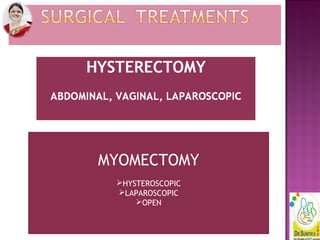
MYOMECTOMY
HYSTEROSCOPIC
LAPAROSCOPIC
OPEN
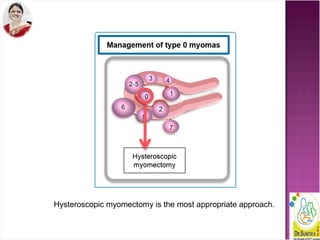
Hysteroscopic myomectomy is the most appropriate approach.
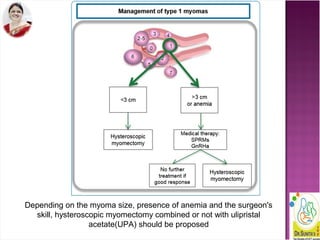
Depending on the myoma size, presence of anemia and the surgeon's
skill, hysteroscopic myomectomy combined or not with ulipristal
acetate(UPA) should be proposed
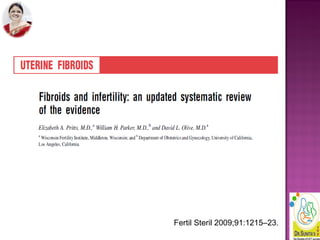
Fertil Steril 2009;91:1215–23.
 systematic review is designed to include these new
studies along with the previously reviewed
manuscripts to address two questions:
1) Do uterine fibroids, of specific size or location,
decrease fertility?; and
2) does removal of the fibroid(s) enhance fertility?
 Of 347 studies initially evaluated, 23 were included
in the data analysis
Fertil Steril 2009;91:1215–23.
 Fertility outcomes are decreased in women with
submucosal fibroids, and removal seems to
confer benefit.
 Subserosal fibroids do not affect fertility
outcomes, and removal does not confer benefit.
 Intramural fibroids appear to decrease fertility
Fertil Steril 2009;91:1215–23.
-Pregnancy after myomectomy 75% in
1st y
PR drops sharply after this time
(Dessole et al, 2001).
If possible, therefore, myomectomy
should be timed when a woman is ready
to start a family
10-75% (mean:
50%)(Donnez & jadoul, 2000).
The differences may be attributed to:
1.Age & other infertility factors
2.Factors related to fibroid
3.Technical factors
The approach depend on:
Fibroid: Site, number and size
Surgeon: Expertise
Patient: preference
1.In women with infertility, an effort should be made to
adequately evaluate and classify fibroids, particularly
those impinging on the endometrial cavity, using
transvaginal ultrasound, hysteroscopy,
hysterosonography, or magnetic resonance imaging.
(IIIA)
2.Preoperative assessment of submucosal fibroids
should include, in addition to an assessment of fibroid
size and location within the uterine cavity, evaluation of
the degree of invasion of the cavity and thickness of
residual myometrium to the serosa. A combination of
hysteroscopy and transvaginal ultrasound or
hysterosonography are the modalities of choice. (IIIB)
3.Submucosal fibroids are managed
hysteroscopically. The fibroid size should be <
5 cm, although larger fibroids have been
managed hysteroscopically, but repeat
procedures are often necessary. (IIIB)
4.A hysterosalpingogram is not an appropriate
exam to evaluate and classify fibroids. (IIID)
5.In women with otherwise unexplained
infertility, submucosal fibroids should be
removed in order to improve conception and
pregnancy rates.
(II2A)
6.Removal of subserosal fibroids is not
recommended. (IIID)
7.There is fair evidence to recommend against
myomectomy in women with intramural fibroids
(hysteroscopically confirmed intact
endometrium) and otherwise unexplained
infertility, regardless of their size. (II2D)
If the patient has no other options, the benefits
of myomectomy should be weighed against the
risks, and management of intramural fibroids
should be individualized. (IIIC)
8.If fibroids are removed abdominally, efforts should be
made to use an anterior uterine incision to minimize the
formation of postoperative adhesions. (II2A)
9.Widespread use of the laparoscopic approach to
myomectomy may be limited by the technical difficulty of
this procedure. Patient selection should be
individualized based on the number, size, and location
of uterine fibroids and the skill of the surgeon. (IIIA)
10.Women, fertile or infertile, seeking future pregnancy
should not generally be offered uterine artery
embolization as a treatment option for uterine fibroids.
(II3E).
Q 1 WHAT TYPE OF FIBROIDS AFFECT FERTILITY
• LEOMYOMAS THAT DISTORT THE UTERINE CAVITIES
•( submucosal or intramural)
•Q 2 WHAT IS THE IMPACT OF SMALL CAVITY DISTORTING INTRAMURAL
FIBROIDS ON ART
•CONTROVERTIAL
•SINGNIFICAT REDUCTION IN CLINICAL AND ONGOING PREGNANCY RATES
WITH INTRAMURAL FIBROIDS OF ≤ 5 cm
Q 3 IS MYOMECTAMY RECOMMENDED BEFORE IVF IN NON DISTORTING
FIBROIDS?
THE PATIENTS SHOULD BE COUNCELLED THAT THEY HAVE SIMILAR
OUTCOMES WITH THOSE TAHT HAVE NO FIBROIDS
Q 4 WHAT COMPLECATION OCCUR IN PREGNANCY WITH FIBROIDS ?
PAIN FUL DEGENARATION
MISCARRIAGE
PREMATURE DELIVERY
ABNORMAL FOETAL POSITION
PLACENTAL ABSUPTION
My Lectures/Videos and talks are
available on :
You tube
Slideshare(linkedin)
FIBROIDS AND INFERTILITY

FIBROIDS AND INFERTILITY

  • 1.
    Dr. Sunita ChandraDr.Sunita Chandra M.D.M.D. Director, Morpheus Lucknow Fertility CentreDirector, Morpheus Lucknow Fertility Centre Director, Rajendra Nagar Hospital & IVF CentreDirector, Rajendra Nagar Hospital & IVF Centre Fellowship IVF,GermanyFellowship IVF,Germany
  • 3.
  • 4.
    20-40% OF WOMENOF REPRODUCTIVE AGE ASSOCIATED WITH INFERTILITY : 5-10% ONLY CAUSE OF INFERTILITY: 2-3%
  • 5.
     Fibroids (myomasor leiomyomas) are non- cancerous tumors which grow in or around the uterus, developing from cells that make up the uterus.  This is a very common condition, affecting between 30-77% of women during their reproductive years.
  • 8.
    •Exact cause isunknown. •Fibroid growth is affected by the reproductive hormones estrogen and progesterone. •Genetic predisposition •Myometrial and leiomyoma stem cell have been identified that transform and grow into fibroids under the influence of hormones •Fibroids have higher concentrations of estradiol, aromatase,progesterone receptor ER α •However it is progesterone that influences the proliferation of fibroids
  • 11.
    ABNORMAL UTERINE BLEEDING BULKRELATED SYMPTOMS ACUTE PAIN INFERTILITY/ REPRODUCTIVE DYSFUCTION DEPRESSION BLOATING FREQUENT URINATION, CONSTIPATION
  • 12.
     Most fibroidsdo not affect a woman’s fertility.  They are mostly found as incidental findings during an ultrasound scan and the vast majority have no effect and do not need any treatment.  The critical aspect is whether the fibroid is distorting the lining of the uterus, which most do not.
  • 13.
    • Where thefibroid is very large distorting the lining of the uterus • Where the fibroid is located inside the uterus itself (called a sub mucous fibroid). In these two situations, surgery to remove the fibroid may be needed. However, most fibroids do not need any treatment at all.
  • 14.
    Effect on fertilizationEffect on implantation Anatomic distortion of the cervix Altered endometrial development Altered uterine contractility Prevention of efflux of discharge or blood Deformity of the endometrial cavity Distortion of the shape of the endometrium Obstruction of tubal ostia MECHANISMS BY WHICH FIBROIDS AFFECT REPRODUCTIVE FUNCTION SUBMUCOSAL FIBROIDES ALSO LEADS TO LOWER PREGNANCY IMPLANTATION AND DELIVERY RATES (Cook H et al 2010)
  • 16.
    1. Physical Factors: •Given their size and location, it is unsurprising that simple physical impedance to the transport of sperm, egg or embryo has been proffered as a mechanism to explain the anti-fertility effects of fibroids. 2. Alteration of Uterine Contractions: • Uterine contractions increase in frequency in the early follicular phase from the fundus to cervix whereas in peri- ovulatory and luteal phase, their direction is reversed from the cervix to fundus. • Fibroids are also known to influence the contractility of the myometrium and induce a chronic inflammatory reaction, both of which may hinder implantation
  • 17.
    3.Cytokine Factors: •Certain earlypregnancy intrauterine cytokines are thought to be responsible for implantation and early embryonic development. •Ben-Nagi et al. reported significant reduction in levels of certain cytokines mainly IL10 and glycodelin in the mid-luteal uterine washings of women with submucosal fibroids •Glycodelin is a progesterone-regulated glycoprotein secreted into uterine luminal cavity by secretory/decidualized endometrial glands and has properties like promoting angiogenesis and suppressing natural killer (NK) cells.
  • 18.
    4.Genetic: •Endometrial HOXA10, HOXA11and BTEB1 gene expression has been shown to modulate endometrial receptivity. •The reduction or absence of HOXA10 in the uterine endometrium leads to infertility due to the inability of the embryo to implant. •The downregulation of endometrial HOXA 1 gene expression results in defective decidualization possibly mediated via secretion of transforming growth factor beta3 (TGF-β3).
  • 19.
    Alterations in theEndo-myometrial Junctional (EMJ) Zone: •The EMJ which represents the inner 1/3rd of the myometrium abutting the endometrium contributes macrophages and uterine natural killer (uNK) cells which are essential for the process of endometrial decidualization in the mid-luteal window of implantation. • In women with uterine fibroids, Kitaya et al. found significant reduction in concentrations of both macrophages and uNK cells in the EMJ, thus, negatively affecting implantation.
  • 20.
    In some women, notreatment is better than treatment
  • 21.
    Treatment depends on Type& severity of symptoms Size of myomas Location of myoma, Patient age Reproductive plans , obstetrics history
  • 22.
    1. Infertile patientswithout any identifiable etiology except uterine myomas 2. Asymptomatic fibroid 3. About 3- 7% of fibroides can regress over 6 months to 3 years in premenopausal women Expectant Management
  • 23.
     Oral contraceptives GnRH agonist eg: Leuprolide, triptorelin  GnRH antagonist  Progestins  LNG IUD – Levonorgestral IntraUterine Device  SPRMs-Selective progestreone receptor modulator  Ulipristal Acetate (UPA) ( Croxtall JD et al 2012)  Vilaprisan ( stronger than UPA, but phase III trials underway ( Bradley L et al 2016)
  • 24.
     Mifepristone  Raloxifene Aromatse inhibitors  Anti- Fibrinolitic agents FUTURE TREATMENTS EGCG- Green tea extract ( appears to block each stage of tumor genesis, clinic trials are needed) Lanreotide (long acting somatostatin analogue)
  • 26.
  • 27.
    Hysteroscopic myomectomy isthe most appropriate approach.
  • 28.
    Depending on themyoma size, presence of anemia and the surgeon's skill, hysteroscopic myomectomy combined or not with ulipristal acetate(UPA) should be proposed
  • 30.
  • 31.
     systematic reviewis designed to include these new studies along with the previously reviewed manuscripts to address two questions: 1) Do uterine fibroids, of specific size or location, decrease fertility?; and 2) does removal of the fibroid(s) enhance fertility?  Of 347 studies initially evaluated, 23 were included in the data analysis Fertil Steril 2009;91:1215–23.
  • 32.
     Fertility outcomesare decreased in women with submucosal fibroids, and removal seems to confer benefit.  Subserosal fibroids do not affect fertility outcomes, and removal does not confer benefit.  Intramural fibroids appear to decrease fertility Fertil Steril 2009;91:1215–23.
  • 33.
    -Pregnancy after myomectomy75% in 1st y PR drops sharply after this time (Dessole et al, 2001). If possible, therefore, myomectomy should be timed when a woman is ready to start a family 10-75% (mean: 50%)(Donnez & jadoul, 2000). The differences may be attributed to: 1.Age & other infertility factors 2.Factors related to fibroid 3.Technical factors
  • 34.
    The approach dependon: Fibroid: Site, number and size Surgeon: Expertise Patient: preference
  • 36.
    1.In women withinfertility, an effort should be made to adequately evaluate and classify fibroids, particularly those impinging on the endometrial cavity, using transvaginal ultrasound, hysteroscopy, hysterosonography, or magnetic resonance imaging. (IIIA) 2.Preoperative assessment of submucosal fibroids should include, in addition to an assessment of fibroid size and location within the uterine cavity, evaluation of the degree of invasion of the cavity and thickness of residual myometrium to the serosa. A combination of hysteroscopy and transvaginal ultrasound or hysterosonography are the modalities of choice. (IIIB)
  • 37.
    3.Submucosal fibroids aremanaged hysteroscopically. The fibroid size should be < 5 cm, although larger fibroids have been managed hysteroscopically, but repeat procedures are often necessary. (IIIB) 4.A hysterosalpingogram is not an appropriate exam to evaluate and classify fibroids. (IIID) 5.In women with otherwise unexplained infertility, submucosal fibroids should be removed in order to improve conception and pregnancy rates. (II2A)
  • 38.
    6.Removal of subserosalfibroids is not recommended. (IIID) 7.There is fair evidence to recommend against myomectomy in women with intramural fibroids (hysteroscopically confirmed intact endometrium) and otherwise unexplained infertility, regardless of their size. (II2D) If the patient has no other options, the benefits of myomectomy should be weighed against the risks, and management of intramural fibroids should be individualized. (IIIC)
  • 39.
    8.If fibroids areremoved abdominally, efforts should be made to use an anterior uterine incision to minimize the formation of postoperative adhesions. (II2A) 9.Widespread use of the laparoscopic approach to myomectomy may be limited by the technical difficulty of this procedure. Patient selection should be individualized based on the number, size, and location of uterine fibroids and the skill of the surgeon. (IIIA) 10.Women, fertile or infertile, seeking future pregnancy should not generally be offered uterine artery embolization as a treatment option for uterine fibroids. (II3E).
  • 40.
    Q 1 WHATTYPE OF FIBROIDS AFFECT FERTILITY • LEOMYOMAS THAT DISTORT THE UTERINE CAVITIES •( submucosal or intramural) •Q 2 WHAT IS THE IMPACT OF SMALL CAVITY DISTORTING INTRAMURAL FIBROIDS ON ART •CONTROVERTIAL •SINGNIFICAT REDUCTION IN CLINICAL AND ONGOING PREGNANCY RATES WITH INTRAMURAL FIBROIDS OF ≤ 5 cm
  • 41.
    Q 3 ISMYOMECTAMY RECOMMENDED BEFORE IVF IN NON DISTORTING FIBROIDS? THE PATIENTS SHOULD BE COUNCELLED THAT THEY HAVE SIMILAR OUTCOMES WITH THOSE TAHT HAVE NO FIBROIDS Q 4 WHAT COMPLECATION OCCUR IN PREGNANCY WITH FIBROIDS ? PAIN FUL DEGENARATION MISCARRIAGE PREMATURE DELIVERY ABNORMAL FOETAL POSITION PLACENTAL ABSUPTION
  • 42.
    My Lectures/Videos andtalks are available on : You tube Slideshare(linkedin)

Editor's Notes

  • #28 Figure 7 Management of type 0 myomas. Hysteroscopic myomectomy is the most appropriate approach. Fibroid classification cartoon republished with permission from Munro et al. (2011).
  • #29 Figure 8 Management of type 1 myomas. Depending on the myoma size, presence of anemia and the surgeon&amp;apos;s skill, hysteroscopic myomectomy combined or not with ulipristal acetate(UPA) should be proposed. Fibroid classification cartoon republished with permission from Munro et al.(2011).
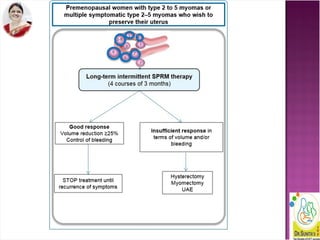
  • #30 Figure 12 Management of type 2 to 5 myomas or multiple myomas (type 2–5) in premenopausal women wishing to preserve their uterus. In this case, long-term (four courses of three months) intermittent therapy with SPRMs is proposed. Fibroid classification cartoon republished with permission from Munro et al. (2011).