Republic of the Philippines
RAMON MAGSAYSAY TECHNOLOGICAL UNIVERSITY
SOUTH CAMPUS
COLLEGE OF EDUCATION, ARTS AND SCIENCES
Nat. Sci. 4- Environmental Science/ECOLOGY
Prepared by: Bryan F. Mose
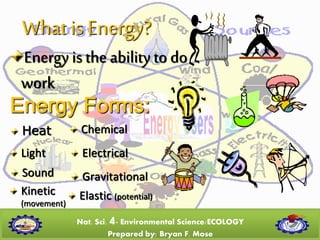
Energy is the ability to do
work
What is Energy?
Heat
Light
Sound
Kinetic
(movement)
Chemical
Electrical
Gravitational
Elastic (potential)
Nat. Sci. 4- Environmental Science/ECOLOGY
Prepared by: Bryan F. Mose
Nat. Sci. 4- Environmental Science/ECOLOGY
Prepared by: Bryan F. Mose
Nat. Sci. 4- Environmental Science/ECOLOGY
Prepared by: Bryan F. Mose
• All forms of energy are stored
in different ways, in the energy
sources we use every day.
• These sources are divided into
2 groups.
Nat. Sci. 4- Environmental Science/ECOLOGY
Prepared by: Bryan F. Mose
Nat. Sci. 4- Environmental Science/ECOLOGY
Prepared by: Bryan F. Mose
Renewable
An energy source that can
be replenished in a short
period of time.
Non–Renewable
Non-renewable resources
are resources for which
there is a limited supply.
2TYPESOFRESOURCES
Nat. Sci. 4- Environmental Science/ECOLOGY
Prepared by: Bryan F. Mose
Examples of:
Non-Renewable Energy
Oil
Coal
Natural Gas
Nuclear
Nat. Sci. 4- Environmental Science/ECOLOGY
Prepared by: Bryan F. Mose
Examples of:
Renewable Energy
Sun
Wind
Geothermal
Biomass (plants)
Water
Nat. Sci. 4- Environmental Science/ECOLOGY
Prepared by: Bryan F. Mose
Fossil fuel
 Primary non-renewable fossil sources
burn coal or hydrocarbon fuels, which
are the remains of the decomposition
of plants and animals.
3main types of fossil fuels:
• coal
• petroleum
• natural gas
Nat. Sci. 4- Environmental Science/ECOLOGY
Prepared by: Bryan F. Mose
Nat. Sci. 4- Environmental Science/ECOLOGY
Prepared by: Bryan F. Mose
Nat. Sci. 4- Environmental Science/ECOLOGY
Prepared by: Bryan F. Mose
Effect of fossil fuel
 The combustion of fossil fuels leads
to the release of pollution into the
atmosphere.
 They are causes of the global
warming.
 Greenhouse gas emissions result
from fossil fuel-based electricity
generation.
Nat. Sci. 4- Environmental Science/ECOLOGY
Prepared by: Bryan F. Mose
Nuclear Fuels
The other form of non-
renewable resource used
to produce energy,
nuclear fuels, is primarily
obtained through the
mining and refining of
uranium ore.
Uranium
is a naturally occurring
element found within the
Earth's core.
Nat. Sci. 4- Environmental Science/ECOLOGY
Prepared by: Bryan F. Mose
The Philippines has large reserves
of many natural resources. these
are oil, natural gas and coal.
Other sources of energy that can be
harnessed include geothermal
energy and hydroelectricity.
Nat. Sci. 4- Environmental Science/ECOLOGY
Prepared by: Bryan F. Mose
Oil barrels
The Philippines' proven oil deposits
currently stand at 138 million barrels.
Natural gas flame
Natural gas deposits in the Philippines are
located offshore, above the country's deep-
sea oil reserves. The Philippines possesses
3.9 trillion cubic feet of natural gas
reserves.
Nat. Sci. 4- Environmental Science/ECOLOGY
Prepared by: Bryan F. Mose
Coal mining
The Philippines holds 260 million short
tons of usable coal reserves.
While it has recently increased extraction,
consumption still far outpaces production,
forcing the country to rely on imports to
meet demand.
Nat. Sci. 4- Environmental Science/ECOLOGY
Prepared by: Bryan F. Mose
Other sources of energy
Geothermal Energy
Currently, the
Philippines is the
second highest
producer of
geothermal energy.
The government has
set a goal to surpass
the United States as
the highest producer
in the world.
Nat. Sci. 4- Environmental Science/ECOLOGY
Prepared by: Bryan F. Mose
THE PRODUCTION OF
GEOTHERMAL ENERGY
In the Philippines
geothermal energy
already provides
27% of the
country's total
electricity
production
generated in power
plants.
Geothermal power
plants are on the
islands Luzon,
Negros, Mindanao
and Leyte.
Power plant in Tongonan, region Ormoc City,
Leyte (Picture: PNOC)
Nat. Sci. 4- Environmental Science/ECOLOGY
Prepared by: Bryan F. Mose
Hydroelectricity
Hydroelectricity centers in
the Philippines generate
2,900 megawatts of
electricity, which is 19
percent of the country's
total electricity
consumption.
The rate of production has
remained constant for
decades, but there are
plans to introduce more
hydroelectric centers.
Nat. Sci. 4- Environmental Science/ECOLOGY
Prepared by: Bryan F. Mose
!!!
Nat. Sci. 4- Environmental Science/ECOLOGY
Prepared by: Bryan F. Mose
Nat. Sci. 4- Environmental Science/ECOLOGY
Prepared by: Bryan F. Mose
Hydroelectricity is the
term referring to
electricity generated by
hydropower.
The production of
electrical power through
the use of the
gravitational force of
falling or flowing water.
Nat. Sci. 4- Environmental Science/ECOLOGY
Prepared by: Bryan F. Mose
• The heat inside the
Earth produces
steam and hot
water that can be
used to power
generators and
produce electricity,
or for other
applications such as
home heating and
power generation
for industry.
Nat. Sci. 4- Environmental Science/ECOLOGY
Prepared by: Bryan F. Mose
• The sun is our most
powerful source of
energy.
• Solar energy, radiant light
and heat from the sun, is
harnessed using a range
of ever-evolving
technologies such as solar
heating, photovoltaic,
concentrated solar power,
solar architecture and
artificial photosynthesis.
Nat. Sci. 4- Environmental Science/ECOLOGY
Prepared by: Bryan F. Mose
• Wind energy is
captured by wind
turbines and used to
generate electricity.
• As offshore wind
speeds average ~90%
greater than that of
land, so offshore
resources can
contribute substantially
more energy than land
stationed turbines.
Nat. Sci. 4- Environmental Science/ECOLOGY
Prepared by: Bryan F. Mose
• Biomass is biological material
derived from living, or
recently living organisms. It
most often refers to plants or
plant-derived materials which
are specifically called
lignocellulosic biomass.
• biomass includes plant or
animal matter that can be
converted into fibers or other
industrial chemicals, including
biofuels.
Nat. Sci. 4- Environmental Science/ECOLOGY
Prepared by: Bryan F. Mose
“Lets save the energy!!”
How will you conserve our
energy resources?
By watching this video clip! 
Nat. Sci. 4- Environmental Science/ECOLOGY
Prepared by: Bryan F. Mose
Nat. Sci. 4- Environmental Science/ECOLOGY
Prepared by: Bryan F. Mose
“Love is like the sun: has inner energy
source shines on you.”
-Helene Lagerberg

Energy situation

  • 1.
    Republic of thePhilippines RAMON MAGSAYSAY TECHNOLOGICAL UNIVERSITY SOUTH CAMPUS COLLEGE OF EDUCATION, ARTS AND SCIENCES
  • 2.
    Nat. Sci. 4-Environmental Science/ECOLOGY Prepared by: Bryan F. Mose Energy is the ability to do work What is Energy? Heat Light Sound Kinetic (movement) Chemical Electrical Gravitational Elastic (potential)
  • 3.
    Nat. Sci. 4-Environmental Science/ECOLOGY Prepared by: Bryan F. Mose
  • 4.
    Nat. Sci. 4-Environmental Science/ECOLOGY Prepared by: Bryan F. Mose
  • 5.
    Nat. Sci. 4-Environmental Science/ECOLOGY Prepared by: Bryan F. Mose • All forms of energy are stored in different ways, in the energy sources we use every day. • These sources are divided into 2 groups.
  • 6.
    Nat. Sci. 4-Environmental Science/ECOLOGY Prepared by: Bryan F. Mose
  • 7.
    Nat. Sci. 4-Environmental Science/ECOLOGY Prepared by: Bryan F. Mose Renewable An energy source that can be replenished in a short period of time. Non–Renewable Non-renewable resources are resources for which there is a limited supply. 2TYPESOFRESOURCES
  • 8.
    Nat. Sci. 4-Environmental Science/ECOLOGY Prepared by: Bryan F. Mose Examples of: Non-Renewable Energy Oil Coal Natural Gas Nuclear
  • 9.
    Nat. Sci. 4-Environmental Science/ECOLOGY Prepared by: Bryan F. Mose Examples of: Renewable Energy Sun Wind Geothermal Biomass (plants) Water
  • 10.
    Nat. Sci. 4-Environmental Science/ECOLOGY Prepared by: Bryan F. Mose Fossil fuel  Primary non-renewable fossil sources burn coal or hydrocarbon fuels, which are the remains of the decomposition of plants and animals. 3main types of fossil fuels: • coal • petroleum • natural gas
  • 11.
    Nat. Sci. 4-Environmental Science/ECOLOGY Prepared by: Bryan F. Mose
  • 12.
    Nat. Sci. 4-Environmental Science/ECOLOGY Prepared by: Bryan F. Mose
  • 13.
    Nat. Sci. 4-Environmental Science/ECOLOGY Prepared by: Bryan F. Mose Effect of fossil fuel  The combustion of fossil fuels leads to the release of pollution into the atmosphere.  They are causes of the global warming.  Greenhouse gas emissions result from fossil fuel-based electricity generation.
  • 14.
    Nat. Sci. 4-Environmental Science/ECOLOGY Prepared by: Bryan F. Mose Nuclear Fuels The other form of non- renewable resource used to produce energy, nuclear fuels, is primarily obtained through the mining and refining of uranium ore. Uranium is a naturally occurring element found within the Earth's core.
  • 15.
    Nat. Sci. 4-Environmental Science/ECOLOGY Prepared by: Bryan F. Mose The Philippines has large reserves of many natural resources. these are oil, natural gas and coal. Other sources of energy that can be harnessed include geothermal energy and hydroelectricity.
  • 16.
    Nat. Sci. 4-Environmental Science/ECOLOGY Prepared by: Bryan F. Mose Oil barrels The Philippines' proven oil deposits currently stand at 138 million barrels. Natural gas flame Natural gas deposits in the Philippines are located offshore, above the country's deep- sea oil reserves. The Philippines possesses 3.9 trillion cubic feet of natural gas reserves.
  • 17.
    Nat. Sci. 4-Environmental Science/ECOLOGY Prepared by: Bryan F. Mose Coal mining The Philippines holds 260 million short tons of usable coal reserves. While it has recently increased extraction, consumption still far outpaces production, forcing the country to rely on imports to meet demand.
  • 18.
    Nat. Sci. 4-Environmental Science/ECOLOGY Prepared by: Bryan F. Mose Other sources of energy Geothermal Energy Currently, the Philippines is the second highest producer of geothermal energy. The government has set a goal to surpass the United States as the highest producer in the world.
  • 19.
    Nat. Sci. 4-Environmental Science/ECOLOGY Prepared by: Bryan F. Mose THE PRODUCTION OF GEOTHERMAL ENERGY In the Philippines geothermal energy already provides 27% of the country's total electricity production generated in power plants. Geothermal power plants are on the islands Luzon, Negros, Mindanao and Leyte. Power plant in Tongonan, region Ormoc City, Leyte (Picture: PNOC)
  • 20.
    Nat. Sci. 4-Environmental Science/ECOLOGY Prepared by: Bryan F. Mose Hydroelectricity Hydroelectricity centers in the Philippines generate 2,900 megawatts of electricity, which is 19 percent of the country's total electricity consumption. The rate of production has remained constant for decades, but there are plans to introduce more hydroelectric centers.
  • 21.
    Nat. Sci. 4-Environmental Science/ECOLOGY Prepared by: Bryan F. Mose !!!
  • 22.
    Nat. Sci. 4-Environmental Science/ECOLOGY Prepared by: Bryan F. Mose
  • 23.
    Nat. Sci. 4-Environmental Science/ECOLOGY Prepared by: Bryan F. Mose Hydroelectricity is the term referring to electricity generated by hydropower. The production of electrical power through the use of the gravitational force of falling or flowing water.
  • 24.
    Nat. Sci. 4-Environmental Science/ECOLOGY Prepared by: Bryan F. Mose • The heat inside the Earth produces steam and hot water that can be used to power generators and produce electricity, or for other applications such as home heating and power generation for industry.
  • 25.
    Nat. Sci. 4-Environmental Science/ECOLOGY Prepared by: Bryan F. Mose • The sun is our most powerful source of energy. • Solar energy, radiant light and heat from the sun, is harnessed using a range of ever-evolving technologies such as solar heating, photovoltaic, concentrated solar power, solar architecture and artificial photosynthesis.
  • 26.
    Nat. Sci. 4-Environmental Science/ECOLOGY Prepared by: Bryan F. Mose • Wind energy is captured by wind turbines and used to generate electricity. • As offshore wind speeds average ~90% greater than that of land, so offshore resources can contribute substantially more energy than land stationed turbines.
  • 27.
    Nat. Sci. 4-Environmental Science/ECOLOGY Prepared by: Bryan F. Mose • Biomass is biological material derived from living, or recently living organisms. It most often refers to plants or plant-derived materials which are specifically called lignocellulosic biomass. • biomass includes plant or animal matter that can be converted into fibers or other industrial chemicals, including biofuels.
  • 28.
    Nat. Sci. 4-Environmental Science/ECOLOGY Prepared by: Bryan F. Mose “Lets save the energy!!” How will you conserve our energy resources? By watching this video clip! 
  • 29.
    Nat. Sci. 4-Environmental Science/ECOLOGY Prepared by: Bryan F. Mose
  • 30.
    Nat. Sci. 4-Environmental Science/ECOLOGY Prepared by: Bryan F. Mose “Love is like the sun: has inner energy source shines on you.” -Helene Lagerberg

Editor's Notes

  • #17 Recent discovery of deep-water oil resources has encouraged greater production of oil, but it is still not enough to meet the country's petroleum needs without imports.