PRESENTED BY:
R.L.S.ADITYA
TMBA/13-06
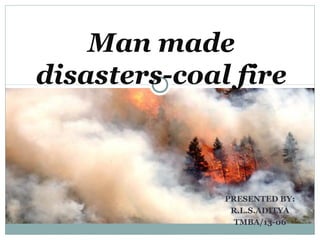
Man made
disasters-coal fire
The term "Coal fire" refers to a burning or smoldering
coal seam, coal storage pile or coal waste pile. Two
major causes have been identified for coal fires:
Natural causes:
coal seam or dust can be exposed by the erosion or a
subsidence event, strike by lightning or ignite by a
wildfire.
Human causes:
 friction, electricity or oxygen can ignite coal peat or
dust during regular extraction, illegal mining,
transportation.
Introduction
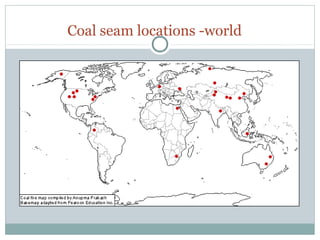
Coal seam locations -world
Active coal seams and coal fire mines
Anna Waste Dump, Aachen Anthracite Coal Field,
Alsdorf,germany
Brennender Berg (Burning Mountain),
Saarland,Germany
Smoking Hills in Canada’s Northwest Territories
Benxihu Colliery (1942) - China
Courrieres Coal Mine (1906) - France
Mitsubishi Hojyo Coal Mine (1914) - Japan
Oaks Colliery Explosion (1866) - United Kingdom
Dhanbad Coal Mine (1965 and1975) - India
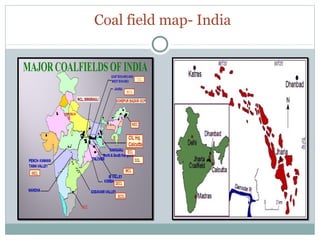
Coal field map- India
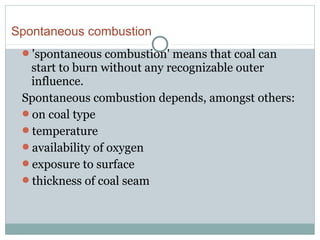
'spontaneous combustion' means that coal can
start to burn without any recognizable outer
influence.
Spontaneous combustion depends, amongst others:
on coal type
temperature
availability of oxygen
exposure to surface
thickness of coal seam
Spontaneous combustion
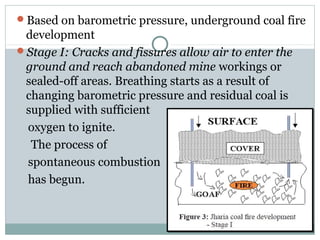
Based on barometric pressure, underground coal fire
development
Stage I: Cracks and fissures allow air to enter the
ground and reach abandoned mine workings or
sealed-off areas. Breathing starts as a result of
changing barometric pressure and residual coal is
supplied with sufficient
oxygen to ignite.
The process of
spontaneous combustion
has begun.
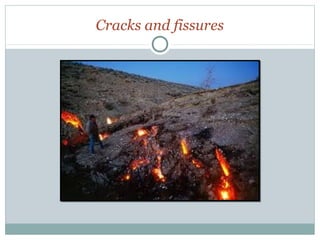
Cracks and fissures
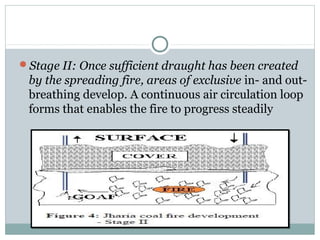
Stage II: Once sufficient draught has been created
by the spreading fire, areas of exclusive in- and out-
breathing develop. A continuous air circulation loop
forms that enables the fire to progress steadily
DETECTION OF SPONTANEOUS
COMBUSTION
Chemical Indication / Fire Ratios
The composites of gas concentration have been suggested
to assist in the interpretation of fire gases.
Some of these are as follows:
Graham's ratio [C0]/402
Willet's ratio CO2/[excess N2 + CO2 + combustibles]
As a thumb rule it can be taken that
• 0.4% or less indicates normal value
• 0.5% ___ necessity for a thorough a checkup
• 1% ____existence of heating
• 2% ____ serious heating approaches active fire
• 3% and above _____ action fire with certainty
CONTROL OF SPONTANEOUS COMBUSTION
three types of gases which have already been used
to fight mine fires.
a) Carbon dioxide b) inert gases c)Nitrogen
Inorganic Inhibitors
magnesium chloride, cadmium chloride &
trisodium
Sealant
Mica, rubber, bitumen
High Pressure Foam
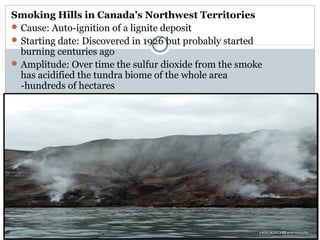
Smoking Hills in Canada’s Northwest Territories
Cause: Auto-ignition of a lignite deposit
Starting date: Discovered in 1926 but probably started
burning centuries ago
Amplitude: Over time the sulfur dioxide from the smoke
has acidified the tundra biome of the whole area
-hundreds of hectares
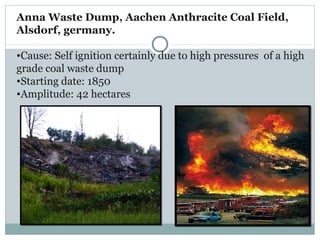
Anna Waste Dump, Aachen Anthracite Coal Field,
Alsdorf, germany.
•Cause: Self ignition certainly due to high pressures of a high
grade coal waste dump
•Starting date: 1850
•Amplitude: 42 hectares
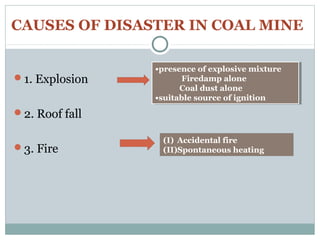
CAUSES OF DISASTER IN COAL MINE
1. Explosion
2. Roof fall
3. Fire
•presence of explosive mixture
Firedamp alone
Coal dust alone
•suitable source of ignition
•presence of explosive mixture
Firedamp alone
Coal dust alone
•suitable source of ignition
(I) Accidental fire
(II)Spontaneous heating
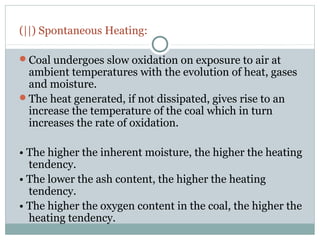
(||) Spontaneous Heating:
Coal undergoes slow oxidation on exposure to air at
ambient temperatures with the evolution of heat, gases
and moisture.
The heat generated, if not dissipated, gives rise to an
increase the temperature of the coal which in turn
increases the rate of oxidation.
• The higher the inherent moisture, the higher the heating
tendency.
• The lower the ash content, the higher the heating
tendency.
• The higher the oxygen content in the coal, the higher the
heating tendency.
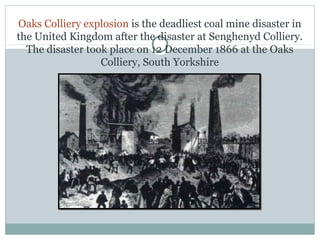
Oaks Colliery explosion is the deadliest coal mine disaster in
the United Kingdom after the disaster at Senghenyd Colliery.
The disaster took place on 12 December 1866 at the Oaks
Colliery, South Yorkshire
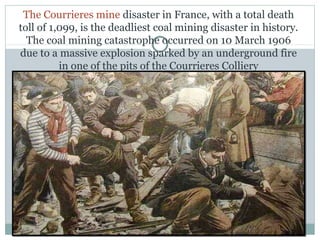
The Courrieres mine disaster in France, with a total death
toll of 1,099, is the deadliest coal mining disaster in history.
The coal mining catastrophe occurred on 10 March 1906
due to a massive explosion sparked by an underground fire
in one of the pits of the Courrieres Colliery
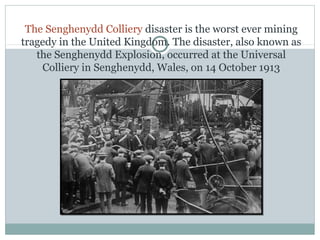
The Senghenydd Colliery disaster is the worst ever mining
tragedy in the United Kingdom. The disaster, also known as
the Senghenydd Explosion, occurred at the Universal
Colliery in Senghenydd, Wales, on 14 October 1913
Impact on atmospheric environment
Release of carbon dioxide, a greenhouse gas, is one of
the major cause to climate change and global warming,
according to the IPCC.
 Coal is the largest contributor to the human-made
increase of CO2 in the atmosphere.
 According to Guan et al., coal fires in northern China
discharge into the atmosphere each year:
 490,200 t of carbon monoxide (CO),
 514,700 t of sulfur dioxide (SO2),
300,000 t of nitrogen dioxide (NO2),
112,000 t of dust,
as well as other harmful gases such as carbon dioxide
(CO2) and hydrogen sulfide (H2S).
Impact on soil environment
Soil moisture and air have a great impact on plant
growth. Coal fires change the physico-chemical
properties of soil. Yellow burned soil is omnipresent
in coal fire areas
Soil becomes fragile and prone to crumbling, with
very low organic matter content and only small
numbers of microorganisms
Impact on human health
Coal tar is a respiratory carcinogen identified by the
International Cancer Research Institution of the
World Health Organization.
 Arsenic contained in coal fire discharge can cause
chronic intoxication with after-effects such as
pigment deficiency, over-pigmentation, and skin
cancer.
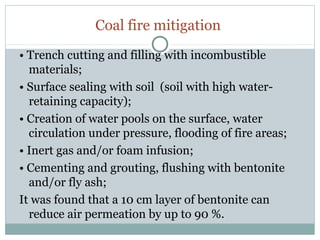
Coal fire mitigation
• Trench cutting and filling with incombustible
materials;
• Surface sealing with soil (soil with high water-
retaining capacity);
• Creation of water pools on the surface, water
circulation under pressure, flooding of fire areas;
• Inert gas and/or foam infusion;
• Cementing and grouting, flushing with bentonite
and/or fly ash;
It was found that a 10 cm layer of bentonite can
reduce air permeation by up to 90 %.
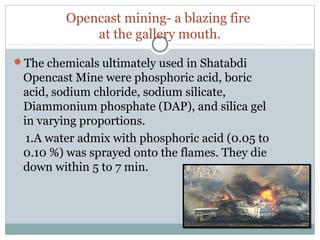
Opencast mining- a blazing fire
at the gallery mouth.
The chemicals ultimately used in Shatabdi
Opencast Mine were phosphoric acid, boric
acid, sodium chloride, sodium silicate,
Diammonium phosphate (DAP), and silica gel
in varying proportions.
1.A water admix with phosphoric acid (0.05 to
0.10 %) was sprayed onto the flames. They die
down within 5 to 7 min.
DAP (0.03 to 0.1 %) was sprayed with a fog fighter.
After spraying, temperatures in the debris dropped
from 450 to 60 °C and below within 10 to 12 h
overlying rock strata, they fell from 250 to 80°C
within fifteen to twenty days
Silica gel, a mixture of sodium silicate and DAP,
was applied afterwards to form an impervious
coating on the coal surface and thus reduce the risk
of re-ignition.
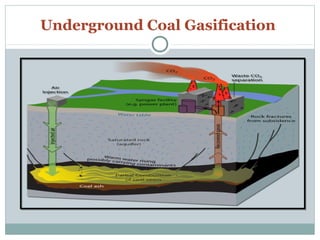
Underground Coal Gasification
A more-controlled version of a natural coal seam fire
produces primarily hydrogen and CO2, with lesser
amounts of carbon monoxide, methane, and trace
amounts of other gases
syngas and can be combusted directly to produce
heat
greatly reduce the impacts associated with coal
mining, coal dust, and the emissions of sulfur
dioxide and nitrous oxides
Groundwater Contamination- leach out into
surrounding groundwater.
Conclusion
India coal mining industry strive
toward zero disaster
proper Vigilance
Environmental tele-monitoring in fire
prone areas.
Thank you 

Coal fire tmba 13-06

  • 1.
  • 2.
    The term "Coalfire" refers to a burning or smoldering coal seam, coal storage pile or coal waste pile. Two major causes have been identified for coal fires: Natural causes: coal seam or dust can be exposed by the erosion or a subsidence event, strike by lightning or ignite by a wildfire. Human causes:  friction, electricity or oxygen can ignite coal peat or dust during regular extraction, illegal mining, transportation. Introduction
  • 3.
  • 4.
    Active coal seamsand coal fire mines Anna Waste Dump, Aachen Anthracite Coal Field, Alsdorf,germany Brennender Berg (Burning Mountain), Saarland,Germany Smoking Hills in Canada’s Northwest Territories Benxihu Colliery (1942) - China Courrieres Coal Mine (1906) - France Mitsubishi Hojyo Coal Mine (1914) - Japan Oaks Colliery Explosion (1866) - United Kingdom Dhanbad Coal Mine (1965 and1975) - India
  • 5.
  • 6.
    'spontaneous combustion' meansthat coal can start to burn without any recognizable outer influence. Spontaneous combustion depends, amongst others: on coal type temperature availability of oxygen exposure to surface thickness of coal seam Spontaneous combustion
  • 7.
    Based on barometricpressure, underground coal fire development Stage I: Cracks and fissures allow air to enter the ground and reach abandoned mine workings or sealed-off areas. Breathing starts as a result of changing barometric pressure and residual coal is supplied with sufficient oxygen to ignite. The process of spontaneous combustion has begun.
  • 8.
  • 9.
    Stage II: Oncesufficient draught has been created by the spreading fire, areas of exclusive in- and out- breathing develop. A continuous air circulation loop forms that enables the fire to progress steadily
  • 10.
    DETECTION OF SPONTANEOUS COMBUSTION ChemicalIndication / Fire Ratios The composites of gas concentration have been suggested to assist in the interpretation of fire gases. Some of these are as follows: Graham's ratio [C0]/402 Willet's ratio CO2/[excess N2 + CO2 + combustibles] As a thumb rule it can be taken that • 0.4% or less indicates normal value • 0.5% ___ necessity for a thorough a checkup • 1% ____existence of heating • 2% ____ serious heating approaches active fire • 3% and above _____ action fire with certainty
  • 11.
    CONTROL OF SPONTANEOUSCOMBUSTION three types of gases which have already been used to fight mine fires. a) Carbon dioxide b) inert gases c)Nitrogen Inorganic Inhibitors magnesium chloride, cadmium chloride & trisodium Sealant Mica, rubber, bitumen High Pressure Foam
  • 12.
    Smoking Hills inCanada’s Northwest Territories Cause: Auto-ignition of a lignite deposit Starting date: Discovered in 1926 but probably started burning centuries ago Amplitude: Over time the sulfur dioxide from the smoke has acidified the tundra biome of the whole area -hundreds of hectares
  • 13.
    Anna Waste Dump,Aachen Anthracite Coal Field, Alsdorf, germany. •Cause: Self ignition certainly due to high pressures of a high grade coal waste dump •Starting date: 1850 •Amplitude: 42 hectares
  • 14.
    CAUSES OF DISASTERIN COAL MINE 1. Explosion 2. Roof fall 3. Fire •presence of explosive mixture Firedamp alone Coal dust alone •suitable source of ignition •presence of explosive mixture Firedamp alone Coal dust alone •suitable source of ignition (I) Accidental fire (II)Spontaneous heating
  • 15.
    (||) Spontaneous Heating: Coalundergoes slow oxidation on exposure to air at ambient temperatures with the evolution of heat, gases and moisture. The heat generated, if not dissipated, gives rise to an increase the temperature of the coal which in turn increases the rate of oxidation. • The higher the inherent moisture, the higher the heating tendency. • The lower the ash content, the higher the heating tendency. • The higher the oxygen content in the coal, the higher the heating tendency.
  • 16.
    Oaks Colliery explosionis the deadliest coal mine disaster in the United Kingdom after the disaster at Senghenyd Colliery. The disaster took place on 12 December 1866 at the Oaks Colliery, South Yorkshire
  • 17.
    The Courrieres minedisaster in France, with a total death toll of 1,099, is the deadliest coal mining disaster in history. The coal mining catastrophe occurred on 10 March 1906 due to a massive explosion sparked by an underground fire in one of the pits of the Courrieres Colliery
  • 18.
    The Senghenydd Collierydisaster is the worst ever mining tragedy in the United Kingdom. The disaster, also known as the Senghenydd Explosion, occurred at the Universal Colliery in Senghenydd, Wales, on 14 October 1913
  • 19.
    Impact on atmosphericenvironment Release of carbon dioxide, a greenhouse gas, is one of the major cause to climate change and global warming, according to the IPCC.  Coal is the largest contributor to the human-made increase of CO2 in the atmosphere.  According to Guan et al., coal fires in northern China discharge into the atmosphere each year:  490,200 t of carbon monoxide (CO),  514,700 t of sulfur dioxide (SO2), 300,000 t of nitrogen dioxide (NO2), 112,000 t of dust, as well as other harmful gases such as carbon dioxide (CO2) and hydrogen sulfide (H2S).
  • 20.
    Impact on soilenvironment Soil moisture and air have a great impact on plant growth. Coal fires change the physico-chemical properties of soil. Yellow burned soil is omnipresent in coal fire areas Soil becomes fragile and prone to crumbling, with very low organic matter content and only small numbers of microorganisms
  • 21.
    Impact on humanhealth Coal tar is a respiratory carcinogen identified by the International Cancer Research Institution of the World Health Organization.  Arsenic contained in coal fire discharge can cause chronic intoxication with after-effects such as pigment deficiency, over-pigmentation, and skin cancer.
  • 22.
    Coal fire mitigation •Trench cutting and filling with incombustible materials; • Surface sealing with soil (soil with high water- retaining capacity); • Creation of water pools on the surface, water circulation under pressure, flooding of fire areas; • Inert gas and/or foam infusion; • Cementing and grouting, flushing with bentonite and/or fly ash; It was found that a 10 cm layer of bentonite can reduce air permeation by up to 90 %.
  • 23.
    Opencast mining- ablazing fire at the gallery mouth. The chemicals ultimately used in Shatabdi Opencast Mine were phosphoric acid, boric acid, sodium chloride, sodium silicate, Diammonium phosphate (DAP), and silica gel in varying proportions. 1.A water admix with phosphoric acid (0.05 to 0.10 %) was sprayed onto the flames. They die down within 5 to 7 min.
  • 24.
    DAP (0.03 to0.1 %) was sprayed with a fog fighter. After spraying, temperatures in the debris dropped from 450 to 60 °C and below within 10 to 12 h overlying rock strata, they fell from 250 to 80°C within fifteen to twenty days Silica gel, a mixture of sodium silicate and DAP, was applied afterwards to form an impervious coating on the coal surface and thus reduce the risk of re-ignition.
  • 25.
  • 26.
    A more-controlled versionof a natural coal seam fire produces primarily hydrogen and CO2, with lesser amounts of carbon monoxide, methane, and trace amounts of other gases syngas and can be combusted directly to produce heat greatly reduce the impacts associated with coal mining, coal dust, and the emissions of sulfur dioxide and nitrous oxides Groundwater Contamination- leach out into surrounding groundwater.
  • 27.
    Conclusion India coal miningindustry strive toward zero disaster proper Vigilance Environmental tele-monitoring in fire prone areas.
  • 28.