COAGULATION  DISORDERS AND  ANAESTHESIA PRESENTERS:  DR UNNIKRISHNAN P DR SUNEESH THILAK CO-ORDINATOR DR C MADHUSOODHANAN PILLAI MODERATORS: DR GEETHA N K DR ASHA K S
What is normal hemostasis? Clot at the spot…. Not elsewhere…!
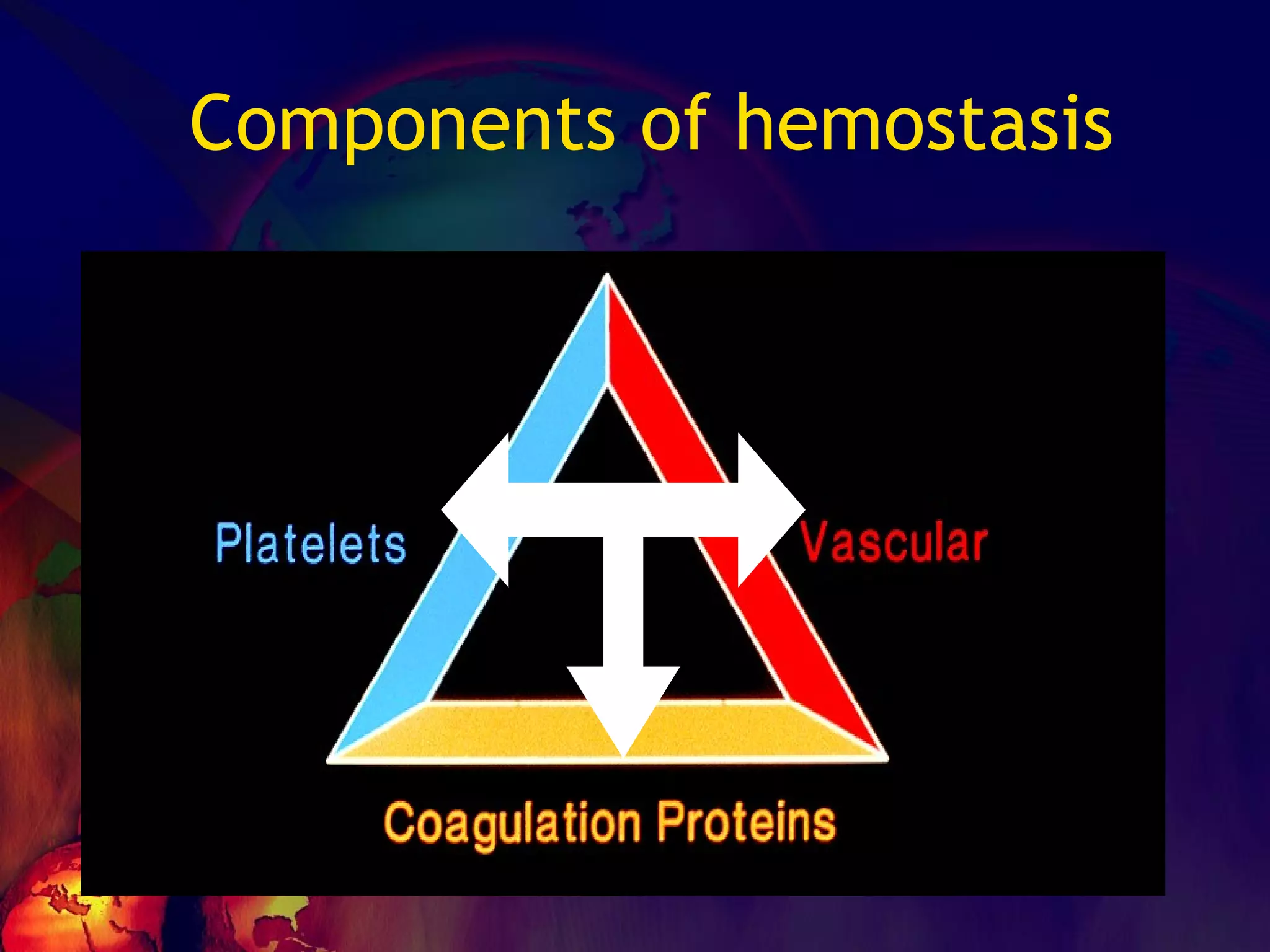
Components of hemostasis Interactive
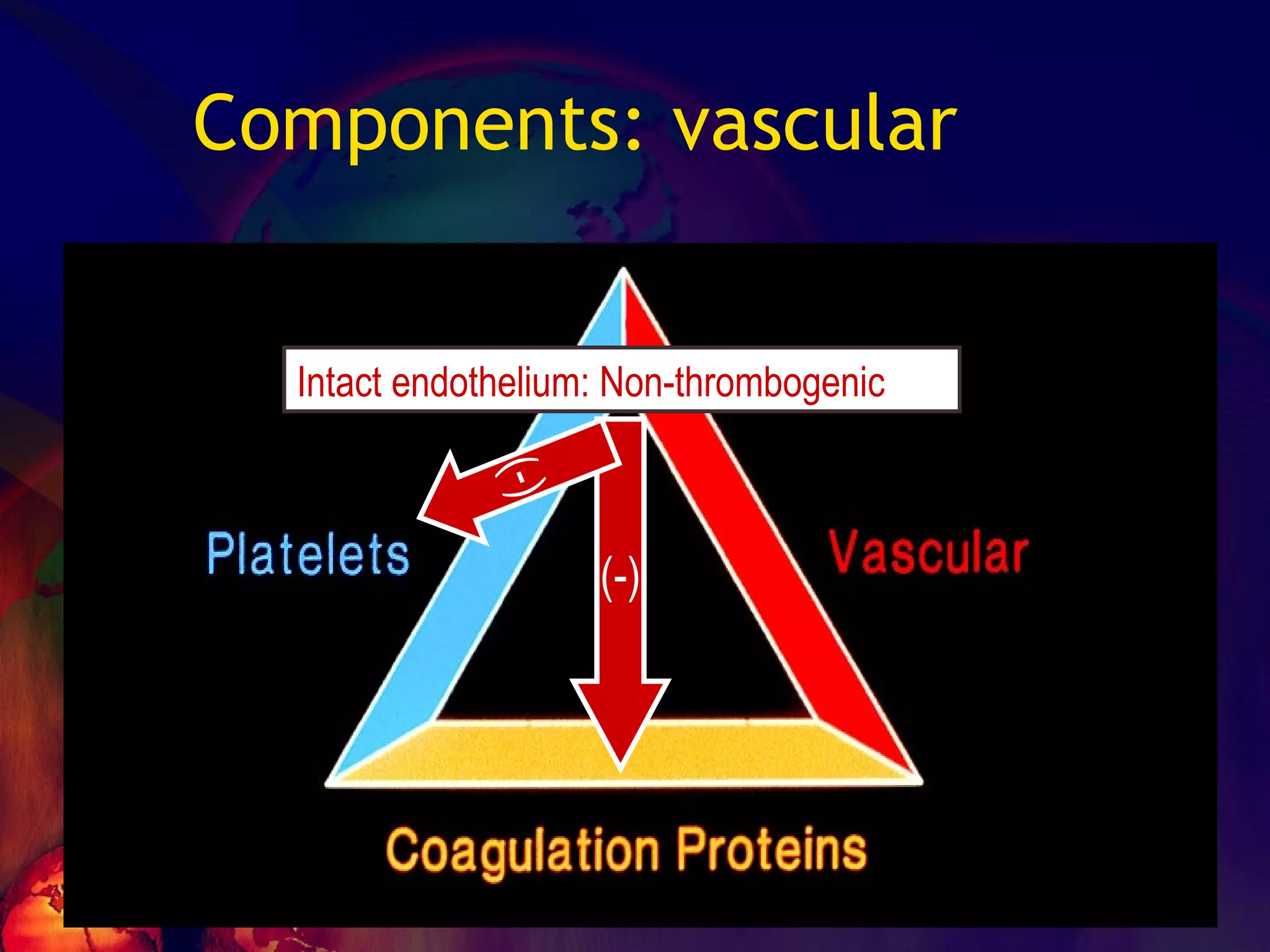
Components: vascular Intact endothelium: Non-thrombogenic (-) (-)
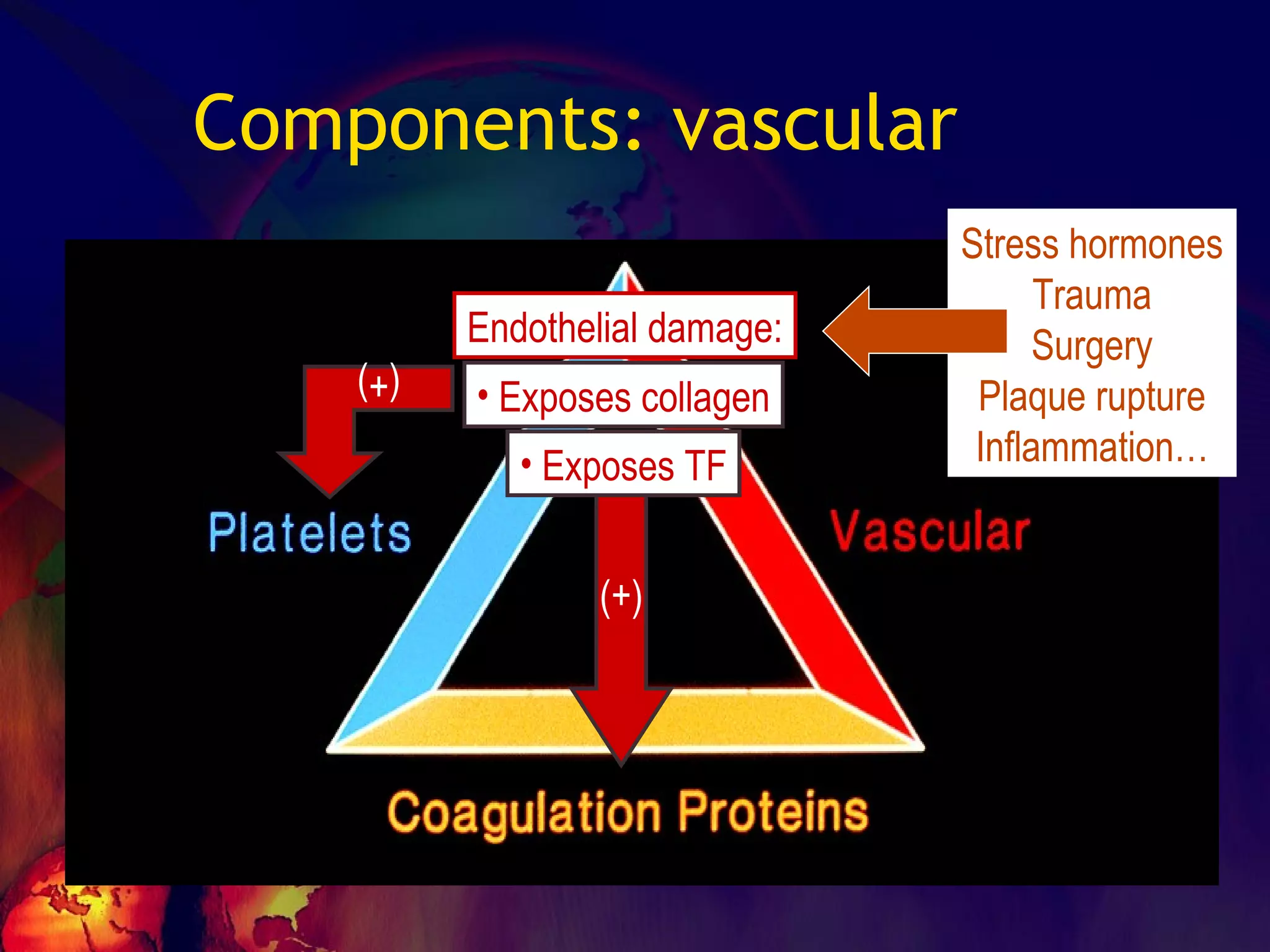
Components: vascular Endothelial damage: (+) (+) Stress hormones Trauma Surgery Plaque rupture Inflammation… Exposes collagen Exposes TF
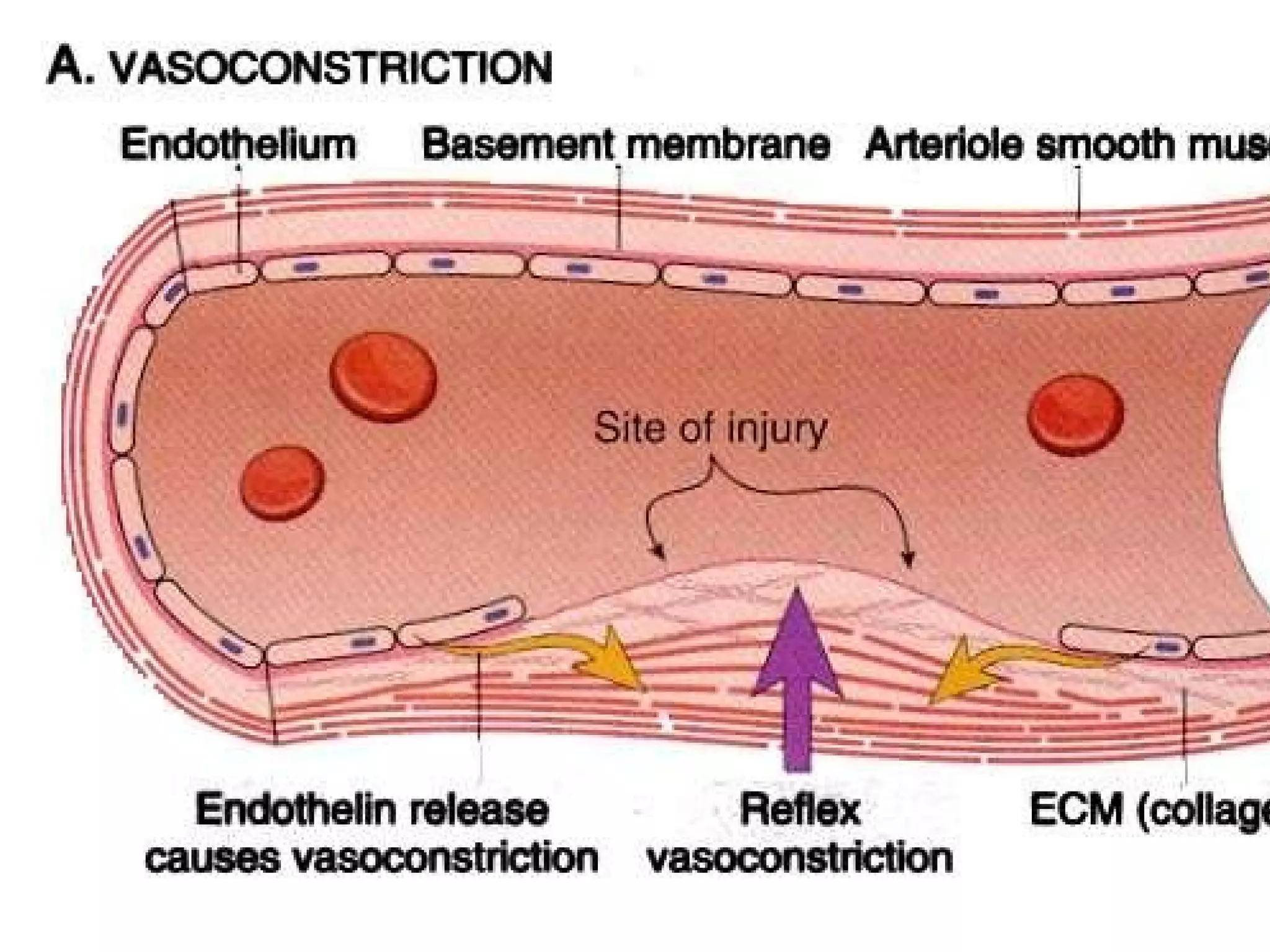
The first event….. VASOSPASM neurogenic humoral  …… but can’t rely on it fully.
 
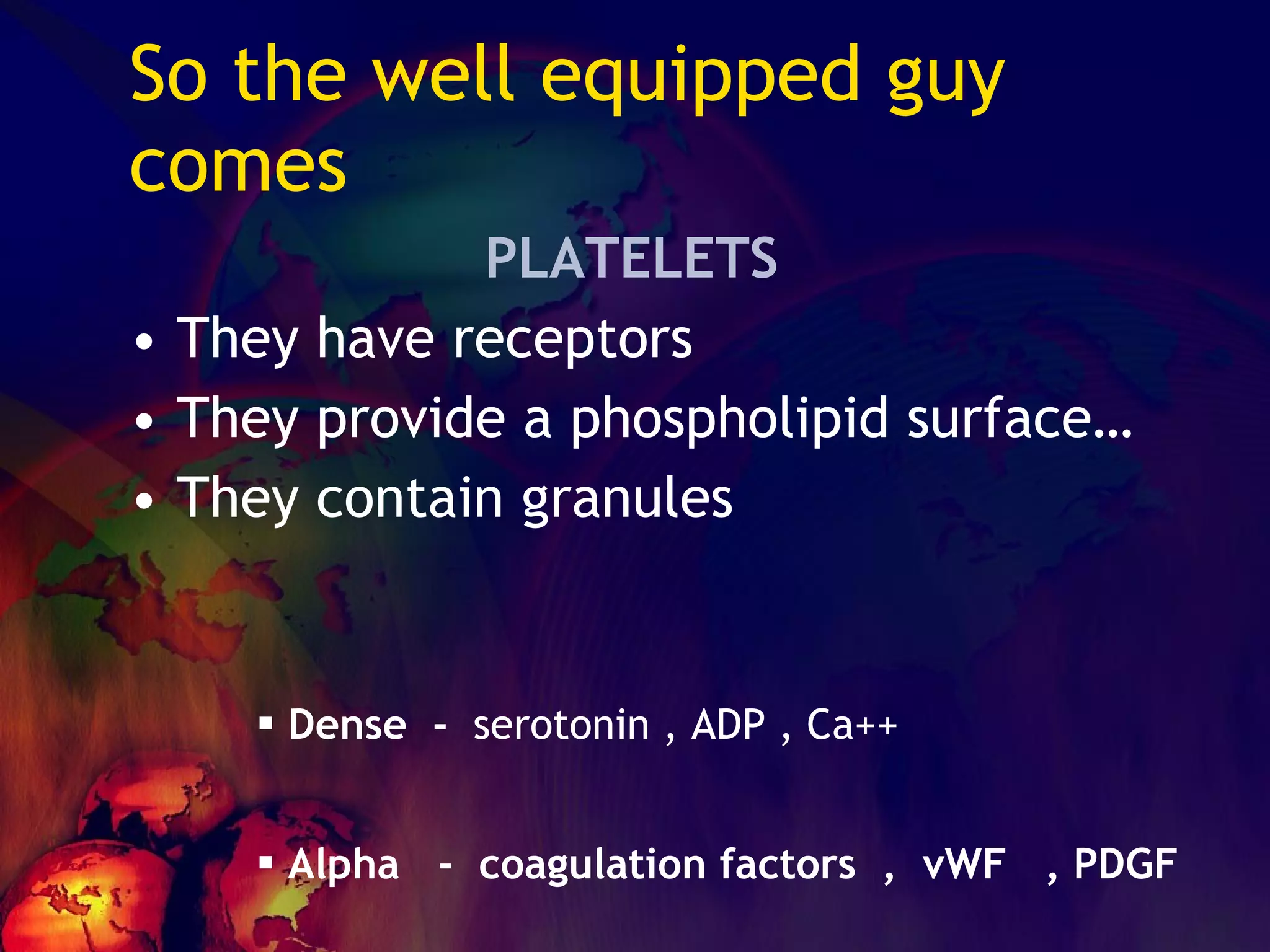
So the well equipped guy comes PLATELETS They have receptors They provide a phospholipid surface… They contain granules Dense  -  serotonin , ADP , Ca++ Alpha  -  coagulation factors  ,  vWF  , PDGF
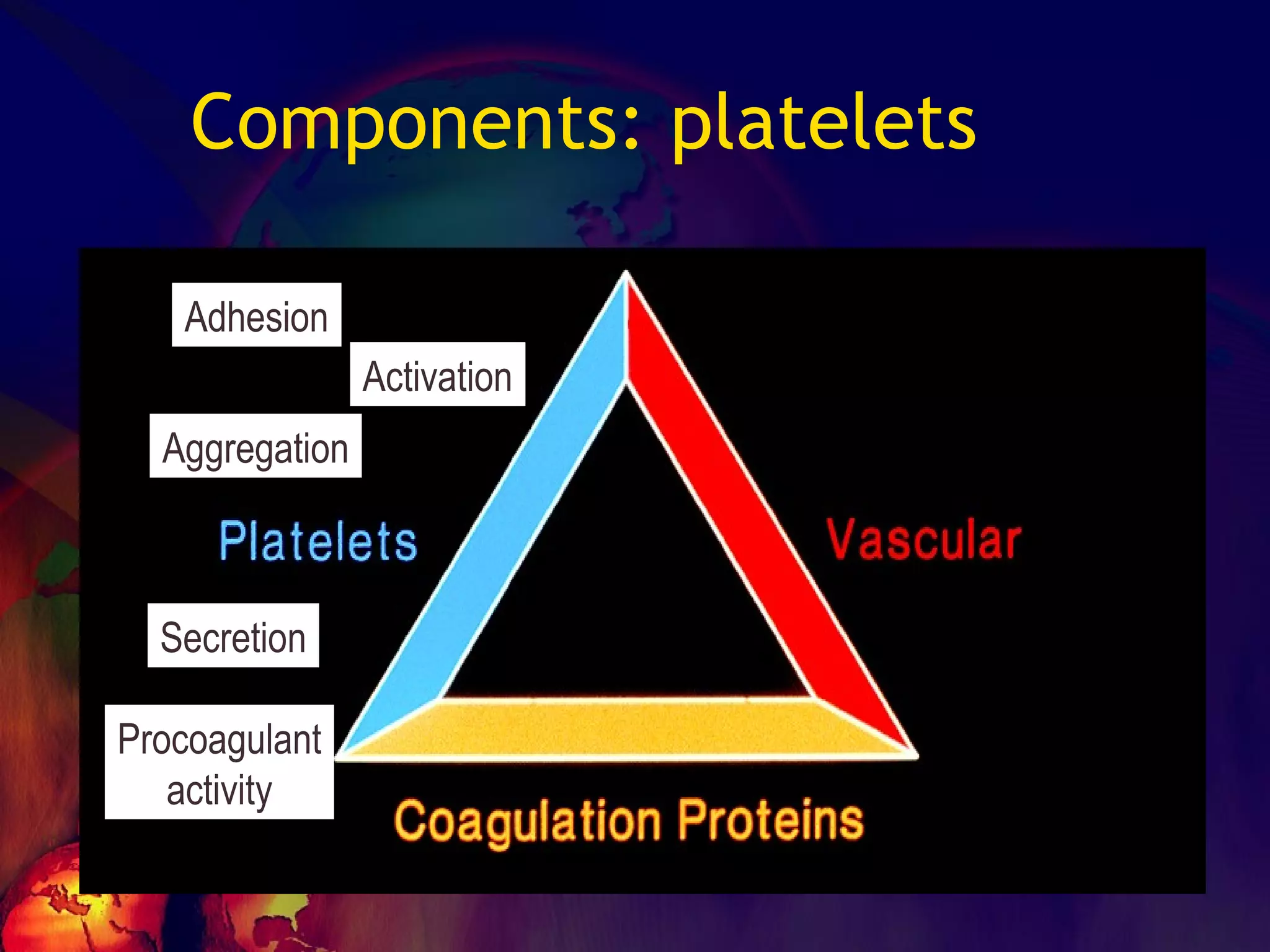
Components: platelets   Adhesion Activation Aggregation Secretion Procoagulant activity
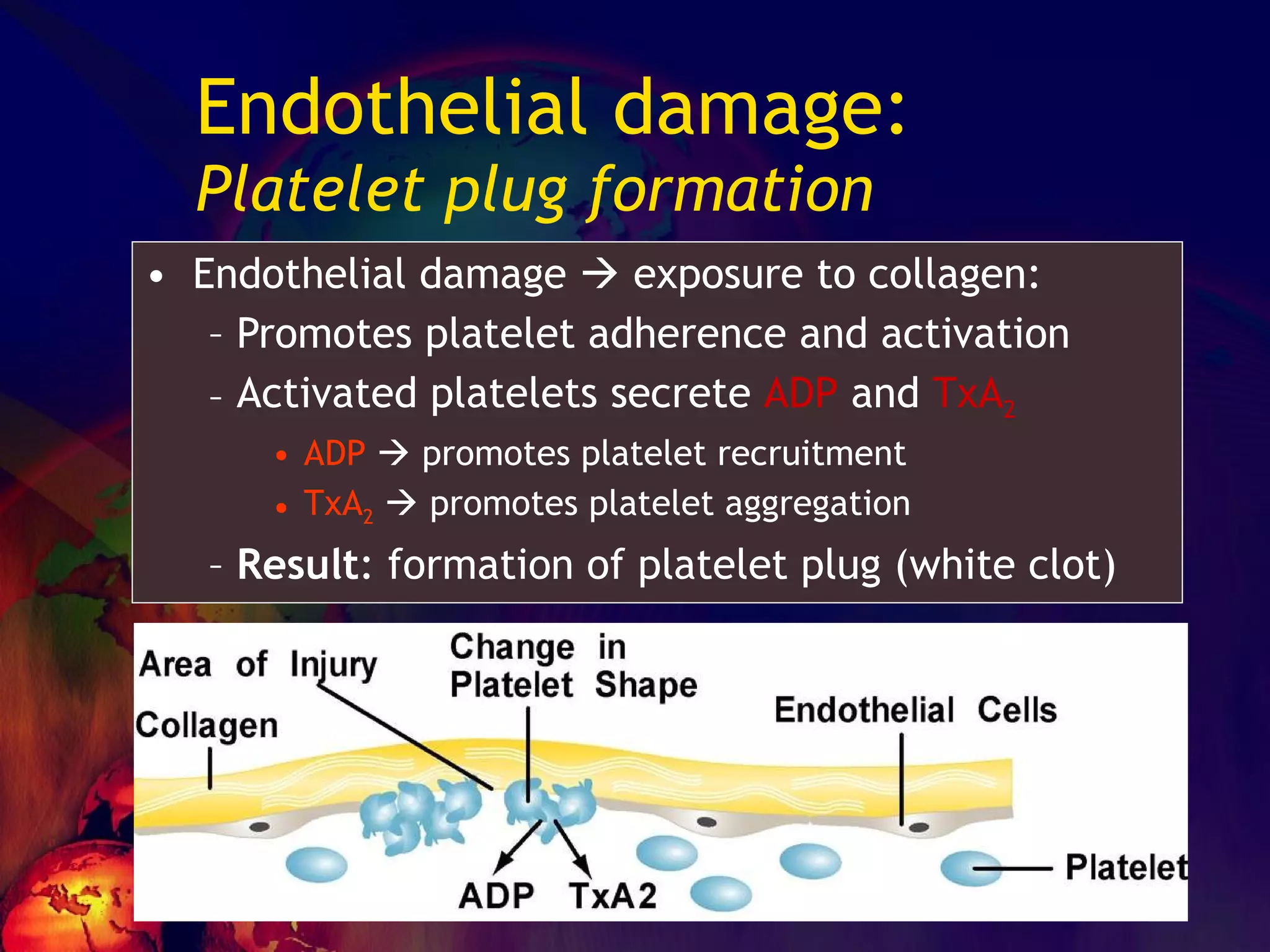
Endothelial damage: Platelet plug formation Endothelial damage    exposure to collagen: Promotes platelet adherence and activation Activated platelets secrete  ADP  and  TxA 2 ADP     promotes platelet recruitment TxA 2     promotes platelet aggregation Result : formation of platelet plug (white clot)
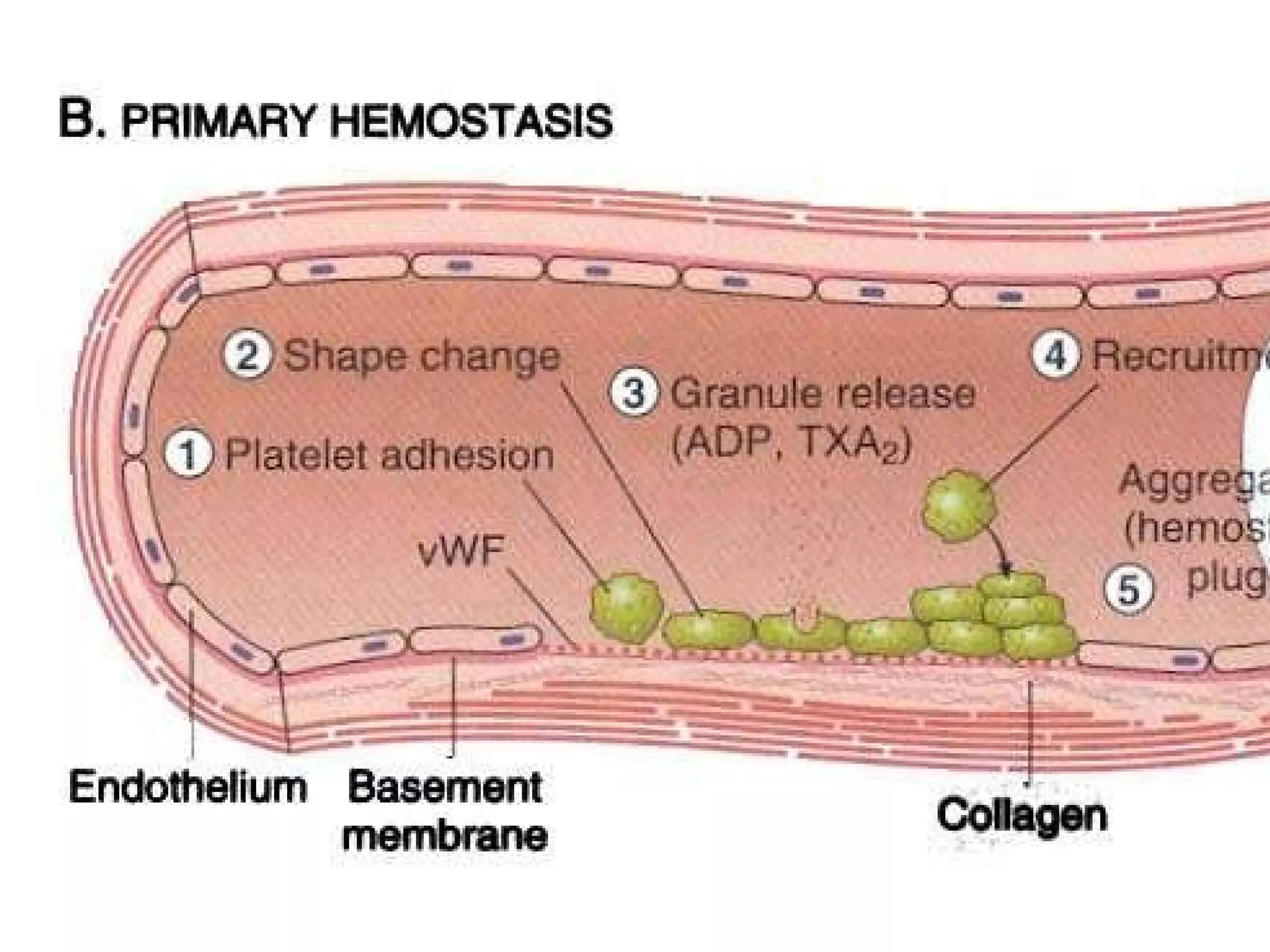
No one can hide the insults from them…… ADHESION – [vWF] SECRETION-[TxA2,ADP] AGGREGATION Leads to  PRIMARY HEMOSTASIS
 
Leads to….   PRIMARY HEMOSTASIS Occurs within SECONDS
The  balancing act PG E2  PG I2  NO  …….. all these oppose TxA2 & ADP
In need of…. FIBRIN The linking of platelets in the primary  plug, by fibrin, converts it into a definitive clot.  This requires the  participation of the  Coagulation Cascade. This process is known as  SECONDARY  HEMOSTASIS
Prompt………. But finely controlled Precursor Zymogens  Active Enzyme Rapid response Finely regulated Negative feedback loops Decrease in substrate Inhibitors Quiescent endothelium
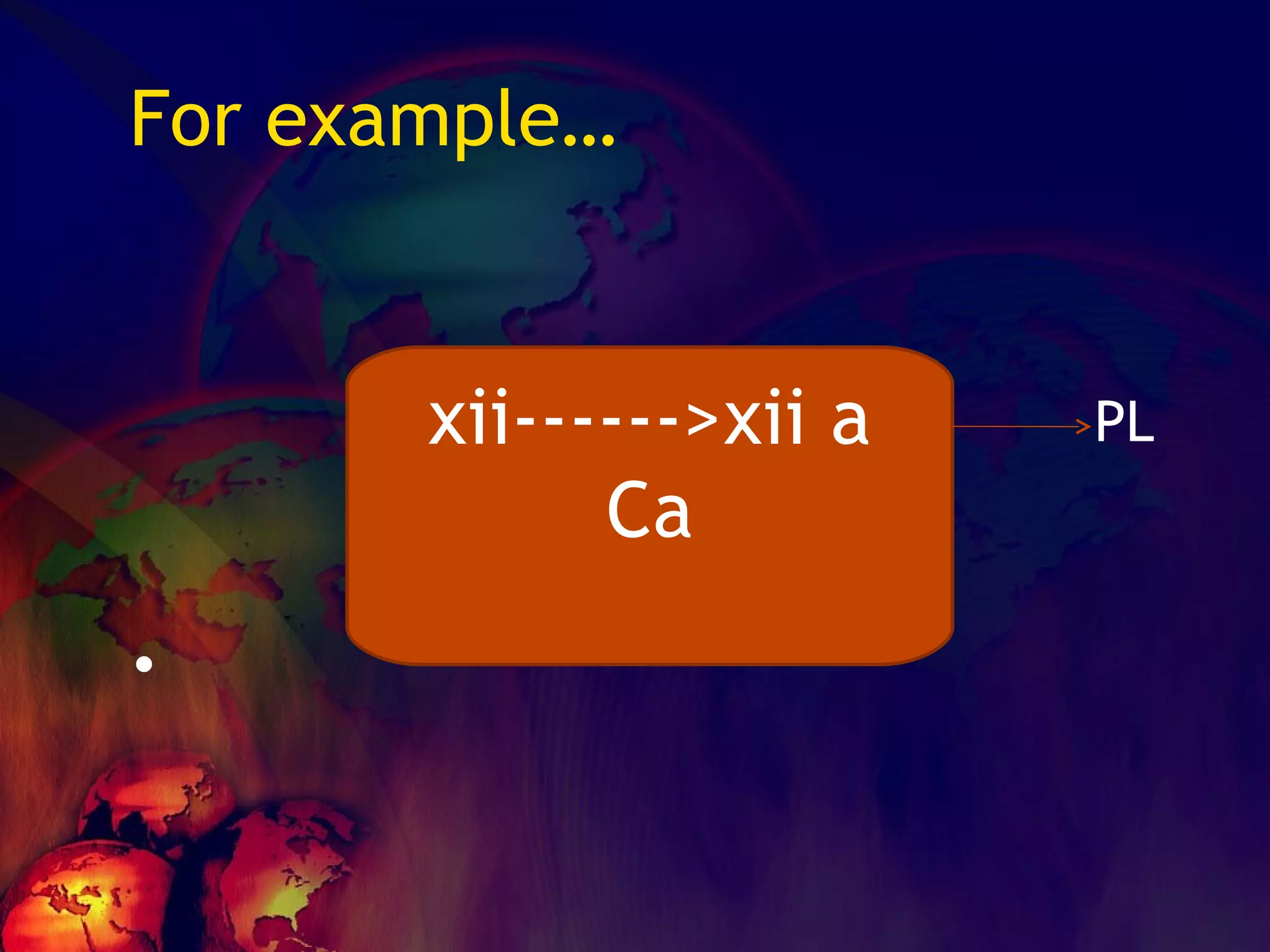
For example… PL xii------>xii a Ca
 
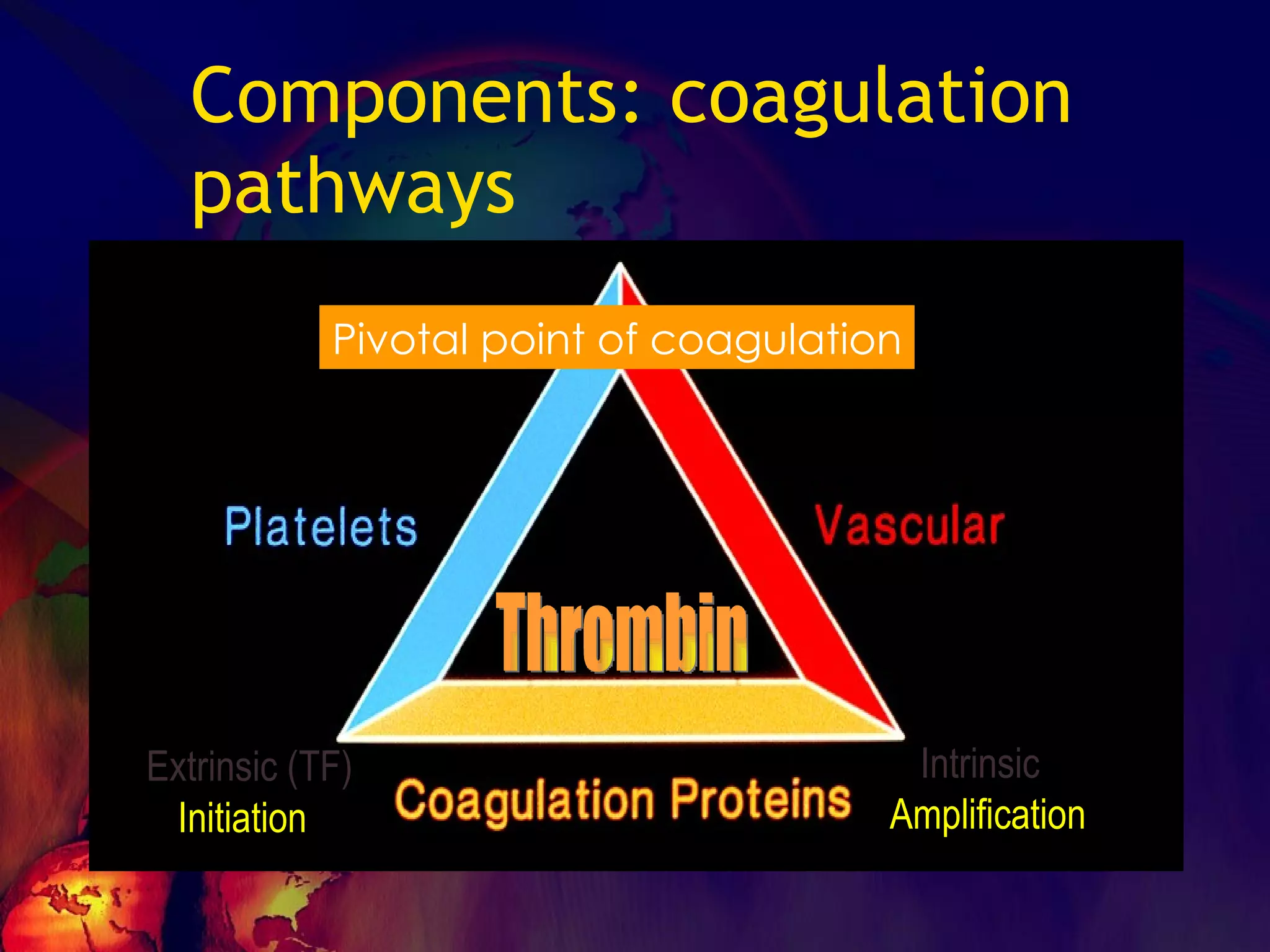
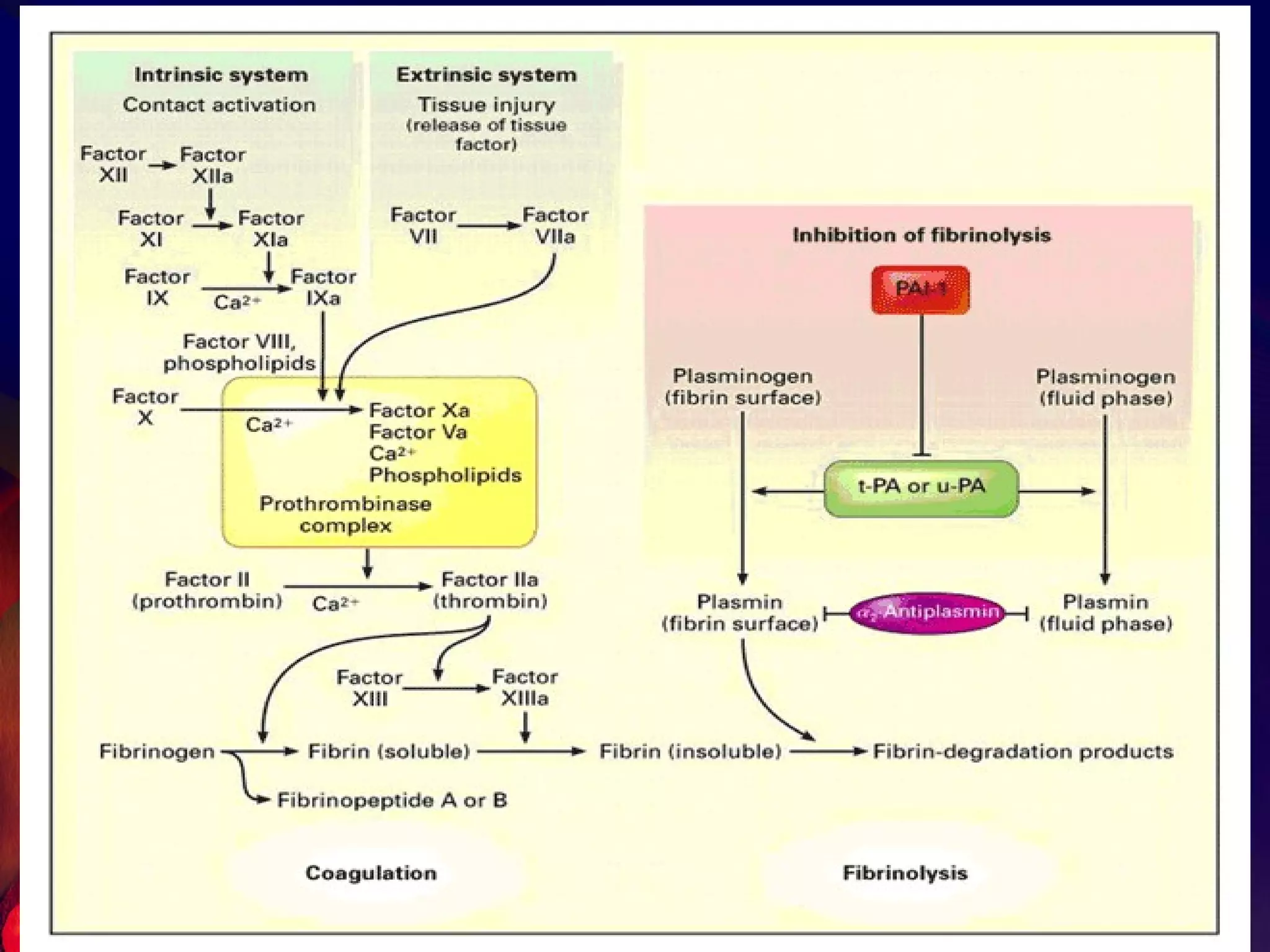
Components: coagulation pathways Extrinsic (TF) Intrinsic  Initiation Amplification Thrombin Pivotal point of coagulation
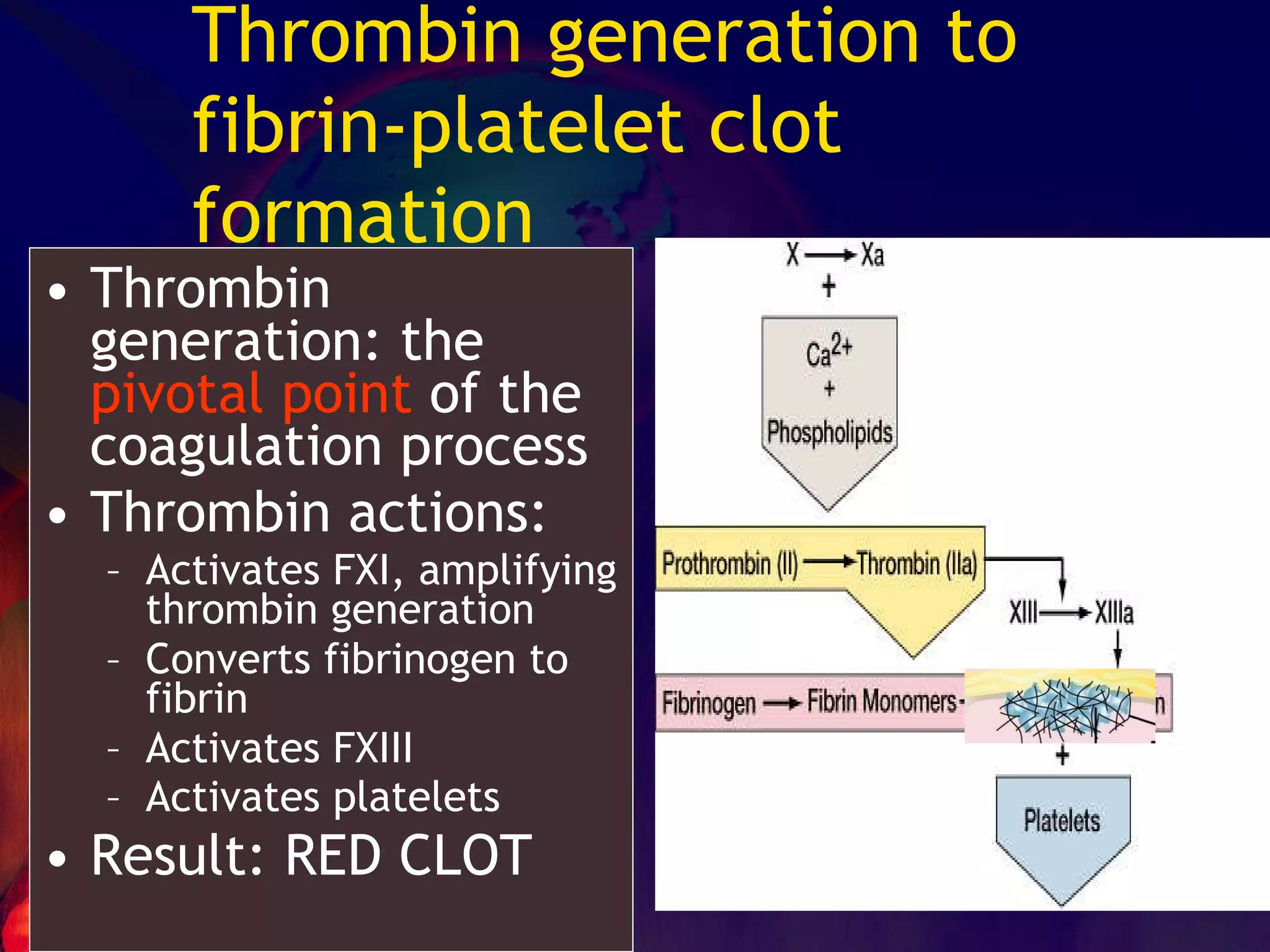
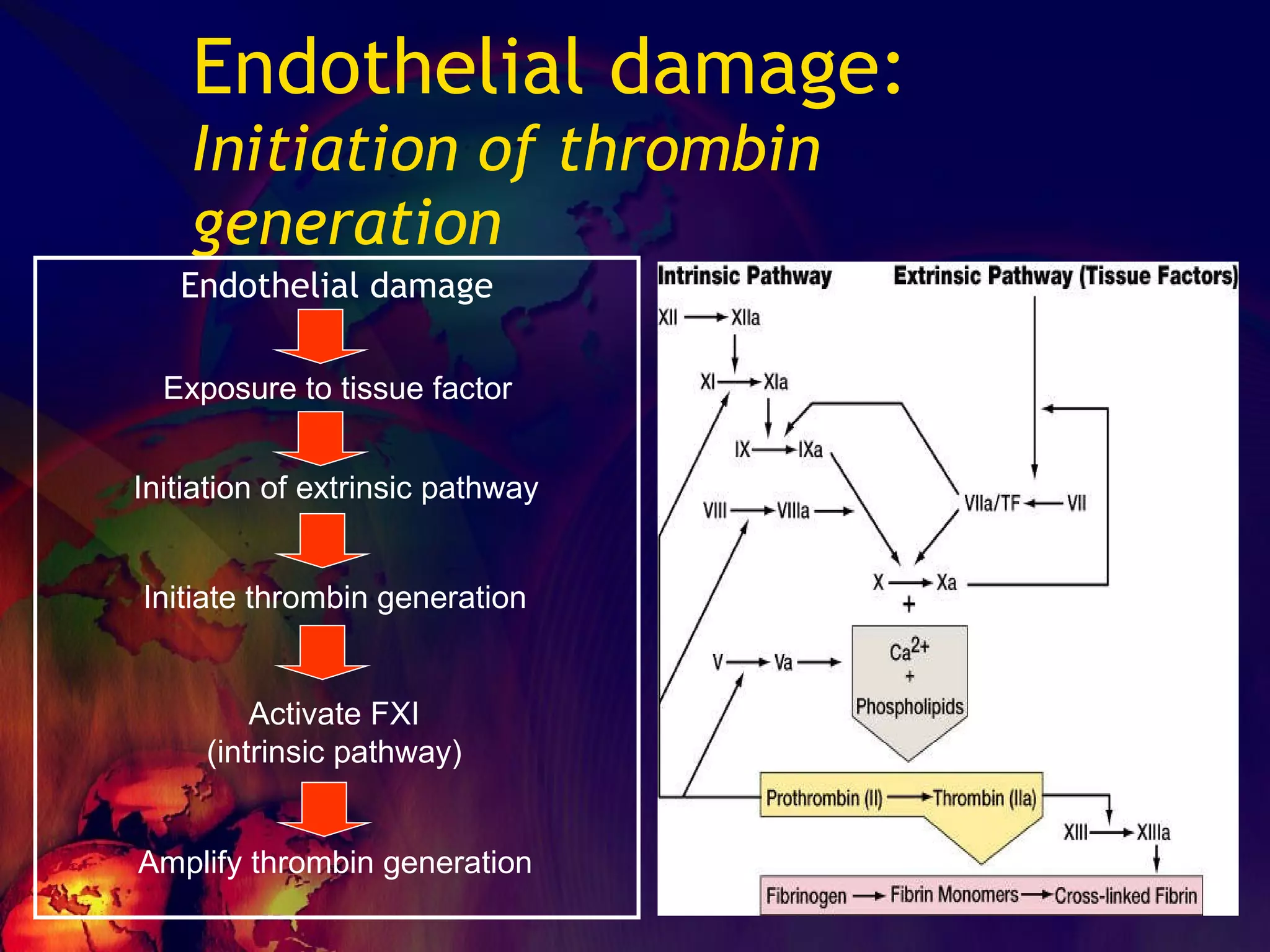
Thrombin generation: the  pivotal point  of the coagulation process Thrombin actions: Activates FXI, amplifying thrombin generation Converts fibrinogen to fibrin Activates FXIII Activates platelets   Result: RED CLOT Thrombin generation to fibrin-platelet clot formation
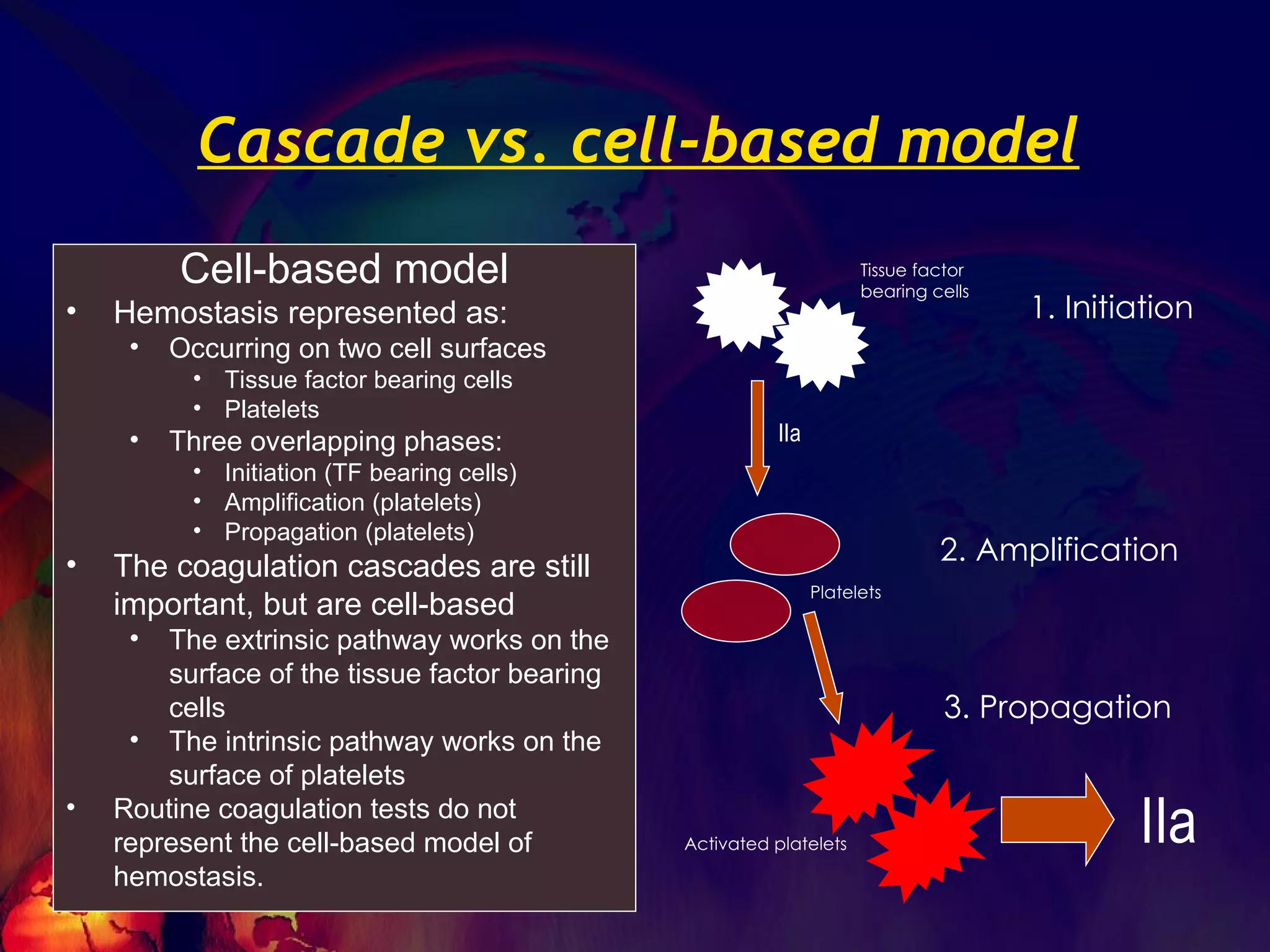
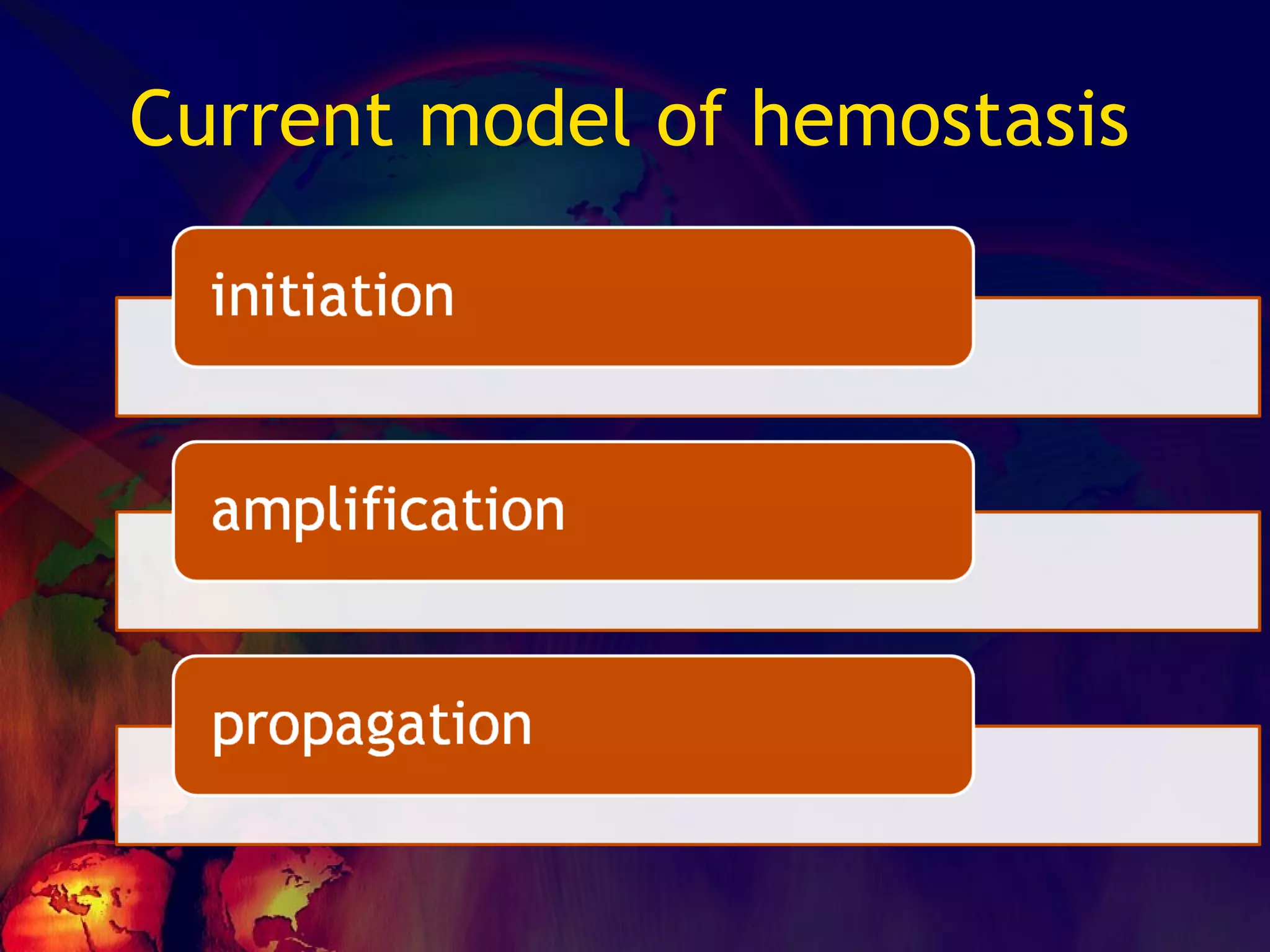
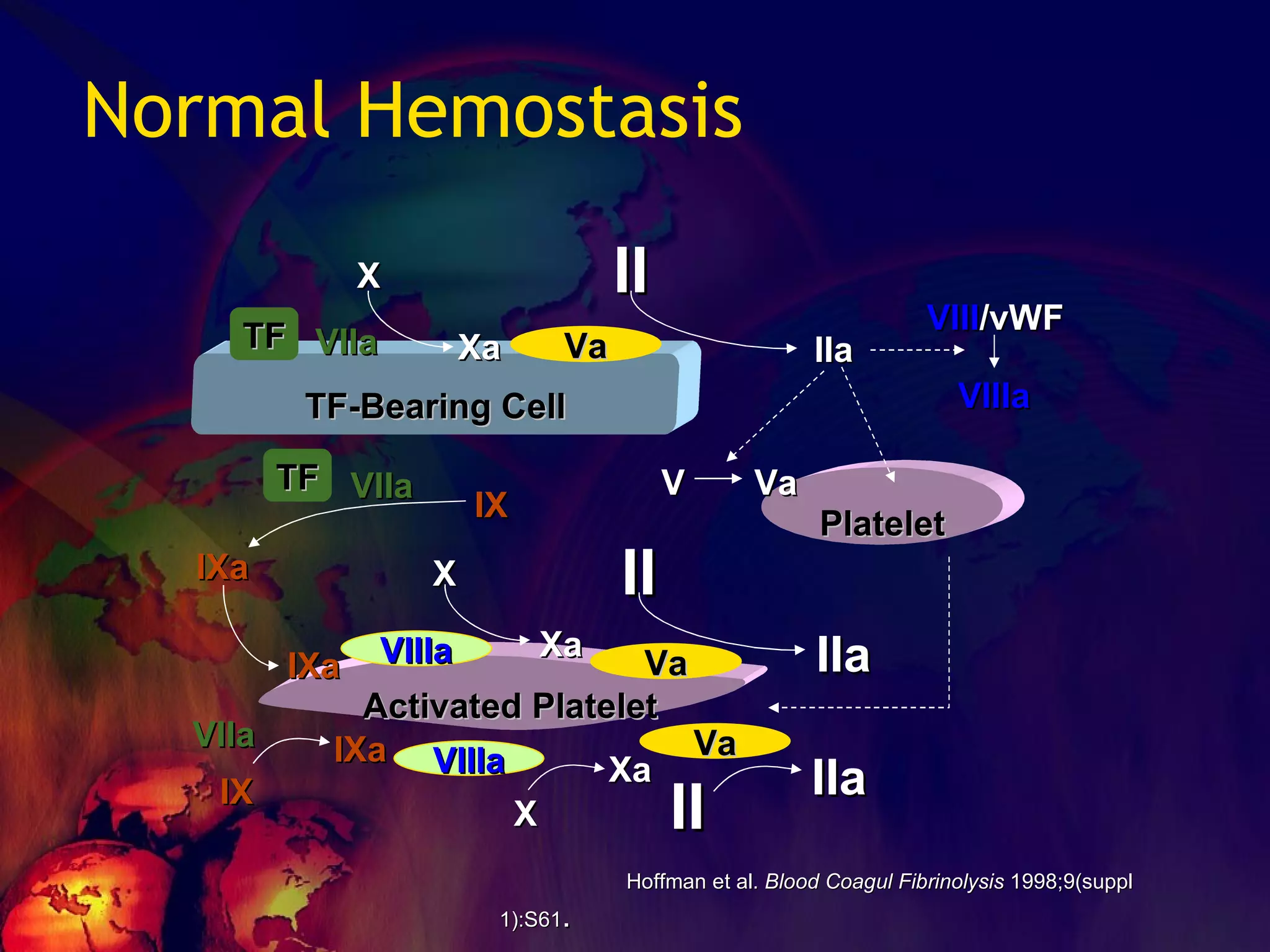
Cascade vs. cell-based model Cell-based model Hemostasis represented as: Occurring on two cell surfaces  Tissue factor bearing cells Platelets  Three overlapping phases: Initiation (TF bearing cells) Amplification (platelets) Propagation (platelets) The coagulation cascades are still important, but are cell-based The extrinsic pathway works on the surface of the tissue factor bearing cells The intrinsic pathway works on the surface of platelets Routine coagulation tests do not represent the cell-based model of hemostasis. Tissue factor bearing cells 1. Initiation Platelets Activated platelets 2. Amplification 3. Propagation IIa IIa
Cellular components Platelets Endothelium Monocytes Erythrocytes
Molecular components Coagulation factors  and   inhibitors Fibrinolytic factors  and  inhibitors Adhesive proteins Calcium Immunoglobulins PL  PG  Cytokines
Current model of hemostasis
Normal Hemostasis Hoffman et al.  Blood Coagul Fibrinolysis  1998;9(suppl 1):S61 . X II II X IX TF-Bearing Cell Activated Platelet Platelet TF VIIIa Va VIIIa Va Va VIIa TF VIIa Xa IIa IX V Va II VIII /vWF VIIIa IXa X IXa IXa VIIa Xa IIa IIa Xa
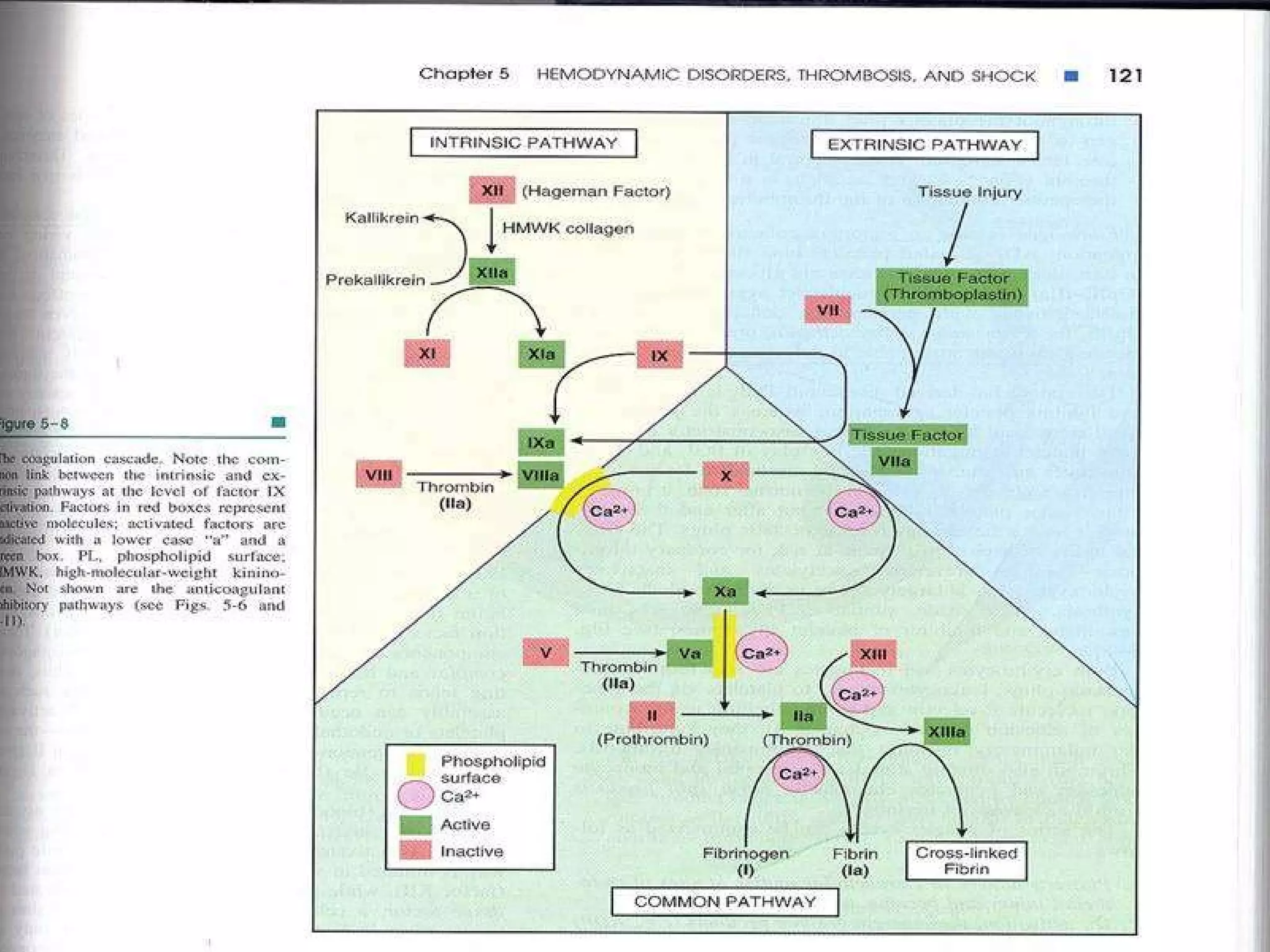
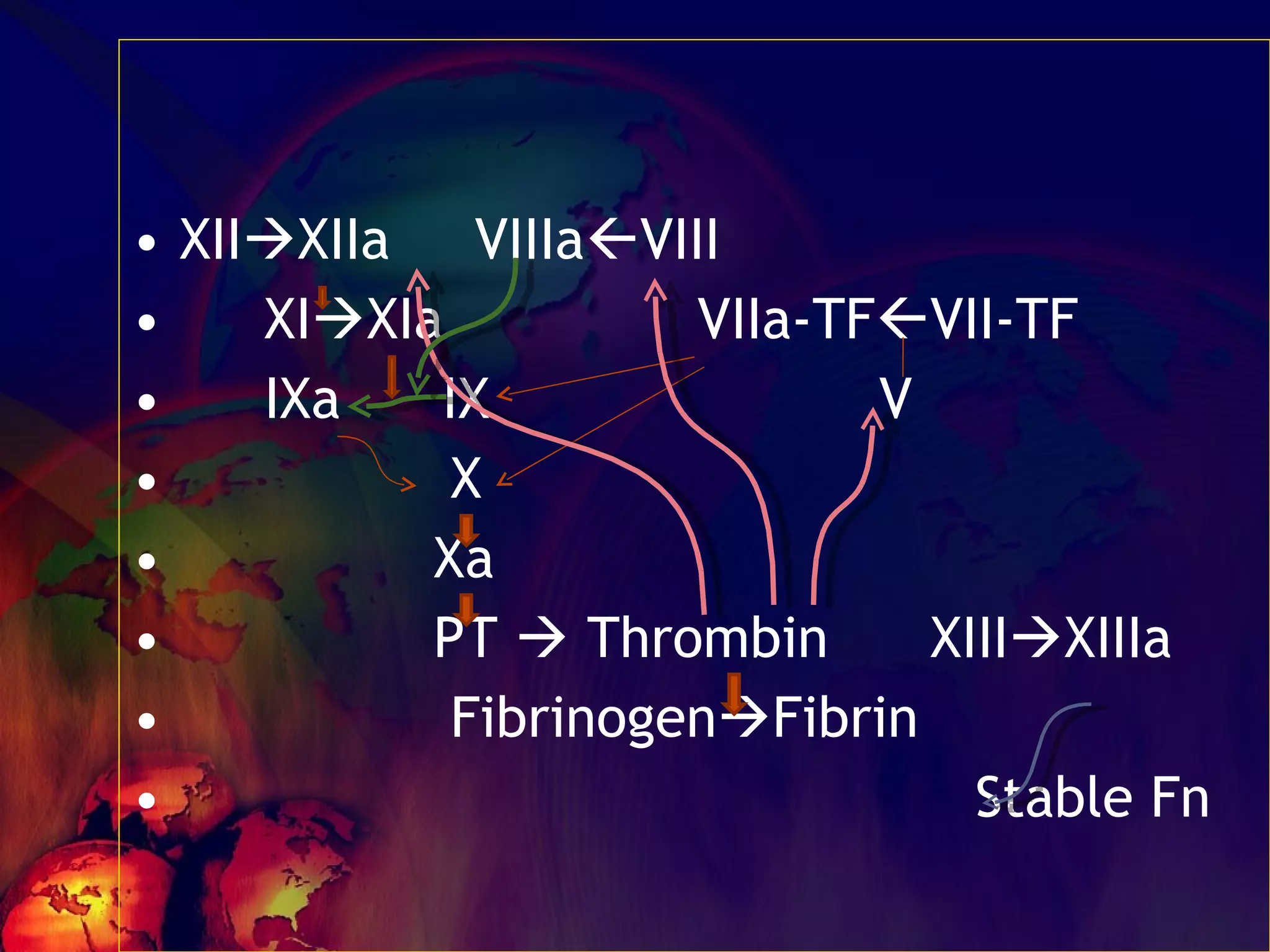
XII  XIIa  VIIIa  VIII XI  XIa  VIIa-TF  VII-TF IXa  IX  V X Xa PT    Thrombin  XIII  XIIIa  Fibrinogen  Fibrin Stable Fn
Endothelial damage: Initiation of thrombin generation Endothelial damage Exposure to tissue factor Initiation of extrinsic pathway Initiate thrombin generation Activate FXI (intrinsic pathway) Amplify thrombin generation
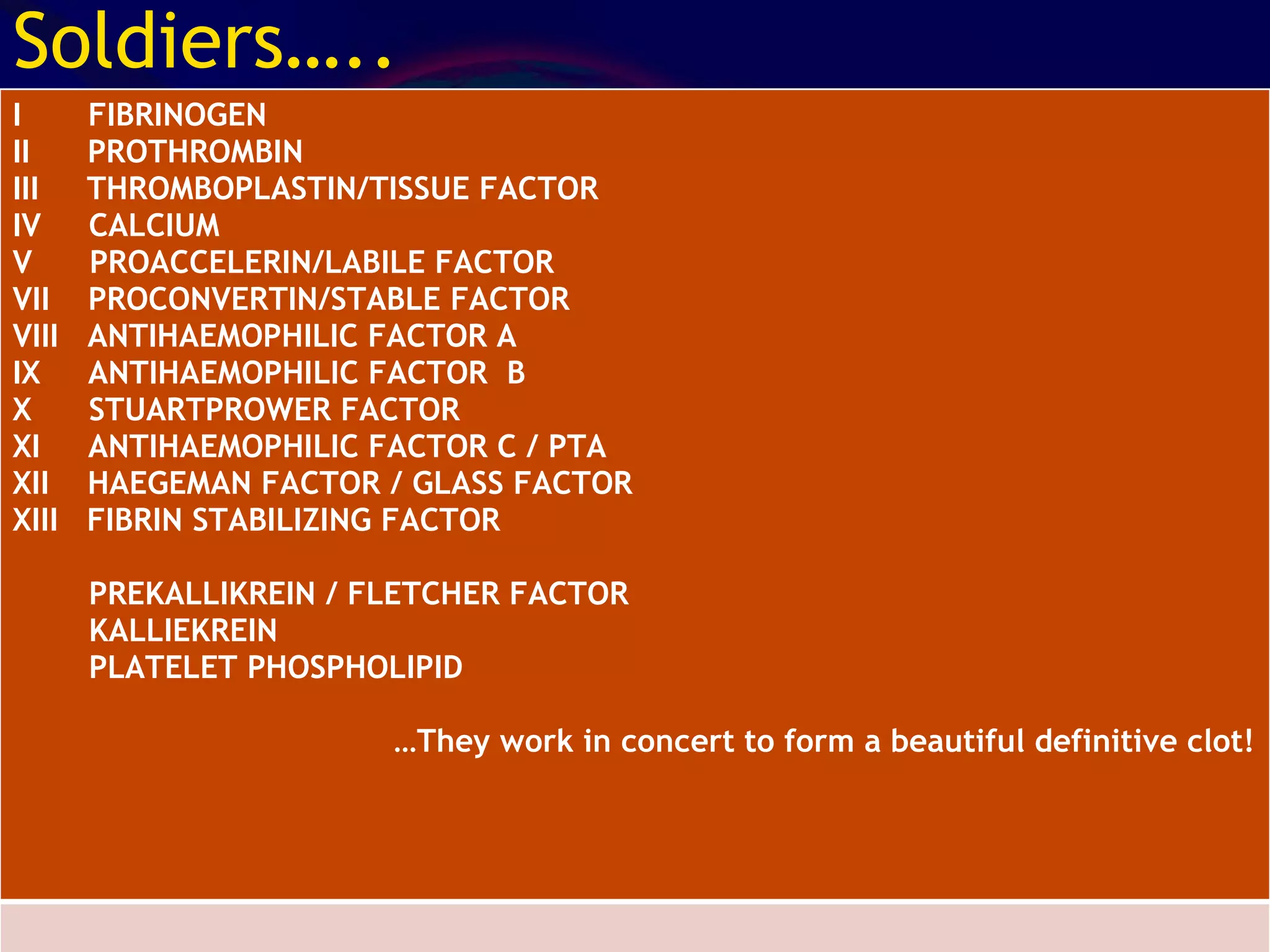
Soldiers….. I  FIBRINOGEN II  PROTHROMBIN III  THROMBOPLASTIN/TISSUE FACTOR IV  CALCIUM V  PROACCELERIN/LABILE FACTOR VII  PROCONVERTIN/STABLE FACTOR VIII  ANTIHAEMOPHILIC FACTOR A IX  ANTIHAEMOPHILIC FACTOR  B X  STUARTPROWER FACTOR XI  ANTIHAEMOPHILIC FACTOR C / PTA XII  HAEGEMAN FACTOR / GLASS FACTOR XIII  FIBRIN STABILIZING FACTOR PREKALLIKREIN / FLETCHER FACTOR KALLIEKREIN PLATELET PHOSPHOLIPID … They work in concert to form a beautiful definitive clot!
 
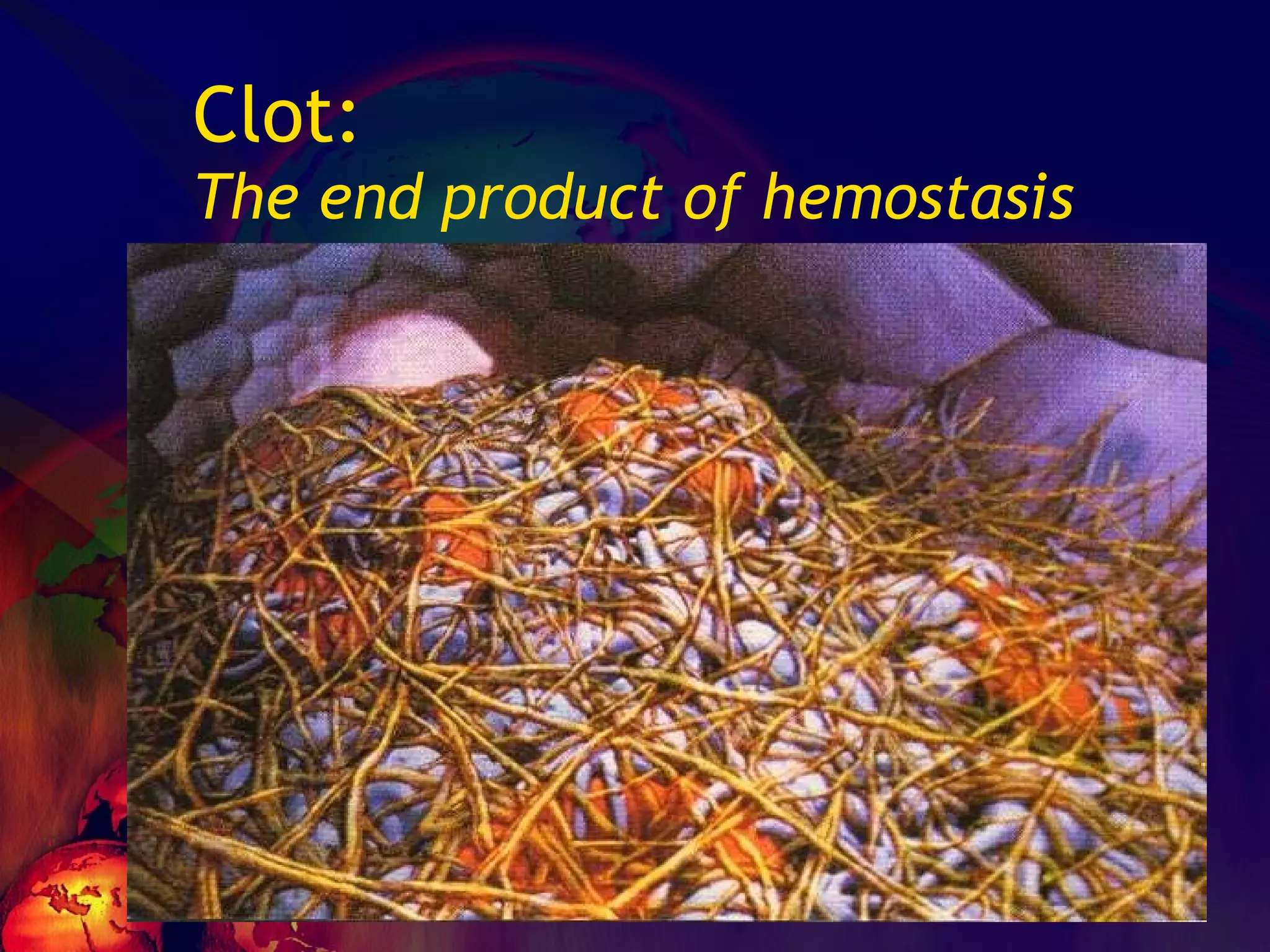
Clot: The end product of hemostasis
The rebels…. ANTICLOTTING MECHANISMS  1  LIMITING COAGULATION CASCADE 2  FIBRINOLYTIC SYSTEM
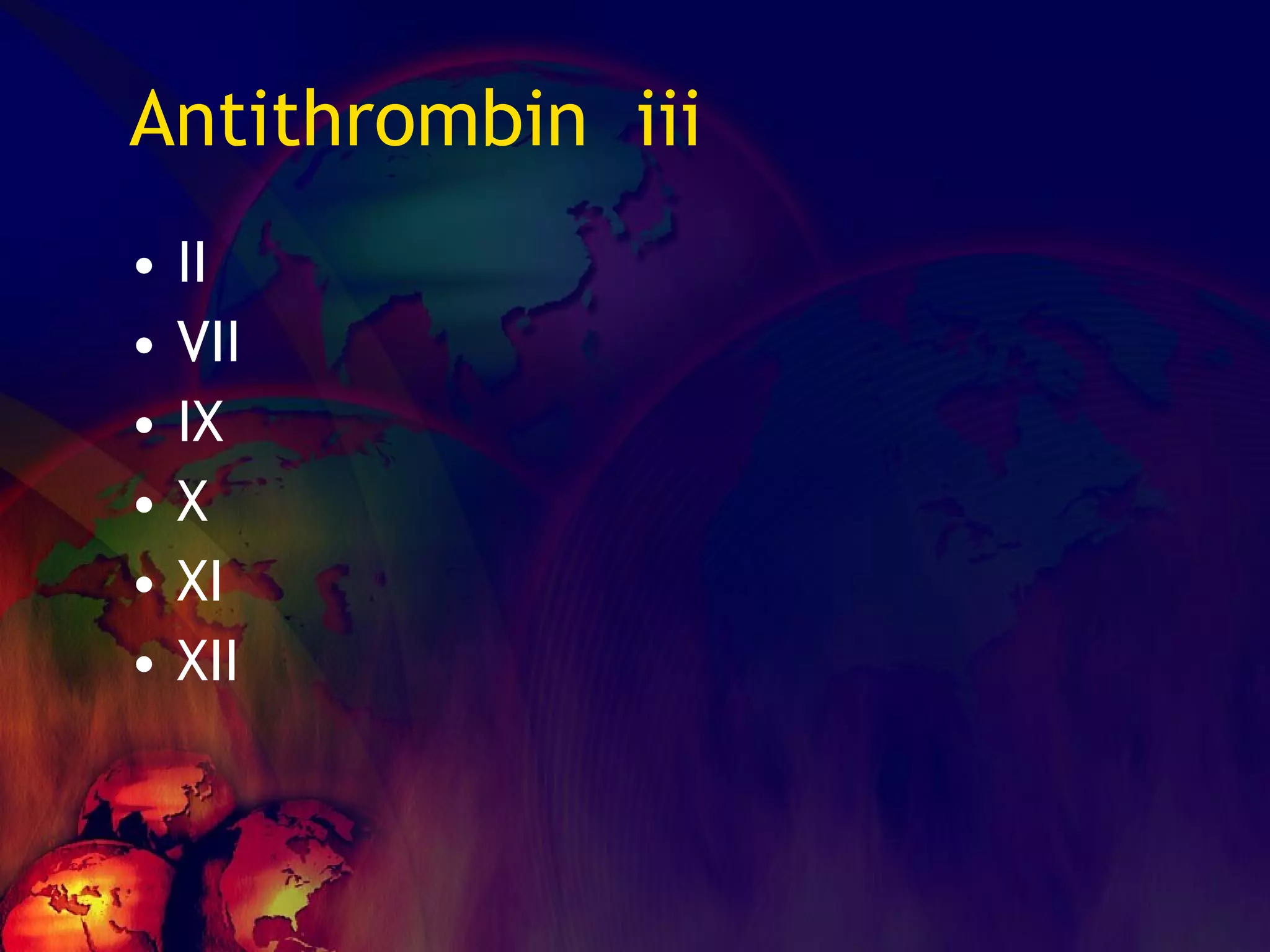
Antithrombin  iii II VII IX X XI XII
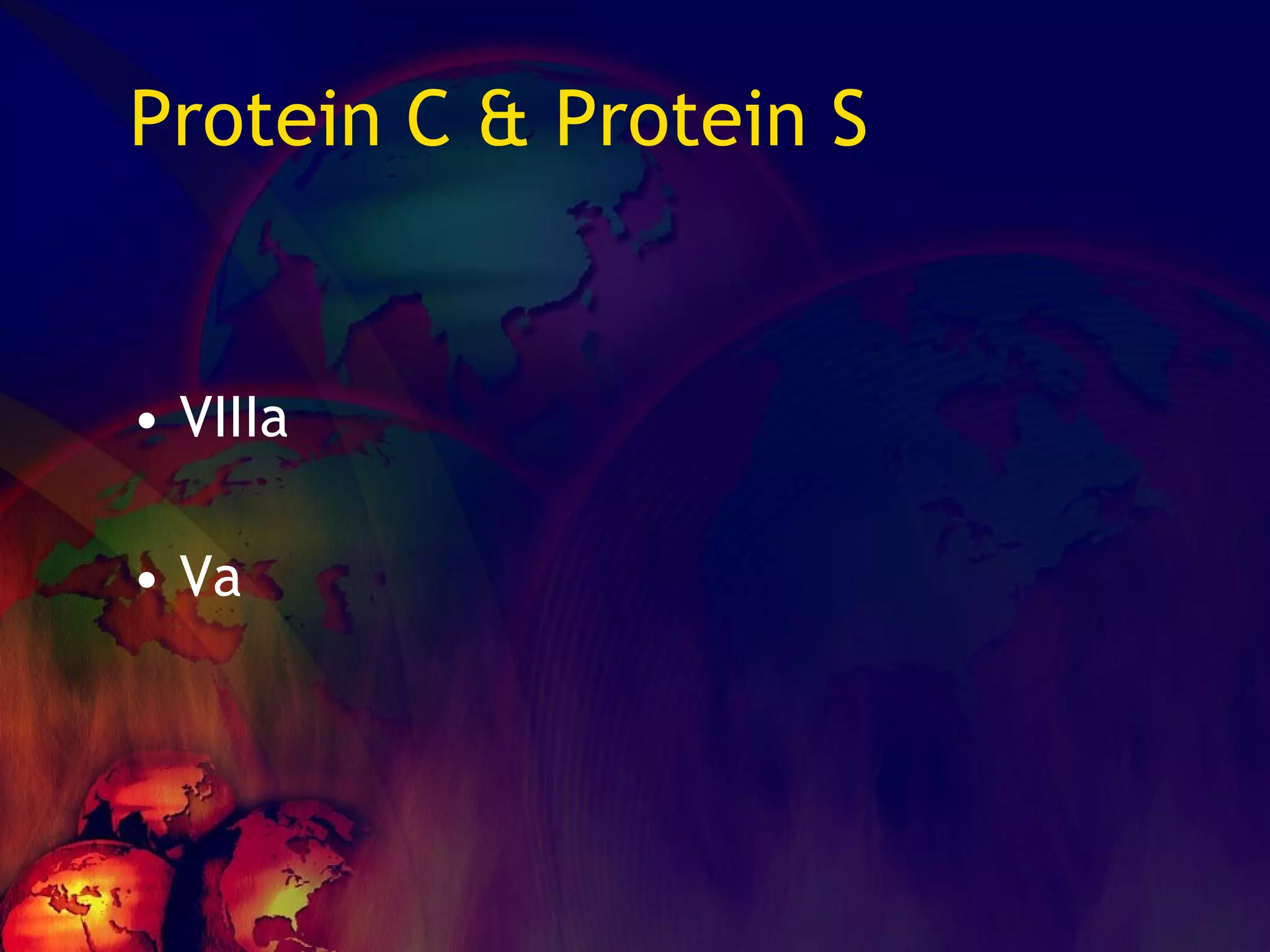
Protein C & Protein S VIIIa Va
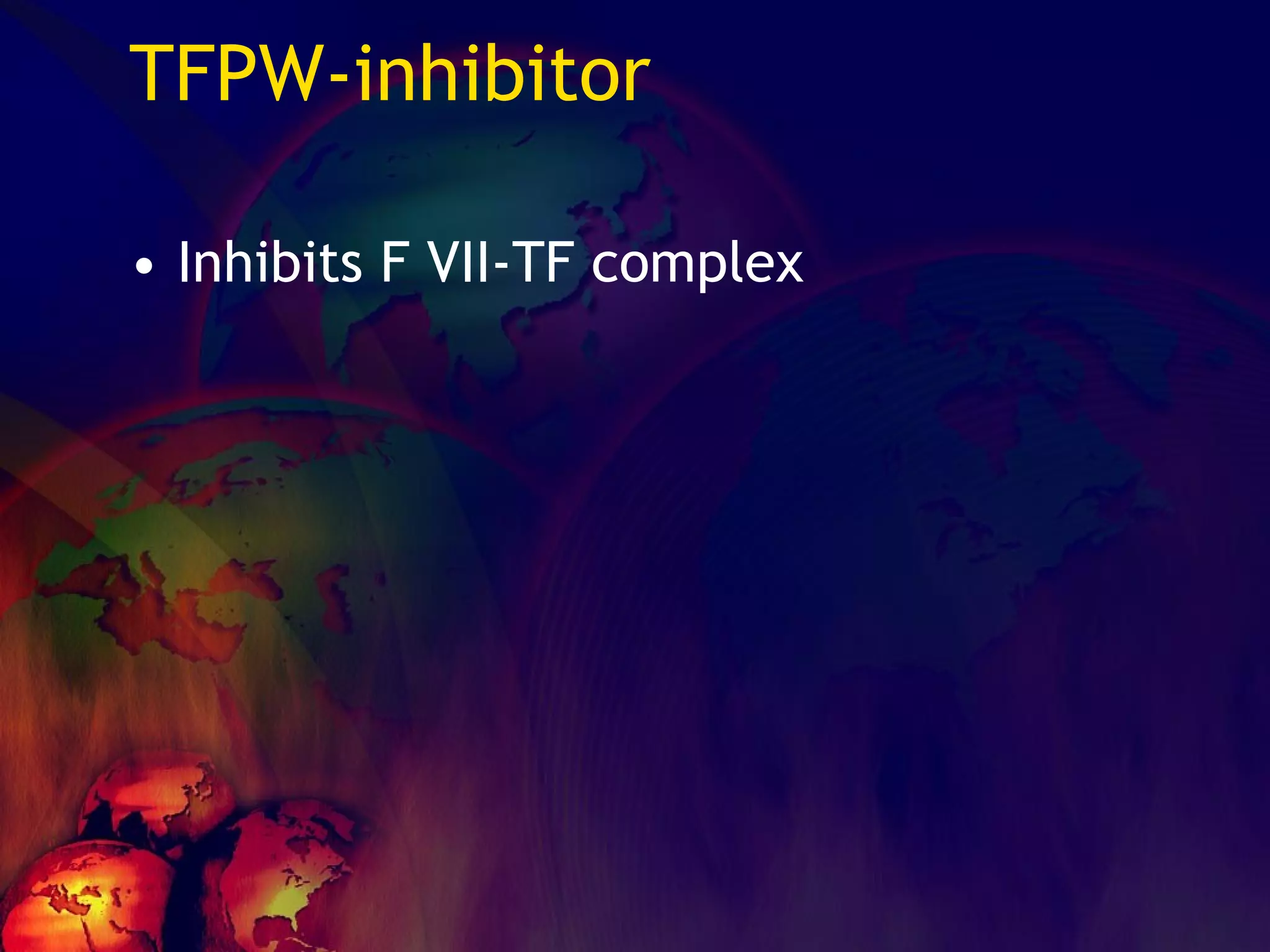
TFPW-inhibitor Inhibits F VII-TF complex
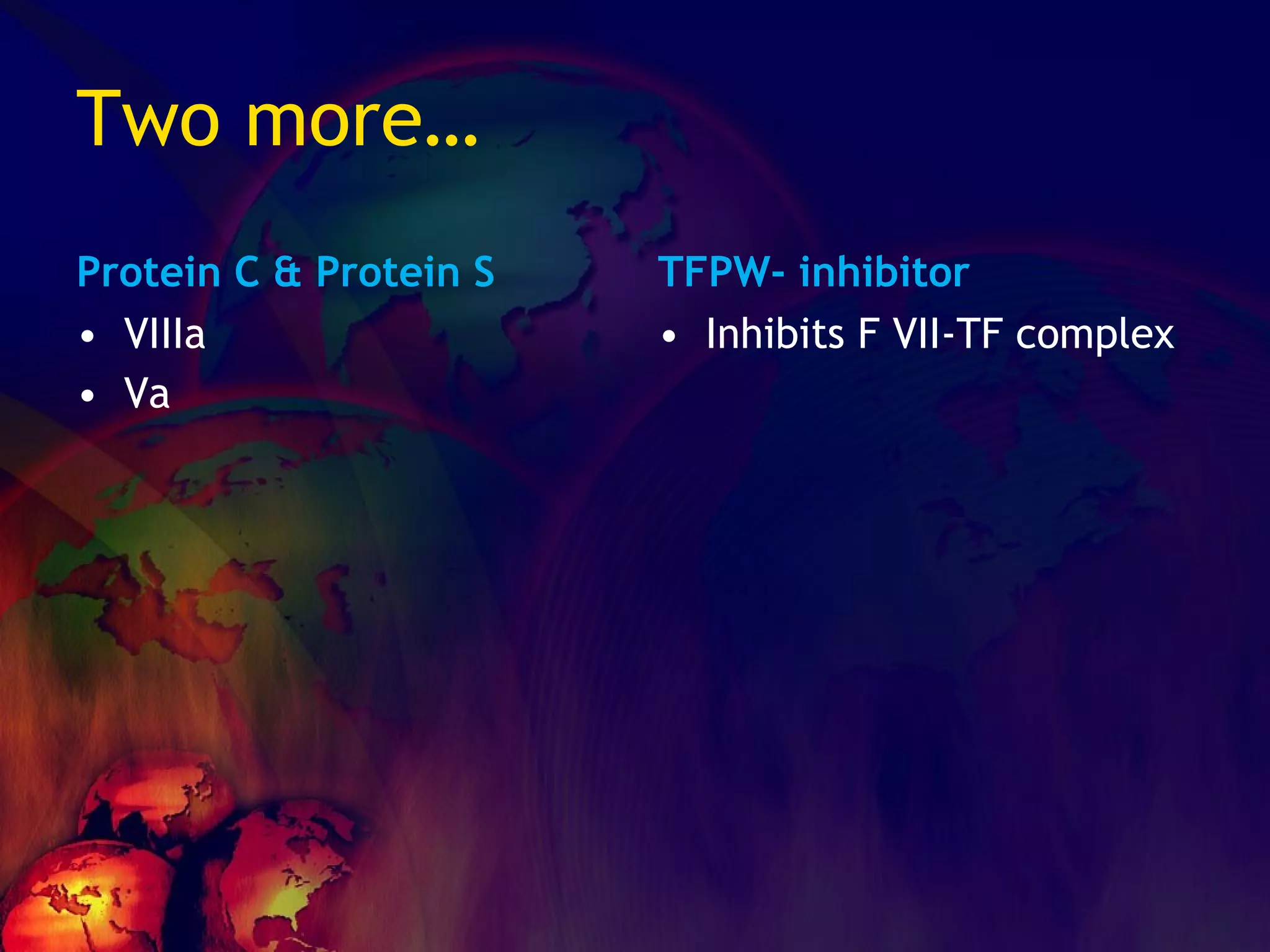
Two more… Protein C & Protein S VIIIa Va TFPW- inhibitor Inhibits F VII-TF complex
Fibrinolysis Plasmin is the key component
 
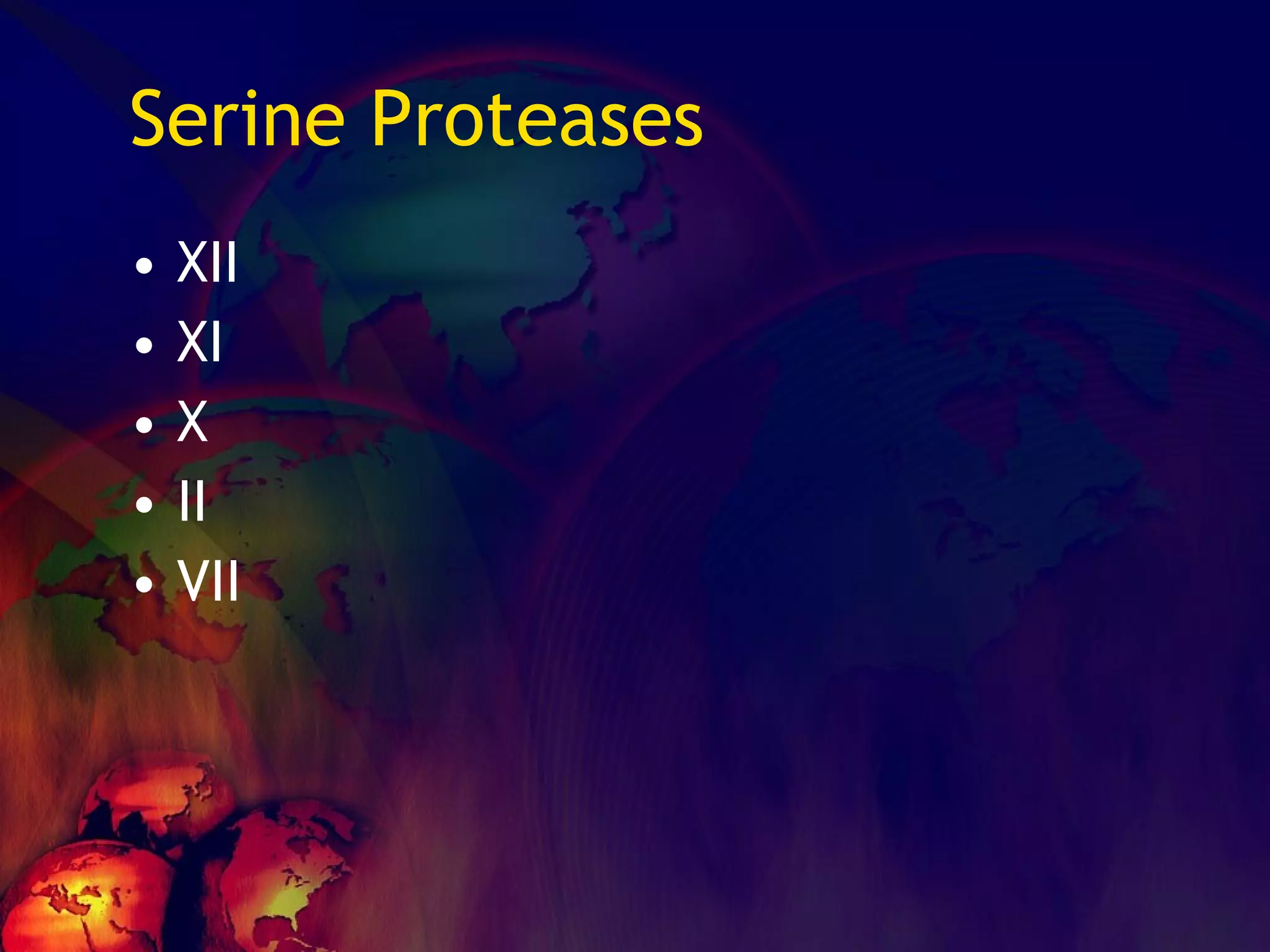
Serine Proteases XII XI X II VII
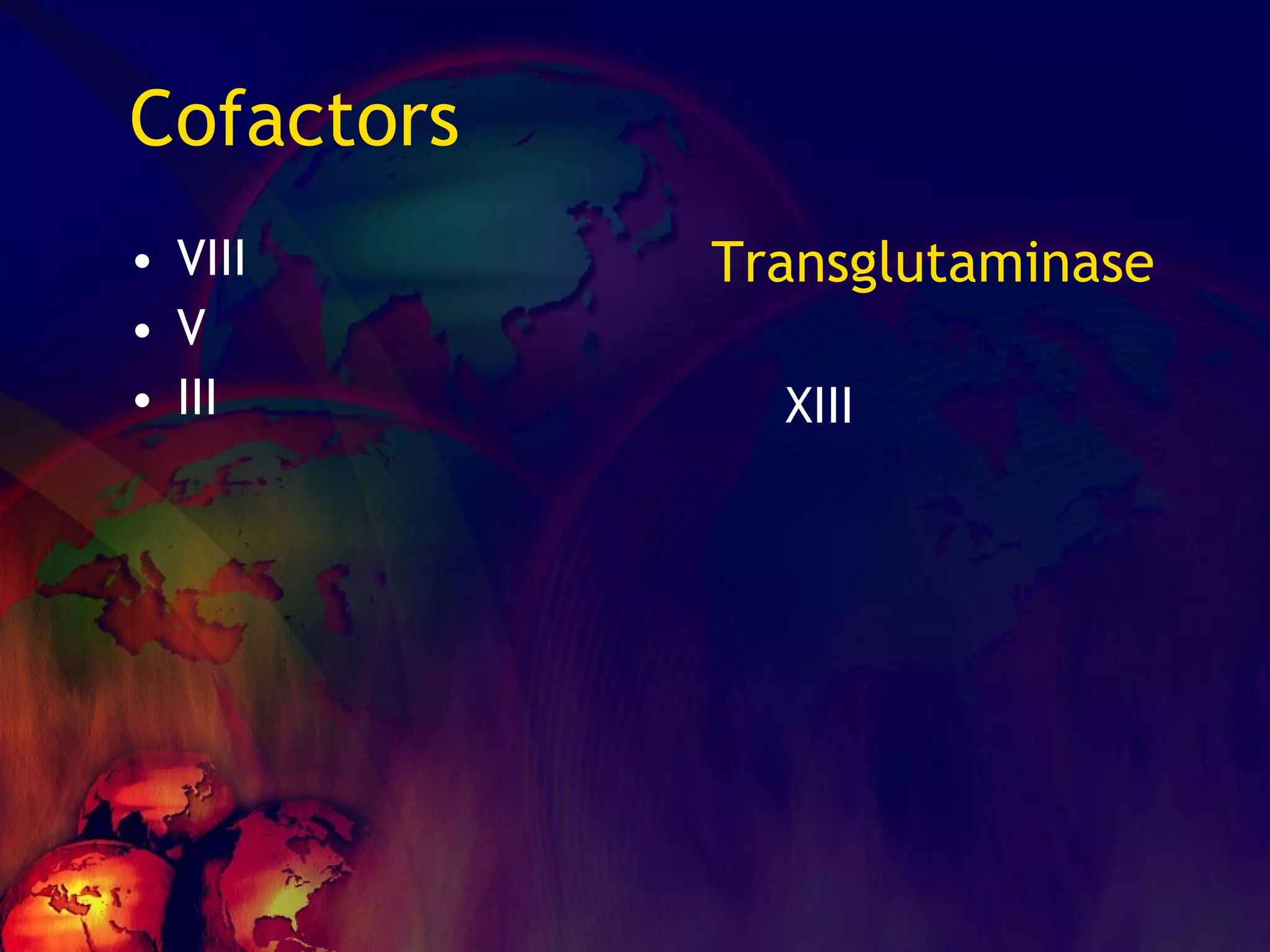
Cofactors VIII V III Transglutaminase XIII
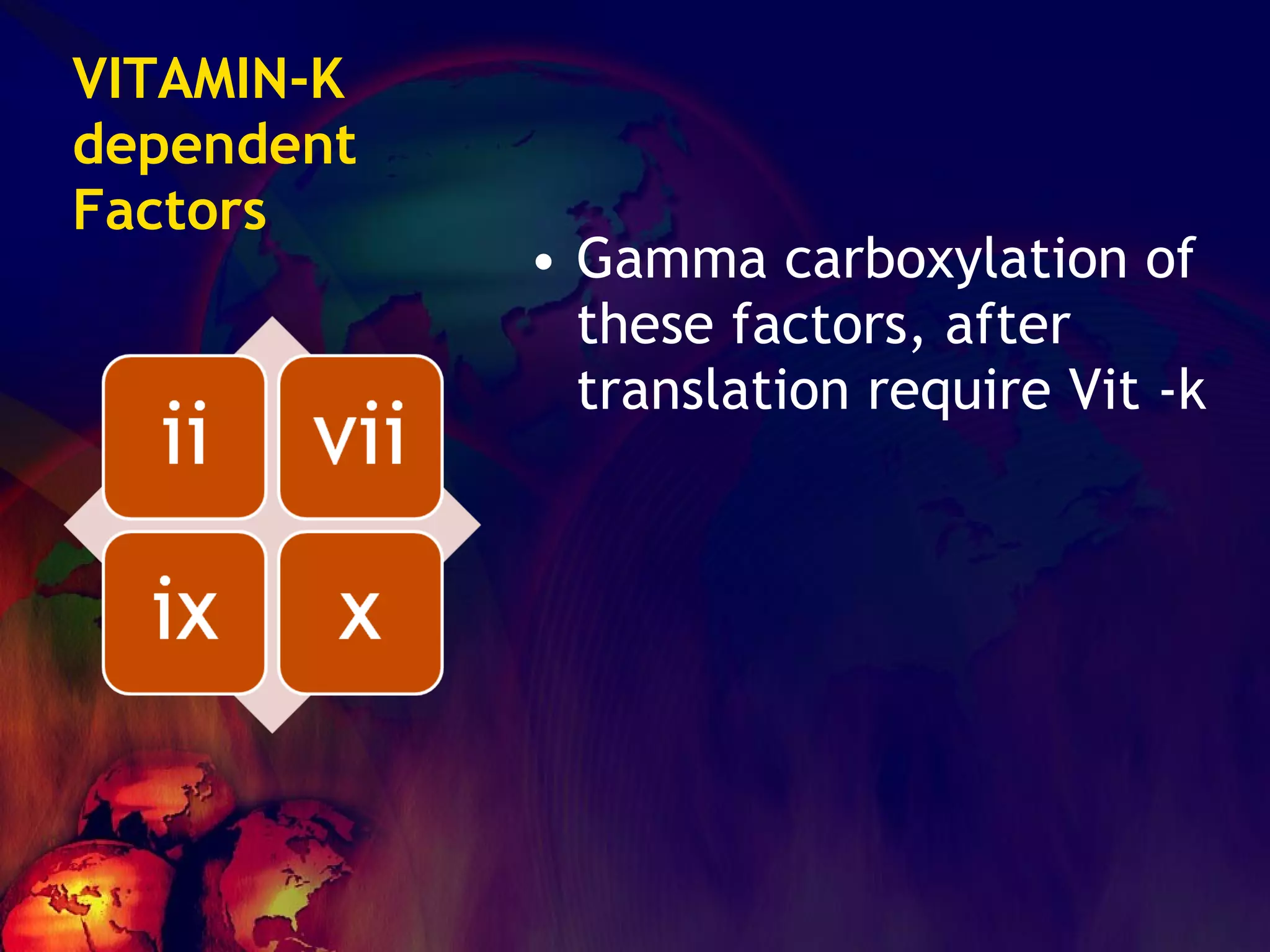
VITAMIN-K dependent Factors Gamma carboxylation of these factors, after translation require Vit -k
Question hour in AAC INFANCY SURGERIES FAMILY HISTORY DRUGS  HORMONAL REPLACEMENT / OCP HISTORY OF BLEEDING IN THE PAST
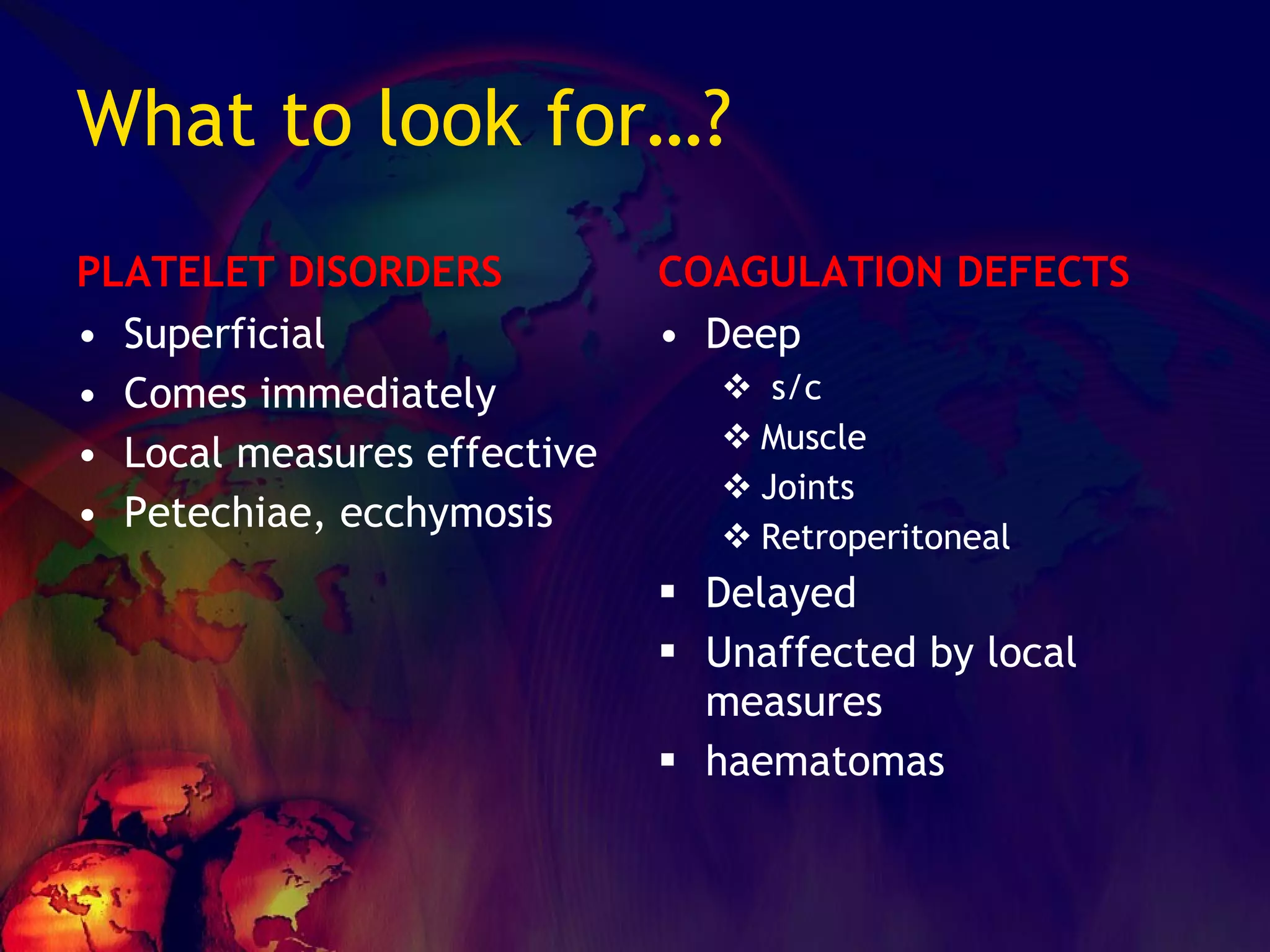
What to look for…? PLATELET DISORDERS Superficial Comes immediately Local measures effective Petechiae, ecchymosis COAGULATION DEFECTS Deep s/c Muscle Joints Retroperitoneal Delayed Unaffected by local measures haematomas
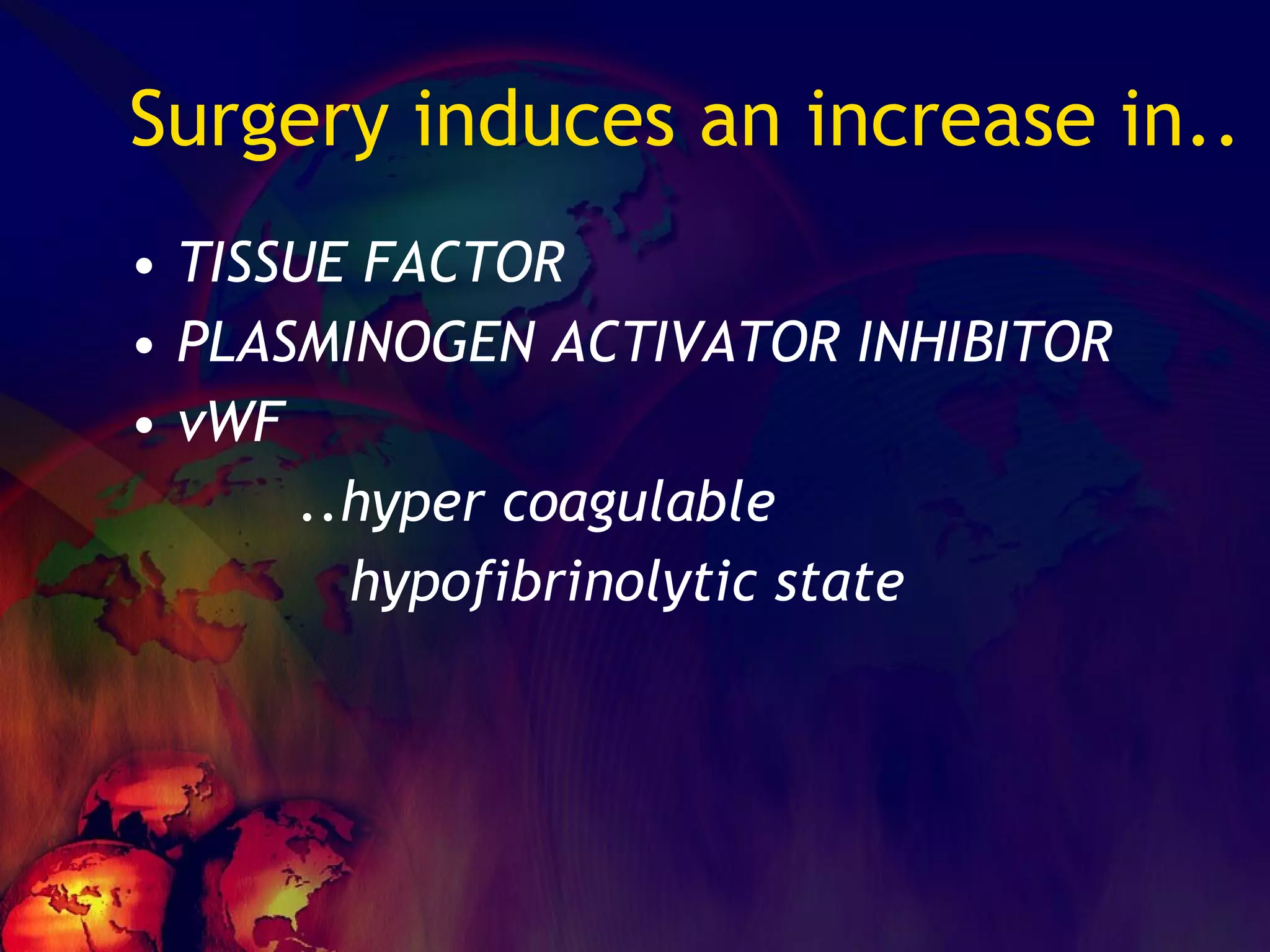
Surgery induces an increase in.. TISSUE FACTOR PLASMINOGEN ACTIVATOR INHIBITOR vWF ..hyper coagulable hypofibrinolytic state
These factors arise concern about the hemostasis Surgery Immobility Infection Ca Hypothermia Acidosis Volume expanders Extracorporeal circulation
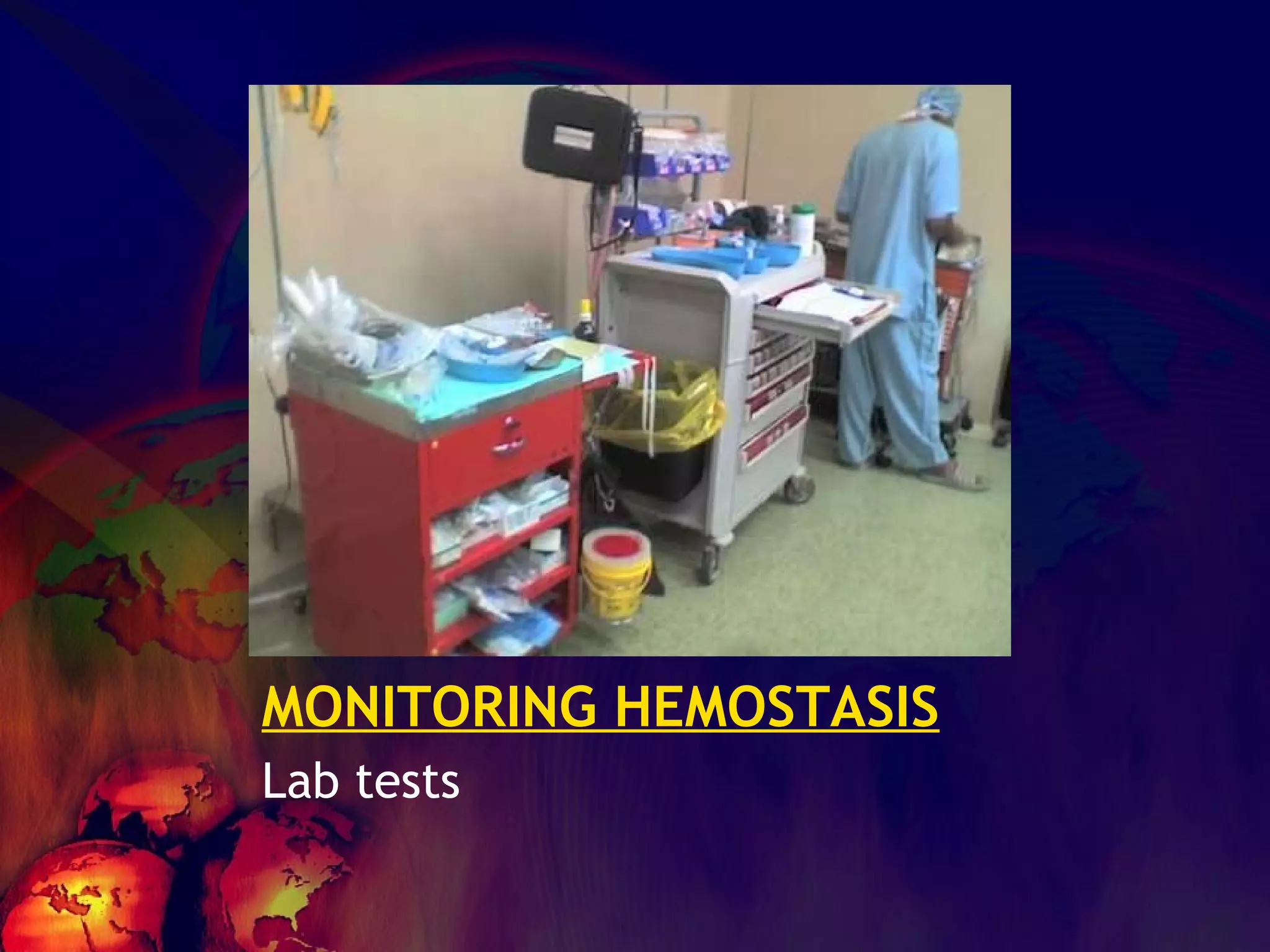
MONITORING HEMOSTASIS Lab tests
Feel.. There is no plan to stop Ohhh ..
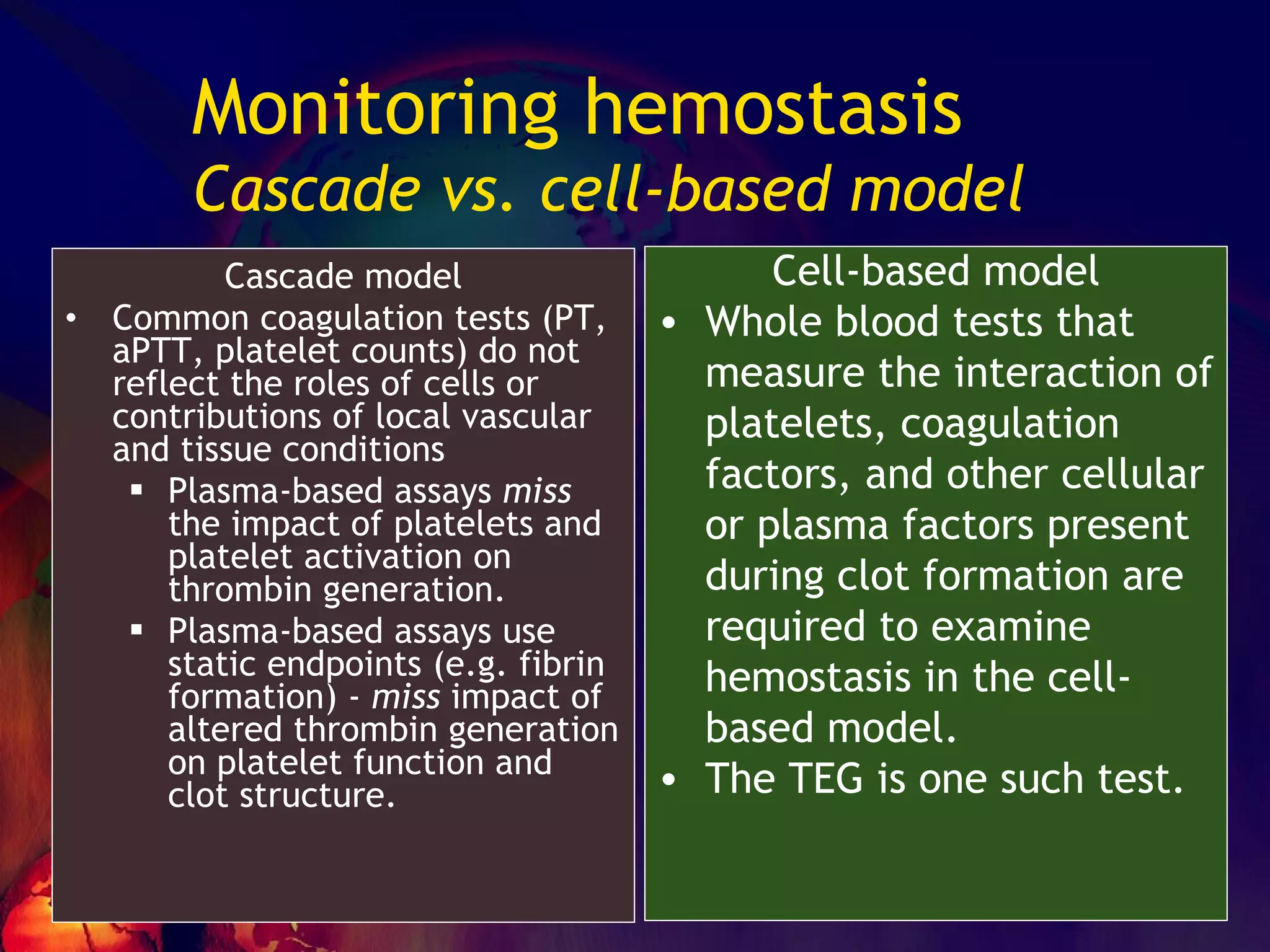
Monitoring hemostasis Cascade vs. cell-based model Cell-based model Whole blood tests that measure the interaction of platelets, coagulation factors, and other cellular or plasma factors present during clot formation are required to examine hemostasis in the cell-based model. The TEG is one such test. Cascade model Common coagulation tests (PT, aPTT, platelet counts) do not reflect the roles of cells or contributions of local vascular and tissue conditions Plasma-based assays  miss  the impact of platelets and platelet activation on thrombin generation. Plasma-based assays use static endpoints (e.g. fibrin formation) -  miss  impact of altered thrombin generation on platelet function and clot structure.
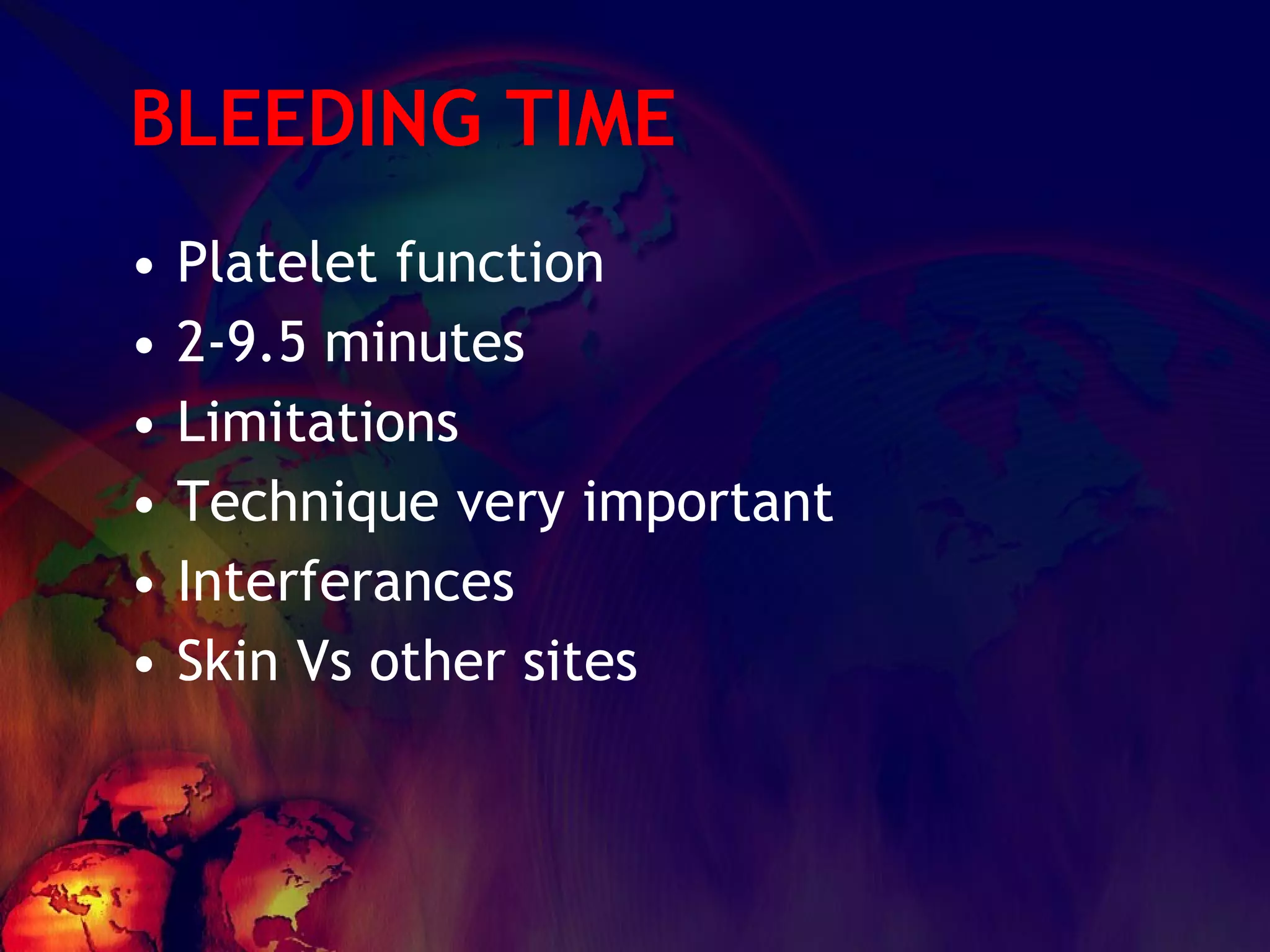
BLEEDING TIME Platelet function 2-9.5 minutes Limitations Technique very important Interferances Skin Vs other sites
Platelet count 1.5 – 4.5 Lakhs/uL The grading of risk Idiot EDTA Coulter principle
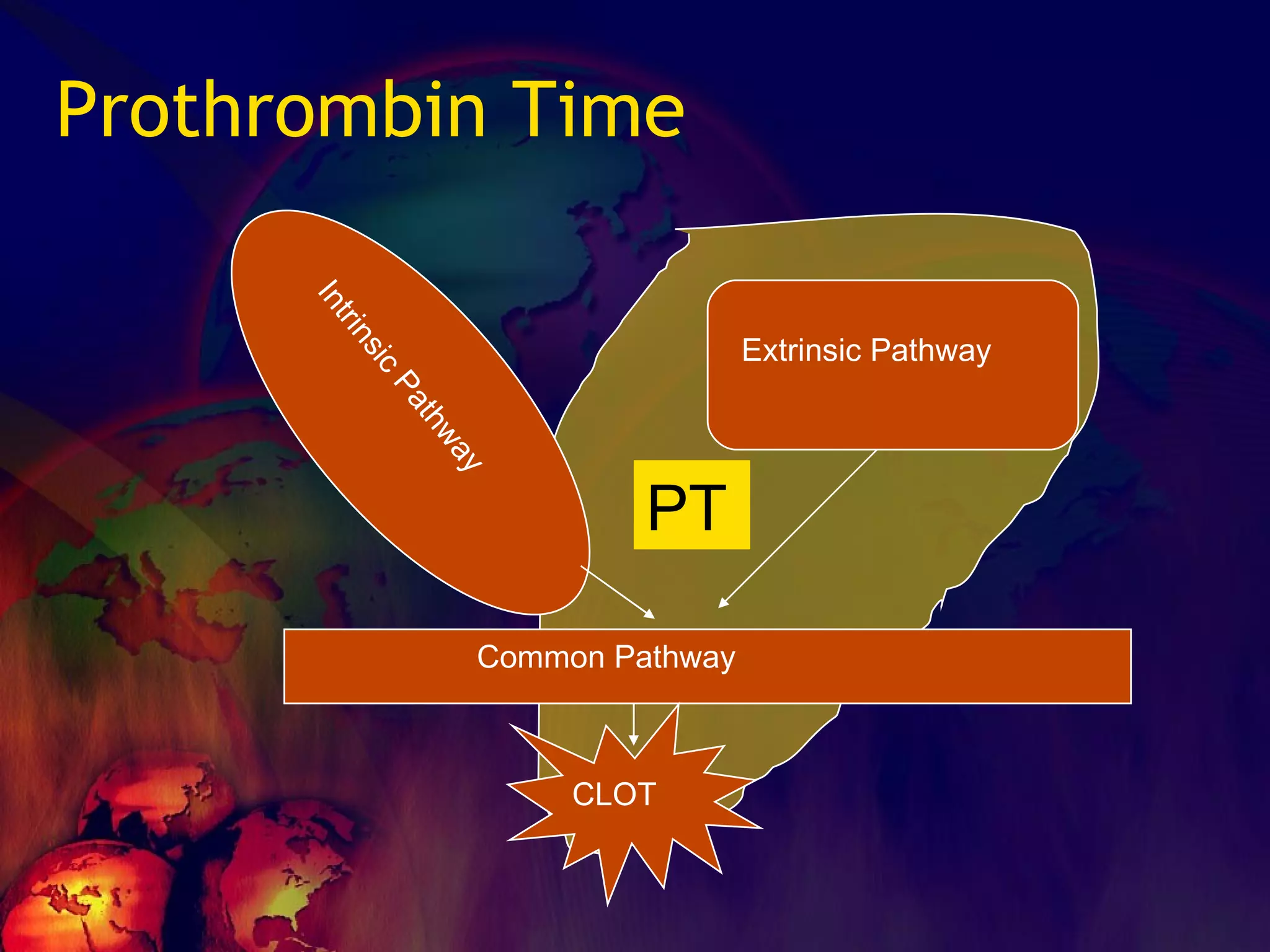
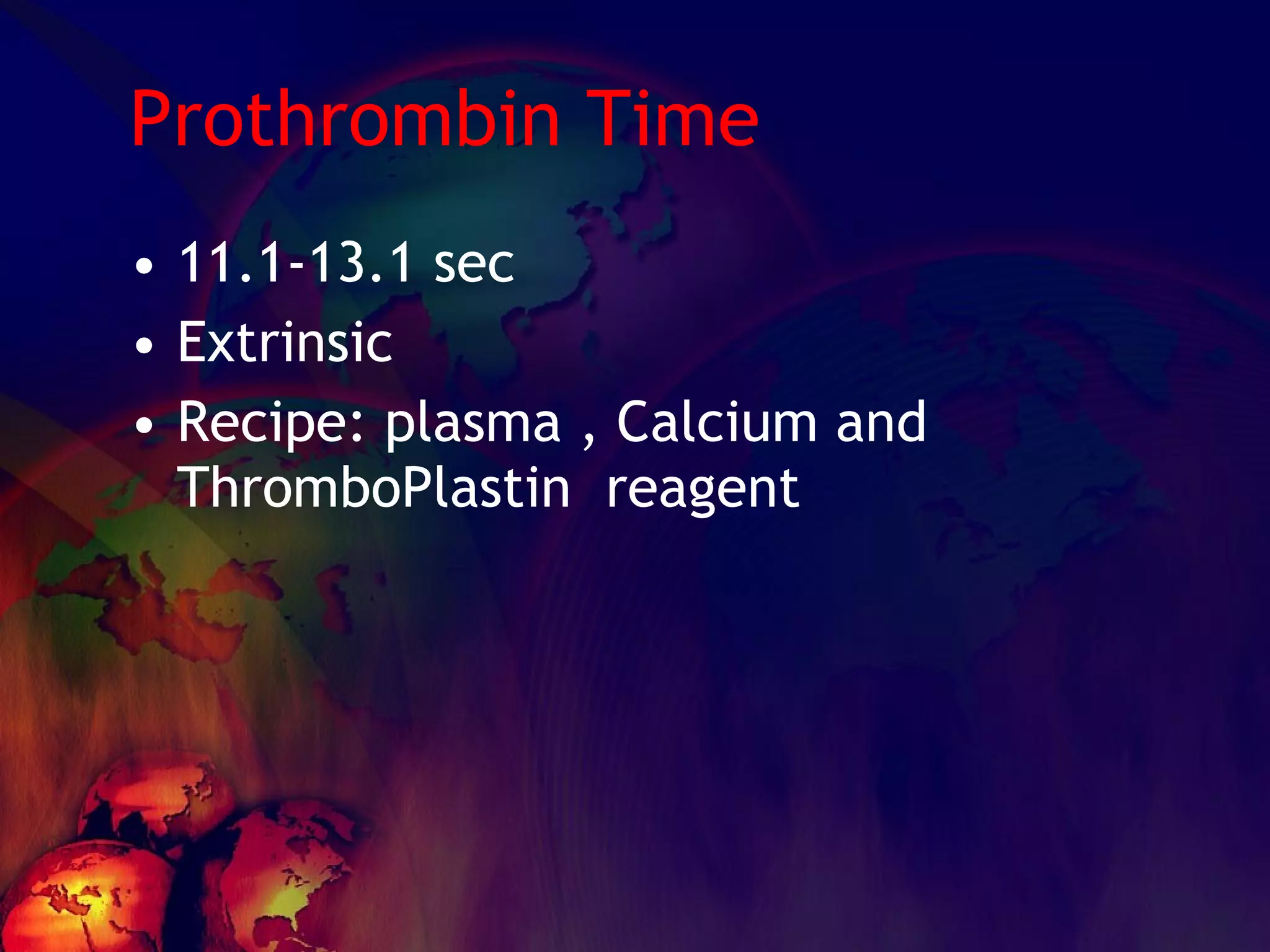
Prothrombin Time 11.1-13.1 sec Extrinsic Recipe: plasma , Calcium and ThromboPlastin  reagent
Prothrombin Time Intrinsic Pathway Extrinsic Pathway Common Pathway CLOT PT
What is INR? The aim is standardization of PT values ISI expresses the  sensitivity  of the PT reagent of a particular lab to that of WHO reagent. Patient PT / mean normal PT [PT ratio]^ ISI
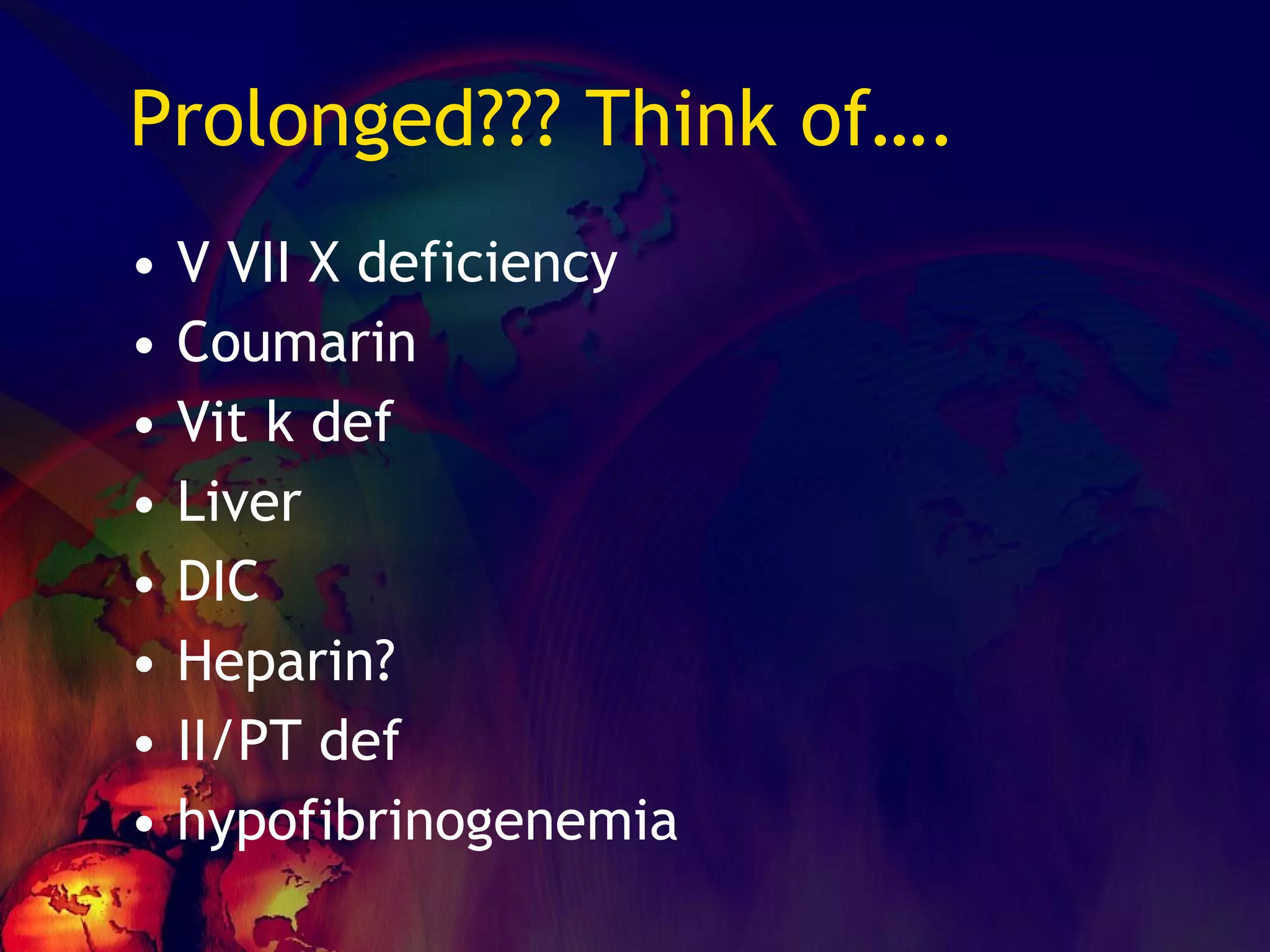
Prolonged??? Think of…. V VII X deficiency Coumarin Vit k def Liver DIC Heparin? II/PT def hypofibrinogenemia
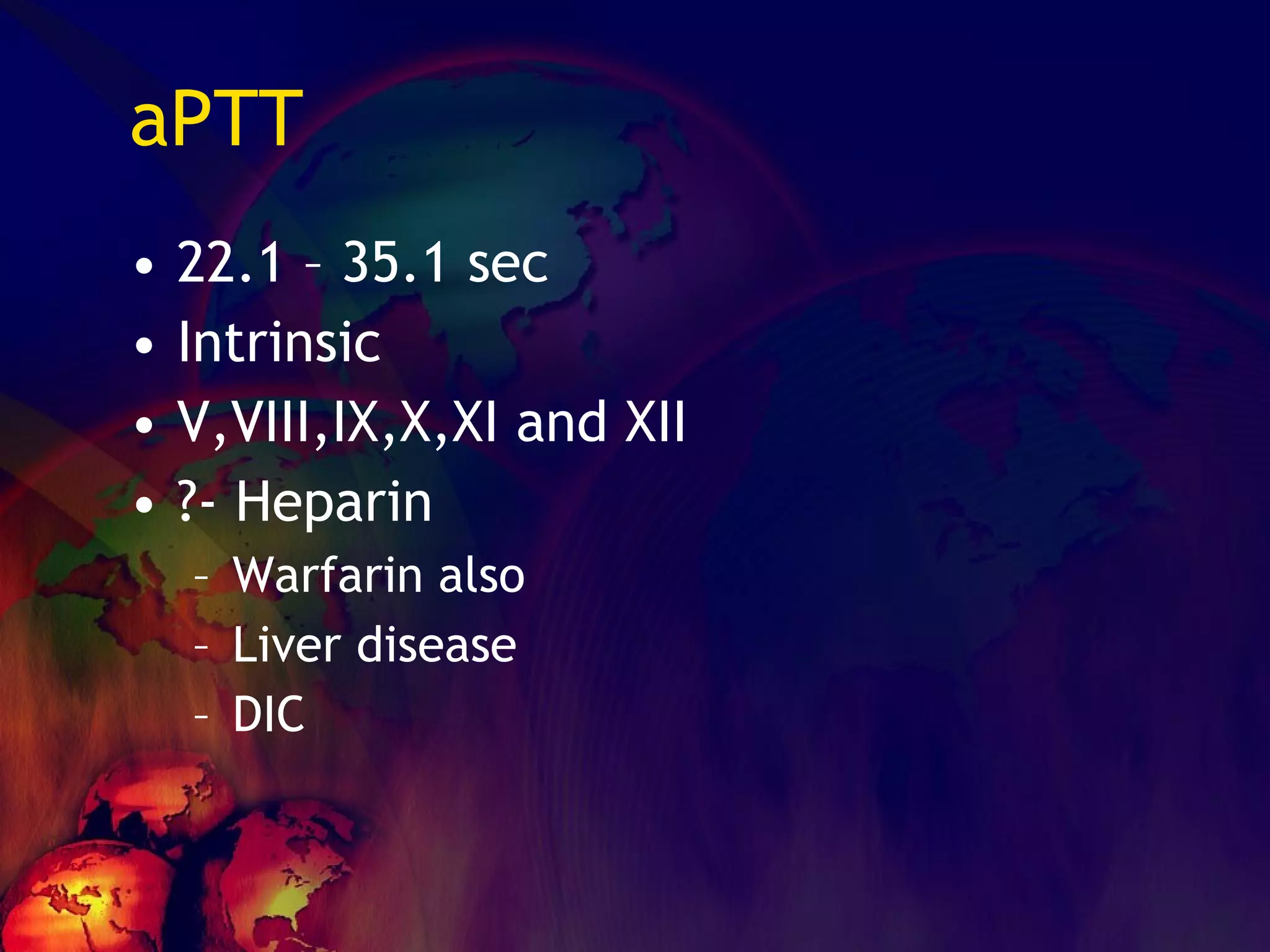
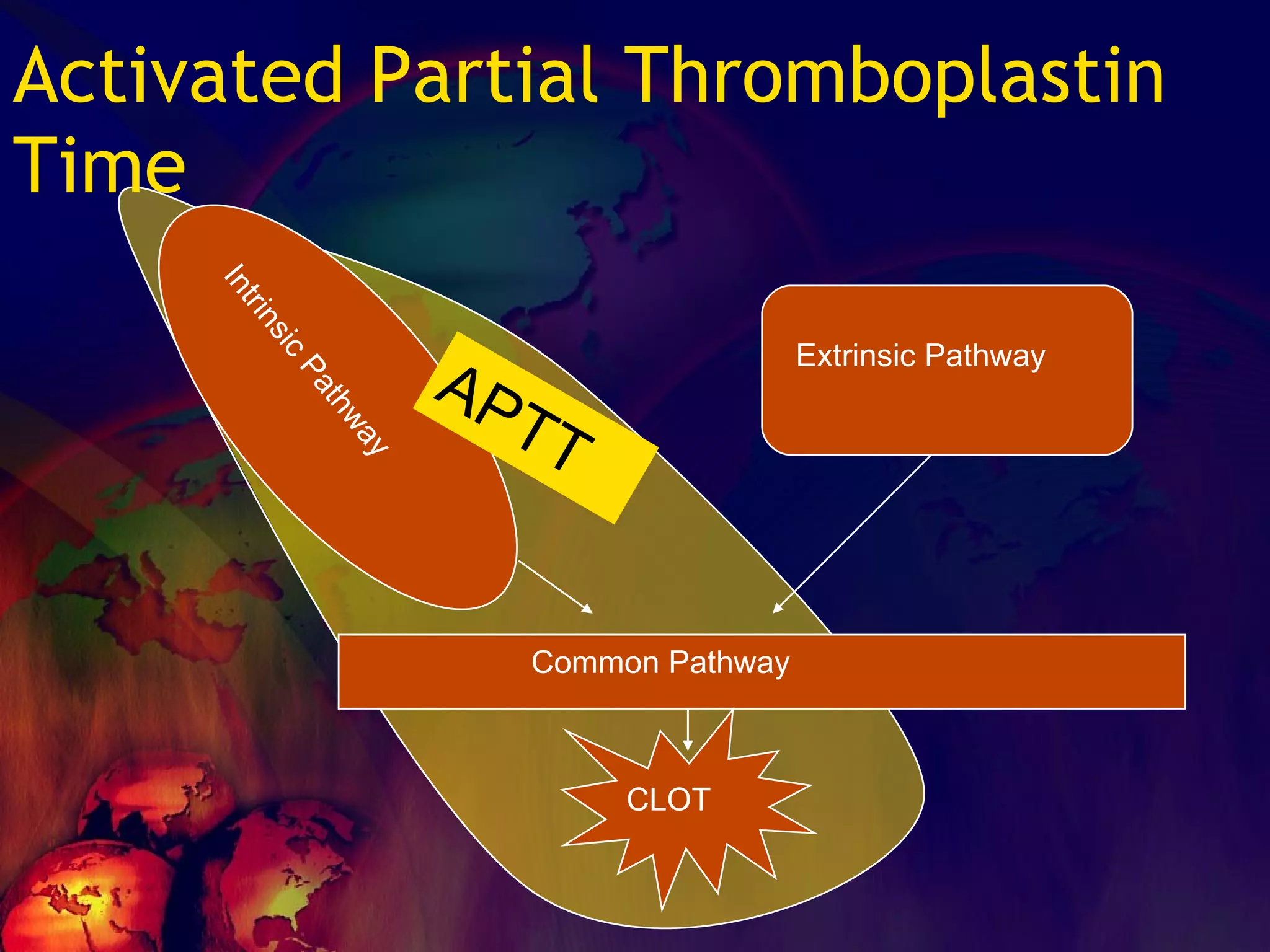
aPTT 22.1 – 35.1 sec Intrinsic V,VIII,IX,X,XI and XII ?- Heparin Warfarin also Liver disease DIC
Activated Partial Thromboplastin Time Intrinsic Pathway Extrinsic Pathway Common Pathway CLOT APTT
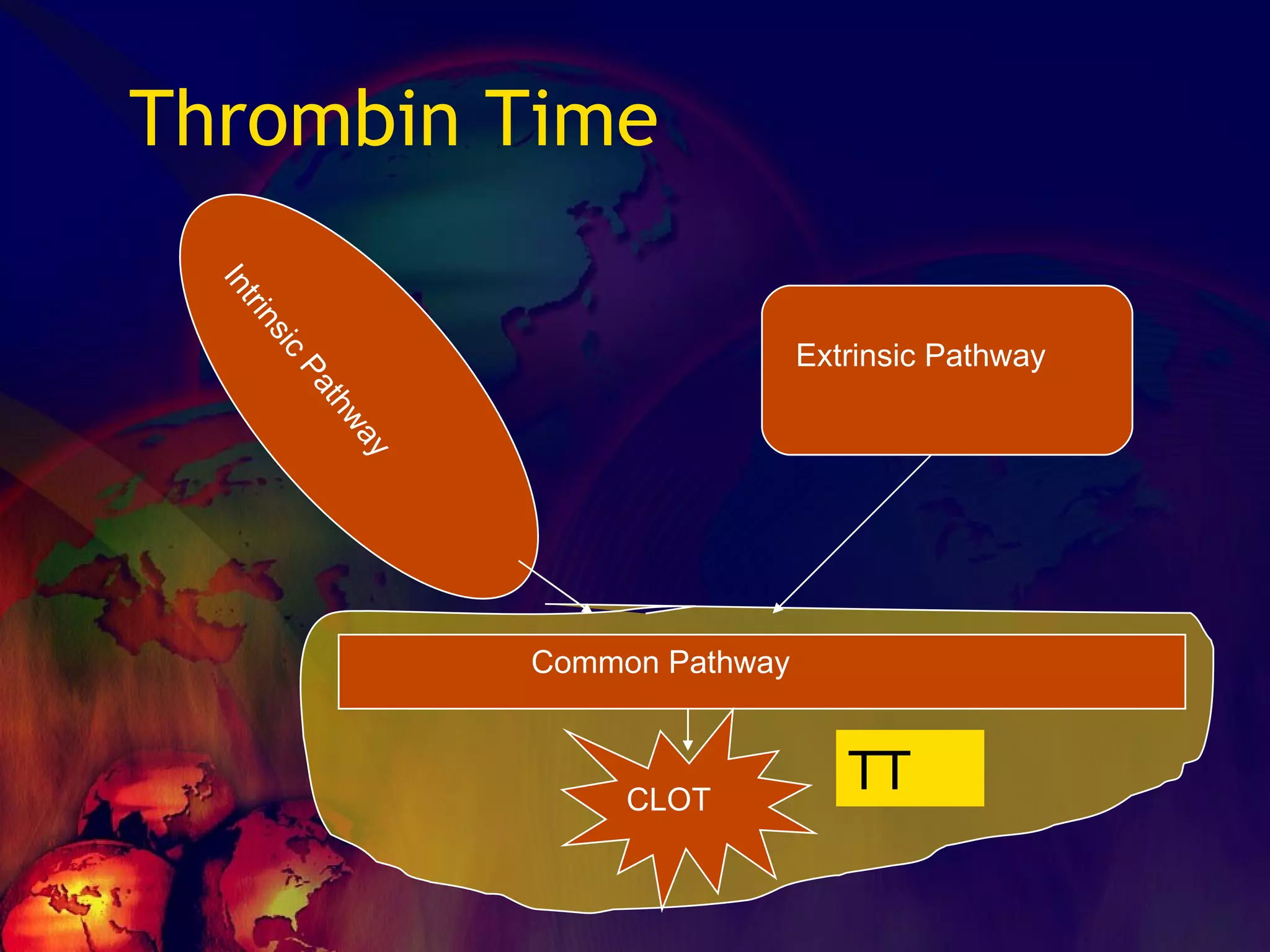
Thrombin Time Late… Circulating heparin levels Hypofibrinogenemia Increased FDP 16 – 24 sec
Thrombin Time Intrinsic Pathway Extrinsic Pathway Common Pathway CLOT TT
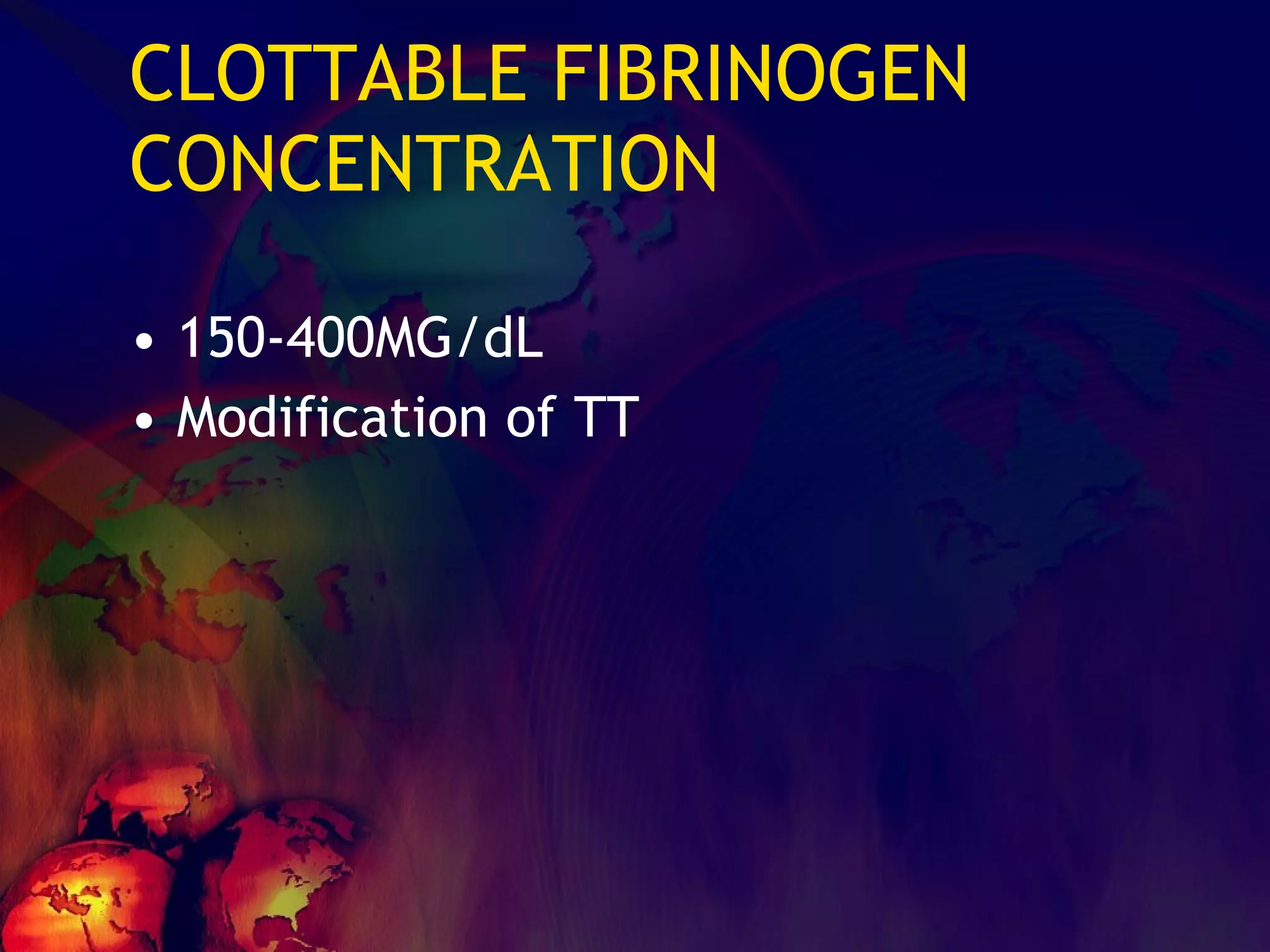
CLOTTABLE FIBRINOGEN CONCENTRATION 150-400MG/dL Modification of TT
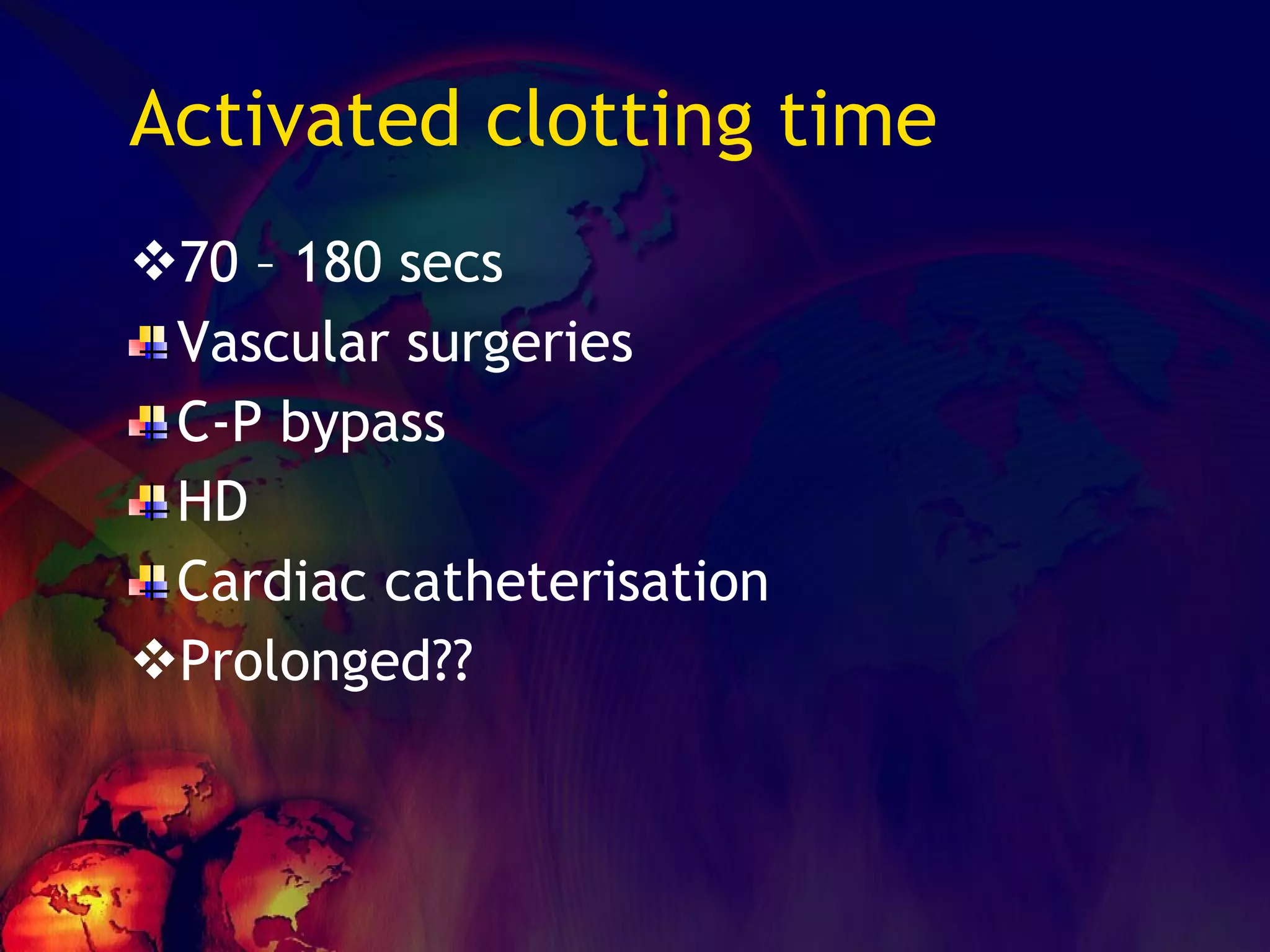
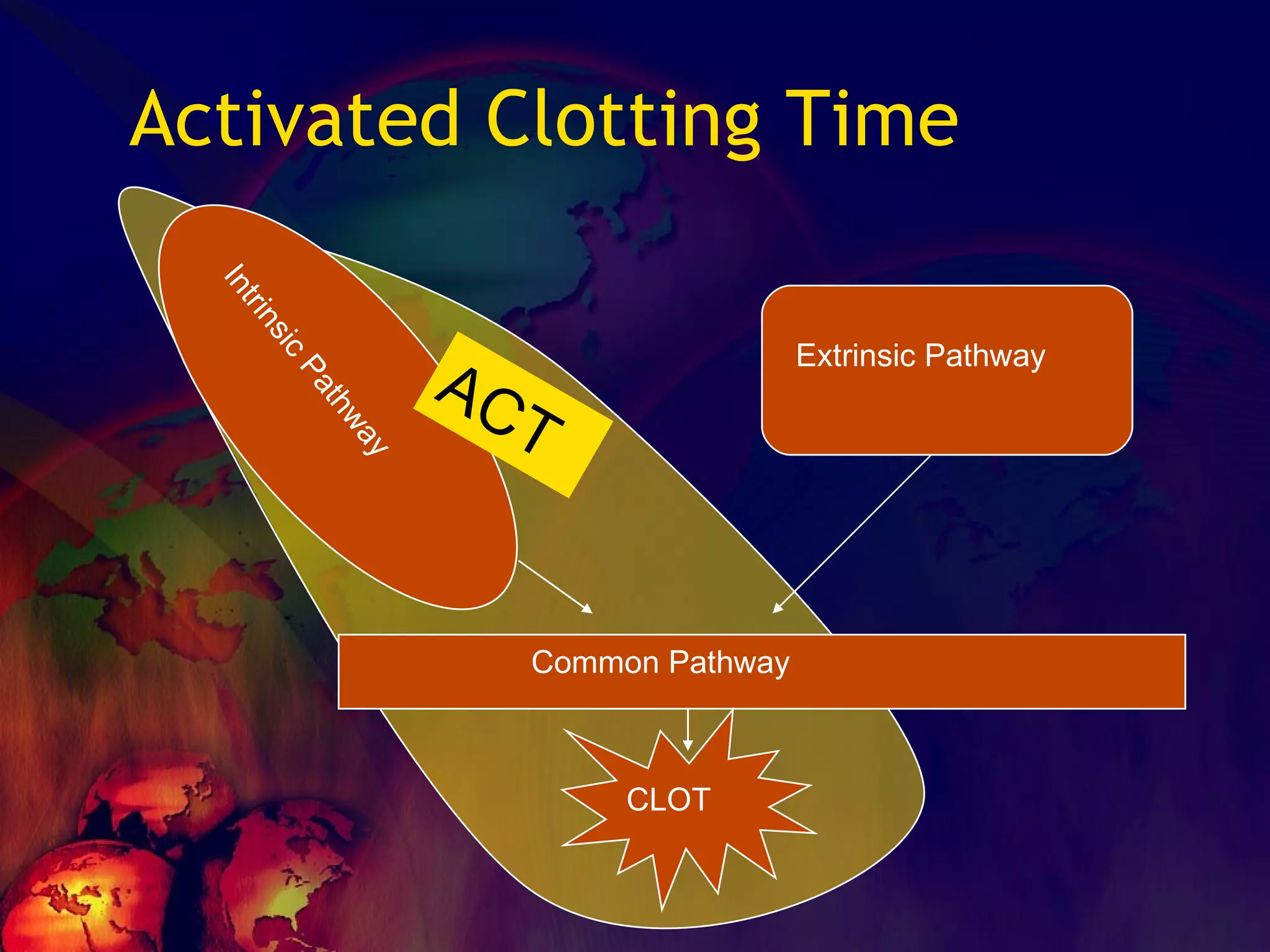
Activated clotting time 70 – 180 secs Vascular surgeries C-P bypass  HD Cardiac catheterisation Prolonged??
Activated Clotting Time Intrinsic Pathway Extrinsic Pathway Common Pathway CLOT ACT
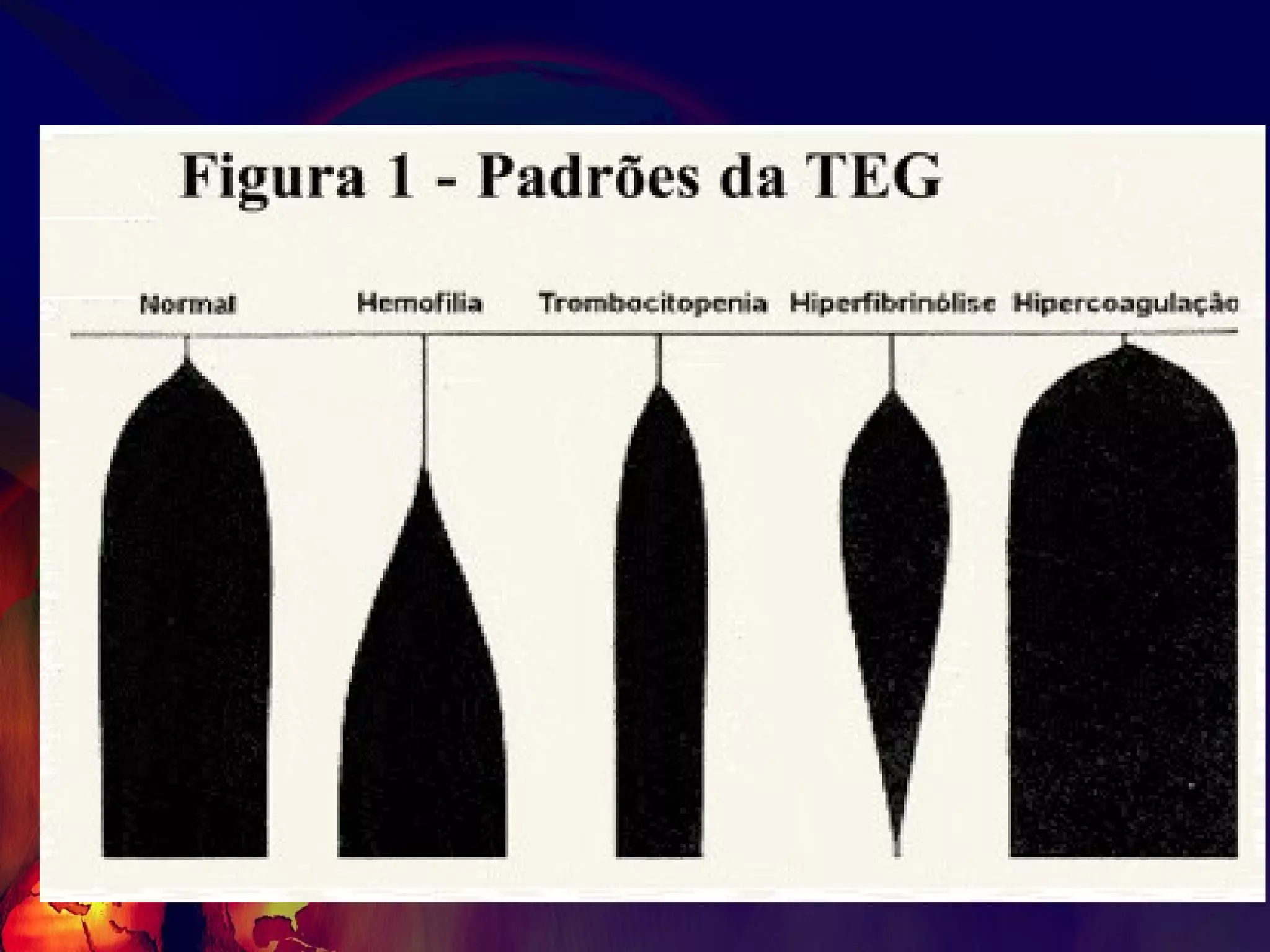
Thromboelastography Viscoelastic properties Blood product transfusion according to need.
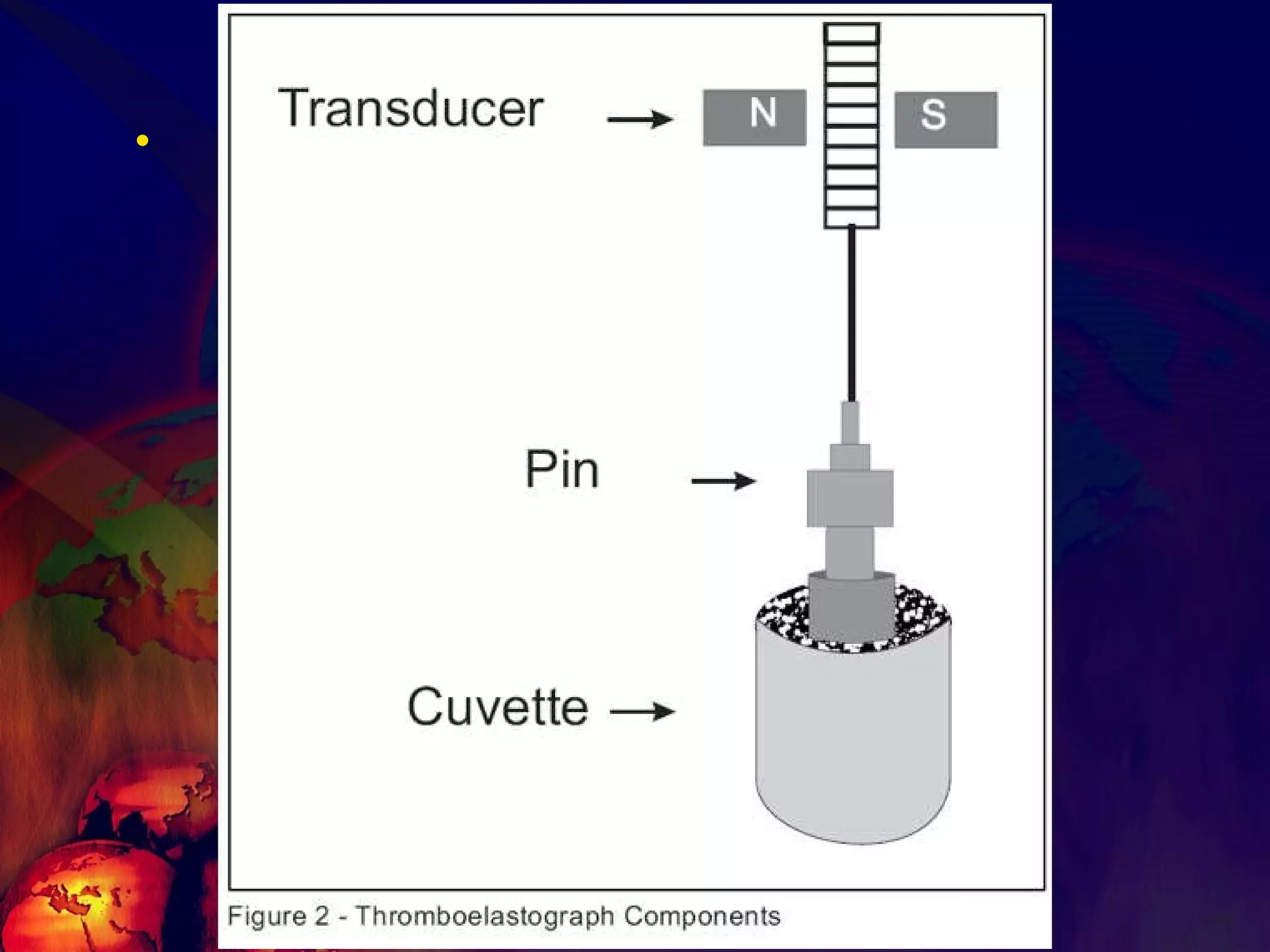
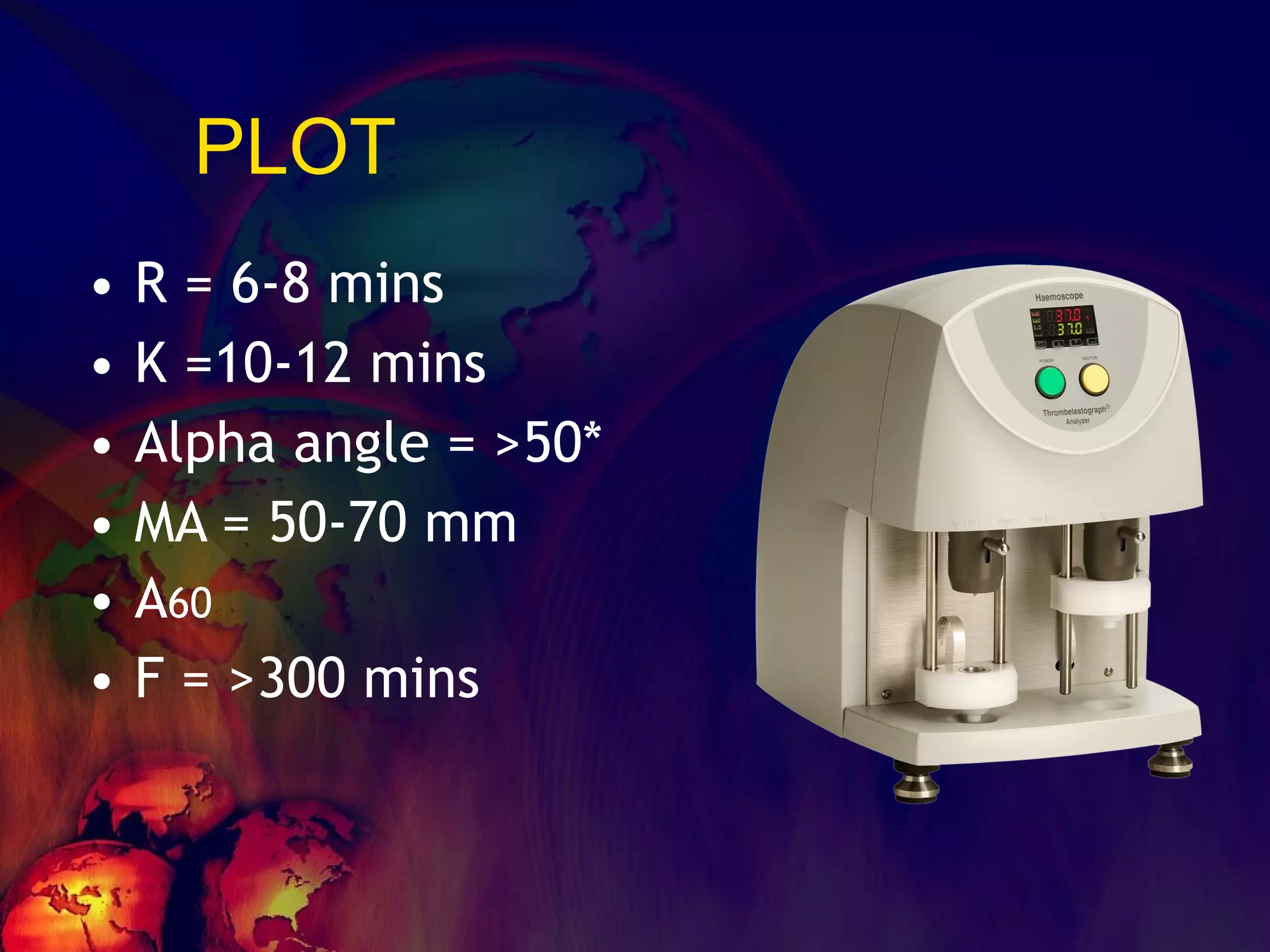
The TEG® System CELITE activated  0.36ml blood Cuvette Piston  4.5* Cuvette oscillates , piston free Cuvette  Clot  Piston  Plot of piston Stronger clot    THICK TEG Weaker clot    NARROW TEG
.
 
.
..
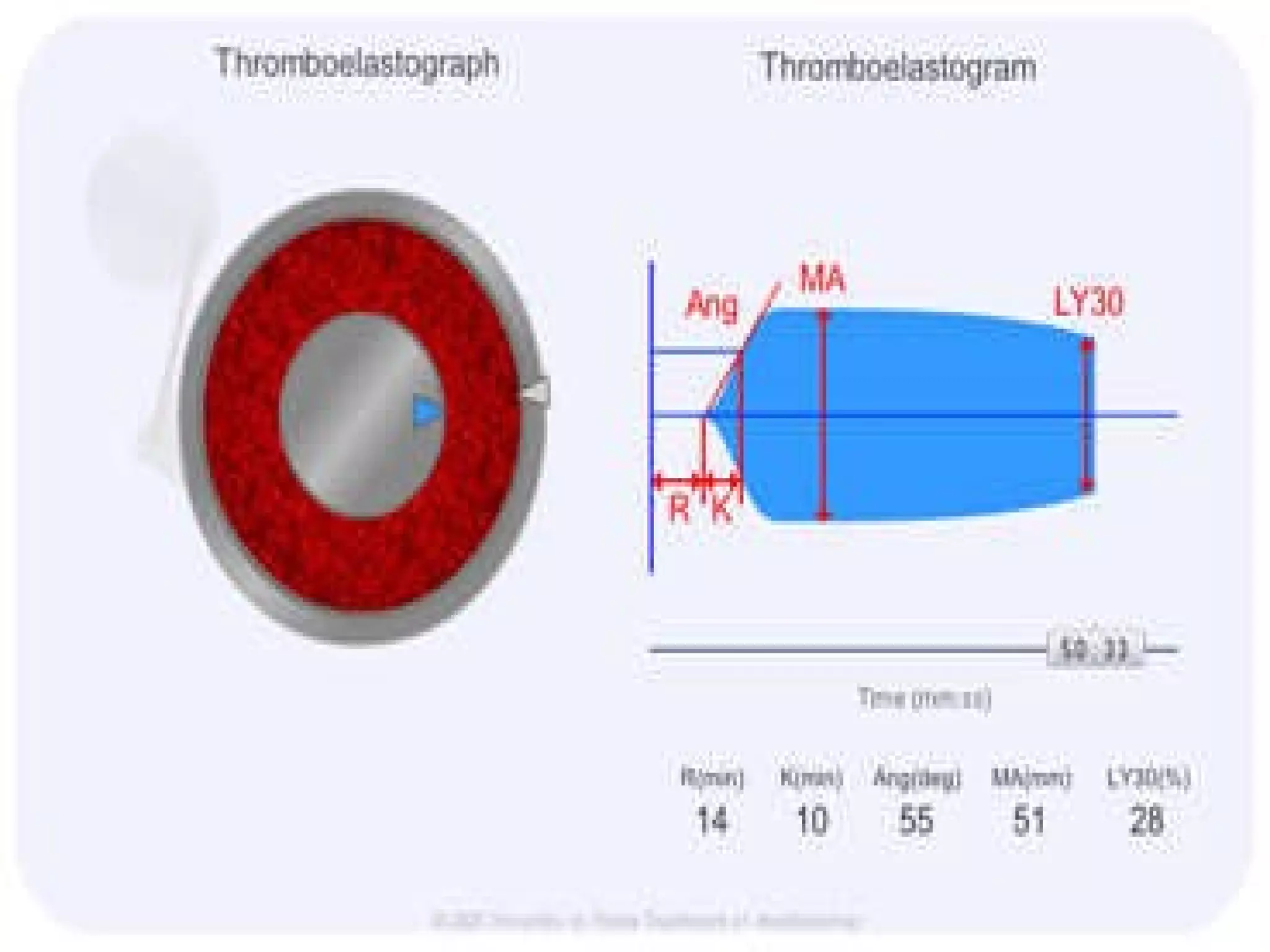
PLOT  R = 6-8 mins K =10-12 mins Alpha angle = >50* MA = 50-70 mm A 60  F = >300 mins
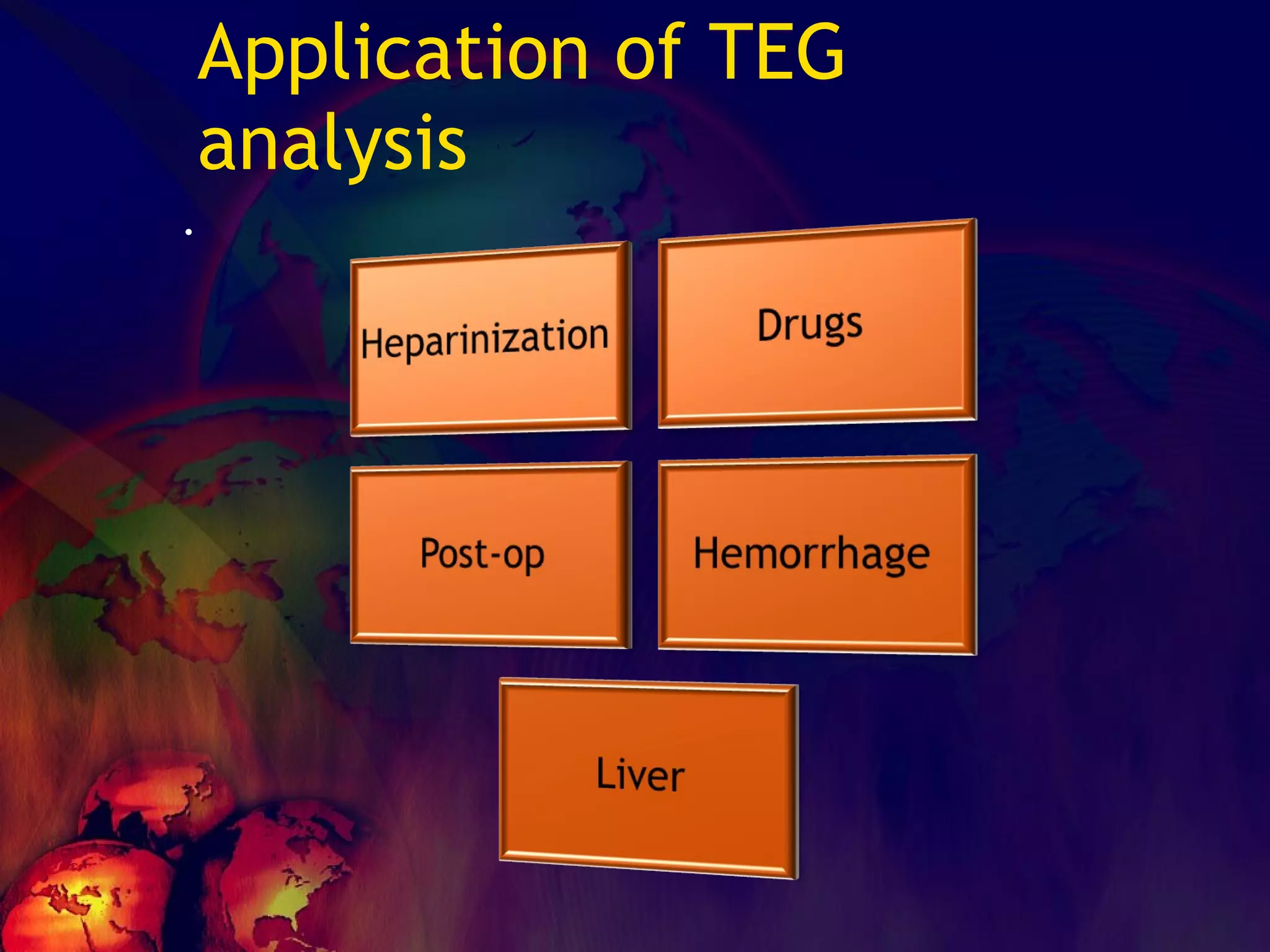
Application of TEG analysis .
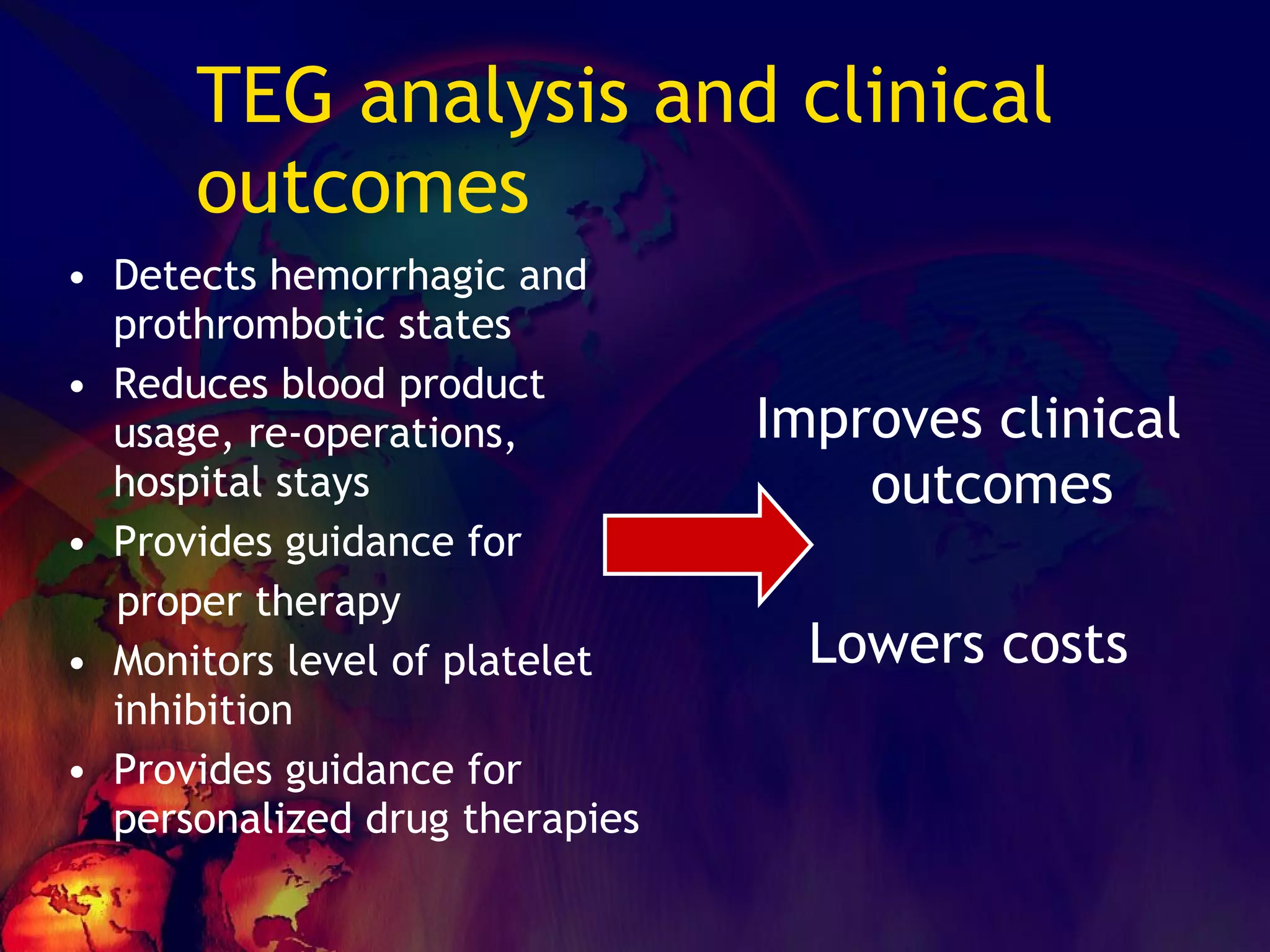
TEG analysis and clinical outcomes Detects hemorrhagic and prothrombotic states  Reduces blood product usage, re-operations, hospital stays Provides guidance for  proper therapy  Monitors level of platelet inhibition Provides guidance for personalized drug therapies Improves clinical outcomes Lowers costs
???? The TEG can distinguish between surgical bleeding and bleeding due to a  coagulopathy.  True  or False? Next
Platelet function analyzers PFA-100 MEDTRONIC HEMOSTATUS
Still not over…?$# Hmmm…
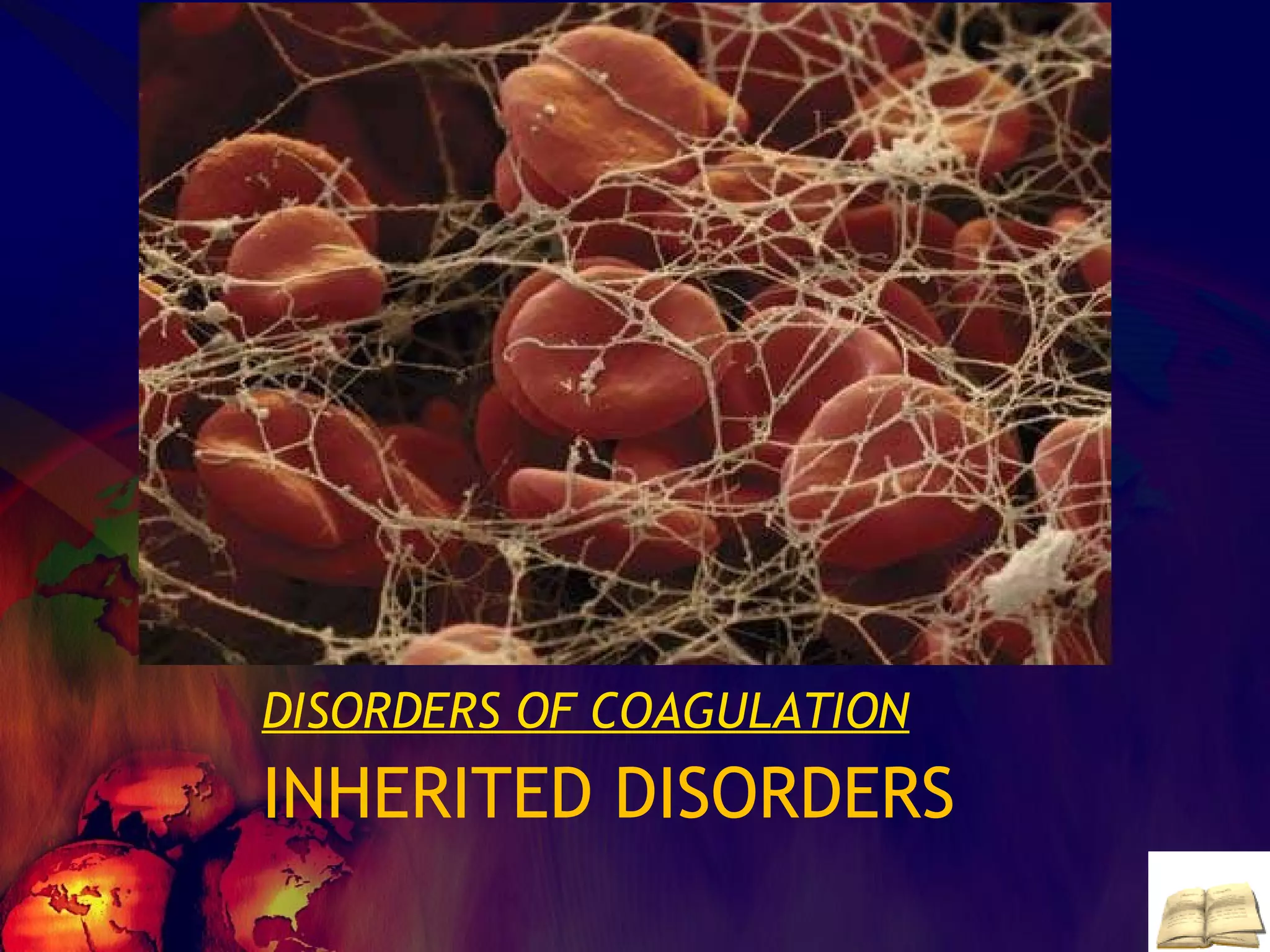
DISORDERS OF COAGULATION INHERITED DISORDERS
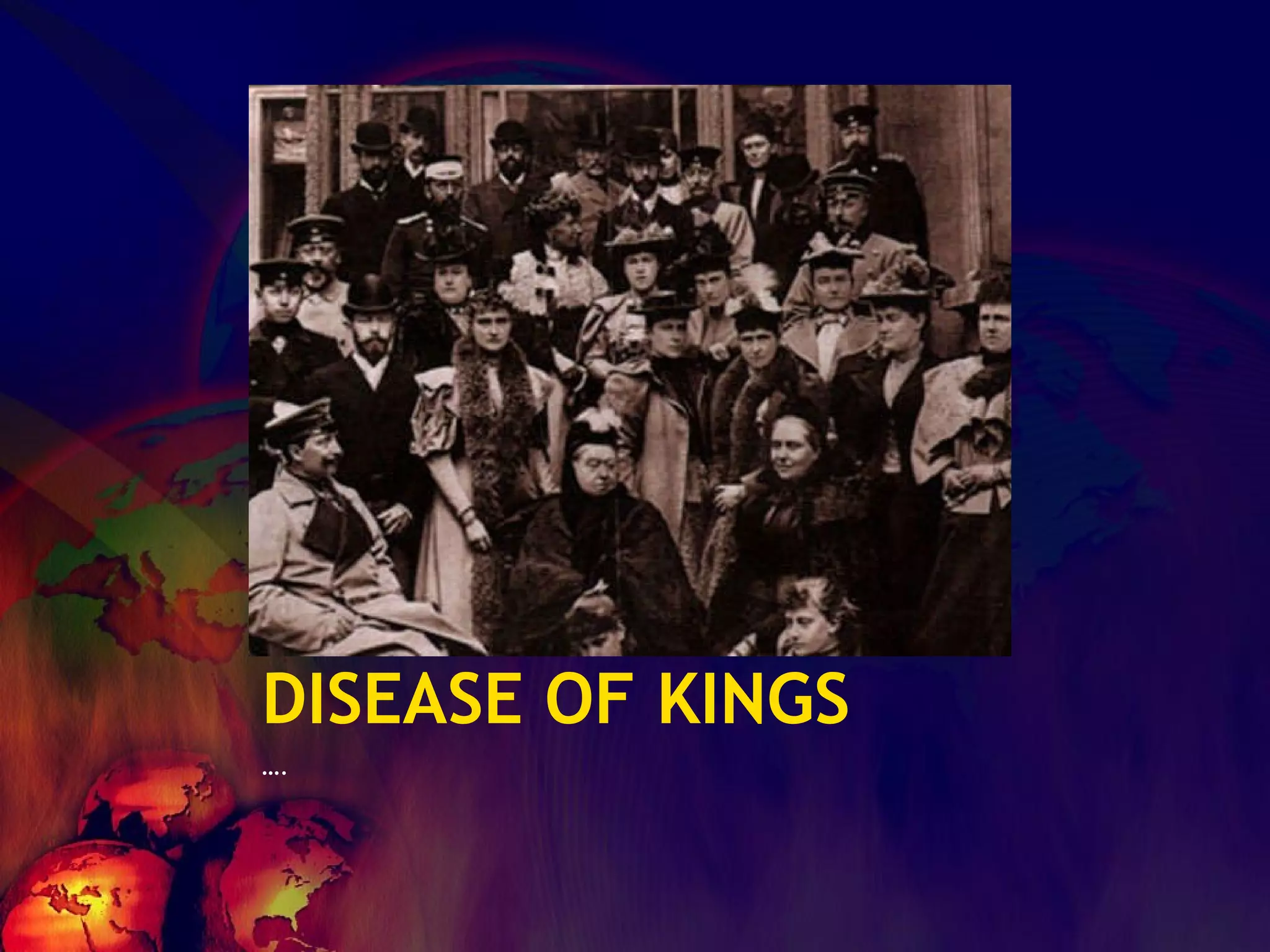
DISEASE OF KINGS … .
What is Hemophilia? Hemophilia is an inherited bleeding disorder in which there is a deficiency or lack of factor VIII (hemophilia A) or factor IX (hemophilia B)
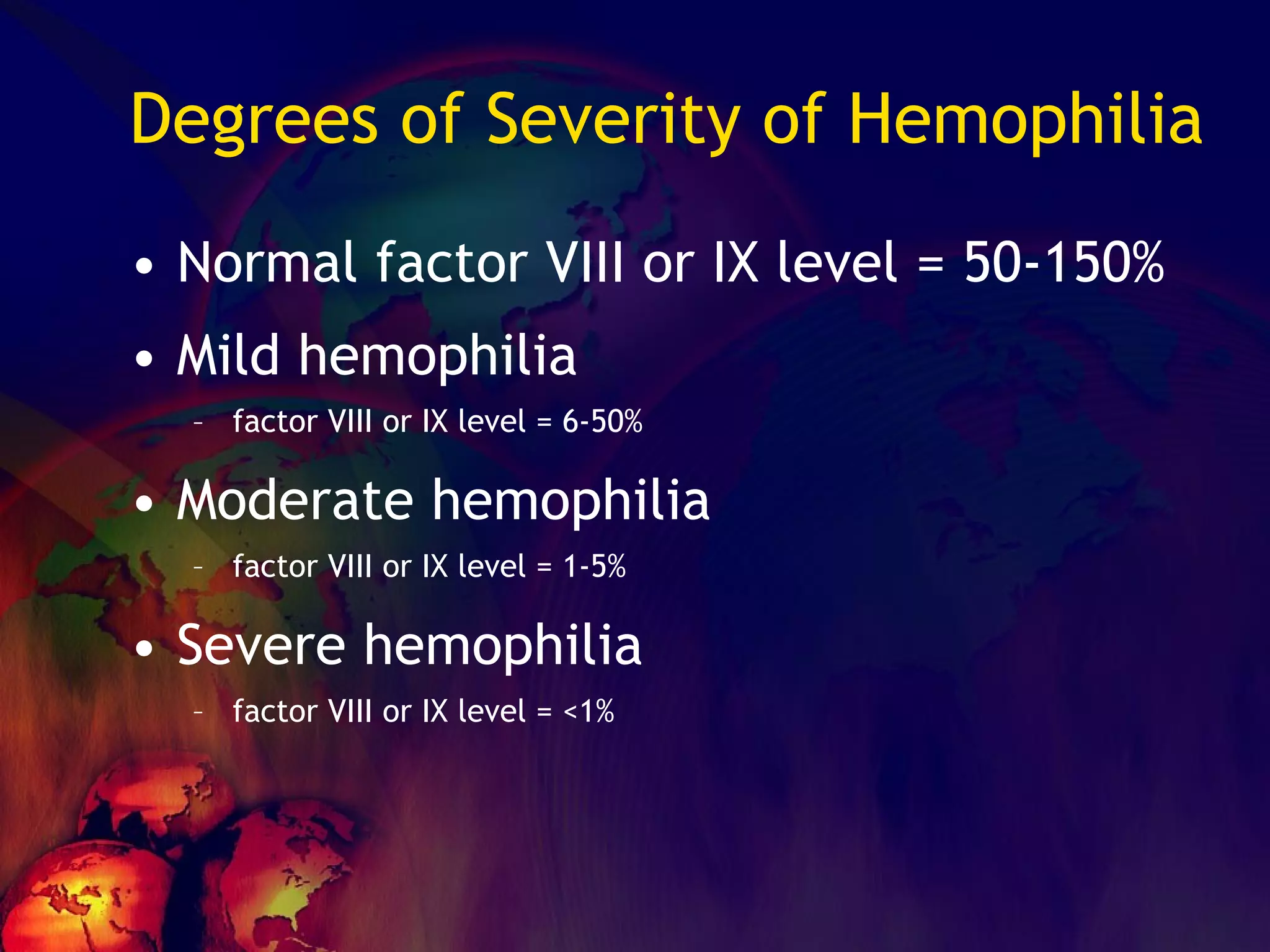
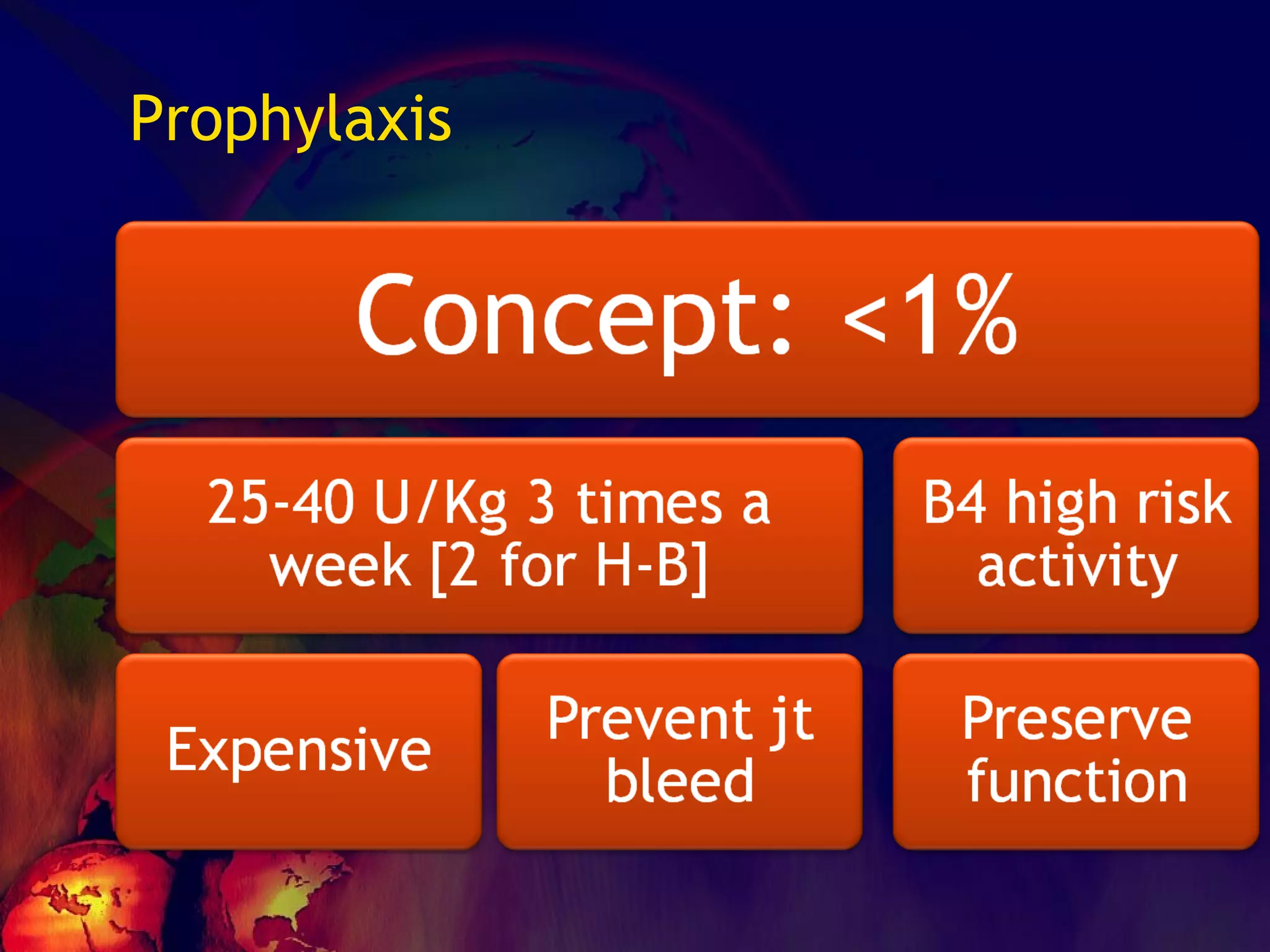
Degrees of Severity of Hemophilia Normal factor VIII or IX level = 50-150% Mild hemophilia factor VIII or IX level = 6-50%  Moderate hemophilia factor VIII or IX level = 1-5% Severe hemophilia factor VIII or IX level = <1%
CLINICAL FEATURES
Types of Bleeds Joint bleeding - hemarthrosis Muscle hemorrhage Soft tissue Life threatening-bleeding Other
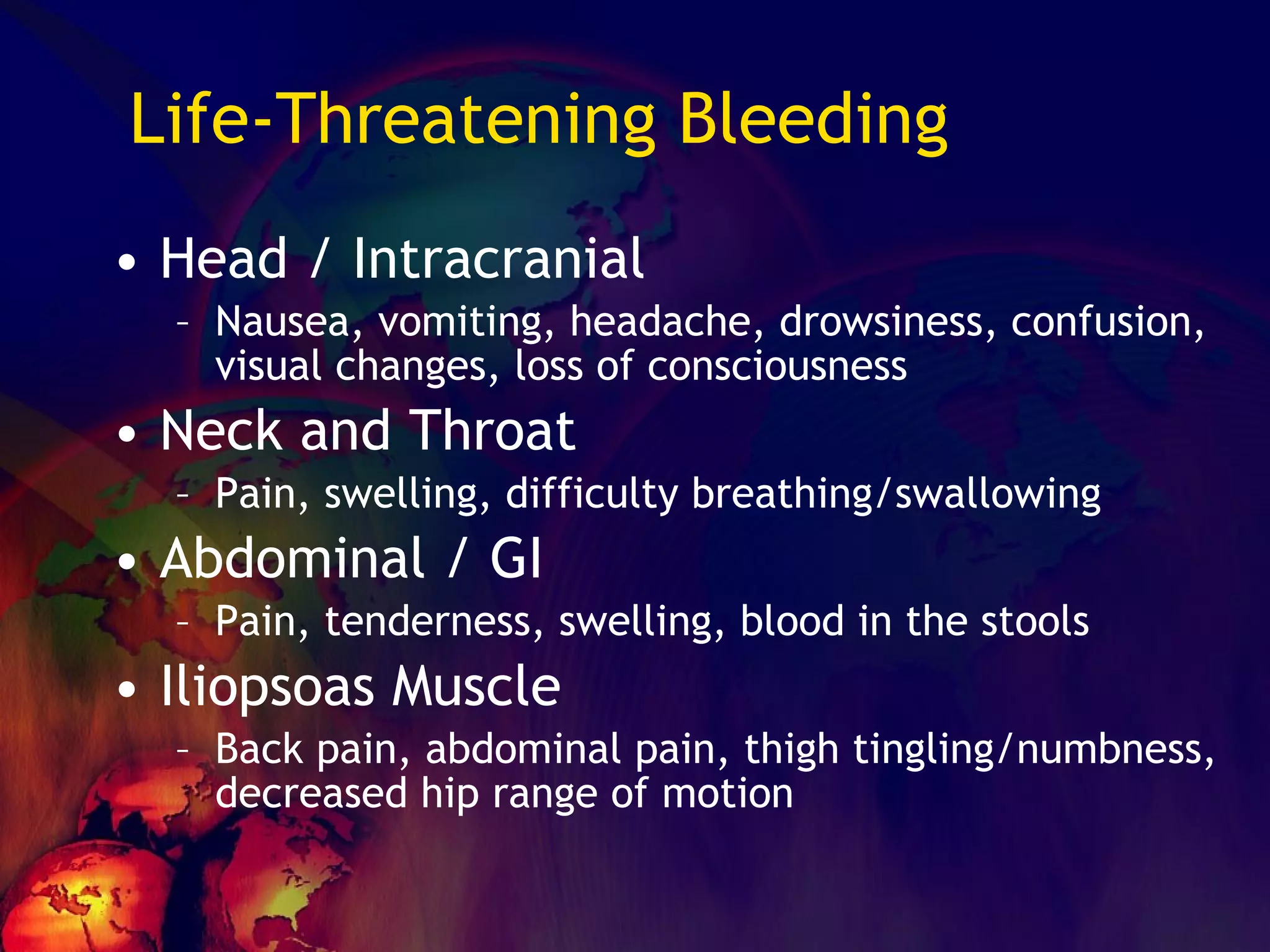
Life-Threatening Bleeding Head / Intracranial Nausea, vomiting, headache, drowsiness, confusion, visual changes, loss of consciousness Neck and Throat Pain, swelling, difficulty breathing/swallowing Abdominal / GI Pain, tenderness, swelling, blood in the stools Iliopsoas Muscle Back pain, abdominal pain, thigh tingling/numbness, decreased hip range of motion
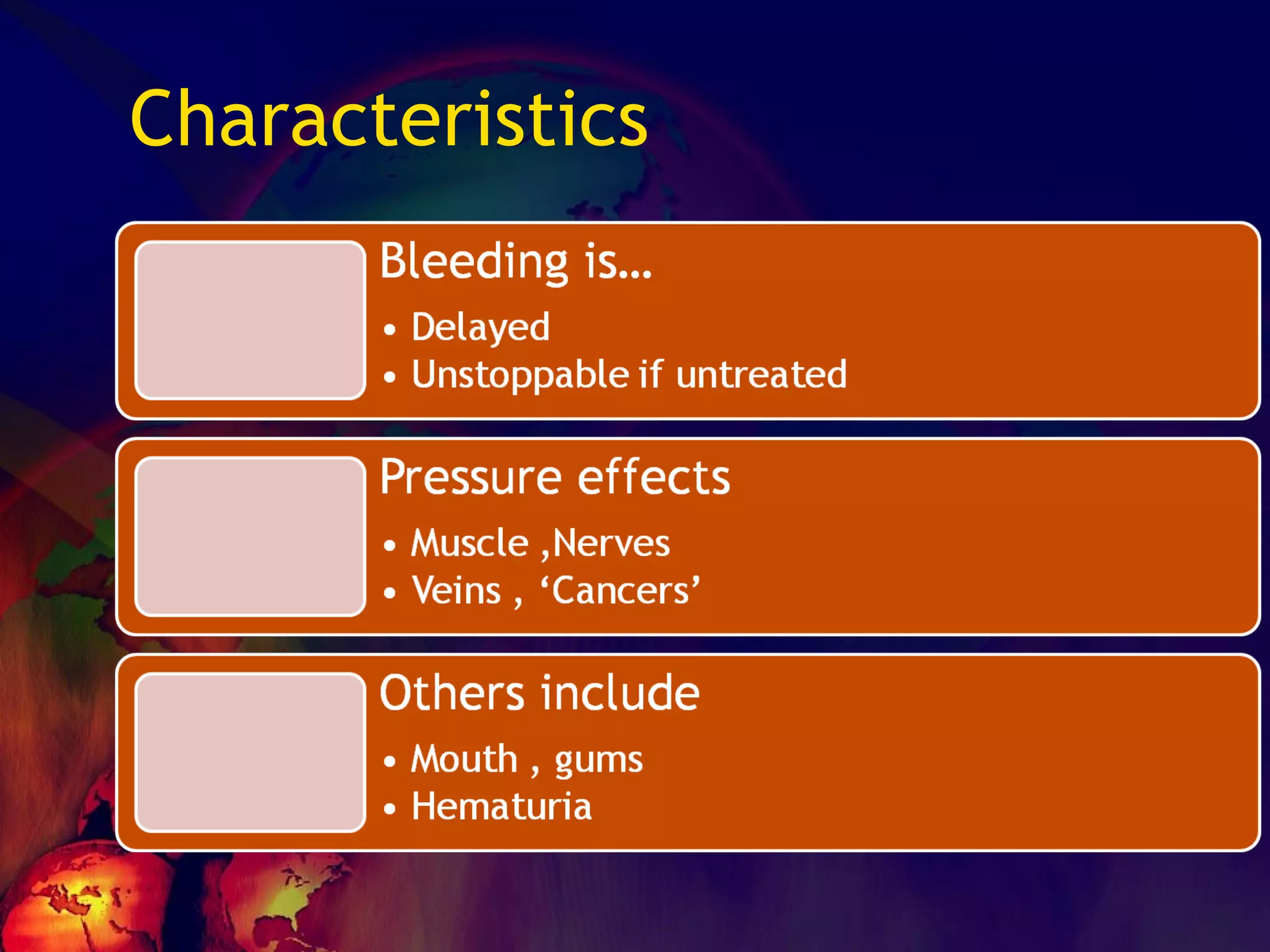
Characteristics
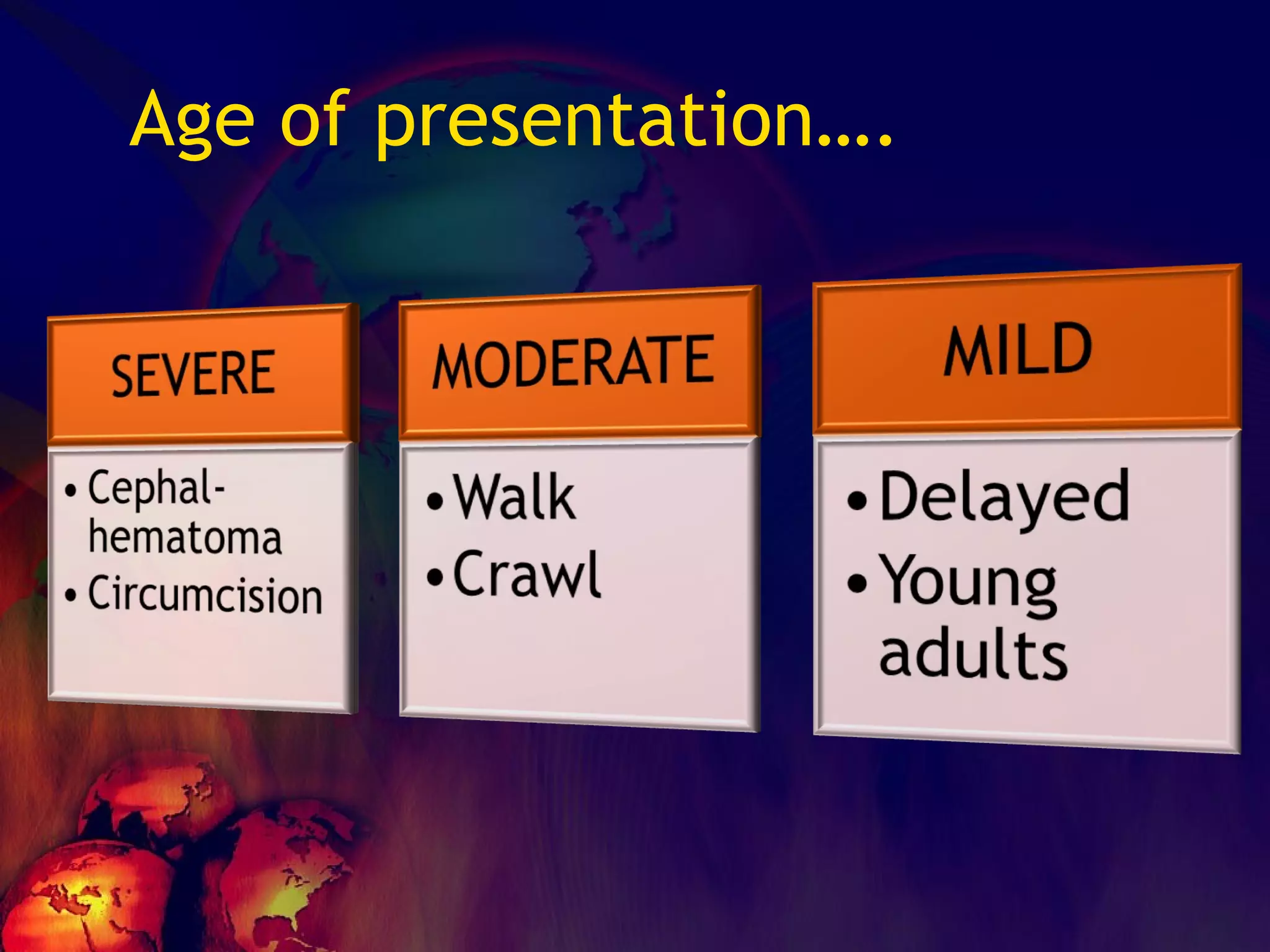
Age of presentation….
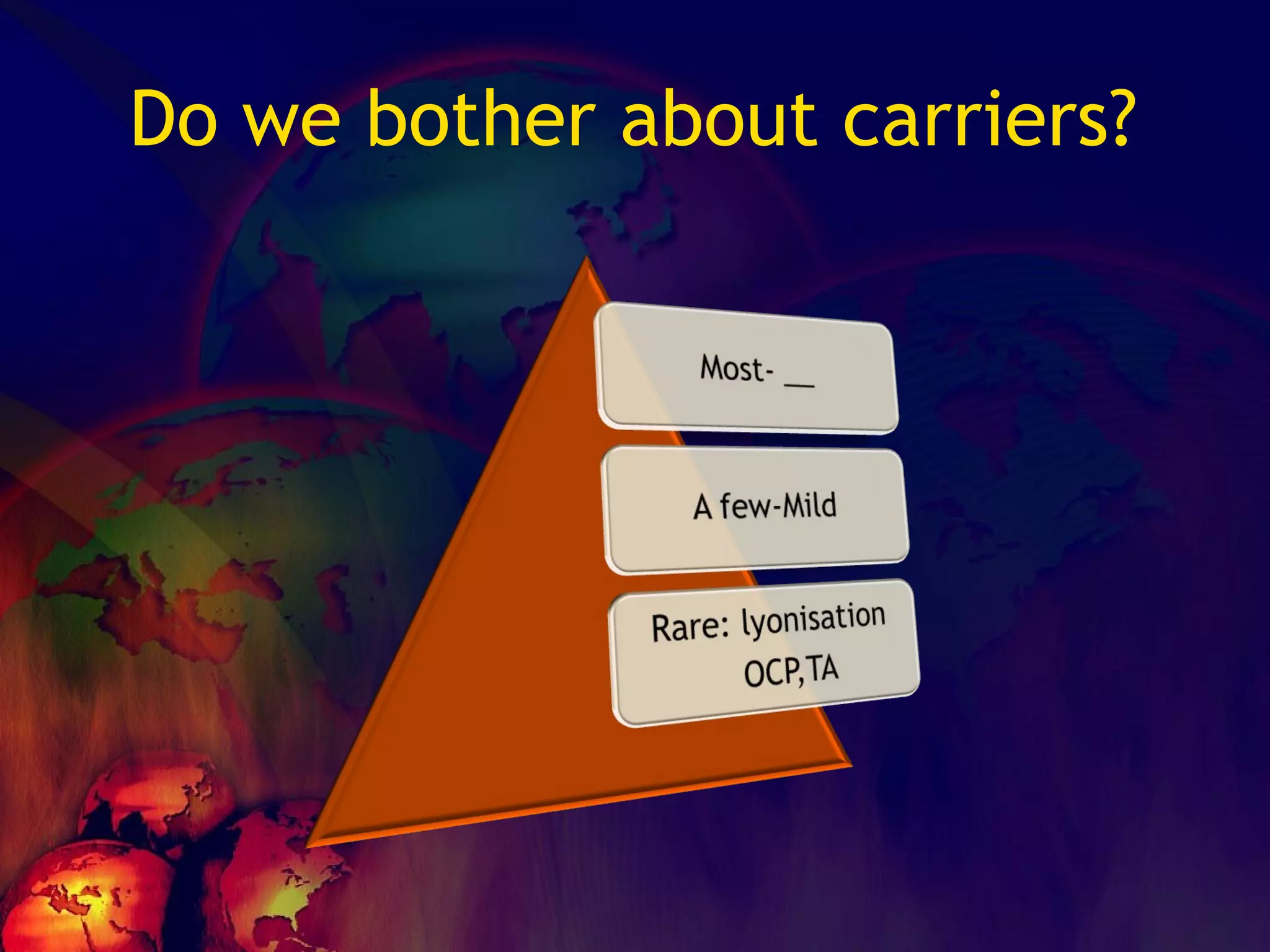
Do we bother about carriers?
Investigations… Prolonged  PTT with normal Platelet count, BT and PT supports the diagnosis F VIII assay confirms the diagnosis and allows differentiation from…..?
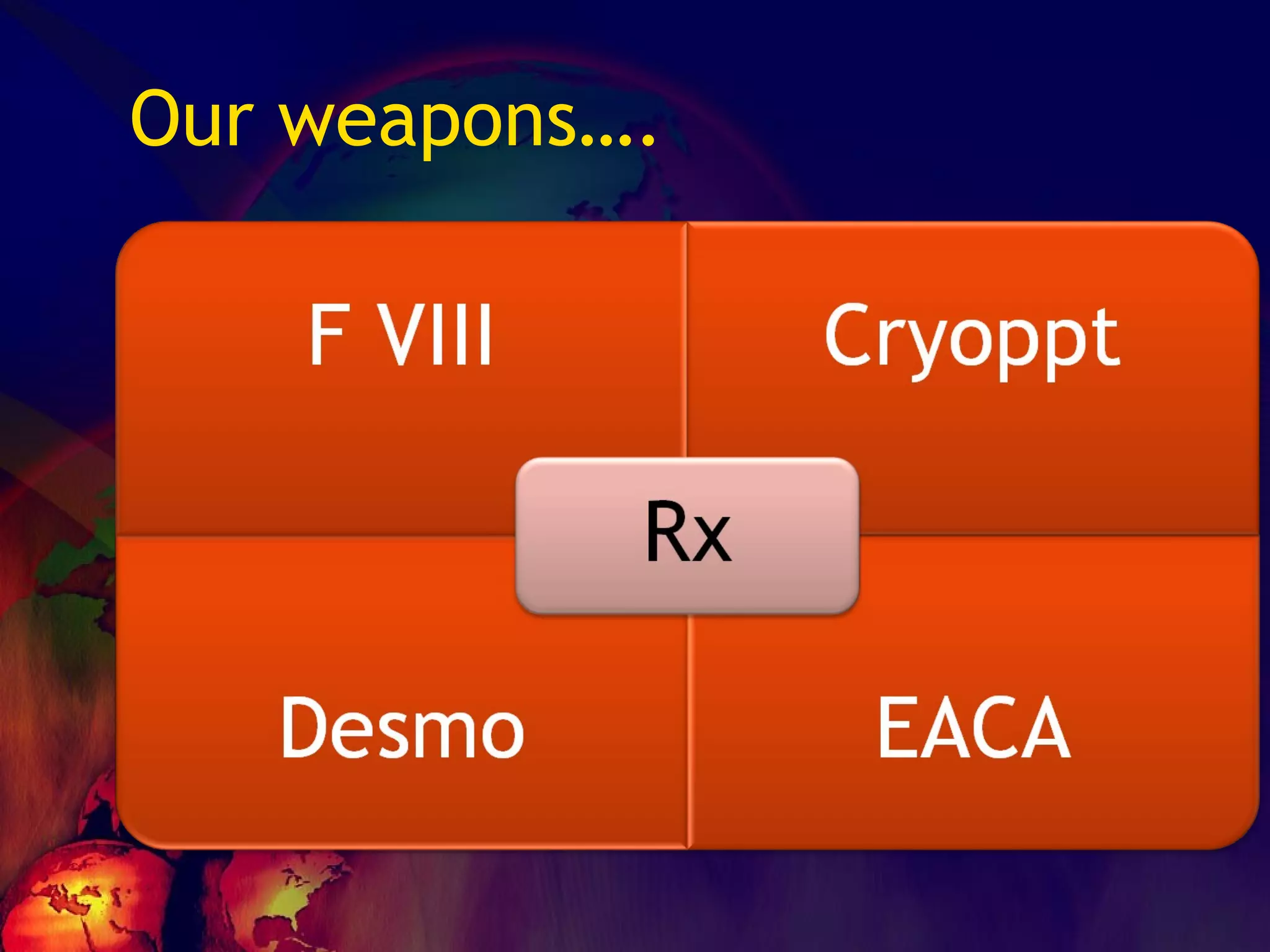
Our weapons….
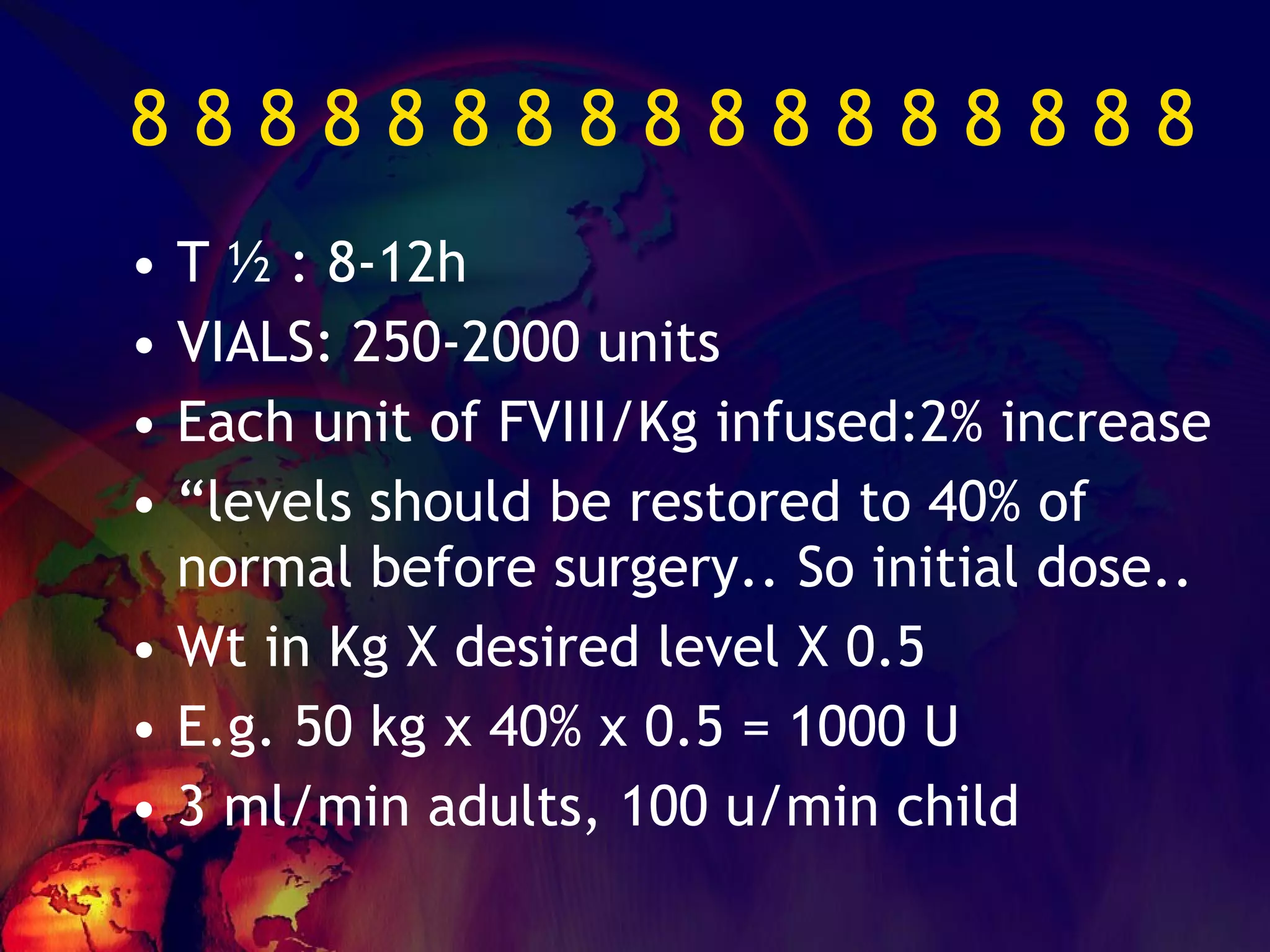
8 8 8 8 8 8 8 8 8 8 8 8 8 8 8 8 8  T ½ : 8-12h VIALS: 250-2000 units Each unit of FVIII/Kg infused:2% increase “ levels should be restored to 40% of normal before surgery.. So initial dose.. Wt in Kg X desired level X 0.5 E.g. 50 kg x 40% x 0.5 = 1000 U 3 ml/min adults, 100 u/min child
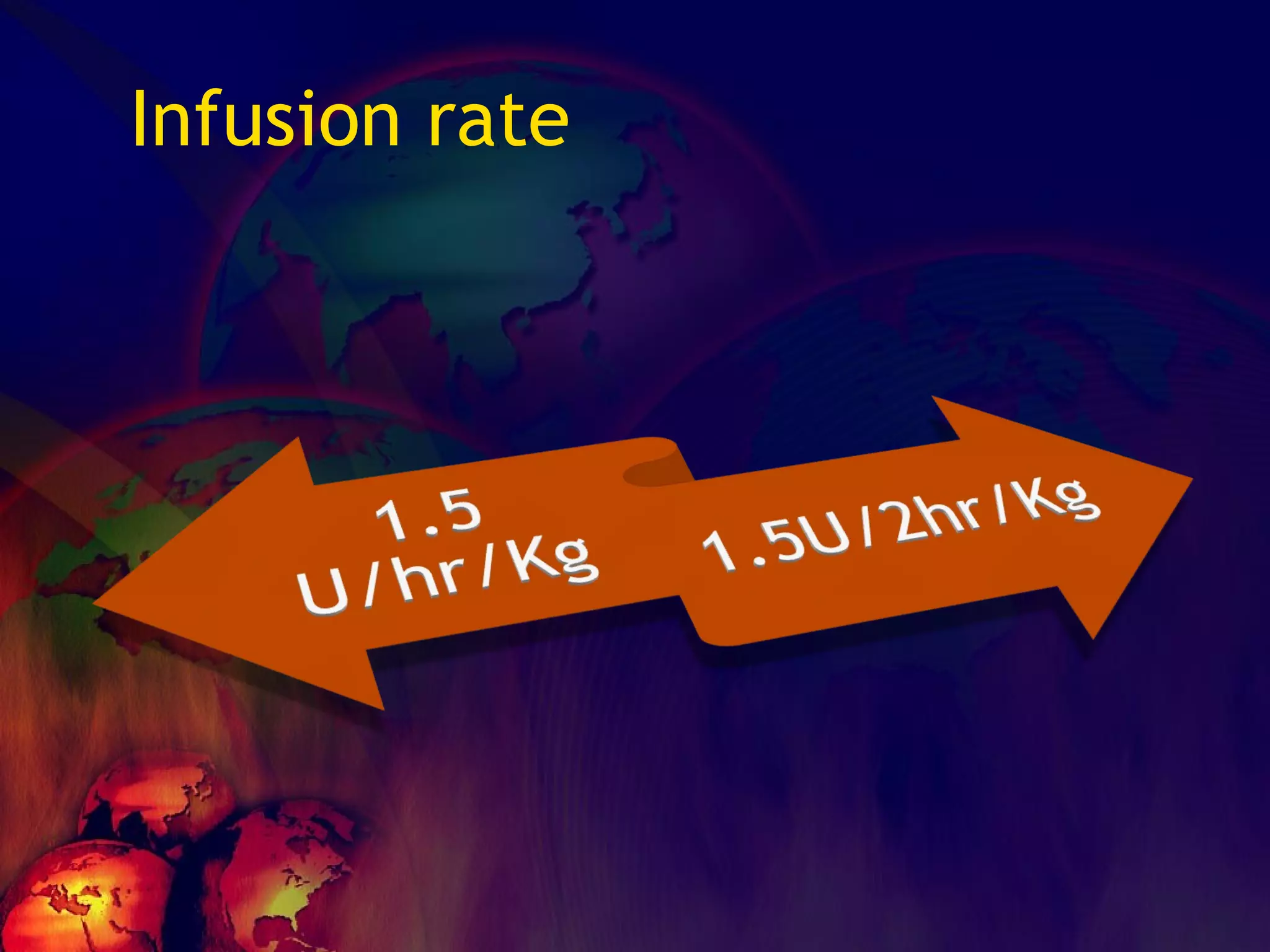
Infusion rate
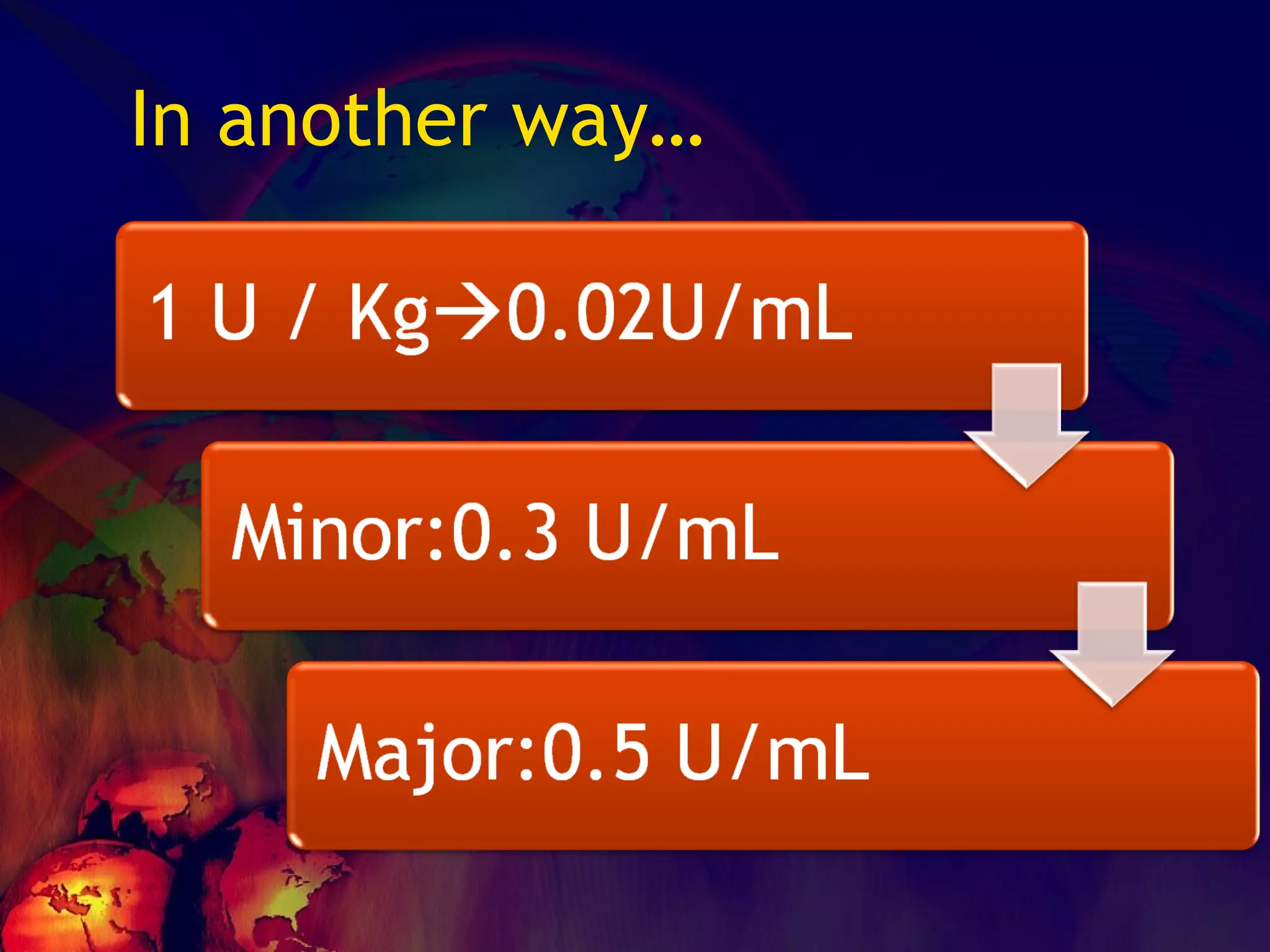
In another way…
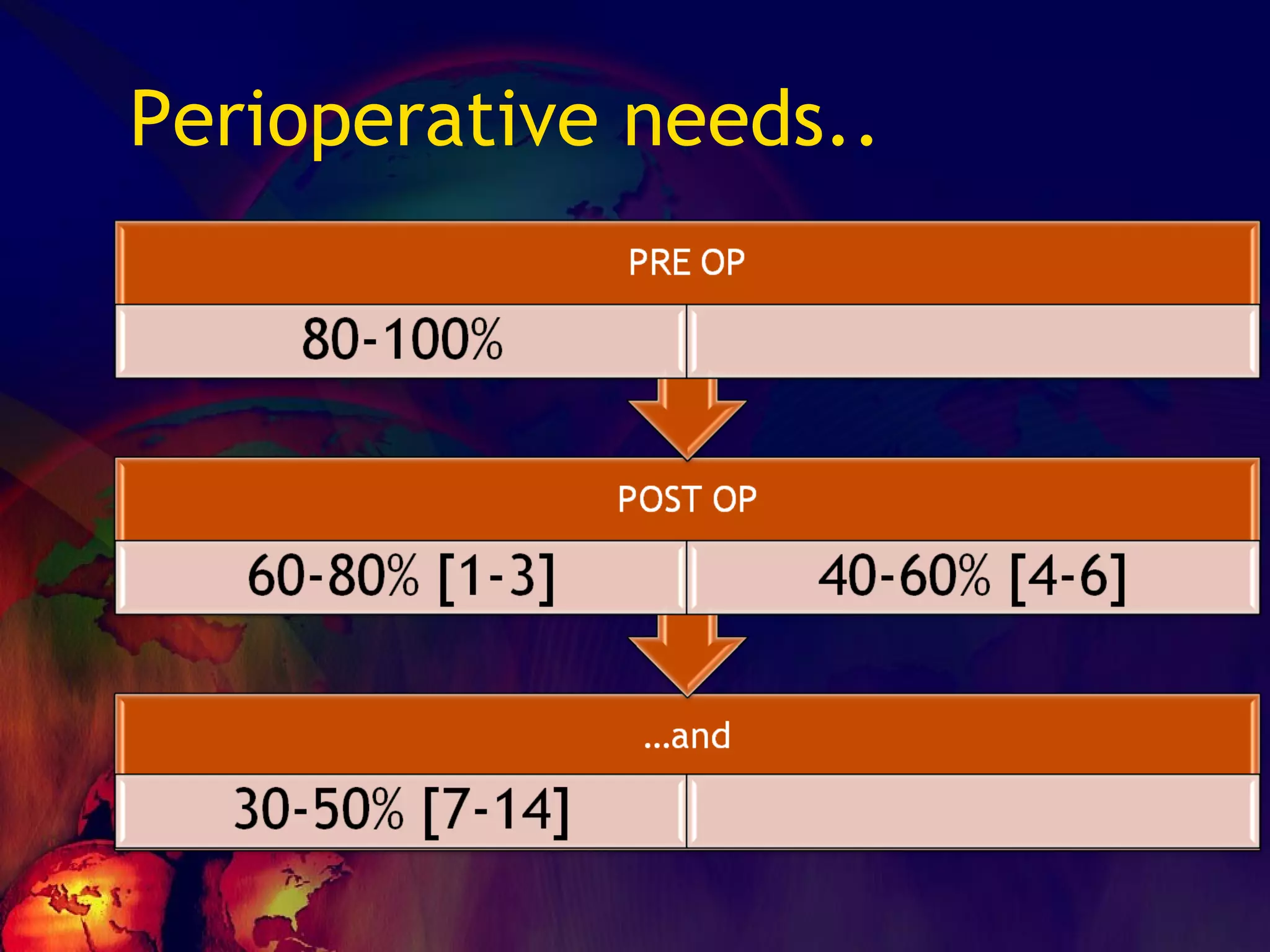
Perioperative needs..
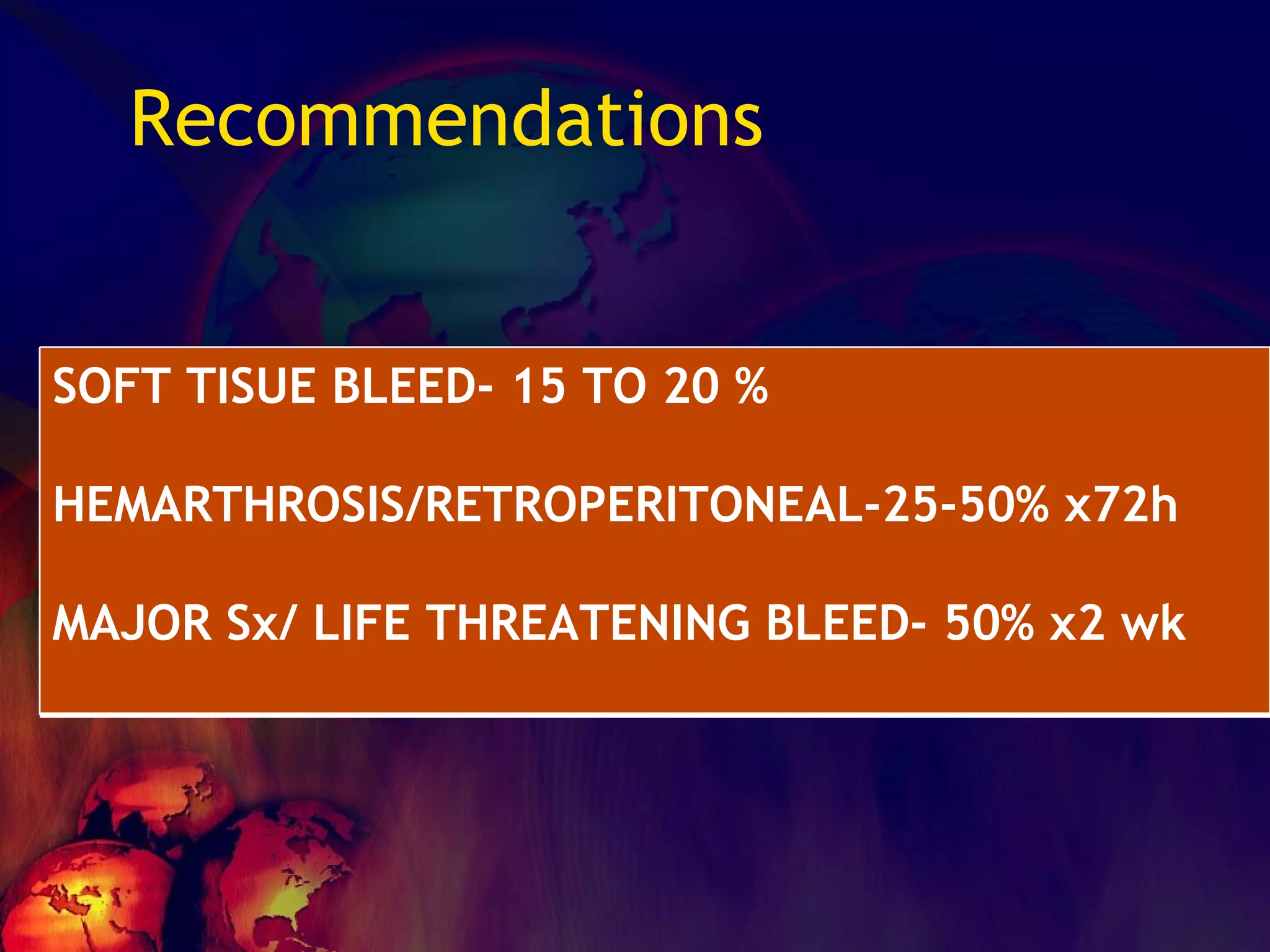
Recommendations  SOFT TISUE BLEED- 15 TO 20 % HEMARTHROSIS/RETROPERITONEAL-25-50% x72h MAJOR Sx/ LIFE THREATENING BLEED- 50% x2 wk
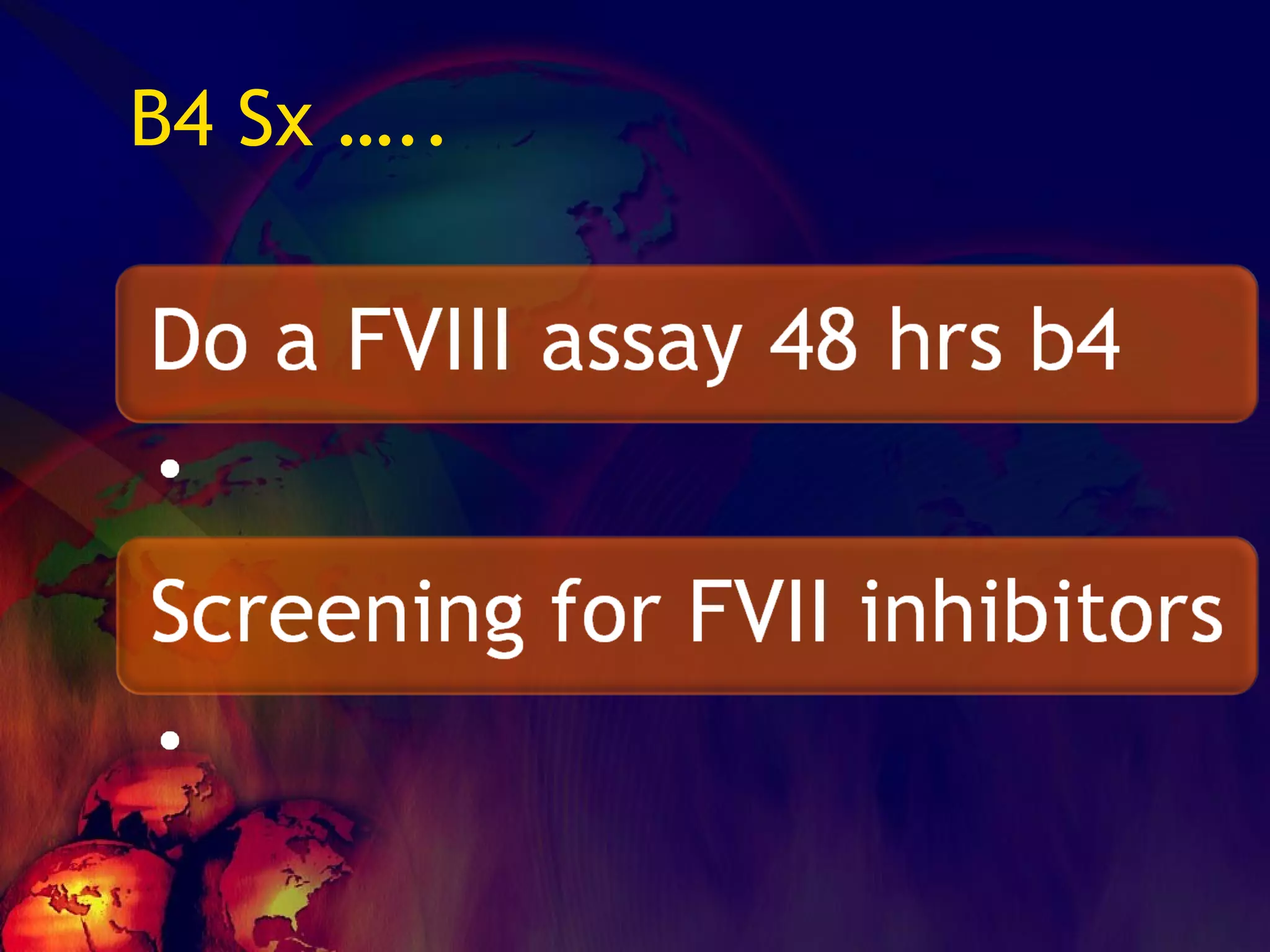
B4 Sx …..
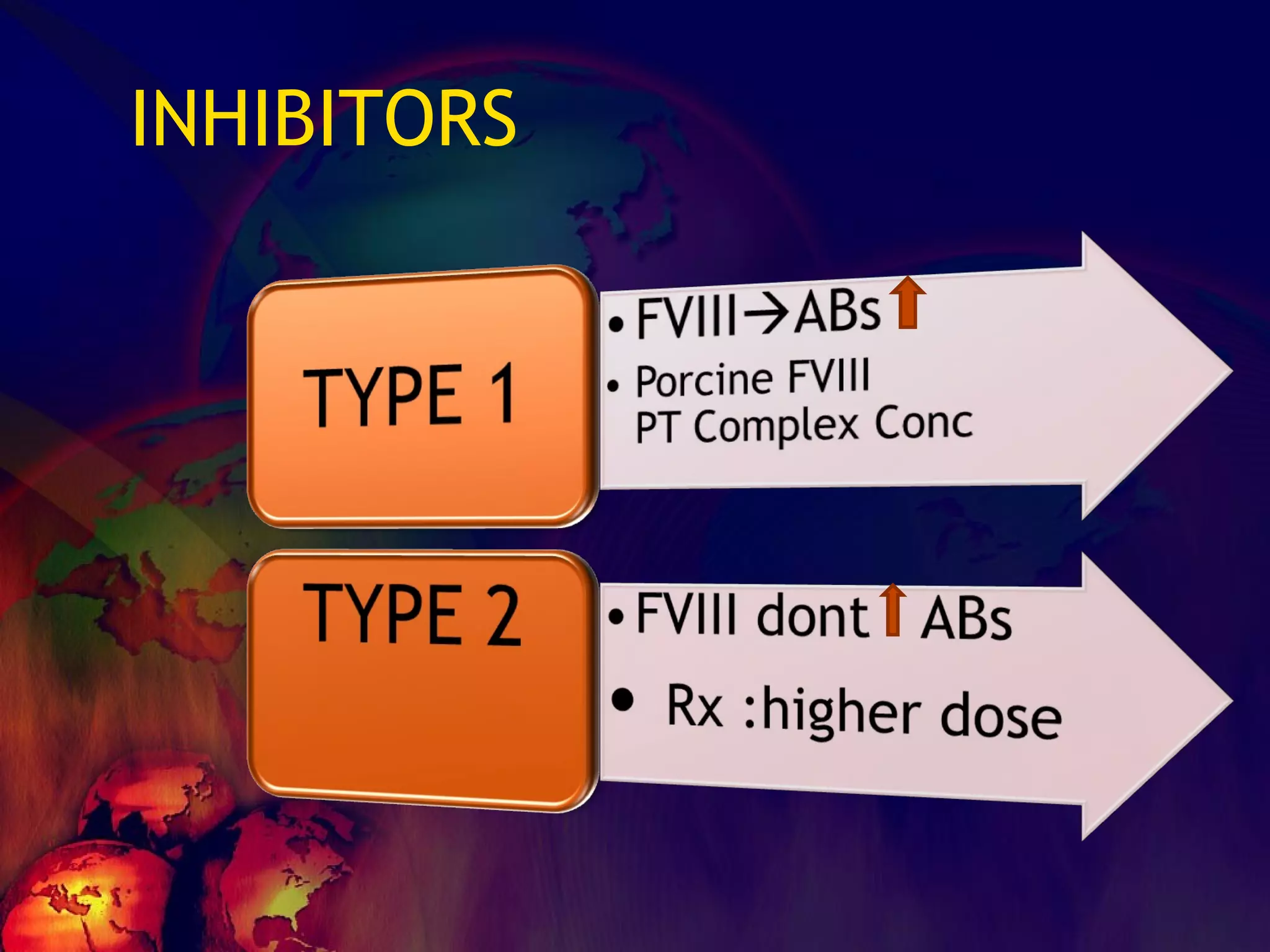
INHIBITORS
Prophylaxis
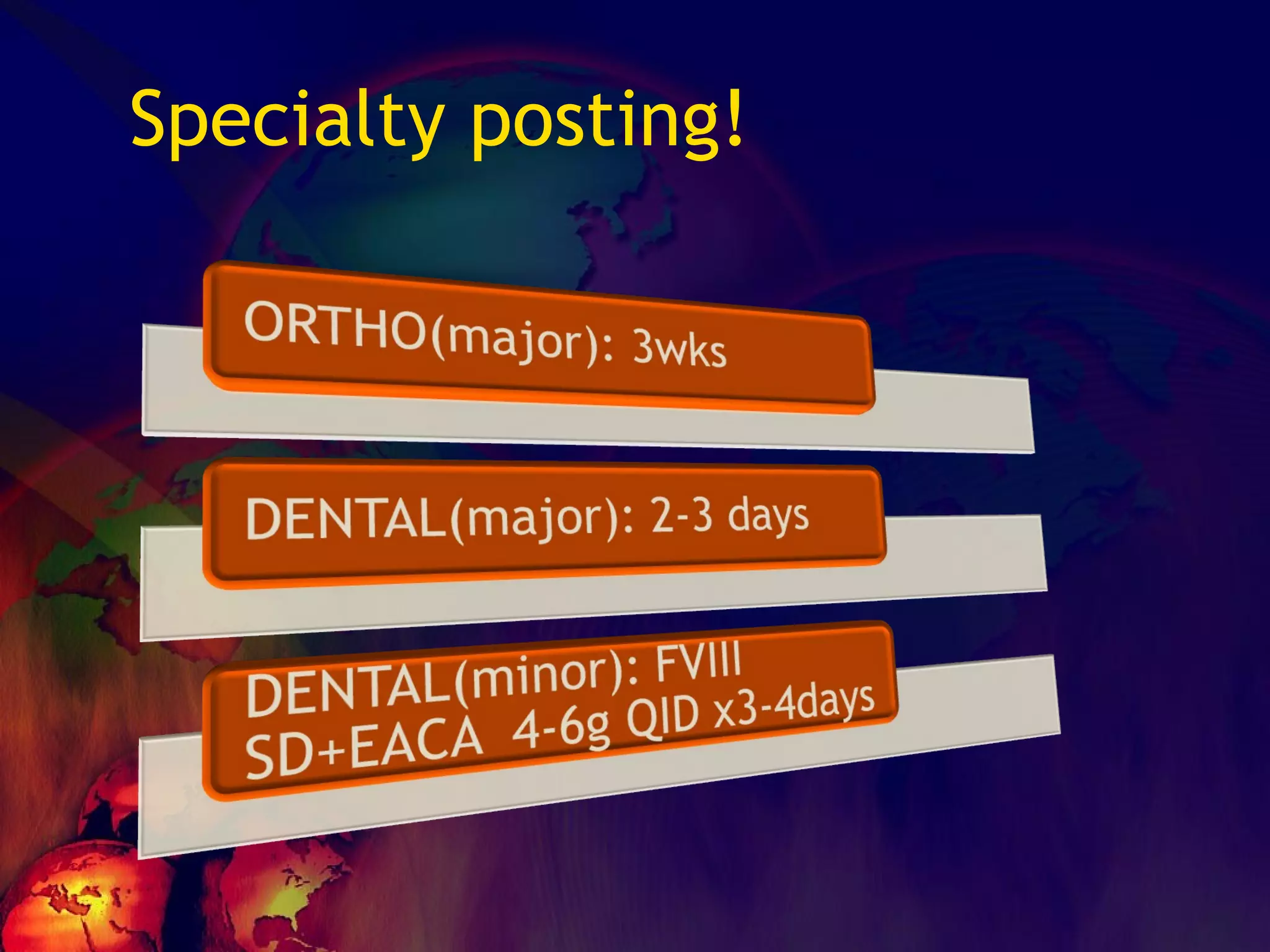
Specialty posting!
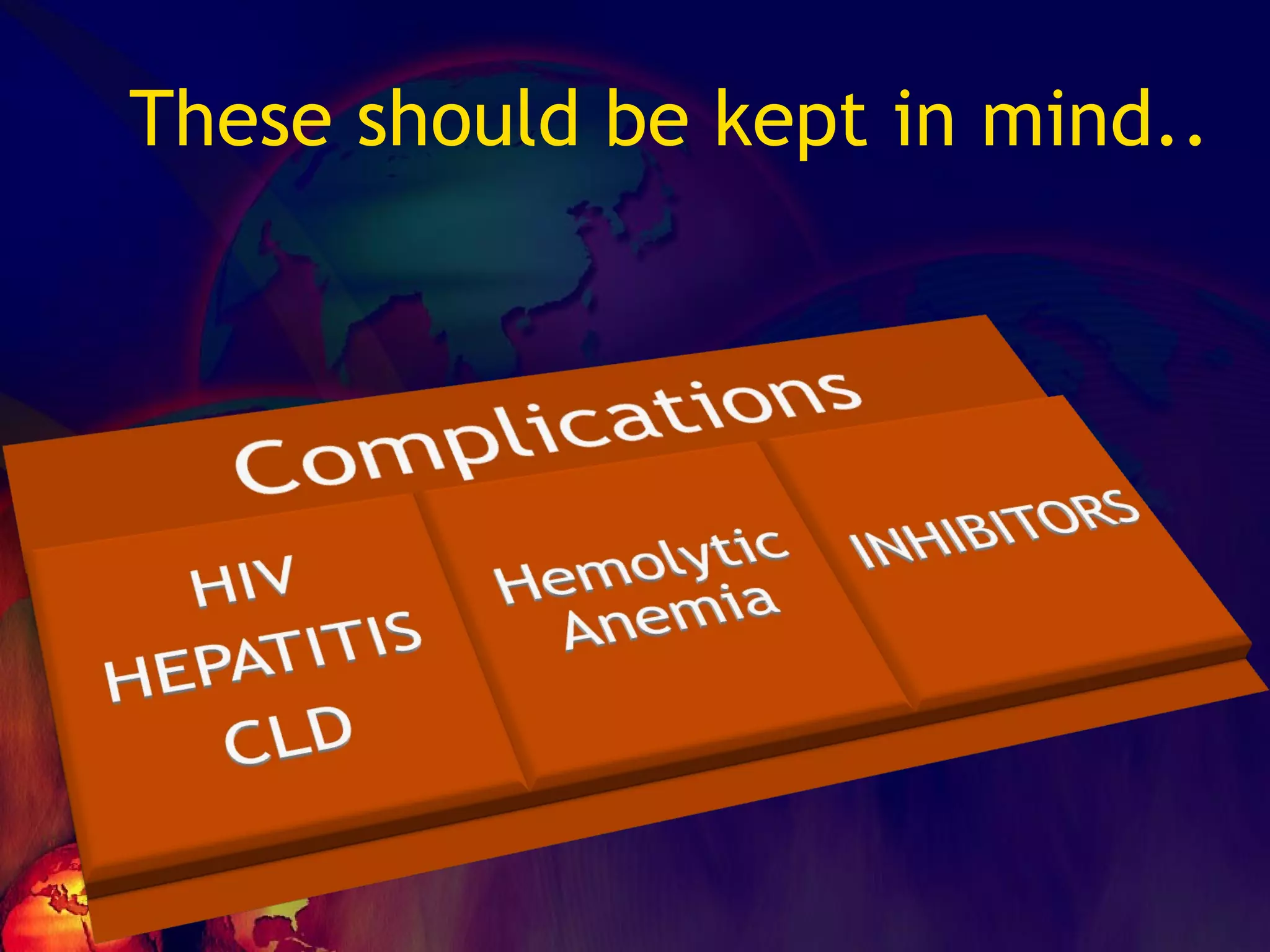
These should be kept in mind..
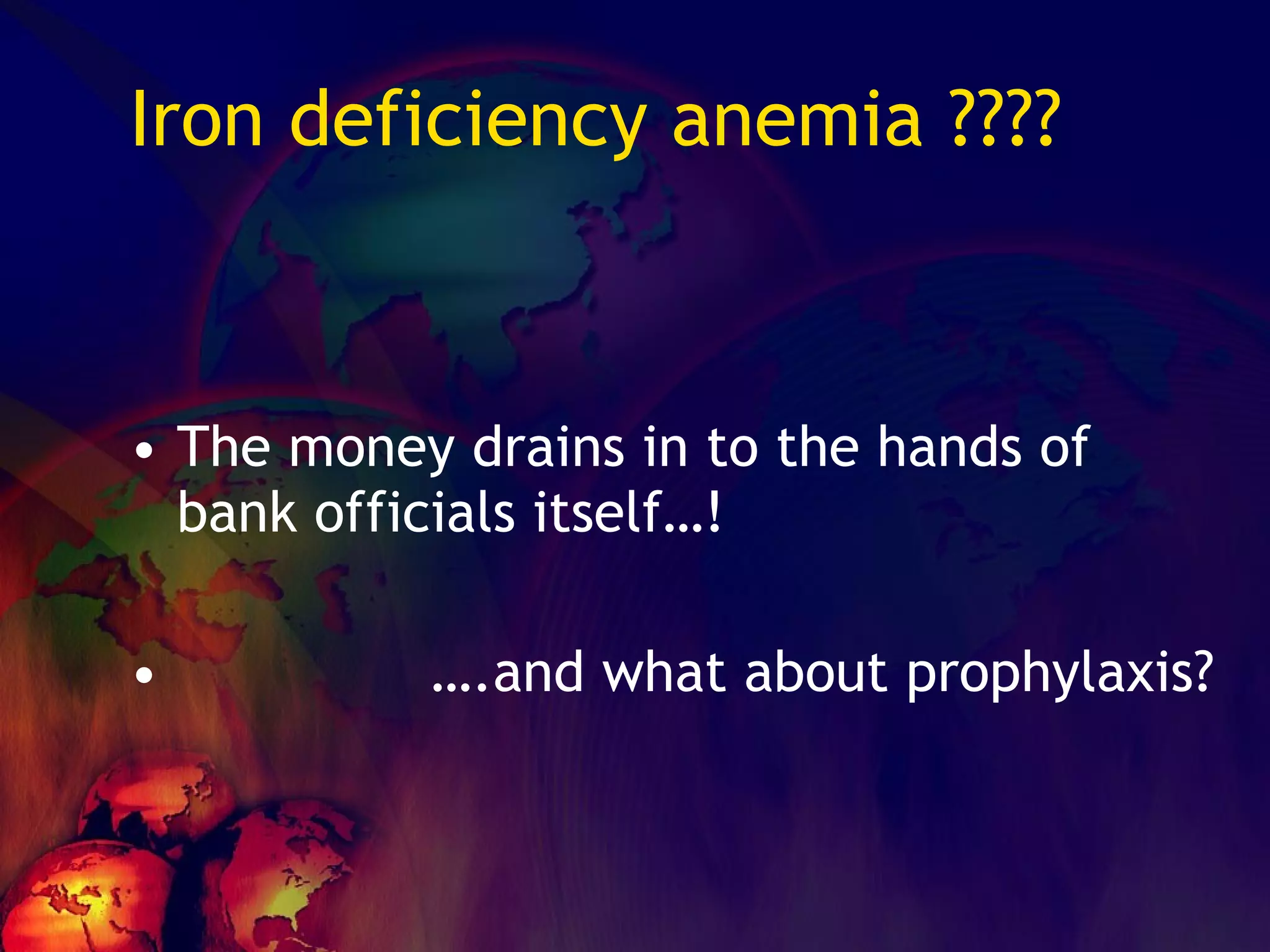
Iron deficiency anemia ???? The money drains in to the hands of bank officials itself…! … .and what about prophylaxis?
Precautions
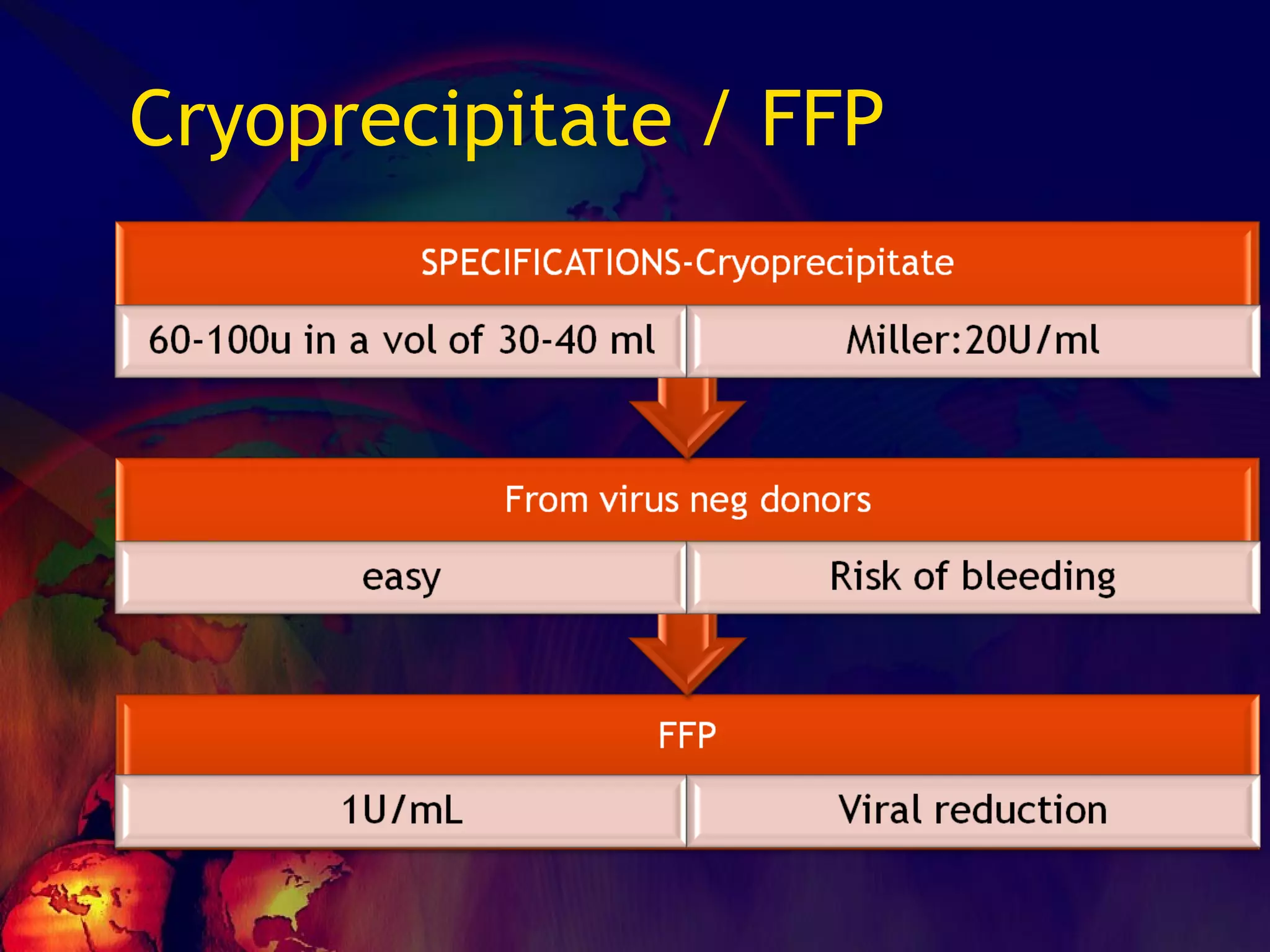
Cryoprecipitate / FFP
Desmopressin
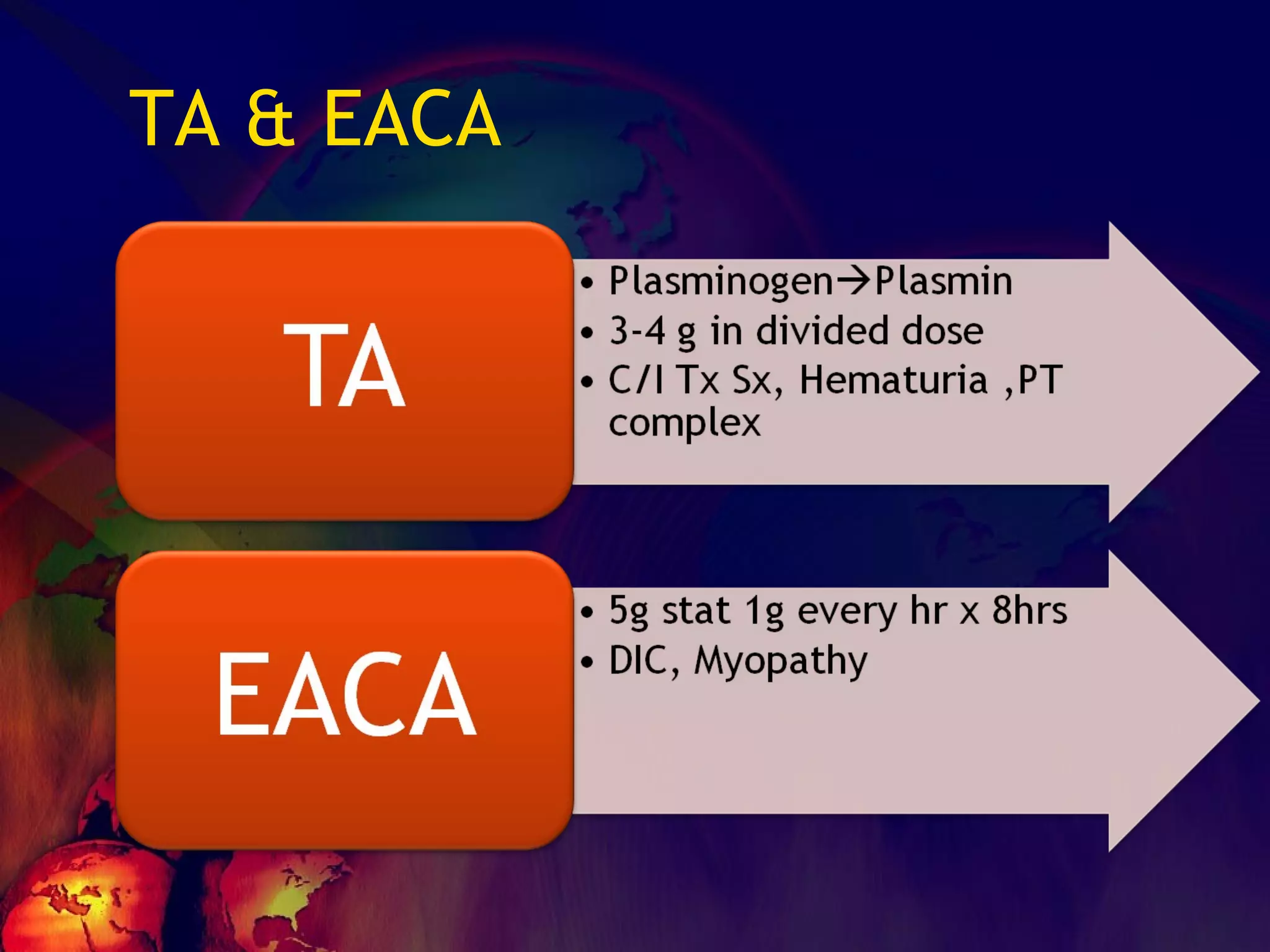
TA & EACA
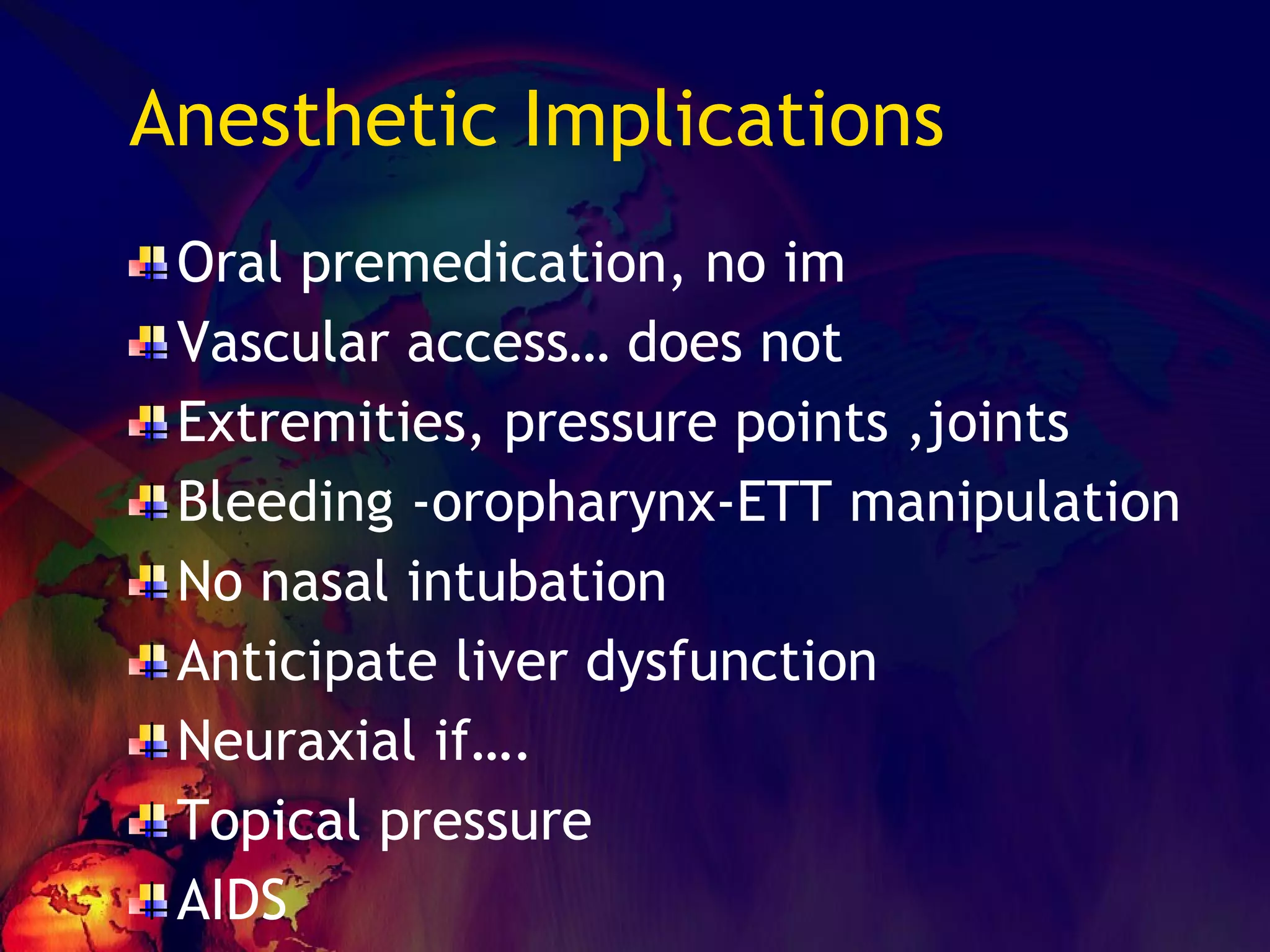
Anesthetic Implications  Oral premedication, no im Vascular access… does not Extremities, pressure points ,joints Bleeding -oropharynx-ETT manipulation No nasal intubation Anticipate liver dysfunction Neuraxial if…. Topical pressure AIDS
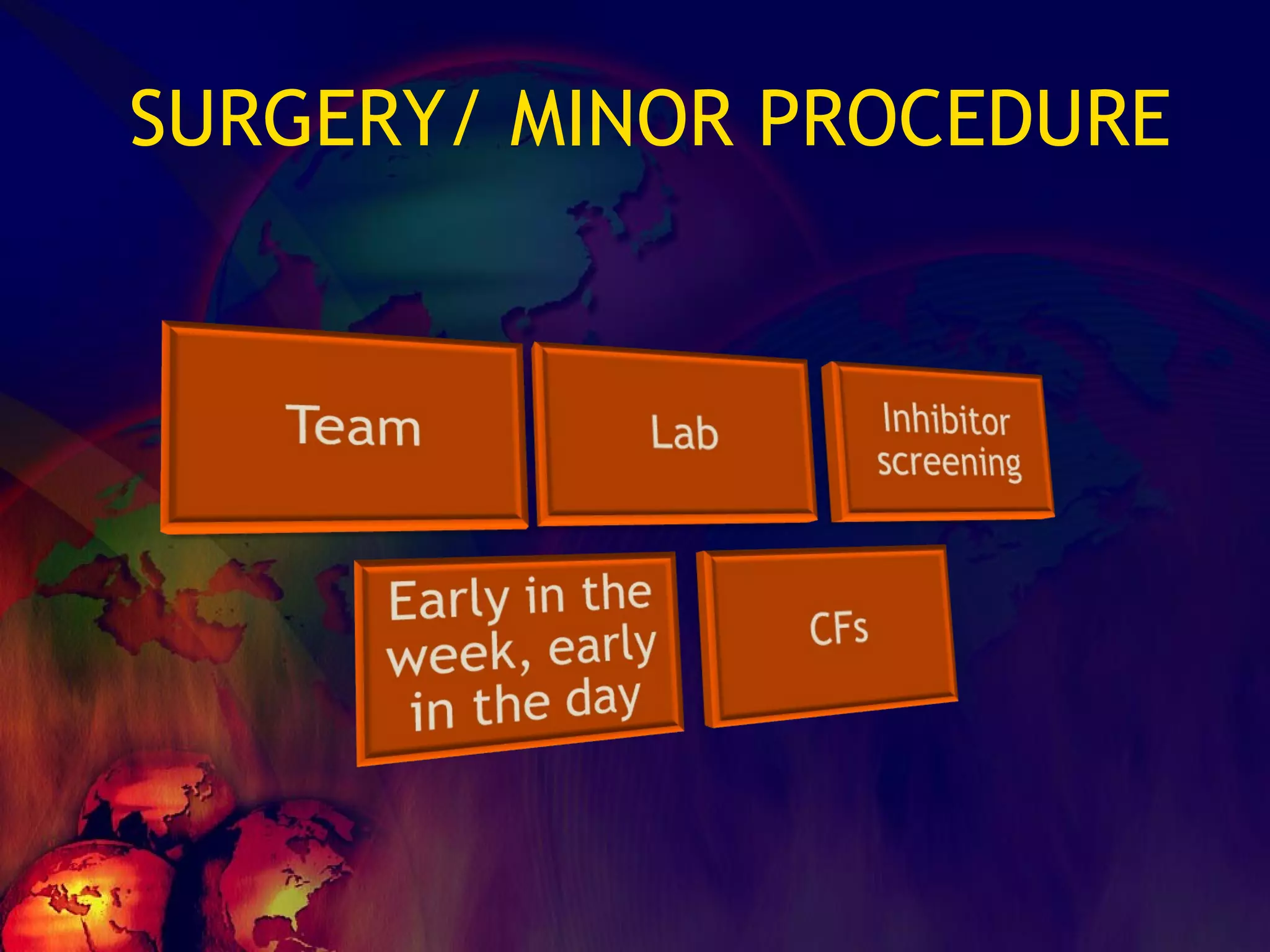
SURGERY/ MINOR PROCEDURE
Good news….
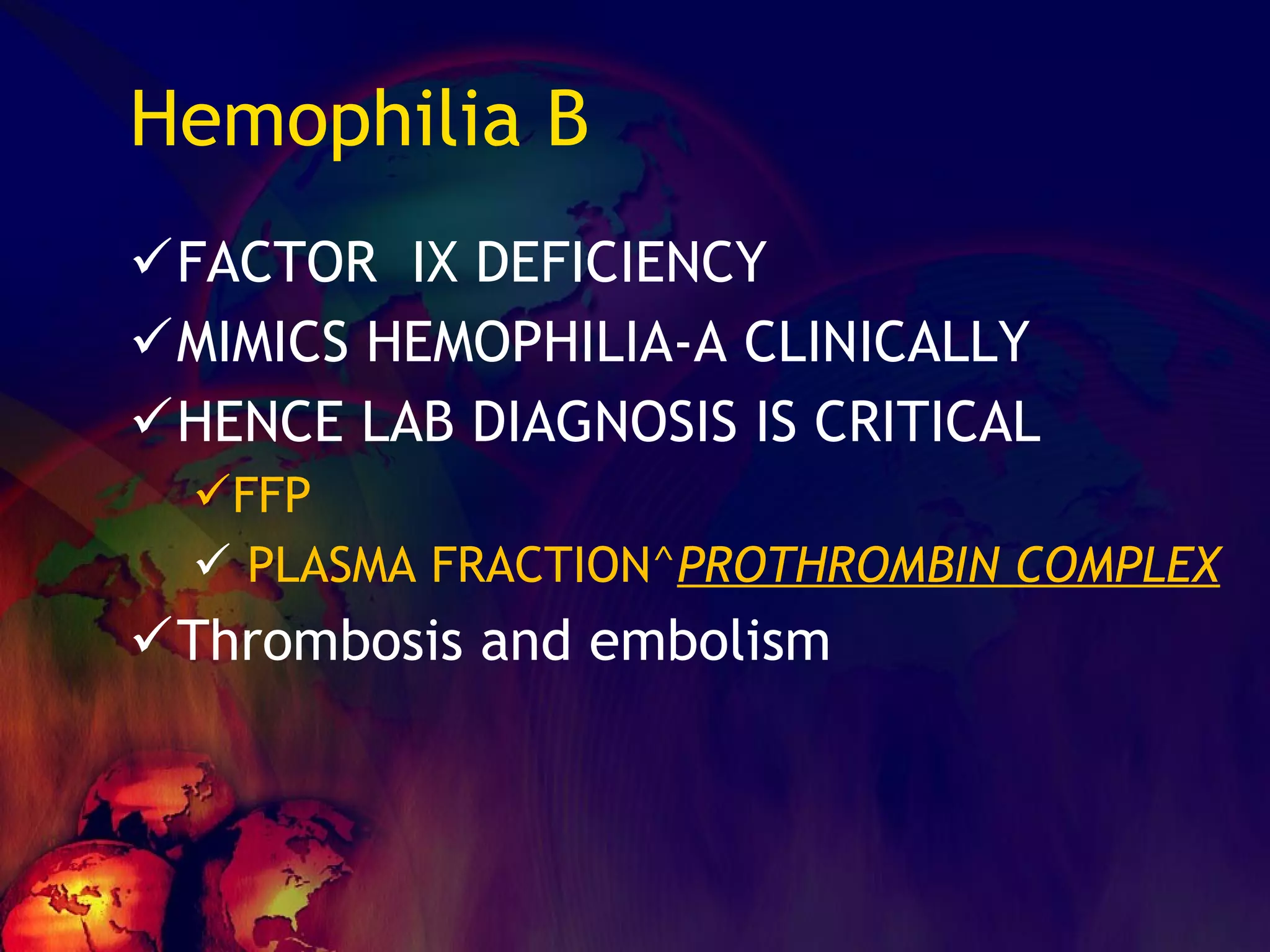
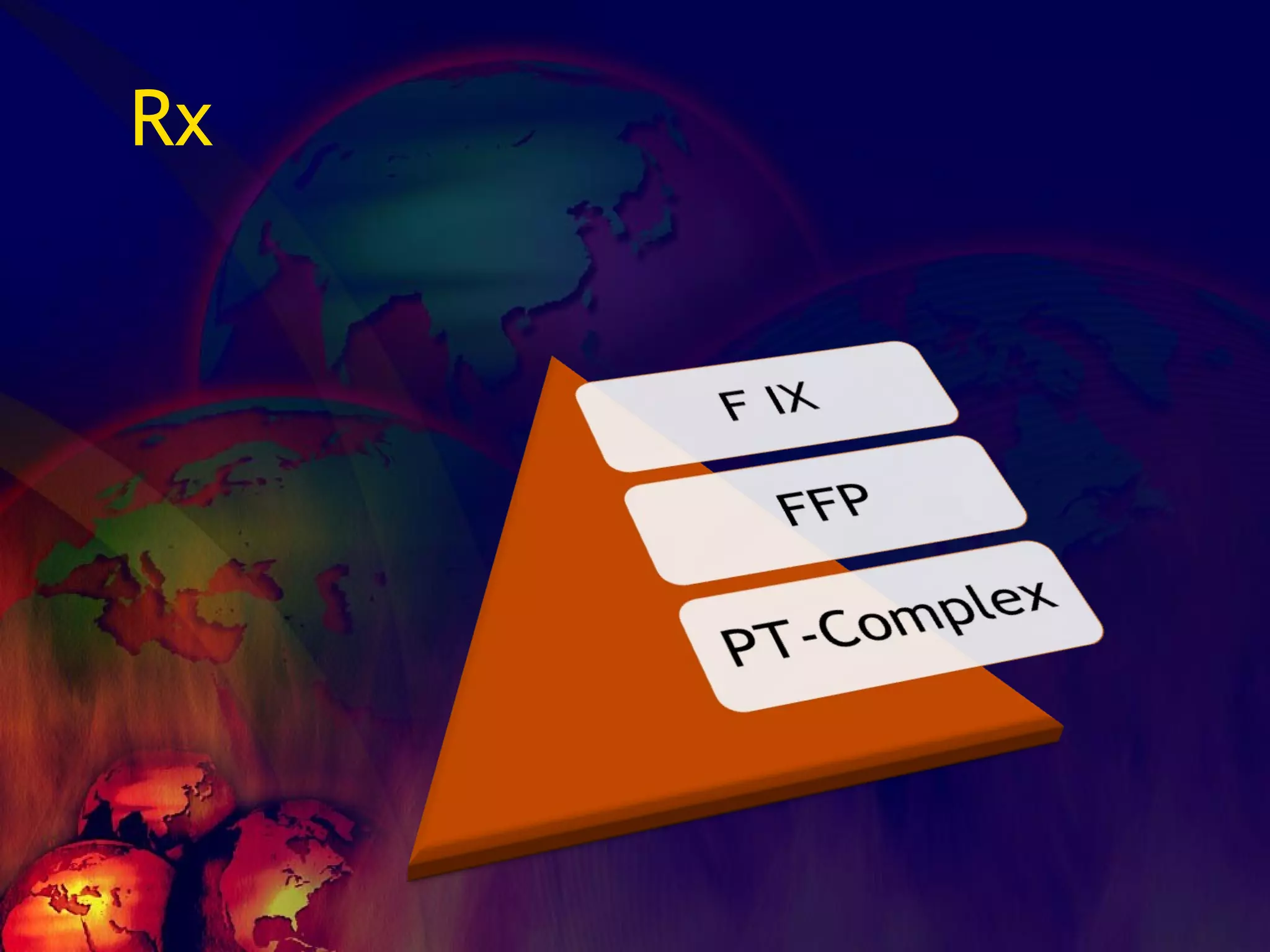
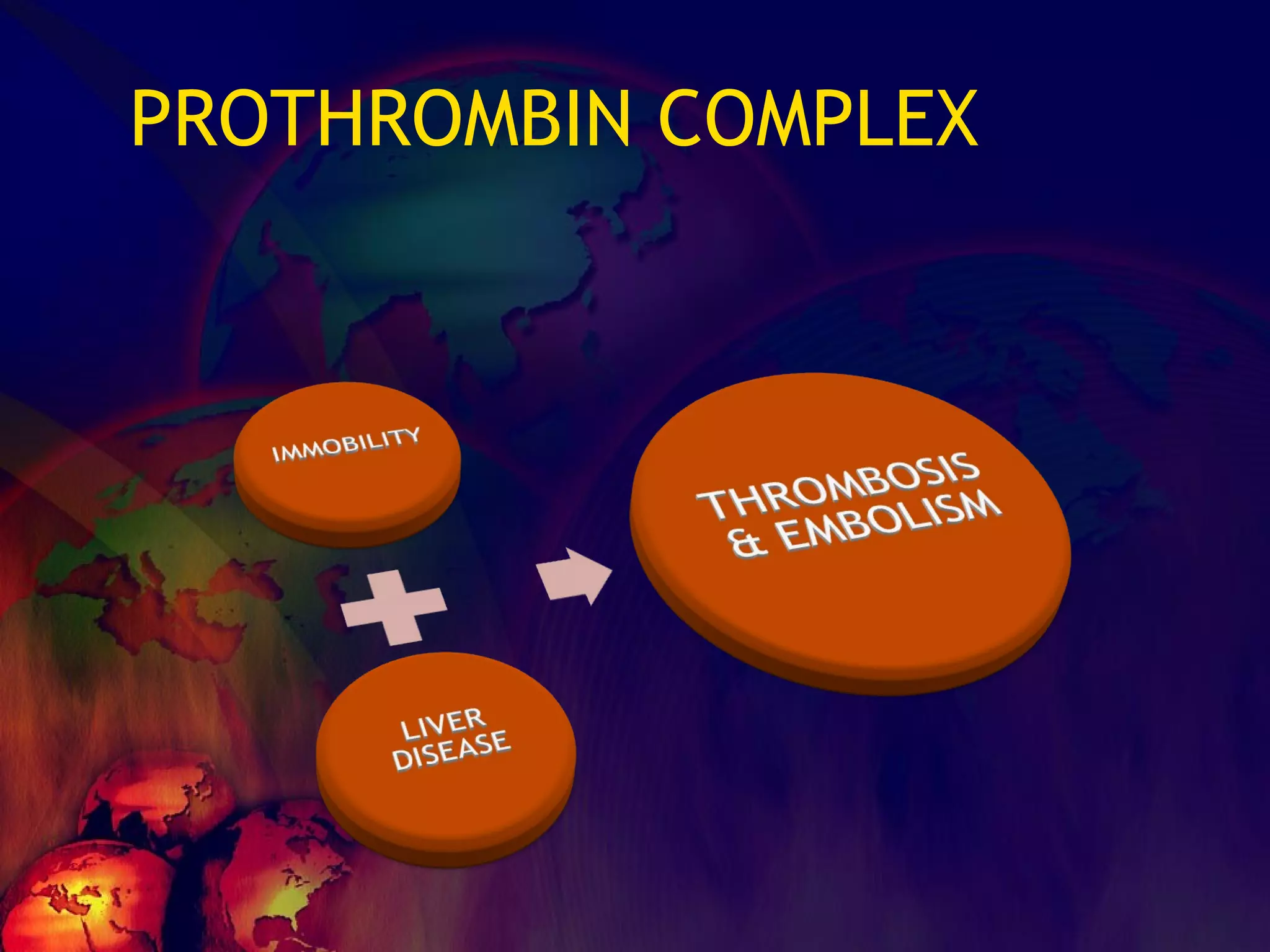
Hemophilia B FACTOR  IX DEFICIENCY MIMICS HEMOPHILIA-A CLINICALLY HENCE LAB DIAGNOSIS IS CRITICAL FFP  PLASMA FRACTION^ PROTHROMBIN COMPLEX Thrombosis and embolism
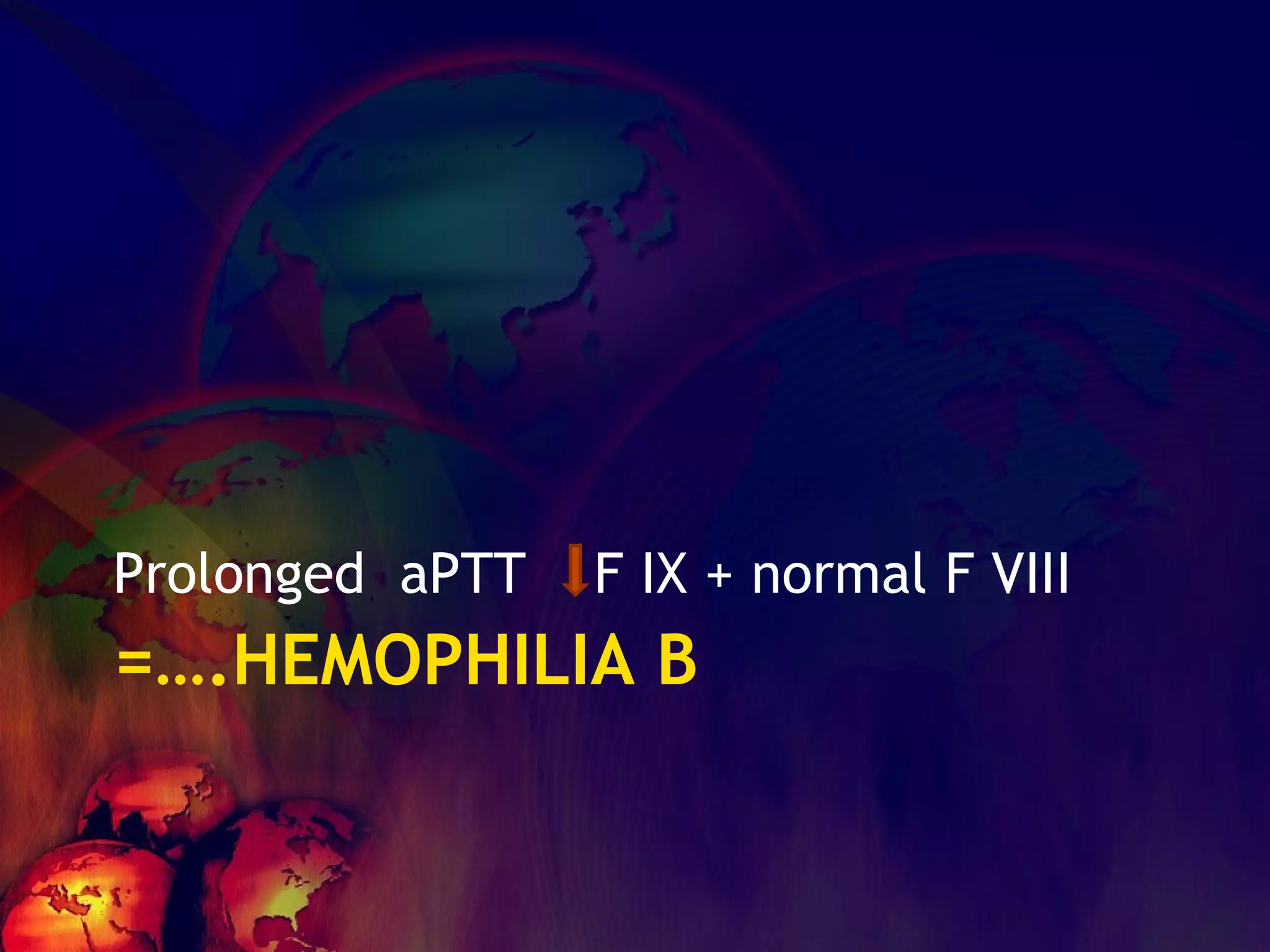
=….HEMOPHILIA B Prolonged  aPTT  F IX + normal F VIII
Rx
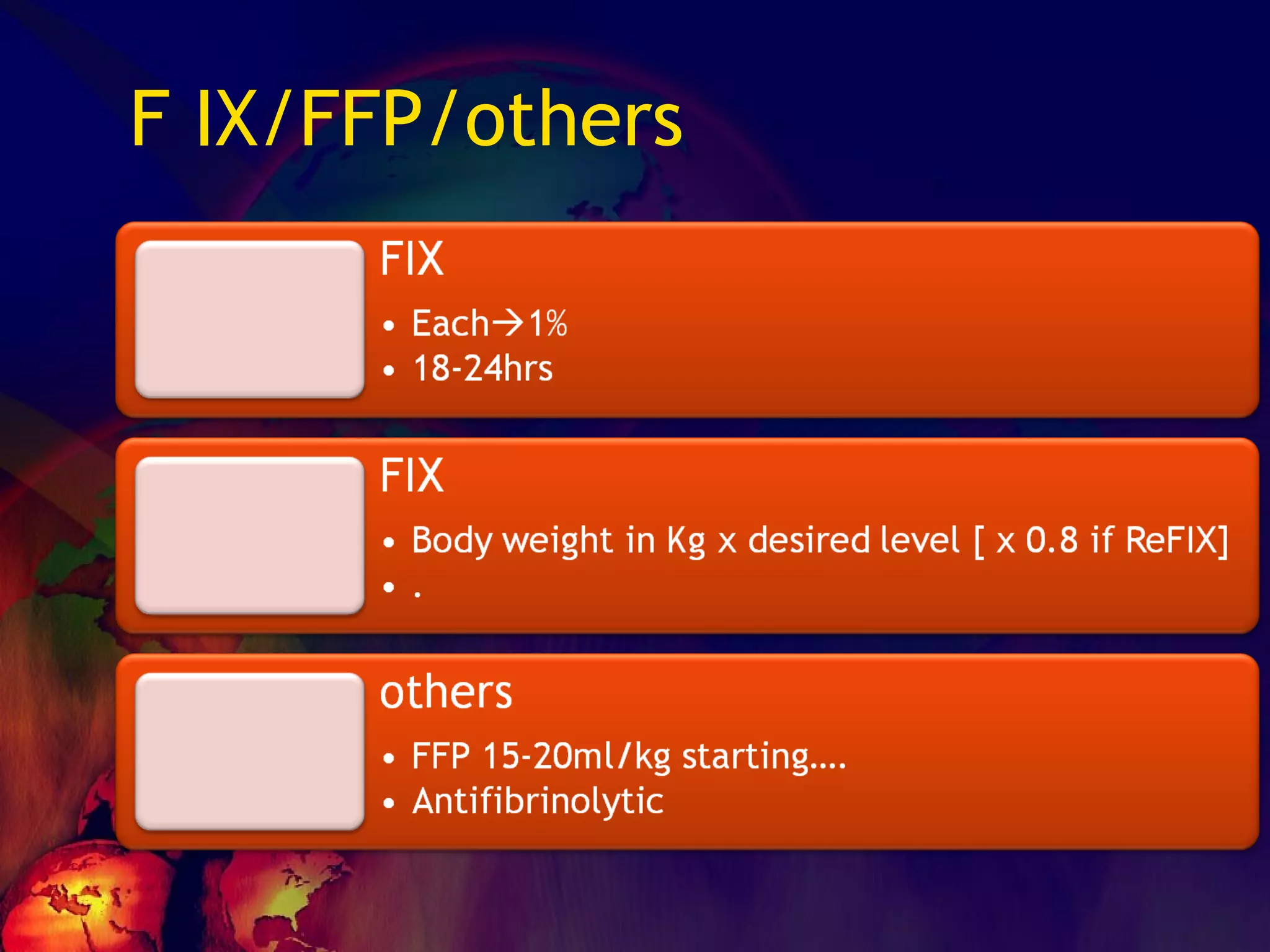
F IX/FFP/others
PROTHROMBIN COMPLEX
Any factor concentrate for exhausted audience..???
Who am I  ? Which is the most common inherited bleeding disorder? Bleeding only after surgery and minor trauma only…. BT prolonged + reduced plasma F VIII activity
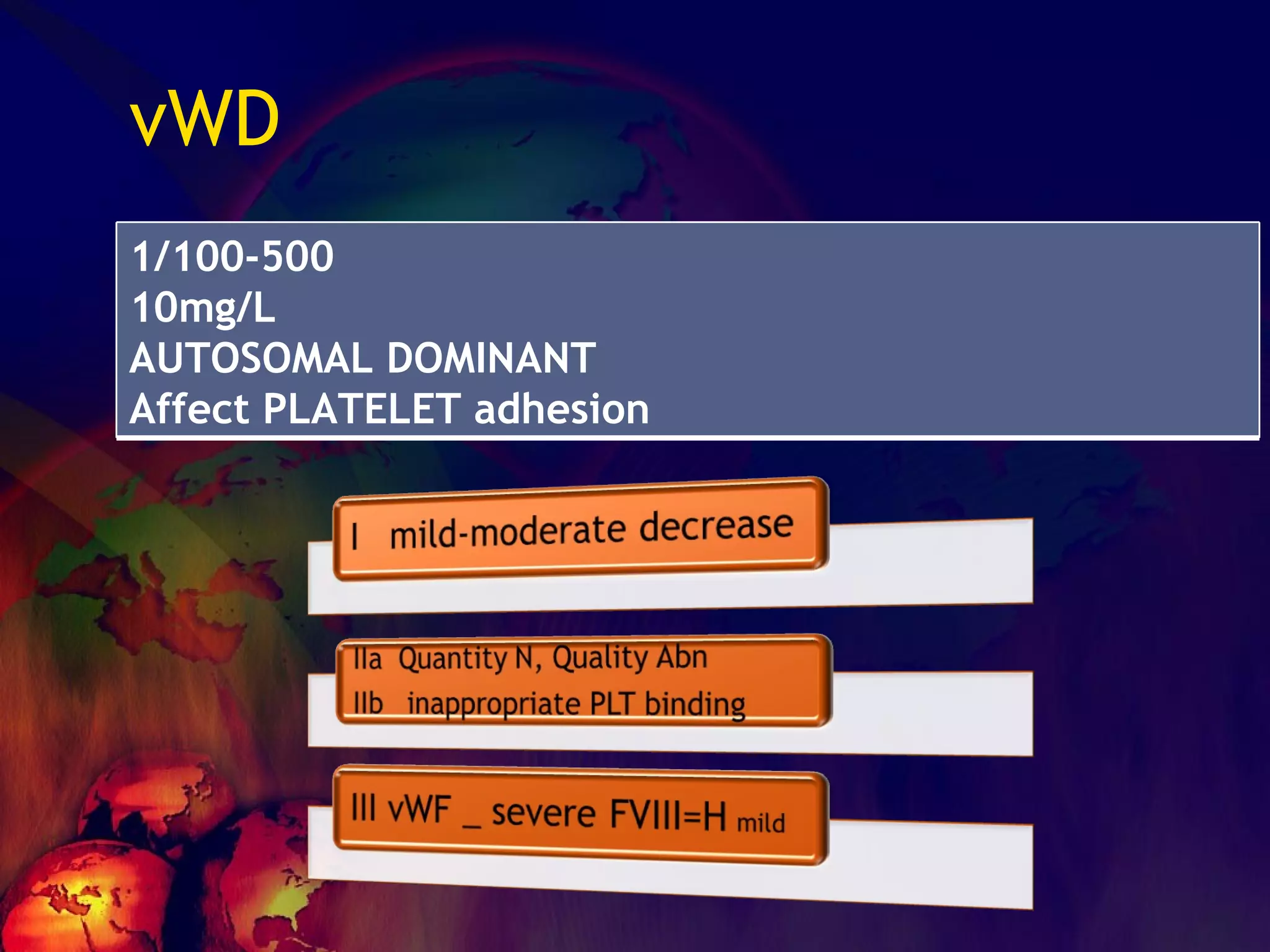
vWD 1/100-500 10mg/L AUTOSOMAL DOMINANT Affect PLATELET adhesion
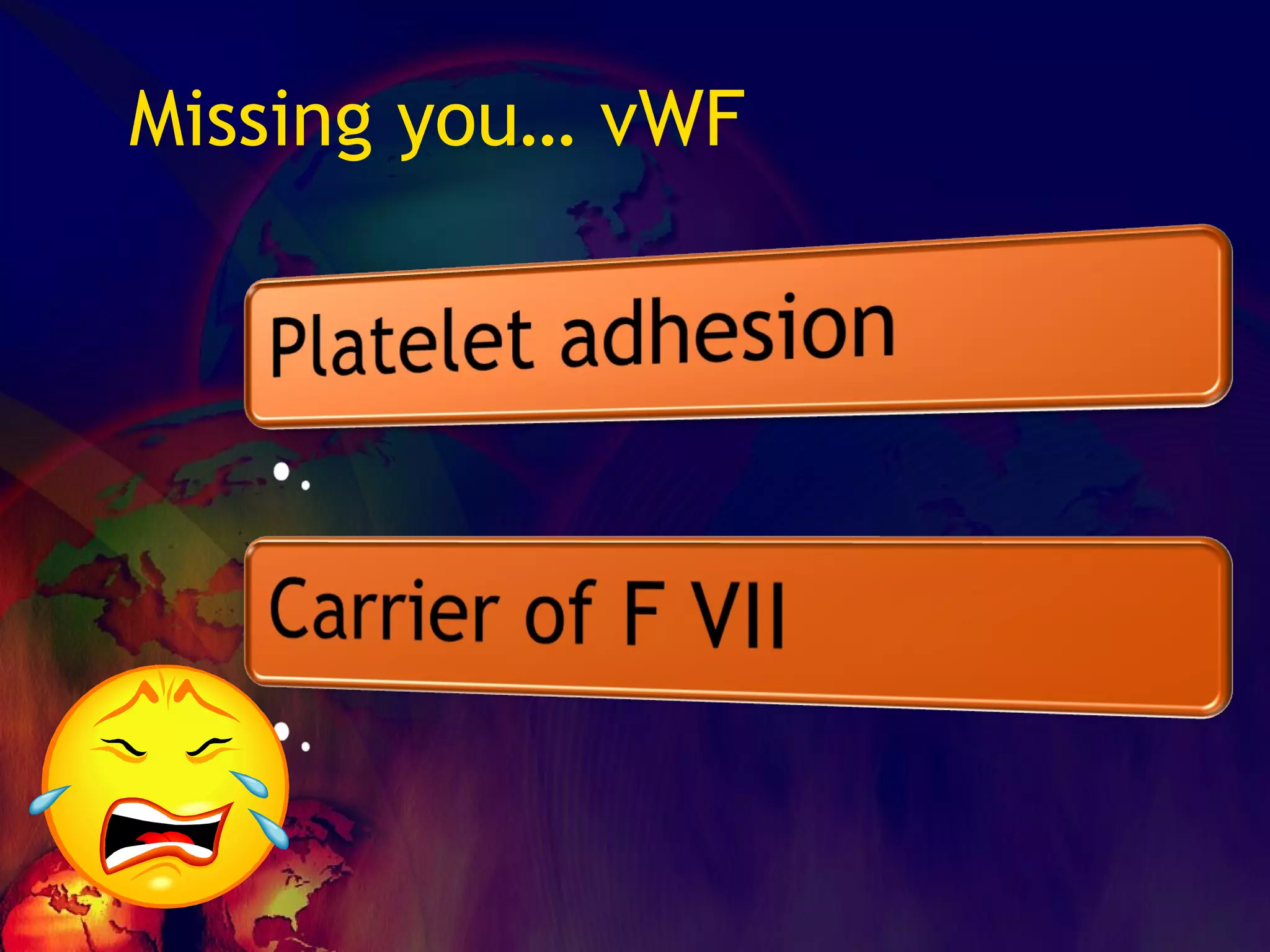
Missing you… vWF
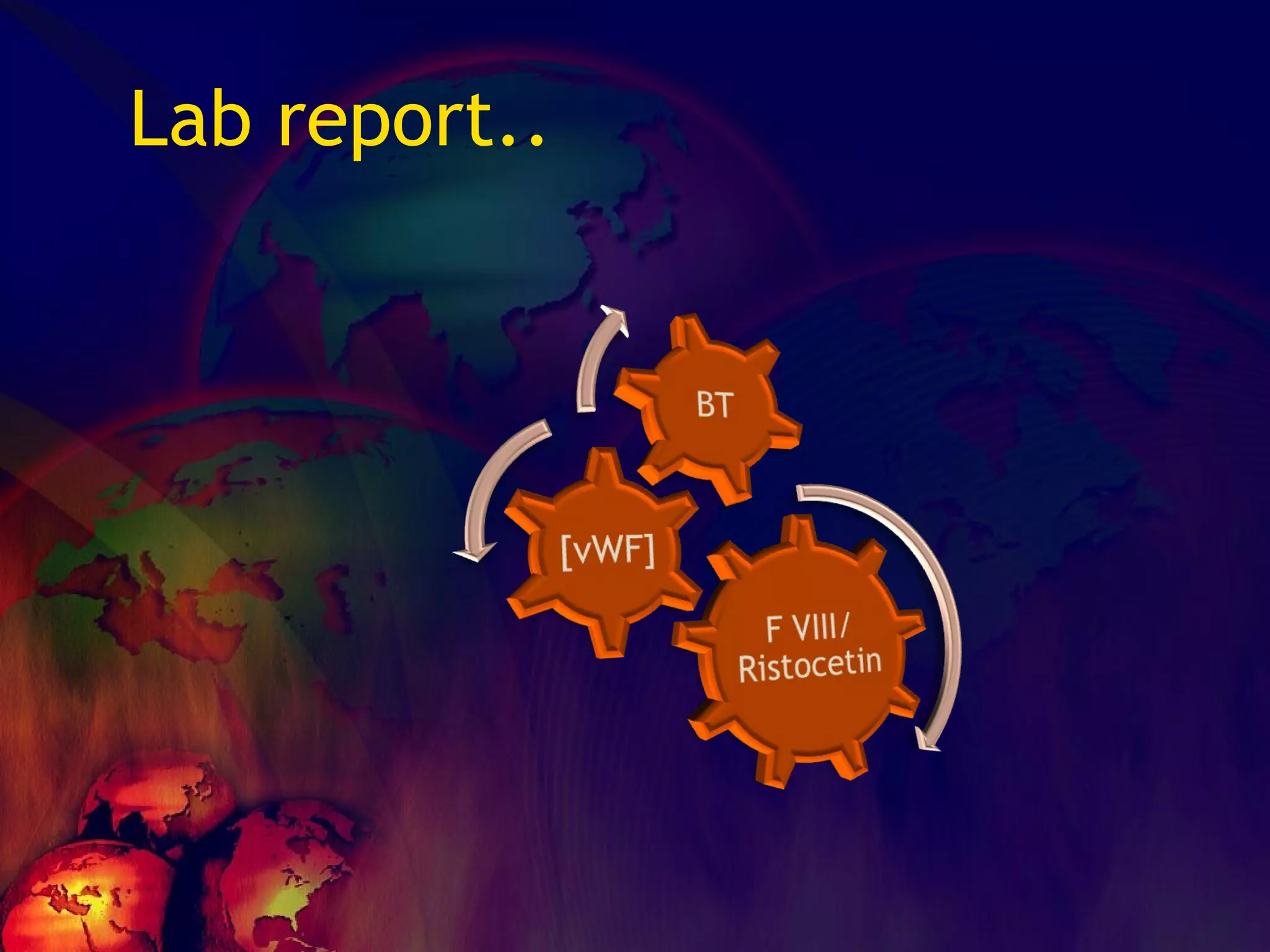
Lab report..
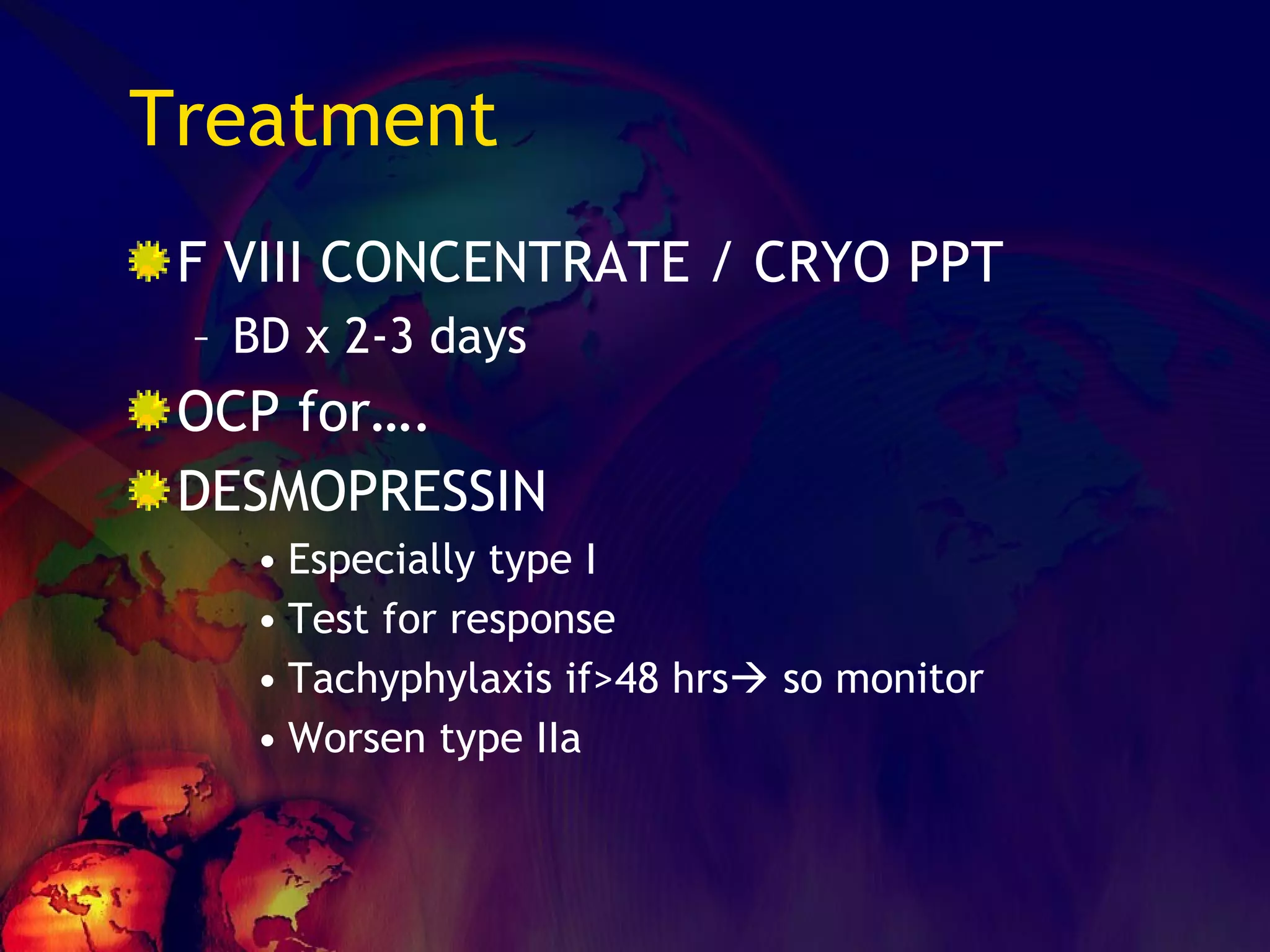
Treatment F VIII CONCENTRATE / CRYO PPT BD x 2-3 days OCP for…. DESMOPRESSIN Especially type I Test for response Tachyphylaxis if>48 hrs   so monitor Worsen type IIa
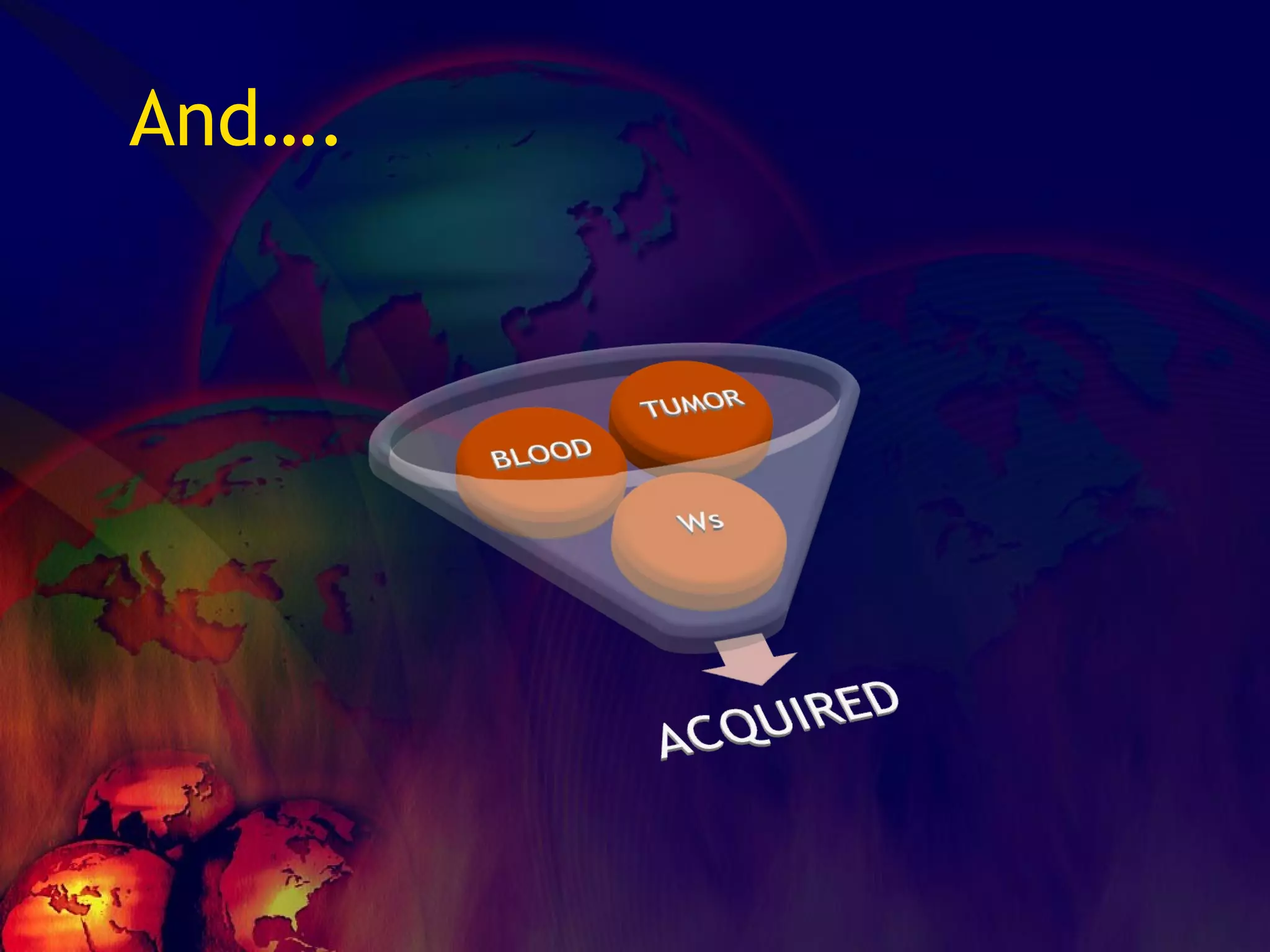
And….
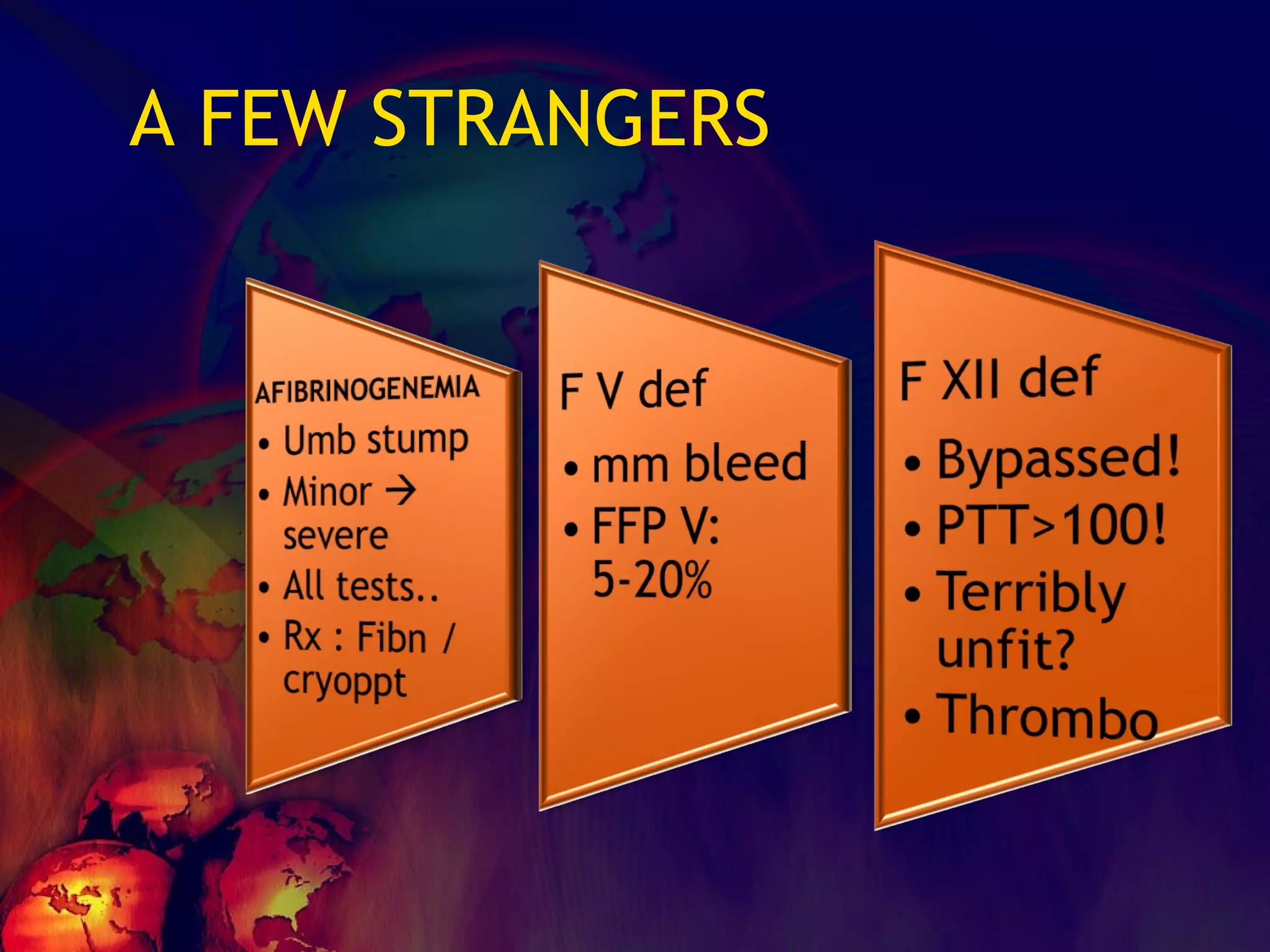
A FEW STRANGERS
… .
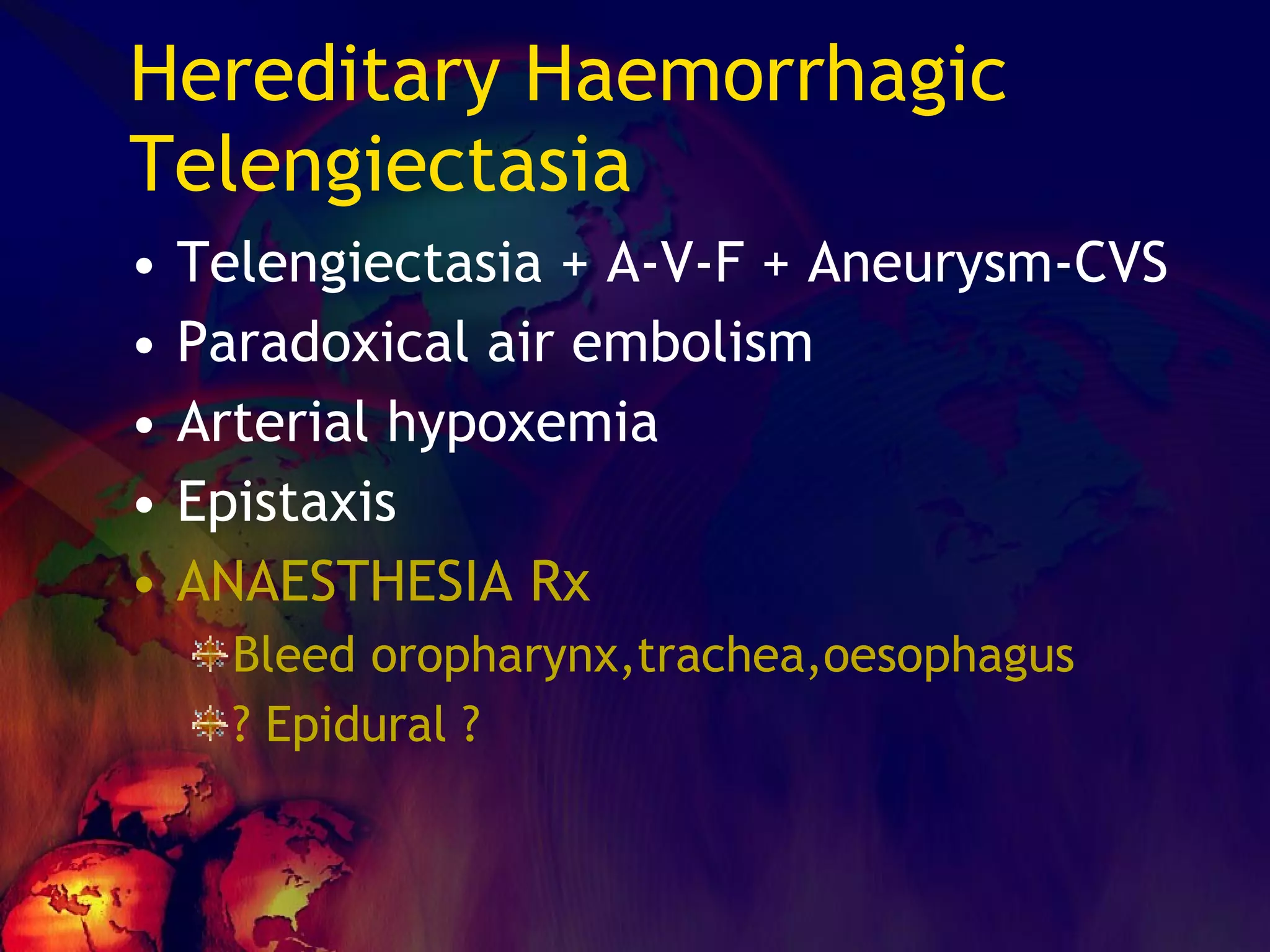
Hereditary Haemorrhagic Telengiectasia  Telengiectasia + A-V-F + Aneurysm-CVS Paradoxical air embolism Arterial hypoxemia Epistaxis ANAESTHESIA Rx Bleed oropharynx,trachea,oesophagus ? Epidural ?
Hereditary thrombocytopenia
Can our routine tests detect a fibrinolytic defect? Bleeding tendency+++ But all tests normal E.g. Alpha 2 antiplasmin deficiency Rx - EACA
HYPERCOAGULABLE STATES PRO-PROCOAGULANT state!! Focal Don’t predispose to arterial thrombus
What’s it? Useless Heparin!!! Govt supply?? Very energetic F II & F V! DIC ,Liver  disease, heparin Rx OCPs ? Hmm.. No. Rx :AT III [A/C] Oral Anti coagulants [C/C]
Protein C Deficiency F V , F VIII Acquired def seen in… Life threatening complications Be suspicious.. Regional Vs GA , oral anticoagulants
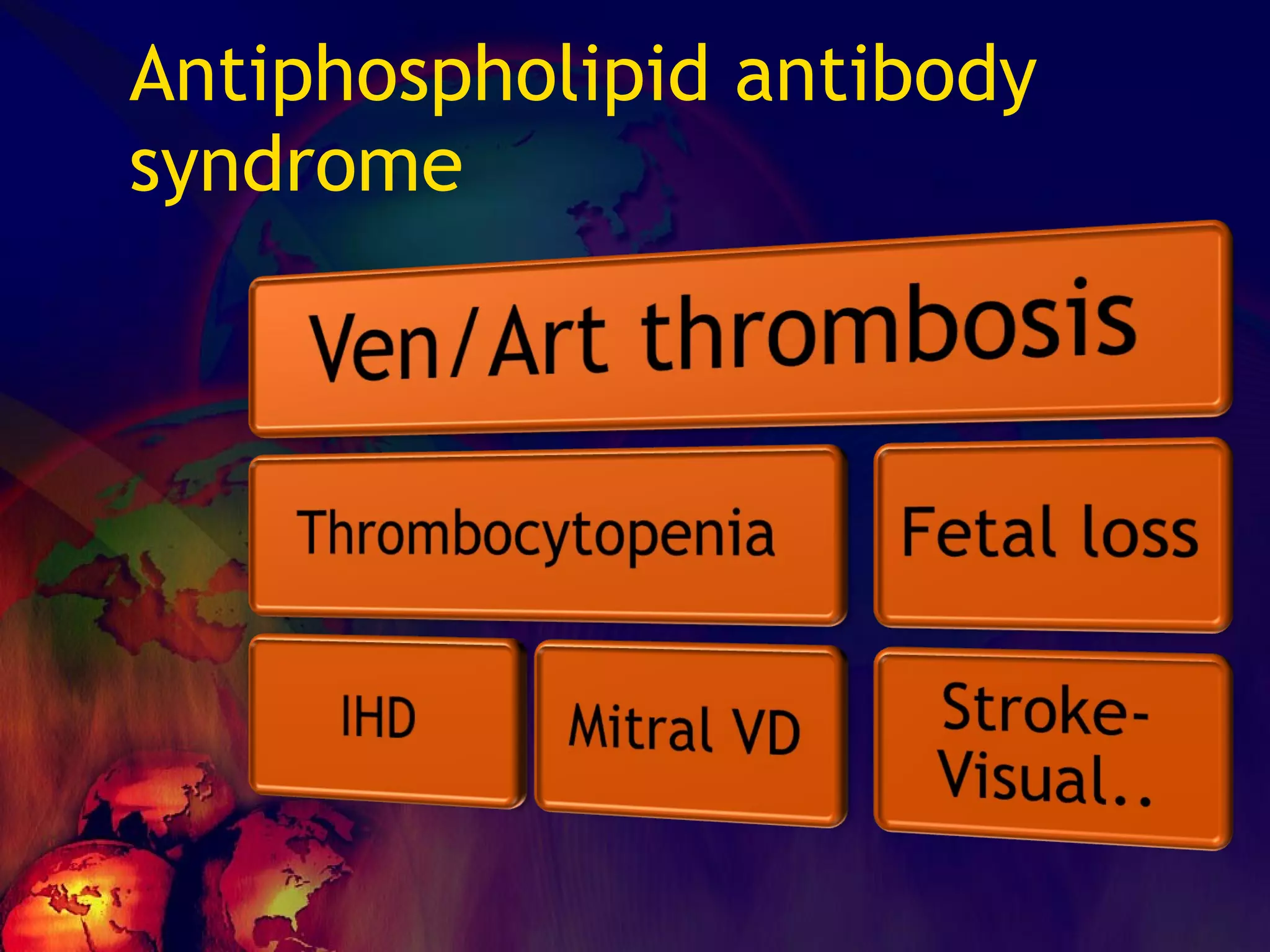
Antiphospholipid antibody syndrome
Strategy ?? Anesthesia ? Thrombosis- prophylaxis Cardiac Sx
THANK YOU
No thanks …………..?%#
References Anesthesia and Coexisting disease 4 th  e , STOELTING MILLER’S ANAESTHESIA ,6th e HARRISONS Principles of Internal Medicine,16 th  e A Practice of Anesthesia  ,Wylie  and Churchill Davidson Clinical Anesthesiology, G Edward Morgan Pathologic Basis of Disease, Kumar, Kotran and Robbins Review of Medical Physiology,GANONG,22 nd  e
… World Federation of Hemophilia Guidelines AnesthesiaUK.org bja.oxfordjournals.org National hemophilia foundation, Educational Tools The Internet Journal of Anesthesiology

Coagulation Disorders and Anesthesia-Basic pathophysiology

  • 1.
    COAGULATION DISORDERSAND ANAESTHESIA PRESENTERS: DR UNNIKRISHNAN P DR SUNEESH THILAK CO-ORDINATOR DR C MADHUSOODHANAN PILLAI MODERATORS: DR GEETHA N K DR ASHA K S
  • 2.
    What is normalhemostasis? Clot at the spot…. Not elsewhere…!
  • 3.
  • 4.
    Components: vascular Intactendothelium: Non-thrombogenic (-) (-)
  • 5.
    Components: vascular Endothelialdamage: (+) (+) Stress hormones Trauma Surgery Plaque rupture Inflammation… Exposes collagen Exposes TF
  • 6.
    The first event…..VASOSPASM neurogenic humoral …… but can’t rely on it fully.
  • 7.
  • 8.
    So the wellequipped guy comes PLATELETS They have receptors They provide a phospholipid surface… They contain granules Dense - serotonin , ADP , Ca++ Alpha - coagulation factors , vWF , PDGF
  • 9.
    Components: platelets Adhesion Activation Aggregation Secretion Procoagulant activity
  • 10.
    Endothelial damage: Plateletplug formation Endothelial damage  exposure to collagen: Promotes platelet adherence and activation Activated platelets secrete ADP and TxA 2 ADP  promotes platelet recruitment TxA 2  promotes platelet aggregation Result : formation of platelet plug (white clot)
  • 11.
    No one canhide the insults from them…… ADHESION – [vWF] SECRETION-[TxA2,ADP] AGGREGATION Leads to PRIMARY HEMOSTASIS
  • 12.
  • 13.
    Leads to…. PRIMARY HEMOSTASIS Occurs within SECONDS
  • 14.
    The balancingact PG E2 PG I2 NO …….. all these oppose TxA2 & ADP
  • 15.
    In need of….FIBRIN The linking of platelets in the primary plug, by fibrin, converts it into a definitive clot. This requires the participation of the Coagulation Cascade. This process is known as SECONDARY HEMOSTASIS
  • 16.
    Prompt………. But finelycontrolled Precursor Zymogens Active Enzyme Rapid response Finely regulated Negative feedback loops Decrease in substrate Inhibitors Quiescent endothelium
  • 17.
    For example… PLxii------>xii a Ca
  • 18.
  • 19.
    Components: coagulation pathwaysExtrinsic (TF) Intrinsic Initiation Amplification Thrombin Pivotal point of coagulation
  • 20.
    Thrombin generation: the pivotal point of the coagulation process Thrombin actions: Activates FXI, amplifying thrombin generation Converts fibrinogen to fibrin Activates FXIII Activates platelets Result: RED CLOT Thrombin generation to fibrin-platelet clot formation
  • 21.
    Cascade vs. cell-basedmodel Cell-based model Hemostasis represented as: Occurring on two cell surfaces Tissue factor bearing cells Platelets Three overlapping phases: Initiation (TF bearing cells) Amplification (platelets) Propagation (platelets) The coagulation cascades are still important, but are cell-based The extrinsic pathway works on the surface of the tissue factor bearing cells The intrinsic pathway works on the surface of platelets Routine coagulation tests do not represent the cell-based model of hemostasis. Tissue factor bearing cells 1. Initiation Platelets Activated platelets 2. Amplification 3. Propagation IIa IIa
  • 22.
    Cellular components PlateletsEndothelium Monocytes Erythrocytes
  • 23.
    Molecular components Coagulationfactors and inhibitors Fibrinolytic factors and inhibitors Adhesive proteins Calcium Immunoglobulins PL PG Cytokines
  • 24.
    Current model ofhemostasis
  • 25.
    Normal Hemostasis Hoffmanet al. Blood Coagul Fibrinolysis 1998;9(suppl 1):S61 . X II II X IX TF-Bearing Cell Activated Platelet Platelet TF VIIIa Va VIIIa Va Va VIIa TF VIIa Xa IIa IX V Va II VIII /vWF VIIIa IXa X IXa IXa VIIa Xa IIa IIa Xa
  • 26.
    XII  XIIa VIIIa  VIII XI  XIa VIIa-TF  VII-TF IXa IX V X Xa PT  Thrombin XIII  XIIIa Fibrinogen  Fibrin Stable Fn
  • 27.
    Endothelial damage: Initiationof thrombin generation Endothelial damage Exposure to tissue factor Initiation of extrinsic pathway Initiate thrombin generation Activate FXI (intrinsic pathway) Amplify thrombin generation
  • 28.
    Soldiers….. I FIBRINOGEN II PROTHROMBIN III THROMBOPLASTIN/TISSUE FACTOR IV CALCIUM V PROACCELERIN/LABILE FACTOR VII PROCONVERTIN/STABLE FACTOR VIII ANTIHAEMOPHILIC FACTOR A IX ANTIHAEMOPHILIC FACTOR B X STUARTPROWER FACTOR XI ANTIHAEMOPHILIC FACTOR C / PTA XII HAEGEMAN FACTOR / GLASS FACTOR XIII FIBRIN STABILIZING FACTOR PREKALLIKREIN / FLETCHER FACTOR KALLIEKREIN PLATELET PHOSPHOLIPID … They work in concert to form a beautiful definitive clot!
  • 29.
  • 30.
    Clot: The endproduct of hemostasis
  • 31.
    The rebels…. ANTICLOTTINGMECHANISMS 1 LIMITING COAGULATION CASCADE 2 FIBRINOLYTIC SYSTEM
  • 32.
    Antithrombin iiiII VII IX X XI XII
  • 33.
    Protein C &Protein S VIIIa Va
  • 34.
  • 35.
    Two more… ProteinC & Protein S VIIIa Va TFPW- inhibitor Inhibits F VII-TF complex
  • 36.
    Fibrinolysis Plasmin isthe key component
  • 37.
  • 38.
  • 39.
    Cofactors VIII VIII Transglutaminase XIII
  • 40.
    VITAMIN-K dependent FactorsGamma carboxylation of these factors, after translation require Vit -k
  • 41.
    Question hour inAAC INFANCY SURGERIES FAMILY HISTORY DRUGS HORMONAL REPLACEMENT / OCP HISTORY OF BLEEDING IN THE PAST
  • 42.
    What to lookfor…? PLATELET DISORDERS Superficial Comes immediately Local measures effective Petechiae, ecchymosis COAGULATION DEFECTS Deep s/c Muscle Joints Retroperitoneal Delayed Unaffected by local measures haematomas
  • 43.
    Surgery induces anincrease in.. TISSUE FACTOR PLASMINOGEN ACTIVATOR INHIBITOR vWF ..hyper coagulable hypofibrinolytic state
  • 44.
    These factors ariseconcern about the hemostasis Surgery Immobility Infection Ca Hypothermia Acidosis Volume expanders Extracorporeal circulation
  • 45.
  • 46.
    Feel.. There isno plan to stop Ohhh ..
  • 47.
    Monitoring hemostasis Cascadevs. cell-based model Cell-based model Whole blood tests that measure the interaction of platelets, coagulation factors, and other cellular or plasma factors present during clot formation are required to examine hemostasis in the cell-based model. The TEG is one such test. Cascade model Common coagulation tests (PT, aPTT, platelet counts) do not reflect the roles of cells or contributions of local vascular and tissue conditions Plasma-based assays miss the impact of platelets and platelet activation on thrombin generation. Plasma-based assays use static endpoints (e.g. fibrin formation) - miss impact of altered thrombin generation on platelet function and clot structure.
  • 48.
    BLEEDING TIME Plateletfunction 2-9.5 minutes Limitations Technique very important Interferances Skin Vs other sites
  • 49.
    Platelet count 1.5– 4.5 Lakhs/uL The grading of risk Idiot EDTA Coulter principle
  • 50.
    Prothrombin Time 11.1-13.1sec Extrinsic Recipe: plasma , Calcium and ThromboPlastin reagent
  • 51.
    Prothrombin Time IntrinsicPathway Extrinsic Pathway Common Pathway CLOT PT
  • 52.
    What is INR?The aim is standardization of PT values ISI expresses the sensitivity of the PT reagent of a particular lab to that of WHO reagent. Patient PT / mean normal PT [PT ratio]^ ISI
  • 53.
    Prolonged??? Think of….V VII X deficiency Coumarin Vit k def Liver DIC Heparin? II/PT def hypofibrinogenemia
  • 54.
    aPTT 22.1 –35.1 sec Intrinsic V,VIII,IX,X,XI and XII ?- Heparin Warfarin also Liver disease DIC
  • 55.
    Activated Partial ThromboplastinTime Intrinsic Pathway Extrinsic Pathway Common Pathway CLOT APTT
  • 56.
    Thrombin Time Late…Circulating heparin levels Hypofibrinogenemia Increased FDP 16 – 24 sec
  • 57.
    Thrombin Time IntrinsicPathway Extrinsic Pathway Common Pathway CLOT TT
  • 58.
    CLOTTABLE FIBRINOGEN CONCENTRATION150-400MG/dL Modification of TT
  • 59.
    Activated clotting time70 – 180 secs Vascular surgeries C-P bypass HD Cardiac catheterisation Prolonged??
  • 60.
    Activated Clotting TimeIntrinsic Pathway Extrinsic Pathway Common Pathway CLOT ACT
  • 61.
    Thromboelastography Viscoelastic propertiesBlood product transfusion according to need.
  • 62.
    The TEG® SystemCELITE activated 0.36ml blood Cuvette Piston 4.5* Cuvette oscillates , piston free Cuvette Clot Piston Plot of piston Stronger clot  THICK TEG Weaker clot  NARROW TEG
  • 63.
  • 64.
  • 65.
  • 66.
  • 67.
    PLOT R= 6-8 mins K =10-12 mins Alpha angle = >50* MA = 50-70 mm A 60 F = >300 mins
  • 68.
  • 69.
    TEG analysis andclinical outcomes Detects hemorrhagic and prothrombotic states Reduces blood product usage, re-operations, hospital stays Provides guidance for proper therapy Monitors level of platelet inhibition Provides guidance for personalized drug therapies Improves clinical outcomes Lowers costs
  • 70.
    ???? The TEGcan distinguish between surgical bleeding and bleeding due to a coagulopathy. True or False? Next
  • 71.
    Platelet function analyzersPFA-100 MEDTRONIC HEMOSTATUS
  • 72.
  • 73.
    DISORDERS OF COAGULATIONINHERITED DISORDERS
  • 74.
  • 75.
    What is Hemophilia?Hemophilia is an inherited bleeding disorder in which there is a deficiency or lack of factor VIII (hemophilia A) or factor IX (hemophilia B)
  • 76.
    Degrees of Severityof Hemophilia Normal factor VIII or IX level = 50-150% Mild hemophilia factor VIII or IX level = 6-50% Moderate hemophilia factor VIII or IX level = 1-5% Severe hemophilia factor VIII or IX level = <1%
  • 77.
  • 78.
    Types of BleedsJoint bleeding - hemarthrosis Muscle hemorrhage Soft tissue Life threatening-bleeding Other
  • 79.
    Life-Threatening Bleeding Head/ Intracranial Nausea, vomiting, headache, drowsiness, confusion, visual changes, loss of consciousness Neck and Throat Pain, swelling, difficulty breathing/swallowing Abdominal / GI Pain, tenderness, swelling, blood in the stools Iliopsoas Muscle Back pain, abdominal pain, thigh tingling/numbness, decreased hip range of motion
  • 80.
  • 81.
  • 82.
    Do we botherabout carriers?
  • 83.
    Investigations… Prolonged PTT with normal Platelet count, BT and PT supports the diagnosis F VIII assay confirms the diagnosis and allows differentiation from…..?
  • 84.
  • 85.
    8 8 88 8 8 8 8 8 8 8 8 8 8 8 8 8 T ½ : 8-12h VIALS: 250-2000 units Each unit of FVIII/Kg infused:2% increase “ levels should be restored to 40% of normal before surgery.. So initial dose.. Wt in Kg X desired level X 0.5 E.g. 50 kg x 40% x 0.5 = 1000 U 3 ml/min adults, 100 u/min child
  • 86.
  • 87.
  • 88.
  • 89.
    Recommendations SOFTTISUE BLEED- 15 TO 20 % HEMARTHROSIS/RETROPERITONEAL-25-50% x72h MAJOR Sx/ LIFE THREATENING BLEED- 50% x2 wk
  • 90.
  • 91.
  • 92.
  • 93.
  • 94.
    These should bekept in mind..
  • 95.
    Iron deficiency anemia???? The money drains in to the hands of bank officials itself…! … .and what about prophylaxis?
  • 96.
  • 97.
  • 98.
  • 99.
  • 100.
    Anesthetic Implications Oral premedication, no im Vascular access… does not Extremities, pressure points ,joints Bleeding -oropharynx-ETT manipulation No nasal intubation Anticipate liver dysfunction Neuraxial if…. Topical pressure AIDS
  • 101.
  • 102.
  • 103.
    Hemophilia B FACTOR IX DEFICIENCY MIMICS HEMOPHILIA-A CLINICALLY HENCE LAB DIAGNOSIS IS CRITICAL FFP PLASMA FRACTION^ PROTHROMBIN COMPLEX Thrombosis and embolism
  • 104.
    =….HEMOPHILIA B Prolonged aPTT F IX + normal F VIII
  • 105.
  • 106.
  • 107.
  • 108.
    Any factor concentratefor exhausted audience..???
  • 109.
    Who am I ? Which is the most common inherited bleeding disorder? Bleeding only after surgery and minor trauma only…. BT prolonged + reduced plasma F VIII activity
  • 110.
    vWD 1/100-500 10mg/LAUTOSOMAL DOMINANT Affect PLATELET adhesion
  • 111.
  • 112.
  • 113.
    Treatment F VIIICONCENTRATE / CRYO PPT BD x 2-3 days OCP for…. DESMOPRESSIN Especially type I Test for response Tachyphylaxis if>48 hrs  so monitor Worsen type IIa
  • 114.
  • 115.
  • 116.
  • 117.
    Hereditary Haemorrhagic Telengiectasia Telengiectasia + A-V-F + Aneurysm-CVS Paradoxical air embolism Arterial hypoxemia Epistaxis ANAESTHESIA Rx Bleed oropharynx,trachea,oesophagus ? Epidural ?
  • 118.
  • 119.
    Can our routinetests detect a fibrinolytic defect? Bleeding tendency+++ But all tests normal E.g. Alpha 2 antiplasmin deficiency Rx - EACA
  • 120.
    HYPERCOAGULABLE STATES PRO-PROCOAGULANTstate!! Focal Don’t predispose to arterial thrombus
  • 121.
    What’s it? UselessHeparin!!! Govt supply?? Very energetic F II & F V! DIC ,Liver disease, heparin Rx OCPs ? Hmm.. No. Rx :AT III [A/C] Oral Anti coagulants [C/C]
  • 122.
    Protein C DeficiencyF V , F VIII Acquired def seen in… Life threatening complications Be suspicious.. Regional Vs GA , oral anticoagulants
  • 123.
  • 124.
    Strategy ?? Anesthesia? Thrombosis- prophylaxis Cardiac Sx
  • 125.
  • 126.
  • 127.
    References Anesthesia andCoexisting disease 4 th e , STOELTING MILLER’S ANAESTHESIA ,6th e HARRISONS Principles of Internal Medicine,16 th e A Practice of Anesthesia ,Wylie and Churchill Davidson Clinical Anesthesiology, G Edward Morgan Pathologic Basis of Disease, Kumar, Kotran and Robbins Review of Medical Physiology,GANONG,22 nd e
  • 128.
    … World Federationof Hemophilia Guidelines AnesthesiaUK.org bja.oxfordjournals.org National hemophilia foundation, Educational Tools The Internet Journal of Anesthesiology