Coaching to Improve Teaching and Learning July 19, 2007 Stephen G. Barkley Performance Learning Systems 888.424.9700 [email_address]
Quality pg 10 “While quality is difficult to define precisely, it almost always includes  caring  for each other, is always  useful , has always involved  hard work  on someone’s part and when we are involved with it as either a provider or a receiver, it always  feels good.  Because it feels so good, I believe all of us carry in our heads a clear idea of what quality is for ourselves.” William Glaser, M.D. Education Week, May 13, 1992
Coaching Beliefs page 18 1) Everyone working in the  school should be observed once a  week and receive feedback.  2) The most skilled and professional  educators should be coached the most.
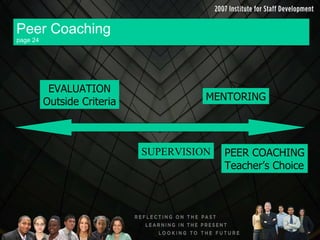
Peer Coaching page 24 EVALUATION Outside Criteria MENTORING PEER COACHING Teacher’s Choice SUPERVISION
page 14 Practice Consciously Gain Options Celebrate
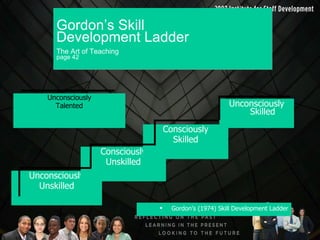
Gordon’s Skill Development Ladder The Art of Teaching page 42 Unconsciously Talented Unconsciously Unskilled Consciously Unskilled Consciously Skilled Unconsciously Skilled Gordon’s (1974) Skill Development Ladder
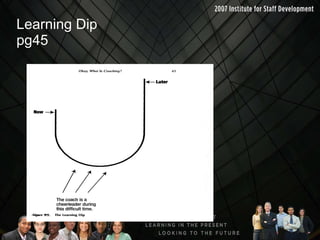
Learning Dip pg45
Teacher Relationships Parallel Play Adversarial Relationships Congenial Relationships Collegial Relationships Roland S. Barth Relationships Within the Schoolhouse ASCD 2006
 
LIST QUESTIONS YOU USUALLY ASK IN PREOBSERVATION CONFERENCES
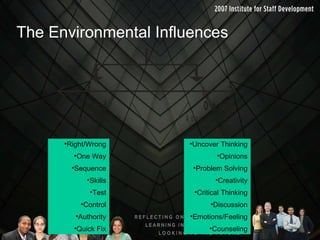
The Environment Influences page 57
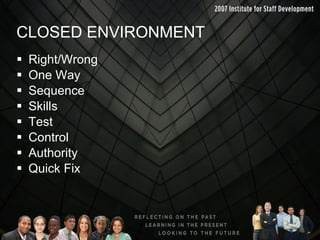
CLOSED ENVIRONMENT Right/Wrong One Way Sequence Skills Test Control Authority Quick Fix
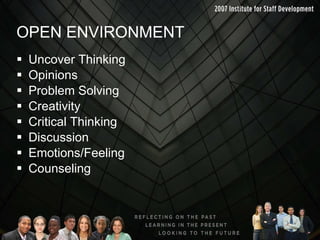
OPEN ENVIRONMENT Uncover Thinking Opinions Problem Solving Creativity Critical Thinking Discussion Emotions/Feeling Counseling
The Environmental Influences Right/Wrong One Way Sequence Skills Test Control Authority Quick Fix Uncover Thinking Opinions Problem Solving Creativity Critical Thinking Discussion Emotions/Feeling Counseling
 
LISTENING TEST page 93 You believe that . . . . . . . . . . .  My focus is . . . . . . . . . . . . . . . I should notice . . . . . . . . . . . . .

Coaching to improve teaching and learning

  • 1.
  • 2.
    Coaching to ImproveTeaching and Learning July 19, 2007 Stephen G. Barkley Performance Learning Systems 888.424.9700 [email_address]
  • 3.
    Quality pg 10“While quality is difficult to define precisely, it almost always includes caring for each other, is always useful , has always involved hard work on someone’s part and when we are involved with it as either a provider or a receiver, it always feels good. Because it feels so good, I believe all of us carry in our heads a clear idea of what quality is for ourselves.” William Glaser, M.D. Education Week, May 13, 1992
  • 4.
    Coaching Beliefs page18 1) Everyone working in the school should be observed once a week and receive feedback. 2) The most skilled and professional educators should be coached the most.
  • 5.
    Peer Coaching page24 EVALUATION Outside Criteria MENTORING PEER COACHING Teacher’s Choice SUPERVISION
  • 6.
    page 14 PracticeConsciously Gain Options Celebrate
  • 7.
    Gordon’s Skill DevelopmentLadder The Art of Teaching page 42 Unconsciously Talented Unconsciously Unskilled Consciously Unskilled Consciously Skilled Unconsciously Skilled Gordon’s (1974) Skill Development Ladder
  • 8.
  • 9.
    Teacher Relationships ParallelPlay Adversarial Relationships Congenial Relationships Collegial Relationships Roland S. Barth Relationships Within the Schoolhouse ASCD 2006
  • 10.
  • 11.
    LIST QUESTIONS YOUUSUALLY ASK IN PREOBSERVATION CONFERENCES
  • 12.
  • 13.
    CLOSED ENVIRONMENT Right/WrongOne Way Sequence Skills Test Control Authority Quick Fix
  • 14.
    OPEN ENVIRONMENT UncoverThinking Opinions Problem Solving Creativity Critical Thinking Discussion Emotions/Feeling Counseling
  • 15.
    The Environmental InfluencesRight/Wrong One Way Sequence Skills Test Control Authority Quick Fix Uncover Thinking Opinions Problem Solving Creativity Critical Thinking Discussion Emotions/Feeling Counseling
  • 16.
  • 17.
    LISTENING TEST page93 You believe that . . . . . . . . . . . My focus is . . . . . . . . . . . . . . . I should notice . . . . . . . . . . . . .