• INTERPERSONAL SKILL - Introduction,types,examples,way to
improve it,importance,management roles
• GROUP DYNAMICS - Meaning and defination of group,types of
groups,meaning and defination of group dynamics,components of
group dynamics,stages of group dynamics,principles,theories of
group formation
• EMOTIONAL INTELLIGENCE -Meaning and defination of
emotional intelligence,importance,case in favour and agains
emotional intelligence,dimensions of emotional intelligence
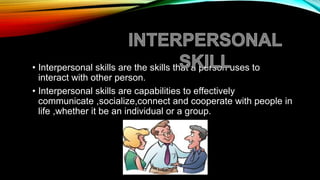
• Interpersonal skills are the skills that a person uses to
interact with other person.
• Interpersonal skills are capabilities to effectively
communicate ,socialize,connect and cooperate with people in
life ,whether it be an individual or a group.
• ASSERTION SKILLS
• ACTIVE LISTENING
• QUESTIONING SKILL
• CONFLICT RESOLUTION
• LOOK
• ASK
• LISTEN
• COMPREHEND
• LEARN
• IDENTIFY
• COMMIT
• COMMUNICATE CLEARLY
• SMILE
• BE OBSERVANT
• BE APPRICIATIVE
• ACTIVE LISTENING
• BRING PEOPLE TOGETHER
• We have come to understand that in todays competitive and demanding
workplace,managers can’t succed on their technical skills alone. They also have to
have good people skill.
• Play a significant role in understanding human behaviour and determining
manager’s effectiveness.
• Help in developing personality,communication and enterpreneurial talent .
• Keep high performing employees .
• Help in making workplace more pleasant and improving workplace
satisfation.Creating a pleasant workplace help to generate superior financial
performance.
• There is a growing awareness of the need for understanding the means and
outcomes of social responsibilty.
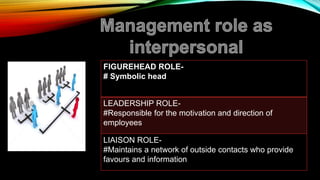
FIGUREHEAD ROLE-
# Symbolic head
LEADERSHIP ROLE-
#Responsible for the motivation and direction of
employees
LIAISON ROLE-
#Maintains a network of outside contacts who provide
favours and information
• According to Harold Koontz,2004- “A group may be defined
as two or more prople acting interdependently in a unified
manner towards the achievement of common goals.”
• According to Stephen P. Robbinse- “A group is defined as two
or more individuals ,interacting and interdependant who come
together to achieve particular objectives.”
• FORMAL GROUP-It refers to a designated work group defined by
an organisation structure.In formal groups, the behaviour team
members should engage in are stipulated by and directed
towards organisational goals.
• INFORMAL GROUP-Informal Groups are natural formation in the
work environment that appear in response to the need for social
contact.
• Group Dynamics refers to those forces operating or present in the
group and which influence the behaviour of the members of the
group.these forces are group leadership,group norms,group
composition,group cohesiveness etc.
• This study provides information to the managers about the way to
control the behaviour of the members of the group.
• According to ‘Kurt Levin’-Group Dynamics deal with internal
nature of groups,how they are formed, what structure and
process they adopt,how they function and affect individual
members,other members and the organisation.
• GROUP NORMS
• GROUP LEADERSHIP
• GROUP COHESIVENESS
• GROUP STATUS
• GROUP DIVERSITY
• GROUP ROLES
• GROUP THINK
• STRONG SENSE OF BELONGINGS
• INFLUENCING MEMBER OF GROUP
• SHARING OF INFORMATION AMONG THE GROUP
• ADJUSTMENT AMONG MEMBERS OF THE GROUP
• COMMON MOTIVE
• MEMBER PARTICIPATION IS MUST
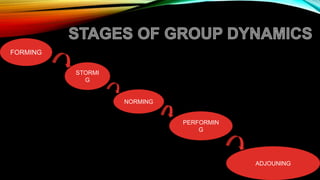
FORMING
STORMI
G
NORMING
PERFORMIN
G
ADJOUNING
• Propinquity Theory
• Activity interaction and sentiment
Theory
• Balance Theory
• Exchange Theory
INTRODUCTION-
The term emotional intelligence was officialy coined in 1990 by Salovey
and Mayer .
Emotional intelligence is “The capacity for recognising our own feelings
and those of others,for motivating ourselves and for managing emotions
well in ourselves and in our relationships.”
Emotional intelligence is person’s ability to-
1)Perceive emotions in the self and others.
2)Understand the meanings of these emotions.
3)Regulate ones emotions
• According to Salovey and Mayer – “Emotional intelligence is
defined as the subset of social intelligence that involves the ability
to monitor one’s own and others feelings and emotions ,to
discriminate among them and to use this information to guide
one’s thinking and actions.”
• It provides a means to generate ideas,a feeling or a team spirit.
• It is the key to creating a work climate in which employes are
nurtured and encouraged .
• It creates self awareness, self management capability and social
skills.
• It helps in sucessfully manages group processes that can
influences performance .
• Emotionally intelligent people are sellf motivated and able to
build trust quickly with others .
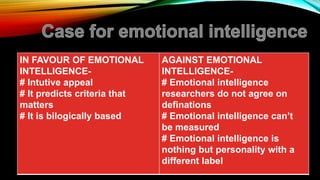
IN FAVOUR OF EMOTIONAL
INTELLIGENCE-
# Intutive appeal
# It predicts criteria that
matters
# It is bilogically based
AGAINST EMOTIONAL
INTELLIGENCE-
# Emotional intelligence
researchers do not agree on
definations
# Emotional intelligence can’t
be measured
# Emotional intelligence is
nothing but personality with a
different label
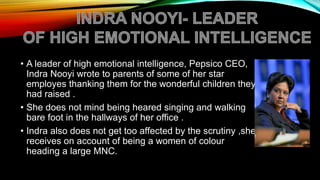
• A leader of high emotional intelligence, Pepsico CEO,
Indra Nooyi wrote to parents of some of her star
employes thanking them for the wonderful children they
had raised .
• She does not mind being heared singing and walking
bare foot in the hallways of her office .
• Indra also does not get too affected by the scrutiny ,she
receives on account of being a women of colour
heading a large MNC.
• SELF AWARENESS
• SELF MANAGEMENT
• SELF MOTIVATION
• EMPATHY
• SOCIAL SKILLS
• Luthans, F., Organisational Behaviour,Tata McGraw Hill.
• Robbins, S., Judge, T. & Sanghi, S., Organisational Behaviour,
Prentice Hall of India
organisation behaviour

organisation behaviour

  • 2.
    • INTERPERSONAL SKILL- Introduction,types,examples,way to improve it,importance,management roles • GROUP DYNAMICS - Meaning and defination of group,types of groups,meaning and defination of group dynamics,components of group dynamics,stages of group dynamics,principles,theories of group formation • EMOTIONAL INTELLIGENCE -Meaning and defination of emotional intelligence,importance,case in favour and agains emotional intelligence,dimensions of emotional intelligence
  • 4.
    • Interpersonal skillsare the skills that a person uses to interact with other person. • Interpersonal skills are capabilities to effectively communicate ,socialize,connect and cooperate with people in life ,whether it be an individual or a group.
  • 5.
    • ASSERTION SKILLS •ACTIVE LISTENING • QUESTIONING SKILL • CONFLICT RESOLUTION
  • 6.
    • LOOK • ASK •LISTEN • COMPREHEND • LEARN • IDENTIFY • COMMIT
  • 7.
    • COMMUNICATE CLEARLY •SMILE • BE OBSERVANT • BE APPRICIATIVE • ACTIVE LISTENING • BRING PEOPLE TOGETHER
  • 8.
    • We havecome to understand that in todays competitive and demanding workplace,managers can’t succed on their technical skills alone. They also have to have good people skill. • Play a significant role in understanding human behaviour and determining manager’s effectiveness. • Help in developing personality,communication and enterpreneurial talent . • Keep high performing employees . • Help in making workplace more pleasant and improving workplace satisfation.Creating a pleasant workplace help to generate superior financial performance. • There is a growing awareness of the need for understanding the means and outcomes of social responsibilty.
  • 9.
    FIGUREHEAD ROLE- # Symbolichead LEADERSHIP ROLE- #Responsible for the motivation and direction of employees LIAISON ROLE- #Maintains a network of outside contacts who provide favours and information
  • 11.
    • According toHarold Koontz,2004- “A group may be defined as two or more prople acting interdependently in a unified manner towards the achievement of common goals.” • According to Stephen P. Robbinse- “A group is defined as two or more individuals ,interacting and interdependant who come together to achieve particular objectives.”
  • 12.
    • FORMAL GROUP-Itrefers to a designated work group defined by an organisation structure.In formal groups, the behaviour team members should engage in are stipulated by and directed towards organisational goals. • INFORMAL GROUP-Informal Groups are natural formation in the work environment that appear in response to the need for social contact.
  • 13.
    • Group Dynamicsrefers to those forces operating or present in the group and which influence the behaviour of the members of the group.these forces are group leadership,group norms,group composition,group cohesiveness etc. • This study provides information to the managers about the way to control the behaviour of the members of the group. • According to ‘Kurt Levin’-Group Dynamics deal with internal nature of groups,how they are formed, what structure and process they adopt,how they function and affect individual members,other members and the organisation.
  • 14.
    • GROUP NORMS •GROUP LEADERSHIP • GROUP COHESIVENESS • GROUP STATUS • GROUP DIVERSITY • GROUP ROLES • GROUP THINK
  • 15.
    • STRONG SENSEOF BELONGINGS • INFLUENCING MEMBER OF GROUP • SHARING OF INFORMATION AMONG THE GROUP • ADJUSTMENT AMONG MEMBERS OF THE GROUP • COMMON MOTIVE • MEMBER PARTICIPATION IS MUST
  • 16.
  • 17.
    • Propinquity Theory •Activity interaction and sentiment Theory • Balance Theory • Exchange Theory
  • 19.
    INTRODUCTION- The term emotionalintelligence was officialy coined in 1990 by Salovey and Mayer . Emotional intelligence is “The capacity for recognising our own feelings and those of others,for motivating ourselves and for managing emotions well in ourselves and in our relationships.” Emotional intelligence is person’s ability to- 1)Perceive emotions in the self and others. 2)Understand the meanings of these emotions. 3)Regulate ones emotions
  • 20.
    • According toSalovey and Mayer – “Emotional intelligence is defined as the subset of social intelligence that involves the ability to monitor one’s own and others feelings and emotions ,to discriminate among them and to use this information to guide one’s thinking and actions.”
  • 21.
    • It providesa means to generate ideas,a feeling or a team spirit. • It is the key to creating a work climate in which employes are nurtured and encouraged . • It creates self awareness, self management capability and social skills. • It helps in sucessfully manages group processes that can influences performance . • Emotionally intelligent people are sellf motivated and able to build trust quickly with others .
  • 22.
    IN FAVOUR OFEMOTIONAL INTELLIGENCE- # Intutive appeal # It predicts criteria that matters # It is bilogically based AGAINST EMOTIONAL INTELLIGENCE- # Emotional intelligence researchers do not agree on definations # Emotional intelligence can’t be measured # Emotional intelligence is nothing but personality with a different label
  • 23.
    • A leaderof high emotional intelligence, Pepsico CEO, Indra Nooyi wrote to parents of some of her star employes thanking them for the wonderful children they had raised . • She does not mind being heared singing and walking bare foot in the hallways of her office . • Indra also does not get too affected by the scrutiny ,she receives on account of being a women of colour heading a large MNC.
  • 24.
    • SELF AWARENESS •SELF MANAGEMENT • SELF MOTIVATION • EMPATHY • SOCIAL SKILLS
  • 25.
    • Luthans, F.,Organisational Behaviour,Tata McGraw Hill. • Robbins, S., Judge, T. & Sanghi, S., Organisational Behaviour, Prentice Hall of India