#NAFNext2014
#NAFNext2014
SAS Programming for High
School
Teach Your Students to Use Data Analysis for
Problem Solving
Sharon T. Jones, Ed.D, Phillip O. Berry Academy of Technology
Workshop Goals
#NAFNext2014
1. What is SAS? (Language & Company)
2. Why Teach SAS?
4. SAS in the Classroom
5. Relating SAS and NAF
#NAFNext2014
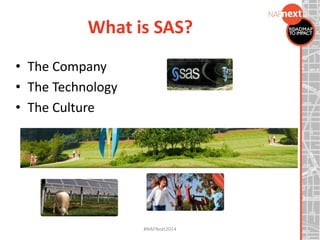
What is SAS?
• The Company
• The Technology
• The Culture
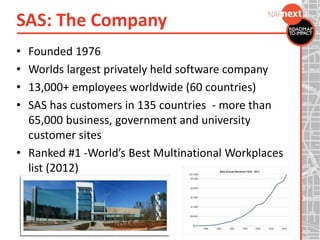
SAS: The Company
• Founded 1976
• Worlds largest privately held software company
• 13,000+ employees worldwide (60 countries)
• SAS has customers in 135 countries - more than
65,000 business, government and university
customer sites
• Ranked #1 -World’s Best Multinational Workplaces
list (2012)
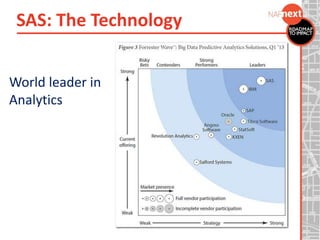
SAS: The Technology
World leader in
Analytics
Programs and Initiatives
National Board for Professional Teaching
Standards
Education Industry Board Memberships
NC 1:1 Learning Technology Initiative
Computer Science Education Week
Boys & Girls Clubs of America
Employee Volunteer Fund
Communities in Schools
STEM Initiative Support
YMCA of the Triangle
Triangle High Five
Donors Choose
Math Summit
Scholarships
Teaching and Learning
SAS Programming for High School Educators
University MS in Advanced Analytics Programs
University Joint Certificate Programs
SAS Global Academic Program
AP Statistics Summer Institute
SAS Student Ambassadors
Industry Advisory Boards
Offerings and Services
Value-Added Assessment Software
Administrative Software & Services
No Cost:
SAS Software Access for Universities
Education Mobile Learning Apps
Online Curriculum Resources
Workshops for Universities
Teaching Materials
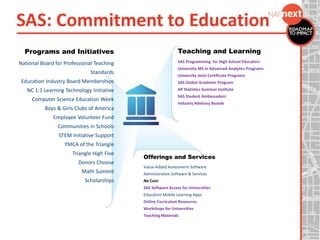
SAS: Commitment to Education
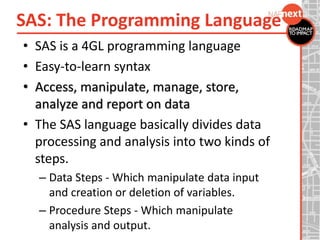
SAS: The Programming Language
• SAS is a 4GL programming language
• Easy-to-learn syntax
• Access, manipulate, manage, store,
analyze and report on data
• The SAS language basically divides data
processing and analysis into two kinds of
steps.
– Data Steps - Which manipulate data input
and creation or deletion of variables.
– Procedure Steps - Which manipulate
analysis and output.
• DirectTV
• T-Mobile
• Williams Sonoma
• Brooks Brothers
• Blue Cross Blue Shield
• Harrah’s Entertainment
• Bank of America
• Citibank
• AutoZone
• Honda
• Expedia
• Family Dollar
• US Department of
Treasury
• US Airforce
• US Census Bureau
• US Centers for Disease
Control & Prevention
• US Fish & Wildlife Service
• Dow Chemical Company
Customers in 135 countries, over 65,000
customer sites
SAS: Who Uses SAS?
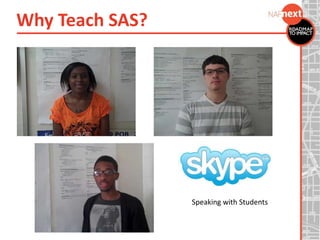
Speaking with Students
Why Teach SAS?
Programming Skills
Critical Thinking and Analytical Skills
Student Engagement and Leadership
Practical Application
Career Opportunities
Certification Opportunities
Why Teach SAS? (What is the value?)
Why Teach SAS?: SAS Programming for HS Overview
• Teaches students how to prepare data for
analysis and write SAS programs to solve
problems
• Two courses available
• Each course aligns to an industry recognized
SAS certification credential
Why Teach SAS?: SAS Programming I
Teaches students -
– Basic SAS programming concepts and tasks,
including accessing and manipulating data;
producing basic list, summary, and statistical
reports; creating SAS data sets; combining SAS
data sets; creating basic graphs; and querying
data using the SQL procedure
Prepares students –
 SAS Certified Base Programmer for SAS 9 credential
Why Teach SAS?: SAS Programming II
Teaches students -
– Comparisons of manipulation
techniques/resource cost benefits designed to
help student programmers choose the most
appropriate technique for their data situation
– How to process SAS data using Structured Query
Language (SQL) & how to use the components of
the SAS macro facility to design, write, and debug
macro systems that are reusable and dynamic
Prepares students –
 SAS Certified Advanced Programmer for SAS 9 credential
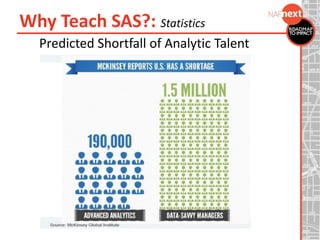
Why Teach SAS?: Statistics
Predicted Shortfall of Analytic Talent
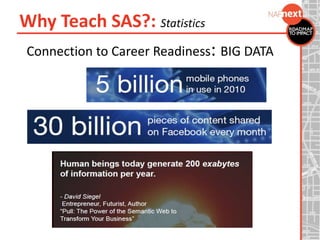
Connection to Career Readiness: BIG DATA
Why Teach SAS?: Statistics
Where is all this data coming from?
• RFID (radio frequency ID) systems generate up to 1,000
times the data of conventional bar code systems
• 10,000 payment card transactions are made every second
around the world
• Walmart handles more than 1 million customer
transactions an hour
• 340 million tweets are sent per day. That's nearly 4,000
tweets per second
• Facebook has more than 901 million active users
generating social interaction data
• More than 5 billion people are calling, texting, tweeting
and browsing websites on mobile phones
Why Teach SAS?: Statistics
SAS in the Classroom: Project Examples
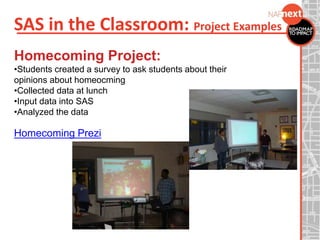
Homecoming Project:
•Students created a survey to ask students about their
opinions about homeocming
•Collected data at lunch
•Input data into SAS
•Analyzed the data
Homecoming Prezi
SAS In the Classroom: Bobcats Project
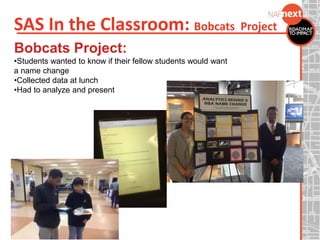
Bobcats Project:
•Students wanted to know if their fellow students would want
a name change
•Collected data at lunch
•Had to analyze and present
SAS in the Classroom: Color Flower
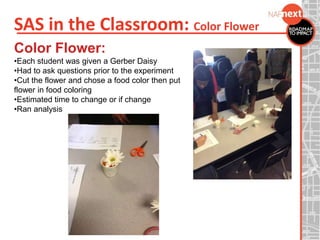
Color Flower:
•Each student was given a Gerber Daisy
•Had to ask questions prior to the experiment
•Cut the flower and chose a food color then put
flower in food coloring
•Estimated time to change or if change
•Ran analysis
Overview of Projects:
Homecoming Project
Charlotte Bobcats Project
Technology Journal Project: students recorded data of pieces of technology
used, ran the data to see what technology was used most
World Statistics Day Project
SuperBowl Project
College Research: researched 10 colleges to find out information about the
schools
Reverse Homecoming
Charlotte Checkers Game: attended a Charlotte Checkers game and recorded
data
New Lunch Survey: a new lunch schedule was implemented and the students
asked if they could run a survey to see if the school population like the new
lunch
Transportation Survey Project
Find all the projects at:
http://sjonespob.webs.com/classdocuments
SAS in the Classroom: Overview
Relating SAS and NAF
Connecting Students and SAS:
"SAS Day"- event on the SAS campus every year where the
students and teachers can network with one another, play with SAS
in ways that are not necessarily covered in their courses, and also
see some of the newest technologies SAS has to offer. This year is
was called "Discover, Lead, Solve"
Internships with SAS- Our high school programs are designed to
give students first hand interaction with state of the art technology, as
well as professional mentorship. SAS’ high school programs provide
students with work-related learning experiences in a positive
corporate environment. SAS Internships
SAS on Advisory Board- SAS has had several members sit on
advisory boards
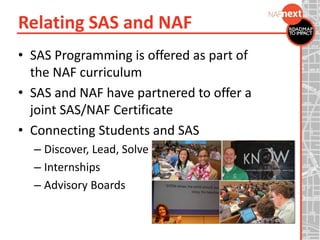
Relating SAS and NAF
• SAS Programming is offered as part of
the NAF curriculum
• SAS and NAF have partnered to offer a
joint SAS/NAF Certificate
• Connecting Students and SAS
– Discover, Lead, Solve
– Internships
– Advisory Boards
Relating SAS and NAF
SAS/NAF Joint Certificate Pathway
• NAF Principles of Information
Technology
• NAF Introduction to Programming
• NAF Database Design
• SAS Programming
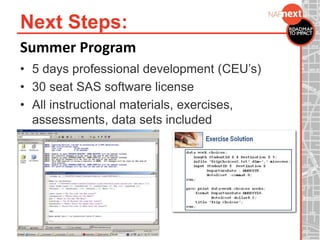
Next Steps:
Summer Program
• 5 days professional development (CEU’s)
• 30 seat SAS software license
• All instructional materials, exercises,
assessments, data sets included
Next Steps:
SAS Programming for High School Workshop
June 22-26, 2015
Cary, NC
Contact Information:
O.B. Barrett
o.b.barrett@sas.com
support.sas.com/highschool
Sharon T. Jones, Ed.D.
Sharont.jones@cms.k12.nc.us
http://sjonespob.webs.com

SAS Programming for High School - Giving Students the Power to Know

  • 1.
  • 2.
    #NAFNext2014 SAS Programming forHigh School Teach Your Students to Use Data Analysis for Problem Solving Sharon T. Jones, Ed.D, Phillip O. Berry Academy of Technology
  • 3.
    Workshop Goals #NAFNext2014 1. Whatis SAS? (Language & Company) 2. Why Teach SAS? 4. SAS in the Classroom 5. Relating SAS and NAF
  • 4.
    #NAFNext2014 What is SAS? •The Company • The Technology • The Culture
  • 5.
    SAS: The Company •Founded 1976 • Worlds largest privately held software company • 13,000+ employees worldwide (60 countries) • SAS has customers in 135 countries - more than 65,000 business, government and university customer sites • Ranked #1 -World’s Best Multinational Workplaces list (2012)
  • 6.
    SAS: The Technology Worldleader in Analytics
  • 7.
    Programs and Initiatives NationalBoard for Professional Teaching Standards Education Industry Board Memberships NC 1:1 Learning Technology Initiative Computer Science Education Week Boys & Girls Clubs of America Employee Volunteer Fund Communities in Schools STEM Initiative Support YMCA of the Triangle Triangle High Five Donors Choose Math Summit Scholarships Teaching and Learning SAS Programming for High School Educators University MS in Advanced Analytics Programs University Joint Certificate Programs SAS Global Academic Program AP Statistics Summer Institute SAS Student Ambassadors Industry Advisory Boards Offerings and Services Value-Added Assessment Software Administrative Software & Services No Cost: SAS Software Access for Universities Education Mobile Learning Apps Online Curriculum Resources Workshops for Universities Teaching Materials SAS: Commitment to Education
  • 8.
    SAS: The ProgrammingLanguage • SAS is a 4GL programming language • Easy-to-learn syntax • Access, manipulate, manage, store, analyze and report on data • The SAS language basically divides data processing and analysis into two kinds of steps. – Data Steps - Which manipulate data input and creation or deletion of variables. – Procedure Steps - Which manipulate analysis and output.
  • 9.
    • DirectTV • T-Mobile •Williams Sonoma • Brooks Brothers • Blue Cross Blue Shield • Harrah’s Entertainment • Bank of America • Citibank • AutoZone • Honda • Expedia • Family Dollar • US Department of Treasury • US Airforce • US Census Bureau • US Centers for Disease Control & Prevention • US Fish & Wildlife Service • Dow Chemical Company Customers in 135 countries, over 65,000 customer sites SAS: Who Uses SAS?
  • 10.
  • 11.
    Programming Skills Critical Thinkingand Analytical Skills Student Engagement and Leadership Practical Application Career Opportunities Certification Opportunities Why Teach SAS? (What is the value?)
  • 12.
    Why Teach SAS?:SAS Programming for HS Overview • Teaches students how to prepare data for analysis and write SAS programs to solve problems • Two courses available • Each course aligns to an industry recognized SAS certification credential
  • 13.
    Why Teach SAS?:SAS Programming I Teaches students - – Basic SAS programming concepts and tasks, including accessing and manipulating data; producing basic list, summary, and statistical reports; creating SAS data sets; combining SAS data sets; creating basic graphs; and querying data using the SQL procedure Prepares students –  SAS Certified Base Programmer for SAS 9 credential
  • 14.
    Why Teach SAS?:SAS Programming II Teaches students - – Comparisons of manipulation techniques/resource cost benefits designed to help student programmers choose the most appropriate technique for their data situation – How to process SAS data using Structured Query Language (SQL) & how to use the components of the SAS macro facility to design, write, and debug macro systems that are reusable and dynamic Prepares students –  SAS Certified Advanced Programmer for SAS 9 credential
  • 15.
    Why Teach SAS?:Statistics Predicted Shortfall of Analytic Talent
  • 16.
    Connection to CareerReadiness: BIG DATA Why Teach SAS?: Statistics
  • 17.
    Where is allthis data coming from? • RFID (radio frequency ID) systems generate up to 1,000 times the data of conventional bar code systems • 10,000 payment card transactions are made every second around the world • Walmart handles more than 1 million customer transactions an hour • 340 million tweets are sent per day. That's nearly 4,000 tweets per second • Facebook has more than 901 million active users generating social interaction data • More than 5 billion people are calling, texting, tweeting and browsing websites on mobile phones Why Teach SAS?: Statistics
  • 18.
    SAS in theClassroom: Project Examples Homecoming Project: •Students created a survey to ask students about their opinions about homeocming •Collected data at lunch •Input data into SAS •Analyzed the data Homecoming Prezi
  • 19.
    SAS In theClassroom: Bobcats Project Bobcats Project: •Students wanted to know if their fellow students would want a name change •Collected data at lunch •Had to analyze and present
  • 20.
    SAS in theClassroom: Color Flower Color Flower: •Each student was given a Gerber Daisy •Had to ask questions prior to the experiment •Cut the flower and chose a food color then put flower in food coloring •Estimated time to change or if change •Ran analysis
  • 21.
    Overview of Projects: HomecomingProject Charlotte Bobcats Project Technology Journal Project: students recorded data of pieces of technology used, ran the data to see what technology was used most World Statistics Day Project SuperBowl Project College Research: researched 10 colleges to find out information about the schools Reverse Homecoming Charlotte Checkers Game: attended a Charlotte Checkers game and recorded data New Lunch Survey: a new lunch schedule was implemented and the students asked if they could run a survey to see if the school population like the new lunch Transportation Survey Project Find all the projects at: http://sjonespob.webs.com/classdocuments SAS in the Classroom: Overview
  • 22.
    Relating SAS andNAF Connecting Students and SAS: "SAS Day"- event on the SAS campus every year where the students and teachers can network with one another, play with SAS in ways that are not necessarily covered in their courses, and also see some of the newest technologies SAS has to offer. This year is was called "Discover, Lead, Solve" Internships with SAS- Our high school programs are designed to give students first hand interaction with state of the art technology, as well as professional mentorship. SAS’ high school programs provide students with work-related learning experiences in a positive corporate environment. SAS Internships SAS on Advisory Board- SAS has had several members sit on advisory boards
  • 23.
    Relating SAS andNAF • SAS Programming is offered as part of the NAF curriculum • SAS and NAF have partnered to offer a joint SAS/NAF Certificate • Connecting Students and SAS – Discover, Lead, Solve – Internships – Advisory Boards
  • 24.
    Relating SAS andNAF SAS/NAF Joint Certificate Pathway • NAF Principles of Information Technology • NAF Introduction to Programming • NAF Database Design • SAS Programming
  • 25.
    Next Steps: Summer Program •5 days professional development (CEU’s) • 30 seat SAS software license • All instructional materials, exercises, assessments, data sets included
  • 26.
    Next Steps: SAS Programmingfor High School Workshop June 22-26, 2015 Cary, NC
  • 27.
    Contact Information: O.B. Barrett o.b.barrett@sas.com support.sas.com/highschool SharonT. Jones, Ed.D. Sharont.jones@cms.k12.nc.us http://sjonespob.webs.com