English projEt
Diffallah Diya Eddin
Institut Supérieur Des TechnologiesInstitut Supérieur Des Technologies
De L'Environnement De L'Urbanisme Et Du BâtimentDe L'Environnement De L'Urbanisme Et Du Bâtiment
3 émé CU_A3 émé CU_A
What is it?What is it?
 Urban design movement originating in the late ’80s –
early ’90s.
 Aims to reform all aspects of real estate development.
 Involves: new development, urban retrofits, and
suburban infill.
 Affects both regional and local plans.
 Supports the creation and restoration of diverse,
walkable, compact, mixed-use communities.
 Currently 500 “New Urbanist” projects in the U.S. alone,
half in urban areas.
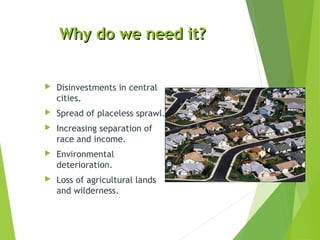
Why do we need it?Why do we need it?
 Disinvestments in central
cities.
 Spread of placeless sprawl.
 Increasing separation of
race and income.
 Environmental
deterioration.
 Loss of agricultural lands
and wilderness.
Root Causes:Root Causes:
 Changing household
demographics.
 Land consumption without
regard to natural features or
physical limits.
 Federal and state policies that
encourage low-density sprawl.
 Street standards are insensitive
to human needs.
 Zoning codes leave little room
for individualization.
Charter of New UrbanismCharter of New Urbanism
The Region: Metropolis, city and town.The Region: Metropolis, city and town.
On a regional scale:
 Finite places with geographic boundaries.
 Fragile relationship between
 urban area and hinterland.
 Development patterns should
 not blur edges of the metropolis.
 Infill development should be
 encouraged over peripheral
 expansion.
 Revenues and resources should be
shared among the municipalities to
avoid destructive competition.
Charter of New UrbanismCharter of New Urbanism
Neighborhood: the district and the corridor.Neighborhood: the district and the corridor.
On a neighborhood scale:
 Neighborhoods should be compact, pedestrian-friendly
and mixed-use.
 Broad range of housing types to
 bring diversity.
 Civic, institutional and commercial
 activity should be embedded in
 neighborhoods, not isolated.
 Public transportation should be
 a viable alternative to the automobile.
 Parks should be a viable alternative to the automobile.
Charter of New UrbanismCharter of New Urbanism
The block, street and building.The block, street and building.
On a block scale:
 Individual architectural projects should
be linked to their surroundings.
 Architecture and landscape design
 should grow from local climate,
topography, history, and building
practice.
 Development must adequately
accommodate automobiles whiles
 being pedestrian-friendly.
 Streets should be safe, yet interesting
and open to the pedestrian.
Principles of NewPrinciples of New
UrbanismUrbanism
1: Walkability1: Walkability
 Most errands should
be accomplished
within a 10-min.
walk from home or
work.
 Pedestrian-friendly
street design.
2: Connectivity2: Connectivity
Interconnected street grid
network disperses traffic
and eases walking.
3: Mixed-use and diversity3: Mixed-use and diversity
A mix of shops, offices,
apartments and homes.
Mixed-use within
neighborhood, within
block, within buildings.
4: Mixed-housing4: Mixed-housing
A range of types, sizes and prices in close proximity.
5: Quality of architecture5: Quality of architecture
& urban design& urban design
Emphasis on beauty, aesthetics, human
comfort, and creating a sense of place.
Human-scale architecture.
6: Traditional neighborhood6: Traditional neighborhood
structurestructure
Highest density at town center; progressively less
dense towards the edge. This urban-to-rural
transect hierarchy has appropriate building and
street types for each area along the continuum.
7: Increased density7: Increased density
 More buildings, residences, shops and services closer
together for easy walking.
 To enable a more efficient use of services and
resources.
8: Transportation8: Transportation
 A network of high-quality transit connecting cities and
towns together.
 Pedestrian-friendly designs that encourage the use of
bicycles, scooters and walking as daily transportation.
9: Sustainability9: Sustainability
 Minimal environmental
impact of development.
 Less use of finite fuels.
 More local production.
Benefits of New UrbanismBenefits of New Urbanism
 Less traffic congestion
and driving.
 Healthier lifestyle:
pedestrian-friendly
communities.
 More freedom and
independence for
children, the elderly
and the poor.
 More open space.
 Less tax money spent
on infrastructure.
Ways to Implement NewWays to Implement New
UrbanismUrbanism
1. The single building
2. Groups of buildings
3. The urban block
4. The neighborhood
5. Networks of neighborhoods
6. Towns
7. Cities
8. Regions
Obstacles to OvercomeObstacles to Overcome
Restrictive zoning
Obstacles to OvercomeObstacles to Overcome
Lack of design standards
Prospect, COProspect, CO Celebration, FLCelebration, FL
Examples of New Urbanism:Examples of New Urbanism:
Minneapolis, MNMinneapolis, MN
Located on the edge of the
campus of the University of
Minnesota, this new
residential community will
consist of more then 500
students and faculty. The
housing development is
complimented by a large
street level retail component
and a 280 stall heating
parking facility.

L'Urbanisme

  • 1.
    English projEt Diffallah DiyaEddin Institut Supérieur Des TechnologiesInstitut Supérieur Des Technologies De L'Environnement De L'Urbanisme Et Du BâtimentDe L'Environnement De L'Urbanisme Et Du Bâtiment 3 émé CU_A3 émé CU_A
  • 2.
    What is it?Whatis it?  Urban design movement originating in the late ’80s – early ’90s.  Aims to reform all aspects of real estate development.  Involves: new development, urban retrofits, and suburban infill.  Affects both regional and local plans.  Supports the creation and restoration of diverse, walkable, compact, mixed-use communities.  Currently 500 “New Urbanist” projects in the U.S. alone, half in urban areas.
  • 3.
    Why do weneed it?Why do we need it?  Disinvestments in central cities.  Spread of placeless sprawl.  Increasing separation of race and income.  Environmental deterioration.  Loss of agricultural lands and wilderness.
  • 4.
    Root Causes:Root Causes: Changing household demographics.  Land consumption without regard to natural features or physical limits.  Federal and state policies that encourage low-density sprawl.  Street standards are insensitive to human needs.  Zoning codes leave little room for individualization.
  • 5.
    Charter of NewUrbanismCharter of New Urbanism The Region: Metropolis, city and town.The Region: Metropolis, city and town. On a regional scale:  Finite places with geographic boundaries.  Fragile relationship between  urban area and hinterland.  Development patterns should  not blur edges of the metropolis.  Infill development should be  encouraged over peripheral  expansion.  Revenues and resources should be shared among the municipalities to avoid destructive competition.
  • 6.
    Charter of NewUrbanismCharter of New Urbanism Neighborhood: the district and the corridor.Neighborhood: the district and the corridor. On a neighborhood scale:  Neighborhoods should be compact, pedestrian-friendly and mixed-use.  Broad range of housing types to  bring diversity.  Civic, institutional and commercial  activity should be embedded in  neighborhoods, not isolated.  Public transportation should be  a viable alternative to the automobile.  Parks should be a viable alternative to the automobile.
  • 7.
    Charter of NewUrbanismCharter of New Urbanism The block, street and building.The block, street and building. On a block scale:  Individual architectural projects should be linked to their surroundings.  Architecture and landscape design  should grow from local climate, topography, history, and building practice.  Development must adequately accommodate automobiles whiles  being pedestrian-friendly.  Streets should be safe, yet interesting and open to the pedestrian.
  • 8.
    Principles of NewPrinciplesof New UrbanismUrbanism
  • 9.
    1: Walkability1: Walkability Most errands should be accomplished within a 10-min. walk from home or work.  Pedestrian-friendly street design.
  • 10.
    2: Connectivity2: Connectivity Interconnectedstreet grid network disperses traffic and eases walking.
  • 11.
    3: Mixed-use anddiversity3: Mixed-use and diversity A mix of shops, offices, apartments and homes. Mixed-use within neighborhood, within block, within buildings.
  • 12.
    4: Mixed-housing4: Mixed-housing Arange of types, sizes and prices in close proximity.
  • 13.
    5: Quality ofarchitecture5: Quality of architecture & urban design& urban design Emphasis on beauty, aesthetics, human comfort, and creating a sense of place. Human-scale architecture.
  • 14.
    6: Traditional neighborhood6:Traditional neighborhood structurestructure Highest density at town center; progressively less dense towards the edge. This urban-to-rural transect hierarchy has appropriate building and street types for each area along the continuum.
  • 15.
    7: Increased density7:Increased density  More buildings, residences, shops and services closer together for easy walking.  To enable a more efficient use of services and resources.
  • 16.
    8: Transportation8: Transportation A network of high-quality transit connecting cities and towns together.  Pedestrian-friendly designs that encourage the use of bicycles, scooters and walking as daily transportation.
  • 17.
    9: Sustainability9: Sustainability Minimal environmental impact of development.  Less use of finite fuels.  More local production.
  • 18.
    Benefits of NewUrbanismBenefits of New Urbanism  Less traffic congestion and driving.  Healthier lifestyle: pedestrian-friendly communities.  More freedom and independence for children, the elderly and the poor.  More open space.  Less tax money spent on infrastructure.
  • 19.
    Ways to ImplementNewWays to Implement New UrbanismUrbanism 1. The single building 2. Groups of buildings 3. The urban block 4. The neighborhood 5. Networks of neighborhoods 6. Towns 7. Cities 8. Regions
  • 20.
    Obstacles to OvercomeObstaclesto Overcome Restrictive zoning
  • 21.
    Obstacles to OvercomeObstaclesto Overcome Lack of design standards Prospect, COProspect, CO Celebration, FLCelebration, FL
  • 22.
    Examples of NewUrbanism:Examples of New Urbanism: Minneapolis, MNMinneapolis, MN Located on the edge of the campus of the University of Minnesota, this new residential community will consist of more then 500 students and faculty. The housing development is complimented by a large street level retail component and a 280 stall heating parking facility.