1DRIVING AND THE BUILT ENVIRONMENT:  THE EFFECTS OF COMPACT DEVELOPMENT ON MOTORIZED TRAVEL, ENERGY USE, AND CO2 EMISSIONSSeptember 1, 2009Transportation Research BoardDivision on Engineering and Physical SciencesOf the National Research CouncilAndy Cotugno, MetroCongress for New Urbanism  Transportation SummitNovember 4-6, 2009
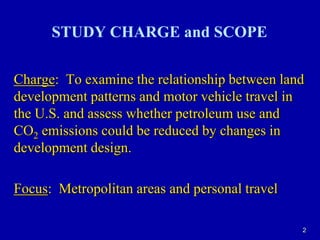
2STUDY CHARGE and SCOPECharge:  To examine the relationship between land development patterns and motor vehicle travel in the U.S. and assess whether petroleum use and CO2 emissions could be reduced by changes in development design.Focus:  Metropolitan areas and personal travel
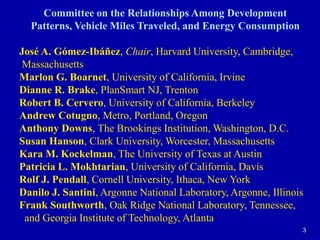
3Committee on the Relationships Among Development Patterns, Vehicle Miles Traveled, and Energy ConsumptionJosé A. Gómez-Ibáñez, Chair, Harvard University, Cambridge, MassachusettsMarlon G. Boarnet, University of California, IrvineDianne R. Brake, PlanSmart NJ, TrentonRobert B. Cervero, University of California, BerkeleyAndrew Cotugno, Metro, Portland, OregonAnthony Downs, The Brookings Institution, Washington, D.C.Susan Hanson, Clark University, Worcester, MassachusettsKara M. Kockelman, The University of Texas at AustinPatricia L. Mokhtarian, University of California, DavisRolf J. Pendall, Cornell University, Ithaca, New YorkDanilo J. Santini, Argonne National Laboratory, Argonne, IllinoisFrank Southworth, Oak Ridge National Laboratory, Tennessee,  and Georgia Institute of Technology, Atlanta
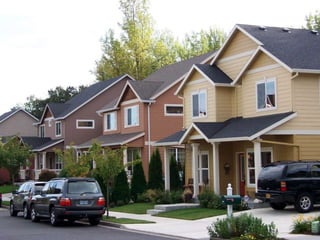
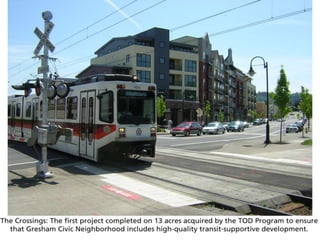
4KEY CONCEPTSCOMPACT, MIXED-USE DEVELOPMENT:  Land use patterns that increase the density, mix of uses, contiguity, connectedness, and pedestrian orientation of developmentLocation matters – high residential density in the middle of nowhere yields few benefitsCompact, mixed-use development ≠ multifamily housing only– small-lot, single-family development can yield benefits
5
6
7FINDINGSFinding 1:More compact development patterns are likely to reduce VMT.
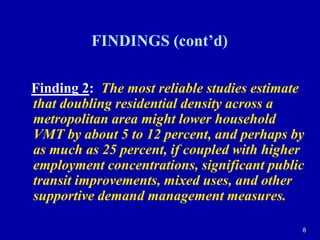
8FINDINGS (cont’d)Finding 2:The most reliable studies estimate that doubling residential density across a metropolitan area might lower household VMT by about 5 to 12 percent, and perhaps by as much as 25 percent, if coupled with higher employment concentrations, significant public transit improvements, mixed uses, and other supportive demand management measures.
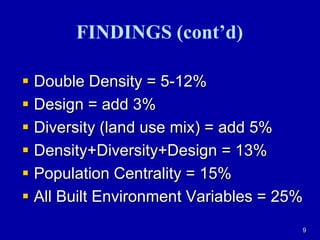
FINDINGS (cont’d)Double Density = 5-12%Design = add 3%Diversity (land use mix) = add 5%Density+Diversity+Design = 13%Population Centrality = 15%All Built Environment Variables = 25%9
10FINDINGS (cont’d) Finding 3:More compact, mixed-use development can produce reductions in energy consumption and CO2 emissions both directly and indirectly.
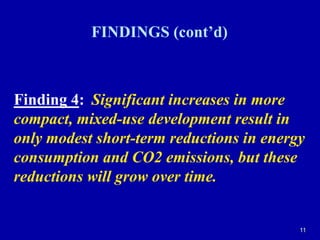
11FINDINGS (cont’d)Finding 4:Significant increases in more compact, mixed-use development result in only modest short-term reductions in energy consumption and CO2 emissions, but these reductions will grow over time.
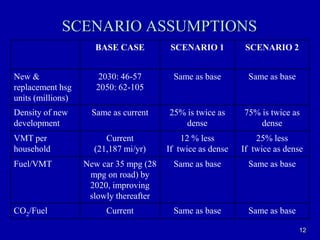
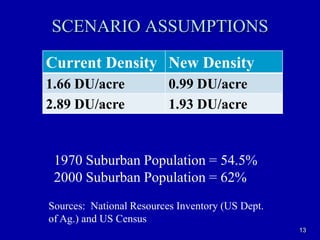
12SCENARIO ASSUMPTIONS
13SCENARIO ASSUMPTIONS1970 Suburban Population = 54.5%2000 Suburban Population = 62%Sources:  National Resources Inventory (US Dept. of Ag.) and US Census
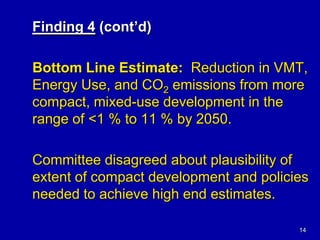
14Finding 4 (cont’d)Bottom Line Estimate:  Reduction in VMT, Energy Use, and CO2 emissions from more compact, mixed-use development in the range of <1 % to 11 % by 2050.Committee disagreed about plausibility of extent of compact development and policies needed to achieve high end estimates.
15FINDINGS (cont’d)Finding 5:Promoting more compact, mixed use development on a large scale will require overcoming numerous obstacles:Local zoning, engineering and parking codes, housing preference
16FINDINGS (cont’d)Finding 6:Changes in development patterns entail other benefits and costs that have not been quantified in this study:  infrastructure costs, social equity, health, neighborhood revitalization, transit feasibility, housing choice and price,  farm land and wildlife habitat preservation
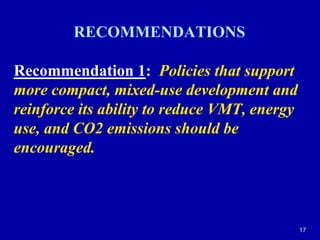
17RECOMMENDATIONSRecommendation 1:  Policies that support more compact, mixed-use development and reinforce its ability to reduce VMT, energy use, and CO2 emissions should be encouraged.
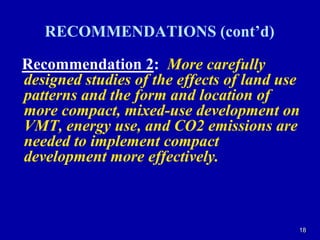
18RECOMMENDATIONS (cont’d) Recommendation 2:  More carefully designed studies of the effects of land use patterns and the form and location of more compact, mixed-use development on VMT, energy use, and CO2 emissions are needed to implement compact development more effectively.
19HOW TO ACCESS THE REPORTReport, report summary, and commissioned papers are availableathttp://www.TRB.org/Publications/Public/Blurbs/162093.aspxQUESTIONS?Andy.Cotugno@oregonmetro.gov

Driving and the Environment: The Effects of Compact Development on Motorized Travel Energy Use and C02 Emissions

  • 1.
    1DRIVING AND THEBUILT ENVIRONMENT: THE EFFECTS OF COMPACT DEVELOPMENT ON MOTORIZED TRAVEL, ENERGY USE, AND CO2 EMISSIONSSeptember 1, 2009Transportation Research BoardDivision on Engineering and Physical SciencesOf the National Research CouncilAndy Cotugno, MetroCongress for New Urbanism Transportation SummitNovember 4-6, 2009
  • 2.
    2STUDY CHARGE andSCOPECharge: To examine the relationship between land development patterns and motor vehicle travel in the U.S. and assess whether petroleum use and CO2 emissions could be reduced by changes in development design.Focus: Metropolitan areas and personal travel
  • 3.
    3Committee on theRelationships Among Development Patterns, Vehicle Miles Traveled, and Energy ConsumptionJosé A. Gómez-Ibáñez, Chair, Harvard University, Cambridge, MassachusettsMarlon G. Boarnet, University of California, IrvineDianne R. Brake, PlanSmart NJ, TrentonRobert B. Cervero, University of California, BerkeleyAndrew Cotugno, Metro, Portland, OregonAnthony Downs, The Brookings Institution, Washington, D.C.Susan Hanson, Clark University, Worcester, MassachusettsKara M. Kockelman, The University of Texas at AustinPatricia L. Mokhtarian, University of California, DavisRolf J. Pendall, Cornell University, Ithaca, New YorkDanilo J. Santini, Argonne National Laboratory, Argonne, IllinoisFrank Southworth, Oak Ridge National Laboratory, Tennessee, and Georgia Institute of Technology, Atlanta
  • 4.
    4KEY CONCEPTSCOMPACT, MIXED-USEDEVELOPMENT: Land use patterns that increase the density, mix of uses, contiguity, connectedness, and pedestrian orientation of developmentLocation matters – high residential density in the middle of nowhere yields few benefitsCompact, mixed-use development ≠ multifamily housing only– small-lot, single-family development can yield benefits
  • 5.
  • 6.
  • 7.
    7FINDINGSFinding 1:More compactdevelopment patterns are likely to reduce VMT.
  • 8.
    8FINDINGS (cont’d)Finding 2:Themost reliable studies estimate that doubling residential density across a metropolitan area might lower household VMT by about 5 to 12 percent, and perhaps by as much as 25 percent, if coupled with higher employment concentrations, significant public transit improvements, mixed uses, and other supportive demand management measures.
  • 9.
    FINDINGS (cont’d)Double Density= 5-12%Design = add 3%Diversity (land use mix) = add 5%Density+Diversity+Design = 13%Population Centrality = 15%All Built Environment Variables = 25%9
  • 10.
    10FINDINGS (cont’d) Finding3:More compact, mixed-use development can produce reductions in energy consumption and CO2 emissions both directly and indirectly.
  • 11.
    11FINDINGS (cont’d)Finding 4:Significantincreases in more compact, mixed-use development result in only modest short-term reductions in energy consumption and CO2 emissions, but these reductions will grow over time.
  • 12.
  • 13.
    13SCENARIO ASSUMPTIONS1970 SuburbanPopulation = 54.5%2000 Suburban Population = 62%Sources: National Resources Inventory (US Dept. of Ag.) and US Census
  • 14.
    14Finding 4 (cont’d)BottomLine Estimate: Reduction in VMT, Energy Use, and CO2 emissions from more compact, mixed-use development in the range of <1 % to 11 % by 2050.Committee disagreed about plausibility of extent of compact development and policies needed to achieve high end estimates.
  • 15.
    15FINDINGS (cont’d)Finding 5:Promotingmore compact, mixed use development on a large scale will require overcoming numerous obstacles:Local zoning, engineering and parking codes, housing preference
  • 16.
    16FINDINGS (cont’d)Finding 6:Changesin development patterns entail other benefits and costs that have not been quantified in this study: infrastructure costs, social equity, health, neighborhood revitalization, transit feasibility, housing choice and price, farm land and wildlife habitat preservation
  • 17.
    17RECOMMENDATIONSRecommendation 1: Policies that support more compact, mixed-use development and reinforce its ability to reduce VMT, energy use, and CO2 emissions should be encouraged.
  • 18.
    18RECOMMENDATIONS (cont’d) Recommendation2: More carefully designed studies of the effects of land use patterns and the form and location of more compact, mixed-use development on VMT, energy use, and CO2 emissions are needed to implement compact development more effectively.
  • 19.
    19HOW TO ACCESSTHE REPORTReport, report summary, and commissioned papers are availableathttp://www.TRB.org/Publications/Public/Blurbs/162093.aspxQUESTIONS?Andy.Cotugno@oregonmetro.gov