Sustainable Communities Building Blocks Program
EPA Office of Sustainable Communities


                                   SUSTAINABLE DESIGN +
                                   DEVELOPMENT


Renaissance Planning Group
Asheboro, North Carolina May 21, 2012
Alan Steinbeck, AICP
About the Sustainable Communities
Building Blocks Program
•   The Sustainable Communities Building Blocks Program seeks
    to provide quick, targeted technical assistance to
    communities using a variety of tools that have demonstrated
    results and widespread application.

•   This technical assistance will help selected local and/or tribal
    governments to implement development approaches that
    protect the environment, improve public health, create jobs,
    expand economic opportunity, and improve overall quality
    of life.


Sustainable Communities Building Blocks Program
Sustainable Design + Development

 •   Purpose of Tool: Help communities understand the key
     principles and decisions at the location, site, and
     building levels that can result in a more sustainable
     plan or development proposal.

 •   Builds upon existing EPA publication,
     Smart Growth Guidelines for Sustainable Design and Developm


 Sustainable Communities Building Blocks Program
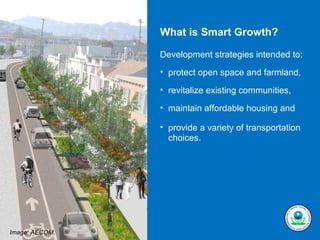
What is Smart Growth?

                Development strategies intended to:
                • protect open space and farmland,

                • revitalize existing communities,

                • maintain affordable housing and

                • provide a variety of transportation
                  choices.


Image: AECOM.
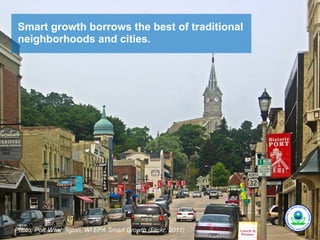
Smart growth borrows the best of traditional
 neighborhoods and cities.


Photo: Port Washington, WI EPA Smart Growth (Flickr, 2011)
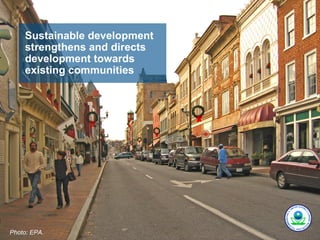
Sustainable development
    strengthens and directs
    development towards
    existing communities


Photo: EPA.
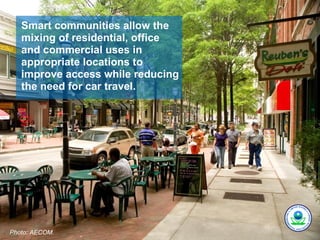
Smart communities allow the
   mixing of residential, office
   and commercial uses in
   appropriate locations to
   improve access while reducing
   the need for car travel.


Photo: AECOM.
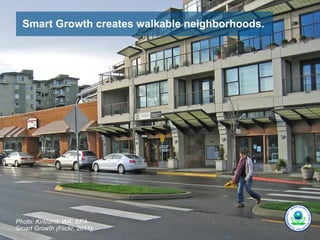
Smart Growth creates walkable neighborhoods.


Photo: Kirkland, WA; EPA
Smart Growth (Flickr, 2011)
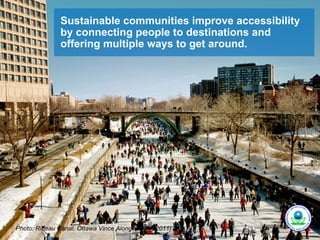
Sustainable communities improve accessibility
               by connecting people to destinations and
               offering multiple ways to get around.


Photo: Rideau Canal, Ottawa Vince Alongi (Flickr, 2011)
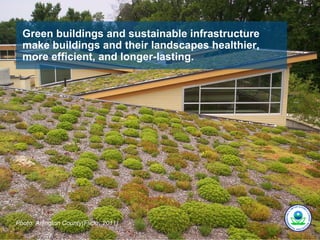
Green buildings and sustainable infrastructure
  make buildings and their landscapes healthier,
  more efficient, and longer-lasting.


Photo: Arlington County(Flickr, 2011)
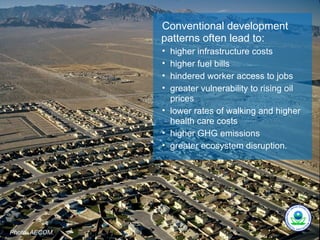
Conventional development
                patterns often lead to:
                • higher infrastructure costs
                • higher fuel bills
                • hindered worker access to jobs
                • greater vulnerability to rising oil
                  prices
                • lower rates of walking and higher
                  health care costs
                • higher GHG emissions
                • greater ecosystem disruption.


Photo: AECOM.
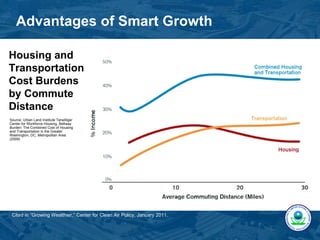
Advantages of Smart Growth

Housing and
Transportation
Cost Burdens
by Commute
Distance
Source: Urban Land Institute Terwilliger
Center for Workforce Housing, Beltway
Burden: The Combined Cost of Housing
and Transportation in the Greater
Washington, DC, Metropolitan Area
(2009)


 Cited in “Growing Wealthier,” Center for Clean Air Policy, January 2011.
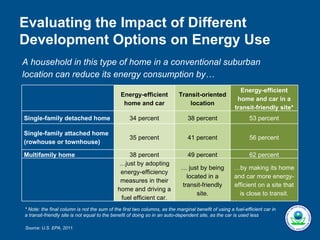
Evaluating the Impact of Different
Development Options on Energy Use
A household in this type of home in a conventional suburban
location can reduce its energy consumption by…
                                                                                                        Energy-efficient
                                              Energy-efficient            Transit-oriented
                                                                                                       home and car in a
                                               home and car                   location
                                                                                                      transit-friendly site*
Single-family detached home                       34 percent                   38 percent                    53 percent

Single-family attached home
                                                  35 percent                   41 percent                    56 percent
(rowhouse or townhouse)

Multifamily home                                 38 percent                    49 percent                    62 percent
                                             …just by adopting
                                                                           … just by being           …by making its home
                                              energy-efficiency
                                                                             located in a            and car more energy-
                                              measures in their
                                                                           transit-friendly          efficient on a site that
                                             home and driving a
                                                                                 site.                 is close to transit.
                                              fuel efficient car.
* Note: the final column is not the sum of the first two columns, as the marginal benefit of using a fuel-efficient car in
a transit-friendly site is not equal to the benefit of doing so in an auto-dependent site, as the car is used less

Source: U.S. EPA, 2011.
Advantages of Compact, Walkable Communities

• Compact development reduces traffic fatalities.
  – Every 1% increase in the index toward more compact development, traffic
    fatality fell by 1.5% and pedestrian fatality rates fell by 3.6% (Reid Ewing, et
    al., 2003)

• Walkable communities save money.
  – A 1999 study by Todd Litman of the Victoria Transportation Policy Institute
    estimated that for each trip not driven, society saves between $1 and $3.50
    in avoided costs (congestion, road maintenance, parking, pollution, noise,
    safety)

• Walkable communities are healthier.
  – Residents of the most walkable environments in Atlanta were found to get
    approximately 37 minutes of moderate activity per day, whereas residents of
    the least walkable environments got only 18 minutes (Lawrence Frank and
    Peter Engelke, 2005)
Cited in “Growing Wealthier,” Center for Clean Air Policy, January 2011.
Advantages of Sustainable Development
   • Sacramento Council of Government found that growing
     in a compact pattern as opposed to sprawl, would result
     in dramatic savings.
      – $9.4 billon less of public infrastructure costs (e.g. transportation, water
        supply, utilities)
      – 14% fewer carbon dioxide emissions
      – $655 million less for residents’ annual fuel costs
      – $8.4 billion less for land purchases to mitigate the environmental harm of
        development
      Cited in “Cities discover economic benefits of sustainable planning, land use,” Sustainable Communities,
      January/February 2011.


Photo: AECOM.
Advantages of Sustainable Design
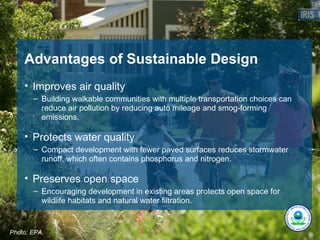
    • Improves air quality
       – Building walkable communities with multiple transportation choices can
         reduce air pollution by reducing auto mileage and smog-forming
         emissions.

    • Protects water quality
       – Compact development with fewer paved surfaces reduces stormwater
         runoff, which often contains phosphorus and nitrogen.
    • Preserves open space
       – Encouraging development in existing areas protects open space for
         wildlife habitats and natural water filtration.
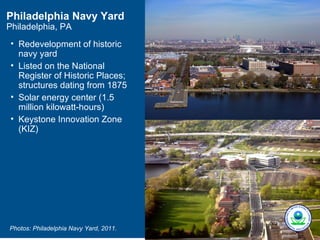

Photo: EPA.
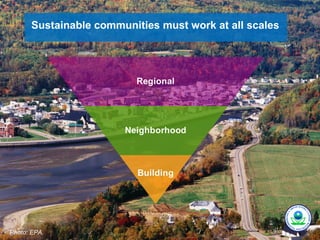
Sustainable communities must work at all scales


Photo: EPA.
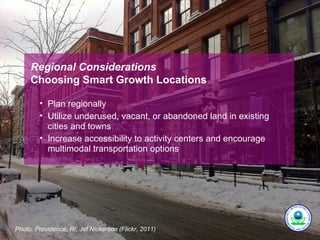
Regional Considerations
     Choosing Smart Growth Locations

        • Plan regionally
        • Utilize underused, vacant, or abandoned land in existing
          cities and towns
        • Increase accessibility to activity centers and encourage
          multimodal transportation options


Photo: Providence, RI; Jef Nickerson (Flickr, 2011)
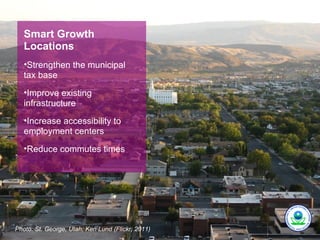
Smart Growth
   Locations
   •Strengthen the municipal
   tax base
   •Improve existing
   infrastructure
   •Increase accessibility to
   employment centers
   •Reduce commutes times


Photo: St. George, Utah; Ken Lund (Flickr, 2011)
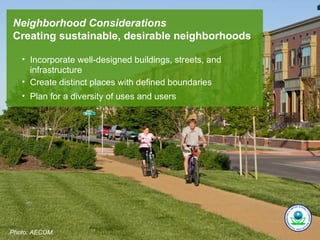
Neighborhood Considerations
Creating sustainable, desirable neighborhoods

   • Incorporate well-designed buildings, streets, and
     infrastructure
   • Create distinct places with defined boundaries
   • Plan for a diversity of uses and users


Photo: AECOM.
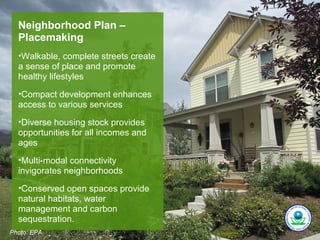
Neighborhood Plan –
  Placemaking
  •Walkable, complete streets create
  a sense of place and promote
  healthy lifestyles
  •Compact development enhances
  access to various services
  •Diverse housing stock provides
  opportunities for all incomes and
  ages
  •Multi-modal connectivity
  invigorates neighborhoods
  •Conserved open spaces provide
  natural habitats, water
  management and carbon
  sequestration.
Photo: EPA.
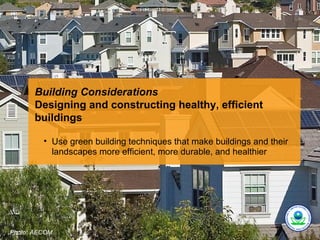
Building Considerations
       Designing and constructing healthy, efficient
       buildings

         • Use green building techniques that make buildings and their
           landscapes more efficient, more durable, and healthier


Photo: AECOM.
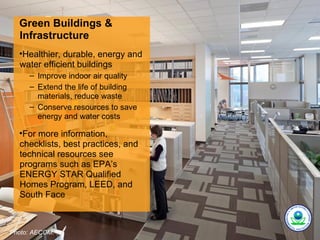
Green Buildings &
  Infrastructure
  •Healthier, durable, energy and
  water efficient buildings
     – Improve indoor air quality
     – Extend the life of building
       materials, reduce waste
     – Conserve resources to save
       energy and water costs

  •For more information,
  checklists, best practices, and
  technical resources see
  programs such as EPA’s
  ENERGY STAR Qualified
  Homes Program, LEED, and
  South Face


Photo: AECOM.
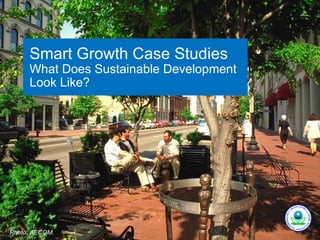
Smart Growth Case Studies
     What Does Sustainable Development
     Look Like?


Photo: AECOM.
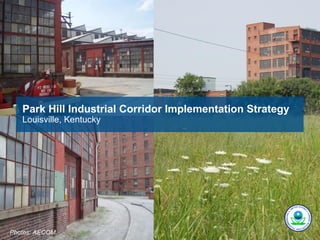
Park Hill Industrial Corridor Implementation Strategy
   Louisville, Kentucky


Photos: AECOM.
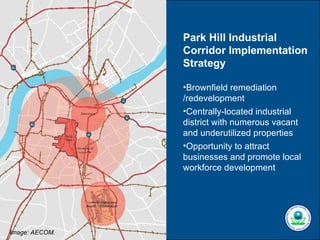
Park Hill Industrial
                Corridor Implementation
                Strategy

                •Brownfield remediation
                /redevelopment
                •Centrally-located industrial
                district with numerous vacant
                and underutilized properties
                •Opportunity to attract
                businesses and promote local
                workforce development


Image: AECOM.
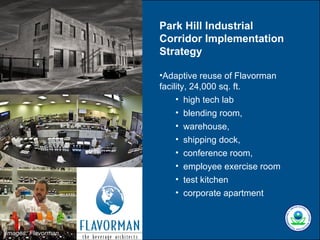
Park Hill Industrial
                     Corridor Implementation
                     Strategy

                     •Adaptive reuse of Flavorman
                     facility, 24,000 sq. ft.
                          • high tech lab
                          • blending room,
                          • warehouse,
                          • shipping dock,
                          • conference room,
                          • employee exercise room
                          • test kitchen
                          • corporate apartment


Images: Flavorman.
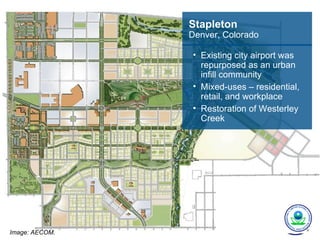
Stapleton
                Denver, Colorado

                • Existing city airport was
                  repurposed as an urban
                  infill community
                • Mixed-uses – residential,
                  retail, and workplace
                • Restoration of Westerley
                  Creek


Image: AECOM.
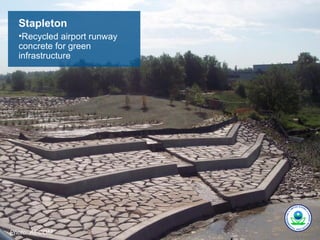
Stapleton
  •Recycled airport runway
  concrete for green
  infrastructure


Photo: AECOM.
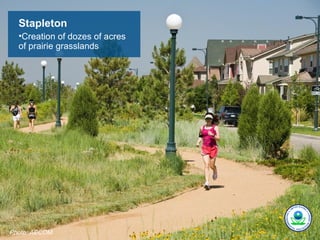
Stapleton
  •Creation of dozes of acres
  of prairie grasslands


Photo: AECOM.
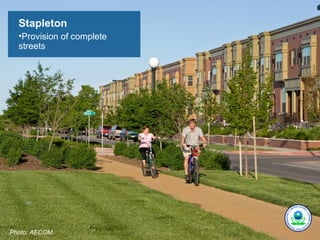
Stapleton
  •Provision of complete
  streets


Photo: AECOM.
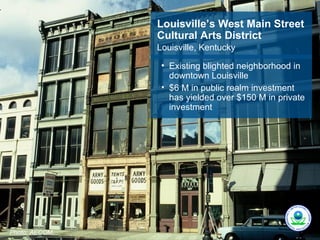
Louisville’s West Main Street
                Cultural Arts District
                Louisville, Kentucky

                 • Existing blighted neighborhood in
                   downtown Louisville
                 • $6 M in public realm investment
                   has yielded over $150 M in private
                   investment


Photo: AECOM.
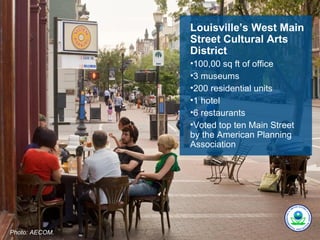
Louisville’s West Main
                Street Cultural Arts
                District
                •100,00 sq ft of office
                •3 museums
                •200 residential units
                •1 hotel
                •6 restaurants
                •Voted top ten Main Street
                by the American Planning
                Association


Photo: AECOM.
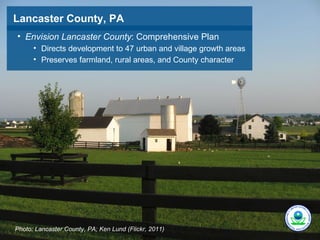
Lancaster County, PA
• Envision Lancaster County: Comprehensive Plan
      • Directs development to 47 urban and village growth areas
      • Preserves farmland, rural areas, and County character


Photo: Lancaster County, PA; Ken Lund (Flickr, 2011)
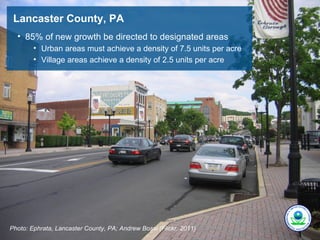
Lancaster County, PA
  • 85% of new growth be directed to designated areas
        • Urban areas must achieve a density of 7.5 units per acre
        • Village areas achieve a density of 2.5 units per acre


Photo: Ephrata, Lancaster County, PA; Andrew Bossi (Flickr, 2011)
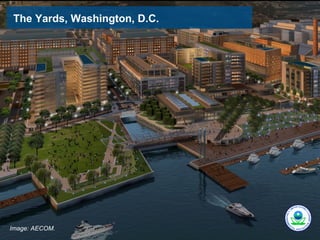
The Yards, Washington, D.C.


Image: AECOM.
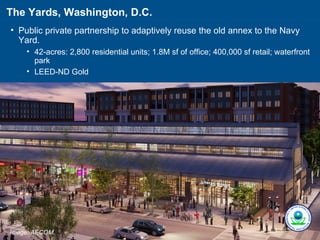
The Yards, Washington, D.C.
• Public private partnership to adaptively reuse the old annex to the Navy
  Yard.
    • 42-acres: 2,800 residential units; 1.8M sf of office; 400,000 sf retail; waterfront
      park
    • LEED-ND Gold


Image: AECOM.
Philadelphia Navy Yard
Philadelphia, PA
 • Redevelopment of historic
   navy yard
 • Listed on the National
   Register of Historic Places;
   structures dating from 1875
 • Solar energy center (1.5
   million kilowatt-hours)
 • Keystone Innovation Zone
   (KIZ)


Photos: Philadelphia Navy Yard, 2011.
Philadelphia Navy Yard
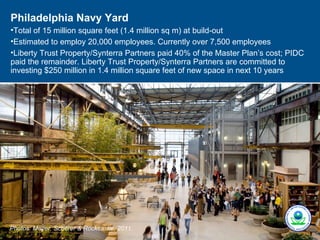
•Total of 15 million square feet (1.4 million sq m) at build-out
•Estimated to employ 20,000 employees. Currently over 7,500 employees
•Liberty Trust Property/Synterra Partners paid 40% of the Master Plan’s cost; PIDC
paid the remainder. Liberty Trust Property/Synterra Partners are committed to
investing $250 million in 1.4 million square feet of new space in next 10 years


Photos: Meyer, Scherer & Rockcastle, 2011.
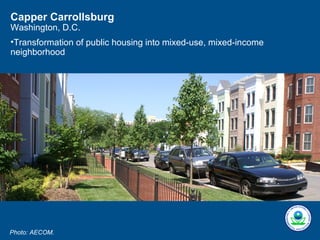
Capper Carrollsburg
Washington, D.C.
•Transformation of public housing into mixed-use, mixed-income
neighborhood


Photo: AECOM.
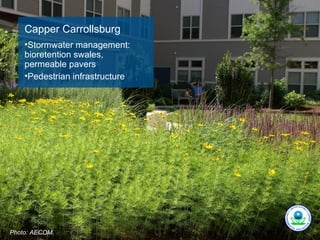
Capper Carrollsburg
    •Stormwater management:
    bioretention swales,
    permeable pavers
    •Pedestrian infrastructure


Photo: AECOM.
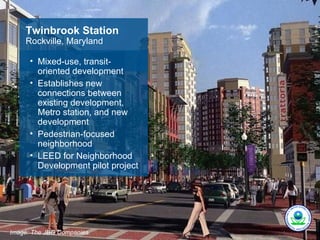
Twinbrook Station
    Rockville, Maryland

      • Mixed-use, transit-
        oriented development
      • Establishes new
        connections between
        existing development,
        Metro station, and new
        development
      • Pedestrian-focused
        neighborhood
      • LEED for Neighborhood
        Development pilot project


Image: The JBG Companies.
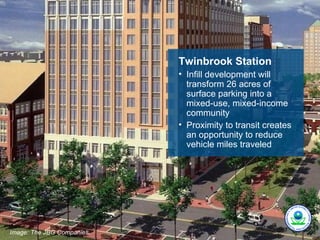
Twinbrook Station
                            • Infill development will
                              transform 26 acres of
                              surface parking into a
                              mixed-use, mixed-income
                              community
                            • Proximity to transit creates
                              an opportunity to reduce
                              vehicle miles traveled


Image: The JBG Companies.
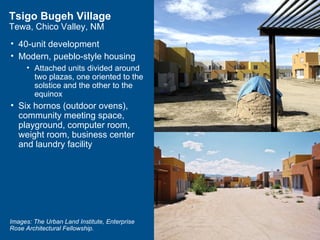
Tsigo Bugeh Village
Tewa, Chico Valley, NM
• 40-unit development
• Modern, pueblo-style housing
     • Attached units divided around
       two plazas, one oriented to the
       solstice and the other to the
       equinox
• Six hornos (outdoor ovens),
  community meeting space,
  playground, computer room,
  weight room, business center
  and laundry facility


Images: The Urban Land Institute, Enterprise
Rose Architectural Fellowship.
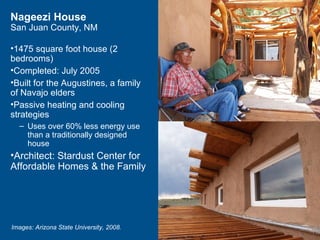
Nageezi House
San Juan County, NM

•1475 square foot house (2
bedrooms)
•Completed: July 2005
•Built for the Augustines, a family
of Navajo elders
•Passive heating and cooling
strategies
  – Uses over 60% less energy use
    than a traditionally designed
    house
•Architect: Stardust Center for
Affordable Homes & the Family


Images: Arizona State University, 2008.
Thank You!


For more information:
www.epa.gov/smartgrowth/buildingblocks.htm

Contact:
Kevin Nelson, AICP
Sustainable Communities Building Blocks Program Manager
nelson.kevin@epa.gov
202-566-2835

Sustainable Communities Building Blocks Program
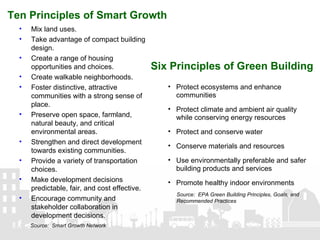
Ten Principles of Smart Growth
  •   Mix land uses.
  •   Take advantage of compact building
      design.
  •   Create a range of housing
      opportunities and choices.               Six Principles of Green Building
  •   Create walkable neighborhoods.
  •   Foster distinctive, attractive              • Protect ecosystems and enhance
      communities with a strong sense of            communities
      place.
                                                  • Protect climate and ambient air quality
  •   Preserve open space, farmland,                while conserving energy resources
      natural beauty, and critical
      environmental areas.                        • Protect and conserve water
  •   Strengthen and direct development
                                                  • Conserve materials and resources
      towards existing communities.
  •   Provide a variety of transportation         • Use environmentally preferable and safer
      choices.                                      building products and services
  •   Make development decisions                  • Promote healthy indoor environments
      predictable, fair, and cost effective.
                                                    Source: EPA Green Building Principles, Goals, and
  •   Encourage community and                       Recommended Practices
      stakeholder collaboration in
      development decisions.
      Source: Smart Growth Network
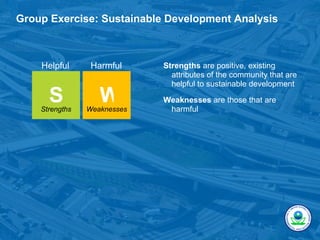
Group Exercise: Sustainable Development Analysis


    Helpful      Harmful     Strengths are positive, existing
                               attributes of the community that are
                               helpful to sustainable development
      S
    Strengths
                   W
                Weaknesses
                             Weaknesses are those that are
                              harmful

Asheboro_Day1_Sustainable_Development

  • 1.
    Sustainable Communities BuildingBlocks Program EPA Office of Sustainable Communities SUSTAINABLE DESIGN + DEVELOPMENT Renaissance Planning Group Asheboro, North Carolina May 21, 2012 Alan Steinbeck, AICP
  • 2.
    About the SustainableCommunities Building Blocks Program • The Sustainable Communities Building Blocks Program seeks to provide quick, targeted technical assistance to communities using a variety of tools that have demonstrated results and widespread application. • This technical assistance will help selected local and/or tribal governments to implement development approaches that protect the environment, improve public health, create jobs, expand economic opportunity, and improve overall quality of life. Sustainable Communities Building Blocks Program
  • 3.
    Sustainable Design +Development • Purpose of Tool: Help communities understand the key principles and decisions at the location, site, and building levels that can result in a more sustainable plan or development proposal. • Builds upon existing EPA publication, Smart Growth Guidelines for Sustainable Design and Developm Sustainable Communities Building Blocks Program
  • 4.
    What is SmartGrowth? Development strategies intended to: • protect open space and farmland, • revitalize existing communities, • maintain affordable housing and • provide a variety of transportation choices. Image: AECOM.
  • 5.
    Smart growth borrowsthe best of traditional neighborhoods and cities. Photo: Port Washington, WI EPA Smart Growth (Flickr, 2011)
  • 6.
    Sustainable development strengthens and directs development towards existing communities Photo: EPA.
  • 7.
    Smart communities allowthe mixing of residential, office and commercial uses in appropriate locations to improve access while reducing the need for car travel. Photo: AECOM.
  • 8.
    Smart Growth createswalkable neighborhoods. Photo: Kirkland, WA; EPA Smart Growth (Flickr, 2011)
  • 9.
    Sustainable communities improveaccessibility by connecting people to destinations and offering multiple ways to get around. Photo: Rideau Canal, Ottawa Vince Alongi (Flickr, 2011)
  • 10.
    Green buildings andsustainable infrastructure make buildings and their landscapes healthier, more efficient, and longer-lasting. Photo: Arlington County(Flickr, 2011)
  • 11.
    Conventional development patterns often lead to: • higher infrastructure costs • higher fuel bills • hindered worker access to jobs • greater vulnerability to rising oil prices • lower rates of walking and higher health care costs • higher GHG emissions • greater ecosystem disruption. Photo: AECOM.
  • 12.
    Advantages of SmartGrowth Housing and Transportation Cost Burdens by Commute Distance Source: Urban Land Institute Terwilliger Center for Workforce Housing, Beltway Burden: The Combined Cost of Housing and Transportation in the Greater Washington, DC, Metropolitan Area (2009) Cited in “Growing Wealthier,” Center for Clean Air Policy, January 2011.
  • 13.
    Evaluating the Impactof Different Development Options on Energy Use A household in this type of home in a conventional suburban location can reduce its energy consumption by… Energy-efficient Energy-efficient Transit-oriented home and car in a home and car location transit-friendly site* Single-family detached home 34 percent 38 percent 53 percent Single-family attached home 35 percent 41 percent 56 percent (rowhouse or townhouse) Multifamily home 38 percent 49 percent 62 percent …just by adopting … just by being …by making its home energy-efficiency located in a and car more energy- measures in their transit-friendly efficient on a site that home and driving a site. is close to transit. fuel efficient car. * Note: the final column is not the sum of the first two columns, as the marginal benefit of using a fuel-efficient car in a transit-friendly site is not equal to the benefit of doing so in an auto-dependent site, as the car is used less Source: U.S. EPA, 2011.
  • 14.
    Advantages of Compact,Walkable Communities • Compact development reduces traffic fatalities. – Every 1% increase in the index toward more compact development, traffic fatality fell by 1.5% and pedestrian fatality rates fell by 3.6% (Reid Ewing, et al., 2003) • Walkable communities save money. – A 1999 study by Todd Litman of the Victoria Transportation Policy Institute estimated that for each trip not driven, society saves between $1 and $3.50 in avoided costs (congestion, road maintenance, parking, pollution, noise, safety) • Walkable communities are healthier. – Residents of the most walkable environments in Atlanta were found to get approximately 37 minutes of moderate activity per day, whereas residents of the least walkable environments got only 18 minutes (Lawrence Frank and Peter Engelke, 2005) Cited in “Growing Wealthier,” Center for Clean Air Policy, January 2011.
  • 15.
    Advantages of SustainableDevelopment • Sacramento Council of Government found that growing in a compact pattern as opposed to sprawl, would result in dramatic savings. – $9.4 billon less of public infrastructure costs (e.g. transportation, water supply, utilities) – 14% fewer carbon dioxide emissions – $655 million less for residents’ annual fuel costs – $8.4 billion less for land purchases to mitigate the environmental harm of development Cited in “Cities discover economic benefits of sustainable planning, land use,” Sustainable Communities, January/February 2011. Photo: AECOM.
  • 16.
    Advantages of SustainableDesign • Improves air quality – Building walkable communities with multiple transportation choices can reduce air pollution by reducing auto mileage and smog-forming emissions. • Protects water quality – Compact development with fewer paved surfaces reduces stormwater runoff, which often contains phosphorus and nitrogen. • Preserves open space – Encouraging development in existing areas protects open space for wildlife habitats and natural water filtration. Photo: EPA.
  • 17.
    Sustainable communities mustwork at all scales Photo: EPA.
  • 18.
    Regional Considerations Choosing Smart Growth Locations • Plan regionally • Utilize underused, vacant, or abandoned land in existing cities and towns • Increase accessibility to activity centers and encourage multimodal transportation options Photo: Providence, RI; Jef Nickerson (Flickr, 2011)
  • 19.
    Smart Growth Locations •Strengthen the municipal tax base •Improve existing infrastructure •Increase accessibility to employment centers •Reduce commutes times Photo: St. George, Utah; Ken Lund (Flickr, 2011)
  • 20.
    Neighborhood Considerations Creating sustainable,desirable neighborhoods • Incorporate well-designed buildings, streets, and infrastructure • Create distinct places with defined boundaries • Plan for a diversity of uses and users Photo: AECOM.
  • 21.
    Neighborhood Plan – Placemaking •Walkable, complete streets create a sense of place and promote healthy lifestyles •Compact development enhances access to various services •Diverse housing stock provides opportunities for all incomes and ages •Multi-modal connectivity invigorates neighborhoods •Conserved open spaces provide natural habitats, water management and carbon sequestration. Photo: EPA.
  • 22.
    Building Considerations Designing and constructing healthy, efficient buildings • Use green building techniques that make buildings and their landscapes more efficient, more durable, and healthier Photo: AECOM.
  • 23.
    Green Buildings & Infrastructure •Healthier, durable, energy and water efficient buildings – Improve indoor air quality – Extend the life of building materials, reduce waste – Conserve resources to save energy and water costs •For more information, checklists, best practices, and technical resources see programs such as EPA’s ENERGY STAR Qualified Homes Program, LEED, and South Face Photo: AECOM.
  • 24.
    Smart Growth CaseStudies What Does Sustainable Development Look Like? Photo: AECOM.
  • 25.
    Park Hill IndustrialCorridor Implementation Strategy Louisville, Kentucky Photos: AECOM.
  • 26.
    Park Hill Industrial Corridor Implementation Strategy •Brownfield remediation /redevelopment •Centrally-located industrial district with numerous vacant and underutilized properties •Opportunity to attract businesses and promote local workforce development Image: AECOM.
  • 27.
    Park Hill Industrial Corridor Implementation Strategy •Adaptive reuse of Flavorman facility, 24,000 sq. ft. • high tech lab • blending room, • warehouse, • shipping dock, • conference room, • employee exercise room • test kitchen • corporate apartment Images: Flavorman.
  • 28.
    Stapleton Denver, Colorado • Existing city airport was repurposed as an urban infill community • Mixed-uses – residential, retail, and workplace • Restoration of Westerley Creek Image: AECOM.
  • 29.
    Stapleton •Recycledairport runway concrete for green infrastructure Photo: AECOM.
  • 30.
    Stapleton •Creationof dozes of acres of prairie grasslands Photo: AECOM.
  • 31.
    Stapleton •Provisionof complete streets Photo: AECOM.
  • 32.
    Louisville’s West MainStreet Cultural Arts District Louisville, Kentucky • Existing blighted neighborhood in downtown Louisville • $6 M in public realm investment has yielded over $150 M in private investment Photo: AECOM.
  • 33.
    Louisville’s West Main Street Cultural Arts District •100,00 sq ft of office •3 museums •200 residential units •1 hotel •6 restaurants •Voted top ten Main Street by the American Planning Association Photo: AECOM.
  • 34.
    Lancaster County, PA •Envision Lancaster County: Comprehensive Plan • Directs development to 47 urban and village growth areas • Preserves farmland, rural areas, and County character Photo: Lancaster County, PA; Ken Lund (Flickr, 2011)
  • 35.
    Lancaster County, PA • 85% of new growth be directed to designated areas • Urban areas must achieve a density of 7.5 units per acre • Village areas achieve a density of 2.5 units per acre Photo: Ephrata, Lancaster County, PA; Andrew Bossi (Flickr, 2011)
  • 36.
    The Yards, Washington,D.C. Image: AECOM.
  • 37.
    The Yards, Washington,D.C. • Public private partnership to adaptively reuse the old annex to the Navy Yard. • 42-acres: 2,800 residential units; 1.8M sf of office; 400,000 sf retail; waterfront park • LEED-ND Gold Image: AECOM.
  • 38.
    Philadelphia Navy Yard Philadelphia,PA • Redevelopment of historic navy yard • Listed on the National Register of Historic Places; structures dating from 1875 • Solar energy center (1.5 million kilowatt-hours) • Keystone Innovation Zone (KIZ) Photos: Philadelphia Navy Yard, 2011.
  • 39.
    Philadelphia Navy Yard •Totalof 15 million square feet (1.4 million sq m) at build-out •Estimated to employ 20,000 employees. Currently over 7,500 employees •Liberty Trust Property/Synterra Partners paid 40% of the Master Plan’s cost; PIDC paid the remainder. Liberty Trust Property/Synterra Partners are committed to investing $250 million in 1.4 million square feet of new space in next 10 years Photos: Meyer, Scherer & Rockcastle, 2011.
  • 40.
    Capper Carrollsburg Washington, D.C. •Transformationof public housing into mixed-use, mixed-income neighborhood Photo: AECOM.
  • 41.
    Capper Carrollsburg •Stormwater management: bioretention swales, permeable pavers •Pedestrian infrastructure Photo: AECOM.
  • 42.
    Twinbrook Station Rockville, Maryland • Mixed-use, transit- oriented development • Establishes new connections between existing development, Metro station, and new development • Pedestrian-focused neighborhood • LEED for Neighborhood Development pilot project Image: The JBG Companies.
  • 43.
    Twinbrook Station • Infill development will transform 26 acres of surface parking into a mixed-use, mixed-income community • Proximity to transit creates an opportunity to reduce vehicle miles traveled Image: The JBG Companies.
  • 44.
    Tsigo Bugeh Village Tewa,Chico Valley, NM • 40-unit development • Modern, pueblo-style housing • Attached units divided around two plazas, one oriented to the solstice and the other to the equinox • Six hornos (outdoor ovens), community meeting space, playground, computer room, weight room, business center and laundry facility Images: The Urban Land Institute, Enterprise Rose Architectural Fellowship.
  • 45.
    Nageezi House San JuanCounty, NM •1475 square foot house (2 bedrooms) •Completed: July 2005 •Built for the Augustines, a family of Navajo elders •Passive heating and cooling strategies – Uses over 60% less energy use than a traditionally designed house •Architect: Stardust Center for Affordable Homes & the Family Images: Arizona State University, 2008.
  • 46.
    Thank You! For moreinformation: www.epa.gov/smartgrowth/buildingblocks.htm Contact: Kevin Nelson, AICP Sustainable Communities Building Blocks Program Manager nelson.kevin@epa.gov 202-566-2835 Sustainable Communities Building Blocks Program
  • 47.
    Ten Principles ofSmart Growth • Mix land uses. • Take advantage of compact building design. • Create a range of housing opportunities and choices. Six Principles of Green Building • Create walkable neighborhoods. • Foster distinctive, attractive • Protect ecosystems and enhance communities with a strong sense of communities place. • Protect climate and ambient air quality • Preserve open space, farmland, while conserving energy resources natural beauty, and critical environmental areas. • Protect and conserve water • Strengthen and direct development • Conserve materials and resources towards existing communities. • Provide a variety of transportation • Use environmentally preferable and safer choices. building products and services • Make development decisions • Promote healthy indoor environments predictable, fair, and cost effective. Source: EPA Green Building Principles, Goals, and • Encourage community and Recommended Practices stakeholder collaboration in development decisions. Source: Smart Growth Network
  • 48.
    Group Exercise: SustainableDevelopment Analysis Helpful Harmful Strengths are positive, existing attributes of the community that are helpful to sustainable development S Strengths W Weaknesses Weaknesses are those that are harmful

Editor's Notes

  • #6 48% of car trips are less than three miles
  • #14 Add images to represent type of house/car
  • #18 48% of car trips are less than three miles
  • #26 Placemaking Adaptive reuse of buildings Characteristic architecture can create sense of place Opportunity for placemaking through the installation of public art
  • #27 1,400 acre site Centrally-located industrial district with numerous vacant and underutilized properties Opportunity to attract businesses and promote local workforce development Remediation and redevelopment of brownfields Opportunity for pedestrian and alternative transportation improvements Access to existing infrastructure: airport, railroads, highways Opportunity for pedestrian and alternative transportation improvements to move local workforce from adjacent neighborhoods to jobs There is a need for and an opportunity for workforce development, with a focus on access and ability to attend (transportation, child care, etc)
  • #28 1,400 acre site Centrally-located industrial district with numerous vacant and underutilized properties Opportunity to attract businesses and promote local workforce development Remediation and redevelopment of brownfields Opportunity for pedestrian and alternative transportation improvements Access to existing infrastructure: airport, railroads, highways Opportunity for pedestrian and alternative transportation improvements to move local workforce from adjacent neighborhoods to jobs There is a need for and an opportunity for workforce development, with a focus on access and ability to attend (transportation, child care, etc)
  • #33 Second largest historic cast iron district in the country, after New York’s Soho Urban revitalization project – previously vacant storefronts The streetscape plan focused on elements in the landscape that could both unify and provide identity for the district. Of special importance were historical features which were expressed as interpretive markers, pavement sculptures, and site furnishings. The site furnishings featured materials found in the architecture, such as cast iron, terra cotta, and limestone. Focus on preserving the scale and character of the neighborhood, highlight historic 19 th century ironwork Stimulated over $150 million in private investment Mixed-use district including offices, art galleries, shops and restaurants
  • #34 Second largest historic cast iron district in the country, after New York’s Soho Urban revitalization project – previously vacant storefronts The streetscape plan focused on elements in the landscape that could both unify and provide identity for the district. Of special importance were historical features which were expressed as interpretive markers, pavement sculptures, and site furnishings. The site furnishings featured materials found in the architecture, such as cast iron, terra cotta, and limestone. Focus on preserving the scale and character of the neighborhood, highlight historic 19 th century ironwork Stimulated over $150 million in private investment Mixed-use district including offices, art galleries, shops and restaurants
  • #41 First project recognized under California’s Zero Energy New Homes program.
  • #42 Infill development Access to transit, walkable to shops, schools, public services
  • #43 Project will transform 26 acres of existing commuter parking lots adjacent to the Twinbrook Metro Station on Red Line of the DC Metro system into 2.2-million-square-foot, mixed-use community. Including residential, retail, commercial space. Opportunity to reduce vehicle miles traveled by providing connections to the adjacent development, the new development and the Metro station “ connect and anchor the sprawling and segregated retail, office and residential areas that currently surround the Twinbrook Metro Station”
  • #44 80% of buildings to pursue LEED certification 15% affordable house 134 dwelling units/acre Partnership between developer, The JGB Companies, and WMATA.
  • #45 pronounced SEE-go BOO-gey Designed to pay homage to one of the oldest housing types in North America, Tsigo Bugeh Village (pronounced SEE-go BOO-gey) is a complex of 40 townhouses arranged around two plazas at San Juan Pueblo, a Native American reservation located a little more than 30 miles (48.3 kilometers) north of Santa Fe, New Mexico. The project features layout and massing that were inspired by the original buildings at the pueblo -- one of the oldest continuously occupied places in North America -- and has both market-rate housing and housing for those earning between 40 and 60 percent of the  area median income .  Funded primarily through  Low-Income Housing Tax Credits  (LIHTCs) and the U.S. Department of Housing and Urban Development (HUD) Native American Housing Assistance and Self-Determination Act of 1996 (NAHASDA), Tsigo Bugeh provides residences primarily to members of the San Juan tribe; non-tribal members are allowed in only if living with a tribal member. Additional funding comes from  HOME funds allocated by the New Mexico Mortgage Finance Authority. Notably, San Juan Pueblo is the first tribe in New Mexico to utilize HOME money.
  • #46 The Nageezi House is the Center's first Affordable + Sustainable Demonstration Home. It is featured in Global Green USA's  Blueprint for Greening Affordable Housing ( Island Press, 2007) and   was   selected as   part of the regional LEED for Homes Pilot program .  The home was completed in July 2005 for the Augustines, a family of Navajo elders living on allotted land of the Navajo Nation in Nageezi, New Mexico. The family's dilapidated home was demolished and the new home was rebuilt on the original slab. Navajo students in the ASU College of Design were an integral part of the design and construction of the home, and the effort evolved into a partnership between the Stardust Center, the Navajo Housing Authority and Navajo FlexCrete, a tribally-owned enterprise. Navajo FlexCrete is a highly insulated aerated concrete block made with fly-ash, a waste product of coal-energy production. The Nageezi House was the first to be built with this material. The home's innovative design reflects the traditional structures of the Navajo, including the  hooghan (home)   and the  chahash'oh ( shade structure ) , After the Augustines moved into their new home, the Stardust Center monitored the house for one year to determine its thermal performance. Overall, the home exceeded performance predictions, demonstrating a 60% reduction in energy use compared to a conventionally-constructed house of the same size. The Center is currently working with the Navajo Housing Authority to develop production versions of the Nageezi House for construction across the reservation. http://stardust.asu.edu/projects/detail.php?id=65