CNU’s Potential Carbon Campaign: Strategy Discussion and Project Update March 5, 2009
Background and Secondary Research
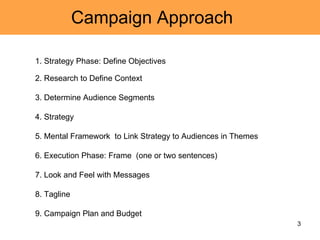
Campaign Approach 1. Strategy Phase: Define Objectives 2. Research to Define Context 3. Determine Audience Segments 4. Strategy  5. Mental Framework  to Link Strategy to Audiences in Themes 6. Execution Phase: Frame  (one or two sentences) 7. Look and Feel with Messages 8. Tagline 9. Campaign Plan and Budget
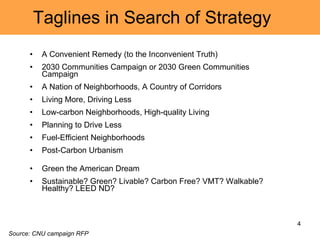
Taglines in Search of Strategy A Convenient Remedy (to the Inconvenient Truth) 2030 Communities Campaign or 2030 Green Communities Campaign A Nation of Neighborhoods, A Country of Corridors Living More, Driving Less Low-carbon Neighborhoods, High-quality Living Planning to Drive Less Fuel-Efficient Neighborhoods Post-Carbon Urbanism Green the American Dream Sustainable? Green? Livable? Carbon Free? VMT? Walkable? Healthy? LEED ND? Source: CNU campaign RFP
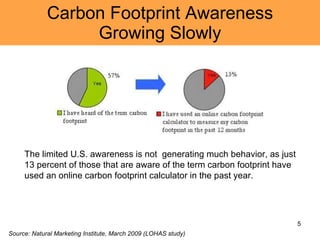
Carbon Footprint Awareness Growing Slowly                                                                                                                                            The limited U.S. awareness is not  generating much behavior, as just 13 percent of those that are aware of the term carbon footprint have used an online carbon footprint calculator in the past year. Source: Natural Marketing Institute, March 2009 (LOHAS study)
Conclusions from Secondary Sources All heat and no “light” Extreme focus on a) proving factual basis of climate change and b) inside baseball policy debates and c) calculators Awareness of global warming has skyrocketed at the consumer and business level - although nearly half the country doesn’t believe in it Crisis mentality creates urgency and passion in some but not most Hand wringing and “challenges” not translating to wins on the ground. Focus is systemic and not personal. Many carbon campaigns are out there - but messages are fractured and not providing any real “air cover”  Source: Collective Strength Secondary Review, 2009
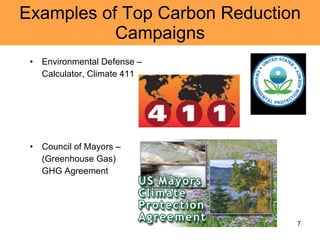
Examples of Top Carbon Reduction Campaigns Environmental Defense –  Calculator, Climate 411 Council of Mayors –  (Greenhouse Gas)  GHG Agreement
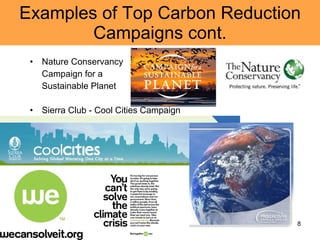
Nature Conservancy Campaign for a  Sustainable Planet Sierra Club - Cool Cities Campaign Examples of Top Carbon Reduction Campaigns cont.
Stakeholder Research
List of Stakeholders Interviewed Ben Brown  Placemaker's  Doug Farr Farr Associates Joe DiStefano Calthorpe Associates Sam Sherman BIA (Builder's Association)  Victor Dover Dover Kohl Carol Colletta CEOs for Cities Chris Leinberger Brookings Institute Mayor David Cieslewicz Madison, WI Nick Donahue Assistant Secretary of Transportation,  Office of Governor Kaine (Virginia) Rose Sheridan American Public Transportation Association Tim Busse Architect, Whittaker Builders Liz Moule Moule & Polyzoides Architects Jim Marston Environmental Defense
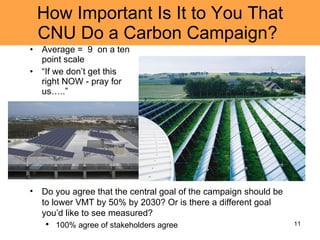
How Important Is It to You That CNU Do a Carbon Campaign?  Average =  9  on a ten point scale “ If we don’t get this right NOW - pray for us…..” Do you agree that the central goal of the campaign should be to lower VMT by 50% by 2030? Or is there a different goal you’d like to see measured? 100% agree of stakeholders agree
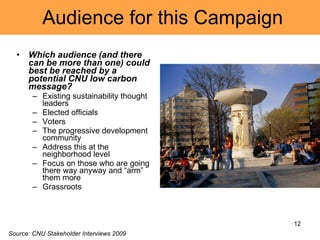
Audience for this Campaign Which audience (and there can be more than one) could best be reached by a potential CNU low carbon message? Existing sustainability thought leaders Elected officials Voters The progressive development community Address this at the neighborhood level Focus on those who are going there way anyway and “arm” them more Grassroots Source: CNU Stakeholder Interviews 2009
What should the CNU low carbon message be? “ Listen to what their desires are, talk about what concerns them directly” “ The traction is going to be in answering what communities want – how do I get out of my car for example” “ Look for something deep and intrinsic in them. Identify what they love about where they live and what the concerns and threats are” “ I don’t feel low carbon is the trick – it doesn’t speak to breadth of the issue” Source: CNU Stakeholder Interviews 2009
What should the CNU low carbon message be? Cont. “ Sustainability, carbon are words that don’t resonate” “ Lifestyle not carbon. People have to study up on carbon. Carbon – the best you can hopeful is ‘neutral’. We can find something that is more inspiring and personal” “ Drive less/ Live more” We need to decide what the product is first before framing or taglines.  We need to decide who we are and what we want to sell. Source: CNU Stakeholder Interviews 2009
CNU’s Strengths and Weaknesses Strengths: Bold ideas, bringing them to the mainstream Inherent in the new urbanism from the begining is the wise use of resources Fearless Not beholden to anyone  developing tools Rendering and visuals Convening Dialog Education Weaknesses: Ego-maniac architects can come off as elitist Making alliances Not good at modeling and backing up ideas with facts and numbers Way too many cooks in the kitchen Making suburbs look better  Seeking the perfect instead of the practical Source: CNU Stakeholder Interviews 2009
CNU Top of Mind and Importance When you think about CNU, what is the first thing that comes to mind? What is the most important thing that CNU does for the US right now? They are best at the neighborhood level, next best at a regional level Not good at all from a global level Design matters. Walkability, mixed use, diverse housing, historic preservation Working hard to change the rules Bringing cutting edge ideas into the mainstream Convening It’s a national body of real experts Fearless and not beholden to anybody Source: CNU Stakeholder Interviews 2009
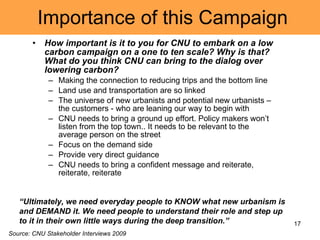
Importance of this Campaign How important is it to you for CNU to embark on a low carbon campaign on a one to ten scale? Why is that? What do you think CNU can bring to the dialog over lowering carbon? Making the connection to reducing trips and the bottom line Land use and transportation are so linked The universe of new urbanists and potential new urbanists – the customers - who are leaning our way to begin with CNU needs to bring a ground up effort. Policy makers won’t listen from the top town.. It needs to be relevant to the average person on the street Focus on the demand side Provide very direct guidance CNU needs to bring a confident message and reiterate, reiterate, reiterate Source: CNU Stakeholder Interviews 2009 “ Ultimately, we need everyday people to KNOW what new urbanism is and DEMAND it. We need people to understand their role and step up to it in their own little ways during the deep transition.”
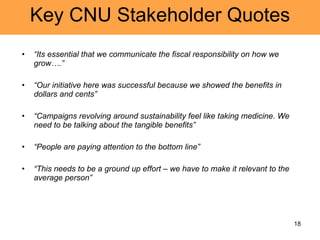
Key CNU Stakeholder Quotes “ Its essential that we communicate the fiscal responsibility on how we grow….” “ Our initiative here was successful because we showed the benefits in dollars and cents” “ Campaigns revolving around sustainability feel like taking medicine. We need to be talking about the tangible benefits” “ People are paying attention to the bottom line” “ This needs to be a ground up effort – we have to make it relevant to the average person”
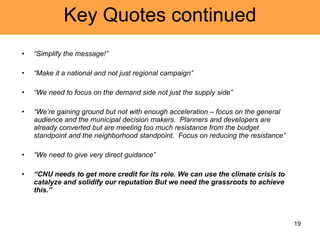
Key Quotes continued “ Simplify the message!” “ Make it a national and not just regional campaign” “ We need to focus on the demand side not just the supply side” “ We’re gaining ground but not with enough acceleration – focus on the general audience and the municipal decision makers.  Planners and developers are already converted but are meeting too much resistance from the budget standpoint and the neighborhood standpoint.  Focus on reducing the resistance” “ We need to give very direct guidance” “ CNU needs to get more credit for its role. We can use the climate crisis to catalyze and solidify our reputation But we need the grassroots to achieve this.”
Synthesis of What We've Learned
Strategic Implications  Leverage CNU strength in being  bold, visual agents of change and take it now to a) the grassroots and b) the main sources of resistance now Attack VMT in plain English  Attack the resistors with irrefutable facts and benefits  Encourage the already “green consumer” to take incremental, low cost “pre-new urbanist” steps now Sell lifestyle and benefits don’t get  PREACHY  or focus on  POLICY Go around the media  - don’t rely on them to get it or do it for you Campaign should be driven by digital/ social media and be hyper visual, not wordy.
Changes in the American Psyche  2001 to 2009 Post 9/11. Post Bailout.  Animosity towards the role of Big Oil in our lives and country Energy Independence “ The Long Emergency” OD on Doom and Outrage Economic catastrophe Insecurity is one of the dominant national frames The power of the grassroots to inspire and move us forward as salvation and transformation.  ( Yes. We. Can. ) People are not going to be moving into new dwellings or new neighborhoods at the same pace in the next five years.  What are we doing to help advance new urbanism during the transition to a new stability?
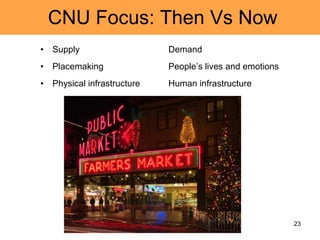
CNU Focus: Then Vs Now Supply  Demand Placemaking People’s lives and emotions Physical infrastructure  Human infrastructure
Possible Steps for Human Infrastructure  Incremental, low/no cost  steps towards new urbanism Highlighting the tangible and emotional benefits of new urbanism as a here and now experience Building organic, self-organizing new urbanist "thought" corridors Empowering everyday people to "feel the difference"  for themselves and to demand more for their tax dollars
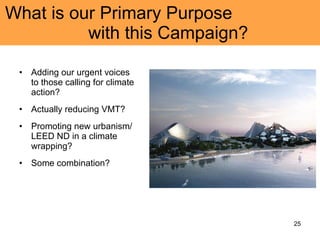
What is our Primary Purpose  with this Campaign?  Adding our urgent voices to those calling for climate action? Actually reducing VMT?  Promoting new urbanism/ LEED ND in a climate wrapping? Some combination?
CNU’s Carbon Paradox We need a VMT reduction campaign BUT Don’t use the words carbon, climate  or VMT Don’t just talk about the alarming “proof” of the Truth Don’t assume people know what you want them to do let alone what they will love about it Buying new homes and moving into new neighborhoods is not the paradigm right now How to make new urbanism relevant in the new economic reality?
Key Audiences
Priority  Audiences Three key audience segments: Directly involved professionals in metro areas State and local elected officials in metropolitan areas State and local agency city managers, CFOs, planners and transportation engineers Transportation engineers Investors and bankers Masters of the universe (small, medium and large business CEOs) Neighborhood leaders in metro areas Already green members of the general public - NPR audience in metro areas
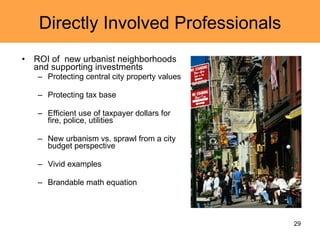
Directly Involved Professionals ROI of  new urbanist neighborhoods and supporting investments Protecting central city property values Protecting tax base Efficient use of taxpayer dollars for fire, police, utilities New urbanism vs. sprawl from a city budget perspective Vivid examples Brandable math equation
Top Ten Issues to Watch for 2009 Balancing the Budget College Tuition Guns Transportation Global Warming Social Safety Net Corrections Energy Controlling Health Costs Redistricting Source: Governing Magazine, February 2008
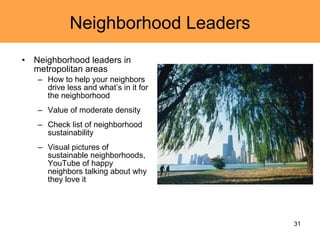
Neighborhood Leaders Neighborhood leaders in metropolitan areas  How to help your neighbors drive less and what’s in it for the neighborhood Value of moderate density Check list of neighborhood sustainability Visual pictures of sustainable neighborhoods, YouTube of happy neighbors talking about why they love it
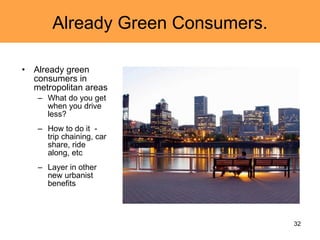
Already Green Consumers. Already green consumers in metropolitan areas What do you get when you drive less?  How to do it  - trip chaining, car share, ride along, etc Layer in other new urbanist benefits
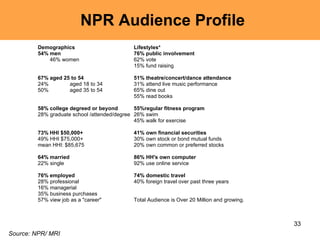
NPR Audience Profile Demographics Lifestyles* 54% men 76% public involvement 46% women 62% vote 15% fund raising 67% aged 25 to 54   51%   theatre/concert/dance attendance 24%  aged 18 to 34  31% attend live music performance 50%  aged 35 to 54 65% dine out 55% read books 58% college degreed or beyond 55%regular fitness program 28% graduate school /attended/degree 26% swim  45% walk for exercise 73% HHI $50,000+ 41%   own financial securities 49% HHI $75,000+  30% own stock or bond mutual funds  mean HHI: $85,675   20% own common or preferred stocks 64% married   86%   HH's own computer 22% single   92% use online service 76% employed   74%   domestic travel  28% professional  40% foreign travel over past three years 16% managerial 35% business purchases 57% view job as a "career"  Total Audience is Over 20 Million and growing.  Source: NPR/ MRI
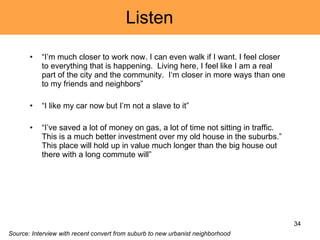
Listen  “ I’m much closer to work now. I can even walk if I want. I feel closer to everything that is happening.  Living here, I feel like I am a real part of the city and the community.  I‘m closer in more ways than one to my friends and neighbors” “ I like my car now but I’m not a slave to it” “ I’ve saved a lot of money on gas, a lot of time not sitting in traffic. This is a much better investment over my old house in the suburbs.”  This place will hold up in value much longer than the big house out there with a long commute will”  Source: Interview with recent convert from suburb to new urbanist neighborhood
First Mental Framework
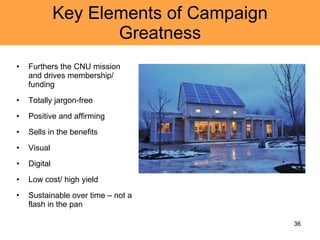
Key Elements of Campaign Greatness Furthers the CNU mission and drives membership/ funding  Totally jargon-free Positive and affirming Sells in the benefits Visual Digital Low cost/ high yield Sustainable over time – not a flash in the pan
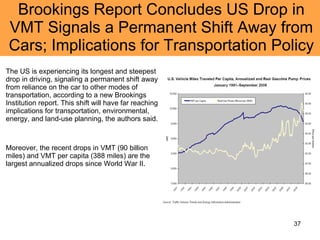
Brookings Report Concludes US Drop in VMT Signals a Permanent Shift Away from Cars; Implications for Transportation Policy The US is experiencing its longest and steepest drop in driving, signaling a permanent shift away from reliance on the car to other modes of transportation, according to a new Brookings Institution report. This shift will have far reaching implications for transportation, environmental, energy, and land-use planning, the authors said. Moreover, the recent drops in VMT (90 billion miles) and VMT per capita (388 miles) are the largest annualized drops since World War II.
Brookings Report Continued “ The American driver has hit a wall. We are now driving the same distance per year as we did in 1998.” —Robert Puentes From October 2007 to September 2008, Americans drove 90 billion fewer miles than the same time period the year before. For the first time in US history, the amount of roadway available to drivers is outpacing the number of miles actually driven. Transit use is at its highest level since the 1950’s, and Amtrak just set a ridership record this year. The Brookings report identifies a variety of factors as responsible for the decline in driving:  Market saturation of vehicle ownership;  A plateau in the number of women entering the workforce;  A possible ceiling in the amount of driving any one individual can tolerate;  Increased ridership on mass transit;  The development of commercial centers closer to home; and  Rising unemployment. Fewer drivers on the road have brought revenues from the gas tax, the primary source of funding for transportation projects, to all-time lows.
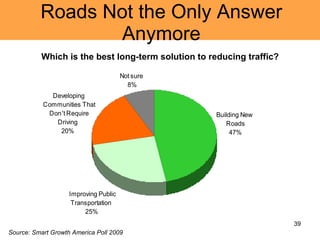
Roads Not the Only Answer Anymore Which is the best long-term solution to reducing traffic? Source: Smart Growth America Poll 2009
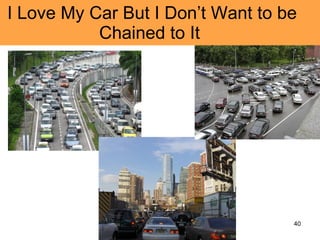
I Love My Car But I Don’t Want to be Chained to It
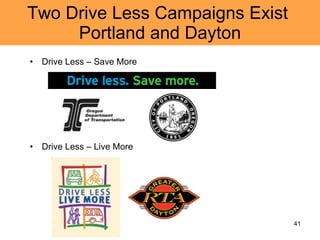
Two Drive Less Campaigns Exist  Portland and Dayton Drive Less – Save More Drive Less – Live More
Drive Less. Direct Guidance With Benefits Drive Less – Save More Live More Walk More Connect More Prosper More  Appreciate More Ask More Give Back More Green it Up More Help America More Help the Planet More Kiss off Big Oil More Drive Less - Go Farther
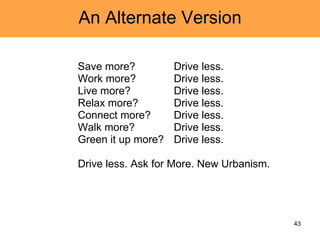
An Alternate Version Save more?  Drive less. Work more?  Drive less. Live more?  Drive less. Relax more?  Drive less. Connect more?  Drive less. Walk more?  Drive less. Green it up more?  Drive less. Drive less. Ask for More. New Urbanism.
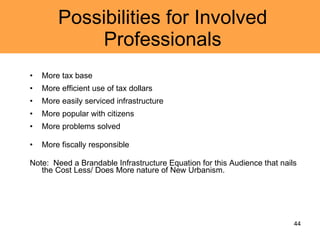
Possibilities for Involved Professionals More tax base More efficient use of tax dollars More easily serviced infrastructure More popular with citizens More problems solved More fiscally responsible Note:  Need a Brandable Infrastructure Equation for this Audience that nails the Cost Less/ Does More nature of New Urbanism.
Recommendation and Next Steps
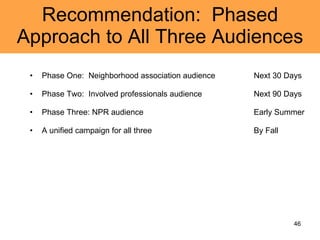
Recommendation:  Phased Approach to All Three Audiences Phase One:  Neighborhood association audience Next 30 Days Phase Two:  Involved professionals audience  Next 90 Days Phase Three: NPR audience  Early Summer A unified campaign for all three By Fall
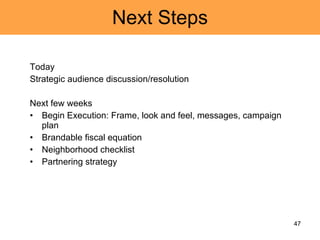
Next Steps Today Strategic audience discussion/resolution Next few weeks Begin Execution: Frame, look and feel, messages, campaign plan Brandable fiscal equation Neighborhood checklist Partnering strategy
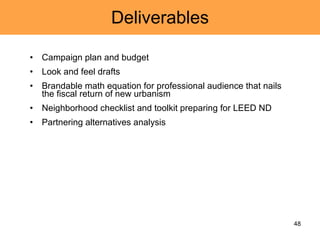
Deliverables Campaign plan and budget Look and feel drafts Brandable math equation for professional audience that nails the fiscal return of new urbanism Neighborhood checklist and toolkit preparing for LEED ND Partnering alternatives analysis

Cnu Carbon Update Final3 09

  • 1.
    CNU’s Potential CarbonCampaign: Strategy Discussion and Project Update March 5, 2009
  • 2.
  • 3.
    Campaign Approach 1.Strategy Phase: Define Objectives 2. Research to Define Context 3. Determine Audience Segments 4. Strategy 5. Mental Framework to Link Strategy to Audiences in Themes 6. Execution Phase: Frame (one or two sentences) 7. Look and Feel with Messages 8. Tagline 9. Campaign Plan and Budget
  • 4.
    Taglines in Searchof Strategy A Convenient Remedy (to the Inconvenient Truth) 2030 Communities Campaign or 2030 Green Communities Campaign A Nation of Neighborhoods, A Country of Corridors Living More, Driving Less Low-carbon Neighborhoods, High-quality Living Planning to Drive Less Fuel-Efficient Neighborhoods Post-Carbon Urbanism Green the American Dream Sustainable? Green? Livable? Carbon Free? VMT? Walkable? Healthy? LEED ND? Source: CNU campaign RFP
  • 5.
    Carbon Footprint AwarenessGrowing Slowly                                                                                                                                            The limited U.S. awareness is not  generating much behavior, as just 13 percent of those that are aware of the term carbon footprint have used an online carbon footprint calculator in the past year. Source: Natural Marketing Institute, March 2009 (LOHAS study)
  • 6.
    Conclusions from SecondarySources All heat and no “light” Extreme focus on a) proving factual basis of climate change and b) inside baseball policy debates and c) calculators Awareness of global warming has skyrocketed at the consumer and business level - although nearly half the country doesn’t believe in it Crisis mentality creates urgency and passion in some but not most Hand wringing and “challenges” not translating to wins on the ground. Focus is systemic and not personal. Many carbon campaigns are out there - but messages are fractured and not providing any real “air cover” Source: Collective Strength Secondary Review, 2009
  • 7.
    Examples of TopCarbon Reduction Campaigns Environmental Defense – Calculator, Climate 411 Council of Mayors – (Greenhouse Gas) GHG Agreement
  • 8.
    Nature Conservancy Campaignfor a Sustainable Planet Sierra Club - Cool Cities Campaign Examples of Top Carbon Reduction Campaigns cont.
  • 9.
  • 10.
    List of StakeholdersInterviewed Ben Brown Placemaker's Doug Farr Farr Associates Joe DiStefano Calthorpe Associates Sam Sherman BIA (Builder's Association) Victor Dover Dover Kohl Carol Colletta CEOs for Cities Chris Leinberger Brookings Institute Mayor David Cieslewicz Madison, WI Nick Donahue Assistant Secretary of Transportation, Office of Governor Kaine (Virginia) Rose Sheridan American Public Transportation Association Tim Busse Architect, Whittaker Builders Liz Moule Moule & Polyzoides Architects Jim Marston Environmental Defense
  • 11.
    How Important IsIt to You That CNU Do a Carbon Campaign? Average = 9 on a ten point scale “ If we don’t get this right NOW - pray for us…..” Do you agree that the central goal of the campaign should be to lower VMT by 50% by 2030? Or is there a different goal you’d like to see measured? 100% agree of stakeholders agree
  • 12.
    Audience for thisCampaign Which audience (and there can be more than one) could best be reached by a potential CNU low carbon message? Existing sustainability thought leaders Elected officials Voters The progressive development community Address this at the neighborhood level Focus on those who are going there way anyway and “arm” them more Grassroots Source: CNU Stakeholder Interviews 2009
  • 13.
    What should theCNU low carbon message be? “ Listen to what their desires are, talk about what concerns them directly” “ The traction is going to be in answering what communities want – how do I get out of my car for example” “ Look for something deep and intrinsic in them. Identify what they love about where they live and what the concerns and threats are” “ I don’t feel low carbon is the trick – it doesn’t speak to breadth of the issue” Source: CNU Stakeholder Interviews 2009
  • 14.
    What should theCNU low carbon message be? Cont. “ Sustainability, carbon are words that don’t resonate” “ Lifestyle not carbon. People have to study up on carbon. Carbon – the best you can hopeful is ‘neutral’. We can find something that is more inspiring and personal” “ Drive less/ Live more” We need to decide what the product is first before framing or taglines. We need to decide who we are and what we want to sell. Source: CNU Stakeholder Interviews 2009
  • 15.
    CNU’s Strengths andWeaknesses Strengths: Bold ideas, bringing them to the mainstream Inherent in the new urbanism from the begining is the wise use of resources Fearless Not beholden to anyone developing tools Rendering and visuals Convening Dialog Education Weaknesses: Ego-maniac architects can come off as elitist Making alliances Not good at modeling and backing up ideas with facts and numbers Way too many cooks in the kitchen Making suburbs look better Seeking the perfect instead of the practical Source: CNU Stakeholder Interviews 2009
  • 16.
    CNU Top ofMind and Importance When you think about CNU, what is the first thing that comes to mind? What is the most important thing that CNU does for the US right now? They are best at the neighborhood level, next best at a regional level Not good at all from a global level Design matters. Walkability, mixed use, diverse housing, historic preservation Working hard to change the rules Bringing cutting edge ideas into the mainstream Convening It’s a national body of real experts Fearless and not beholden to anybody Source: CNU Stakeholder Interviews 2009
  • 17.
    Importance of thisCampaign How important is it to you for CNU to embark on a low carbon campaign on a one to ten scale? Why is that? What do you think CNU can bring to the dialog over lowering carbon? Making the connection to reducing trips and the bottom line Land use and transportation are so linked The universe of new urbanists and potential new urbanists – the customers - who are leaning our way to begin with CNU needs to bring a ground up effort. Policy makers won’t listen from the top town.. It needs to be relevant to the average person on the street Focus on the demand side Provide very direct guidance CNU needs to bring a confident message and reiterate, reiterate, reiterate Source: CNU Stakeholder Interviews 2009 “ Ultimately, we need everyday people to KNOW what new urbanism is and DEMAND it. We need people to understand their role and step up to it in their own little ways during the deep transition.”
  • 18.
    Key CNU StakeholderQuotes “ Its essential that we communicate the fiscal responsibility on how we grow….” “ Our initiative here was successful because we showed the benefits in dollars and cents” “ Campaigns revolving around sustainability feel like taking medicine. We need to be talking about the tangible benefits” “ People are paying attention to the bottom line” “ This needs to be a ground up effort – we have to make it relevant to the average person”
  • 19.
    Key Quotes continued“ Simplify the message!” “ Make it a national and not just regional campaign” “ We need to focus on the demand side not just the supply side” “ We’re gaining ground but not with enough acceleration – focus on the general audience and the municipal decision makers. Planners and developers are already converted but are meeting too much resistance from the budget standpoint and the neighborhood standpoint. Focus on reducing the resistance” “ We need to give very direct guidance” “ CNU needs to get more credit for its role. We can use the climate crisis to catalyze and solidify our reputation But we need the grassroots to achieve this.”
  • 20.
    Synthesis of WhatWe've Learned
  • 21.
    Strategic Implications Leverage CNU strength in being bold, visual agents of change and take it now to a) the grassroots and b) the main sources of resistance now Attack VMT in plain English Attack the resistors with irrefutable facts and benefits Encourage the already “green consumer” to take incremental, low cost “pre-new urbanist” steps now Sell lifestyle and benefits don’t get PREACHY or focus on POLICY Go around the media - don’t rely on them to get it or do it for you Campaign should be driven by digital/ social media and be hyper visual, not wordy.
  • 22.
    Changes in theAmerican Psyche 2001 to 2009 Post 9/11. Post Bailout. Animosity towards the role of Big Oil in our lives and country Energy Independence “ The Long Emergency” OD on Doom and Outrage Economic catastrophe Insecurity is one of the dominant national frames The power of the grassroots to inspire and move us forward as salvation and transformation. ( Yes. We. Can. ) People are not going to be moving into new dwellings or new neighborhoods at the same pace in the next five years. What are we doing to help advance new urbanism during the transition to a new stability?
  • 23.
    CNU Focus: ThenVs Now Supply Demand Placemaking People’s lives and emotions Physical infrastructure Human infrastructure
  • 24.
    Possible Steps forHuman Infrastructure Incremental, low/no cost steps towards new urbanism Highlighting the tangible and emotional benefits of new urbanism as a here and now experience Building organic, self-organizing new urbanist "thought" corridors Empowering everyday people to "feel the difference" for themselves and to demand more for their tax dollars
  • 25.
    What is ourPrimary Purpose with this Campaign? Adding our urgent voices to those calling for climate action? Actually reducing VMT? Promoting new urbanism/ LEED ND in a climate wrapping? Some combination?
  • 26.
    CNU’s Carbon ParadoxWe need a VMT reduction campaign BUT Don’t use the words carbon, climate or VMT Don’t just talk about the alarming “proof” of the Truth Don’t assume people know what you want them to do let alone what they will love about it Buying new homes and moving into new neighborhoods is not the paradigm right now How to make new urbanism relevant in the new economic reality?
  • 27.
  • 28.
    Priority AudiencesThree key audience segments: Directly involved professionals in metro areas State and local elected officials in metropolitan areas State and local agency city managers, CFOs, planners and transportation engineers Transportation engineers Investors and bankers Masters of the universe (small, medium and large business CEOs) Neighborhood leaders in metro areas Already green members of the general public - NPR audience in metro areas
  • 29.
    Directly Involved ProfessionalsROI of new urbanist neighborhoods and supporting investments Protecting central city property values Protecting tax base Efficient use of taxpayer dollars for fire, police, utilities New urbanism vs. sprawl from a city budget perspective Vivid examples Brandable math equation
  • 30.
    Top Ten Issuesto Watch for 2009 Balancing the Budget College Tuition Guns Transportation Global Warming Social Safety Net Corrections Energy Controlling Health Costs Redistricting Source: Governing Magazine, February 2008
  • 31.
    Neighborhood Leaders Neighborhoodleaders in metropolitan areas How to help your neighbors drive less and what’s in it for the neighborhood Value of moderate density Check list of neighborhood sustainability Visual pictures of sustainable neighborhoods, YouTube of happy neighbors talking about why they love it
  • 32.
    Already Green Consumers.Already green consumers in metropolitan areas What do you get when you drive less? How to do it - trip chaining, car share, ride along, etc Layer in other new urbanist benefits
  • 33.
    NPR Audience ProfileDemographics Lifestyles* 54% men 76% public involvement 46% women 62% vote 15% fund raising 67% aged 25 to 54 51% theatre/concert/dance attendance 24% aged 18 to 34 31% attend live music performance 50% aged 35 to 54 65% dine out 55% read books 58% college degreed or beyond 55%regular fitness program 28% graduate school /attended/degree 26% swim 45% walk for exercise 73% HHI $50,000+ 41% own financial securities 49% HHI $75,000+ 30% own stock or bond mutual funds mean HHI: $85,675 20% own common or preferred stocks 64% married 86% HH's own computer 22% single 92% use online service 76% employed 74% domestic travel 28% professional 40% foreign travel over past three years 16% managerial 35% business purchases 57% view job as a "career" Total Audience is Over 20 Million and growing. Source: NPR/ MRI
  • 34.
    Listen “I’m much closer to work now. I can even walk if I want. I feel closer to everything that is happening. Living here, I feel like I am a real part of the city and the community. I‘m closer in more ways than one to my friends and neighbors” “ I like my car now but I’m not a slave to it” “ I’ve saved a lot of money on gas, a lot of time not sitting in traffic. This is a much better investment over my old house in the suburbs.” This place will hold up in value much longer than the big house out there with a long commute will” Source: Interview with recent convert from suburb to new urbanist neighborhood
  • 35.
  • 36.
    Key Elements ofCampaign Greatness Furthers the CNU mission and drives membership/ funding Totally jargon-free Positive and affirming Sells in the benefits Visual Digital Low cost/ high yield Sustainable over time – not a flash in the pan
  • 37.
    Brookings Report ConcludesUS Drop in VMT Signals a Permanent Shift Away from Cars; Implications for Transportation Policy The US is experiencing its longest and steepest drop in driving, signaling a permanent shift away from reliance on the car to other modes of transportation, according to a new Brookings Institution report. This shift will have far reaching implications for transportation, environmental, energy, and land-use planning, the authors said. Moreover, the recent drops in VMT (90 billion miles) and VMT per capita (388 miles) are the largest annualized drops since World War II.
  • 38.
    Brookings Report Continued“ The American driver has hit a wall. We are now driving the same distance per year as we did in 1998.” —Robert Puentes From October 2007 to September 2008, Americans drove 90 billion fewer miles than the same time period the year before. For the first time in US history, the amount of roadway available to drivers is outpacing the number of miles actually driven. Transit use is at its highest level since the 1950’s, and Amtrak just set a ridership record this year. The Brookings report identifies a variety of factors as responsible for the decline in driving: Market saturation of vehicle ownership; A plateau in the number of women entering the workforce; A possible ceiling in the amount of driving any one individual can tolerate; Increased ridership on mass transit; The development of commercial centers closer to home; and Rising unemployment. Fewer drivers on the road have brought revenues from the gas tax, the primary source of funding for transportation projects, to all-time lows.
  • 39.
    Roads Not theOnly Answer Anymore Which is the best long-term solution to reducing traffic? Source: Smart Growth America Poll 2009
  • 40.
    I Love MyCar But I Don’t Want to be Chained to It
  • 41.
    Two Drive LessCampaigns Exist Portland and Dayton Drive Less – Save More Drive Less – Live More
  • 42.
    Drive Less. DirectGuidance With Benefits Drive Less – Save More Live More Walk More Connect More Prosper More Appreciate More Ask More Give Back More Green it Up More Help America More Help the Planet More Kiss off Big Oil More Drive Less - Go Farther
  • 43.
    An Alternate VersionSave more? Drive less. Work more? Drive less. Live more? Drive less. Relax more? Drive less. Connect more? Drive less. Walk more? Drive less. Green it up more? Drive less. Drive less. Ask for More. New Urbanism.
  • 44.
    Possibilities for InvolvedProfessionals More tax base More efficient use of tax dollars More easily serviced infrastructure More popular with citizens More problems solved More fiscally responsible Note: Need a Brandable Infrastructure Equation for this Audience that nails the Cost Less/ Does More nature of New Urbanism.
  • 45.
  • 46.
    Recommendation: PhasedApproach to All Three Audiences Phase One: Neighborhood association audience Next 30 Days Phase Two: Involved professionals audience Next 90 Days Phase Three: NPR audience Early Summer A unified campaign for all three By Fall
  • 47.
    Next Steps TodayStrategic audience discussion/resolution Next few weeks Begin Execution: Frame, look and feel, messages, campaign plan Brandable fiscal equation Neighborhood checklist Partnering strategy
  • 48.
    Deliverables Campaign planand budget Look and feel drafts Brandable math equation for professional audience that nails the fiscal return of new urbanism Neighborhood checklist and toolkit preparing for LEED ND Partnering alternatives analysis