The Greater Sarasota Chamber of Commerce
Sarasota Transportation 101:
Healing the Grid
Andrew Georgiadis, Georgiadis Urban Design
October 17, 2017
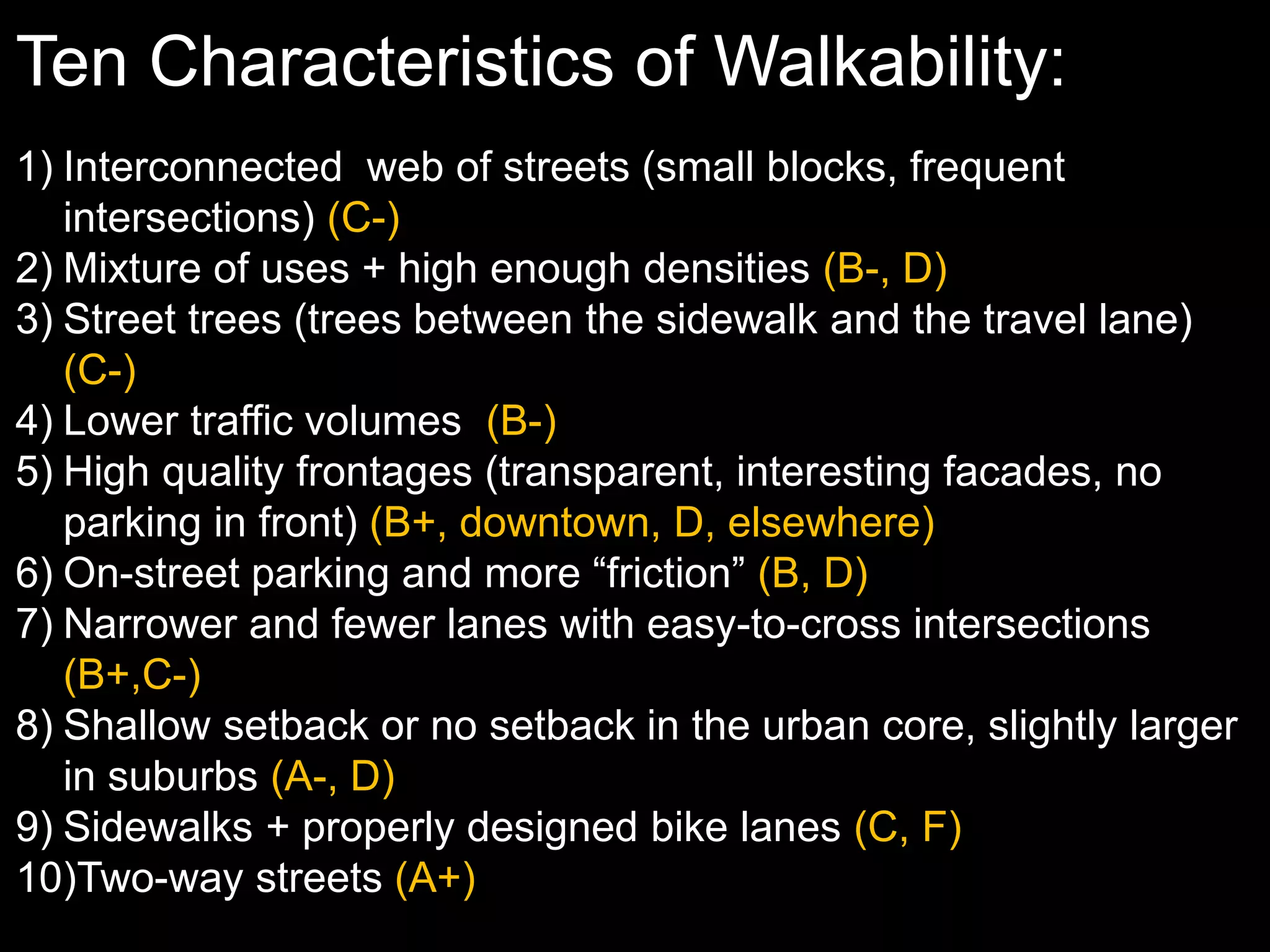
Ten Characteristics of Walkability:
1) Interconnected web of streets (small blocks, frequent
intersections) (C-)
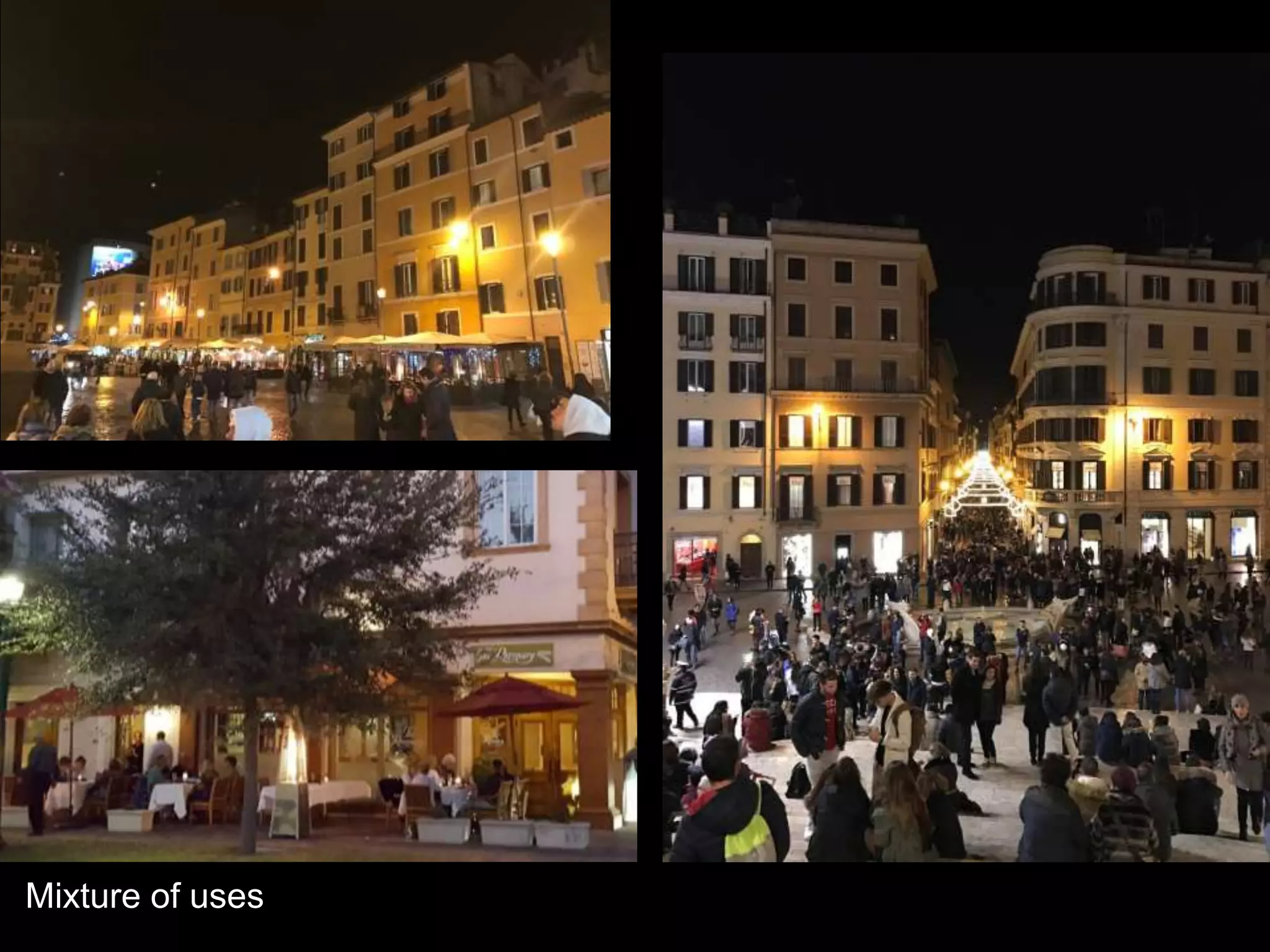
2) Mixture of uses + high enough densities (B-, D)
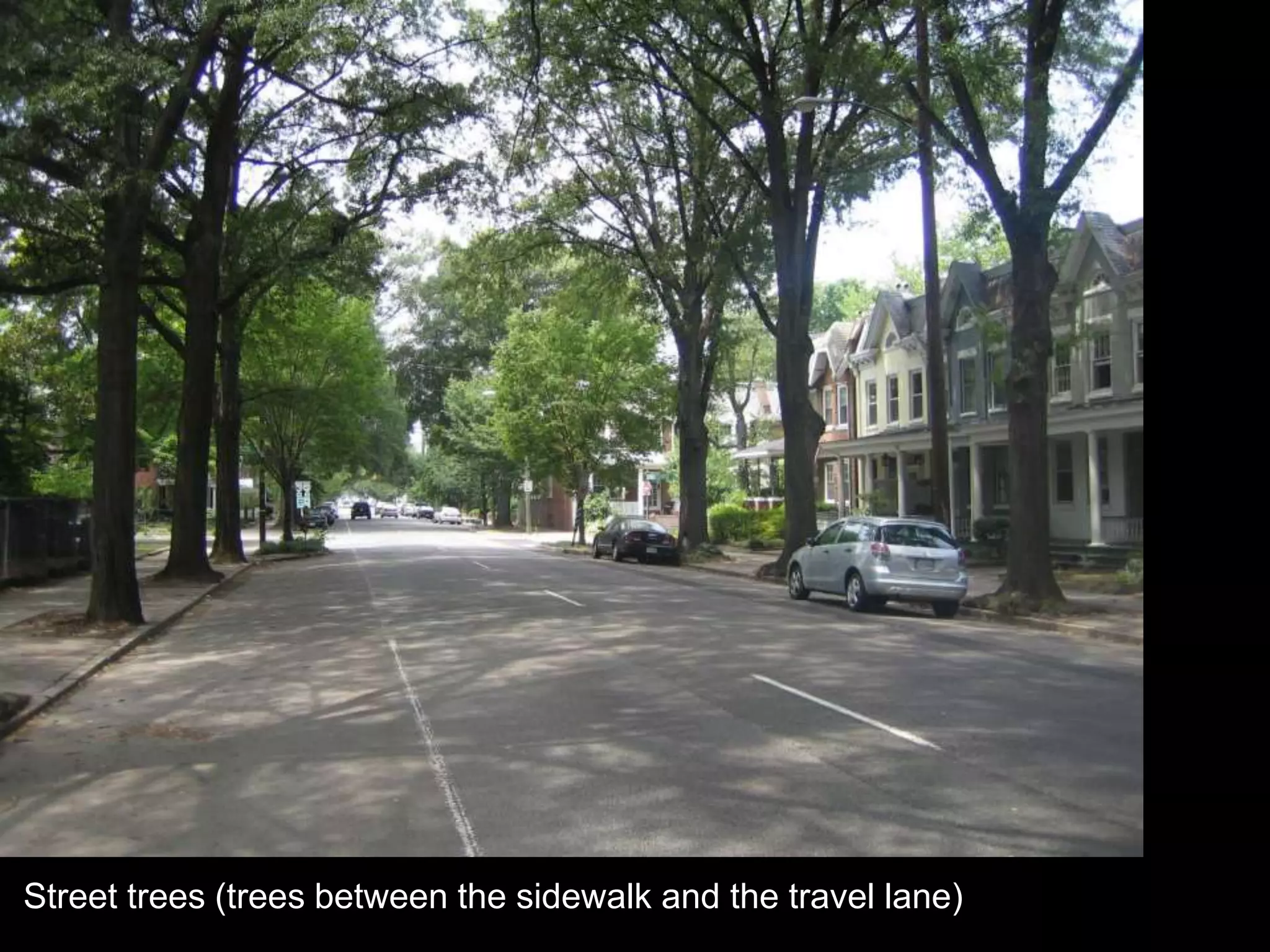
3) Street trees (trees between the sidewalk and the travel lane)
(C-)
4) Lower traffic volumes (B-)
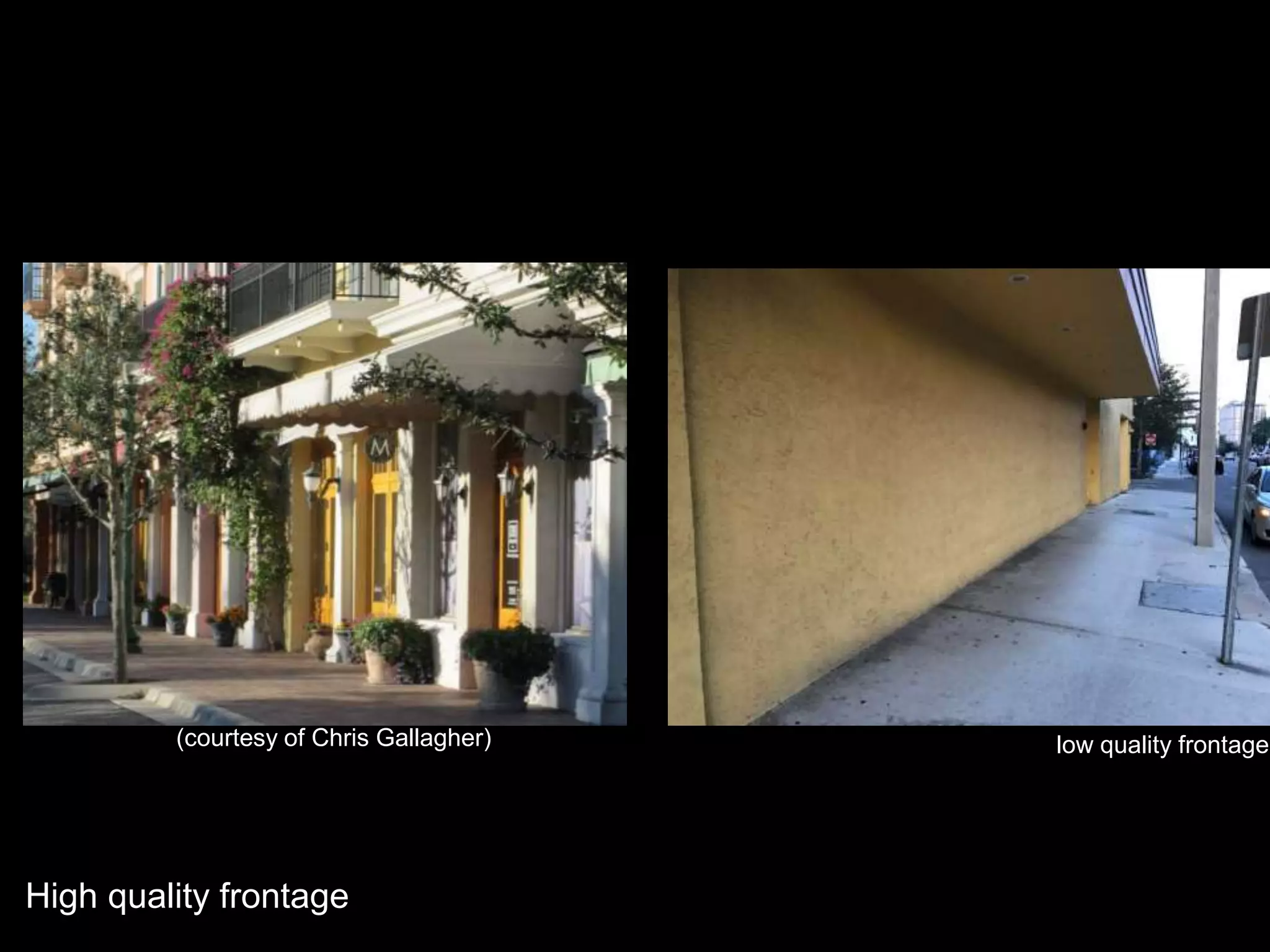
5) High quality frontages (transparent, interesting facades, no
parking in front) (B+, downtown, D, elsewhere)
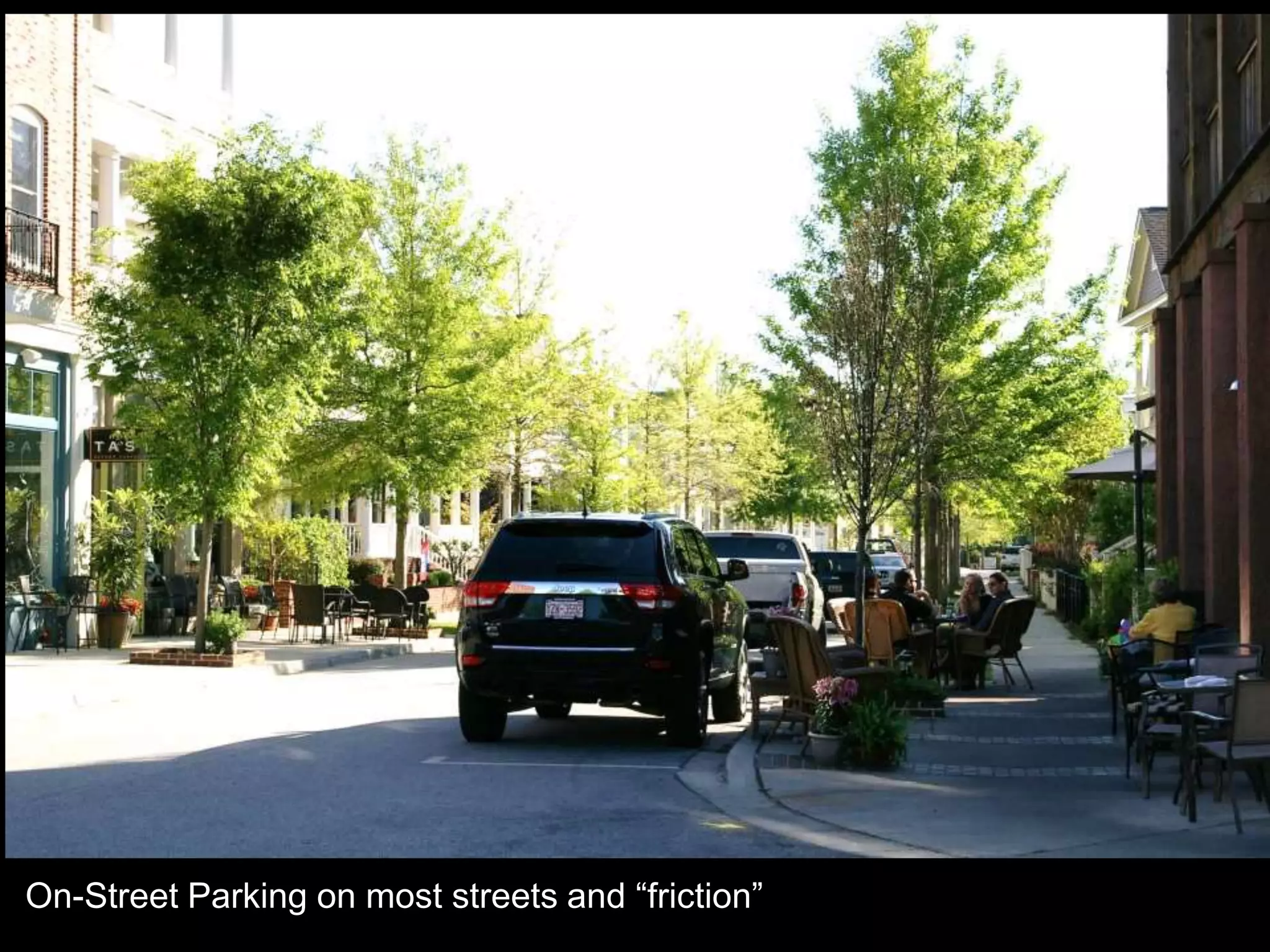
6) On-street parking and more “friction” (B, D)
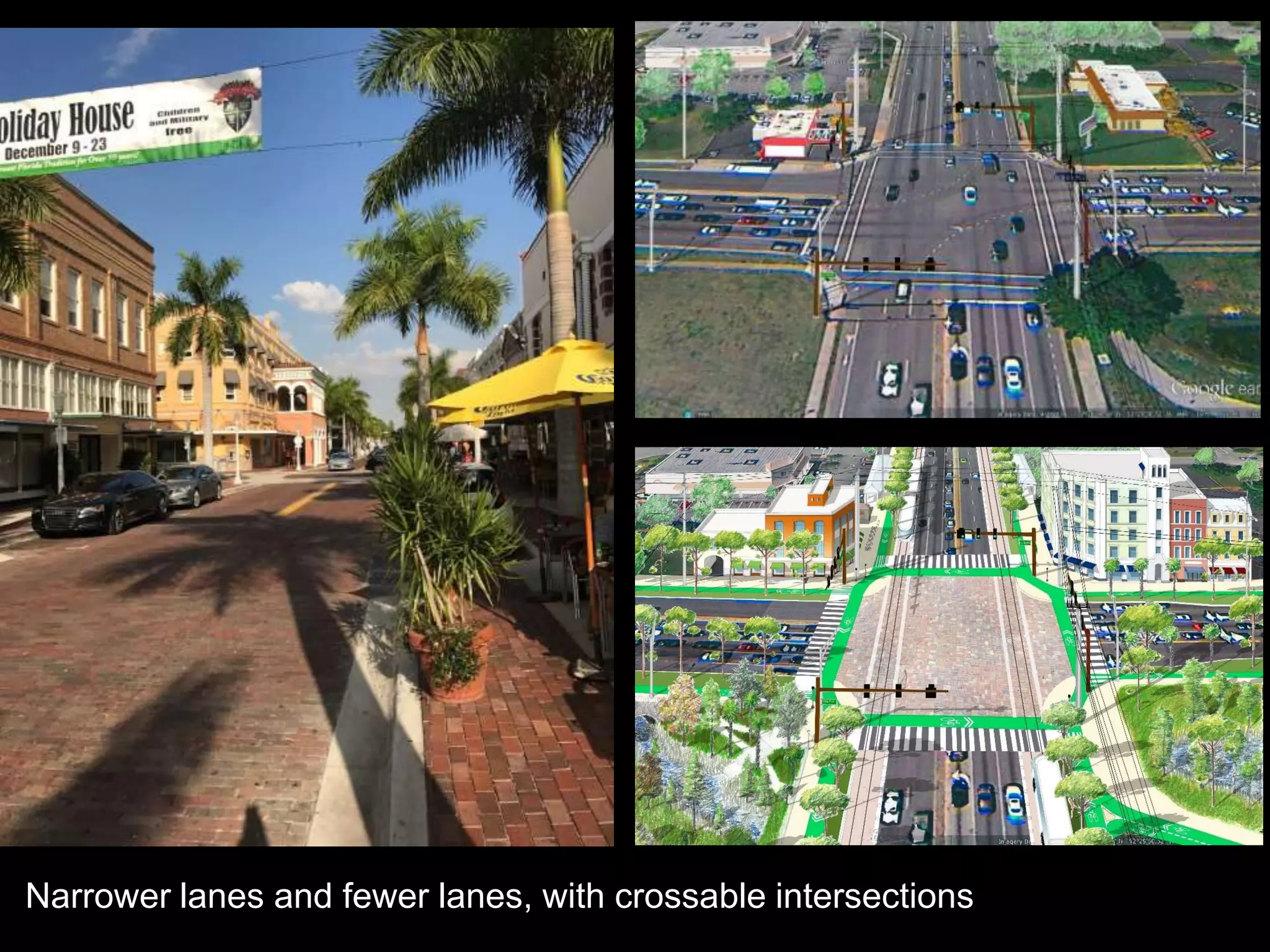
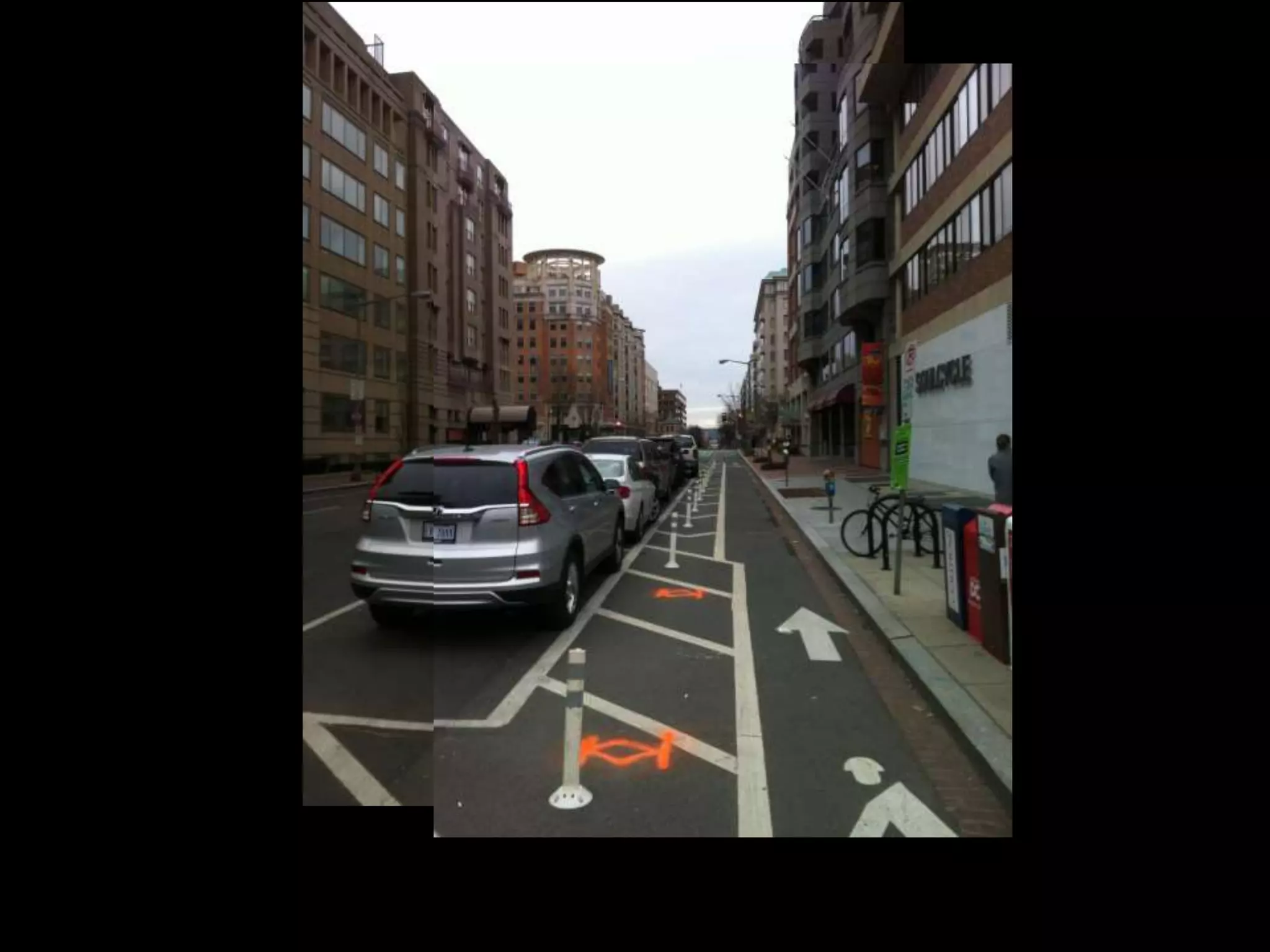
7) Narrower and fewer lanes with easy-to-cross intersections
(B+,C-)
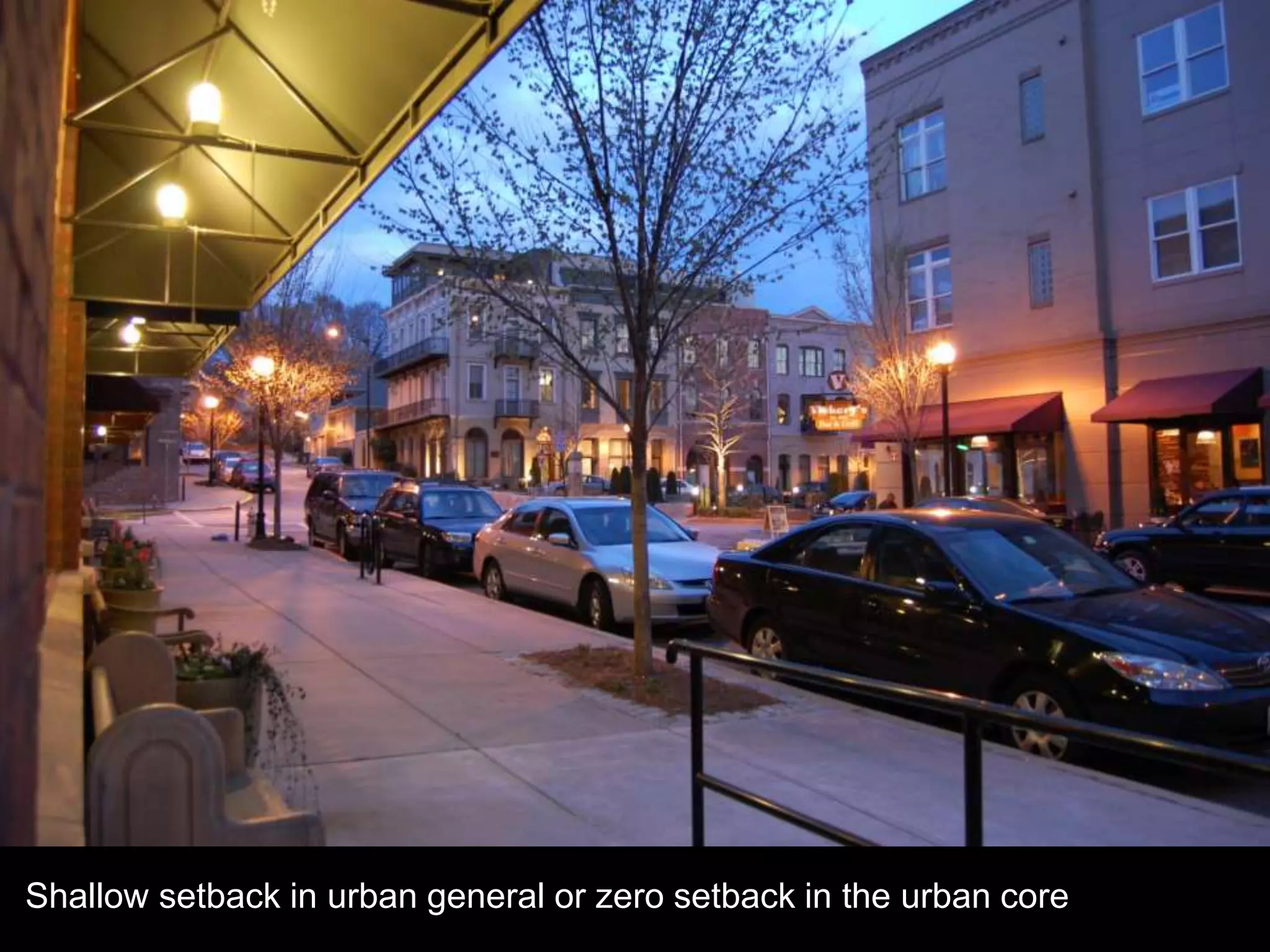
8) Shallow setback or no setback in the urban core, slightly larger
in suburbs (A-, D)
9) Sidewalks + properly designed bike lanes (C, F)
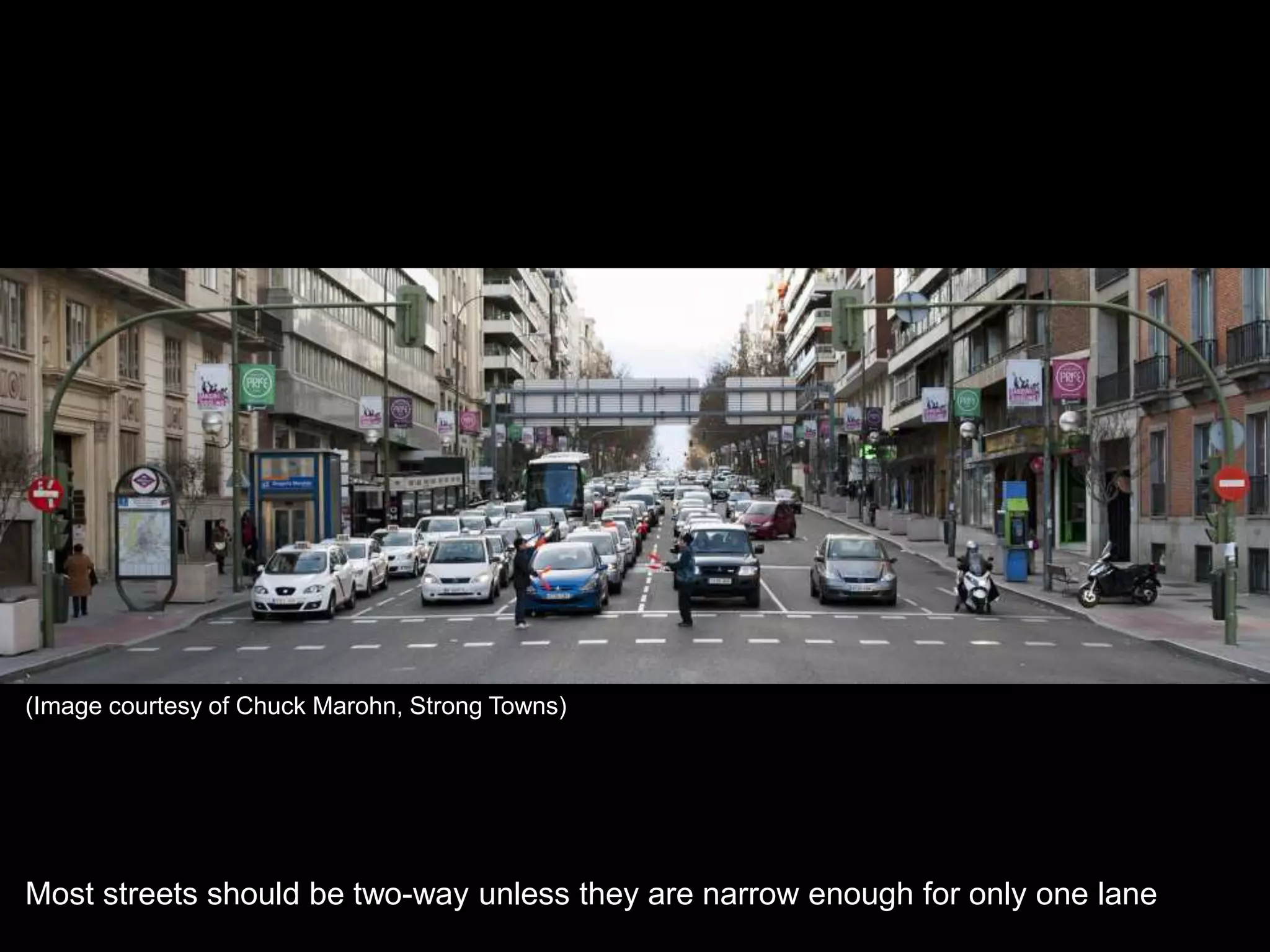
10)Two-way streets (A+)
Origin
Destination
How do we get from here to there?
The Power of Connected Streets
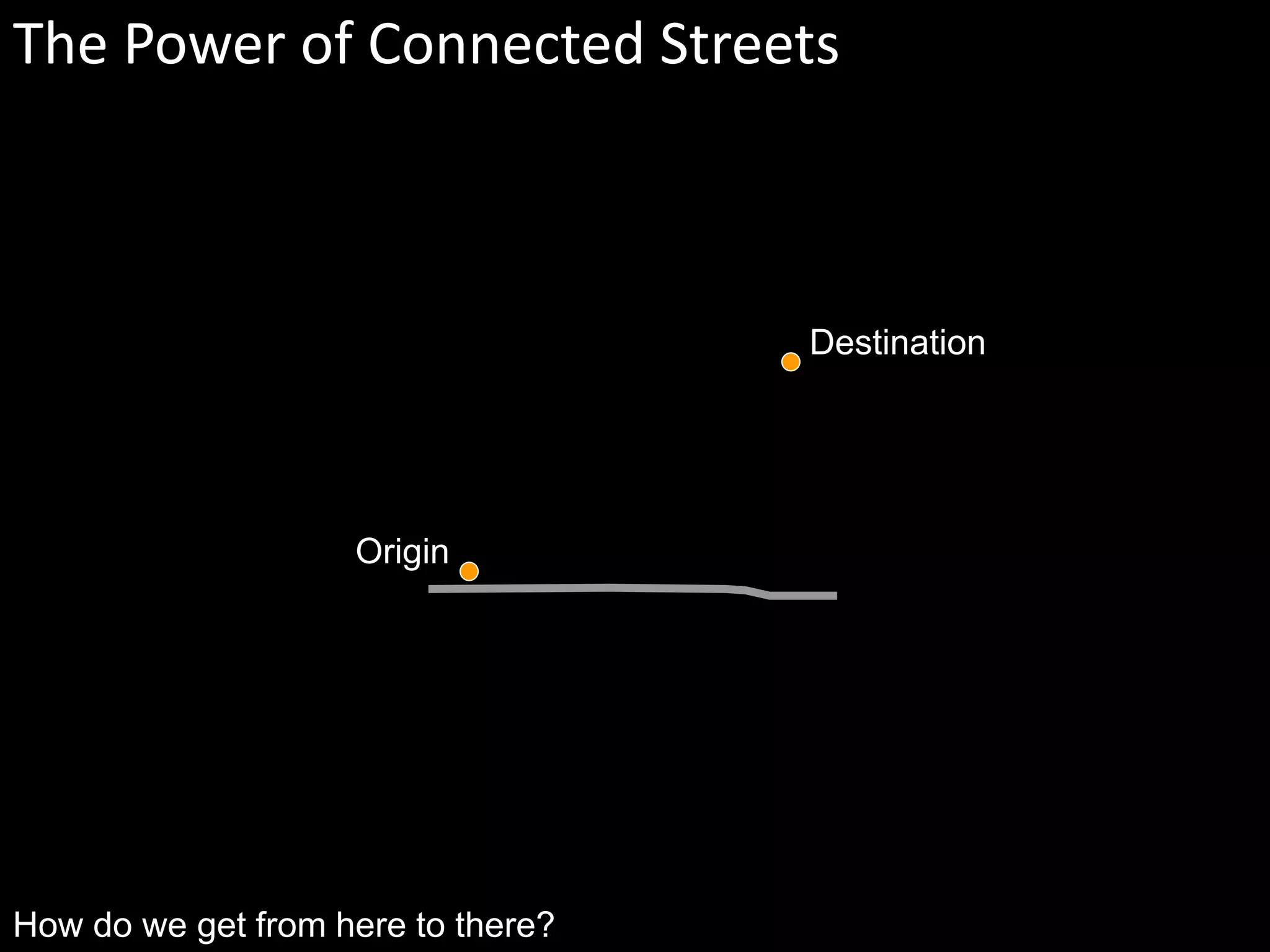
Origin
Destination
How do we get from here to there?
The Power of Connected Streets
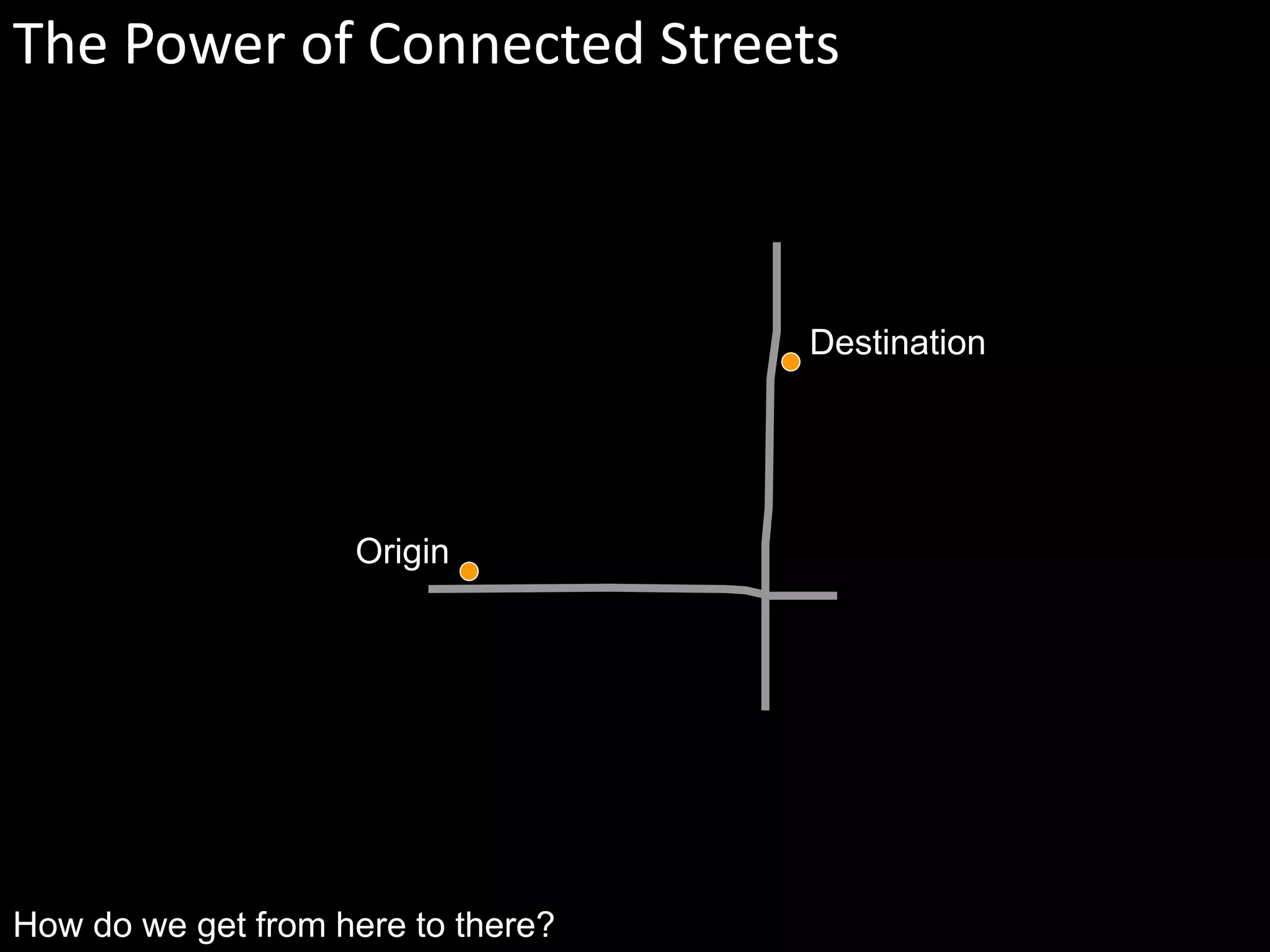
Origin
Destination
How do we get from here to there?
The Power of Connected Streets
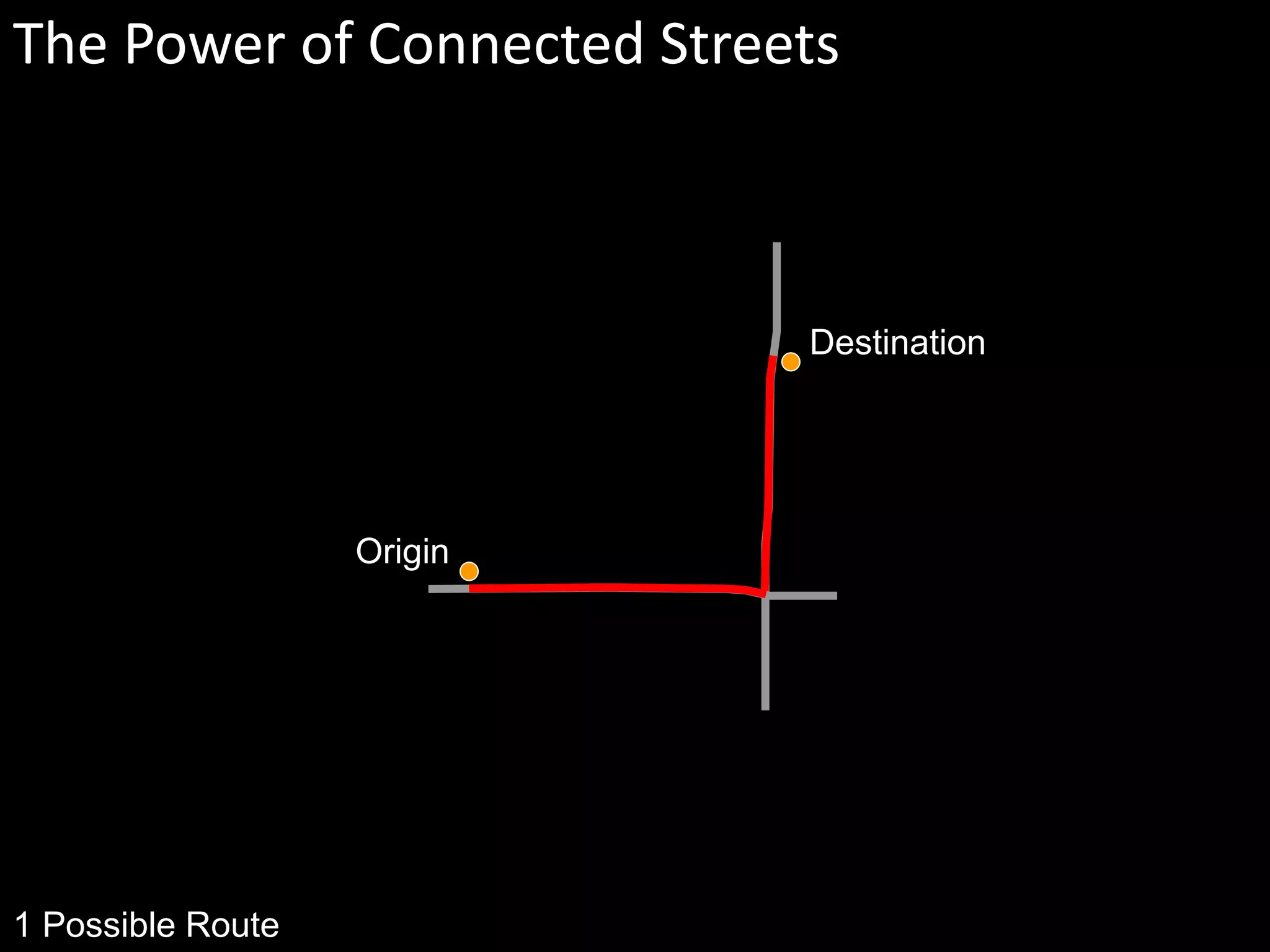
Origin
Destination
1 Possible Route
The Power of Connected Streets
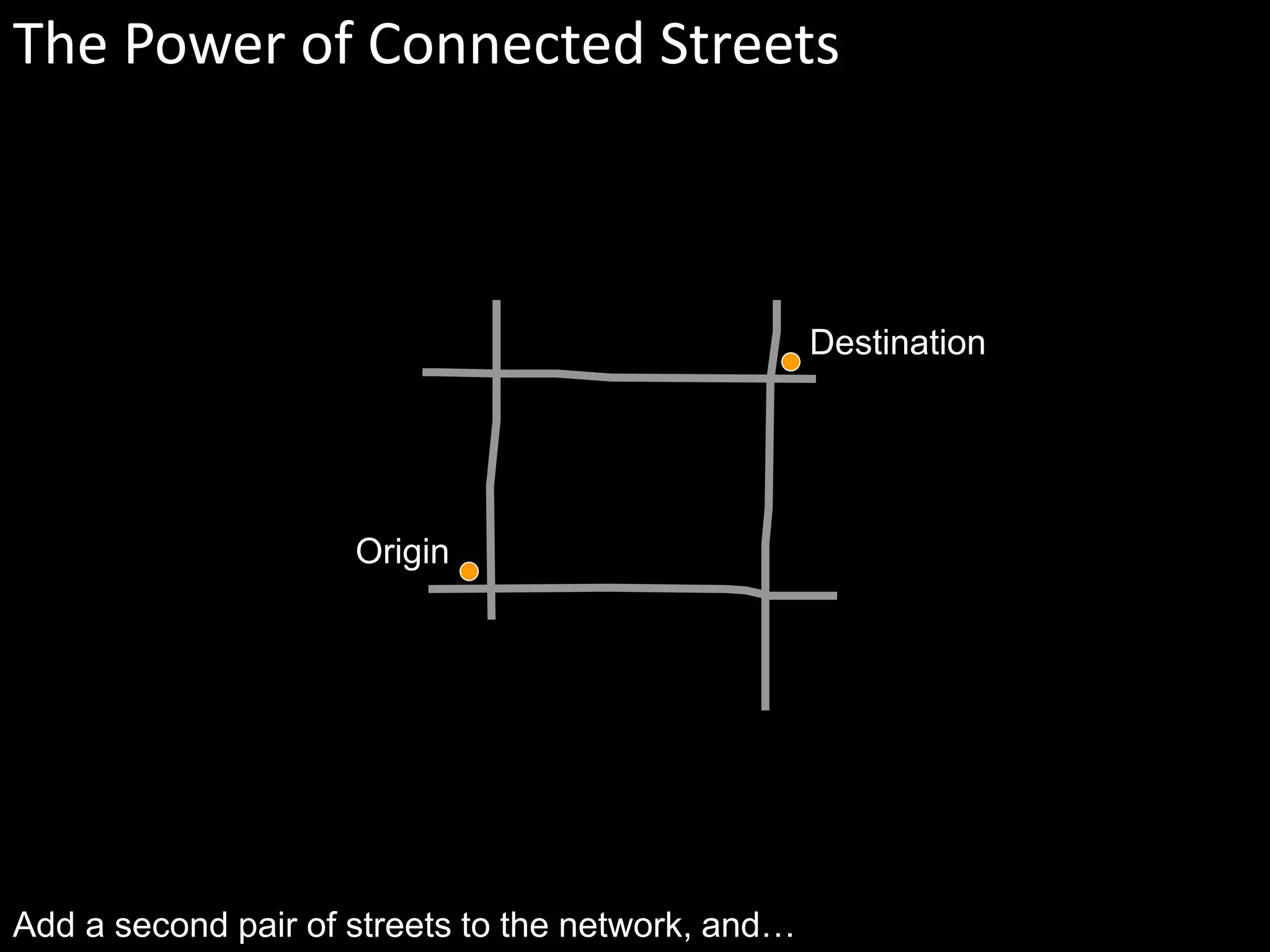
Origin
Destination
Add a second pair of streets to the network, and…
The Power of Connected Streets
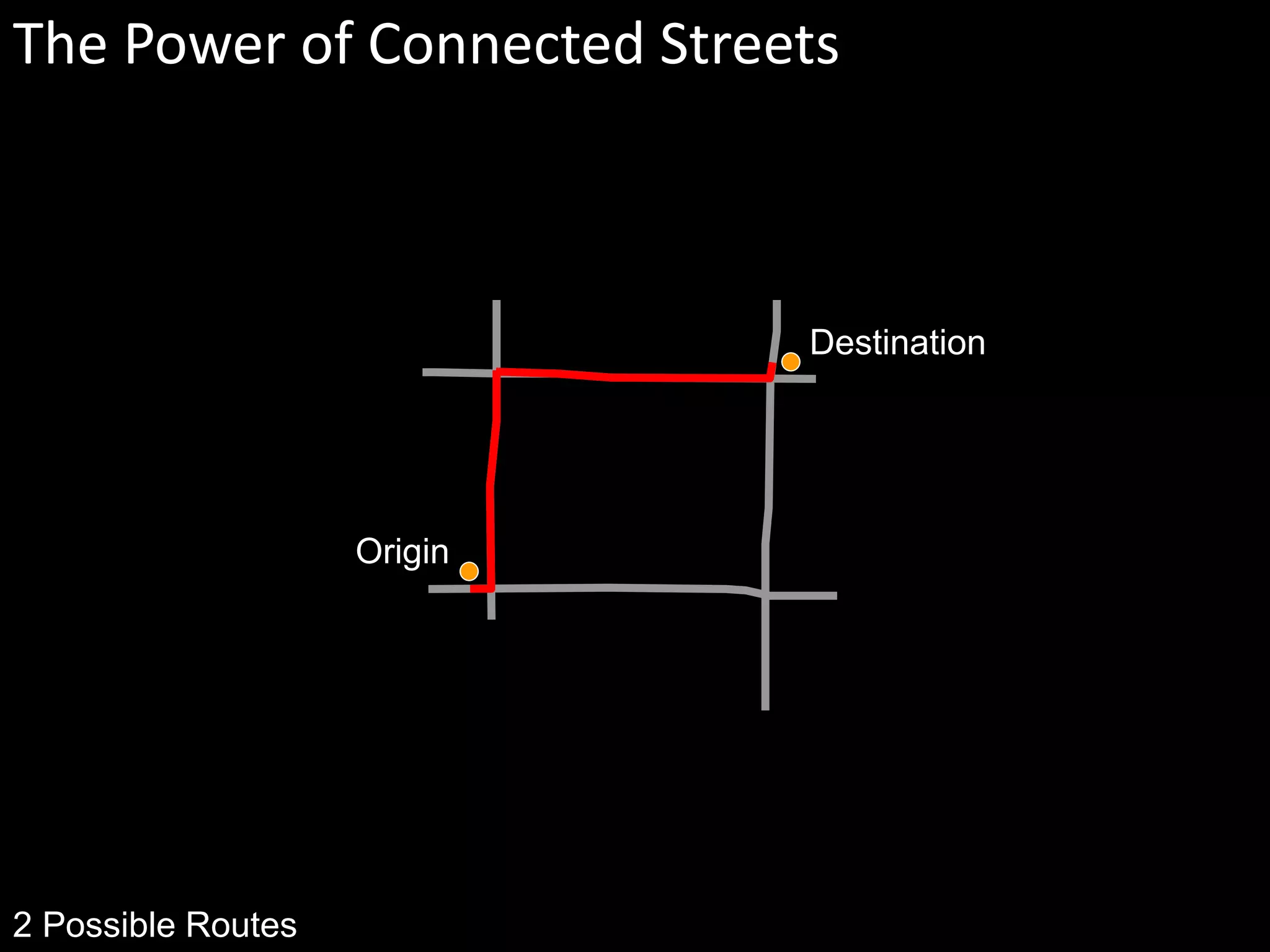
Origin
Destination
2 Possible Routes
The Power of Connected Streets
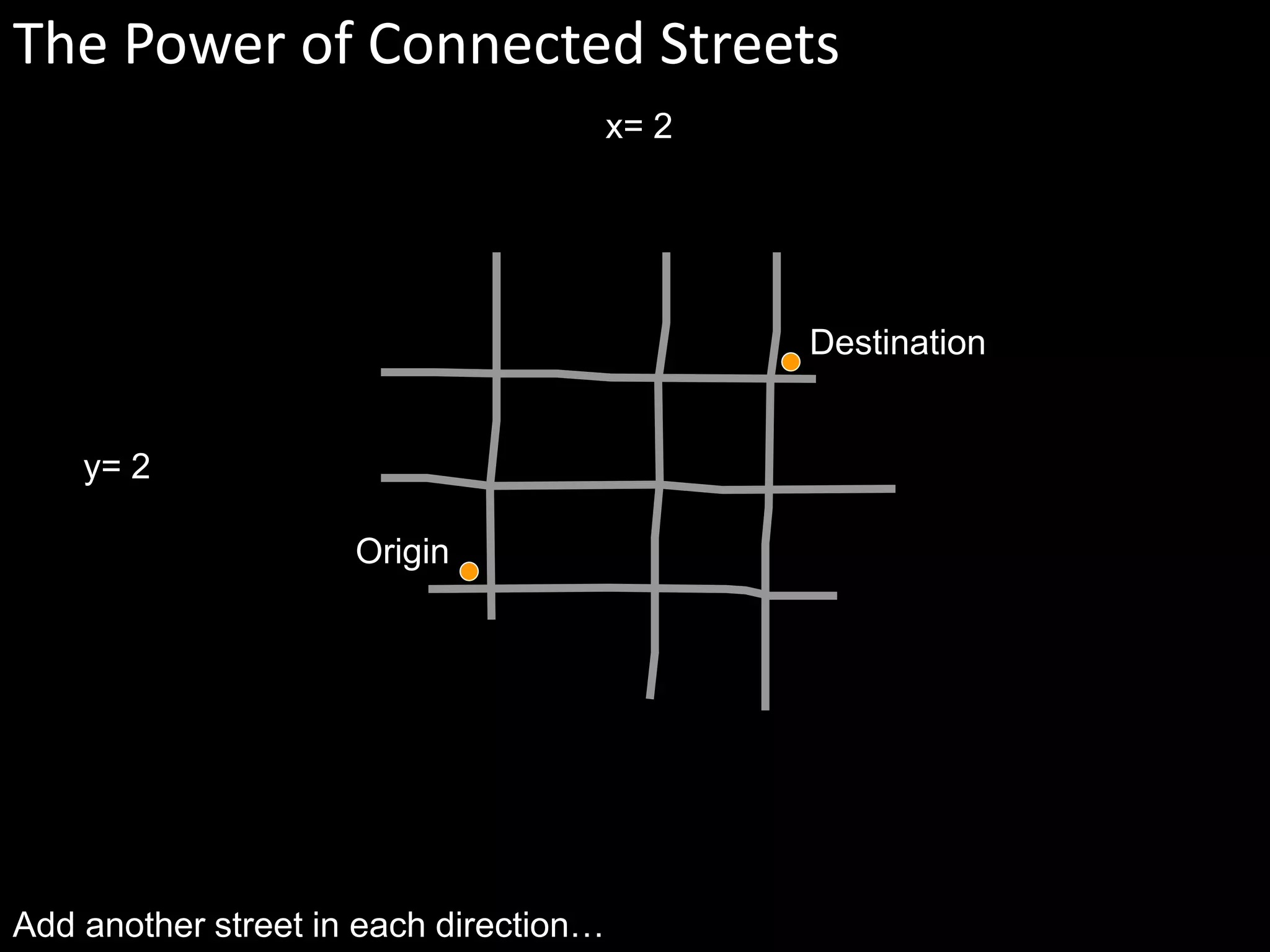
Origin
Destination
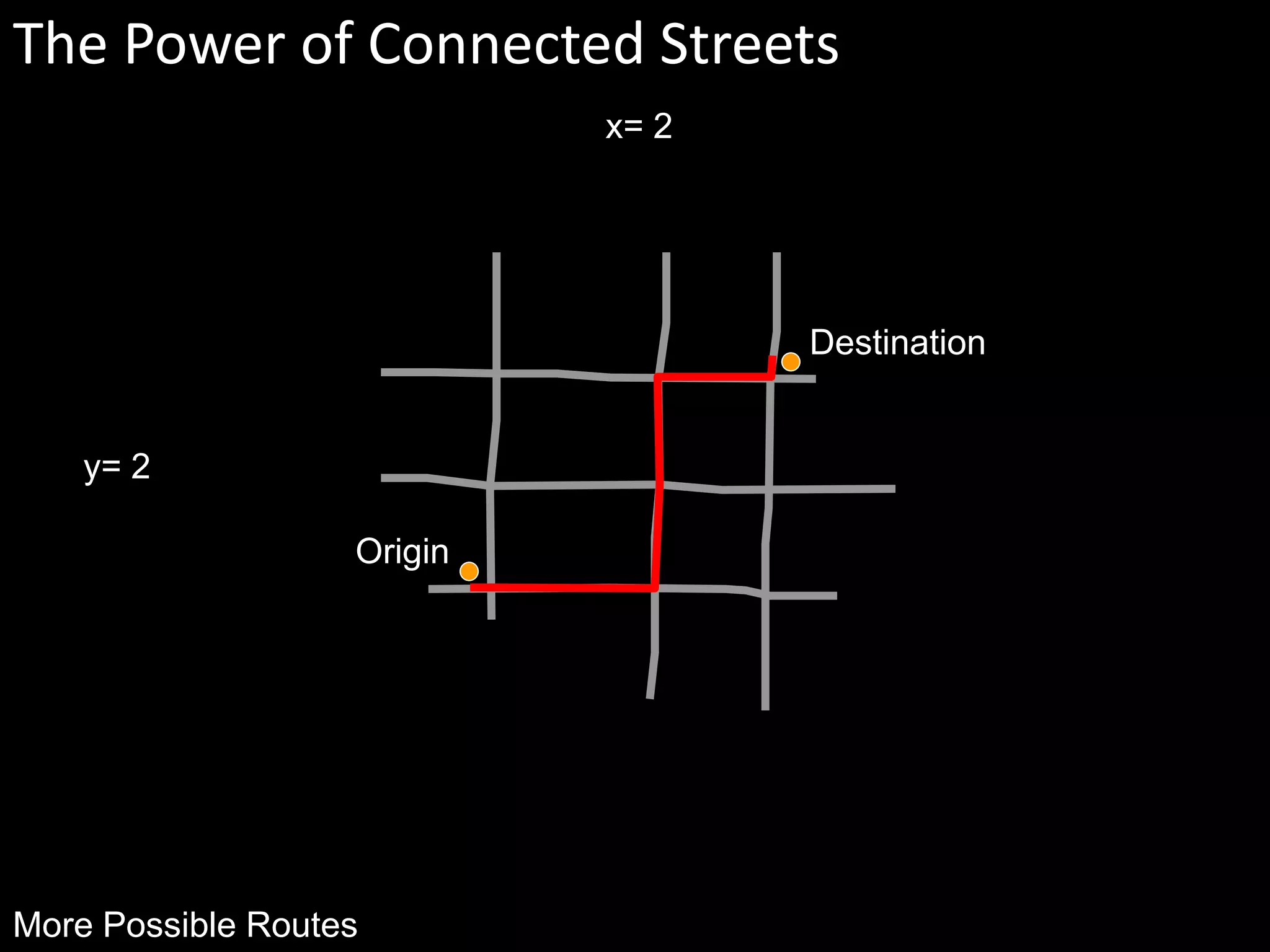
Add another street in each direction…
y= 2
x= 2
The Power of Connected Streets
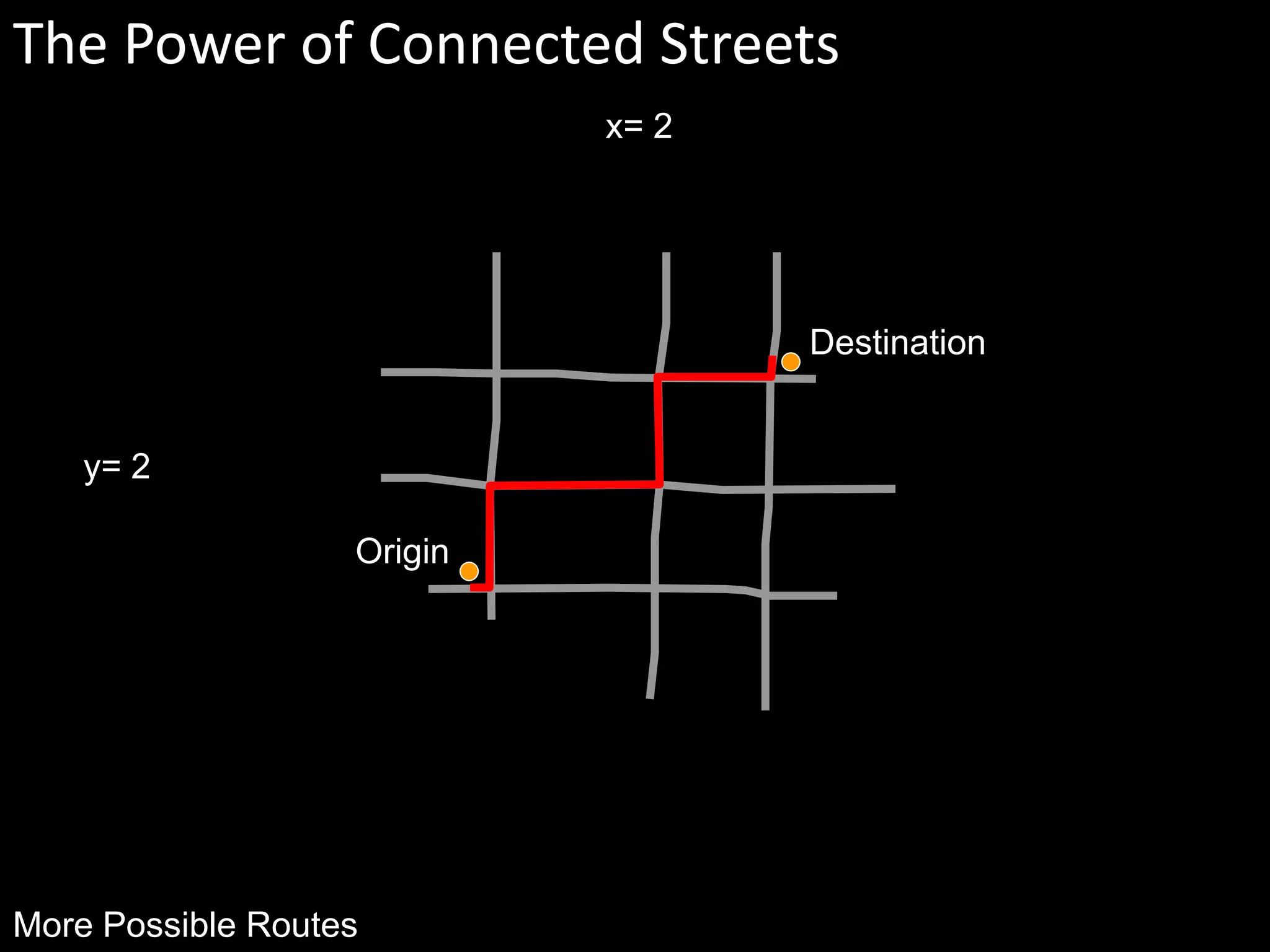
Origin
Destination
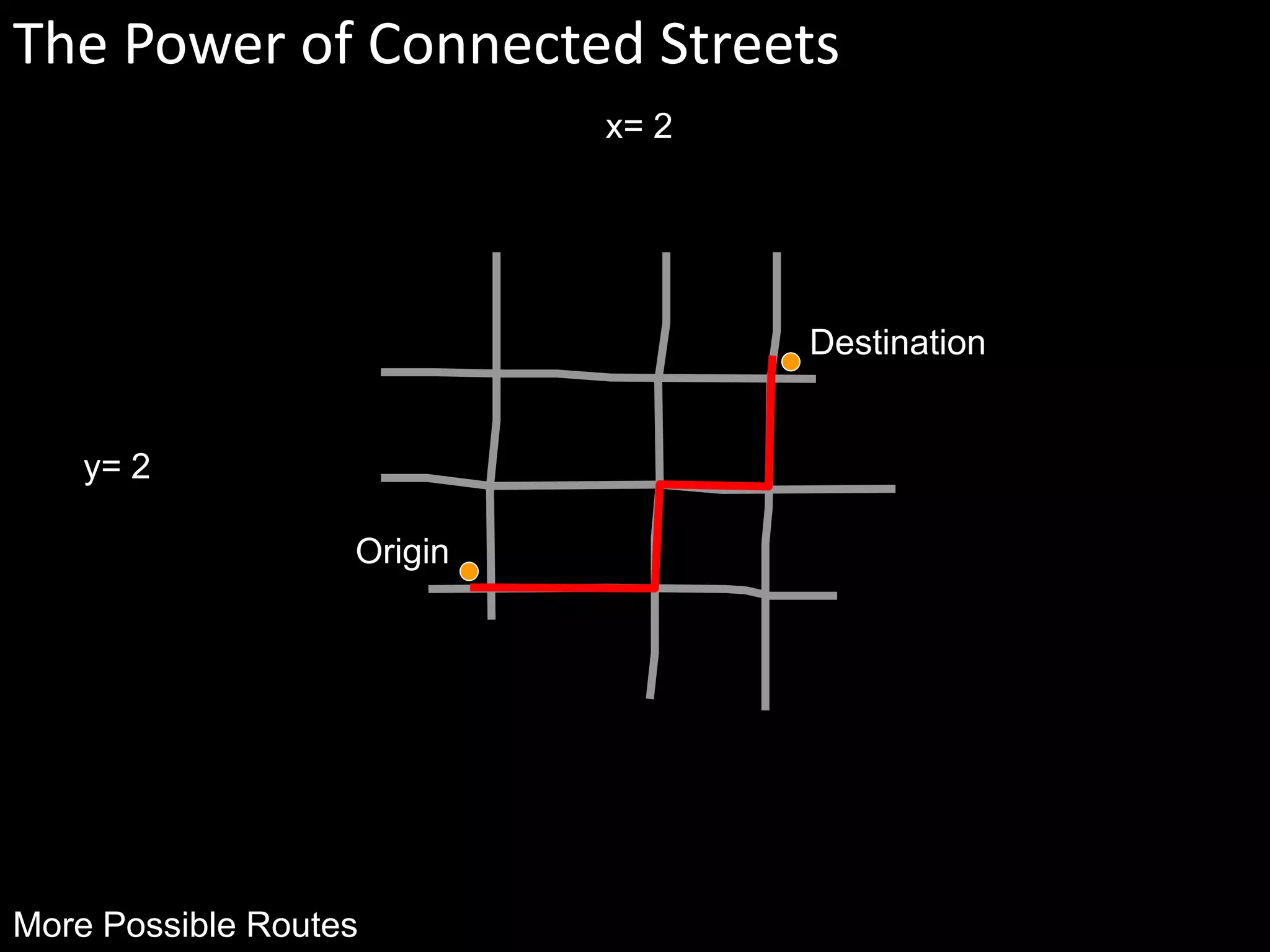
More Possible Routes
y= 2
x= 2
The Power of Connected Streets
Origin
Destination
More Possible Routes
y= 2
x= 2
The Power of Connected Streets
Origin
Destination
More Possible Routes
y= 2
x= 2
The Power of Connected Streets
Origin
Destination
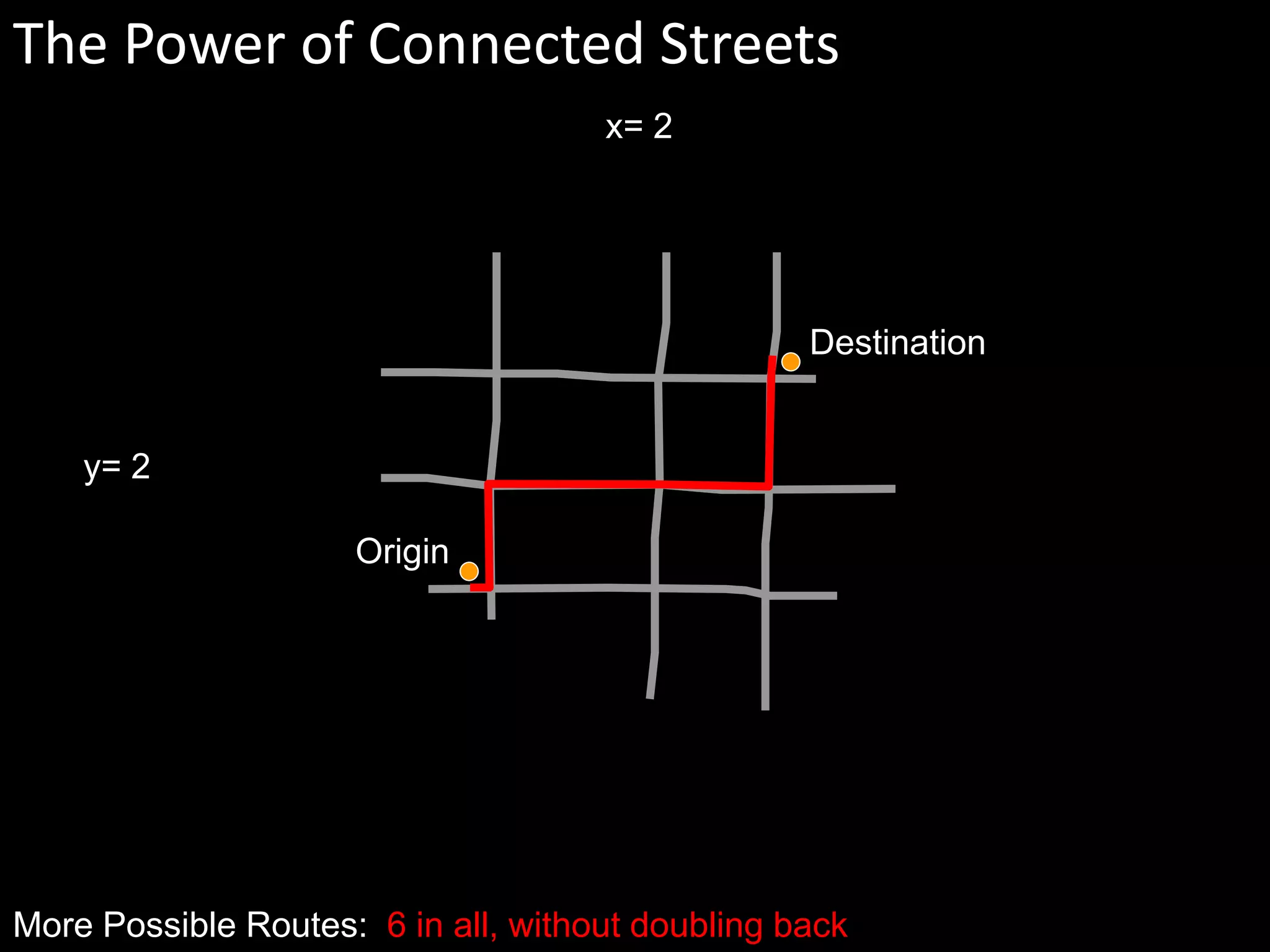
More Possible Routes: 6 in all, without doubling back
y= 2
x= 2
The Power of Connected Streets
Origin
Destination
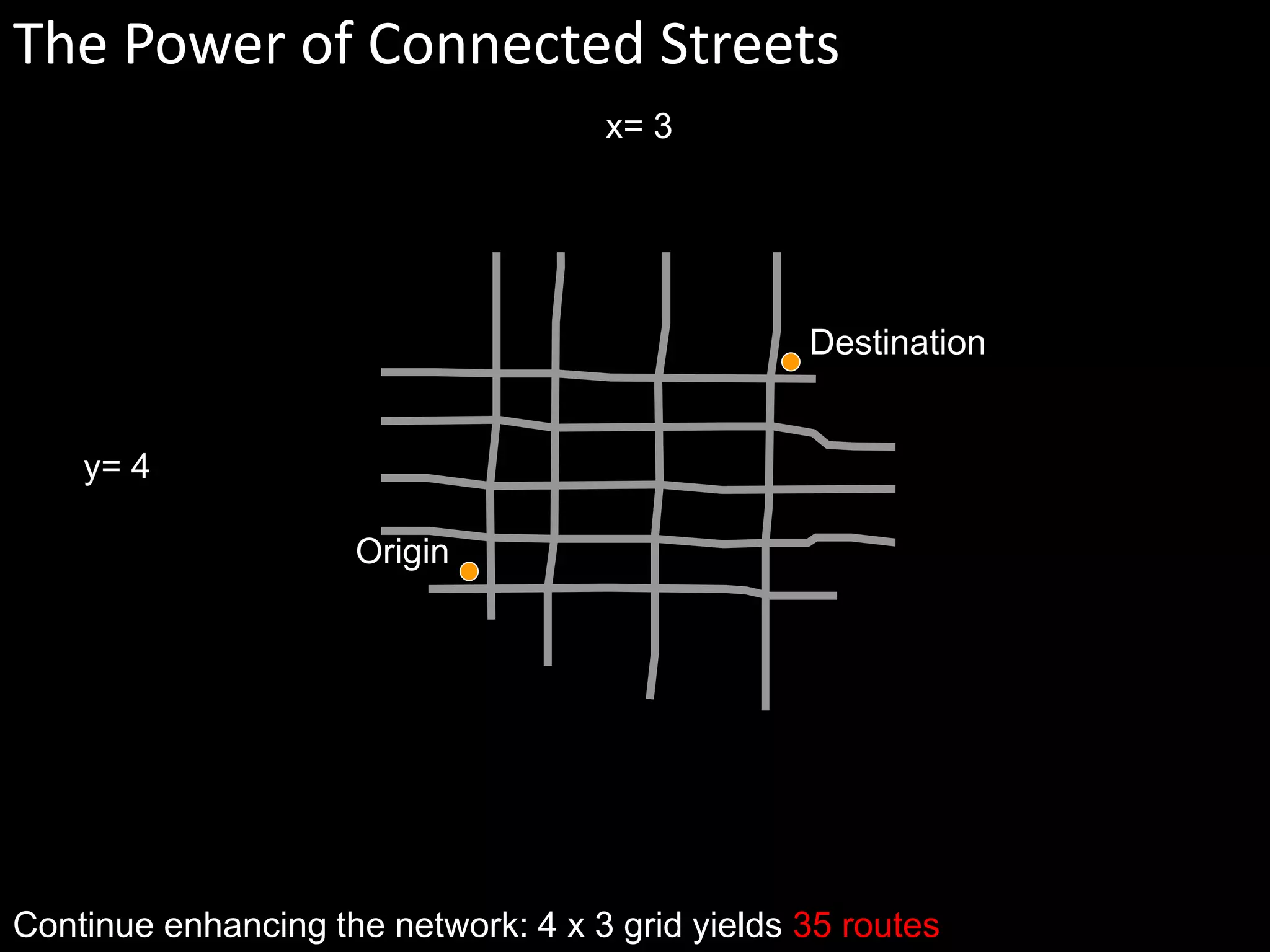
y= 4
x= 3
Continue enhancing the network: 4 x 3 grid yields 35 routes
The Power of Connected Streets
Origin
Destination
y= 4
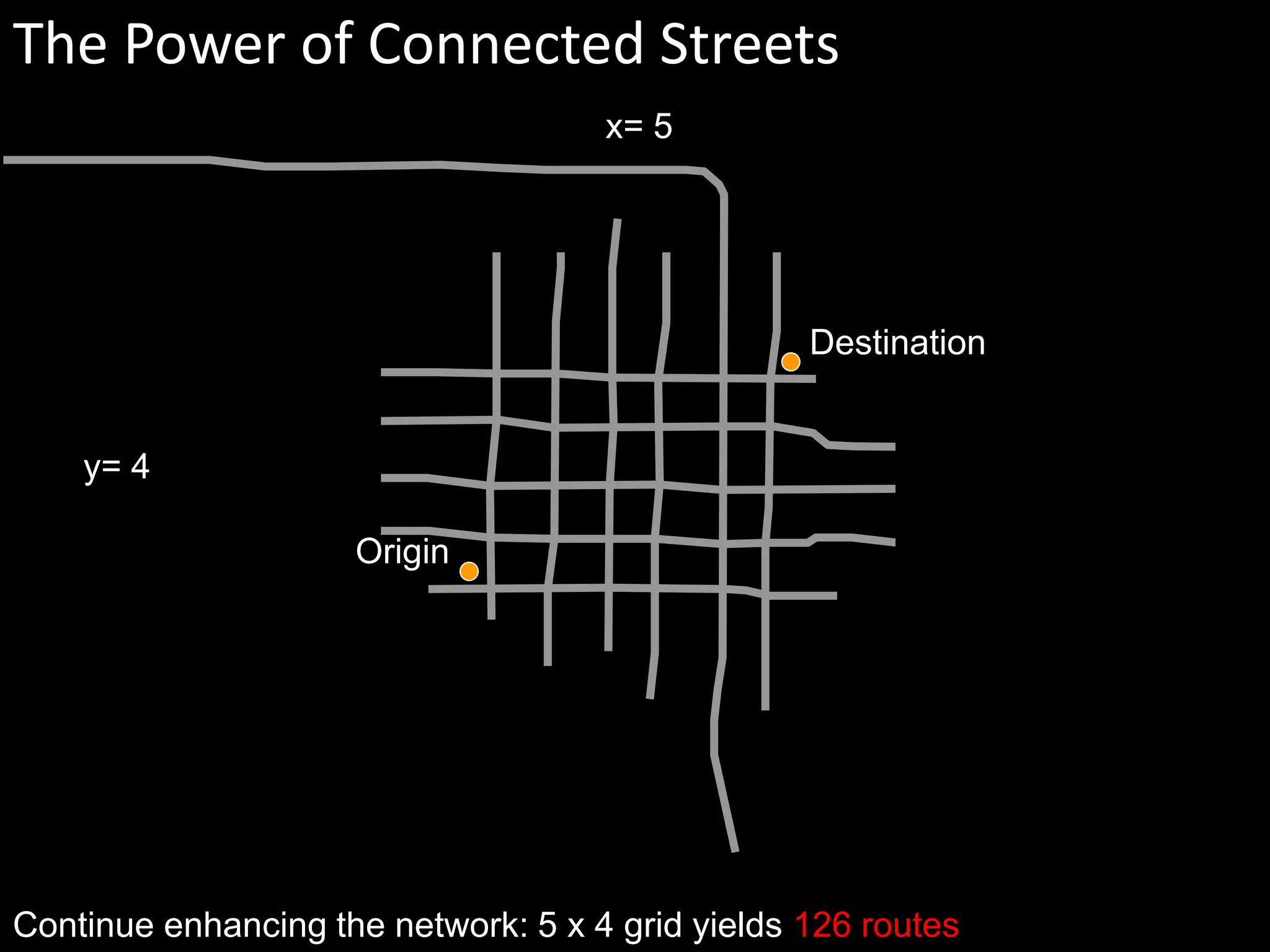
x= 5
Continue enhancing the network: 5 x 4 grid yields 126 routes
The Power of Connected Streets
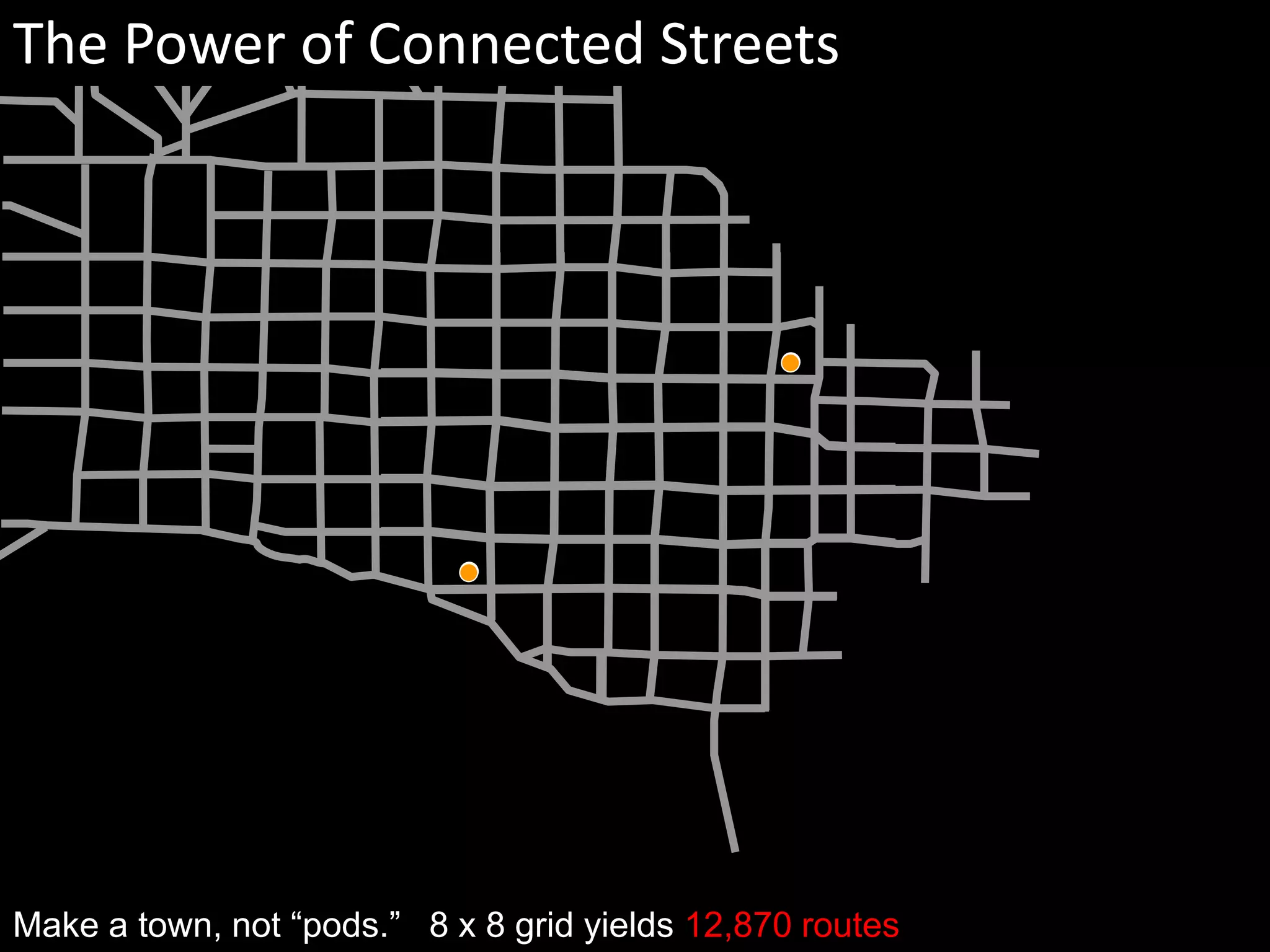
Make a town, not “pods.” 8 x 8 grid yields 12,870 routes
The Power of Connected Streets
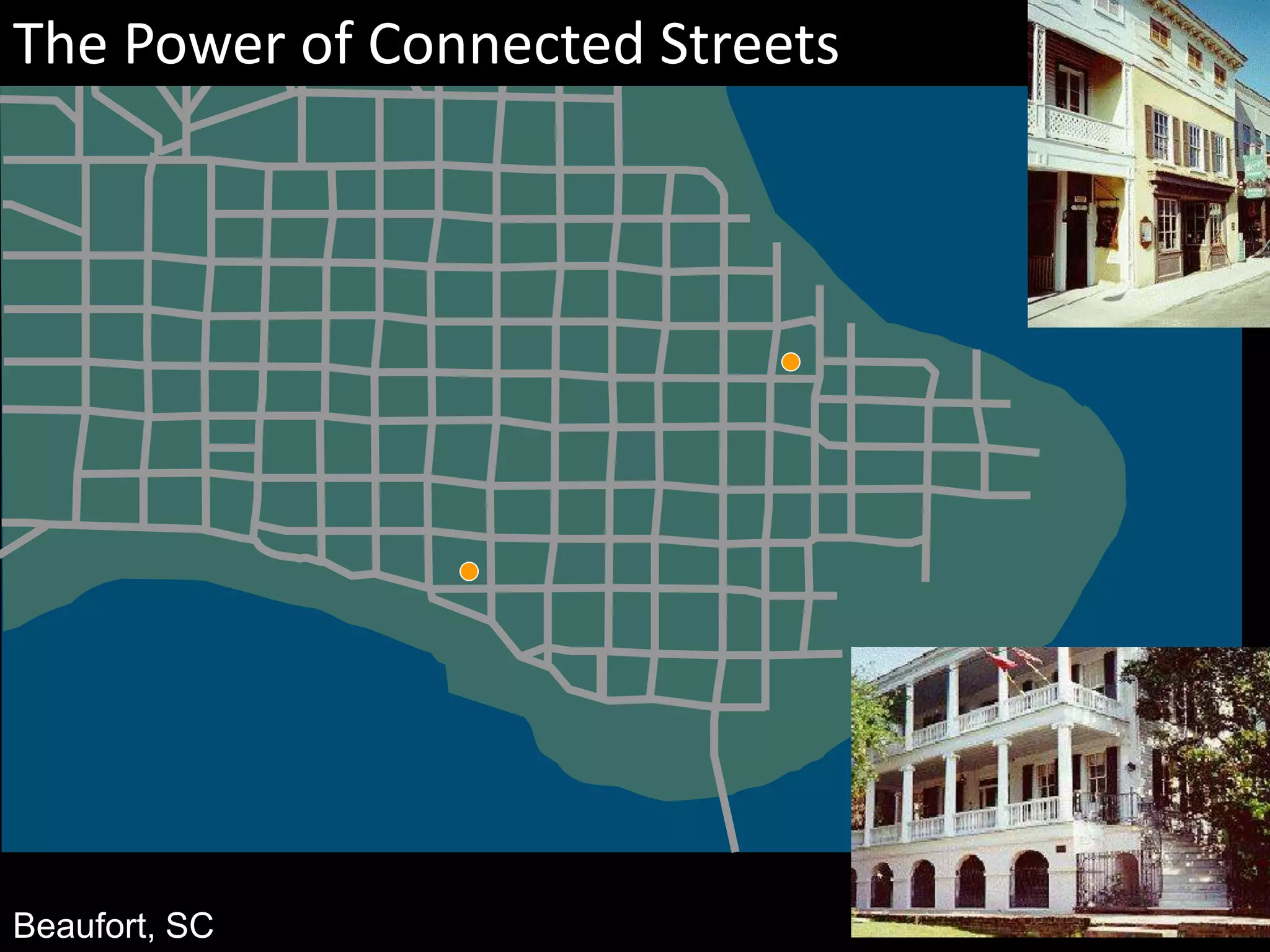
Beaufort, SC
The Power of Connected Streets
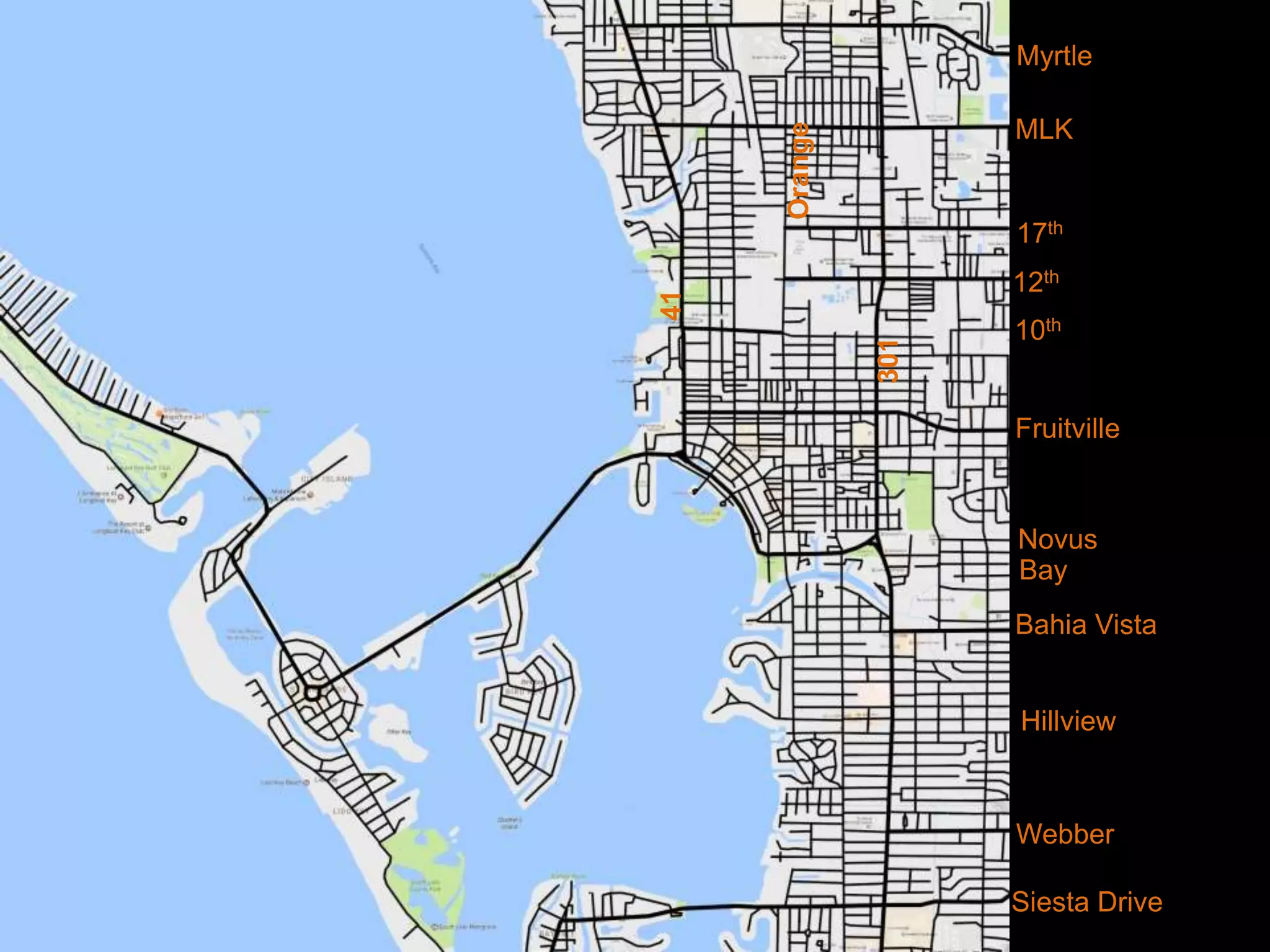
crippled grid:
suburban sarasota
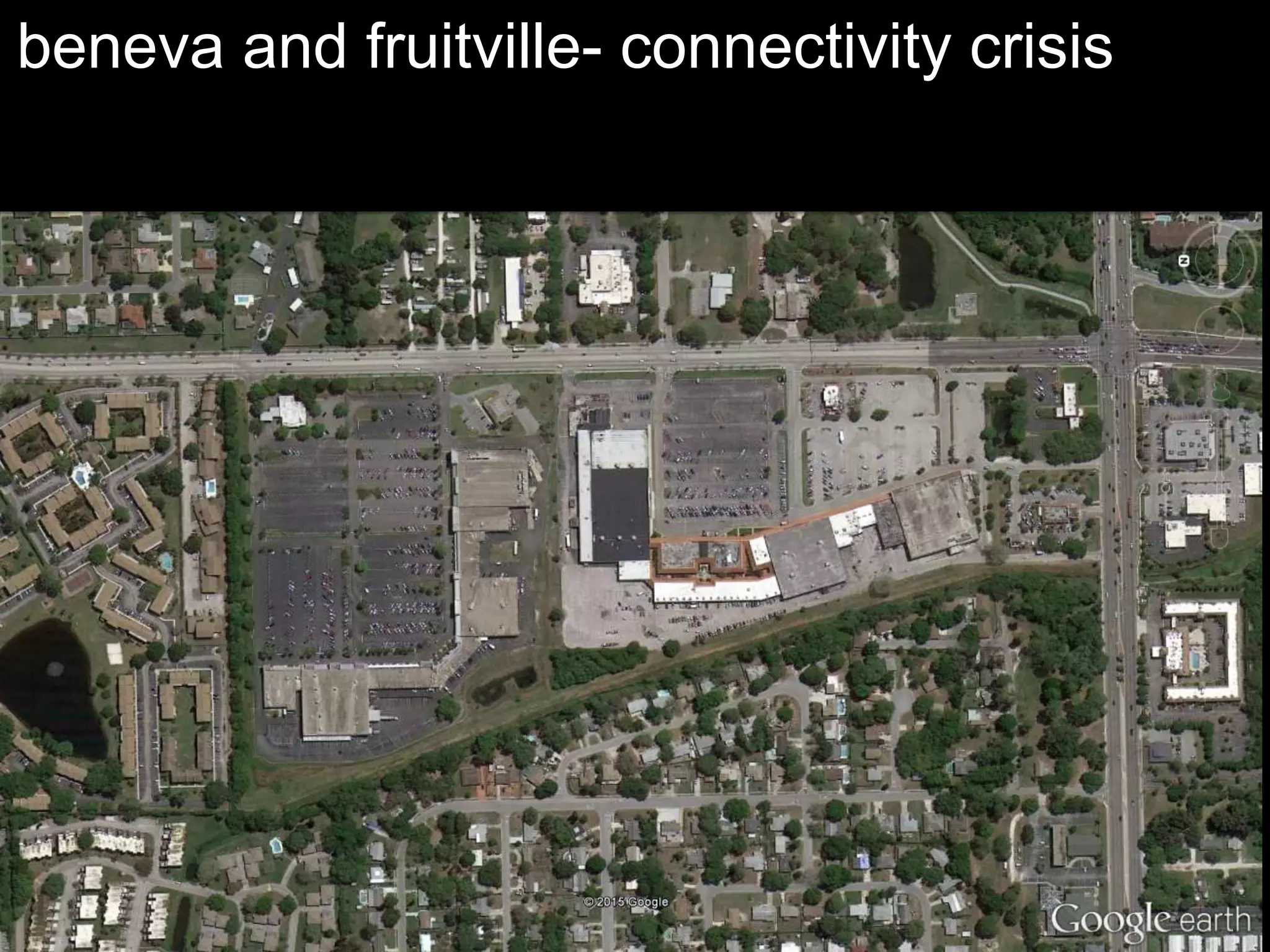
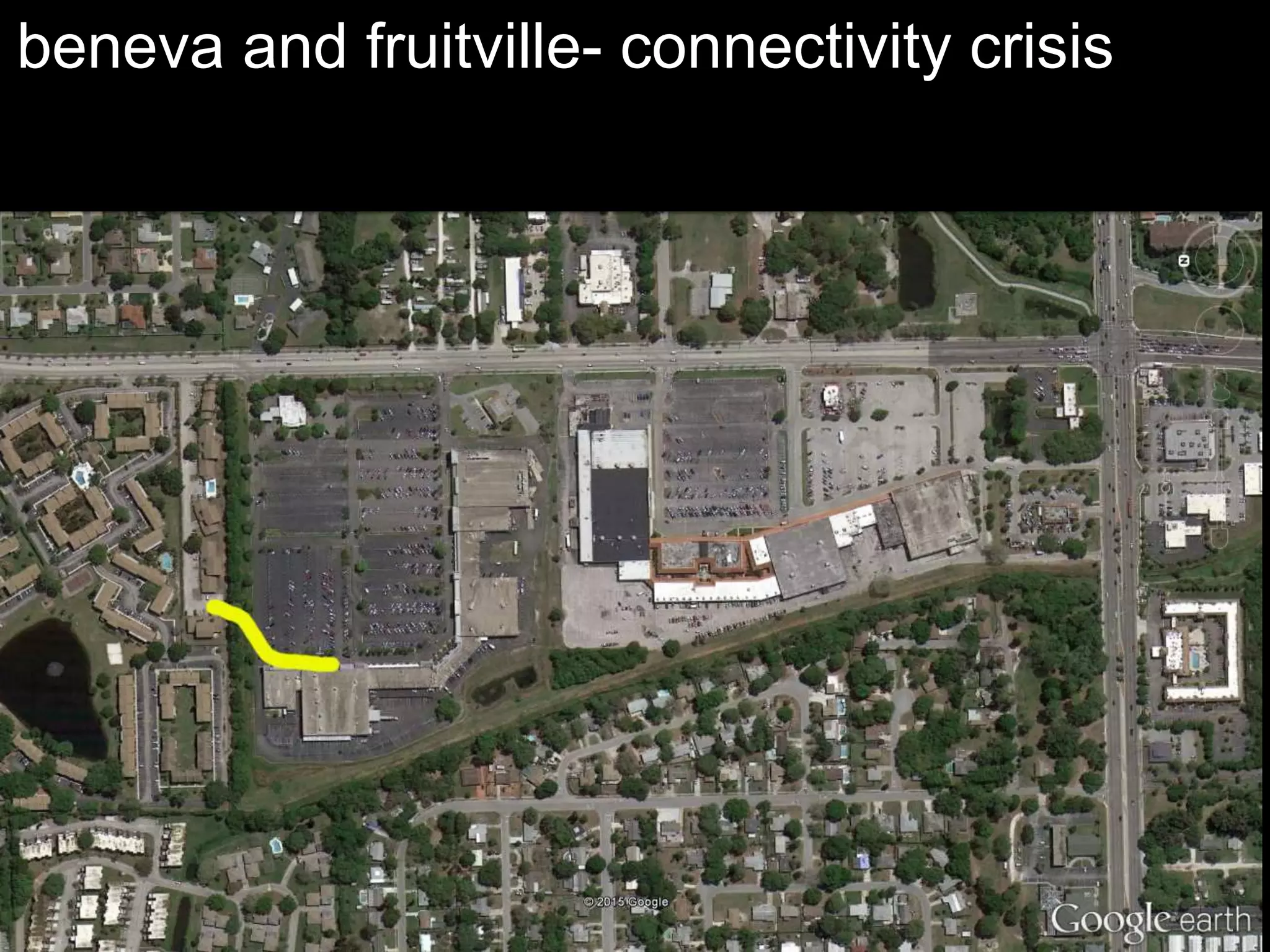
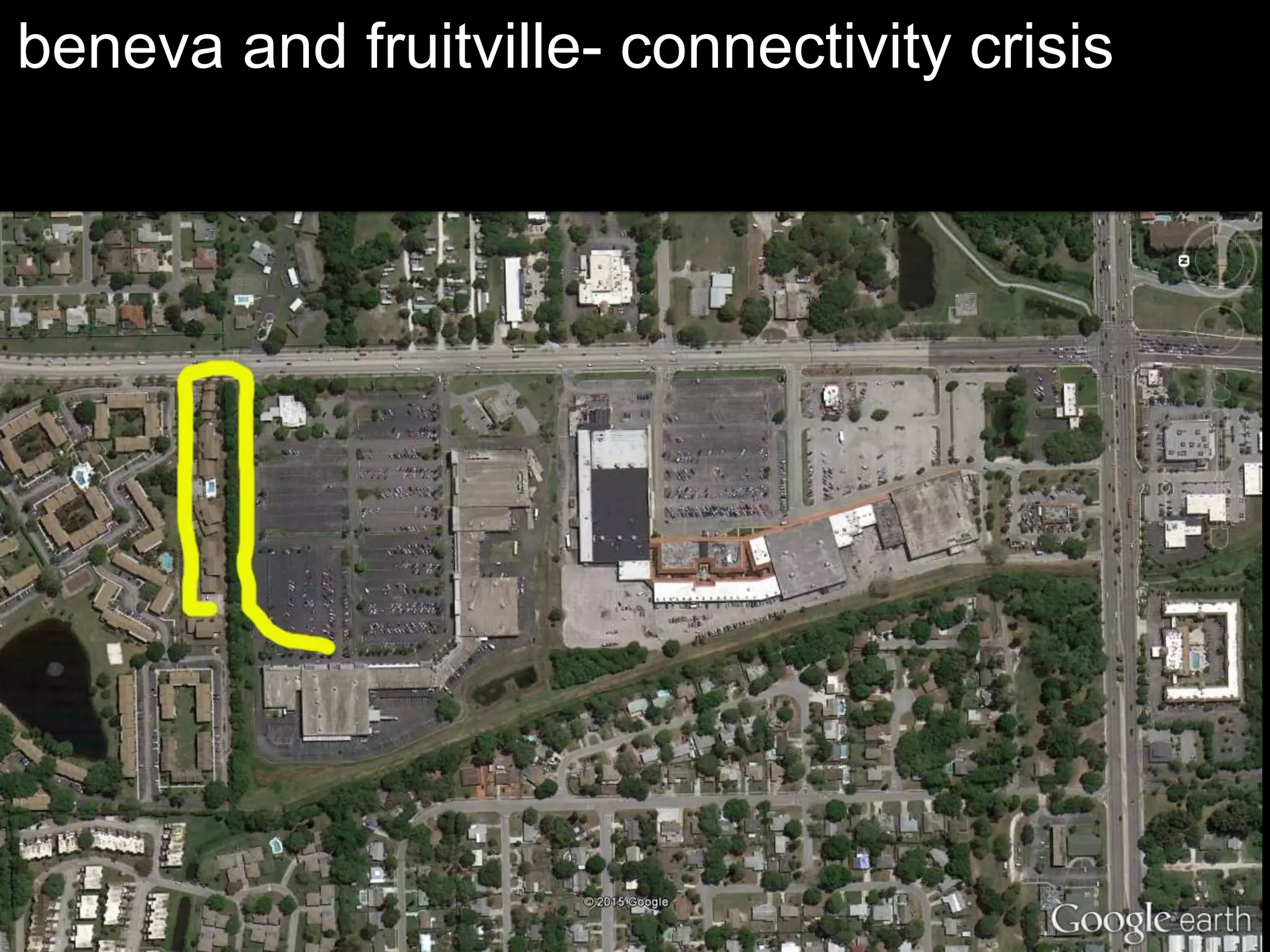
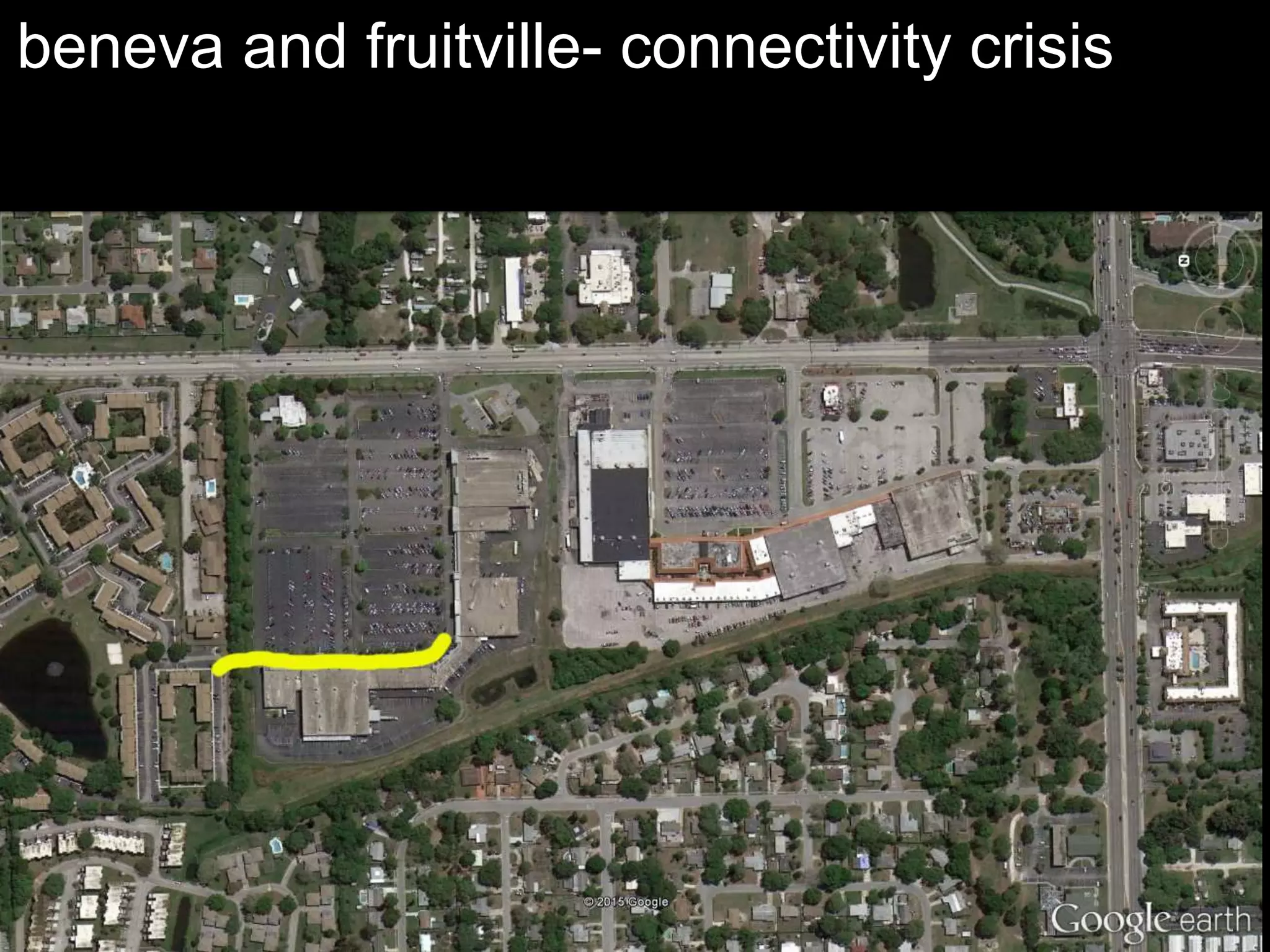
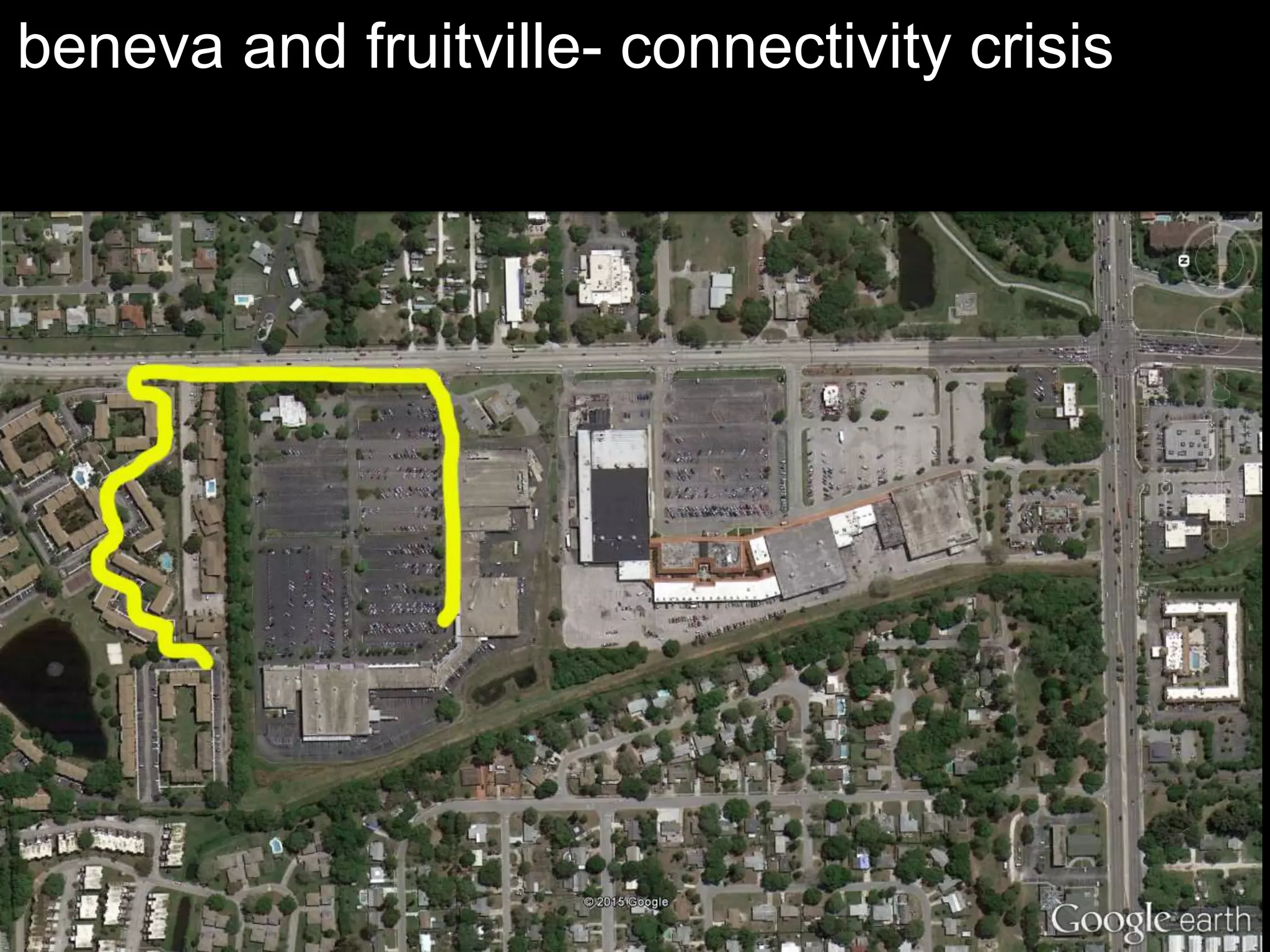
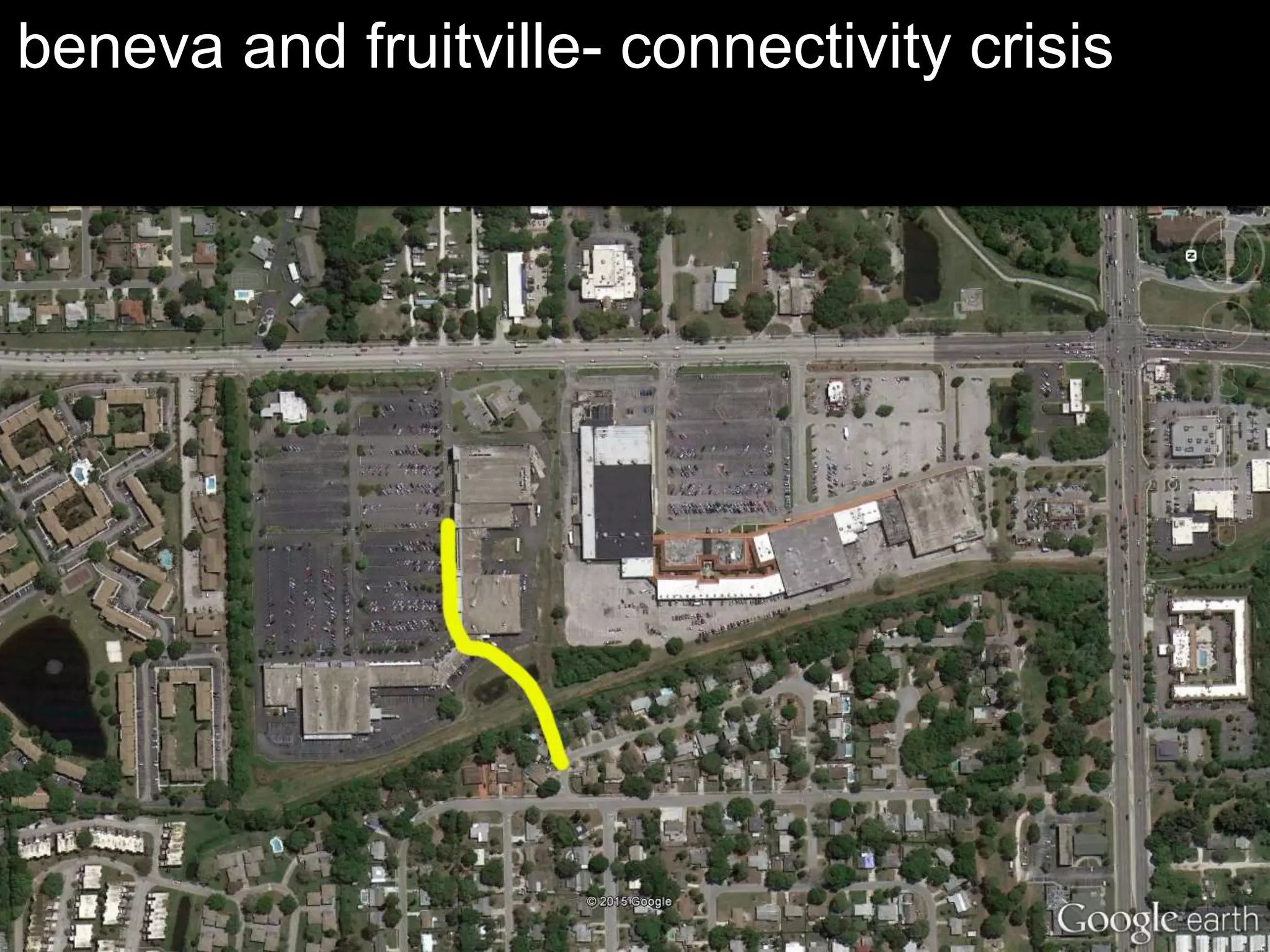
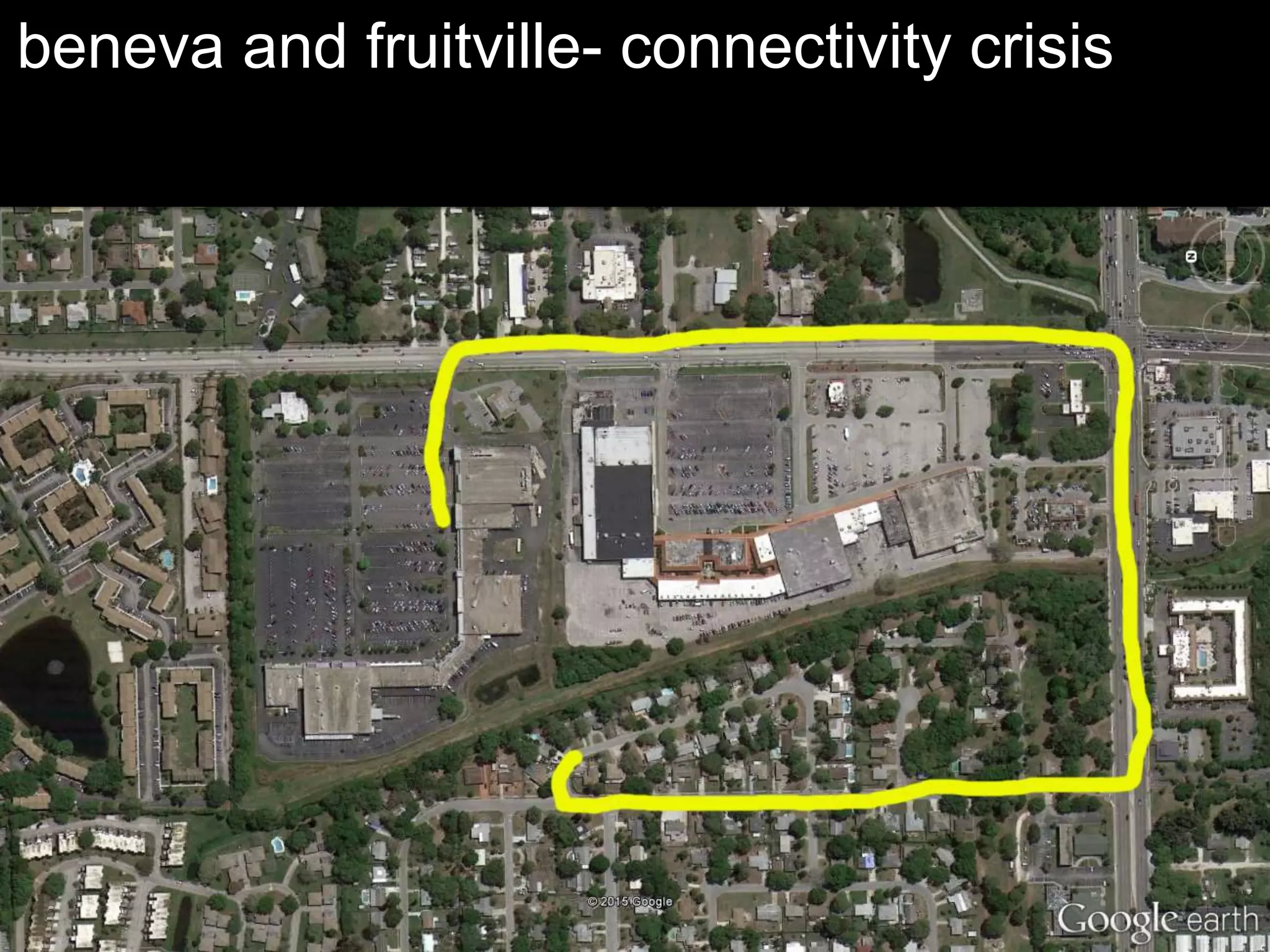
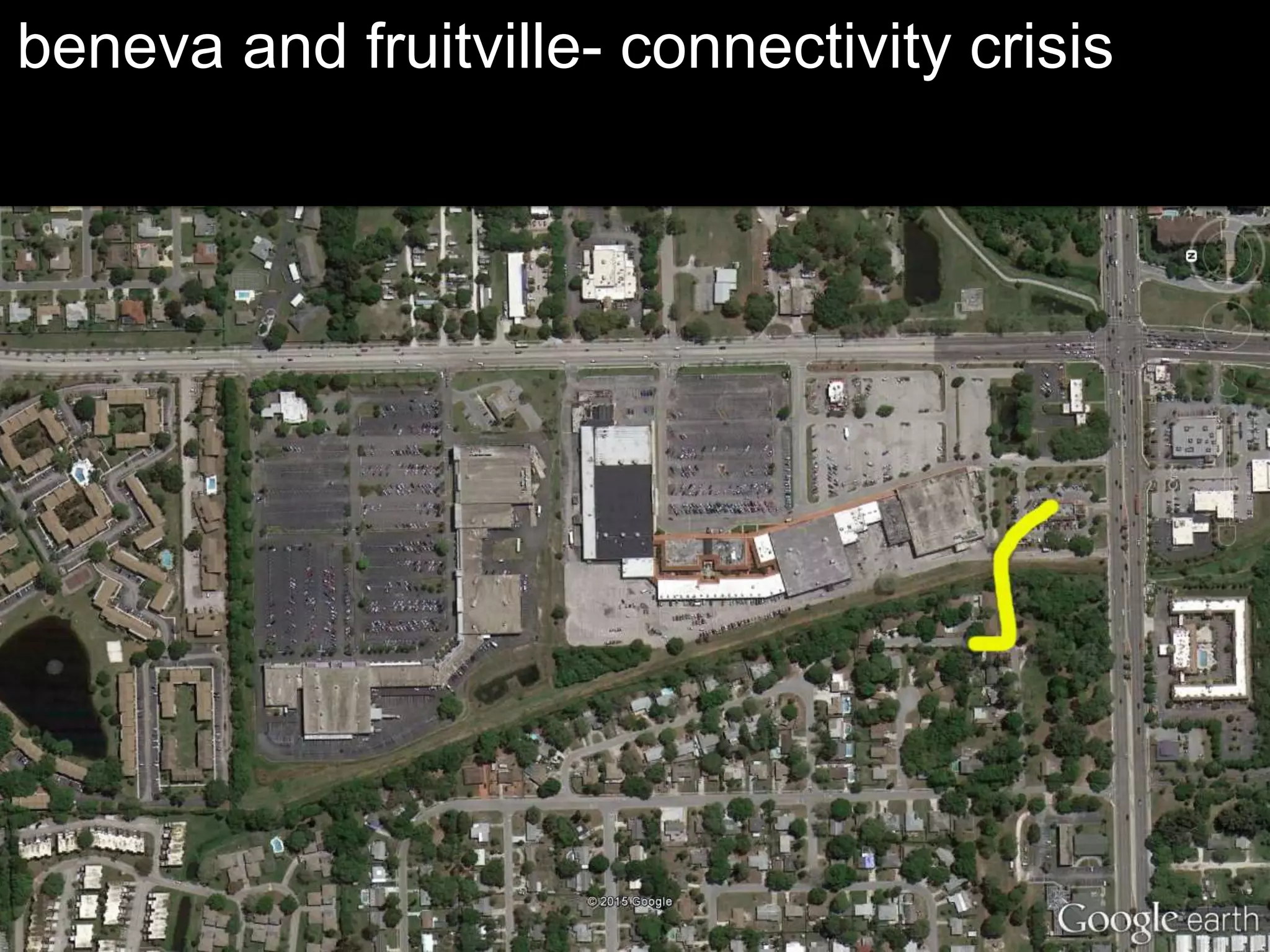
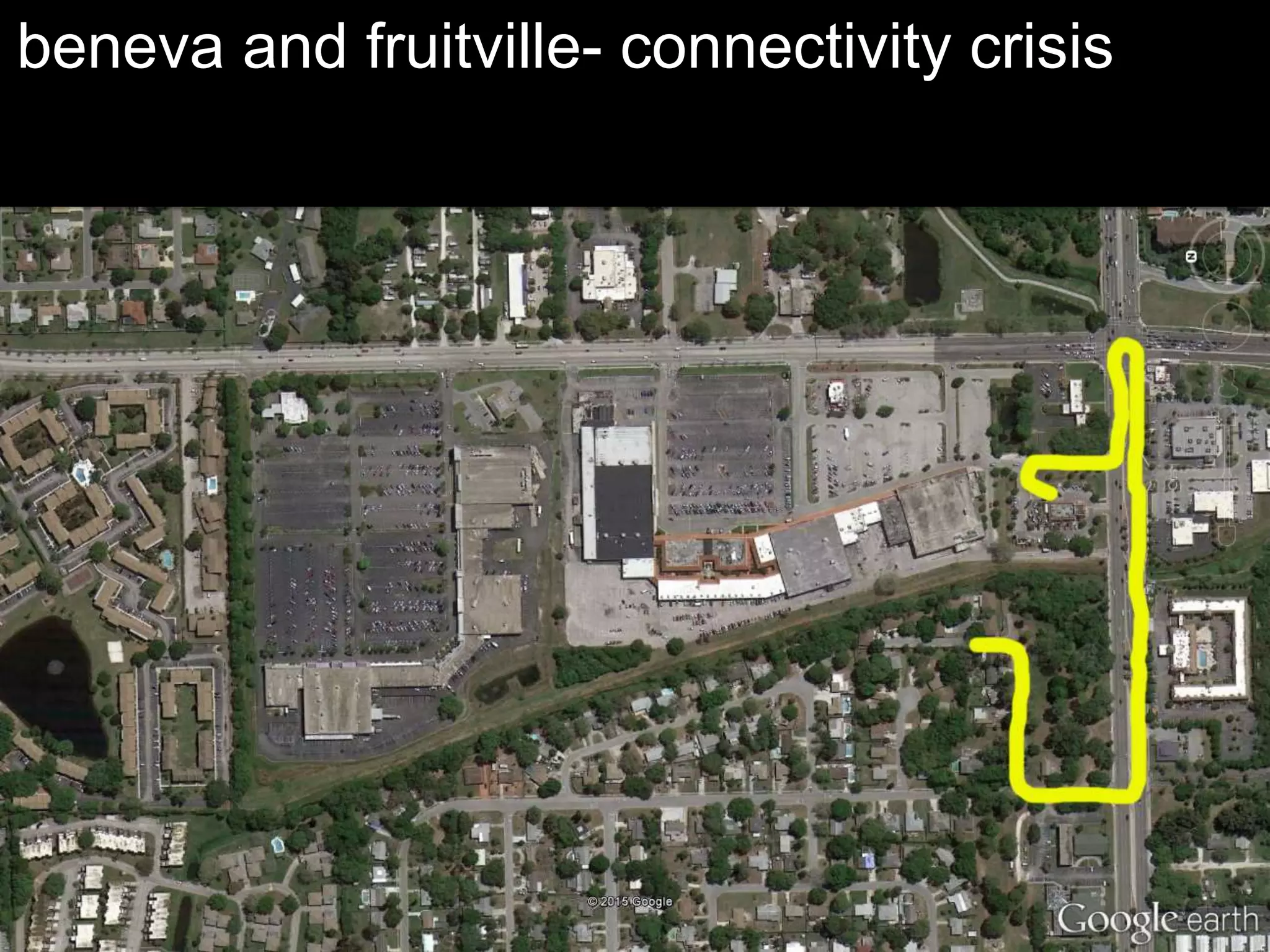
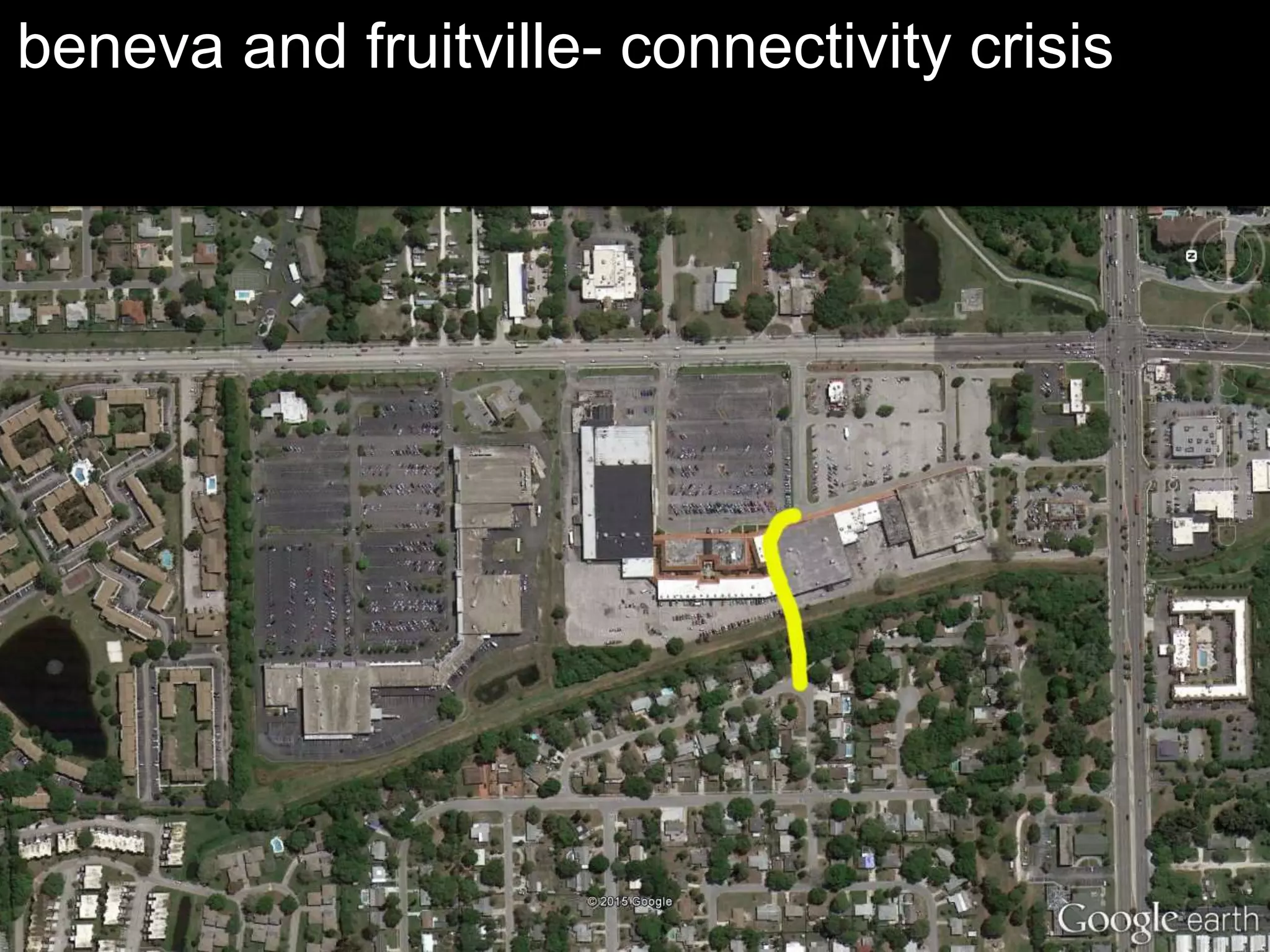
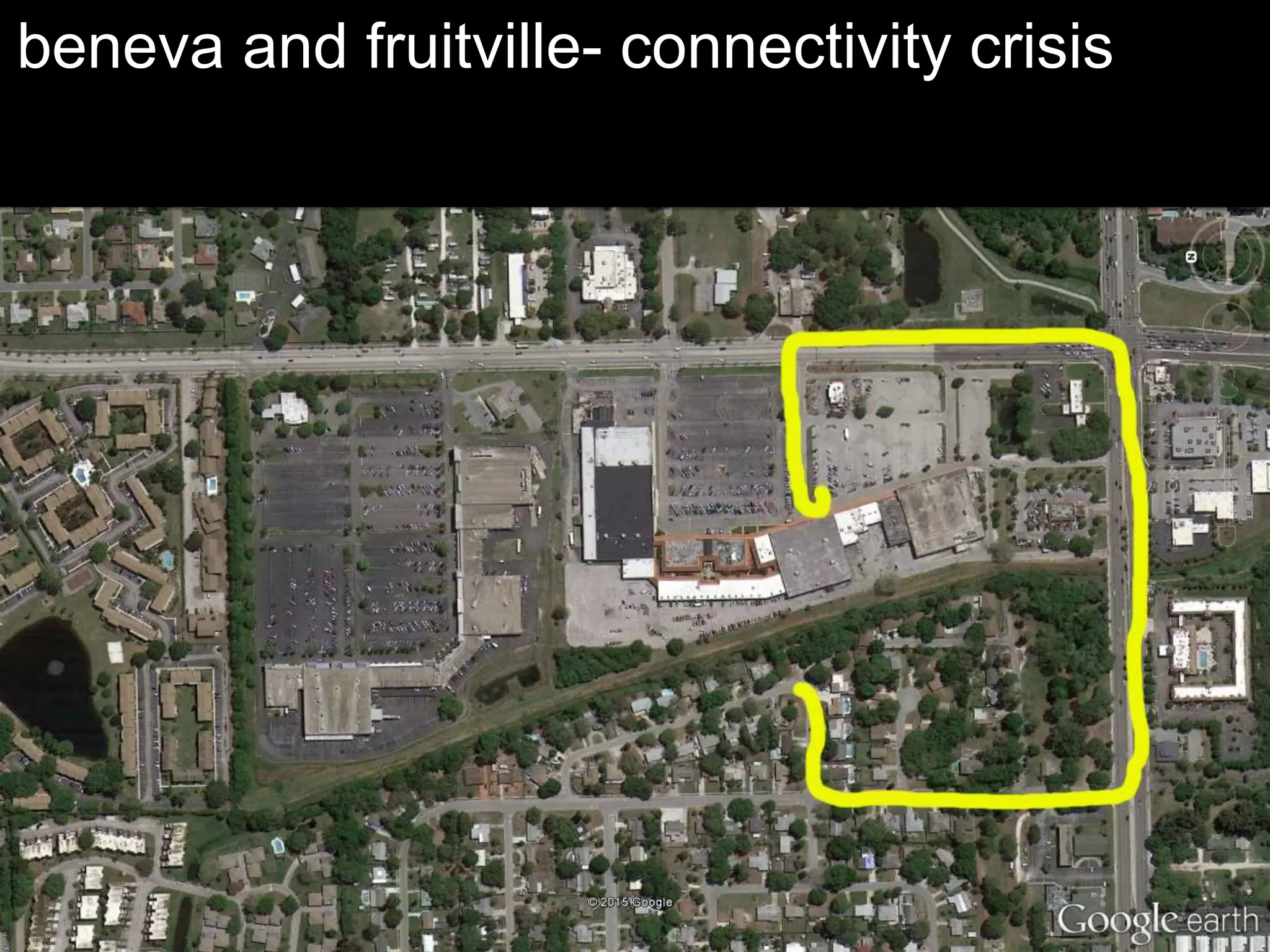
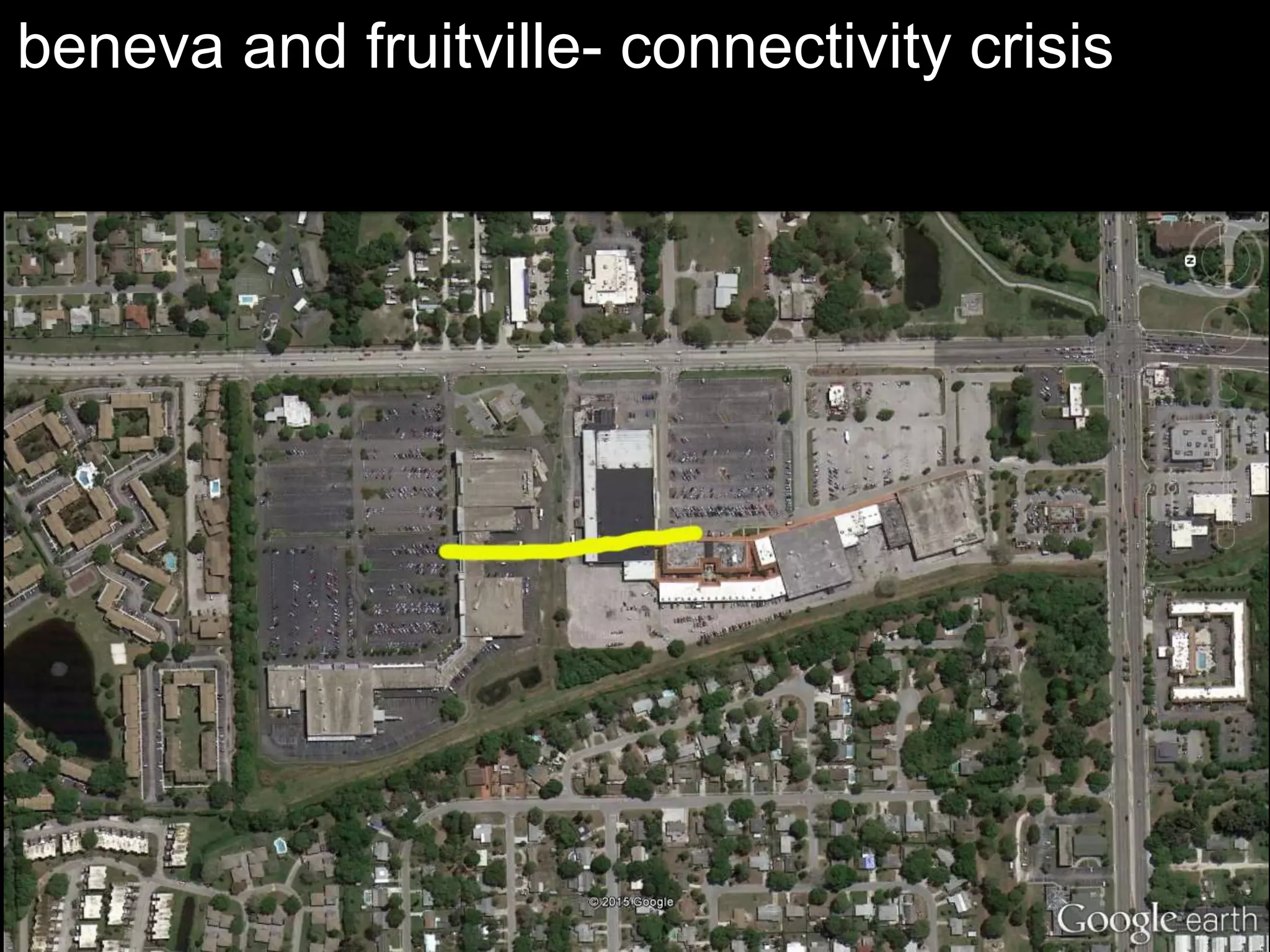
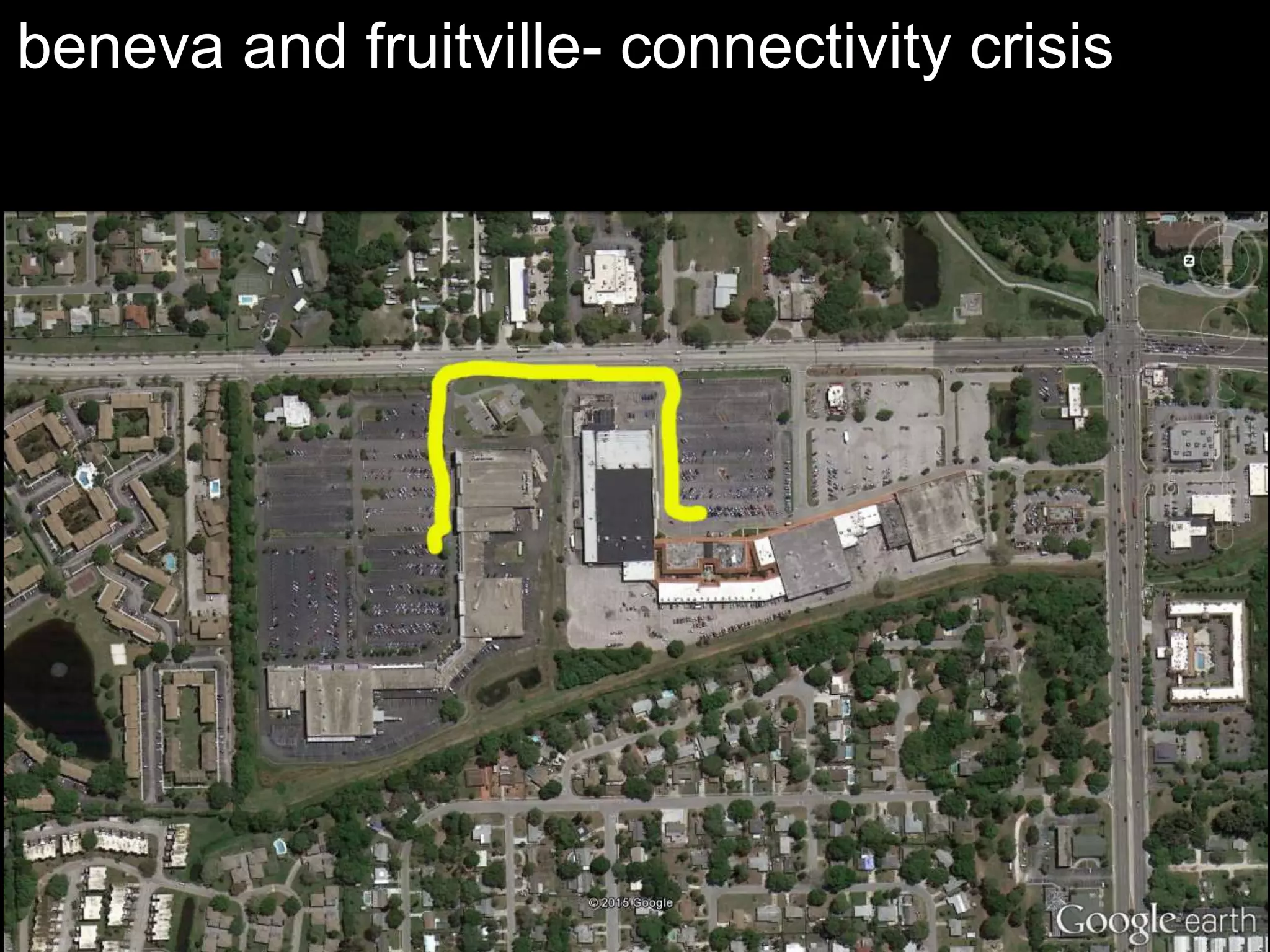
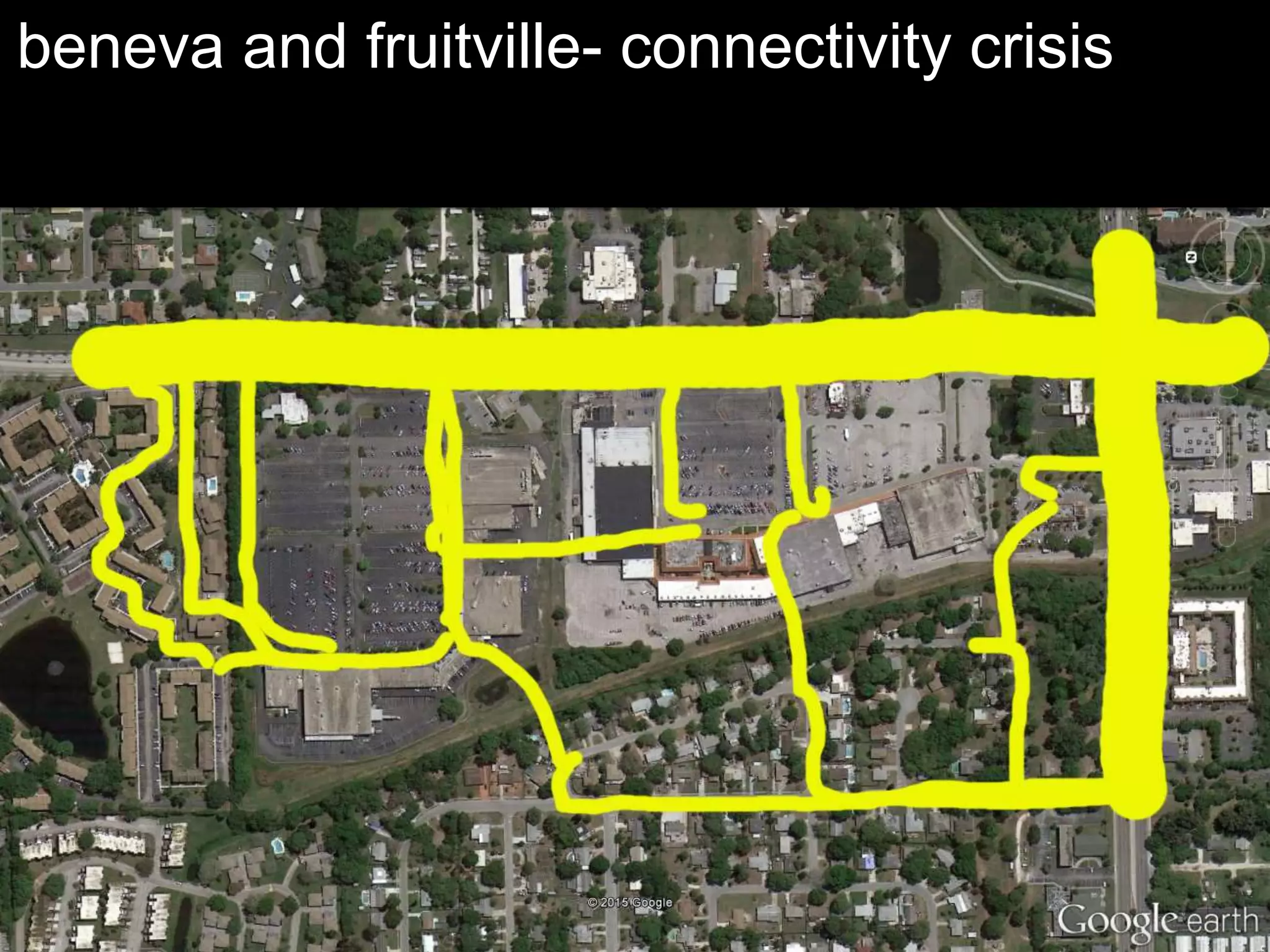
beneva and fruitville- connectivity crisis
crippled grid:
downtown and
central Sarasota districts
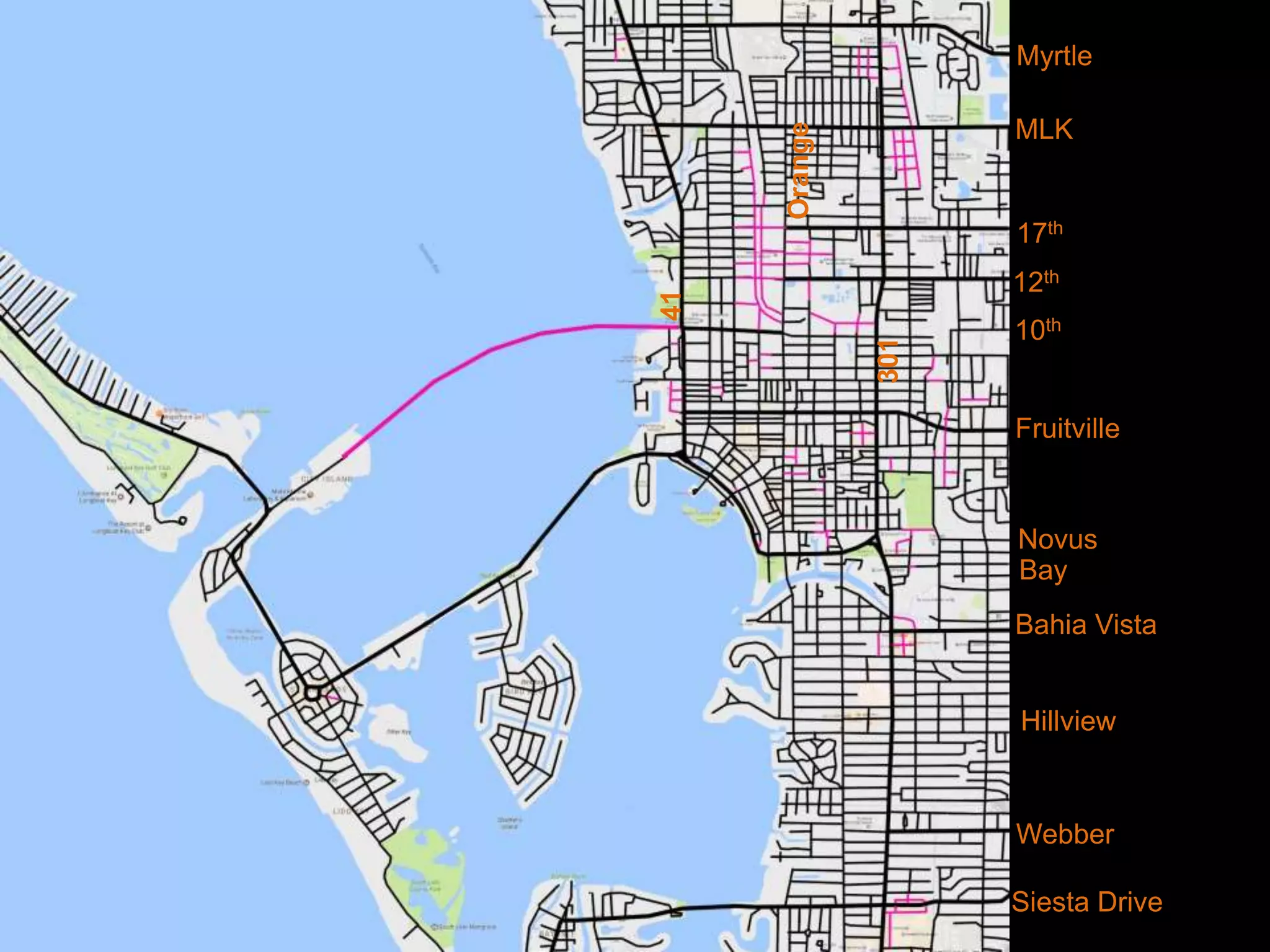
Georgiadis Urban Design Siesta Drive
Bahia Vista
Webber
Fruitville
10th
12th
17th
MLK
Myrtle
Novus
Bay
301
41
Orange
Hillview
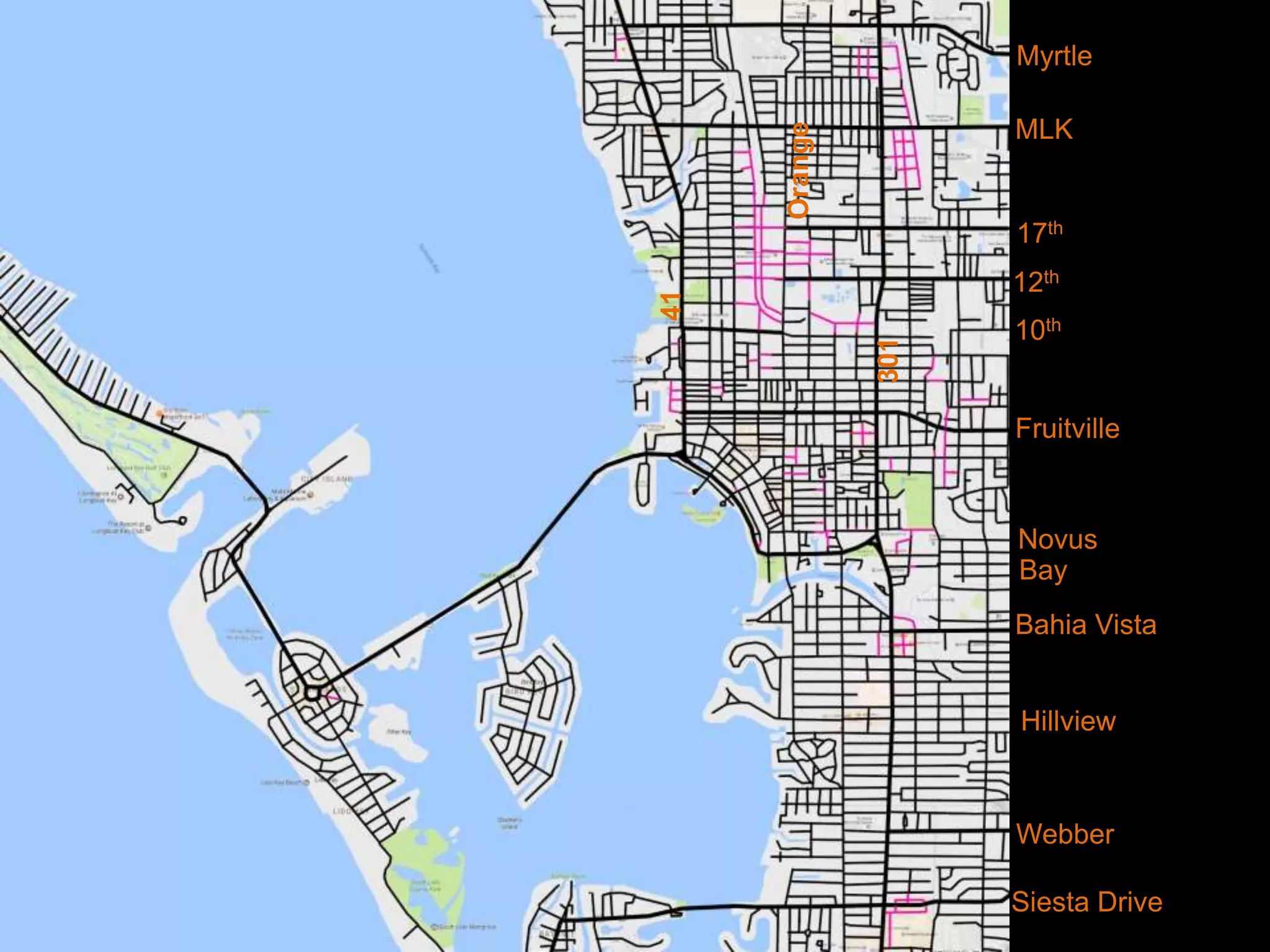
Georgiadis Urban Design Siesta Drive
Bahia Vista
Webber
Fruitville
10th
12th
17th
MLK
Myrtle
Novus
Bay
301
41
Orange
Hillview
Georgiadis Urban Design Siesta Drive
Bahia Vista
Webber
Fruitville
10th
12th
17th
MLK
Myrtle
Novus
Bay
301
41
Orange
Hillview
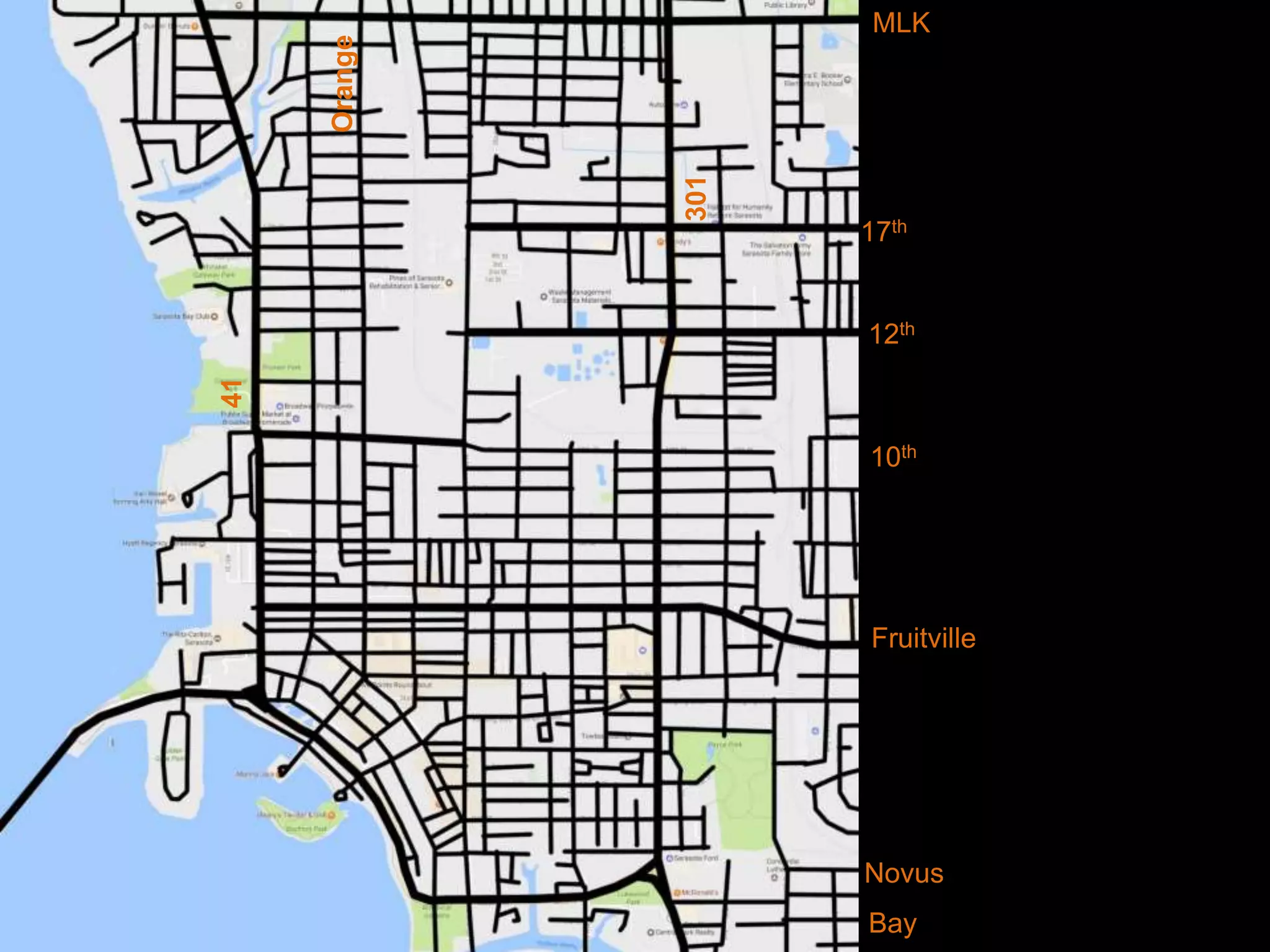
Fruitville
10th
12th
17th
MLK
Novus
Bay
301
41
Orange
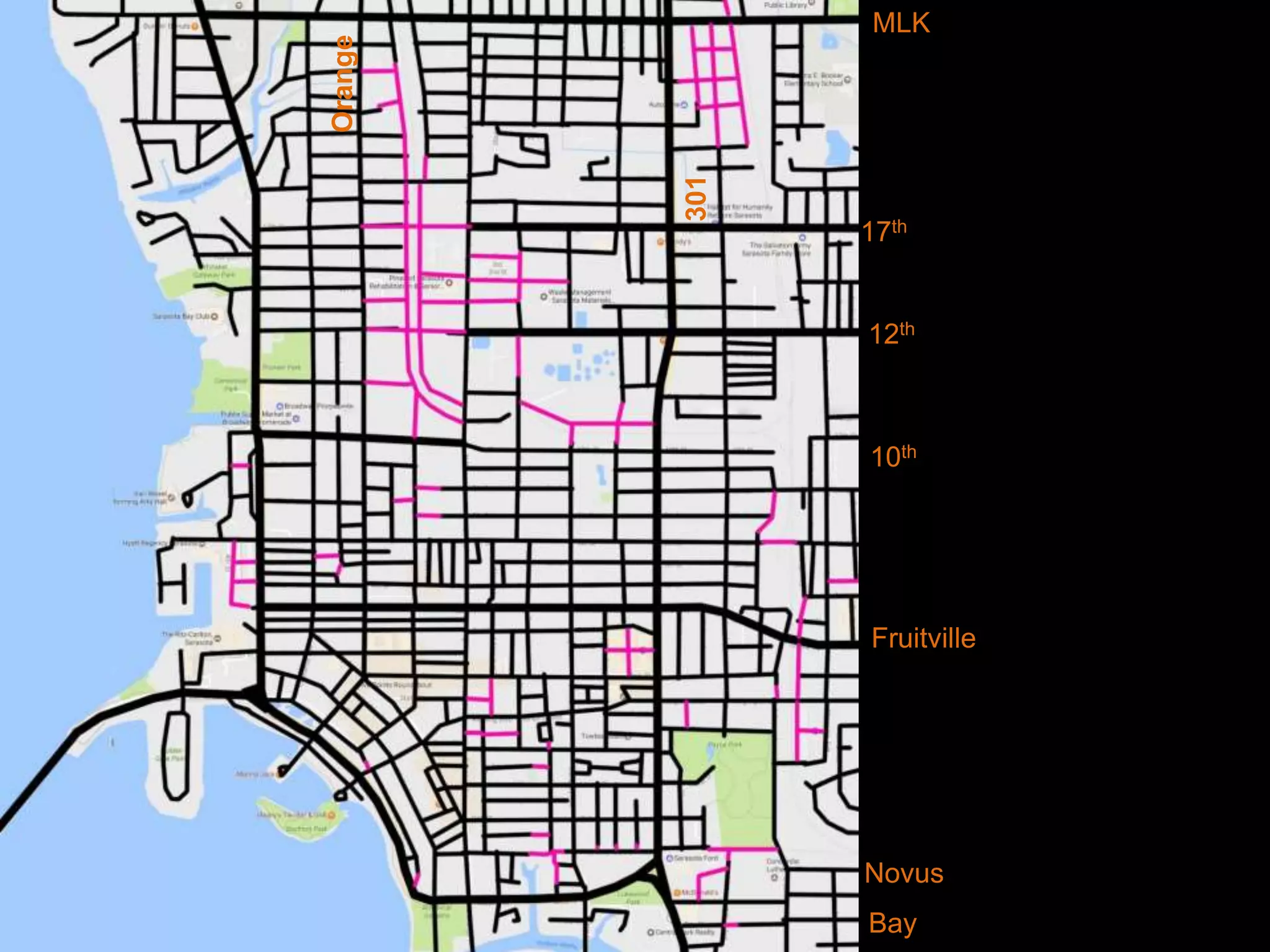
Fruitville
10th
12th
17th
MLK
Novus
Bay
301
Orange
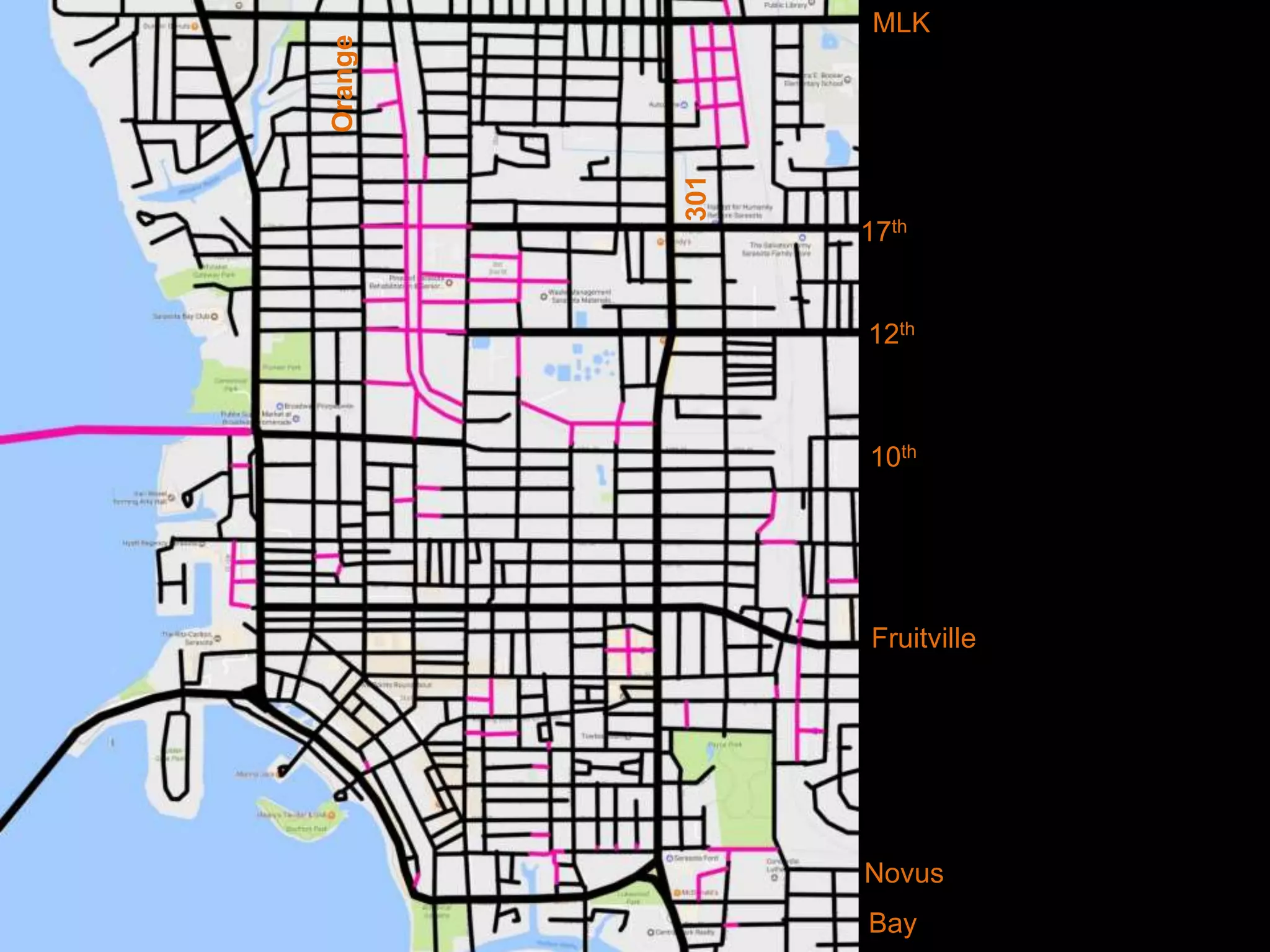
Fruitville
10th
12th
17th
MLK
Novus
Bay
301
Orange
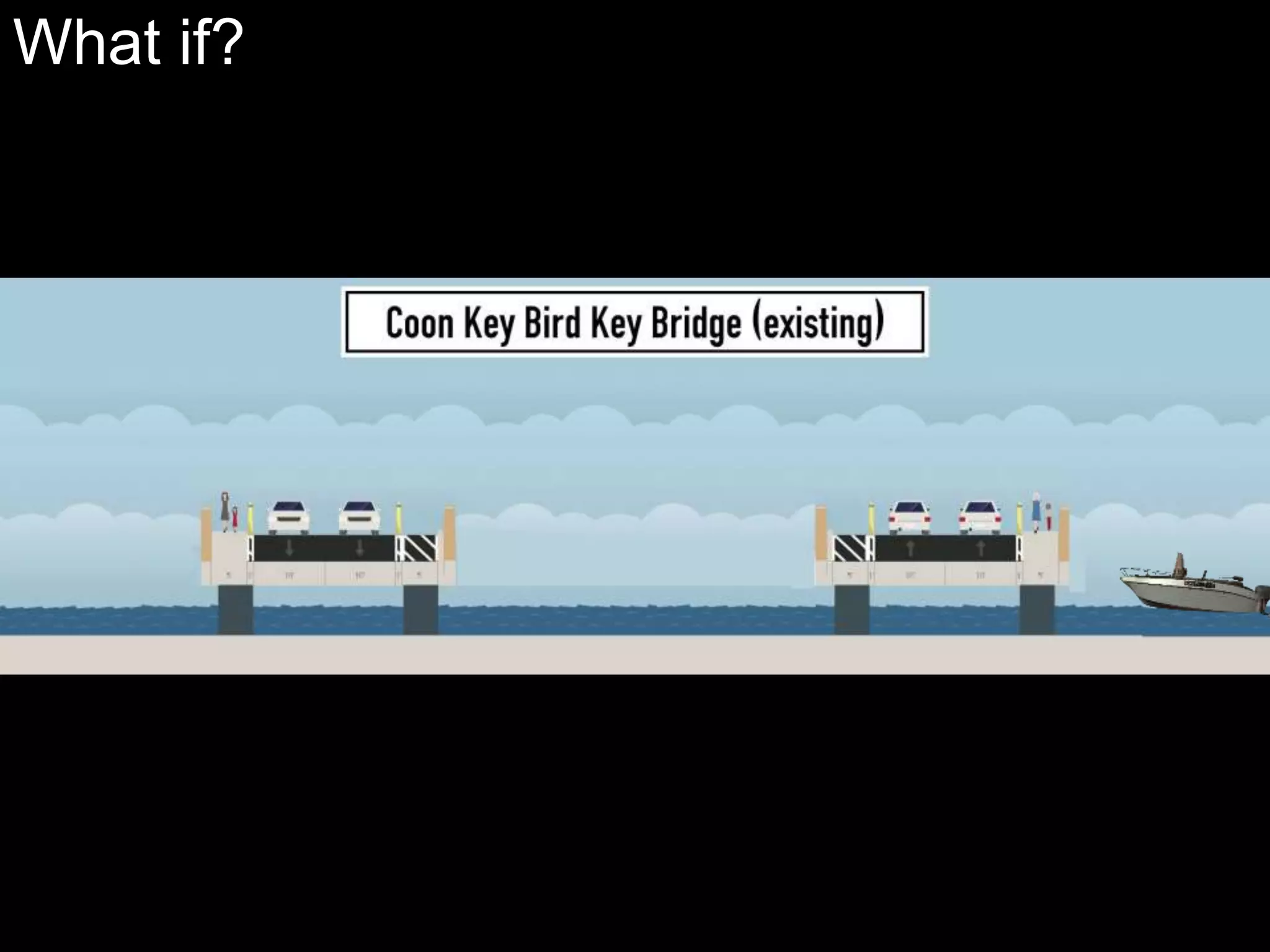
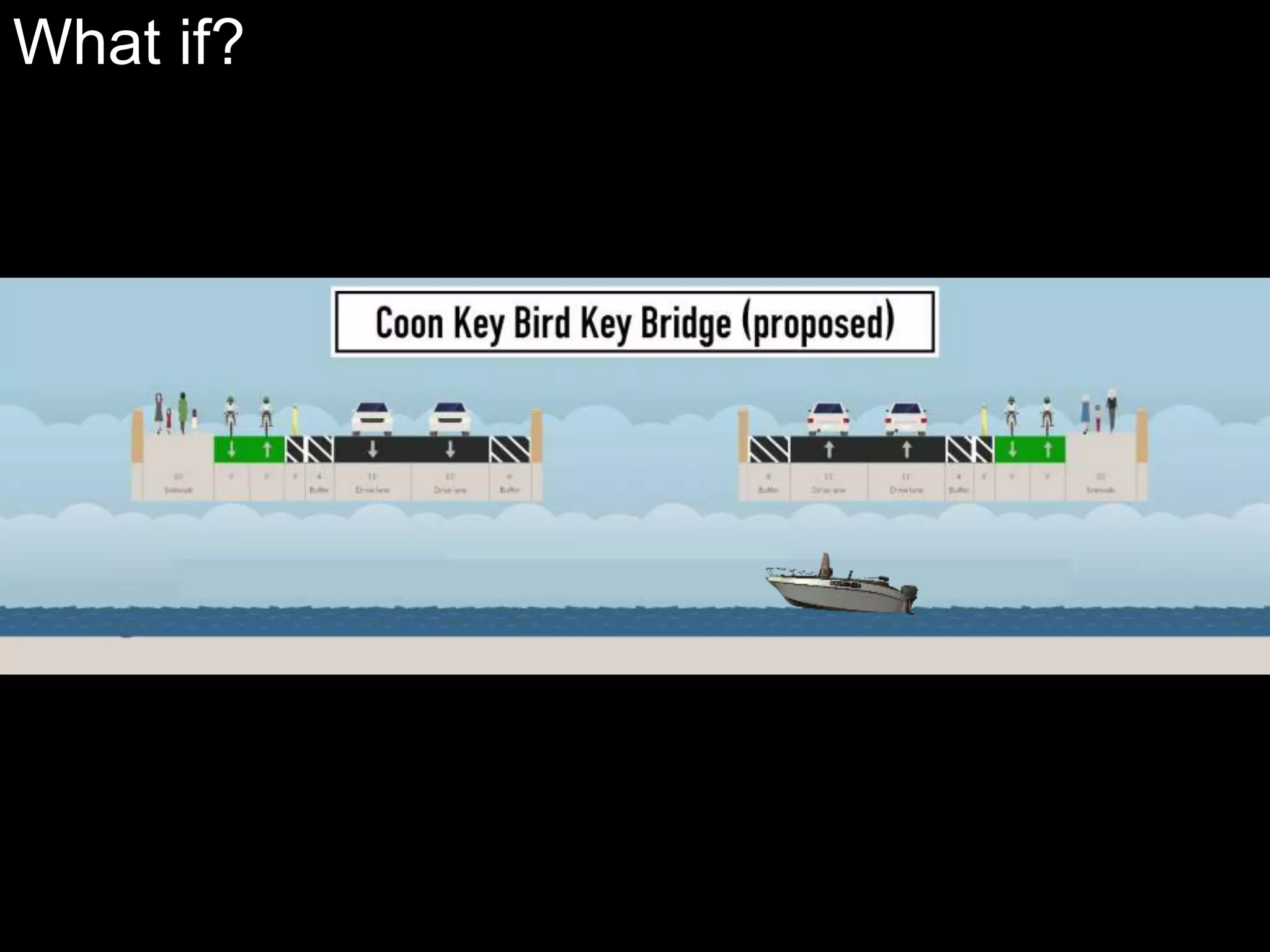
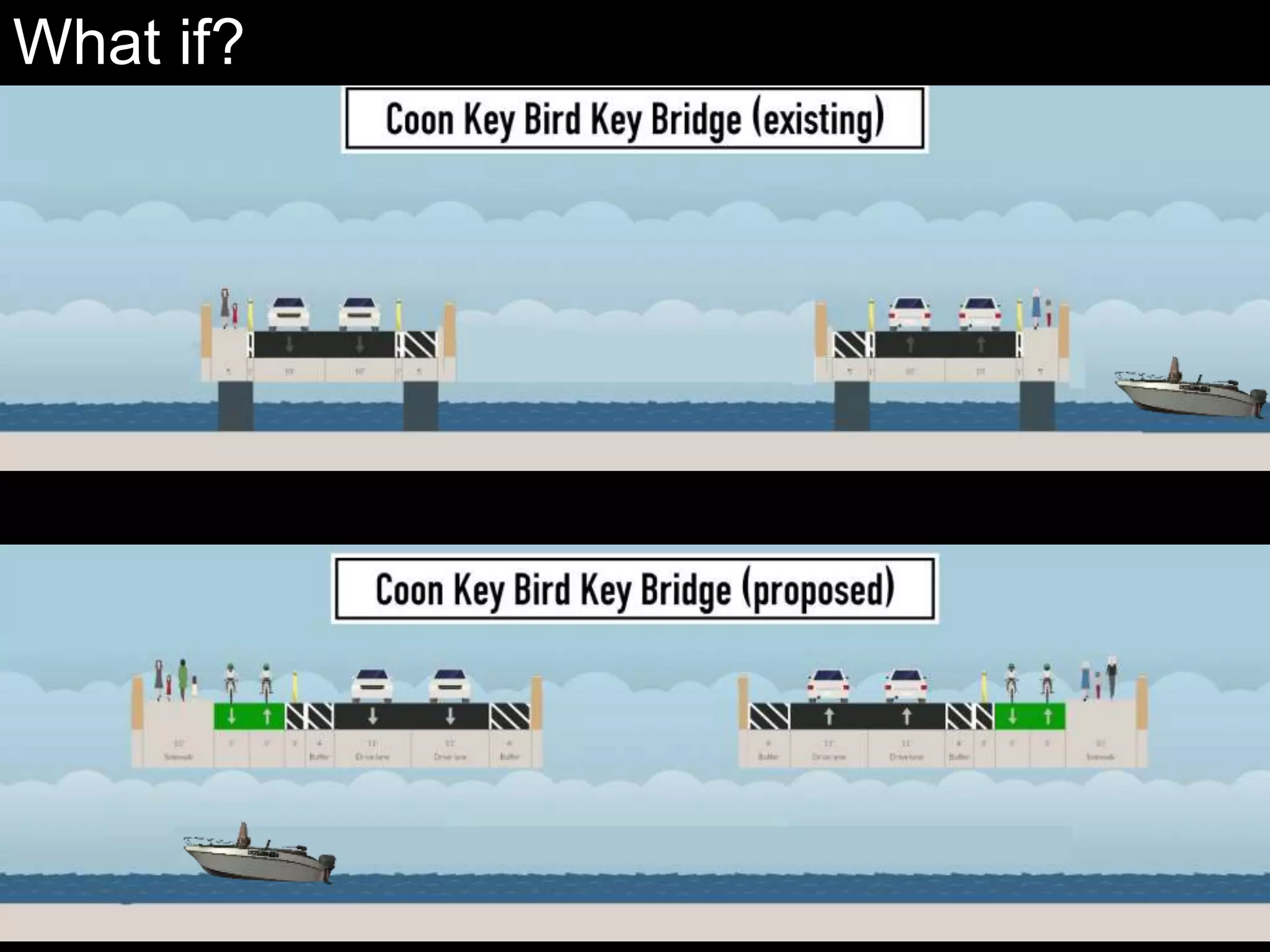
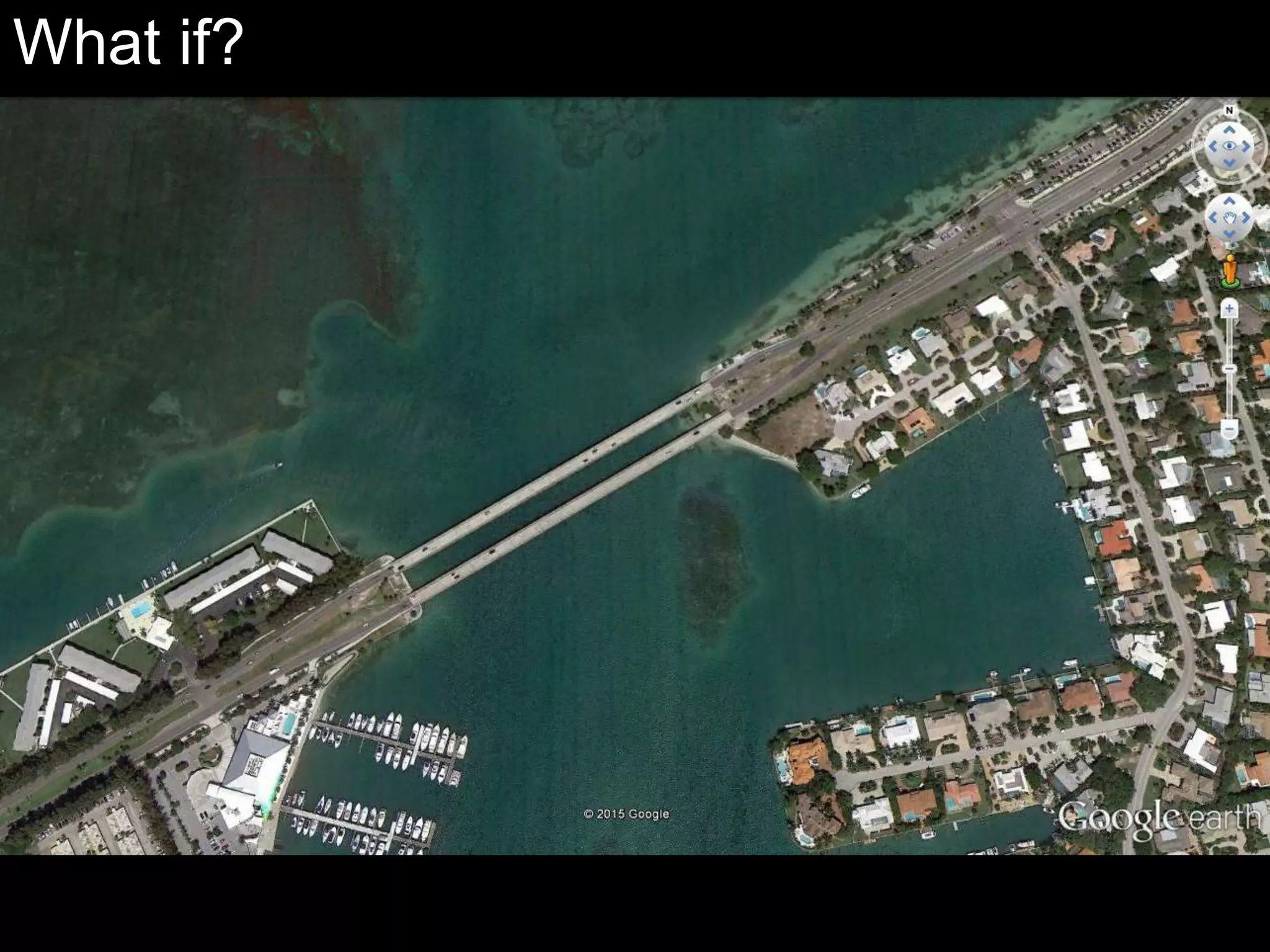
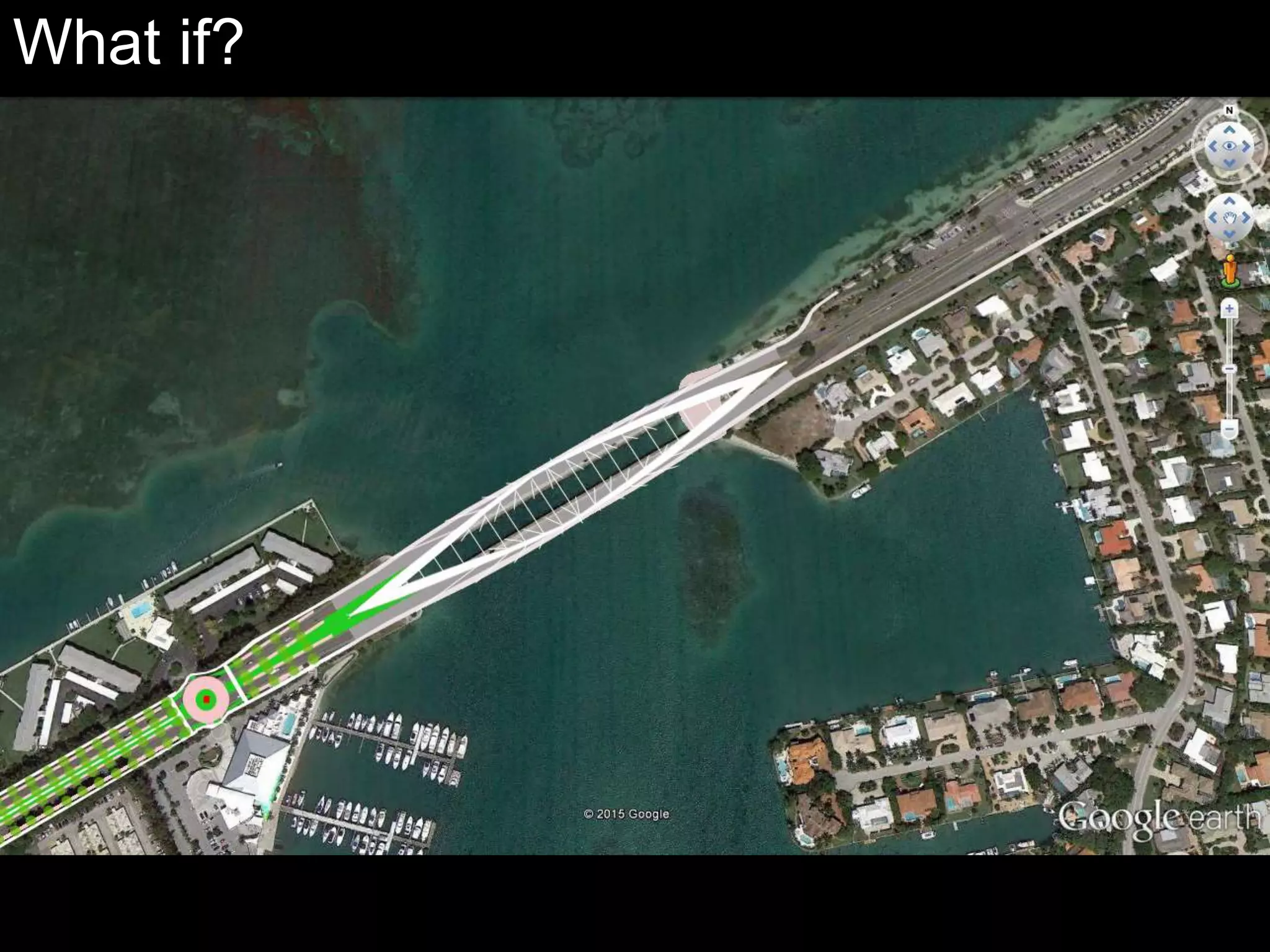
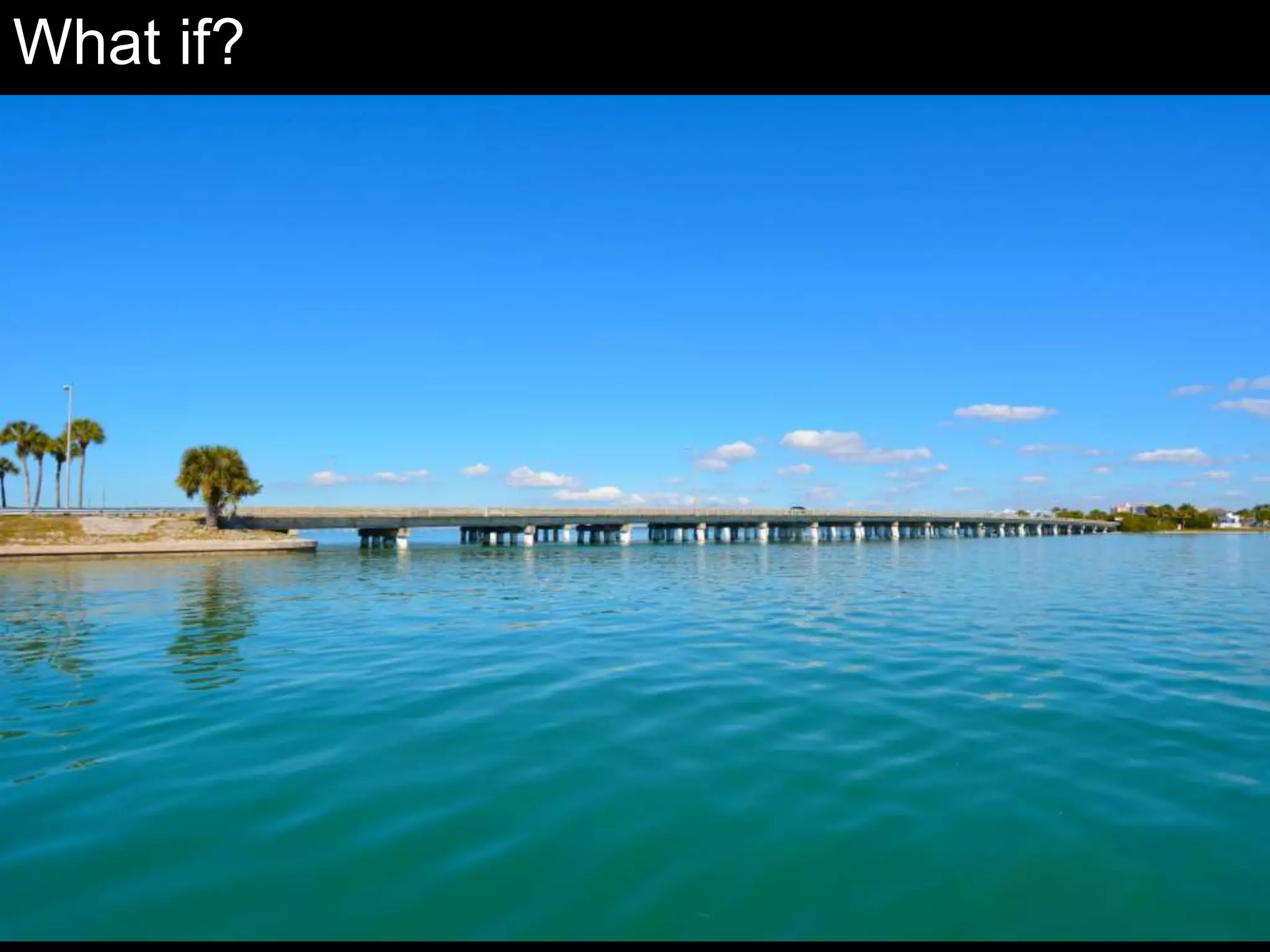
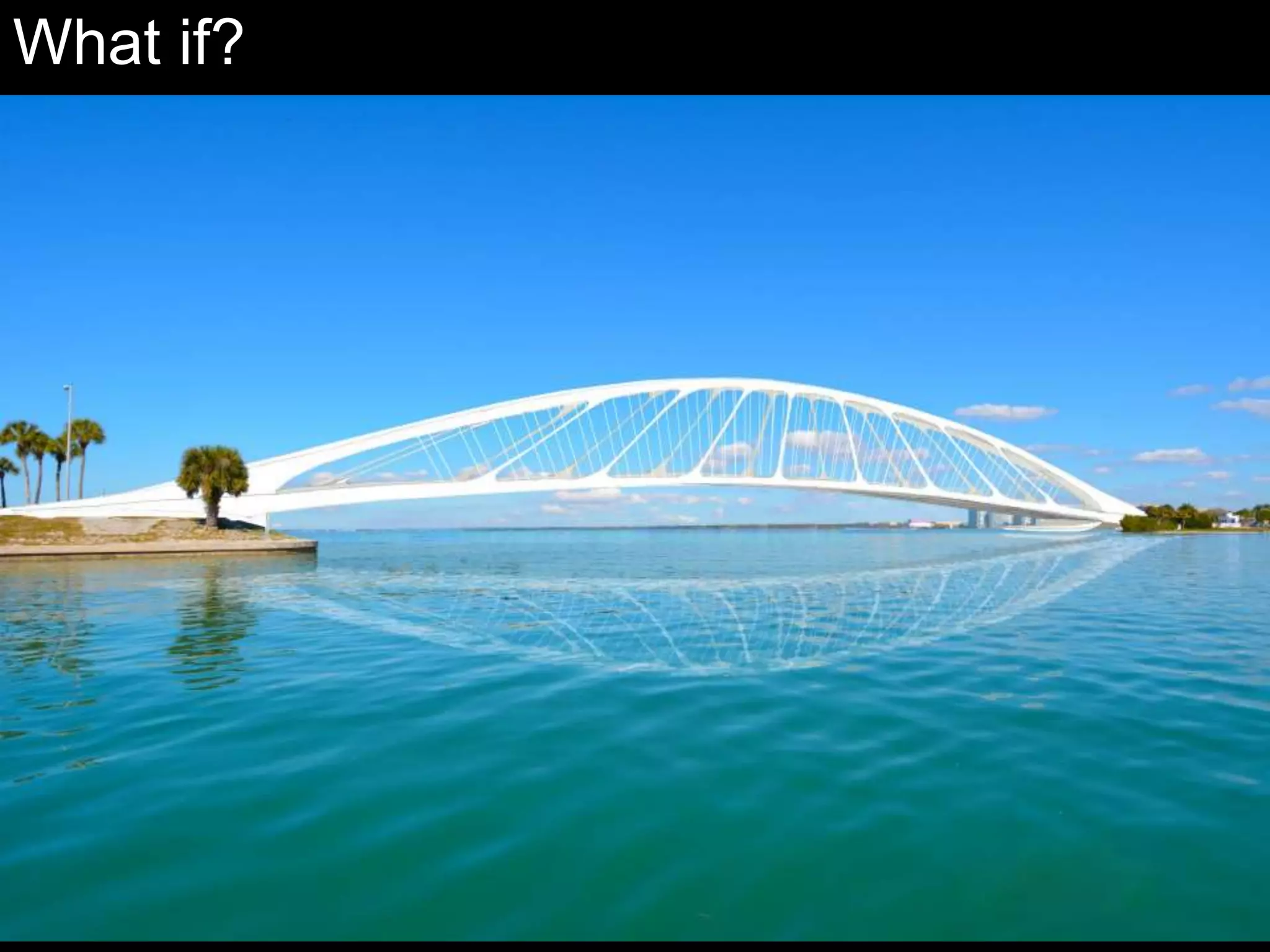
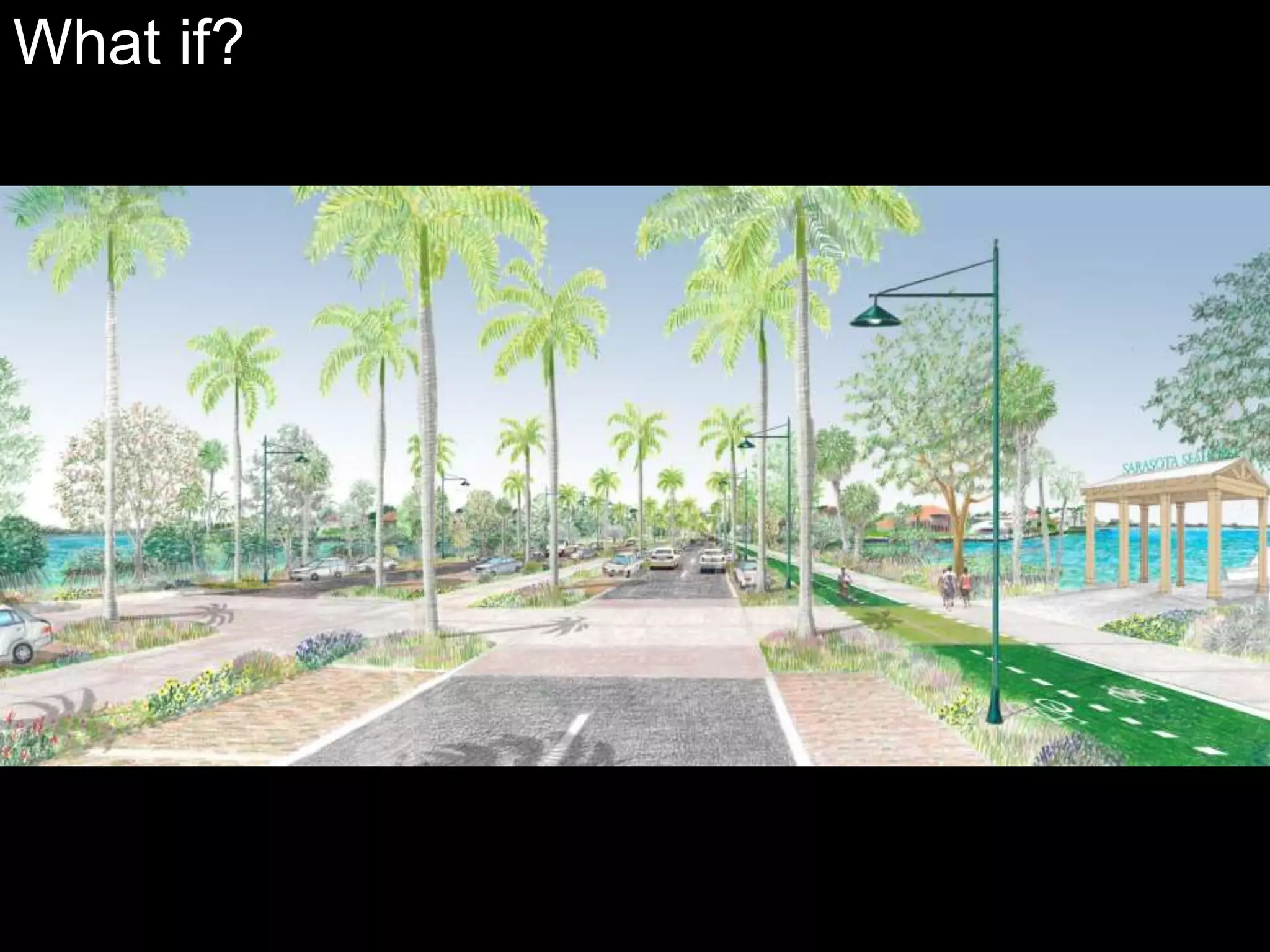
What if?
What if?
What if?
What if?
What if?
What if?
What if?
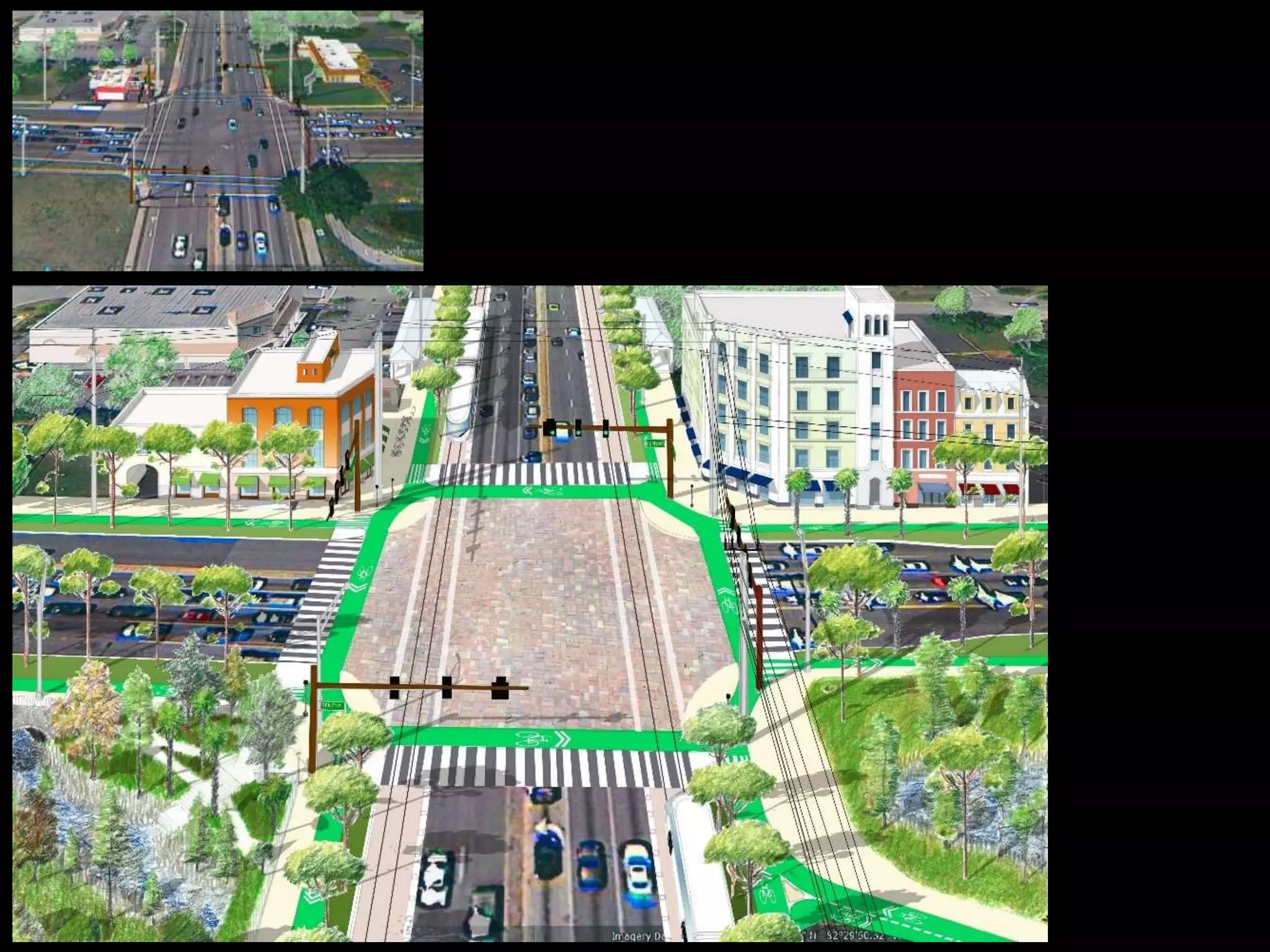
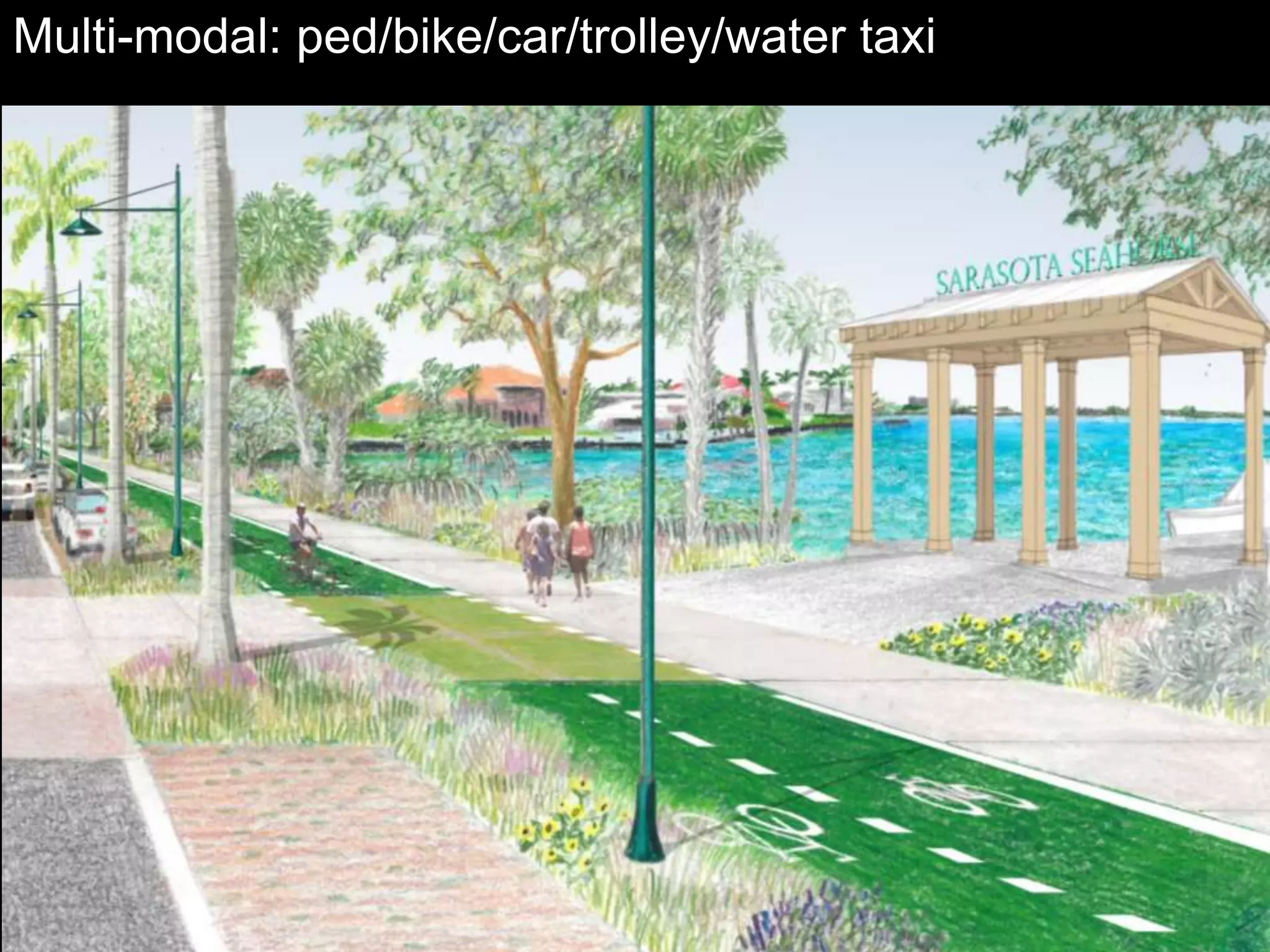
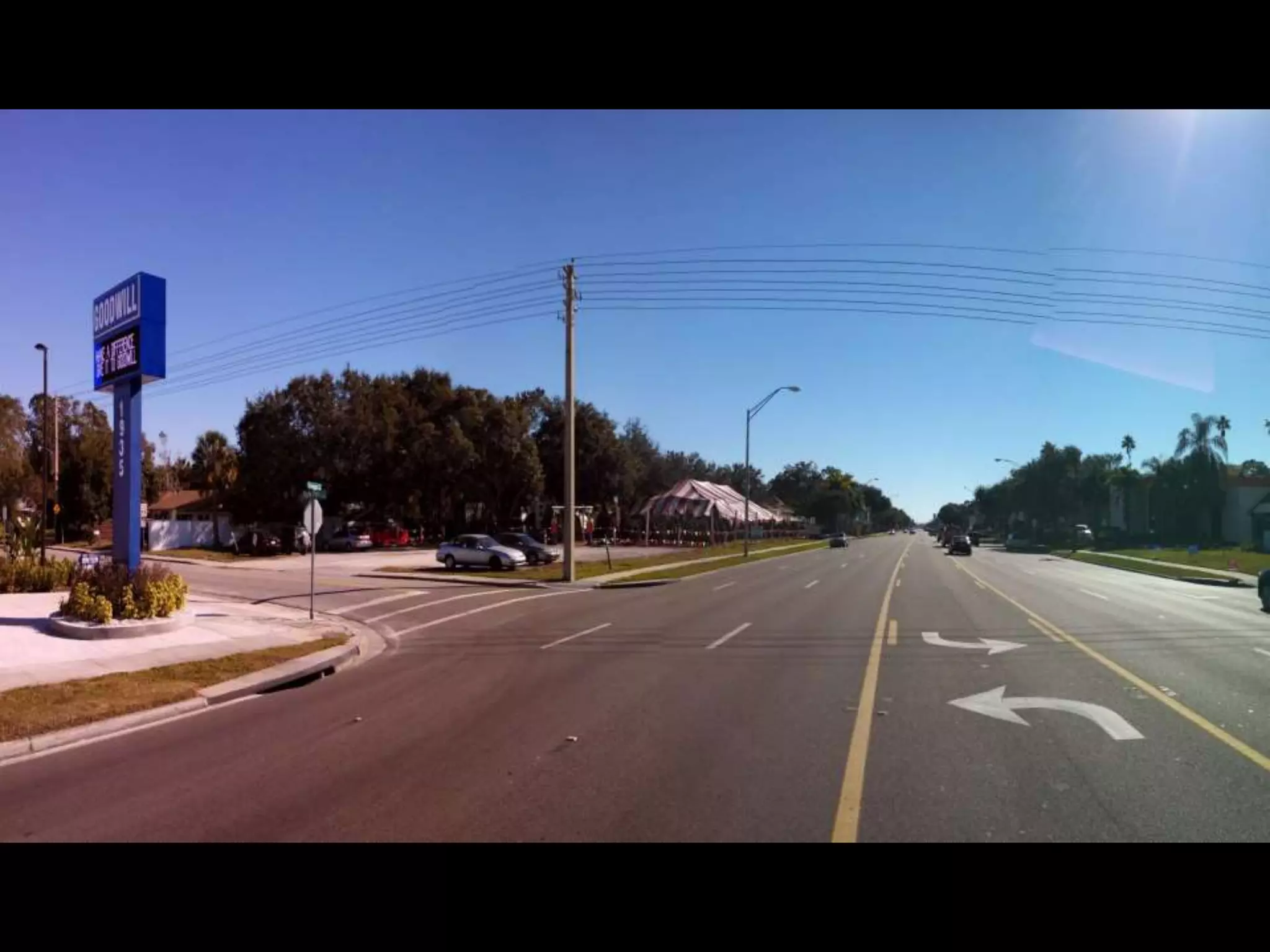
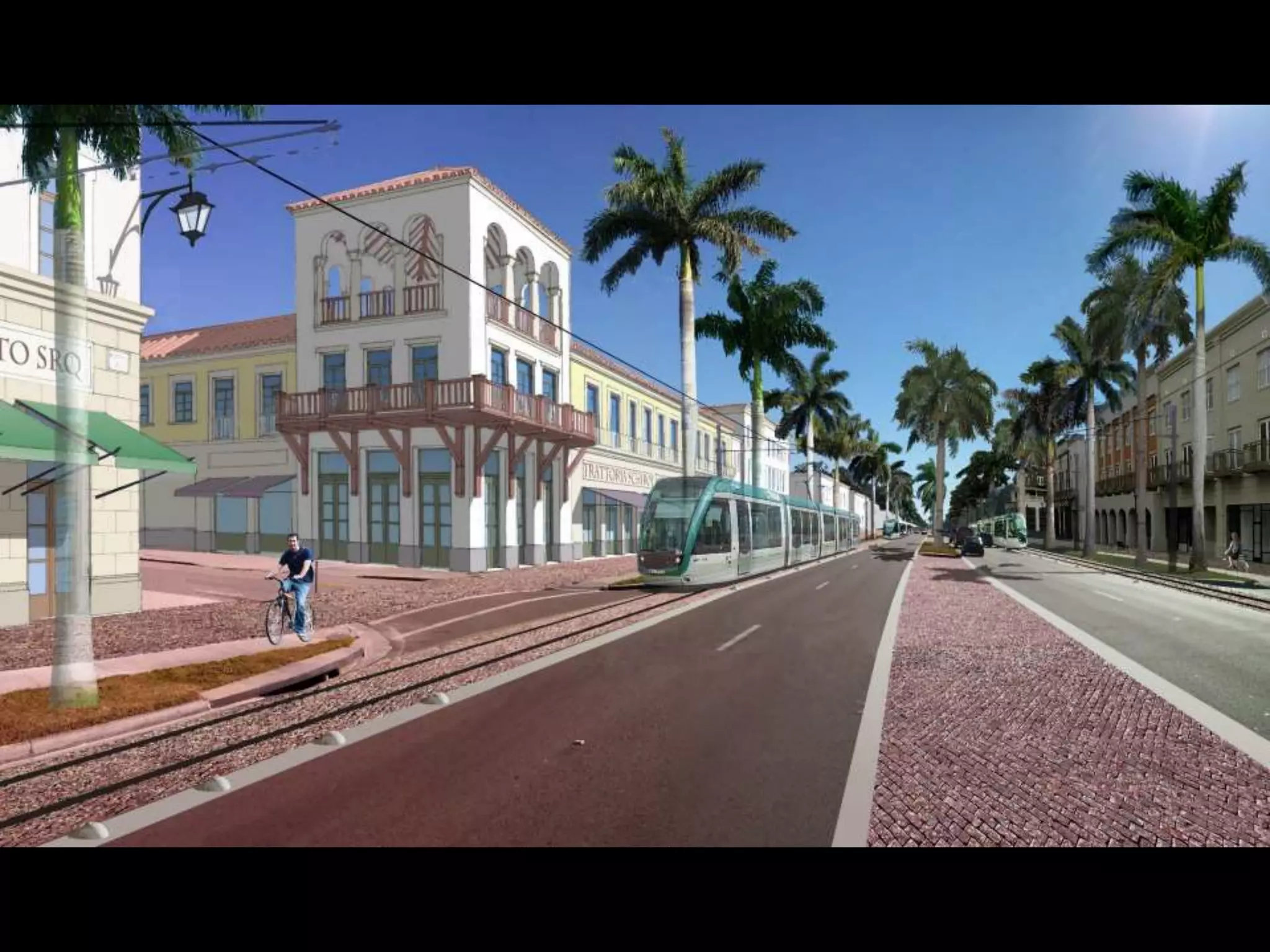
Multi-modal: ped/bike/car/trolley/water taxi
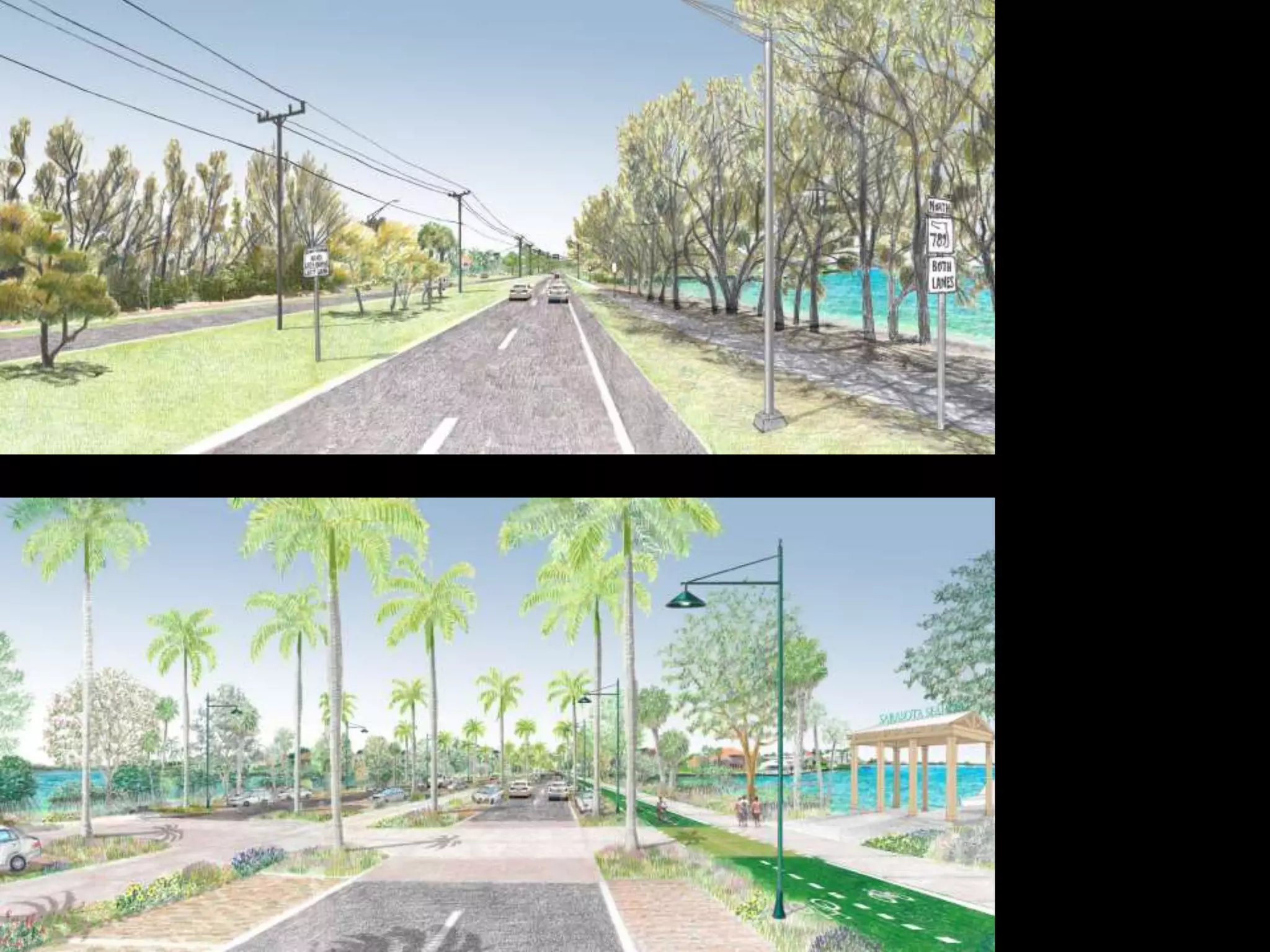
What if?
Mixture of uses
Shallow setback in urban general or zero setback in the urban core
High quality frontage
(courtesy of Chris Gallagher) low quality frontage
On-Street Parking on most streets and “friction”
Narrower lanes and fewer lanes, with crossable intersections
Most streets should be two-way unless they are narrow enough for only one lane
(Image courtesy of Chuck Marohn, Strong Towns)
Street trees (trees between the sidewalk and the travel lane)
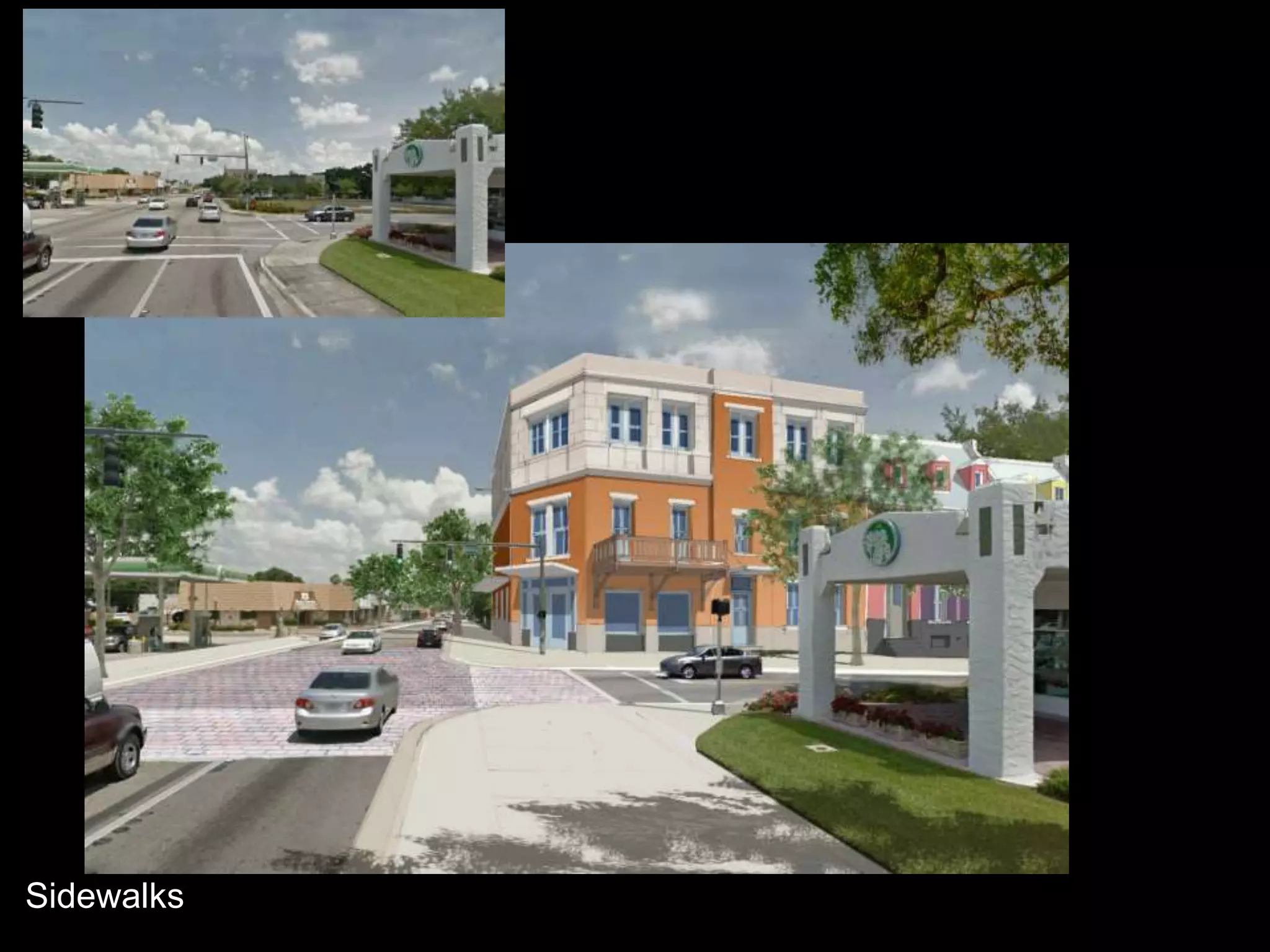
Sidewalks
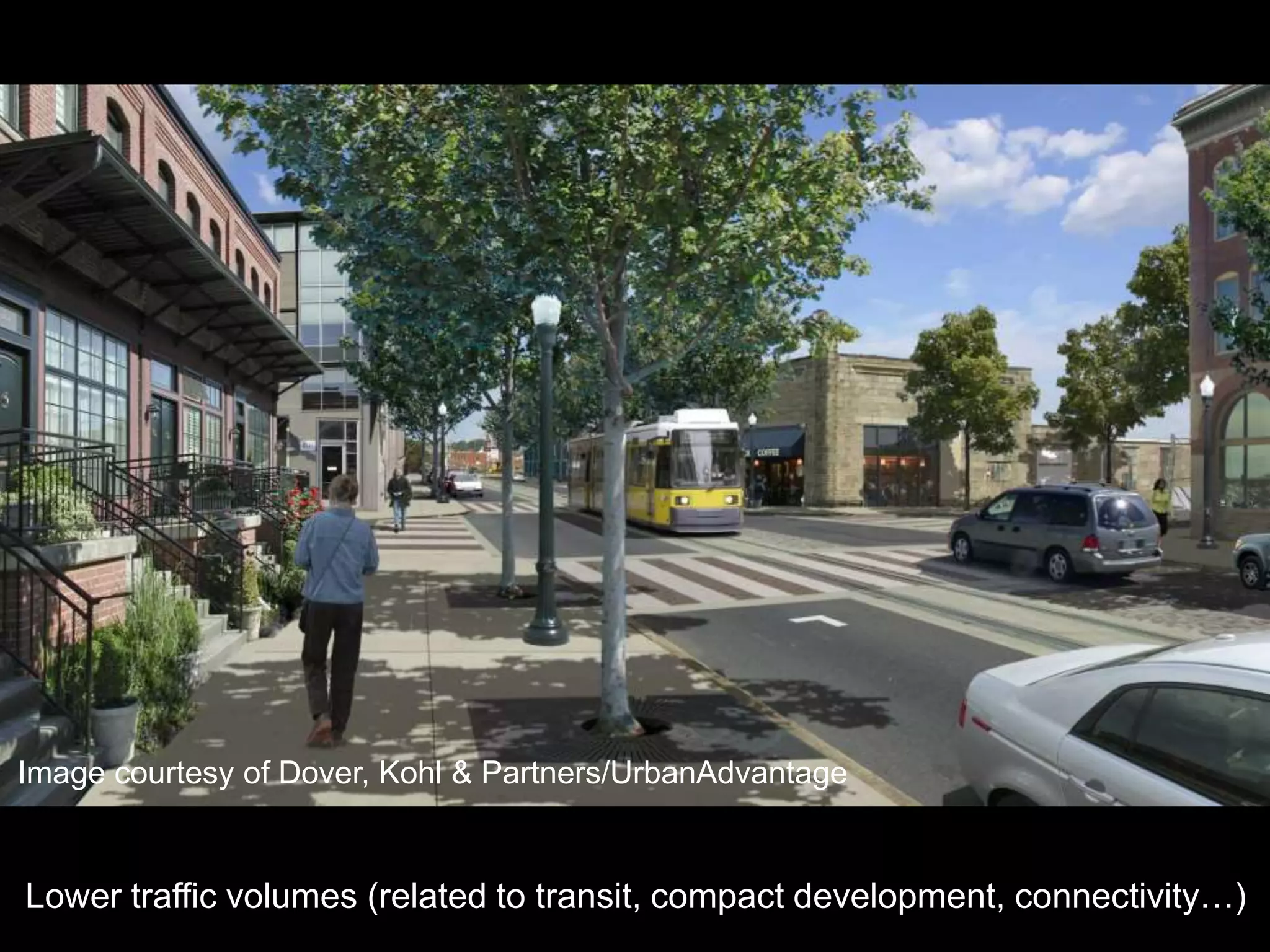
Lower traffic volumes (related to transit, compact development, connectivity…)
Image courtesy of Dover, Kohl & Partners/UrbanAdvantage
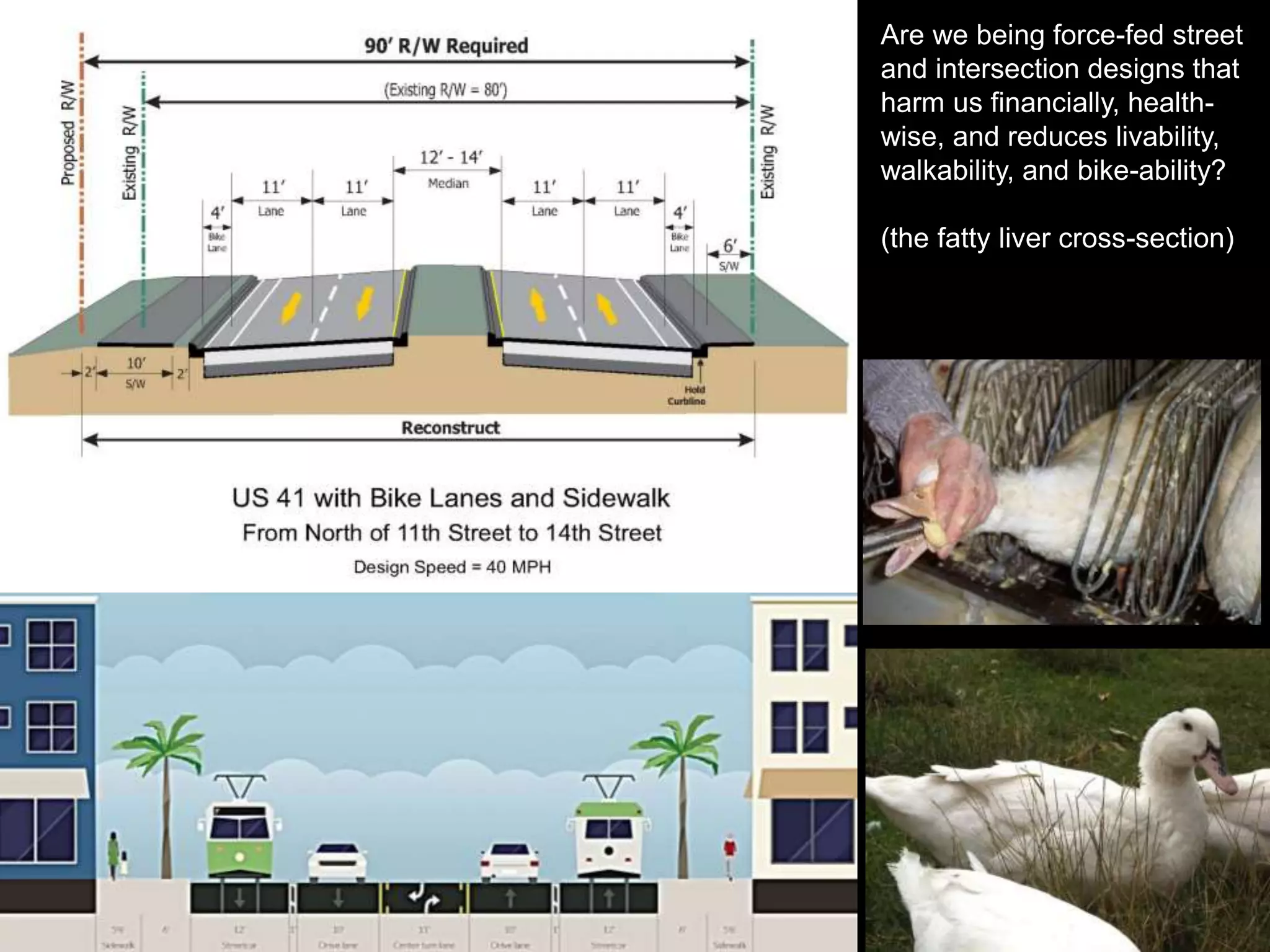
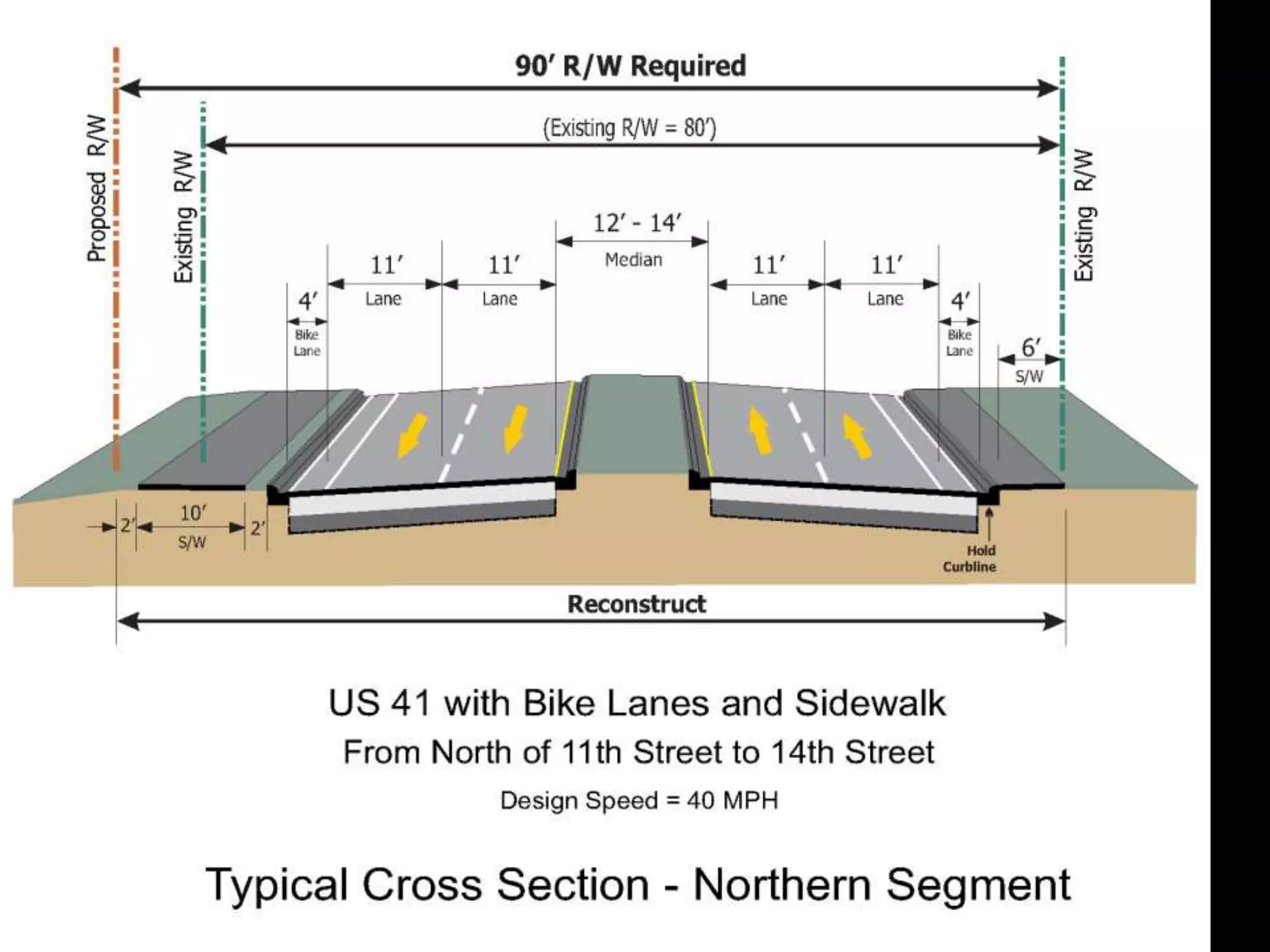
Are we being force-fed street
and intersection designs that
harm us financially, health-
wise, and reduces livability,
walkability, and bike-ability?
(the fatty liver cross-section)
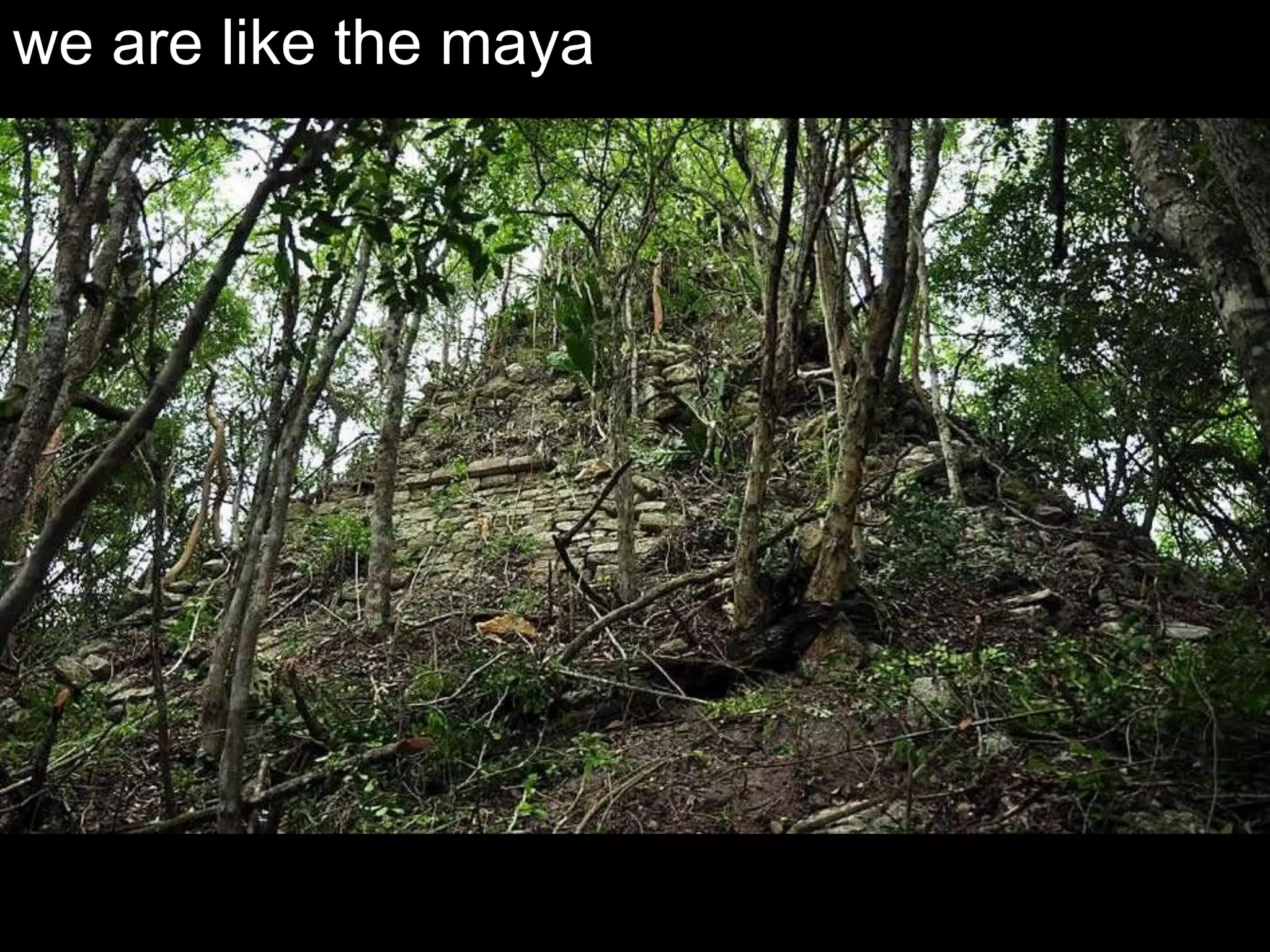
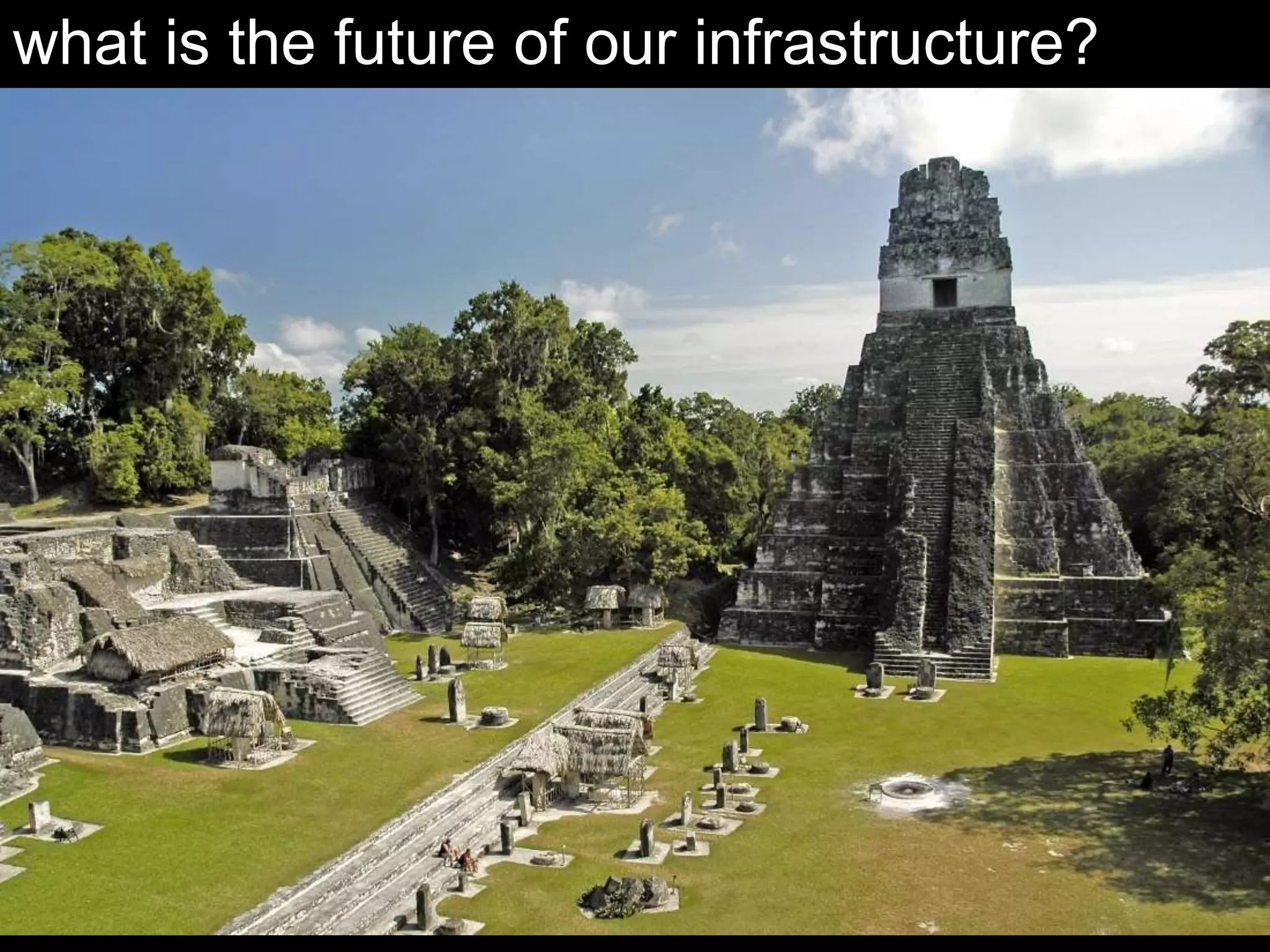
we are like the maya
what is the future of our infrastructure?
Traffic Studies/ Conventional Planning and Approvals
Process:
Traffic Study costs $$ in order to determine how much is
paid to the City, then $$ are paid to the City/County.
Public hopes that the City/County spends it wisely.
Mobility Fee and New Urbanist Planning and Approvals
Process:
$$$$ are paid to the City/County towards implementation
of Premium Transit/Mobility/Multi-modal Plan, authored
by the public and a qualified planner/mobility consultant
with CNU credentials.*
*City receives $$ more this way than the conventional way, but it needs to have
an excellent transit/mobility plan in place.
Praise for the current plan:
Modified the inter-local agreement in order to allow for
the City to spend funds collected from developers on
projects that benefit the City and on projects that are
multi-modal rather than just asphalt.
Constructive criticism for the current plan:
Pages and pages of confusing fee schedules based upon
Euclidean uses could be replaced with a one sentence,
lean, form-based fee schedule that does not consider use:
“Impact fee is equivalent to one dollar per buildable
square foot of the lot-of-record/parcel plus one dollar per
built square foot.”
Why a Premium Transit Network?
• Retain creative class, youngsters, millennials, and those who due
to age and physical limitations cannot drive.
• Fixed-guideway systems promote compact growth and generate
enormous tax revenue for municipalities and counties compared
with lower-grade transit investments.
• GHG/pollutant reduction = air quality and climate change
mitigation
• Reduce parking demand at origin/destination points, thereby
increasing wealth for developers, purchasers, and renters.
• Essential to affordability, as costs of operating and owning
multiple cars can consume up to 1/3 of household budgets.
• Reduce demand for costly auto-centric infrastructure paid for by
tax payers (i.e. parking garages, road widening, and parking lots).
• Reduced auto congestion along certain routes, or at least accept
congestion and give people an alternative to it.
• Walking+biking+transit culture and urbanism improve health.
Minimum Standards in a CNU/Smart Growth Mobility Plan
• Modal Heirarchy Statement
• Modal Spread vs. Modal Shift
• Repeal L.O.S. as a measurement tool, replace it with VMT
reduction
• Missing segment study (Complete-the-grid Connectivity Master
Plan)
• GHG Mitigation Strategy
• Sea-Level Rise Adaptation Strategy
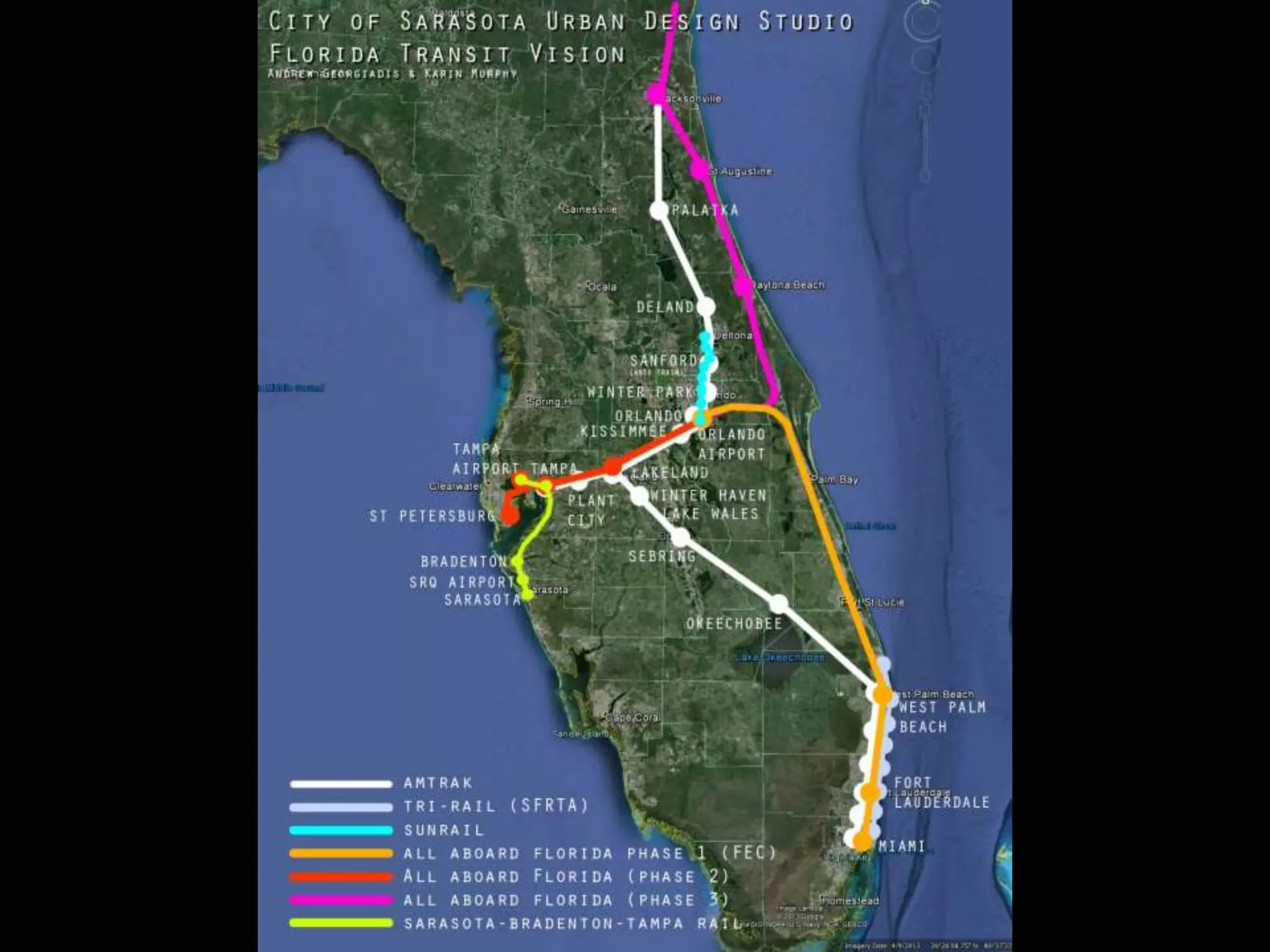
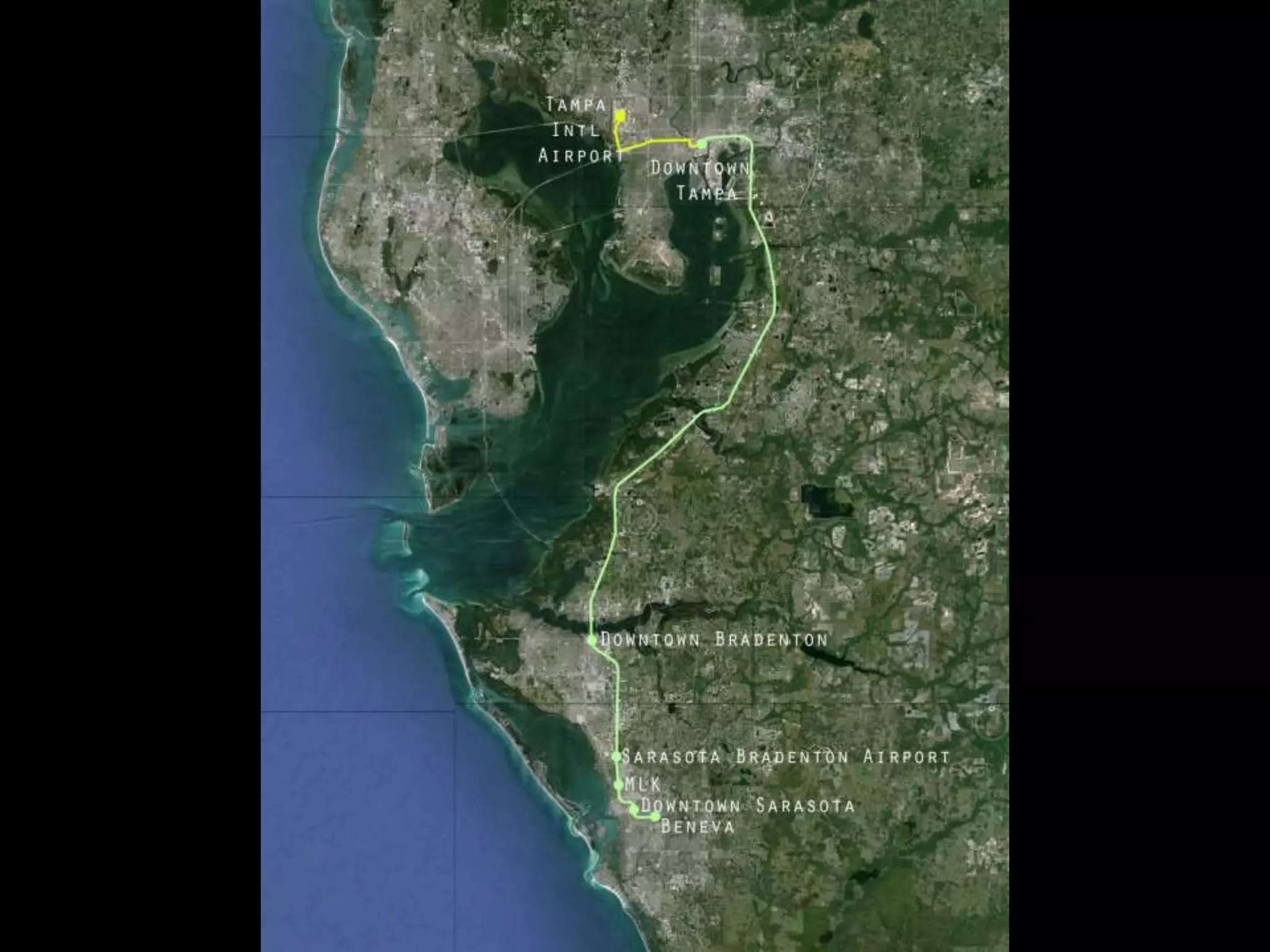
• Premium Transit Master Plan and Phasing Strategy with an
emphasis on low-emissions vehicles such as electric rail and true
BRT
• T.O.D. Master Plan that coordinates land use @ station areas
thereby boosting ridership and increasing profitability of the
system/reducing need for subsidy
Minimum Standards in a CNU/Smart Growth Mobility Plan
• Next Generation Bicycle Plan that emphasizes protected bike
lanes, protected intersections, bike boxes, priority signalization,
vision zero…but…which also acknowledges conventional bike
lanes, sharrows, and M.U.R.T.s as tools in the toolbox
• Bike Share Program
• Multi-modal transfer optimization: Airport/Rail/Bus/Car
Rental/Uber and Train Station/Bike/Ped and Water
Taxi/Automobile/Bike Nodes
• Zip car stations, Citywide Electric Car Charging network.
• Transit frequency and convenience: low headway + dignified
shelters
Financing and Implementing the Mobility Plan
• Overcome the City-held belief that only the County should provide
transit and start dedicating general revenue $$
• Stop spending tens of millions of $$$ on parking garages
• Divert hundred of millions of $$$$ from diverging diamonds and road
widening to transit projects that have a greater economic and quality
of life R.O.I. (requires vision plan to convince FDOT and County)
• Density Bonus in exchange for premium transit contribution $$$
• Fare collection (seamless ticketing and transfers) $$
• 10% local seed money to obtain 90% federal match $$$
• T.I.F.F. + T.O.D. $$$$
• TIGER Discretionary Grants (DOT) $$$
• Gas Tax $$$
• Colleges Transit Surtax $
• Restructure Parkin In-lieu-of fund to benefit transit$
• City bonds $$$$
• Carbon credits $
Non-solutions for the short term:
• pedestrian overpasses
• road widening, addition of turning lanes and travel lanes
• conventional bike lanes
• speed bumps and chicanes
Long term traps:
• encouraging car use by constructing more municipal parking
garages
• subsidizing car use by constructing diverging diamonds and other
freeway ‘improvements’
• expecting autonomous vehicles to make transit obsolete
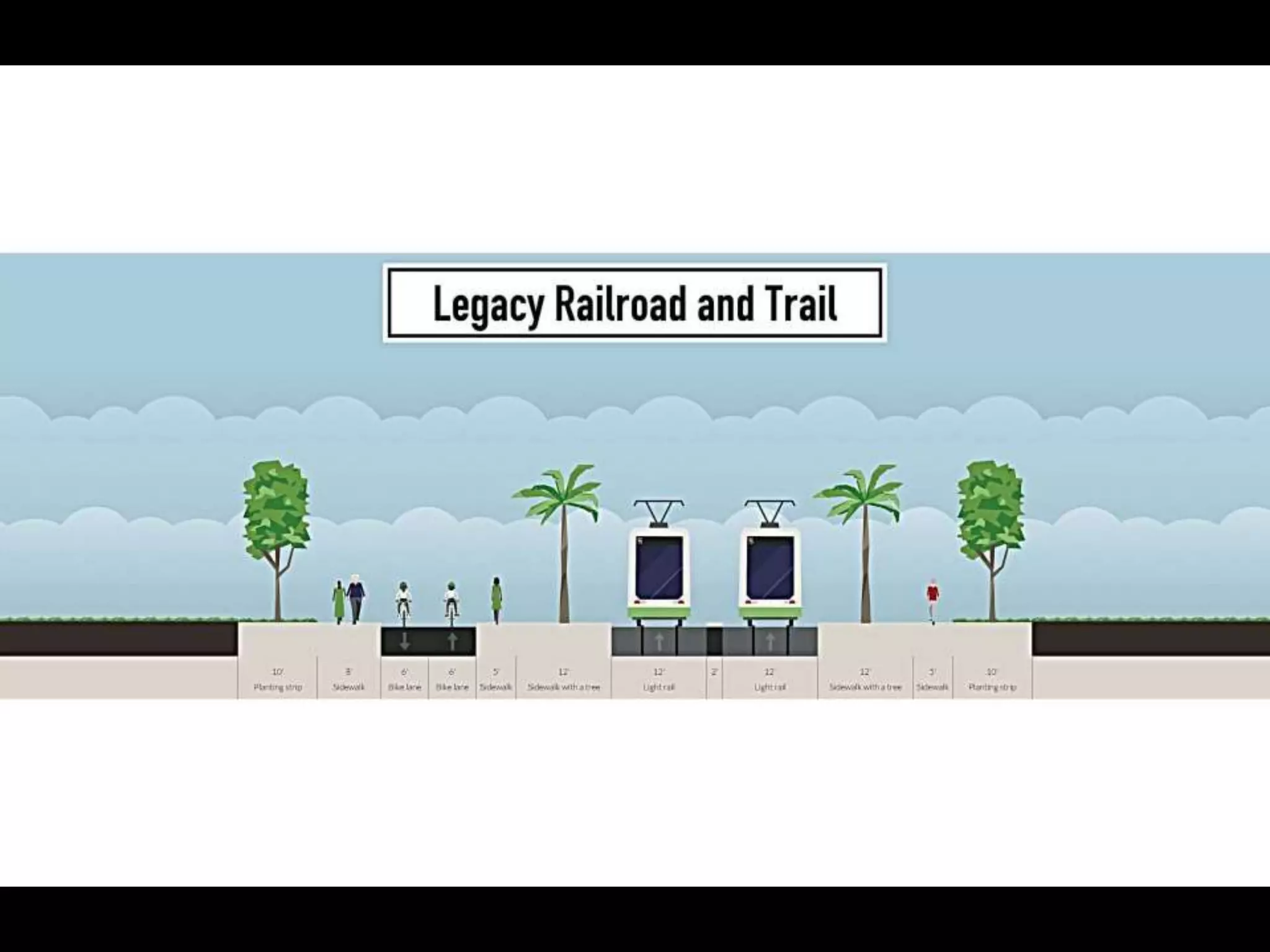
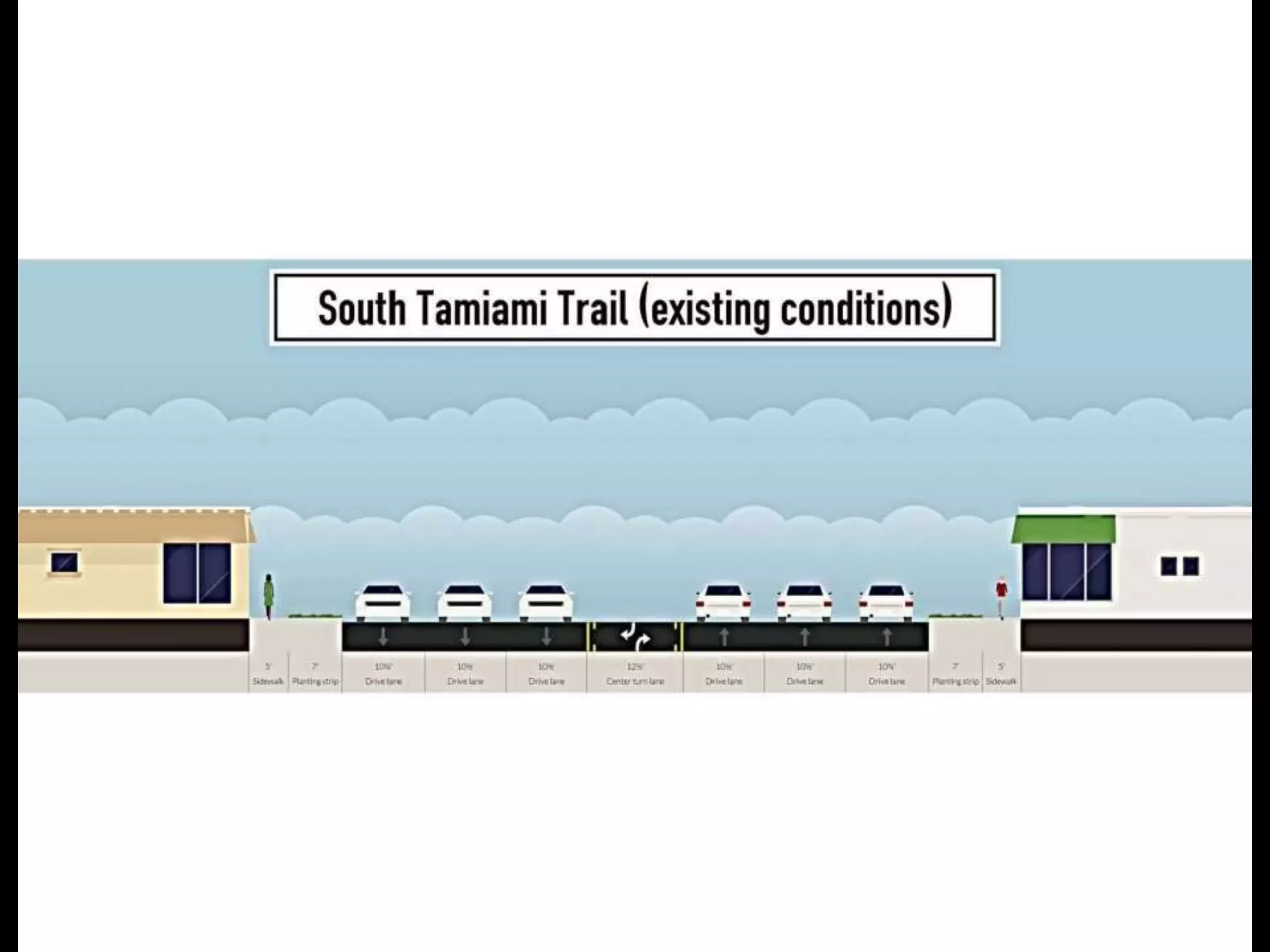
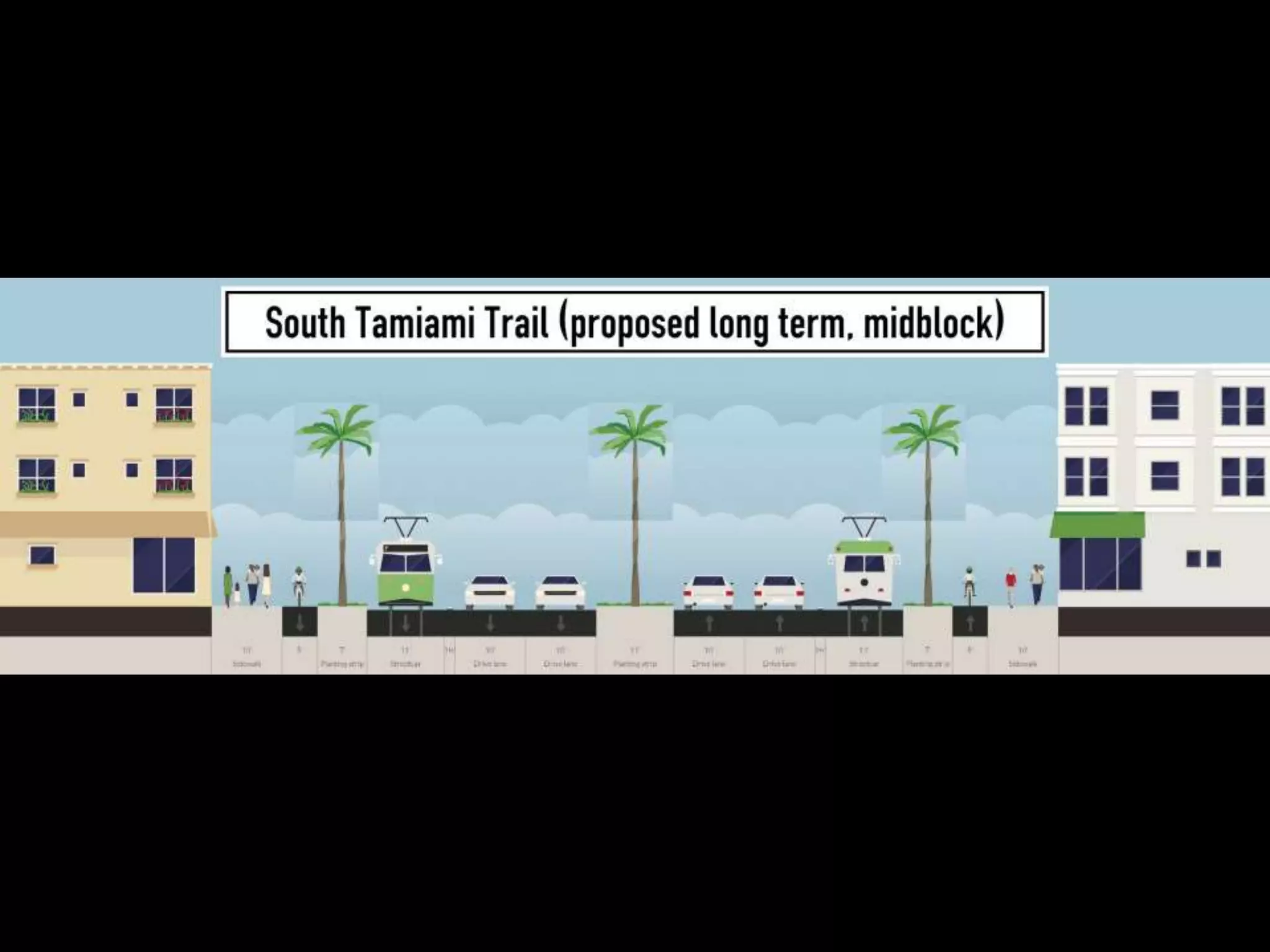
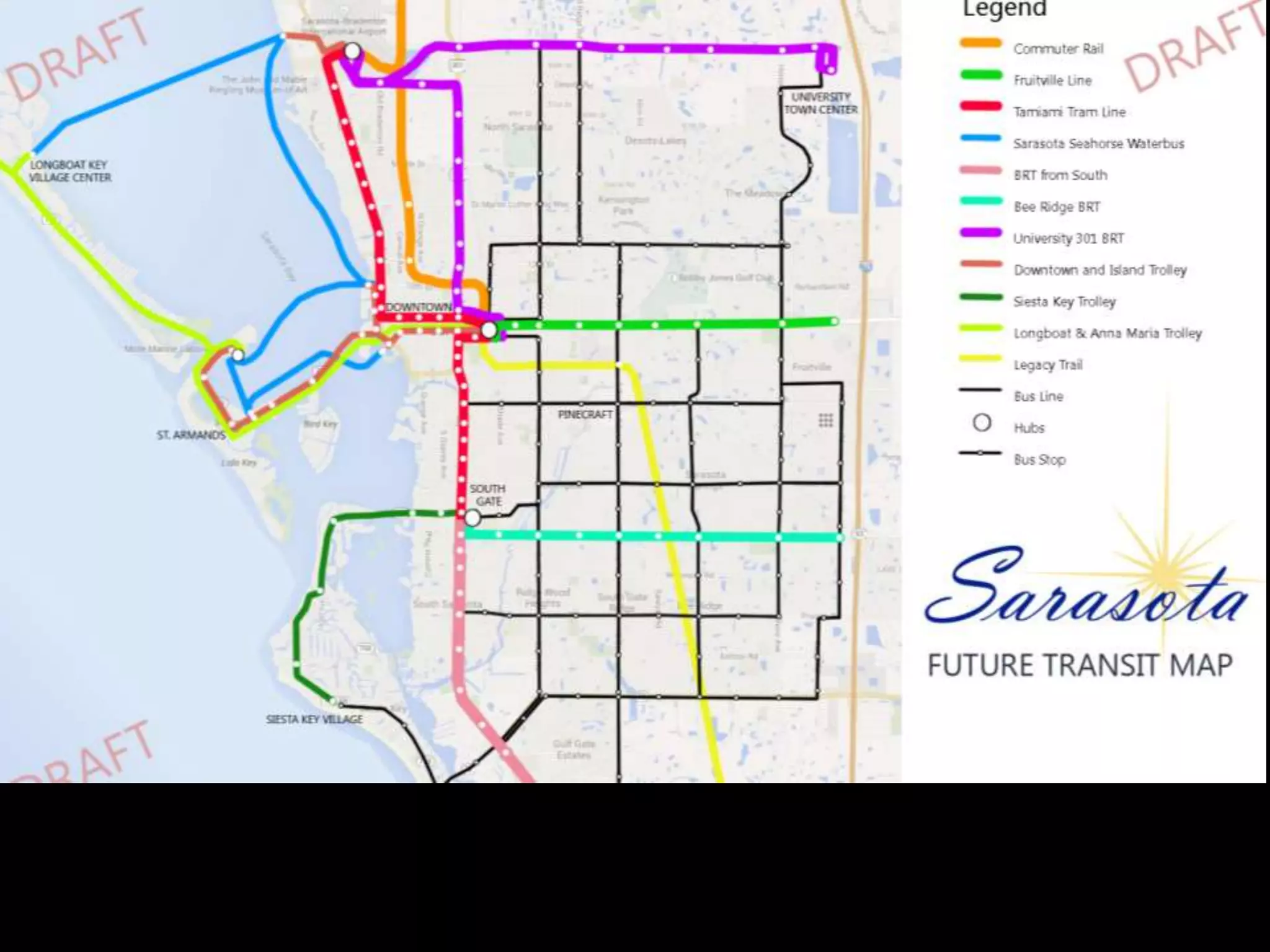
What does a next gen
mobility plan look like?
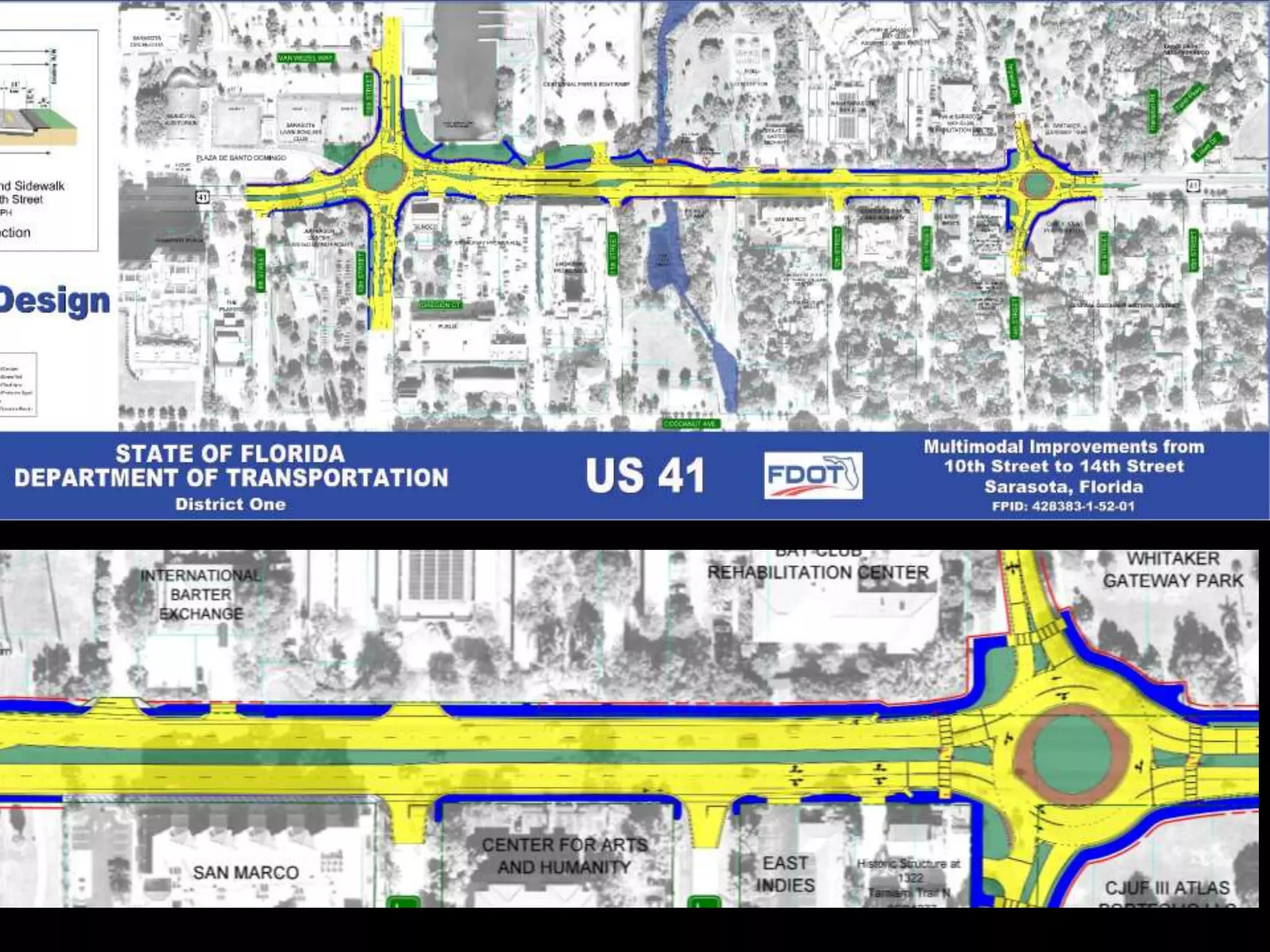
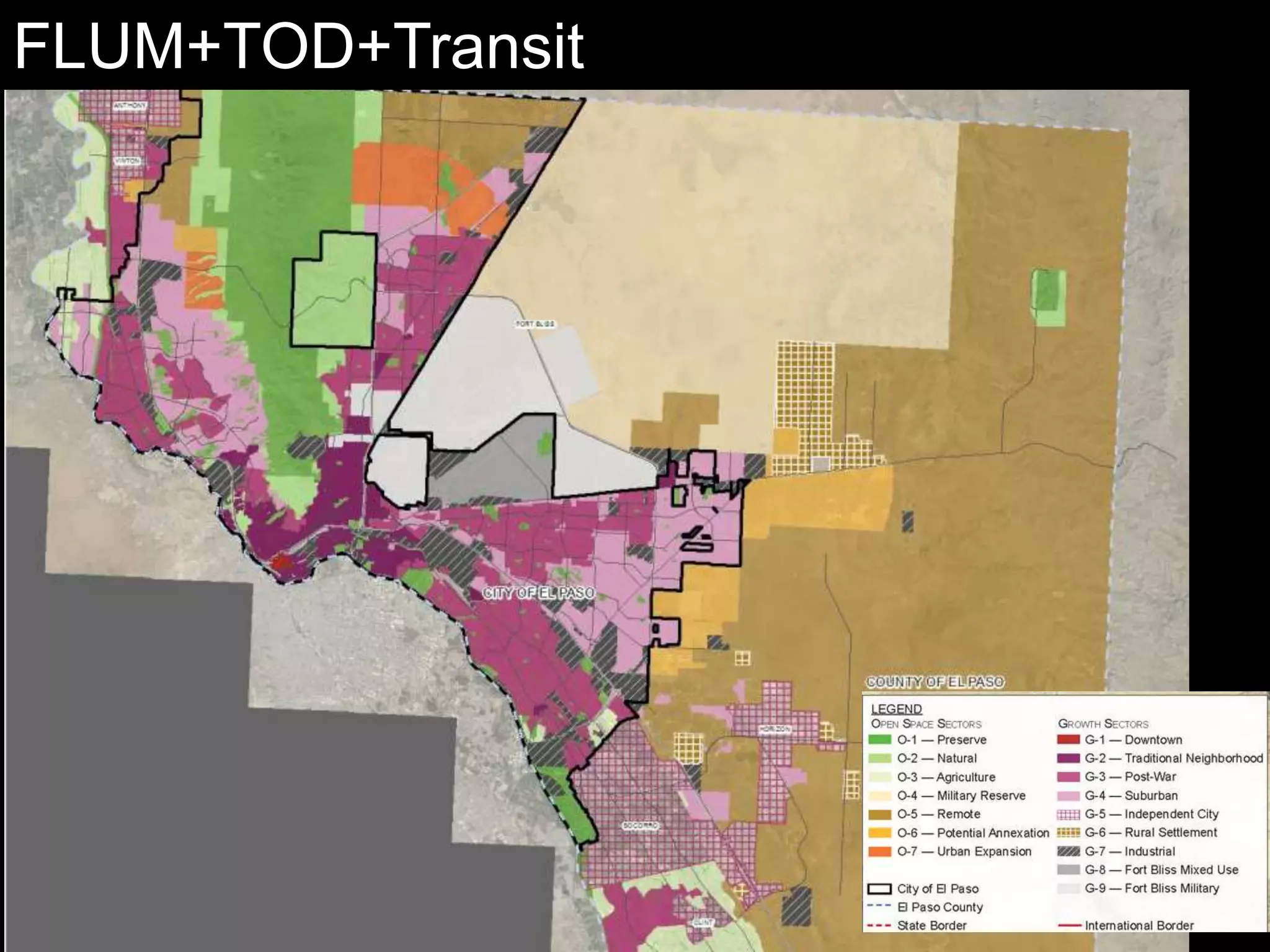
City of El Paso TX, Comprehensive Plan
FLUM+TOD+Transit
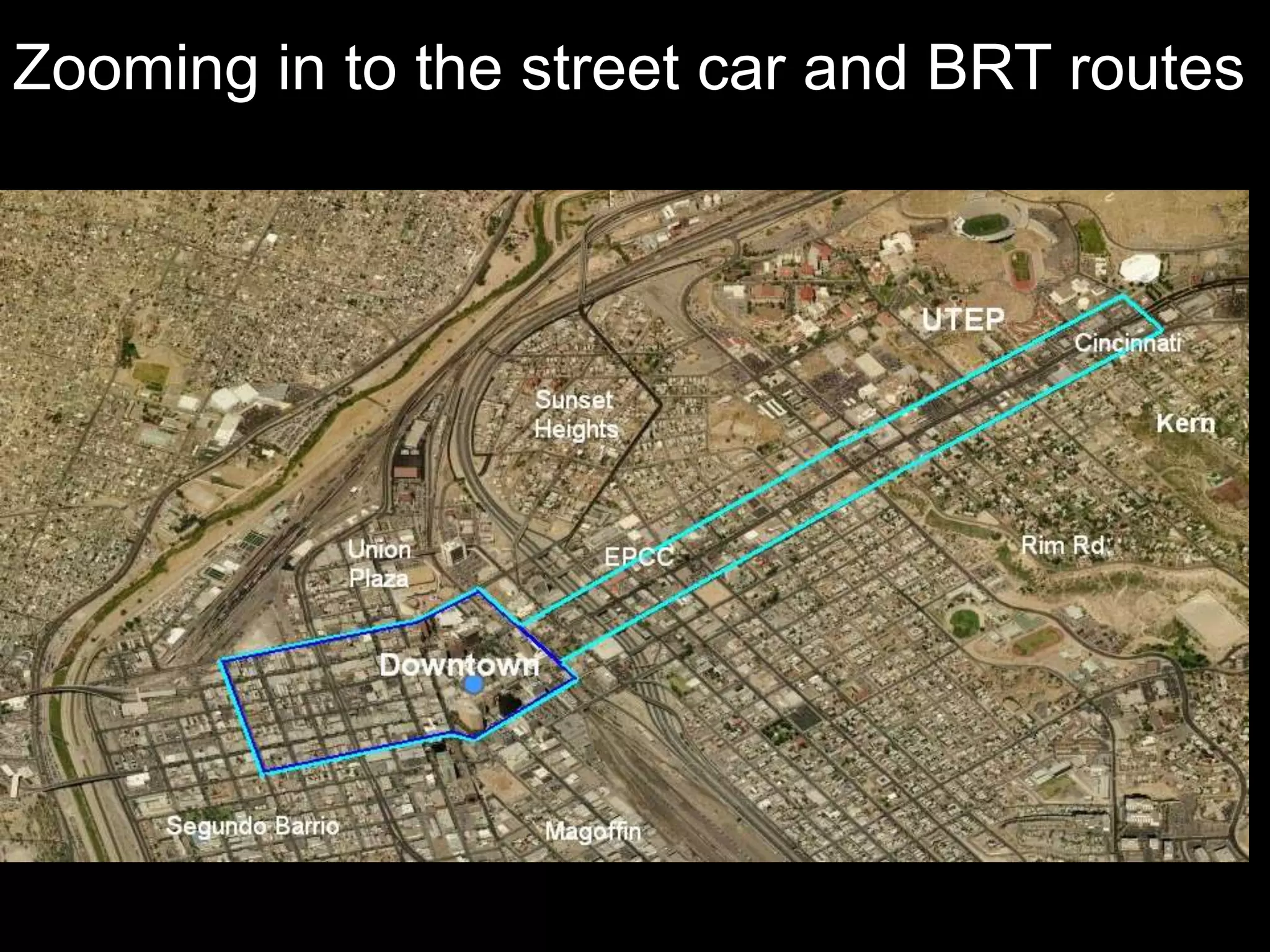
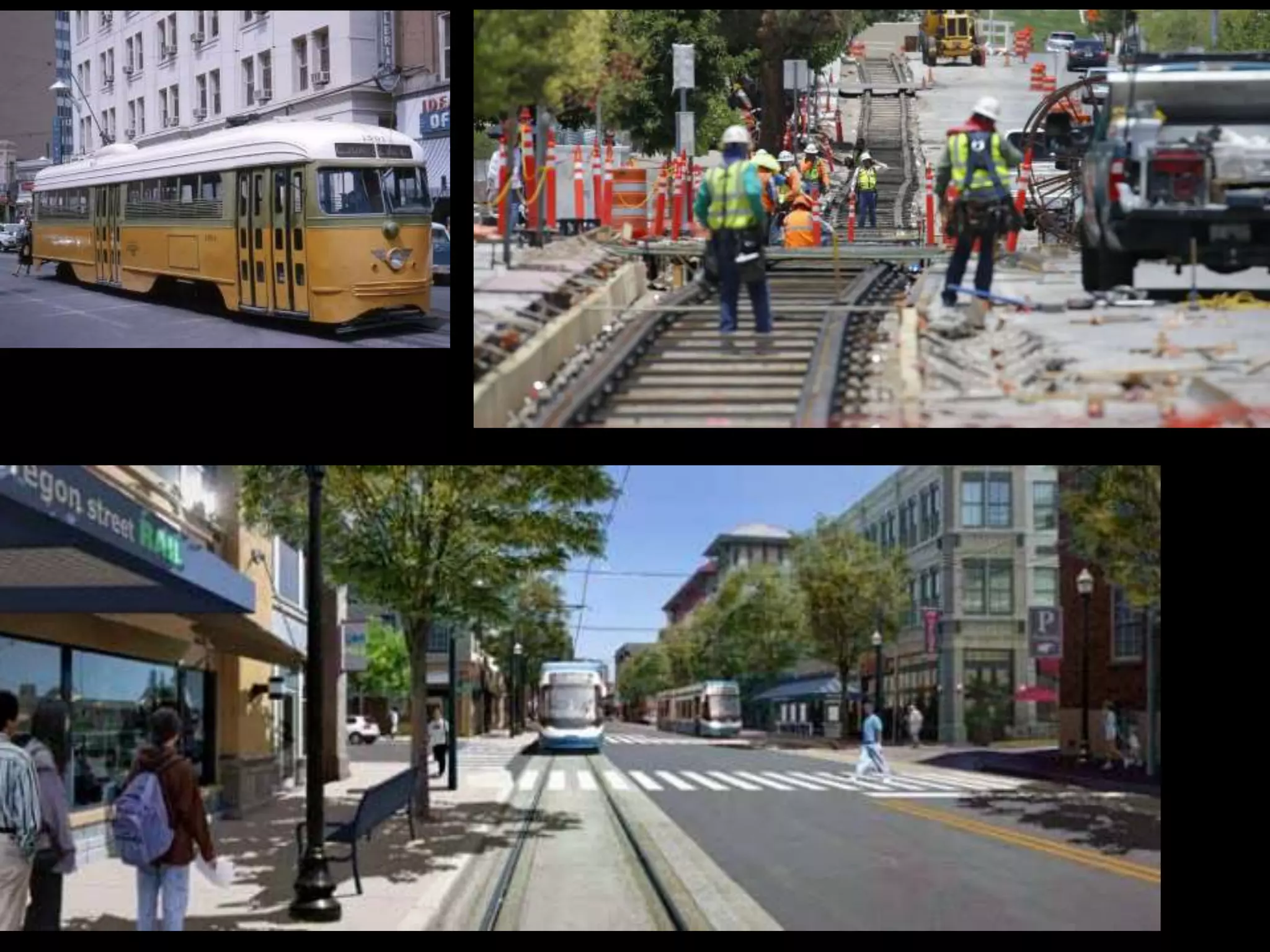
Zooming in to the street car and BRT routes
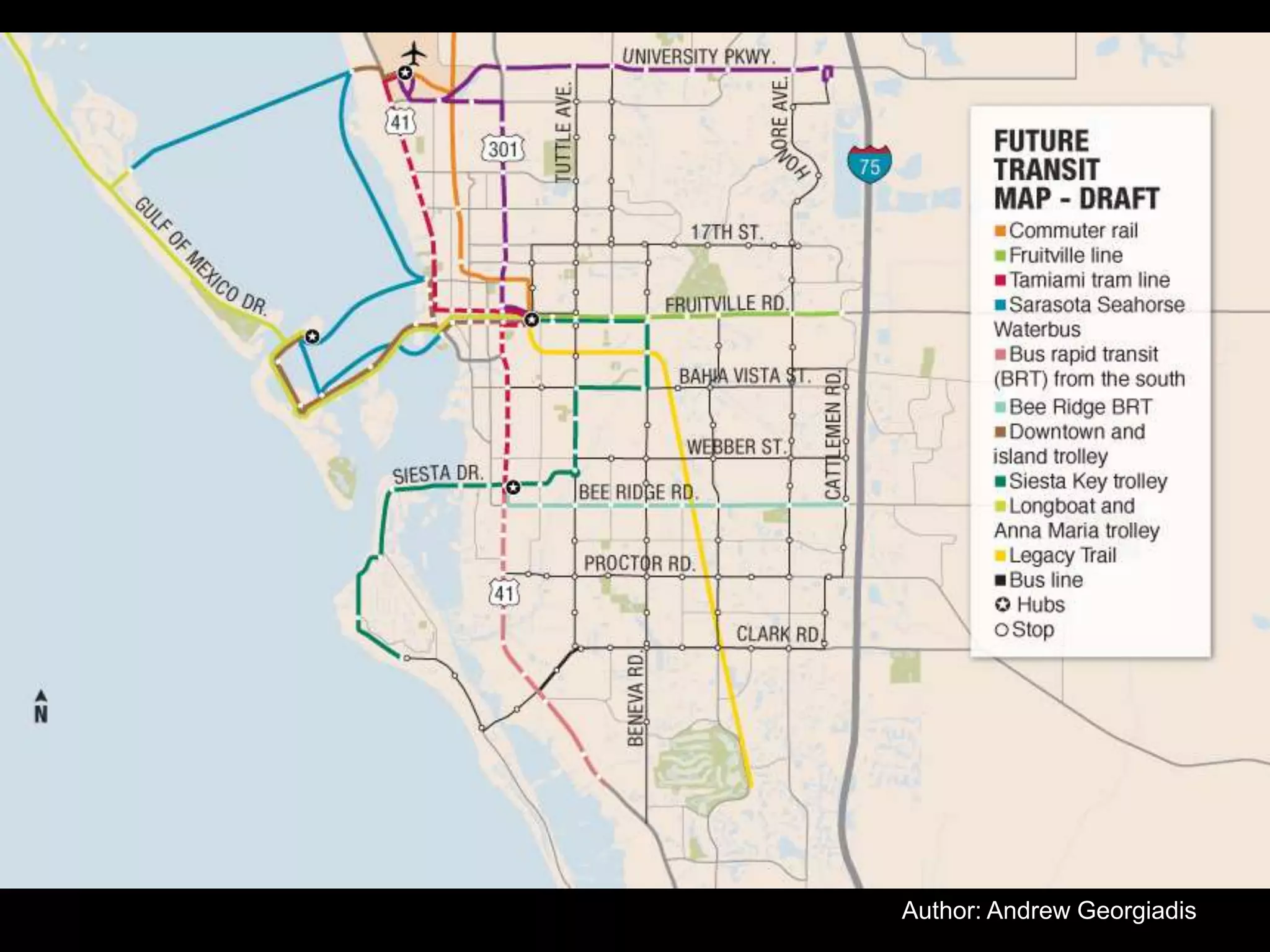
Author: Andrew Georgiadis
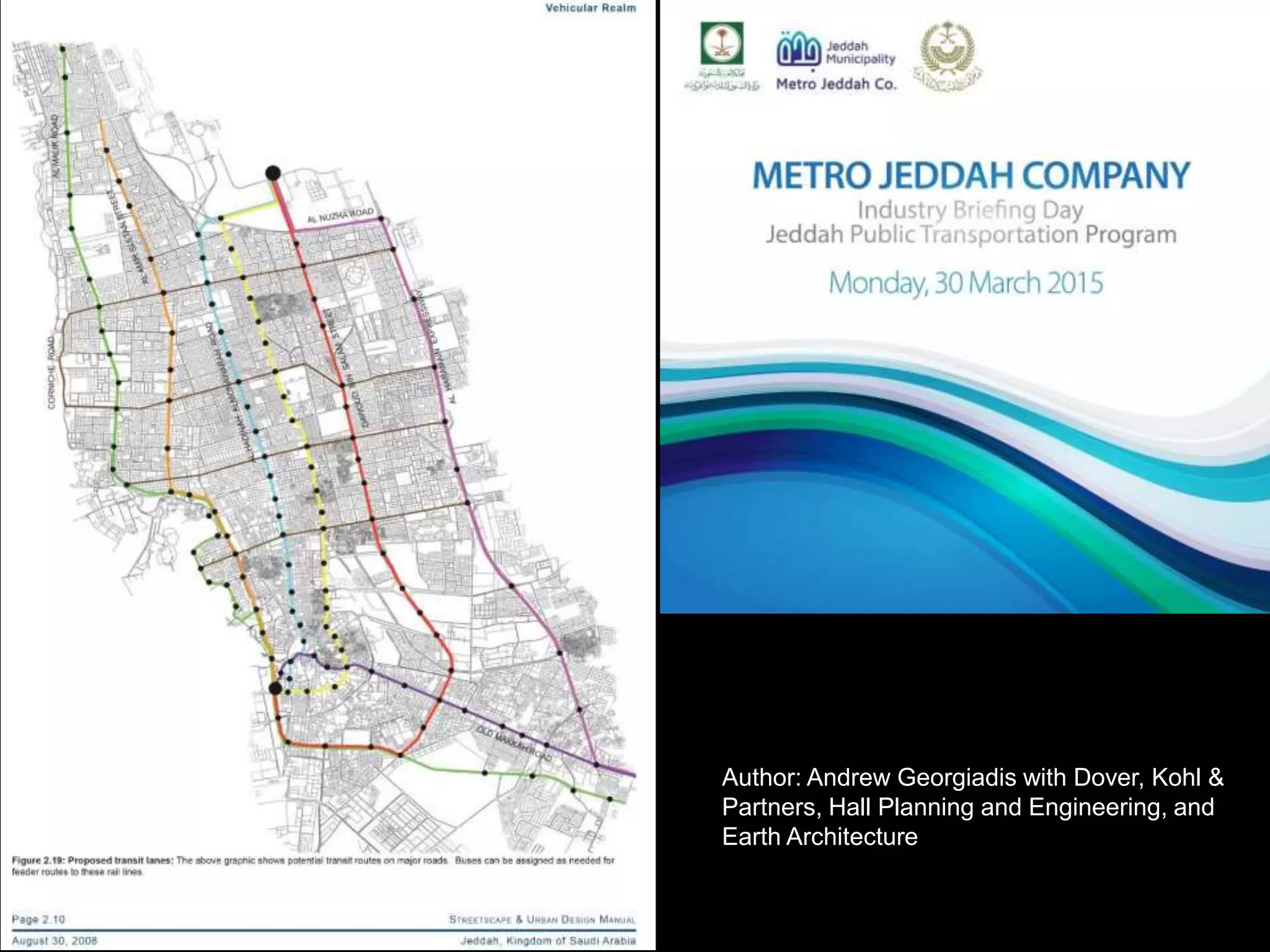
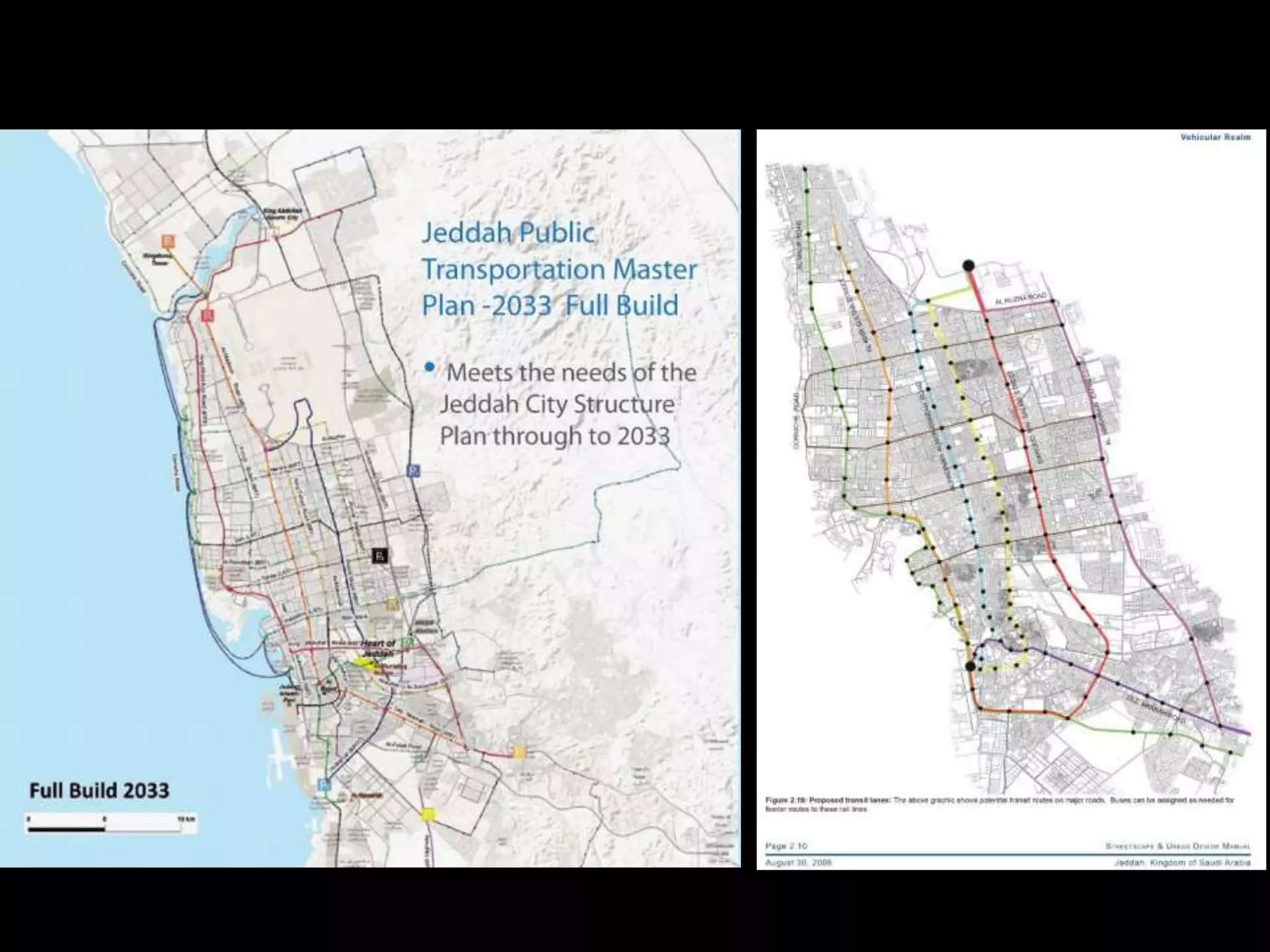
Author: Andrew Georgiadis with Dover, Kohl &
Partners, Hall Planning and Engineering, and
Earth Architecture
Thank you!
Andrew@GeorgiadisUrbanDesign.com
georgiadisurbandesign.com

Grid Un-Locked - Week 4

  • 4.
    The Greater SarasotaChamber of Commerce Sarasota Transportation 101: Healing the Grid Andrew Georgiadis, Georgiadis Urban Design October 17, 2017
  • 5.
    Ten Characteristics ofWalkability: 1) Interconnected web of streets (small blocks, frequent intersections) (C-) 2) Mixture of uses + high enough densities (B-, D) 3) Street trees (trees between the sidewalk and the travel lane) (C-) 4) Lower traffic volumes (B-) 5) High quality frontages (transparent, interesting facades, no parking in front) (B+, downtown, D, elsewhere) 6) On-street parking and more “friction” (B, D) 7) Narrower and fewer lanes with easy-to-cross intersections (B+,C-) 8) Shallow setback or no setback in the urban core, slightly larger in suburbs (A-, D) 9) Sidewalks + properly designed bike lanes (C, F) 10)Two-way streets (A+)
  • 6.
    Origin Destination How do weget from here to there? The Power of Connected Streets
  • 7.
    Origin Destination How do weget from here to there? The Power of Connected Streets
  • 8.
    Origin Destination How do weget from here to there? The Power of Connected Streets
  • 9.
    Origin Destination 1 Possible Route ThePower of Connected Streets
  • 10.
    Origin Destination Add a secondpair of streets to the network, and… The Power of Connected Streets
  • 11.
    Origin Destination 2 Possible Routes ThePower of Connected Streets
  • 12.
    Origin Destination Add another streetin each direction… y= 2 x= 2 The Power of Connected Streets
  • 13.
    Origin Destination More Possible Routes y=2 x= 2 The Power of Connected Streets
  • 14.
    Origin Destination More Possible Routes y=2 x= 2 The Power of Connected Streets
  • 15.
    Origin Destination More Possible Routes y=2 x= 2 The Power of Connected Streets
  • 16.
    Origin Destination More Possible Routes:6 in all, without doubling back y= 2 x= 2 The Power of Connected Streets
  • 17.
    Origin Destination y= 4 x= 3 Continueenhancing the network: 4 x 3 grid yields 35 routes The Power of Connected Streets
  • 18.
    Origin Destination y= 4 x= 5 Continueenhancing the network: 5 x 4 grid yields 126 routes The Power of Connected Streets
  • 19.
    Make a town,not “pods.” 8 x 8 grid yields 12,870 routes The Power of Connected Streets
  • 20.
    Beaufort, SC The Powerof Connected Streets
  • 21.
  • 22.
    beneva and fruitville-connectivity crisis
  • 23.
    beneva and fruitville-connectivity crisis
  • 24.
    beneva and fruitville-connectivity crisis
  • 25.
    beneva and fruitville-connectivity crisis
  • 26.
    beneva and fruitville-connectivity crisis
  • 27.
    beneva and fruitville-connectivity crisis
  • 28.
    beneva and fruitville-connectivity crisis
  • 29.
    beneva and fruitville-connectivity crisis
  • 30.
    beneva and fruitville-connectivity crisis
  • 31.
    beneva and fruitville-connectivity crisis
  • 32.
    beneva and fruitville-connectivity crisis
  • 33.
    beneva and fruitville-connectivity crisis
  • 34.
    beneva and fruitville-connectivity crisis
  • 35.
    beneva and fruitville-connectivity crisis
  • 37.
  • 38.
    Georgiadis Urban DesignSiesta Drive Bahia Vista Webber Fruitville 10th 12th 17th MLK Myrtle Novus Bay 301 41 Orange Hillview
  • 39.
    Georgiadis Urban DesignSiesta Drive Bahia Vista Webber Fruitville 10th 12th 17th MLK Myrtle Novus Bay 301 41 Orange Hillview
  • 40.
    Georgiadis Urban DesignSiesta Drive Bahia Vista Webber Fruitville 10th 12th 17th MLK Myrtle Novus Bay 301 41 Orange Hillview
  • 41.
  • 42.
  • 43.
  • 44.
  • 45.
  • 46.
  • 47.
  • 48.
  • 49.
  • 50.
  • 51.
  • 53.
  • 54.
  • 55.
    Shallow setback inurban general or zero setback in the urban core
  • 56.
    High quality frontage (courtesyof Chris Gallagher) low quality frontage
  • 57.
    On-Street Parking onmost streets and “friction”
  • 58.
    Narrower lanes andfewer lanes, with crossable intersections
  • 59.
    Most streets shouldbe two-way unless they are narrow enough for only one lane (Image courtesy of Chuck Marohn, Strong Towns)
  • 60.
    Street trees (treesbetween the sidewalk and the travel lane)
  • 61.
  • 62.
    Lower traffic volumes(related to transit, compact development, connectivity…) Image courtesy of Dover, Kohl & Partners/UrbanAdvantage
  • 63.
    Are we beingforce-fed street and intersection designs that harm us financially, health- wise, and reduces livability, walkability, and bike-ability? (the fatty liver cross-section)
  • 72.
    we are likethe maya
  • 73.
    what is thefuture of our infrastructure?
  • 79.
    Traffic Studies/ ConventionalPlanning and Approvals Process: Traffic Study costs $$ in order to determine how much is paid to the City, then $$ are paid to the City/County. Public hopes that the City/County spends it wisely. Mobility Fee and New Urbanist Planning and Approvals Process: $$$$ are paid to the City/County towards implementation of Premium Transit/Mobility/Multi-modal Plan, authored by the public and a qualified planner/mobility consultant with CNU credentials.* *City receives $$ more this way than the conventional way, but it needs to have an excellent transit/mobility plan in place.
  • 80.
    Praise for thecurrent plan: Modified the inter-local agreement in order to allow for the City to spend funds collected from developers on projects that benefit the City and on projects that are multi-modal rather than just asphalt. Constructive criticism for the current plan: Pages and pages of confusing fee schedules based upon Euclidean uses could be replaced with a one sentence, lean, form-based fee schedule that does not consider use: “Impact fee is equivalent to one dollar per buildable square foot of the lot-of-record/parcel plus one dollar per built square foot.”
  • 81.
    Why a PremiumTransit Network? • Retain creative class, youngsters, millennials, and those who due to age and physical limitations cannot drive. • Fixed-guideway systems promote compact growth and generate enormous tax revenue for municipalities and counties compared with lower-grade transit investments. • GHG/pollutant reduction = air quality and climate change mitigation • Reduce parking demand at origin/destination points, thereby increasing wealth for developers, purchasers, and renters. • Essential to affordability, as costs of operating and owning multiple cars can consume up to 1/3 of household budgets. • Reduce demand for costly auto-centric infrastructure paid for by tax payers (i.e. parking garages, road widening, and parking lots). • Reduced auto congestion along certain routes, or at least accept congestion and give people an alternative to it. • Walking+biking+transit culture and urbanism improve health.
  • 82.
    Minimum Standards ina CNU/Smart Growth Mobility Plan • Modal Heirarchy Statement • Modal Spread vs. Modal Shift • Repeal L.O.S. as a measurement tool, replace it with VMT reduction • Missing segment study (Complete-the-grid Connectivity Master Plan) • GHG Mitigation Strategy • Sea-Level Rise Adaptation Strategy • Premium Transit Master Plan and Phasing Strategy with an emphasis on low-emissions vehicles such as electric rail and true BRT • T.O.D. Master Plan that coordinates land use @ station areas thereby boosting ridership and increasing profitability of the system/reducing need for subsidy
  • 83.
    Minimum Standards ina CNU/Smart Growth Mobility Plan • Next Generation Bicycle Plan that emphasizes protected bike lanes, protected intersections, bike boxes, priority signalization, vision zero…but…which also acknowledges conventional bike lanes, sharrows, and M.U.R.T.s as tools in the toolbox • Bike Share Program • Multi-modal transfer optimization: Airport/Rail/Bus/Car Rental/Uber and Train Station/Bike/Ped and Water Taxi/Automobile/Bike Nodes • Zip car stations, Citywide Electric Car Charging network. • Transit frequency and convenience: low headway + dignified shelters
  • 84.
    Financing and Implementingthe Mobility Plan • Overcome the City-held belief that only the County should provide transit and start dedicating general revenue $$ • Stop spending tens of millions of $$$ on parking garages • Divert hundred of millions of $$$$ from diverging diamonds and road widening to transit projects that have a greater economic and quality of life R.O.I. (requires vision plan to convince FDOT and County) • Density Bonus in exchange for premium transit contribution $$$ • Fare collection (seamless ticketing and transfers) $$ • 10% local seed money to obtain 90% federal match $$$ • T.I.F.F. + T.O.D. $$$$ • TIGER Discretionary Grants (DOT) $$$ • Gas Tax $$$ • Colleges Transit Surtax $ • Restructure Parkin In-lieu-of fund to benefit transit$ • City bonds $$$$ • Carbon credits $
  • 85.
    Non-solutions for theshort term: • pedestrian overpasses • road widening, addition of turning lanes and travel lanes • conventional bike lanes • speed bumps and chicanes Long term traps: • encouraging car use by constructing more municipal parking garages • subsidizing car use by constructing diverging diamonds and other freeway ‘improvements’ • expecting autonomous vehicles to make transit obsolete
  • 86.
    What does anext gen mobility plan look like?
  • 87.
    City of ElPaso TX, Comprehensive Plan
  • 88.
  • 89.
    Zooming in tothe street car and BRT routes
  • 92.
  • 93.
    Author: Andrew Georgiadiswith Dover, Kohl & Partners, Hall Planning and Engineering, and Earth Architecture
  • 96.