STROKE AND ITS
TYPES
PREPARED BY Dr. Amjad PT
What Is Stroke ?
A stroke occurs when blood
flow to the brain is
interrupted by a blocked or
a burst blood vessel.
CVA
O Sudden loss of neurological function caused by
the interruption of blood flow to brain.
O Focal neurological deficits due to ischemia
O For classical stroke it must persist for at least 24
hours
O Paralysis (Hemiplegia)
O Weakness (Hemiparesis)
O Impairments (reversible) within 3 weeks
O Residual impairment (longer than 3 weeks)
What Is the Impact of Stroke?
O Stroke is the third leading cause of death in
the United States
O On average, someone suffers a stroke every
40 seconds
O About 795,000 Americans suffer a stroke
each year
O About every 4 minutes, someone dies of a
stroke
What Is the Impact of Stroke?
(Continued)
O Stroke is a leading cause of serious, long
disability
O About 6.4 million Americans are stroke
survivors
What Are the Types of Stroke ?
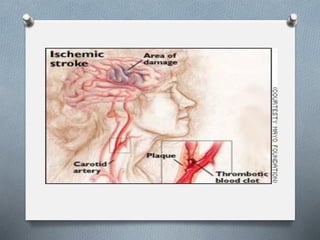
O Ischemic Stroke (Blockage)
O Caused by a blockage in blood vessels in
brain
O Hemorrhagic Stroke (Bleeding)
O Caused by burst or leaking blood vessels in
brain
What Are the Causes of
Ischemic Stroke?
O Begins with the development of fatty
deposits lining the blood vessel wall
O Thrombus: Development of blood clot at the
fatty deposit
O Embolus: Traveling particle too large to pass
through a small vessel
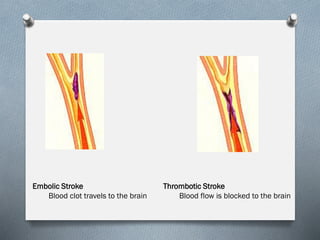
Embolic Stroke
Blood clot travels to the brain
Thrombotic Stroke
Blood flow is blocked to the brain
What Are the Causes of
Hemorrhagic Stroke?
O Occurs when a weakened blood vessel
ruptures
O Aneurysms: Ballooning of a weakened
region of a blood vessel
O Arteriovenous Malformations (AVMs):
abnormal blood vessels
Stroke Risk Factors
That Cannot Be Treated
O Age
O Sex
O Race
O Prior stroke
O Family history
Stroke Risk Factors That Can
Be Treated
O Hypertension/High Blood Pressure
O Heart Disease
O Cigarette Smoking
O Transient Ischemic Attacks
O Diabetes
O Elevated Blood Cholesterol/Lipids
Stroke Risk Factors
Less Well-Documented
O Geographical Location
O Socioeconomic Factors
O Excessive Alcohol Intake
O Certain Kinds of Drug Abuse
Stroke Warning Signs
O Sudden weakness or numbness of the face,
arm or leg, especially on one side of the body
O Sudden confusion, trouble speaking or
understanding
O Sudden trouble seeing in one or both eyes
O Sudden trouble walking, dizziness, loss of
balance or coordination
O Sudden, severe headaches with no known
cause (for hemorrhagic stroke)
ACAS
O Contralateral hemiparesis (LE more than UE)
O Contralateral hemi sensory loss (LE more
than UE)
O Incontinence
O Apraxia
MCAS
Contralateral hemiparesis (UE & face more than
LE)
Contralateral Hemi sensory loss (UE & face more
than LE)
Aphasia
Perceptual deficits
PCAS
• Contralateral homonymous hemianopsia
• Memory defect
• Hemiplegia
• Eye movements
Transient Ischemic Attacks
(TIAs)
O “Warning strokes” that can happen before a
major stroke
O Occur when blood flow through a brain
artery is blocked or reduced for a short time
O Symptoms are temporary but similar to
those of a full fledged stroke
O A person who has a TIA is 9.5 times more
likely to have a stroke
What Parts of the Brain
Are Affected by Stroke?
O LEG
O ARM
O BODY
O HAND
O FACE
O SPEECH
O READING
O SIGHT
O HEARING
What Are the
Effects of Stroke?
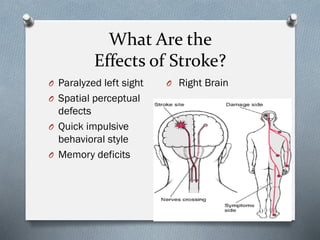
O Paralyzed left sight
O Spatial perceptual
defects
O Quick impulsive
behavioral style
O Memory deficits
O Right Brain
What Are the
Effects of Stroke?
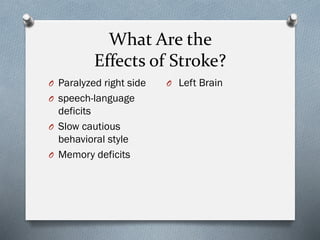
O Paralyzed right side
O speech-language
deficits
O Slow cautious
behavioral style
O Memory deficits
O Left Brain
Motor deficits
O Early stages flaccidity, no voluntry movement
and no reflexes
O Cerebral shock lasts from 72 hours to 2 weeks
(can be longer)
O This is replaced by spasticity, hyperreflexia and
mass pattern (synergies )
O Bobath divided stroke into 3 stages
O 1-The initial flaccid stages
O 2-The stage of spasticity
O 3-The stage of relative recovery
How Are Strokes Treated?
O Ischemic Stroke
O • Clot-busters e.g., t-PA
O • Anticoagulants – warfarin
O • Carotid Endarterectomy
O • Angioplasty/Stents
O Hemorrhagic Stroke
O • Surgical Intervention
O • Endovascular Procedures, e.g., coils
Prevention of Stroke
O Control high blood pressure
O Prevent heart disease
O Stop cigarette smoking
O Recognize signs of TIA and tell physician
O Reduce blood cholesterol levels
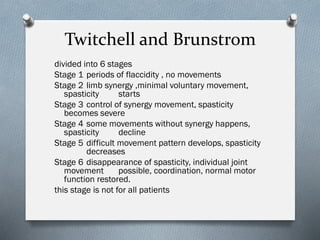
Twitchell and Brunstrom
divided into 6 stages
Stage 1 periods of flaccidity , no movements
Stage 2 limb synergy ,minimal voluntary movement,
spasticity starts
Stage 3 control of synergy movement, spasticity
becomes severe
Stage 4 some movements without synergy happens,
spasticity decline
Stage 5 difficult movement pattern develops, spasticity
decreases
Stage 6 disappearance of spasticity, individual joint
movement possible, coordination, normal motor
function restored.
this stage is not for all patients
Rehabilitation
O After suffering a stroke,
it’s important to begin a
rehabilitation program
as soon as possible
Types of Rehabilitation
Programs
O Hospital programs
O Nursing facilities
O Outpatient programs
O Home-based programs
Rehabilitation Specialists
O Physician
O Rehabilitation nurse
O Physical therapist
O Speech therapist
O Occupational therapist
O Psychiatrist
Learn to recognize a stroke.
Time lost is brain lost.
Stroke is a medical emergency!
If you notice one or more stroke warning
signs,
GET HELP IMMEDIATELY

Stroke and its types

  • 1.
  • 3.
    What Is Stroke? A stroke occurs when blood flow to the brain is interrupted by a blocked or a burst blood vessel.
  • 4.
    CVA O Sudden lossof neurological function caused by the interruption of blood flow to brain. O Focal neurological deficits due to ischemia O For classical stroke it must persist for at least 24 hours O Paralysis (Hemiplegia) O Weakness (Hemiparesis) O Impairments (reversible) within 3 weeks O Residual impairment (longer than 3 weeks)
  • 5.
    What Is theImpact of Stroke? O Stroke is the third leading cause of death in the United States O On average, someone suffers a stroke every 40 seconds O About 795,000 Americans suffer a stroke each year O About every 4 minutes, someone dies of a stroke
  • 6.
    What Is theImpact of Stroke? (Continued) O Stroke is a leading cause of serious, long disability O About 6.4 million Americans are stroke survivors
  • 7.
    What Are theTypes of Stroke ? O Ischemic Stroke (Blockage) O Caused by a blockage in blood vessels in brain O Hemorrhagic Stroke (Bleeding) O Caused by burst or leaking blood vessels in brain
  • 8.
    What Are theCauses of Ischemic Stroke? O Begins with the development of fatty deposits lining the blood vessel wall O Thrombus: Development of blood clot at the fatty deposit O Embolus: Traveling particle too large to pass through a small vessel
  • 9.
    Embolic Stroke Blood clottravels to the brain Thrombotic Stroke Blood flow is blocked to the brain
  • 10.
    What Are theCauses of Hemorrhagic Stroke? O Occurs when a weakened blood vessel ruptures O Aneurysms: Ballooning of a weakened region of a blood vessel O Arteriovenous Malformations (AVMs): abnormal blood vessels
  • 11.
    Stroke Risk Factors ThatCannot Be Treated O Age O Sex O Race O Prior stroke O Family history
  • 12.
    Stroke Risk FactorsThat Can Be Treated O Hypertension/High Blood Pressure O Heart Disease O Cigarette Smoking O Transient Ischemic Attacks O Diabetes O Elevated Blood Cholesterol/Lipids
  • 13.
    Stroke Risk Factors LessWell-Documented O Geographical Location O Socioeconomic Factors O Excessive Alcohol Intake O Certain Kinds of Drug Abuse
  • 14.
    Stroke Warning Signs OSudden weakness or numbness of the face, arm or leg, especially on one side of the body O Sudden confusion, trouble speaking or understanding O Sudden trouble seeing in one or both eyes O Sudden trouble walking, dizziness, loss of balance or coordination O Sudden, severe headaches with no known cause (for hemorrhagic stroke)
  • 15.
    ACAS O Contralateral hemiparesis(LE more than UE) O Contralateral hemi sensory loss (LE more than UE) O Incontinence O Apraxia
  • 16.
    MCAS Contralateral hemiparesis (UE& face more than LE) Contralateral Hemi sensory loss (UE & face more than LE) Aphasia Perceptual deficits
  • 17.
    PCAS • Contralateral homonymoushemianopsia • Memory defect • Hemiplegia • Eye movements
  • 18.
    Transient Ischemic Attacks (TIAs) O“Warning strokes” that can happen before a major stroke O Occur when blood flow through a brain artery is blocked or reduced for a short time O Symptoms are temporary but similar to those of a full fledged stroke O A person who has a TIA is 9.5 times more likely to have a stroke
  • 19.
    What Parts ofthe Brain Are Affected by Stroke? O LEG O ARM O BODY O HAND O FACE O SPEECH O READING O SIGHT O HEARING
  • 20.
    What Are the Effectsof Stroke? O Paralyzed left sight O Spatial perceptual defects O Quick impulsive behavioral style O Memory deficits O Right Brain
  • 21.
    What Are the Effectsof Stroke? O Paralyzed right side O speech-language deficits O Slow cautious behavioral style O Memory deficits O Left Brain
  • 22.
    Motor deficits O Earlystages flaccidity, no voluntry movement and no reflexes O Cerebral shock lasts from 72 hours to 2 weeks (can be longer) O This is replaced by spasticity, hyperreflexia and mass pattern (synergies ) O Bobath divided stroke into 3 stages O 1-The initial flaccid stages O 2-The stage of spasticity O 3-The stage of relative recovery
  • 23.
    How Are StrokesTreated? O Ischemic Stroke O • Clot-busters e.g., t-PA O • Anticoagulants – warfarin O • Carotid Endarterectomy O • Angioplasty/Stents O Hemorrhagic Stroke O • Surgical Intervention O • Endovascular Procedures, e.g., coils
  • 24.
    Prevention of Stroke OControl high blood pressure O Prevent heart disease O Stop cigarette smoking O Recognize signs of TIA and tell physician O Reduce blood cholesterol levels
  • 25.
    Twitchell and Brunstrom dividedinto 6 stages Stage 1 periods of flaccidity , no movements Stage 2 limb synergy ,minimal voluntary movement, spasticity starts Stage 3 control of synergy movement, spasticity becomes severe Stage 4 some movements without synergy happens, spasticity decline Stage 5 difficult movement pattern develops, spasticity decreases Stage 6 disappearance of spasticity, individual joint movement possible, coordination, normal motor function restored. this stage is not for all patients
  • 26.
    Rehabilitation O After sufferinga stroke, it’s important to begin a rehabilitation program as soon as possible
  • 27.
    Types of Rehabilitation Programs OHospital programs O Nursing facilities O Outpatient programs O Home-based programs
  • 28.
    Rehabilitation Specialists O Physician ORehabilitation nurse O Physical therapist O Speech therapist O Occupational therapist O Psychiatrist
  • 29.
    Learn to recognizea stroke. Time lost is brain lost. Stroke is a medical emergency! If you notice one or more stroke warning signs, GET HELP IMMEDIATELY