EPILEPSY & SEIZURE
Classification Part 1
MENTOR : PRESENTOR :
DR.RAHUL GAIKWAD SIR DR.KARUNA TAYADE.
DR. AKSHAY MOHNANI SIR
Introduction
 Seizure is a transient occurrence of signs or symptoms due to abnormal excessive or
synchronous neuronal activity in the brain.
 Epilepsy describes a condition in which a person has a risk of recurrent seizures due to a chronic
, underlying process.
 Using the definition of Epilepsy as two to more unprovoked seizures
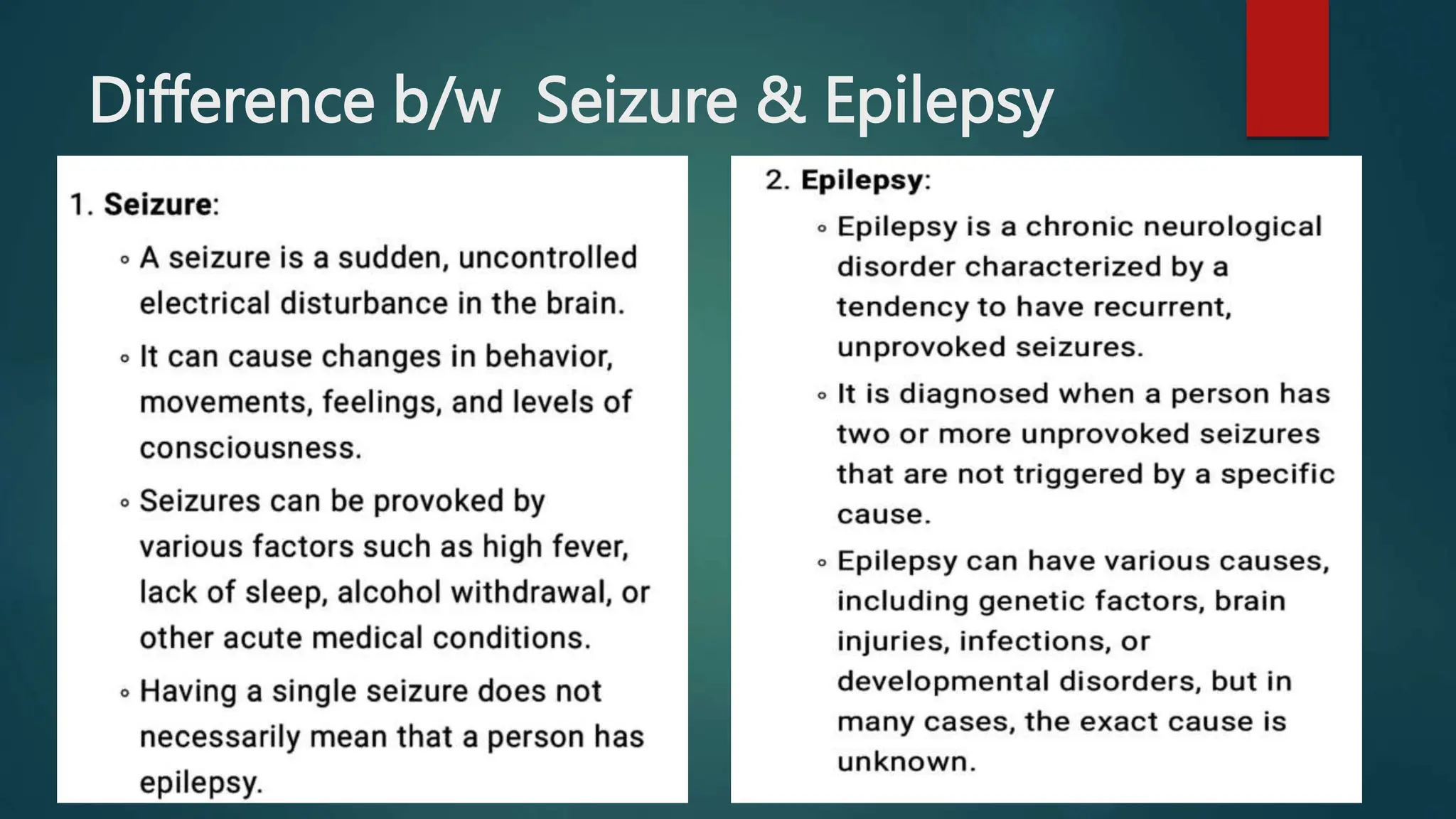
Difference b/w Seizure & Epilepsy
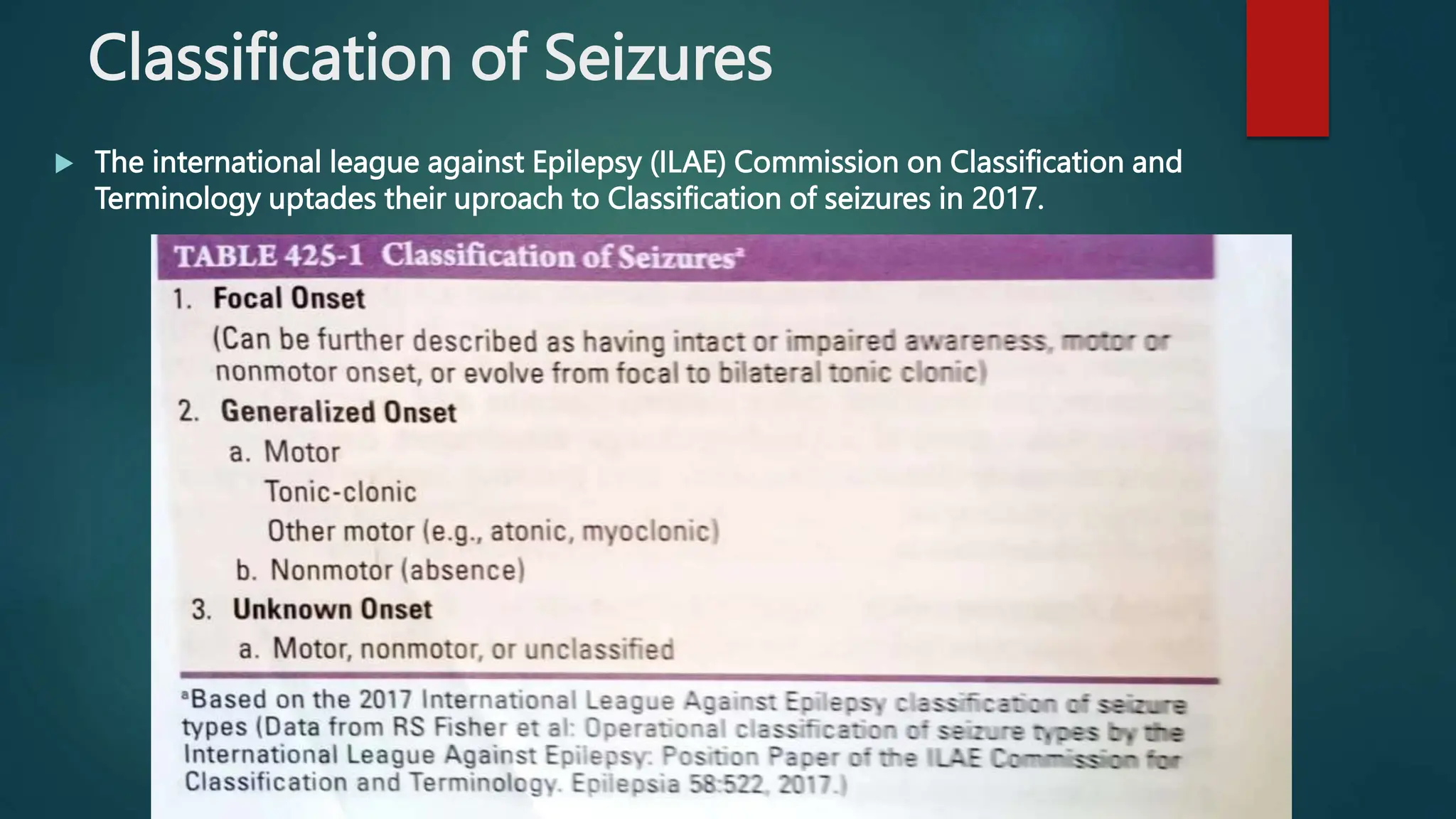
Classification of Seizures
 The international league against Epilepsy (ILAE) Commission on Classification and
Terminology uptades their uproach to Classification of seizures in 2017.
 Focal seizures are often associated with structural abnormalities of the
brain .
 In contrast , Generalised seizures may result from cellular , biochemical , or
structural abnormalities that have a more widespread distribution
Focal Onset Seizures
 Focal seizures arise from neuronal network that is localised within one brain region or more
broadly distributed but within a cerebral hemisphere.
1. Focal Seizures with intact Awareness:
 Focal seizures can have motor manifestation ( such as tonic, Clonic, myoclonic movements) or
non motor manifestations ( such as sensory, autonomic or emotional symptoms) without
impairment of awareness.
 EEG recorded with scalp electrodes during the seizure( ie an ictal EEG) may show abnormal
discharged in a limited region..
 Focal Seizures may manifest as
1. change in somatic sensation (eg , paresthesias)
2. Change in vision (flashing lights or formed hallucinations)
3. Equilibrium (sensation of falling or vertigo)
4. Autonomic function (flushing , sweating , piloerection)
Focal Onset seizures
2. Focal Seizures with impaired Awareness:
 The patient is unable to respond appropriately to visual or verbal commands during the seizure and
has impaired recollection or Awareness of the ictal phase.
 The seizure frequently begin with an aura ( ie a focal seizures without cognitive disturbance)
 The start of the ictal phase is often a motionless state .
 The impaired awareness is usually accompanied by automatisms.
 Automatisms may consist of basic behaviour such as :
1. Chewing.
2. Lip smacking.
3. Picking movements of hands
 Patient is confused following the seizure, & the transition to full recovery of consciousness may range
from seconds to hour.
 FOCAL EPILEPSY:
 Focal epilepsy ➡️ Features
1. Medial temporal lobe epilepsy ➡️automatisms, epigastric aura, amnesia.
2. Frontal lobe epilepsy ➡️ hypermotor seizures , nocturnal seizures.
3. Occipital lobe epilepsy ➡️ visual aura.
4. Occpito- parieto- temporal lobe epilepsy ➡️ complex aura.
Focal onset seizure
Primary Generalised Epilepsy
 Also known as Idiopathic generalised epilepsy..
 Most common generalised epilepsy syndromes.
 Most common generalised epilepsy in childhood.
 Normal development/ normal neurological examination/ normal imaging.
 Provocating Factors:
1. Sleep deprivation.
2. Alcohol
3. Photo sensitivity.
4. Worsens along time of awakening.
 EEG:
1. Normal background.
2. Photoparoxysmal response.
3. Generalised spike wave discharge.
Primary Generalised Epilepsy
Types:
1. Myoclonic epilepsy of infancy ( 6 month to 3 yrs)
2. Epilepsy with myoclonic absense( 1- 12 years)
3. Childhood absence ( 4- 10 years)
4. Juvenile absence epilepsy ( 9 – 13years)
5. Juvenile myoclonic epilepsy( 6-25 yrs)
6. Epilepsy with generalised tonic clonic seizures( 6-47yrs)
Generalised Tonic Clonic Seizures
 The seizure usually begins abruptly without warning , although some patients describe vague
symptoms
 The initial phase of the seizure is usually is usually tonic contraction of muscles throughout the
body.
 Tonic contraction of the muscles expiration and larynx will produce a load moan or “ ictal cry”
 Respiration are impaired , secretion pool in the oropharynx and Cyanosis develops.
 A marked enhancement of sympathetic tone leads to increase in heart rate, blood pressure, pupillary
size.
 After 10 – 20 sec; the tonic phase of seizure evolves into the Clonic phase produced by the
superimposition of periods of muscle relaxation on the tonic muscle contraction.
 The period of relaxation progressively increase but lasts not more than 1 min
 The post ictal phase is characterised by unresponsivness, muscular facility and excessive salivation
that can cause stridorous breathing .
Epilepsy with Generalised Tonic Clonic
Seizures
 Occurs in 6 to 47 yrs ( peak 16 to 20 yrs).
 Bladder or bowel incontinence may occur in post ictal phase.
EEG:
 During the tonic Clonic phase of seizure shows a progressive increased in generalised low voltage
fast activity , followed by generalised high amplitude, polyspike discharged.
 In the Clonic phasev, the high amplitude activity is interrupted by slow wave to create a spike and
slow wave pattern.
 Brief < 3sec .but burst of 2.5 to 4 Hz spike / wave .
Juvenile Myoclonic Epilepsy
 JME is a generalised seizure disorder of unknown cause that appears in early adolescence and is
usually characterised by bilateral myoclonus jerks that may be single or repetitive..
 The myoclonis seizures are most frequent in the morning after awakening and can br Provoked
by sleep deprivation.
 Consciousness is preserved .
Juvenile Myoclonic Epilepsy
 Occurs in 6 to 28 yrs old ( peak 6 to 25 yrs).
 Myoclonus jerk on awakening
 Photosensitivity is common.
 EEG :
1. Polyspike occurring in descending limb without waves.
2. 3 to 6 Hz , 1 to 4 sec.
3. Frontal dominant, shifting asymmetry can occur.
4. Typical 3 Hz spike and wave can seen.
 Treatment :
1. Valproate
2. Lamotrigine.
3. Phenobarbitone.
4. Isolated Myoclonus : Clonazepam
Myoclonic Epilepsy of Infancy
 Earliest Idiopathic Generalised Epilepsy ( 6 months – 3 yrs)
 Present with myoclonus on awakening: Yell because of diaphragm contraction.
 Consciousness is usually preserved.
 Multiple episodes happening per day.
 Provoked by auditors or tactile has better prognosis.
 Remission: 6 month to 5 yrs of onset.
 Treatment : Valproate (DOC) , Clonazepam , levetiracetam.
 DOC in reproductive age group : levetiracetam.
 Alternative drug in reproductive age group : Lamotrigine.
Epilepsy with myoclonic absence
 Onset: 1 to 12 yrs ( peak 7 yrs)
 Myoclonic absence are the defining symptoms.
 Eyelid twitching is absent.
 Personal myoclonus are frequent.
 May have intellectual disability before seizure onset.
 Some may show decline over time.
 Treatment : Resistance to monotherapy
 - 1. Valproate.
2 . Ethosuximide.
3. Valproate/ Ethosuximide+ lamotrigine .
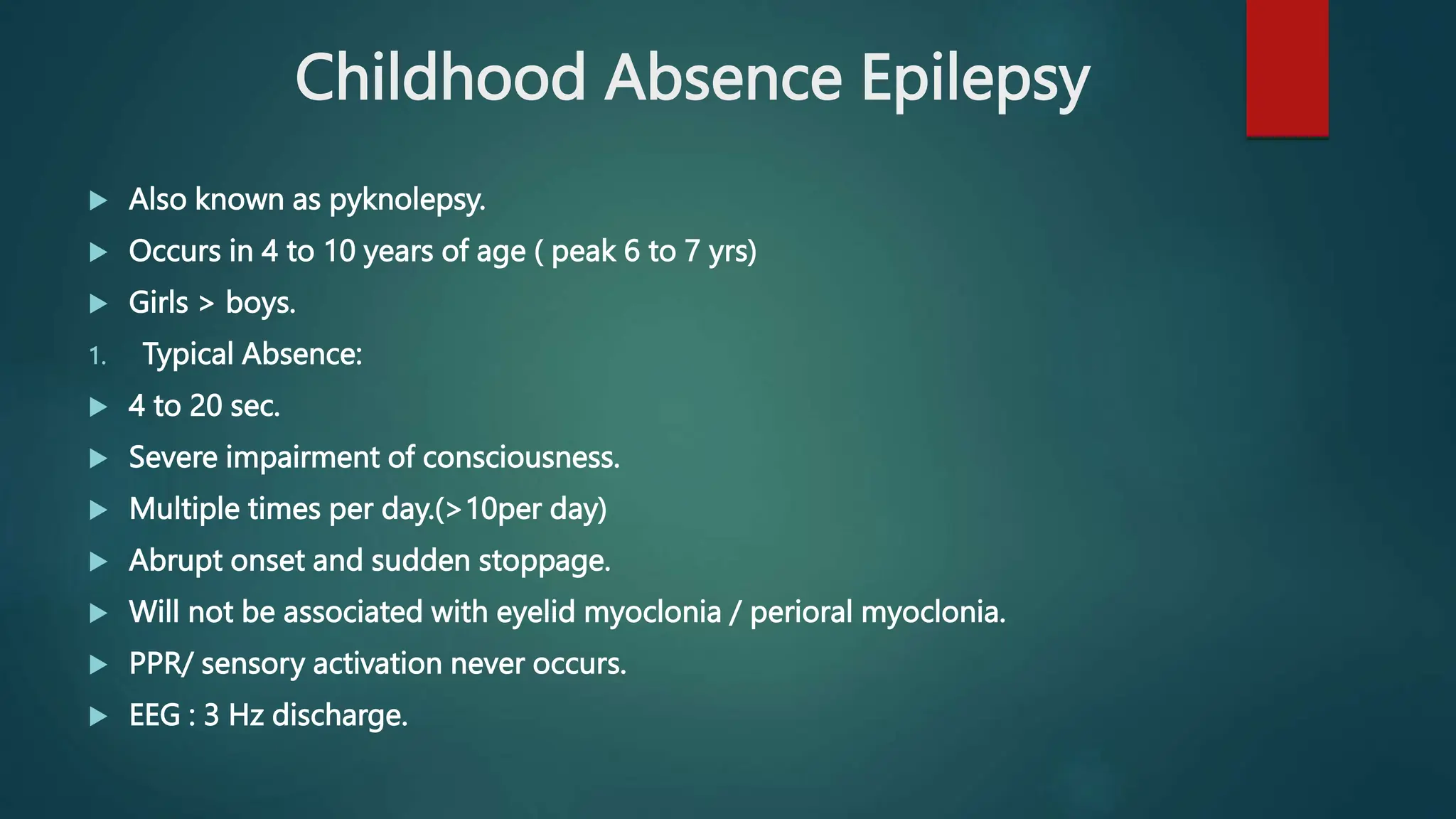
Childhood Absence Epilepsy
 Also known as pyknolepsy.
 Occurs in 4 to 10 years of age ( peak 6 to 7 yrs)
 Girls > boys.
1. Typical Absence:
 4 to 20 sec.
 Severe impairment of consciousness.
 Multiple times per day.(>10per day)
 Abrupt onset and sudden stoppage.
 Will not be associated with eyelid myoclonia / perioral myoclonia.
 PPR/ sensory activation never occurs.
 EEG : 3 Hz discharge.
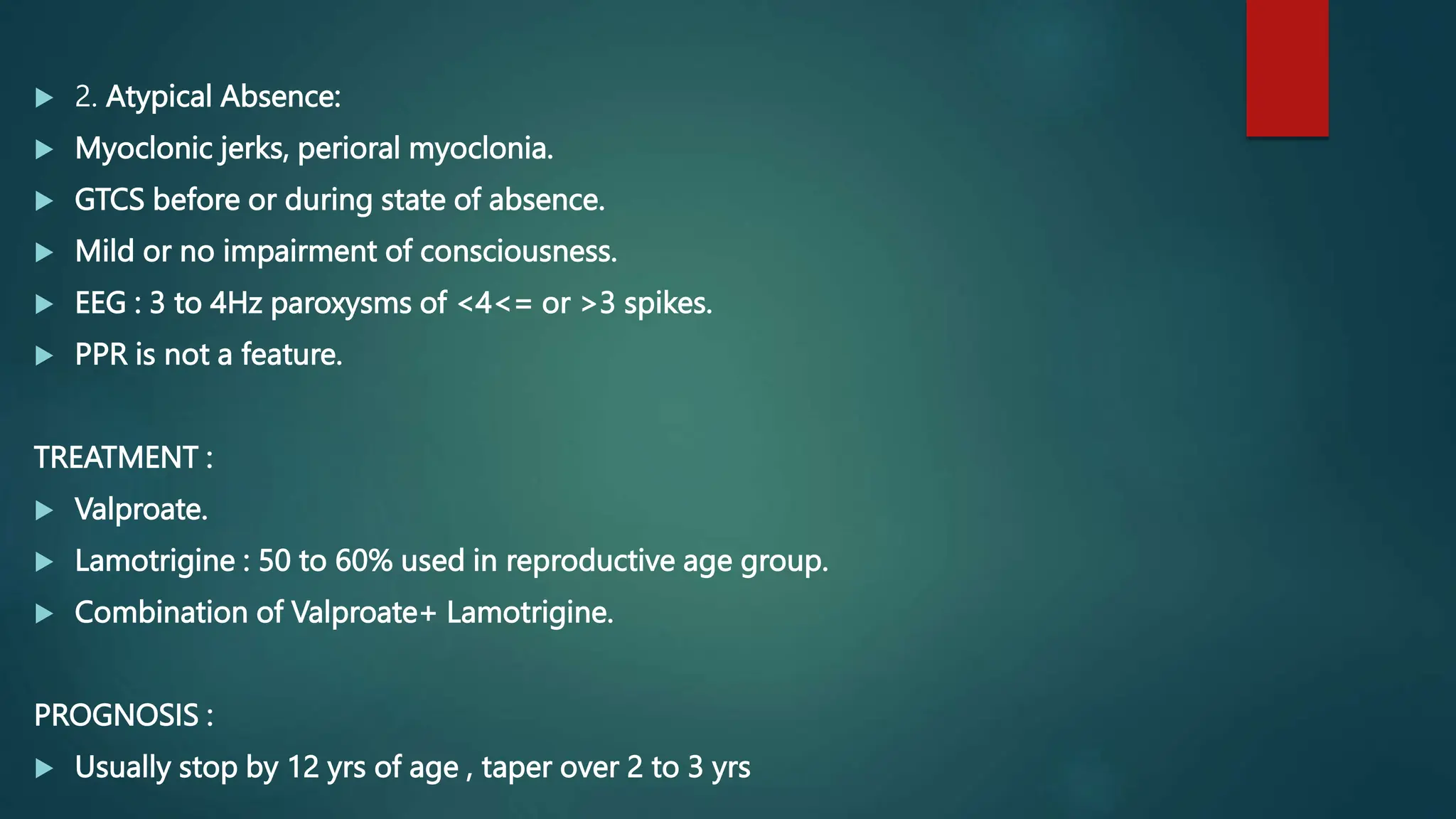
 2. Atypical Absence:
 Myoclonic jerks, perioral myoclonia.
 GTCS before or during state of absence.
 Mild or no impairment of consciousness.
 EEG : 3 to 4Hz paroxysms of <4<= or >3 spikes.
 PPR is not a feature.
TREATMENT :
 Valproate.
 Lamotrigine : 50 to 60% used in reproductive age group.
 Combination of Valproate+ Lamotrigine.
PROGNOSIS :
 Usually stop by 12 yrs of age , taper over 2 to 3 yrs
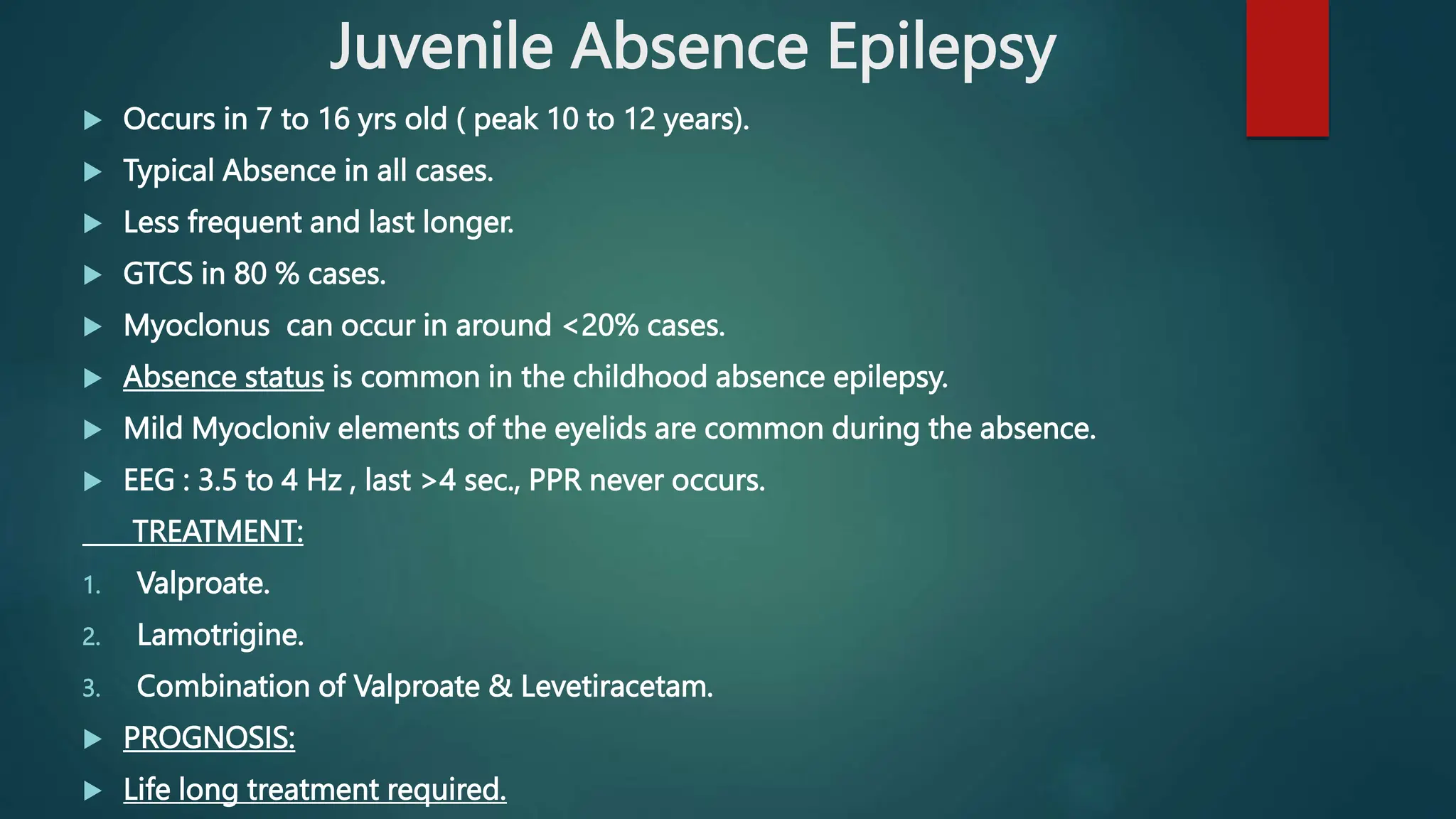
Juvenile Absence Epilepsy
 Occurs in 7 to 16 yrs old ( peak 10 to 12 years).
 Typical Absence in all cases.
 Less frequent and last longer.
 GTCS in 80 % cases.
 Myoclonus can occur in around <20% cases.
 Absence status is common in the childhood absence epilepsy.
 Mild Myocloniv elements of the eyelids are common during the absence.
 EEG : 3.5 to 4 Hz , last >4 sec., PPR never occurs.
TREATMENT:
1. Valproate.
2. Lamotrigine.
3. Combination of Valproate & Levetiracetam.
 PROGNOSIS:
 Life long treatment required.
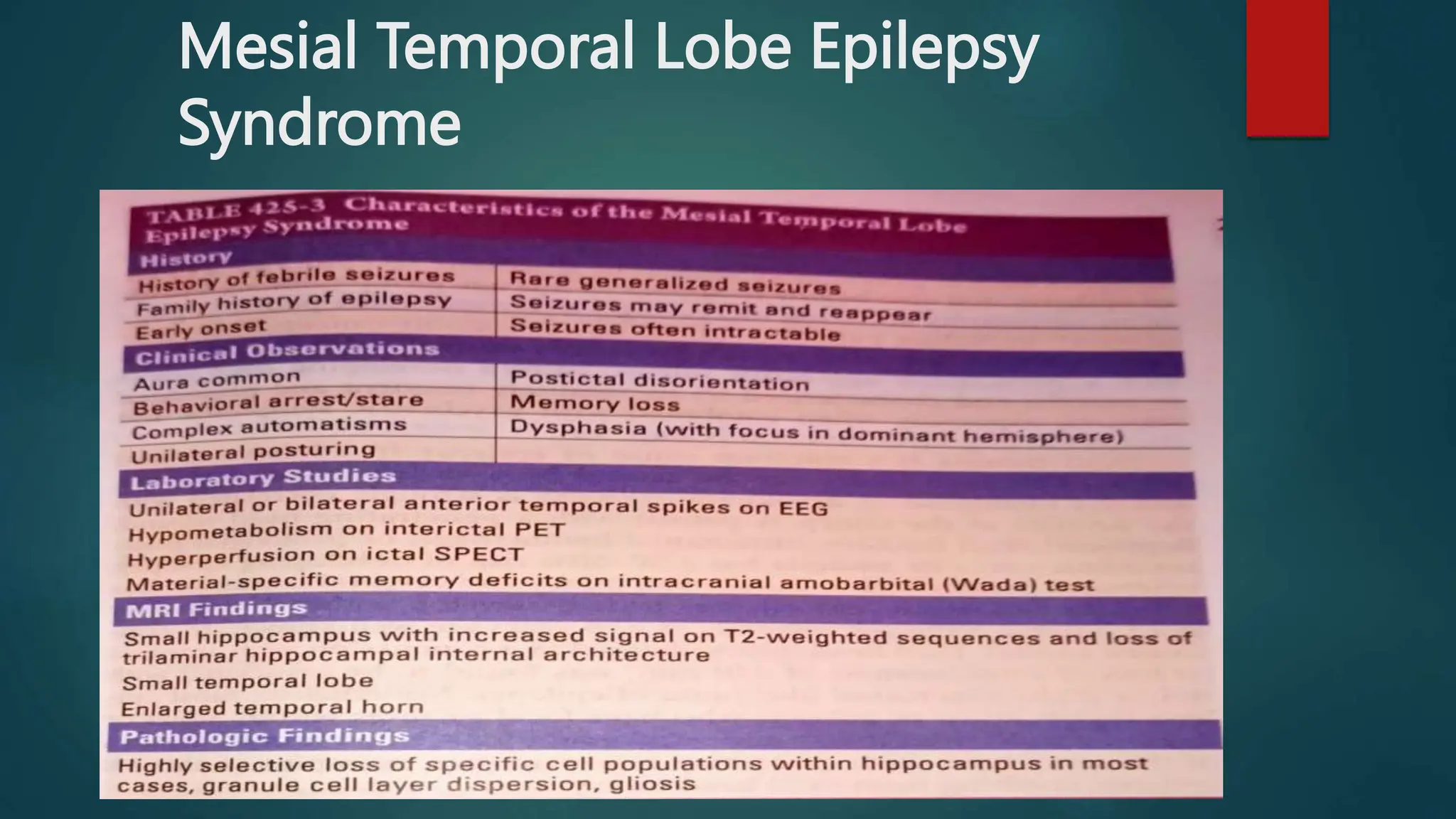
Mesial Temporal Lobe Epilepsy
Syndrome
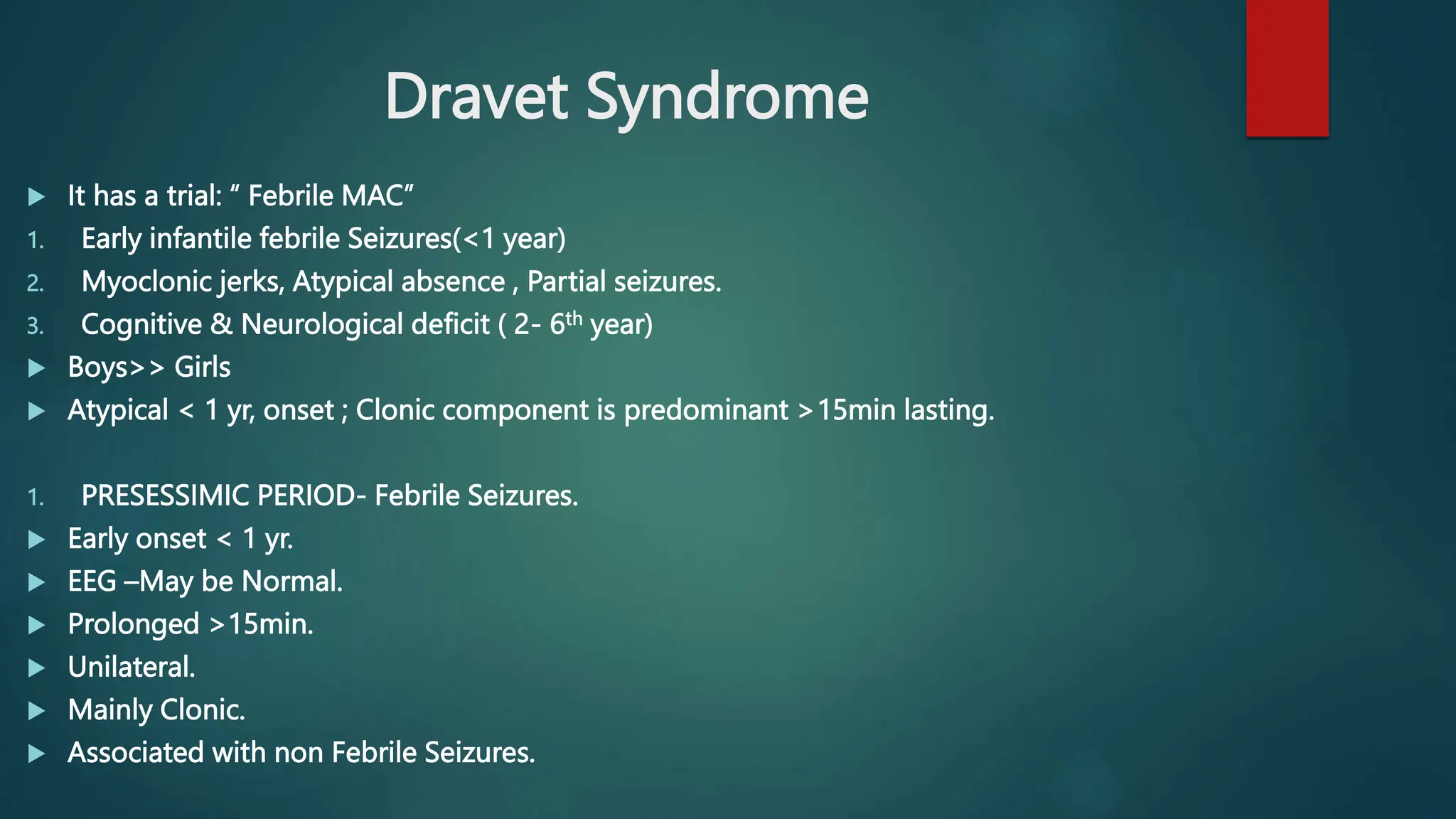
Dravet Syndrome
 It has a trial: “ Febrile MAC”
1. Early infantile febrile Seizures(<1 year)
2. Myoclonic jerks, Atypical absence , Partial seizures.
3. Cognitive & Neurological deficit ( 2- 6th year)
 Boys>> Girls
 Atypical < 1 yr, onset ; Clonic component is predominant >15min lasting.
1. PRESESSIMIC PERIOD- Febrile Seizures.
 Early onset < 1 yr.
 EEG –May be Normal.
 Prolonged >15min.
 Unilateral.
 Mainly Clonic.
 Associated with non Febrile Seizures.
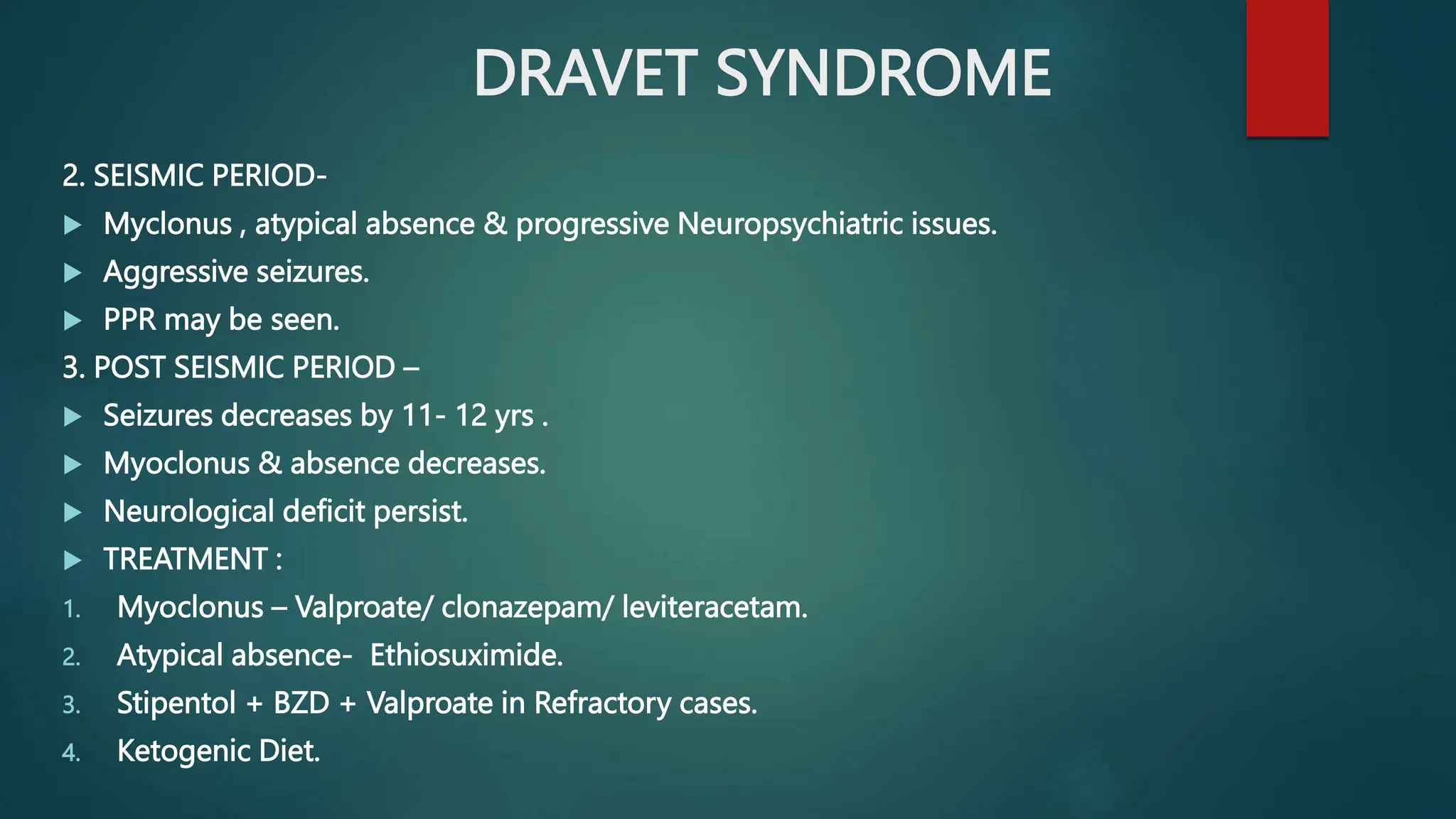
DRAVET SYNDROME
2. SEISMIC PERIOD-
 Myclonus , atypical absence & progressive Neuropsychiatric issues.
 Aggressive seizures.
 PPR may be seen.
3. POST SEISMIC PERIOD –
 Seizures decreases by 11- 12 yrs .
 Myoclonus & absence decreases.
 Neurological deficit persist.
 TREATMENT :
1. Myoclonus – Valproate/ clonazepam/ leviteracetam.
2. Atypical absence- Ethiosuximide.
3. Stipentol + BZD + Valproate in Refractory cases.
4. Ketogenic Diet.
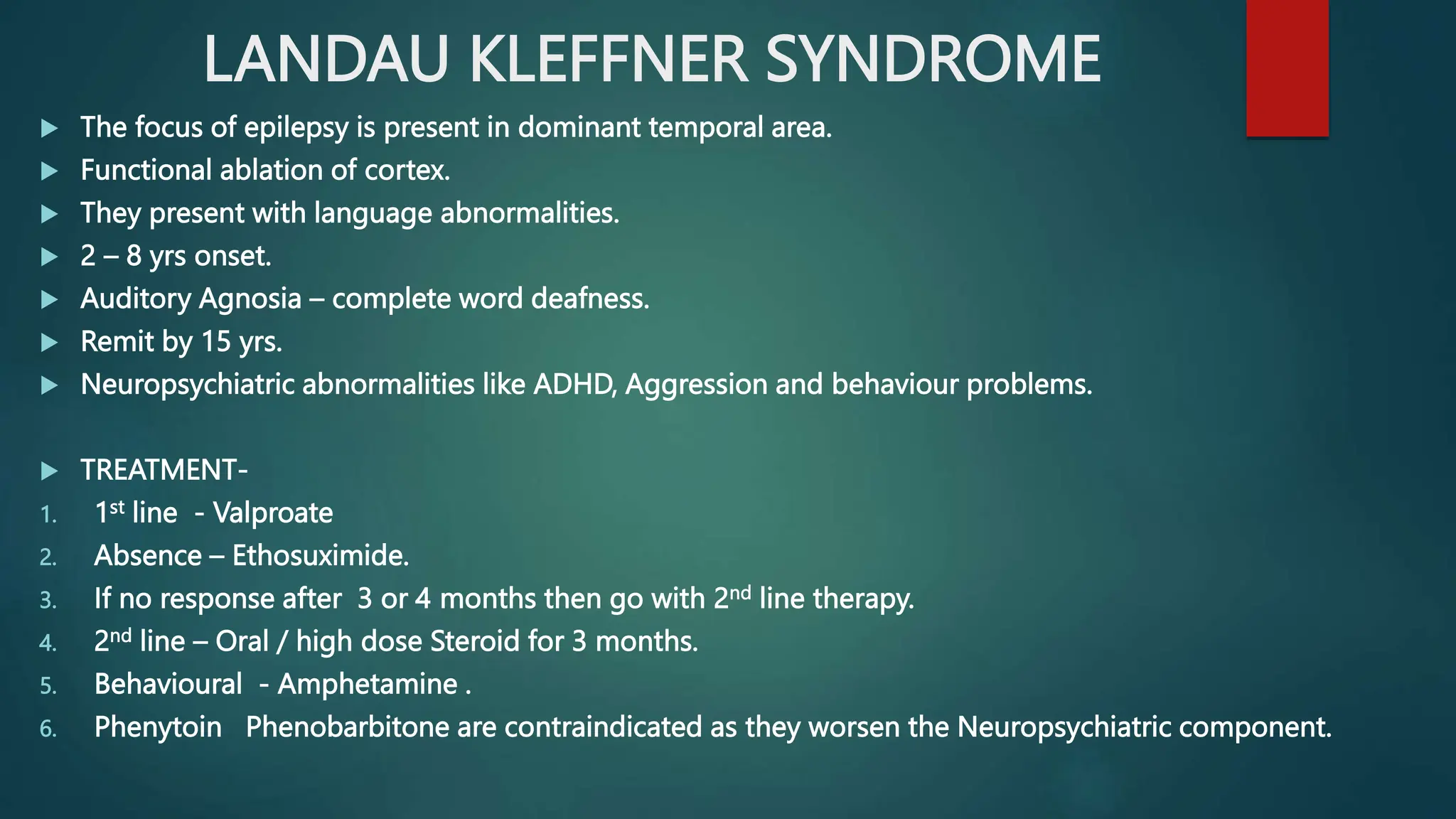
LANDAU KLEFFNER SYNDROME
 The focus of epilepsy is present in dominant temporal area.
 Functional ablation of cortex.
 They present with language abnormalities.
 2 – 8 yrs onset.
 Auditory Agnosia – complete word deafness.
 Remit by 15 yrs.
 Neuropsychiatric abnormalities like ADHD, Aggression and behaviour problems.
 TREATMENT-
1. 1st line - Valproate
2. Absence – Ethosuximide.
3. If no response after 3 or 4 months then go with 2nd line therapy.
4. 2nd line – Oral / high dose Steroid for 3 months.
5. Behavioural - Amphetamine .
6. Phenytoin Phenobarbitone are contraindicated as they worsen the Neuropsychiatric component.
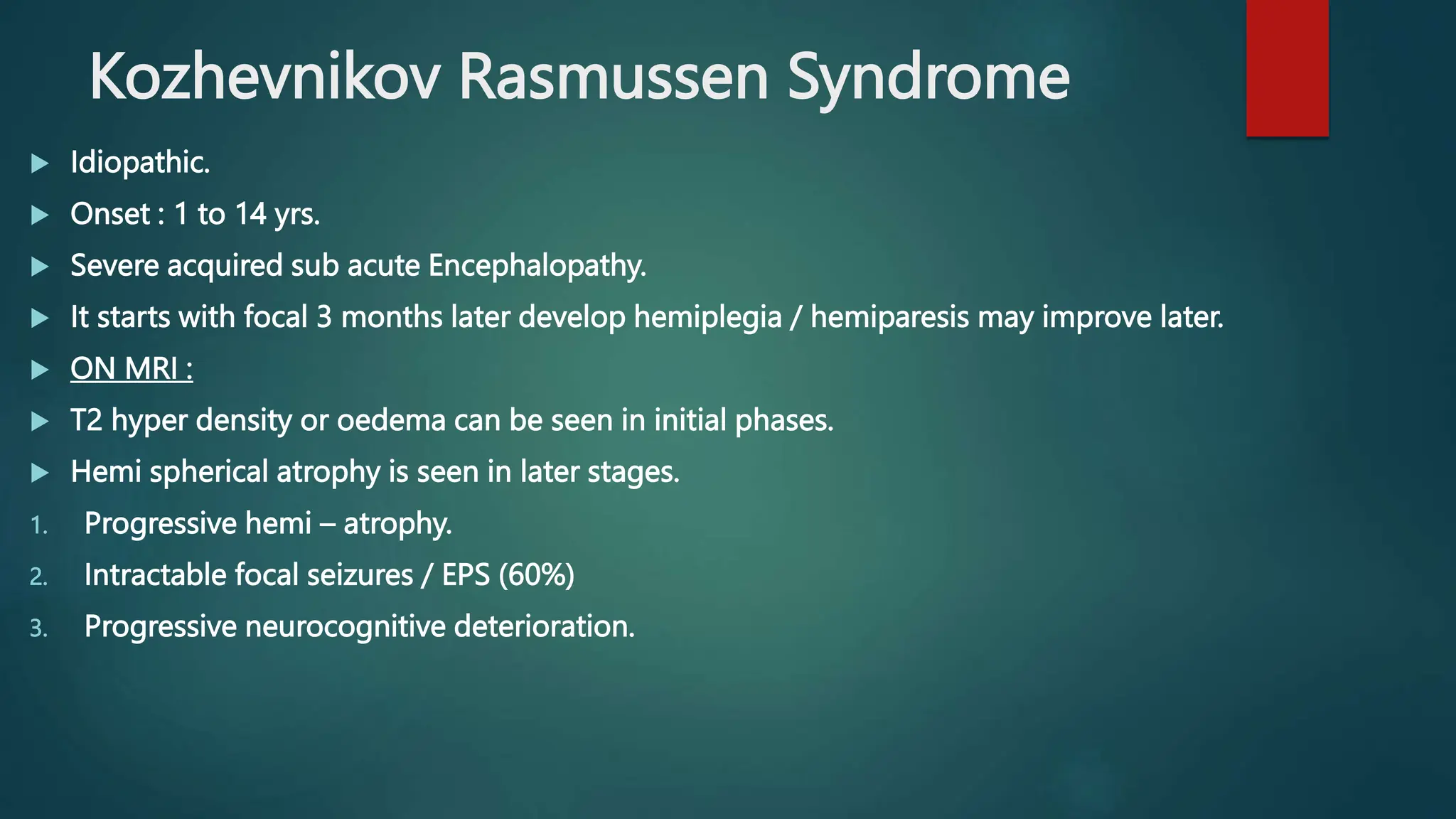
Kozhevnikov Rasmussen Syndrome
 Idiopathic.
 Onset : 1 to 14 yrs.
 Severe acquired sub acute Encephalopathy.
 It starts with focal 3 months later develop hemiplegia / hemiparesis may improve later.
 ON MRI :
 T2 hyper density or oedema can be seen in initial phases.
 Hemi spherical atrophy is seen in later stages.
1. Progressive hemi – atrophy.
2. Intractable focal seizures / EPS (60%)
3. Progressive neurocognitive deterioration.
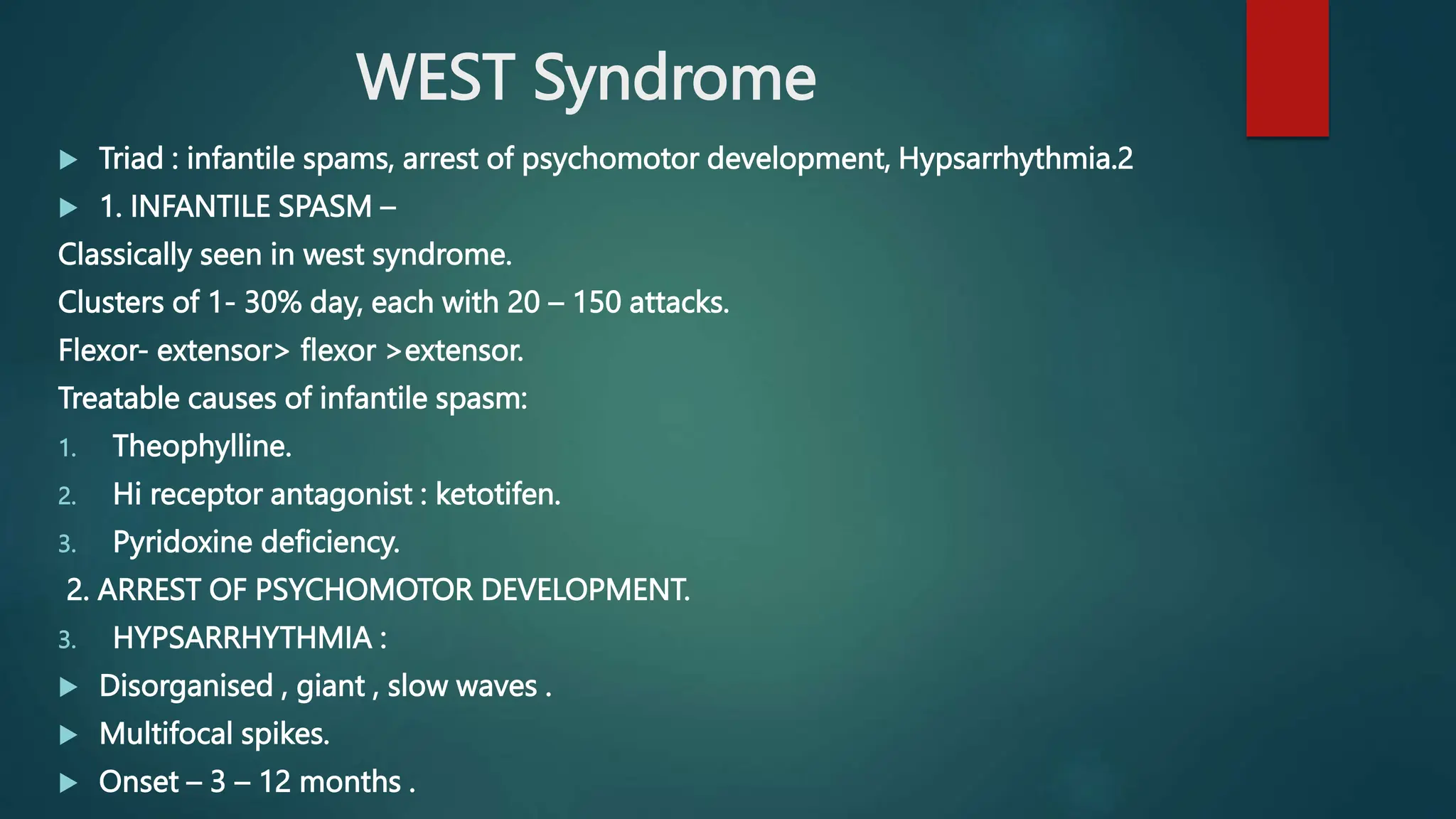
WEST Syndrome
 Triad : infantile spams, arrest of psychomotor development, Hypsarrhythmia.2
 1. INFANTILE SPASM –
Classically seen in west syndrome.
Clusters of 1- 30% day, each with 20 – 150 attacks.
Flexor- extensor> flexor >extensor.
Treatable causes of infantile spasm:
1. Theophylline.
2. Hi receptor antagonist : ketotifen.
3. Pyridoxine deficiency.
2. ARREST OF PSYCHOMOTOR DEVELOPMENT.
3. HYPSARRHYTHMIA :
 Disorganised , giant , slow waves .
 Multifocal spikes.
 Onset – 3 – 12 months .
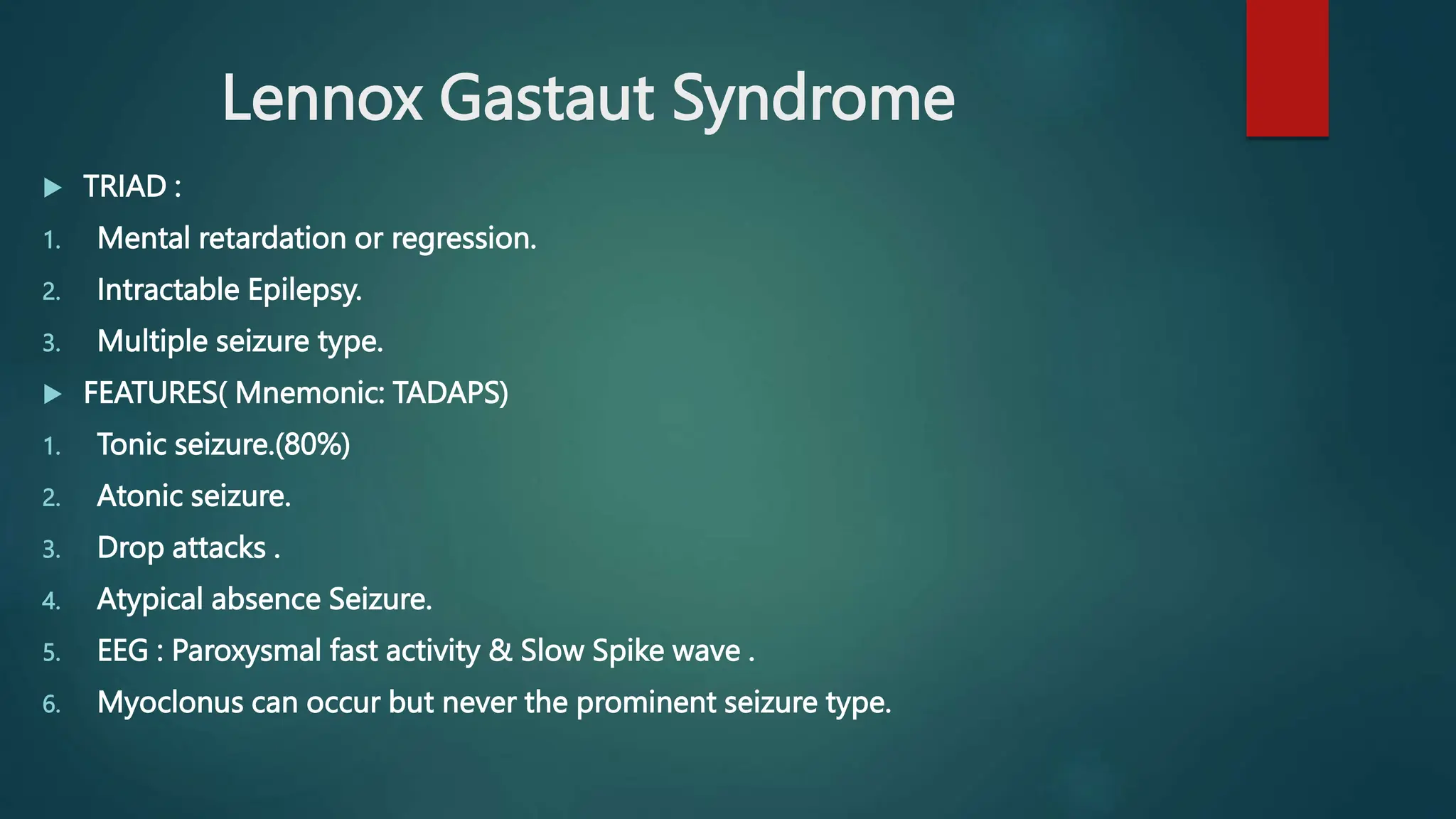
Lennox Gastaut Syndrome
 TRIAD :
1. Mental retardation or regression.
2. Intractable Epilepsy.
3. Multiple seizure type.
 FEATURES( Mnemonic: TADAPS)
1. Tonic seizure.(80%)
2. Atonic seizure.
3. Drop attacks .
4. Atypical absence Seizure.
5. EEG : Paroxysmal fast activity & Slow Spike wave .
6. Myoclonus can occur but never the prominent seizure type.
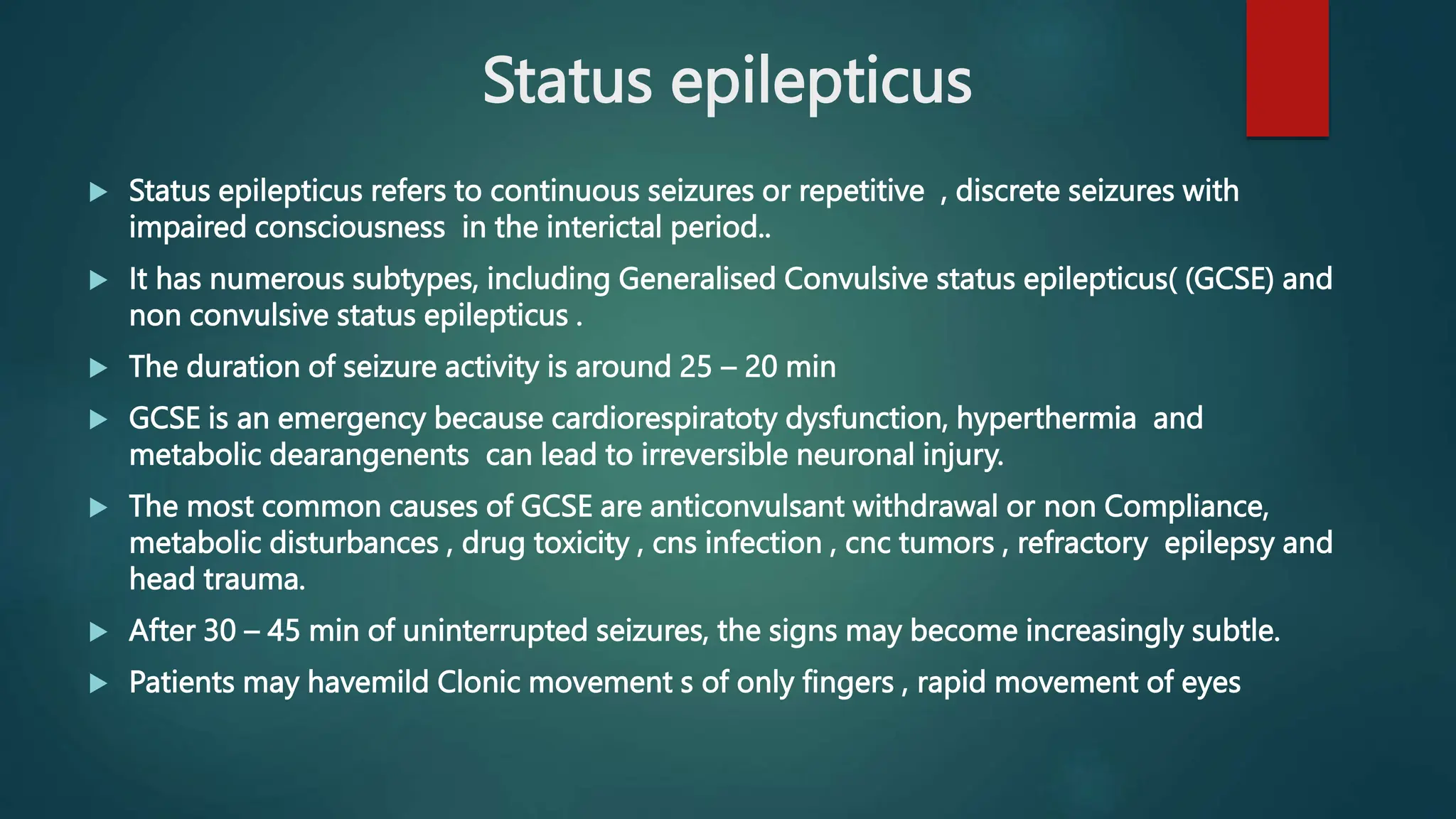
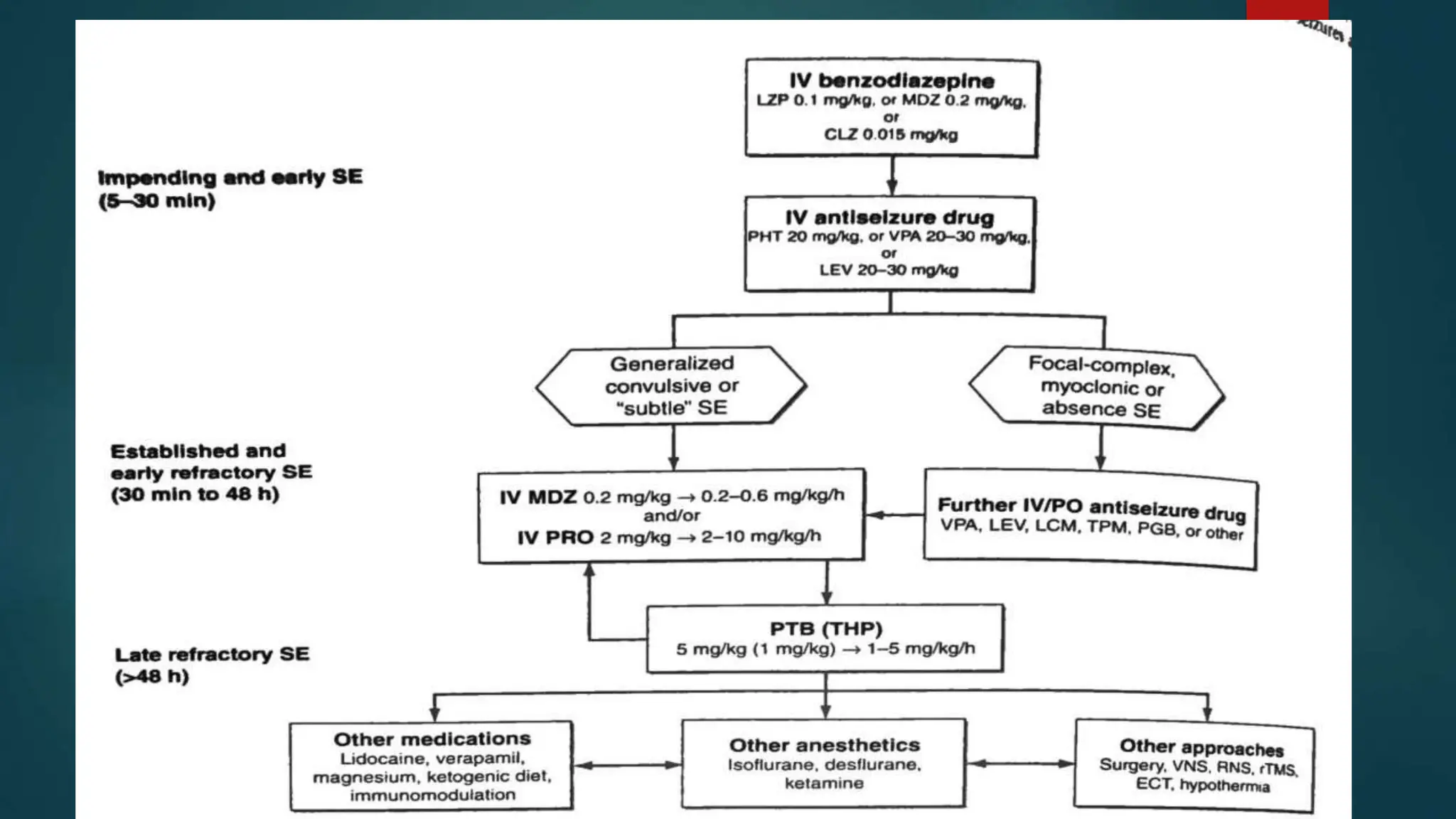
Status epilepticus
 Status epilepticus refers to continuous seizures or repetitive , discrete seizures with
impaired consciousness in the interictal period..
 It has numerous subtypes, including Generalised Convulsive status epilepticus( (GCSE) and
non convulsive status epilepticus .
 The duration of seizure activity is around 25 – 20 min
 GCSE is an emergency because cardiorespiratoty dysfunction, hyperthermia and
metabolic dearangenents can lead to irreversible neuronal injury.
 The most common causes of GCSE are anticonvulsant withdrawal or non Compliance,
metabolic disturbances , drug toxicity , cns infection , cnc tumors , refractory epilepsy and
head trauma.
 After 30 – 45 min of uninterrupted seizures, the signs may become increasingly subtle.
 Patients may havemild Clonic movement s of only fingers , rapid movement of eyes
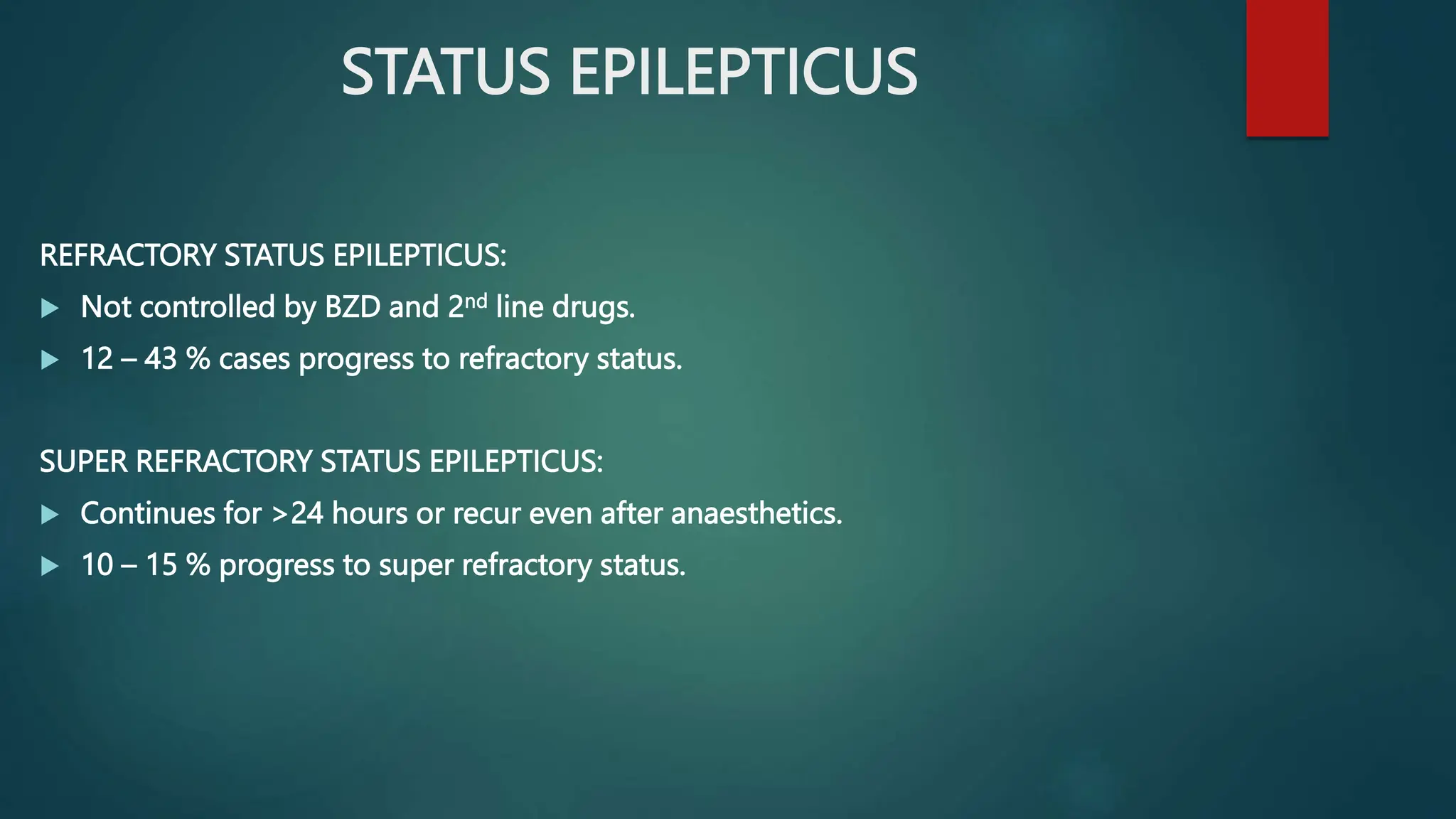
STATUS EPILEPTICUS
REFRACTORY STATUS EPILEPTICUS:
 Not controlled by BZD and 2nd line drugs.
 12 – 43 % cases progress to refractory status.
SUPER REFRACTORY STATUS EPILEPTICUS:
 Continues for >24 hours or recur even after anaesthetics.
 10 – 15 % progress to super refractory status.
THANK YOU...
Epileptiform disorders Classification.pptx

Epileptiform disorders Classification.pptx

  • 1.
    EPILEPSY & SEIZURE ClassificationPart 1 MENTOR : PRESENTOR : DR.RAHUL GAIKWAD SIR DR.KARUNA TAYADE. DR. AKSHAY MOHNANI SIR
  • 2.
    Introduction  Seizure isa transient occurrence of signs or symptoms due to abnormal excessive or synchronous neuronal activity in the brain.  Epilepsy describes a condition in which a person has a risk of recurrent seizures due to a chronic , underlying process.  Using the definition of Epilepsy as two to more unprovoked seizures
  • 3.
  • 4.
    Classification of Seizures The international league against Epilepsy (ILAE) Commission on Classification and Terminology uptades their uproach to Classification of seizures in 2017.
  • 5.
     Focal seizuresare often associated with structural abnormalities of the brain .  In contrast , Generalised seizures may result from cellular , biochemical , or structural abnormalities that have a more widespread distribution
  • 6.
    Focal Onset Seizures Focal seizures arise from neuronal network that is localised within one brain region or more broadly distributed but within a cerebral hemisphere. 1. Focal Seizures with intact Awareness:  Focal seizures can have motor manifestation ( such as tonic, Clonic, myoclonic movements) or non motor manifestations ( such as sensory, autonomic or emotional symptoms) without impairment of awareness.  EEG recorded with scalp electrodes during the seizure( ie an ictal EEG) may show abnormal discharged in a limited region..  Focal Seizures may manifest as 1. change in somatic sensation (eg , paresthesias) 2. Change in vision (flashing lights or formed hallucinations) 3. Equilibrium (sensation of falling or vertigo) 4. Autonomic function (flushing , sweating , piloerection)
  • 7.
    Focal Onset seizures 2.Focal Seizures with impaired Awareness:  The patient is unable to respond appropriately to visual or verbal commands during the seizure and has impaired recollection or Awareness of the ictal phase.  The seizure frequently begin with an aura ( ie a focal seizures without cognitive disturbance)  The start of the ictal phase is often a motionless state .  The impaired awareness is usually accompanied by automatisms.  Automatisms may consist of basic behaviour such as : 1. Chewing. 2. Lip smacking. 3. Picking movements of hands  Patient is confused following the seizure, & the transition to full recovery of consciousness may range from seconds to hour.
  • 8.
     FOCAL EPILEPSY: Focal epilepsy ➡️ Features 1. Medial temporal lobe epilepsy ➡️automatisms, epigastric aura, amnesia. 2. Frontal lobe epilepsy ➡️ hypermotor seizures , nocturnal seizures. 3. Occipital lobe epilepsy ➡️ visual aura. 4. Occpito- parieto- temporal lobe epilepsy ➡️ complex aura. Focal onset seizure
  • 9.
    Primary Generalised Epilepsy Also known as Idiopathic generalised epilepsy..  Most common generalised epilepsy syndromes.  Most common generalised epilepsy in childhood.  Normal development/ normal neurological examination/ normal imaging.  Provocating Factors: 1. Sleep deprivation. 2. Alcohol 3. Photo sensitivity. 4. Worsens along time of awakening.  EEG: 1. Normal background. 2. Photoparoxysmal response. 3. Generalised spike wave discharge.
  • 10.
    Primary Generalised Epilepsy Types: 1.Myoclonic epilepsy of infancy ( 6 month to 3 yrs) 2. Epilepsy with myoclonic absense( 1- 12 years) 3. Childhood absence ( 4- 10 years) 4. Juvenile absence epilepsy ( 9 – 13years) 5. Juvenile myoclonic epilepsy( 6-25 yrs) 6. Epilepsy with generalised tonic clonic seizures( 6-47yrs)
  • 11.
    Generalised Tonic ClonicSeizures  The seizure usually begins abruptly without warning , although some patients describe vague symptoms  The initial phase of the seizure is usually is usually tonic contraction of muscles throughout the body.  Tonic contraction of the muscles expiration and larynx will produce a load moan or “ ictal cry”  Respiration are impaired , secretion pool in the oropharynx and Cyanosis develops.  A marked enhancement of sympathetic tone leads to increase in heart rate, blood pressure, pupillary size.  After 10 – 20 sec; the tonic phase of seizure evolves into the Clonic phase produced by the superimposition of periods of muscle relaxation on the tonic muscle contraction.  The period of relaxation progressively increase but lasts not more than 1 min  The post ictal phase is characterised by unresponsivness, muscular facility and excessive salivation that can cause stridorous breathing .
  • 12.
    Epilepsy with GeneralisedTonic Clonic Seizures  Occurs in 6 to 47 yrs ( peak 16 to 20 yrs).  Bladder or bowel incontinence may occur in post ictal phase. EEG:  During the tonic Clonic phase of seizure shows a progressive increased in generalised low voltage fast activity , followed by generalised high amplitude, polyspike discharged.  In the Clonic phasev, the high amplitude activity is interrupted by slow wave to create a spike and slow wave pattern.  Brief < 3sec .but burst of 2.5 to 4 Hz spike / wave .
  • 13.
    Juvenile Myoclonic Epilepsy JME is a generalised seizure disorder of unknown cause that appears in early adolescence and is usually characterised by bilateral myoclonus jerks that may be single or repetitive..  The myoclonis seizures are most frequent in the morning after awakening and can br Provoked by sleep deprivation.  Consciousness is preserved .
  • 14.
    Juvenile Myoclonic Epilepsy Occurs in 6 to 28 yrs old ( peak 6 to 25 yrs).  Myoclonus jerk on awakening  Photosensitivity is common.  EEG : 1. Polyspike occurring in descending limb without waves. 2. 3 to 6 Hz , 1 to 4 sec. 3. Frontal dominant, shifting asymmetry can occur. 4. Typical 3 Hz spike and wave can seen.  Treatment : 1. Valproate 2. Lamotrigine. 3. Phenobarbitone. 4. Isolated Myoclonus : Clonazepam
  • 15.
    Myoclonic Epilepsy ofInfancy  Earliest Idiopathic Generalised Epilepsy ( 6 months – 3 yrs)  Present with myoclonus on awakening: Yell because of diaphragm contraction.  Consciousness is usually preserved.  Multiple episodes happening per day.  Provoked by auditors or tactile has better prognosis.  Remission: 6 month to 5 yrs of onset.  Treatment : Valproate (DOC) , Clonazepam , levetiracetam.  DOC in reproductive age group : levetiracetam.  Alternative drug in reproductive age group : Lamotrigine.
  • 16.
    Epilepsy with myoclonicabsence  Onset: 1 to 12 yrs ( peak 7 yrs)  Myoclonic absence are the defining symptoms.  Eyelid twitching is absent.  Personal myoclonus are frequent.  May have intellectual disability before seizure onset.  Some may show decline over time.  Treatment : Resistance to monotherapy  - 1. Valproate. 2 . Ethosuximide. 3. Valproate/ Ethosuximide+ lamotrigine .
  • 17.
    Childhood Absence Epilepsy Also known as pyknolepsy.  Occurs in 4 to 10 years of age ( peak 6 to 7 yrs)  Girls > boys. 1. Typical Absence:  4 to 20 sec.  Severe impairment of consciousness.  Multiple times per day.(>10per day)  Abrupt onset and sudden stoppage.  Will not be associated with eyelid myoclonia / perioral myoclonia.  PPR/ sensory activation never occurs.  EEG : 3 Hz discharge.
  • 18.
     2. AtypicalAbsence:  Myoclonic jerks, perioral myoclonia.  GTCS before or during state of absence.  Mild or no impairment of consciousness.  EEG : 3 to 4Hz paroxysms of <4<= or >3 spikes.  PPR is not a feature. TREATMENT :  Valproate.  Lamotrigine : 50 to 60% used in reproductive age group.  Combination of Valproate+ Lamotrigine. PROGNOSIS :  Usually stop by 12 yrs of age , taper over 2 to 3 yrs
  • 19.
    Juvenile Absence Epilepsy Occurs in 7 to 16 yrs old ( peak 10 to 12 years).  Typical Absence in all cases.  Less frequent and last longer.  GTCS in 80 % cases.  Myoclonus can occur in around <20% cases.  Absence status is common in the childhood absence epilepsy.  Mild Myocloniv elements of the eyelids are common during the absence.  EEG : 3.5 to 4 Hz , last >4 sec., PPR never occurs. TREATMENT: 1. Valproate. 2. Lamotrigine. 3. Combination of Valproate & Levetiracetam.  PROGNOSIS:  Life long treatment required.
  • 20.
    Mesial Temporal LobeEpilepsy Syndrome
  • 21.
    Dravet Syndrome  Ithas a trial: “ Febrile MAC” 1. Early infantile febrile Seizures(<1 year) 2. Myoclonic jerks, Atypical absence , Partial seizures. 3. Cognitive & Neurological deficit ( 2- 6th year)  Boys>> Girls  Atypical < 1 yr, onset ; Clonic component is predominant >15min lasting. 1. PRESESSIMIC PERIOD- Febrile Seizures.  Early onset < 1 yr.  EEG –May be Normal.  Prolonged >15min.  Unilateral.  Mainly Clonic.  Associated with non Febrile Seizures.
  • 22.
    DRAVET SYNDROME 2. SEISMICPERIOD-  Myclonus , atypical absence & progressive Neuropsychiatric issues.  Aggressive seizures.  PPR may be seen. 3. POST SEISMIC PERIOD –  Seizures decreases by 11- 12 yrs .  Myoclonus & absence decreases.  Neurological deficit persist.  TREATMENT : 1. Myoclonus – Valproate/ clonazepam/ leviteracetam. 2. Atypical absence- Ethiosuximide. 3. Stipentol + BZD + Valproate in Refractory cases. 4. Ketogenic Diet.
  • 23.
    LANDAU KLEFFNER SYNDROME The focus of epilepsy is present in dominant temporal area.  Functional ablation of cortex.  They present with language abnormalities.  2 – 8 yrs onset.  Auditory Agnosia – complete word deafness.  Remit by 15 yrs.  Neuropsychiatric abnormalities like ADHD, Aggression and behaviour problems.  TREATMENT- 1. 1st line - Valproate 2. Absence – Ethosuximide. 3. If no response after 3 or 4 months then go with 2nd line therapy. 4. 2nd line – Oral / high dose Steroid for 3 months. 5. Behavioural - Amphetamine . 6. Phenytoin Phenobarbitone are contraindicated as they worsen the Neuropsychiatric component.
  • 24.
    Kozhevnikov Rasmussen Syndrome Idiopathic.  Onset : 1 to 14 yrs.  Severe acquired sub acute Encephalopathy.  It starts with focal 3 months later develop hemiplegia / hemiparesis may improve later.  ON MRI :  T2 hyper density or oedema can be seen in initial phases.  Hemi spherical atrophy is seen in later stages. 1. Progressive hemi – atrophy. 2. Intractable focal seizures / EPS (60%) 3. Progressive neurocognitive deterioration.
  • 25.
    WEST Syndrome  Triad: infantile spams, arrest of psychomotor development, Hypsarrhythmia.2  1. INFANTILE SPASM – Classically seen in west syndrome. Clusters of 1- 30% day, each with 20 – 150 attacks. Flexor- extensor> flexor >extensor. Treatable causes of infantile spasm: 1. Theophylline. 2. Hi receptor antagonist : ketotifen. 3. Pyridoxine deficiency. 2. ARREST OF PSYCHOMOTOR DEVELOPMENT. 3. HYPSARRHYTHMIA :  Disorganised , giant , slow waves .  Multifocal spikes.  Onset – 3 – 12 months .
  • 26.
    Lennox Gastaut Syndrome TRIAD : 1. Mental retardation or regression. 2. Intractable Epilepsy. 3. Multiple seizure type.  FEATURES( Mnemonic: TADAPS) 1. Tonic seizure.(80%) 2. Atonic seizure. 3. Drop attacks . 4. Atypical absence Seizure. 5. EEG : Paroxysmal fast activity & Slow Spike wave . 6. Myoclonus can occur but never the prominent seizure type.
  • 27.
    Status epilepticus  Statusepilepticus refers to continuous seizures or repetitive , discrete seizures with impaired consciousness in the interictal period..  It has numerous subtypes, including Generalised Convulsive status epilepticus( (GCSE) and non convulsive status epilepticus .  The duration of seizure activity is around 25 – 20 min  GCSE is an emergency because cardiorespiratoty dysfunction, hyperthermia and metabolic dearangenents can lead to irreversible neuronal injury.  The most common causes of GCSE are anticonvulsant withdrawal or non Compliance, metabolic disturbances , drug toxicity , cns infection , cnc tumors , refractory epilepsy and head trauma.  After 30 – 45 min of uninterrupted seizures, the signs may become increasingly subtle.  Patients may havemild Clonic movement s of only fingers , rapid movement of eyes
  • 28.
    STATUS EPILEPTICUS REFRACTORY STATUSEPILEPTICUS:  Not controlled by BZD and 2nd line drugs.  12 – 43 % cases progress to refractory status. SUPER REFRACTORY STATUS EPILEPTICUS:  Continues for >24 hours or recur even after anaesthetics.  10 – 15 % progress to super refractory status.
  • 30.