CREATIVE
NONFICTION
Lesson 8: Writing Coherent
& Organized Paragraphs
At the end of this lesson, the learner should be able to:
1. define coherence as an element of writing;
2. identify effective techniques to achieve coherence in
writing;
3. write an essay about his family's culture using all of the
strategies learned to create coherent paragraphs.
Objectives
Lesson 8: Writing Coherent and
Organized
Paragraphs
Subject Matter
Prentice Hall. (2004). Grammar & Composition IV. Pearson
Education South Asia Pte Ltd.
Reference(s)
I.ACTIVATION OF PRIOR KNOWLEDGE
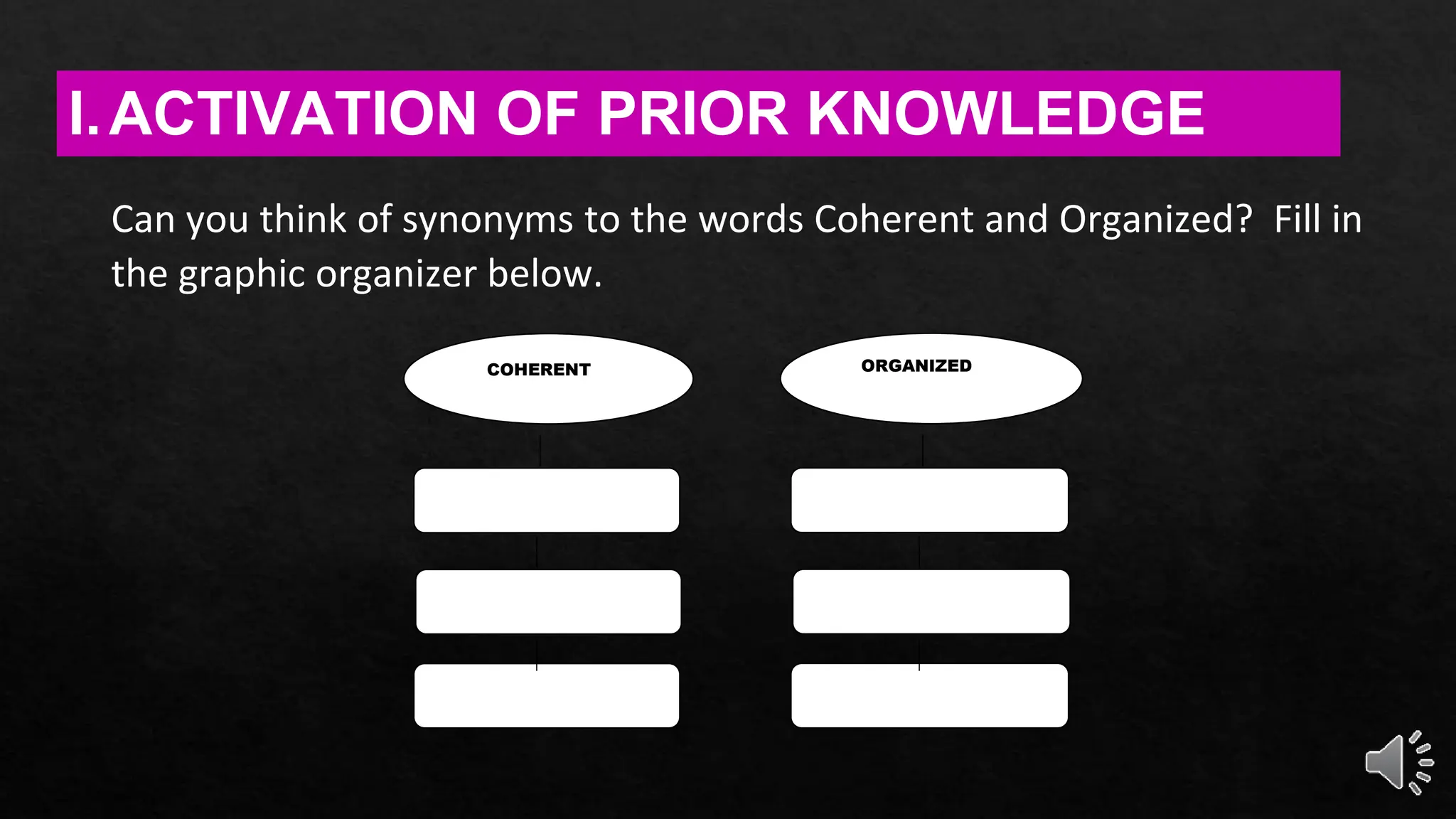
Can you think of synonyms to the words Coherent and Organized? Fill in
the graphic organizer below.
COHERENT ORGANIZED
II. ACQUISITION OF NEW KNOWLEDGE
COHERENCE is integral in writing effective
paragraphs that is, the ideas are logically arranged
and smoothly connected for the reader in addition to
strong topic sentence, solid supporting information,
and unity of thought. Coherent paragraphs are
organized paragraphs.
II. ACQUISITION OF NEW KNOWLEDGE
HOW TO ACHIEVE COHERENCE IN
WRITING?
II. ACQUISITION OF NEW KNOWLEDGE
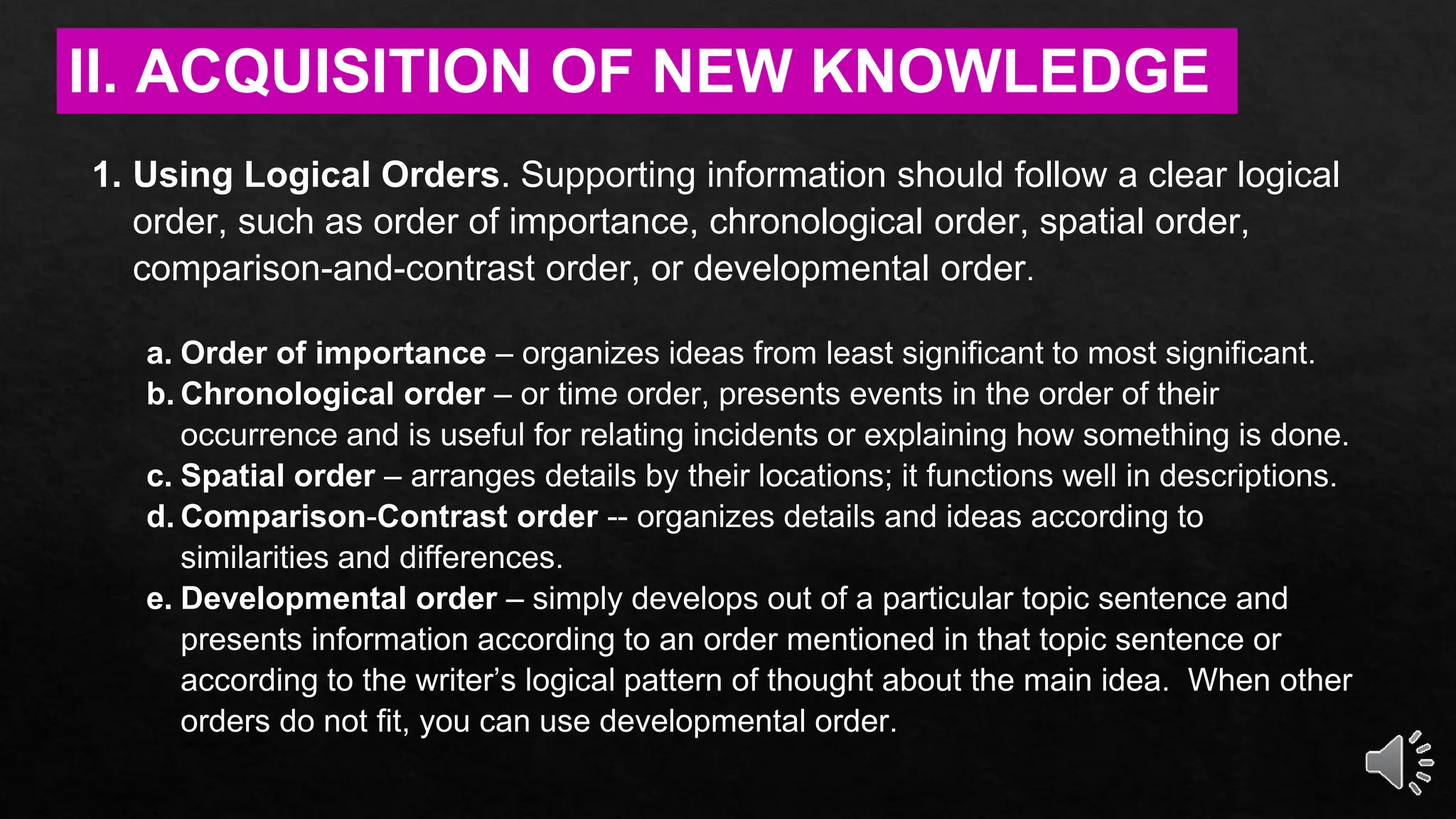
1. Using Logical Orders. Supporting information should follow a clear logical
order, such as order of importance, chronological order, spatial order,
comparison-and-contrast order, or developmental order.
a. Order of importance – organizes ideas from least significant to most significant.
b. Chronological order – or time order, presents events in the order of their
occurrence and is useful for relating incidents or explaining how something is done.
c. Spatial order – arranges details by their locations; it functions well in descriptions.
d. Comparison-Contrast order -- organizes details and ideas according to
similarities and differences.
e. Developmental order – simply develops out of a particular topic sentence and
presents information according to an order mentioned in that topic sentence or
according to the writer’s logical pattern of thought about the main idea. When other
orders do not fit, you can use developmental order.
II. ACQUISITION OF NEW KNOWLEDGE
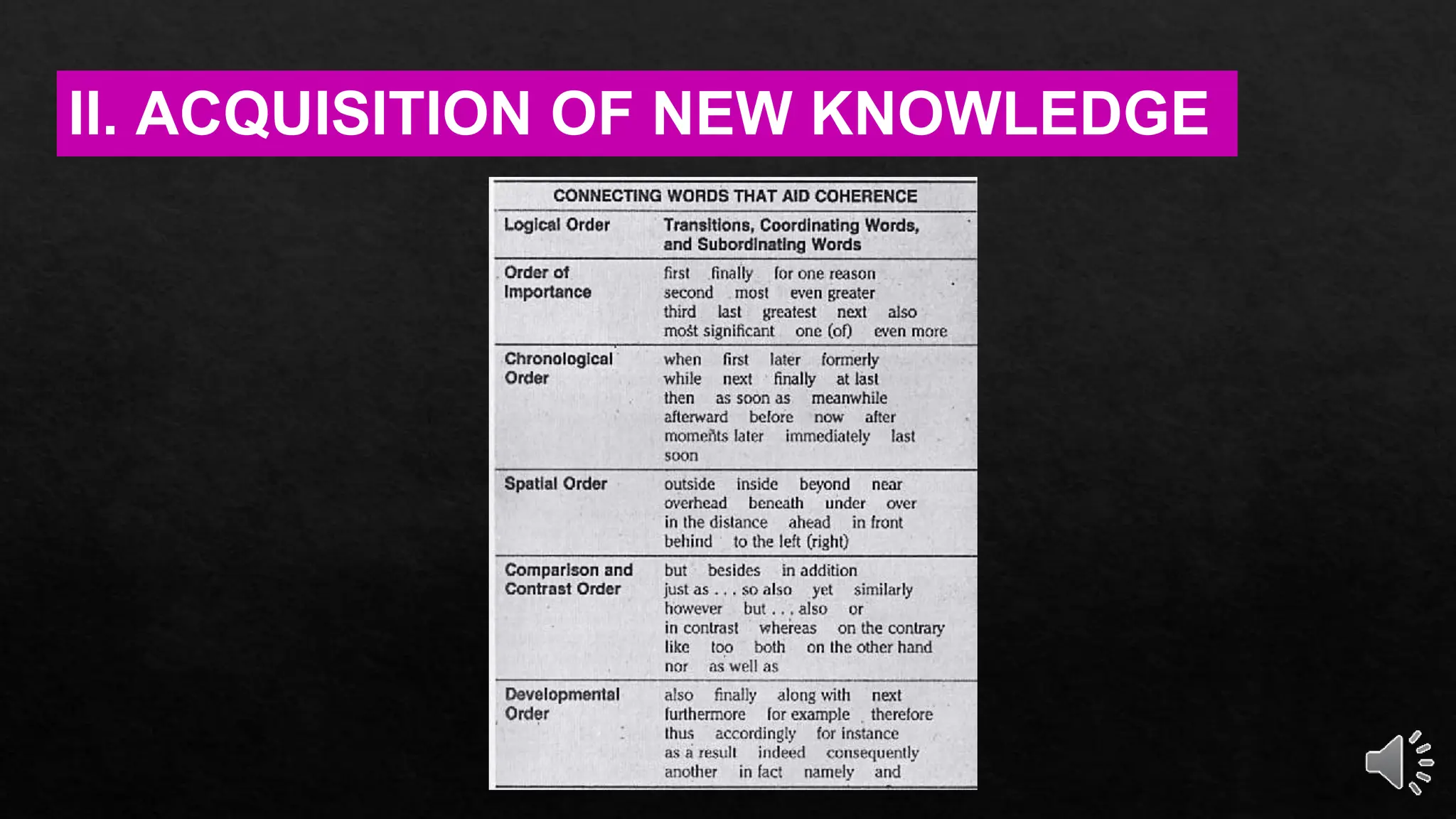
2. Using Transitions and Other Connecting Words. Transitions,
coordinating words, and subordinating words clarify the order of ideas
and connect them smoothly.
II. ACQUISITION OF NEW KNOWLEDGE
3. Use of Repetition, Synonyms, and Consistent Pronouns. Repetition of
main words and the use of synonyms and consistent pronouns also aid
coherence.
Example:
My lolo, on the other hand, is a bit authoritarian. He was unquestionably the
man of the house and the family. He was held in high regard by everyone. He was
also well-liked in the community. If my lolo taught me anything, it would be mostly life
lessons. He would inadvertently but generously share bits of wisdom based on his
own life experiences with us. He was also an excellent storyteller. He would usually
tell us about his experiences during World War II and tales of the supernatural, and his
spooky stories would pique our interest as children. My cousins and I would crowd
around him with wide eyes and attentive ears, engrossed in his stories. My lolo
always made me feel safe and secure.
II. ACQUISITION OF NEW KNOWLEDGE
4. Using Parallelism and Concluding Sentences. Parallel
structures and a concluding sentence can tie together related ideas
in a paragraph.
a.The use of similar grammatical structures (Example: It was my father
who trained me in most of the household chores of cooking rice, sewing
clothes and cleaning the house regularly.) *Gerund phrases as object
of the preposition of
II. ACQUISITION OF NEW KNOWLEDGE
b. A concluding sentence or a final sentence that echoes the main idea,
summarizes the details, or adds a closing thought
Example:
Introduction: All that I am is mostly the result of my experiences and the way I
was raised by my family and “significant others” who have had
a substantial impact on my life.
Conclusion: If there is a road map to getting to know someone, I believe
understanding one's family is it. This is also true for
me; my family is the one that shaped me into the person I am today. They are the
primary movers and shakers in my life to whom I owe much.
II. ACQUISITION OF NEW KNOWLEDGE
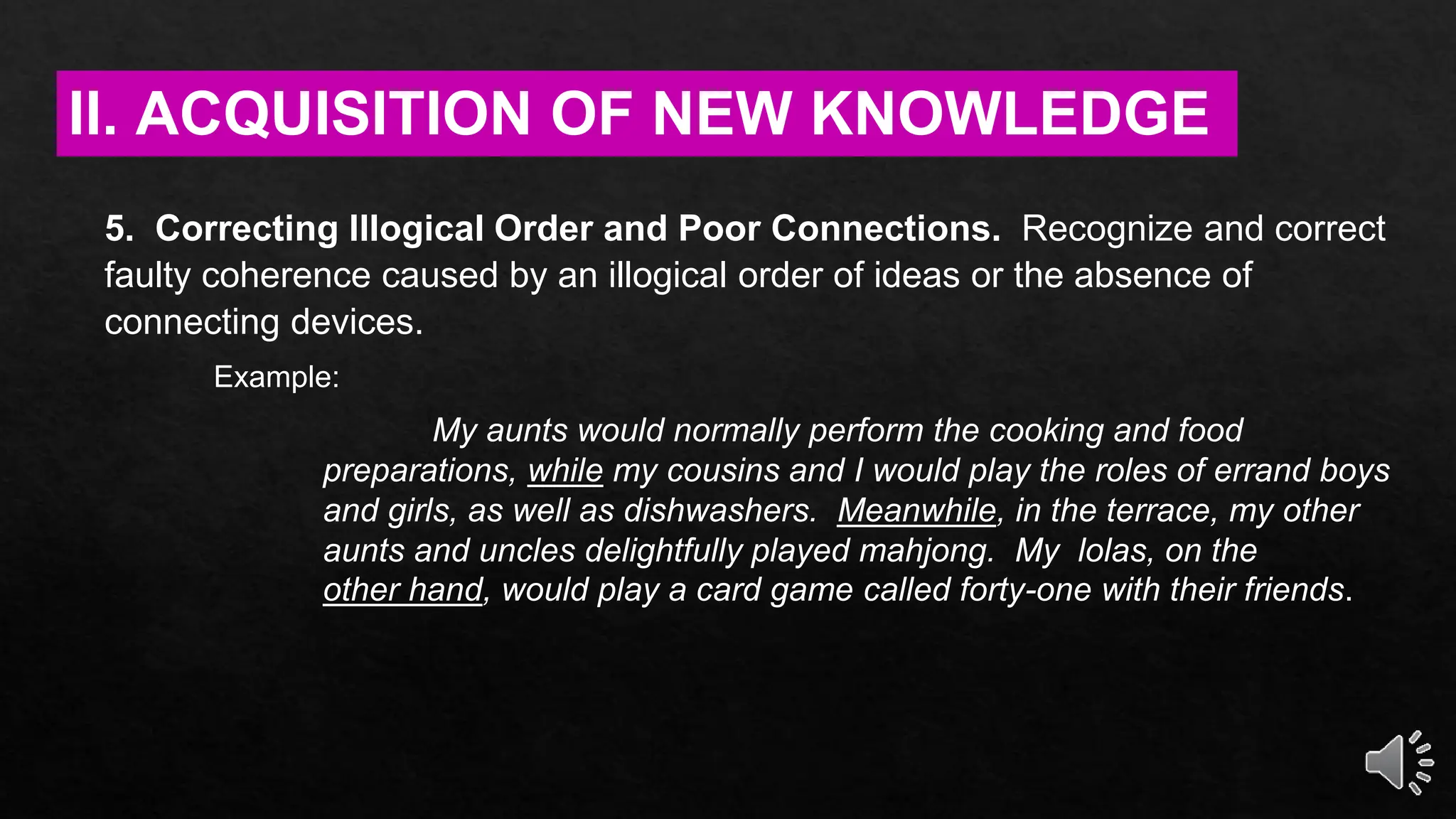
5. Correcting Illogical Order and Poor Connections. Recognize and correct
faulty coherence caused by an illogical order of ideas or the absence of
connecting devices.
Example:
My aunts would normally perform the cooking and food
preparations, while my cousins and I would play the roles of errand boys
and girls, as well as dishwashers. Meanwhile, in the terrace, my other
aunts and uncles delightfully played mahjong. My lolas, on the
other hand, would play a card game called forty-one with their friends.
III. APPLICATION
Achieving Coherence. The following sentences can be arranged to form a coherent paragraph. Decide
on the best order for the sentences by recognizing introductory statements, the topic sentence, and a
logical order for the supporting ideas. Write letters A-F on the space before each number.
_______ 1. First, it failed to explain why the different planets travel at different angles and at different
speeds in relation to each other and to the sun.
_______ 2. French astronomer Pierre de Laplace and German metaphysicist Immanuel Kant
maintained that the planets in our solar system were formed from a central nebula.
_______3. Third, and most obvious to critics of the theory, a planet as massive as Jupiter could not
have been spread out as a thin ring of matter surrounding the sun, because it would
have been impossible for that thin stream to have contracted into a huge spherical body.
_______4. Because of three major drawbacks, however, critics of the theory found it incomplete and
imperfect.
_______5. Second, centrifugal force alone would not have the power to propel rings of matter outward
into space.
_______6. According to this theory, as the nebula began to rotate, it threw off rings of matter
centrifugally, and each of these rings then contracted gravitationally to form the different
planets.
IV. ASSESSMENT
A. Exercise. You are about to read an essay describing a person’s family culture. Go over
the questions below. Then, answer them after you have read the essay. You may write
your answers 1 whole sheet of paper.
1. What is the title of the essay? Is it a good title? Why or why not?
2. How long is the introduction?
3. Is the introduction an effective preparation for the rest of the essay? If so, why? If not, why not?
4. What is the writer’s purpose throughout the essay?
5. What audience did the writer seem to have in mind? What tone does the writer establish?
6. What is the thesis statement? What, if any, subtopics does it explicitly mention?
7. How many body paragraphs does the essay have? What is the topic sentence of each body
paragraph?
8. List two pieces of supporting information presented in each of the body paragraphs. How does this
information help develop the main point of the essay?
9. How long is the conclusion?
10.How does the conclusion remind the reader of the thesis statement? Does the conclusion
satisfactorily complete the essay?
IV. ASSESSMENT
You can read the essay Decoding Me on this link:
https://bit.ly/cnflesson8
IV. ASSESSMENT
A. Enrichment. How about you, what is your family culture? Are you
aware of it? How were you brought up? What beliefs or traditions
your family keep/observe?
Write an essay of not less than 1000 words about your
family culture. Apply all the techniques you have
learned in this lesson to make your writing coherent
and organized. You may use a computer and have it
printed, or you may handwrite it legibly and neatly in a
yellow pad paper. Provide a title for your work.
FREE DOWNLOADABLE PPT &
WORKSHEET
PLEASE CLICK THE LINKS ON THE
DESCRIPTION BELOW.
Thank you for watching
my video.

CNF Lesson 8 writing Coherent & Organized Paragraphs.pptx

  • 1.
    CREATIVE NONFICTION Lesson 8: WritingCoherent & Organized Paragraphs
  • 2.
    At the endof this lesson, the learner should be able to: 1. define coherence as an element of writing; 2. identify effective techniques to achieve coherence in writing; 3. write an essay about his family's culture using all of the strategies learned to create coherent paragraphs. Objectives
  • 3.
    Lesson 8: WritingCoherent and Organized Paragraphs Subject Matter
  • 4.
    Prentice Hall. (2004).Grammar & Composition IV. Pearson Education South Asia Pte Ltd. Reference(s)
  • 5.
    I.ACTIVATION OF PRIORKNOWLEDGE Can you think of synonyms to the words Coherent and Organized? Fill in the graphic organizer below. COHERENT ORGANIZED
  • 6.
    II. ACQUISITION OFNEW KNOWLEDGE COHERENCE is integral in writing effective paragraphs that is, the ideas are logically arranged and smoothly connected for the reader in addition to strong topic sentence, solid supporting information, and unity of thought. Coherent paragraphs are organized paragraphs.
  • 7.
    II. ACQUISITION OFNEW KNOWLEDGE HOW TO ACHIEVE COHERENCE IN WRITING?
  • 8.
    II. ACQUISITION OFNEW KNOWLEDGE 1. Using Logical Orders. Supporting information should follow a clear logical order, such as order of importance, chronological order, spatial order, comparison-and-contrast order, or developmental order. a. Order of importance – organizes ideas from least significant to most significant. b. Chronological order – or time order, presents events in the order of their occurrence and is useful for relating incidents or explaining how something is done. c. Spatial order – arranges details by their locations; it functions well in descriptions. d. Comparison-Contrast order -- organizes details and ideas according to similarities and differences. e. Developmental order – simply develops out of a particular topic sentence and presents information according to an order mentioned in that topic sentence or according to the writer’s logical pattern of thought about the main idea. When other orders do not fit, you can use developmental order.
  • 9.
    II. ACQUISITION OFNEW KNOWLEDGE 2. Using Transitions and Other Connecting Words. Transitions, coordinating words, and subordinating words clarify the order of ideas and connect them smoothly.
  • 10.
    II. ACQUISITION OFNEW KNOWLEDGE
  • 11.
    II. ACQUISITION OFNEW KNOWLEDGE 3. Use of Repetition, Synonyms, and Consistent Pronouns. Repetition of main words and the use of synonyms and consistent pronouns also aid coherence. Example: My lolo, on the other hand, is a bit authoritarian. He was unquestionably the man of the house and the family. He was held in high regard by everyone. He was also well-liked in the community. If my lolo taught me anything, it would be mostly life lessons. He would inadvertently but generously share bits of wisdom based on his own life experiences with us. He was also an excellent storyteller. He would usually tell us about his experiences during World War II and tales of the supernatural, and his spooky stories would pique our interest as children. My cousins and I would crowd around him with wide eyes and attentive ears, engrossed in his stories. My lolo always made me feel safe and secure.
  • 12.
    II. ACQUISITION OFNEW KNOWLEDGE 4. Using Parallelism and Concluding Sentences. Parallel structures and a concluding sentence can tie together related ideas in a paragraph. a.The use of similar grammatical structures (Example: It was my father who trained me in most of the household chores of cooking rice, sewing clothes and cleaning the house regularly.) *Gerund phrases as object of the preposition of
  • 13.
    II. ACQUISITION OFNEW KNOWLEDGE b. A concluding sentence or a final sentence that echoes the main idea, summarizes the details, or adds a closing thought Example: Introduction: All that I am is mostly the result of my experiences and the way I was raised by my family and “significant others” who have had a substantial impact on my life. Conclusion: If there is a road map to getting to know someone, I believe understanding one's family is it. This is also true for me; my family is the one that shaped me into the person I am today. They are the primary movers and shakers in my life to whom I owe much.
  • 14.
    II. ACQUISITION OFNEW KNOWLEDGE 5. Correcting Illogical Order and Poor Connections. Recognize and correct faulty coherence caused by an illogical order of ideas or the absence of connecting devices. Example: My aunts would normally perform the cooking and food preparations, while my cousins and I would play the roles of errand boys and girls, as well as dishwashers. Meanwhile, in the terrace, my other aunts and uncles delightfully played mahjong. My lolas, on the other hand, would play a card game called forty-one with their friends.
  • 15.
    III. APPLICATION Achieving Coherence.The following sentences can be arranged to form a coherent paragraph. Decide on the best order for the sentences by recognizing introductory statements, the topic sentence, and a logical order for the supporting ideas. Write letters A-F on the space before each number. _______ 1. First, it failed to explain why the different planets travel at different angles and at different speeds in relation to each other and to the sun. _______ 2. French astronomer Pierre de Laplace and German metaphysicist Immanuel Kant maintained that the planets in our solar system were formed from a central nebula. _______3. Third, and most obvious to critics of the theory, a planet as massive as Jupiter could not have been spread out as a thin ring of matter surrounding the sun, because it would have been impossible for that thin stream to have contracted into a huge spherical body. _______4. Because of three major drawbacks, however, critics of the theory found it incomplete and imperfect. _______5. Second, centrifugal force alone would not have the power to propel rings of matter outward into space. _______6. According to this theory, as the nebula began to rotate, it threw off rings of matter centrifugally, and each of these rings then contracted gravitationally to form the different planets.
  • 16.
    IV. ASSESSMENT A. Exercise.You are about to read an essay describing a person’s family culture. Go over the questions below. Then, answer them after you have read the essay. You may write your answers 1 whole sheet of paper. 1. What is the title of the essay? Is it a good title? Why or why not? 2. How long is the introduction? 3. Is the introduction an effective preparation for the rest of the essay? If so, why? If not, why not? 4. What is the writer’s purpose throughout the essay? 5. What audience did the writer seem to have in mind? What tone does the writer establish? 6. What is the thesis statement? What, if any, subtopics does it explicitly mention? 7. How many body paragraphs does the essay have? What is the topic sentence of each body paragraph? 8. List two pieces of supporting information presented in each of the body paragraphs. How does this information help develop the main point of the essay? 9. How long is the conclusion? 10.How does the conclusion remind the reader of the thesis statement? Does the conclusion satisfactorily complete the essay?
  • 17.
    IV. ASSESSMENT You canread the essay Decoding Me on this link: https://bit.ly/cnflesson8
  • 18.
    IV. ASSESSMENT A. Enrichment.How about you, what is your family culture? Are you aware of it? How were you brought up? What beliefs or traditions your family keep/observe? Write an essay of not less than 1000 words about your family culture. Apply all the techniques you have learned in this lesson to make your writing coherent and organized. You may use a computer and have it printed, or you may handwrite it legibly and neatly in a yellow pad paper. Provide a title for your work.
  • 19.
    FREE DOWNLOADABLE PPT& WORKSHEET PLEASE CLICK THE LINKS ON THE DESCRIPTION BELOW.
  • 20.
    Thank you forwatching my video.