Word Sense DisambiguationCMSC 723: Computational Linguistics I ― Session #11Jimmy LinThe iSchoolUniversity of MarylandWednesday, November 11, 2009Material drawn from slides by Saif Mohammad and Bonnie Dorr
Progression of the CourseWordsFinite-state morphologyPart-of-speech tagging (TBL + HMM)StructureCFGs + parsing (CKY, Earley)N-gram language modelsMeaning!
Today’s AgendaWord sense disambiguationBeyond lexical semanticsSemantic attachments to syntaxShallow semantics: PropBank
Word Sense Disambiguation
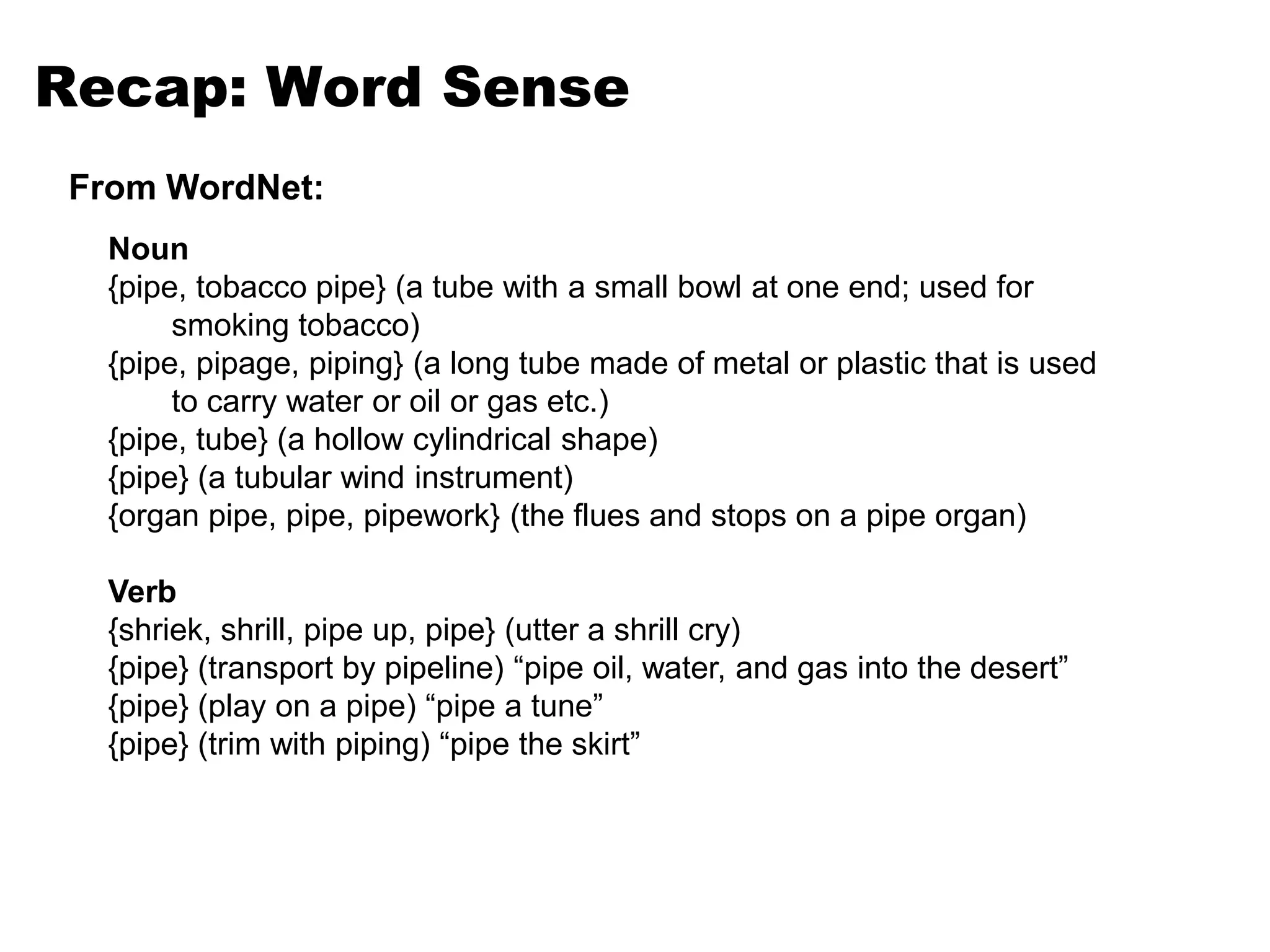
Recap: Word SenseFrom WordNet:Noun{pipe, tobacco pipe} (a tube with a small bowl at one end; used for smoking tobacco) {pipe, pipage, piping} (a long tube made of metal or plastic that is used to carry water or oil or gas etc.) {pipe, tube} (a hollow cylindrical shape) {pipe} (a tubular wind instrument) {organ pipe, pipe, pipework} (the flues and stops on a pipe organ) Verb{shriek, shrill, pipe up, pipe} (utter a shrill cry) {pipe} (transport by pipeline) “pipe oil, water, and gas into the desert”{pipe} (play on a pipe) “pipe a tune”{pipe} (trim with piping) “pipe the skirt”
Word Sense DisambiguationTask: automatically select the correct sense of a wordLexical sampleAll-wordsTheoretically useful for many applications:Semantic similarity (remember from last time?)Information retrievalMachine translation…Solution in search of a problem? Why?
How big is the problem?Most words in English have only one sense62% in Longman’s Dictionary of Contemporary English79% in WordNetBut the others tend to have several sensesAverage of 3.83 in LDOCEAverage of 2.96 in WordNetAmbiguous words are more frequently usedIn the British National Corpus, 84% of instances have more than one senseSome senses are more frequent than others
Ground TruthWhich sense inventory do we use?Issues there?Application specificity?
CorporaLexical sampleline-hard-serve corpus (4k sense-tagged examples)interest corpus (2,369 sense-tagged examples)… All-wordsSemCor (234k words, subset of Brown Corpus)Senseval-3 (2081 tagged content words from 5k total words)…Observations about the size?
EvaluationIntrinsicMeasure accuracy of sense selection wrt ground truthExtrinsicIntegrate WSD as part of a bigger end-to-end system, e.g., machine translation or information retrievalCompare WSD
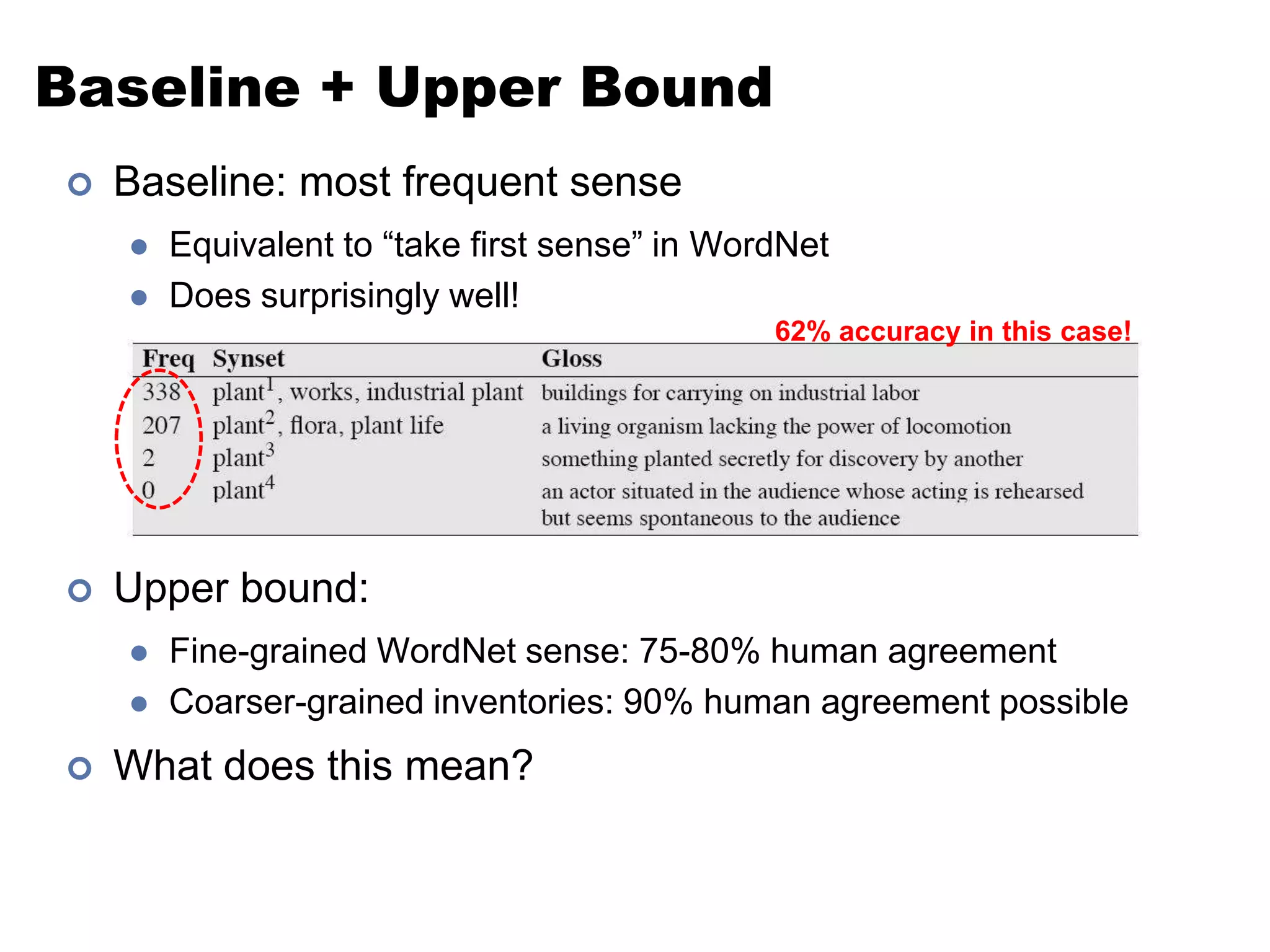
Baseline + Upper BoundBaseline: most frequent senseEquivalent to “take first sense” in WordNetDoes surprisingly well!Upper bound:Fine-grained WordNet sense: 75-80% human agreementCoarser-grained inventories: 90% human agreement possibleWhat does this mean?62% accuracy in this case!
WSD ApproachesDepending on use of manually created knowledge sourcesKnowledge-leanKnowledge-richDepending on use of labeled dataSupervisedSemi- or minimally supervisedUnsupervised
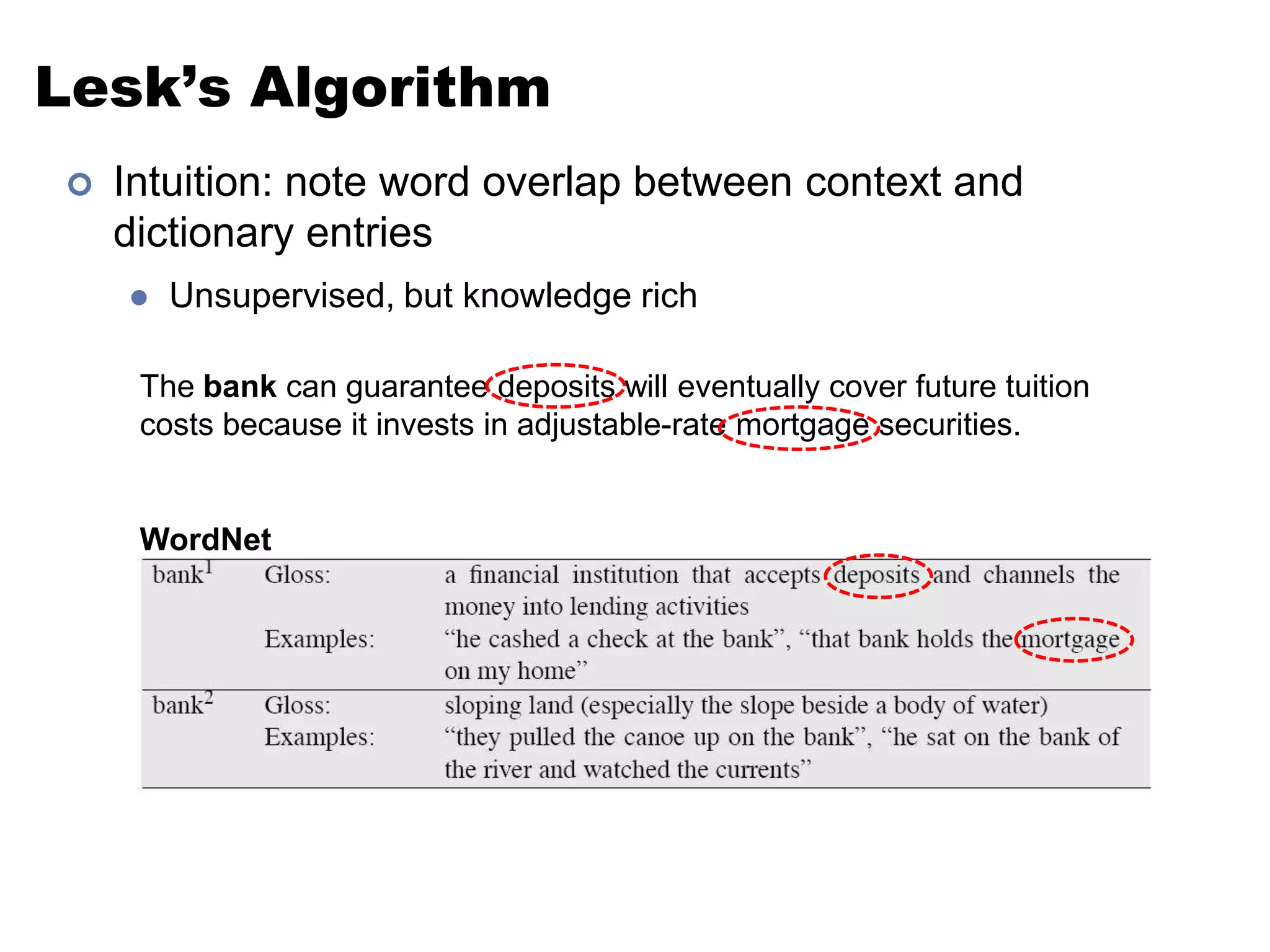
Lesk’s AlgorithmIntuition: note word overlap between context and dictionary entriesUnsupervised, but knowledge richThe bank can guarantee deposits will eventually cover future tuition costs because it invests in adjustable-rate mortgage securities.  WordNet
Lesk’s AlgorithmSimplest implementation:Count overlapping content words between glosses and contextLots of variants:Include the examples in dictionary definitionsInclude hypernyms and hyponymsGive more weight to larger overlaps (e.g., bigrams)Give extra weight to infrequent words (e.g., idf weighting)…Works reasonably well!
Supervised WSD: NLP meets MLWSD as a supervised classification taskTrain a separate classifier for each wordThree components of a machine learning problem:Training data (corpora)Representations (features)Learning method (algorithm, model)
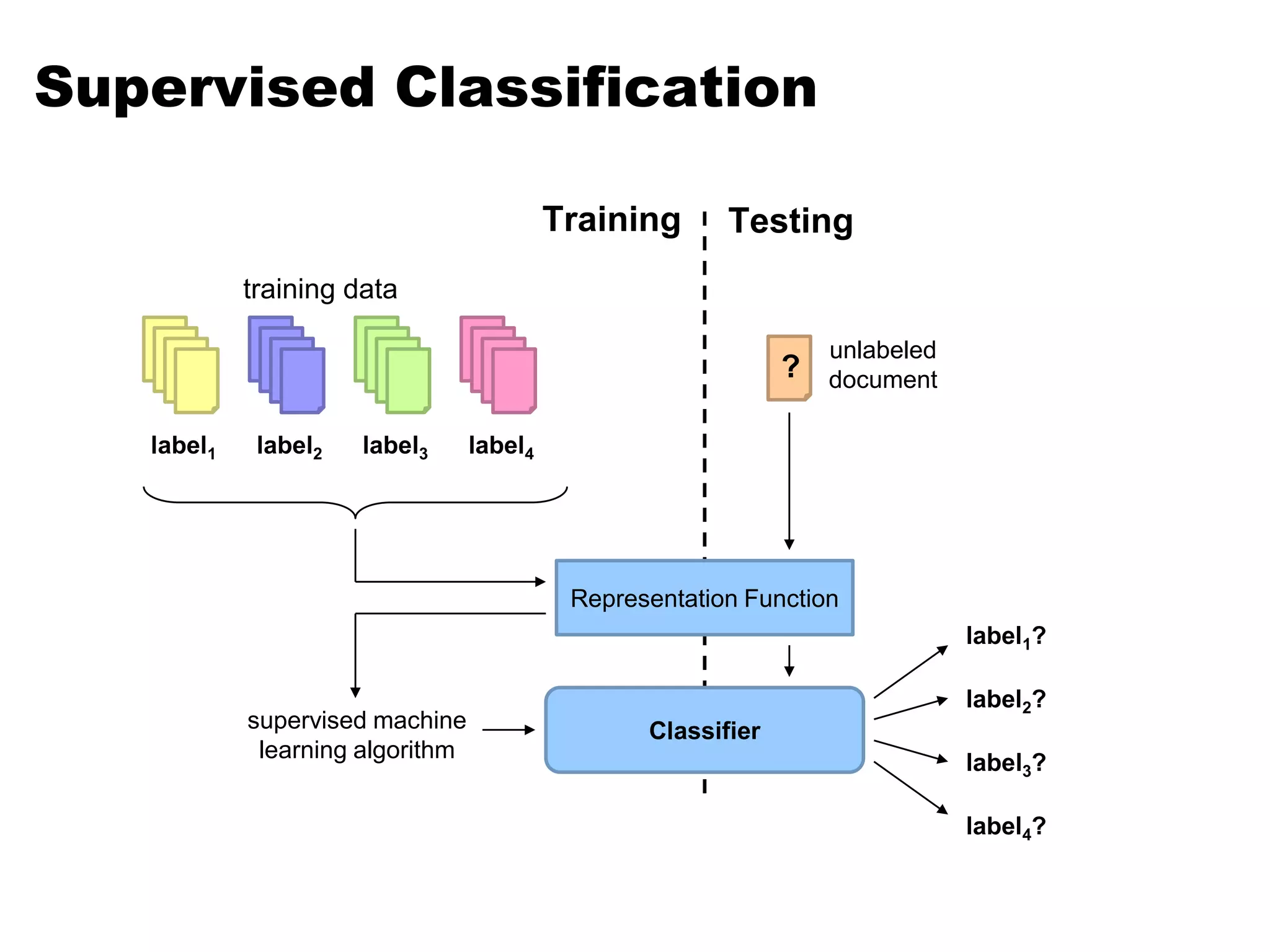
Supervised ClassificationTrainingTestingtraining dataunlabeled document?label1label2label3label4Representation Functionlabel1?label2?Classifiersupervised machine learning algorithmlabel3?label4?
Three Laws of Machine LearningThou shalt not mingle training data with test dataThou shalt not mingle training data with test dataThou shalt not mingle training data with test dataBut what do you do if you need more test data?
FeaturesPossible featuresPOS and surface form of the word itselfSurrounding words and POS tagPositional information of surrounding words and POS tagsSame as above, but with n-gramsGrammatical information…Richness of the features?Richer features = ML algorithm does less of the workMore impoverished features = ML algorithm does more of the work
ClassifiersOnce we cast the WSD problem as supervised classification, many learning techniques are possible:Naïve Bayes (the thing to try first)Decision listsDecision treesMaxEntSupport vector machinesNearest neighbor methods…
Classifiers TradeoffsWhich classifier should I use?It depends:Number of featuresTypes of featuresNumber of possible values for a featureNoise…General advice:Start with Naïve BayesUse decision trees/lists if you want to understand what the classifier is doingSVMs often give state of the art performanceMaxEnt methods also work well
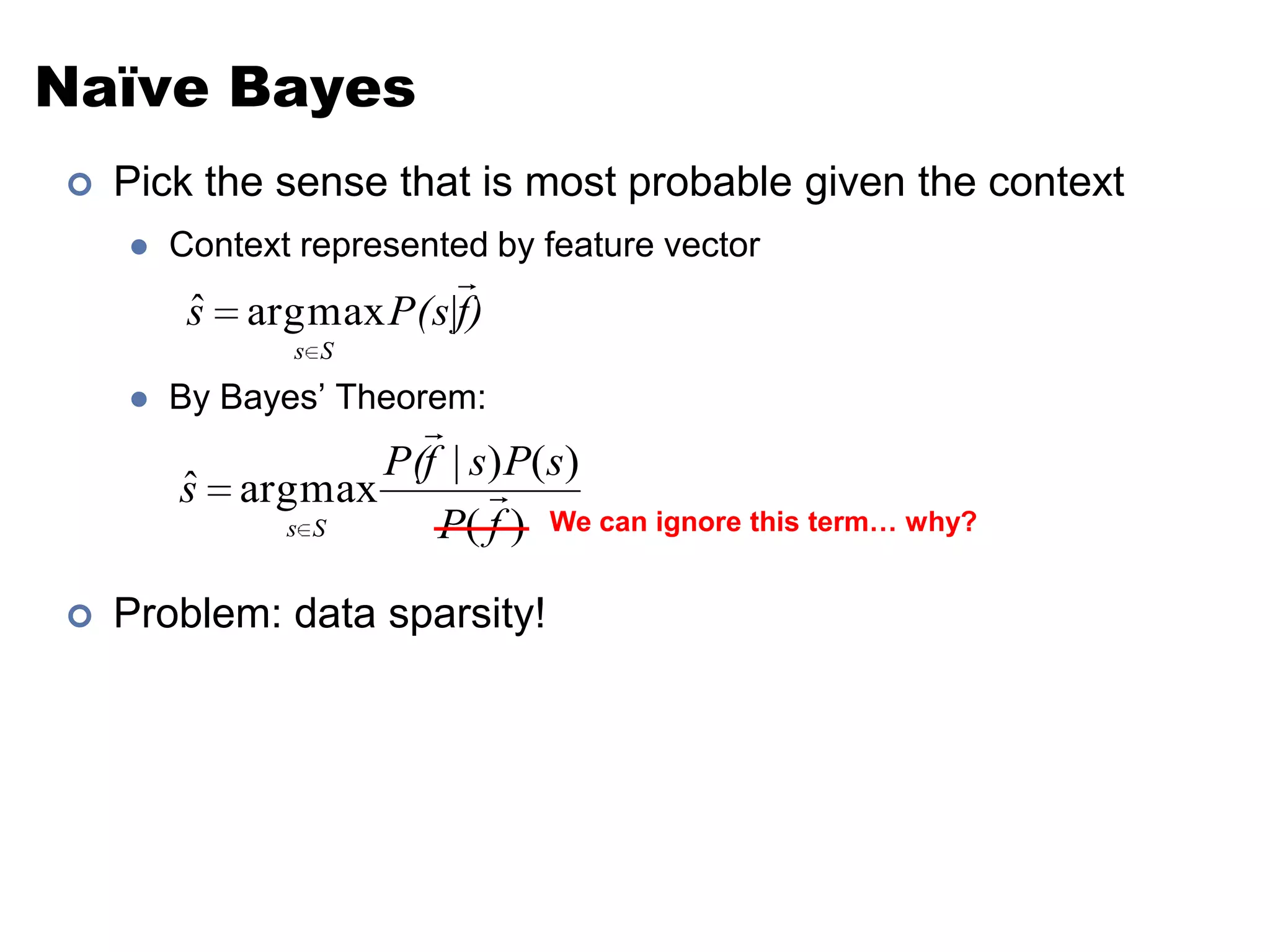
Naïve BayesPick the sense that is most probable given the contextContext represented by feature vectorBy Bayes’ Theorem:Problem: data sparsity!We can ignore this term… why?
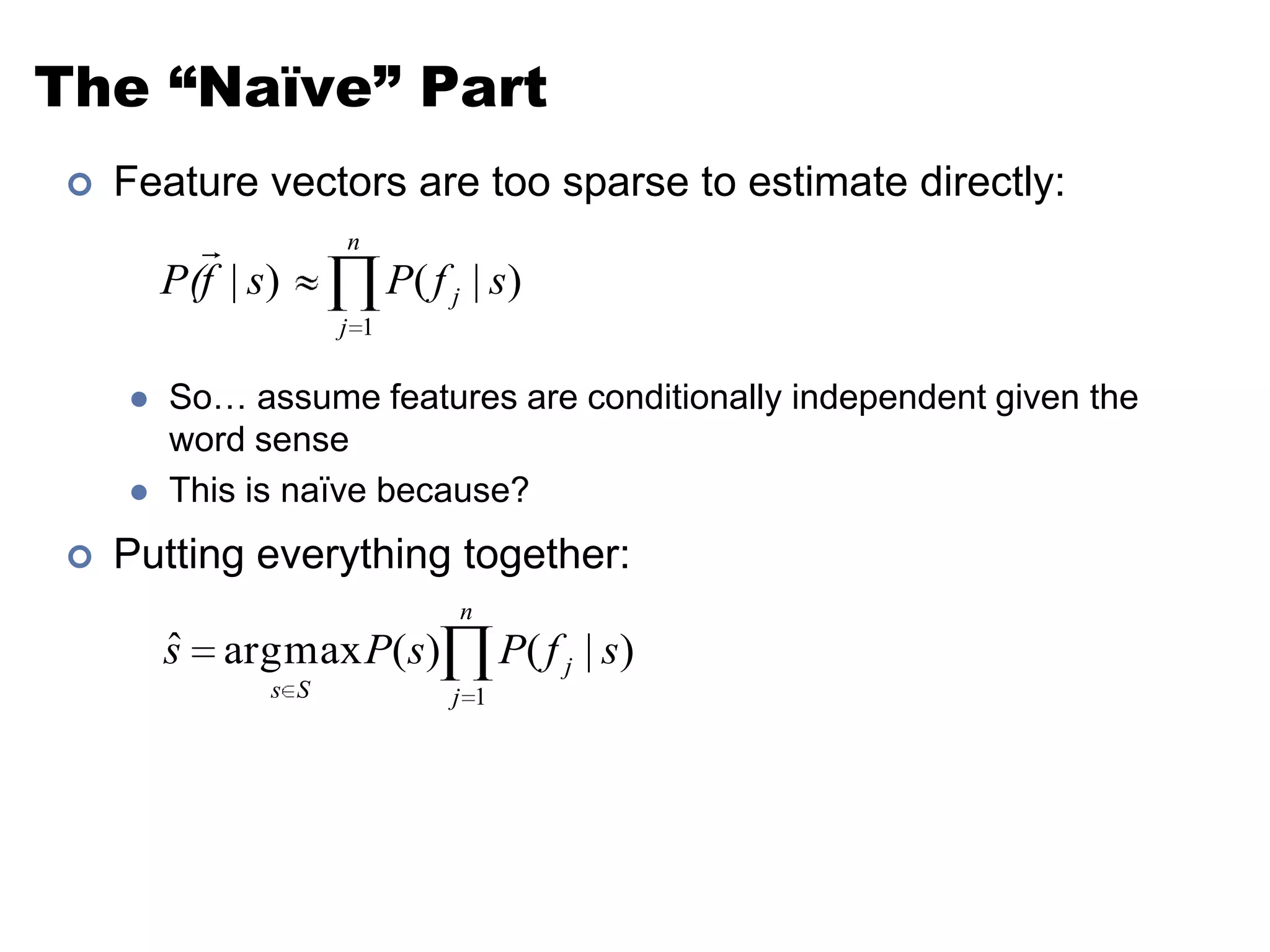
The “Naïve” PartFeature vectors are too sparse to estimate directly:So… assume features are conditionally independent given the word senseThis is naïve because?Putting everything together:
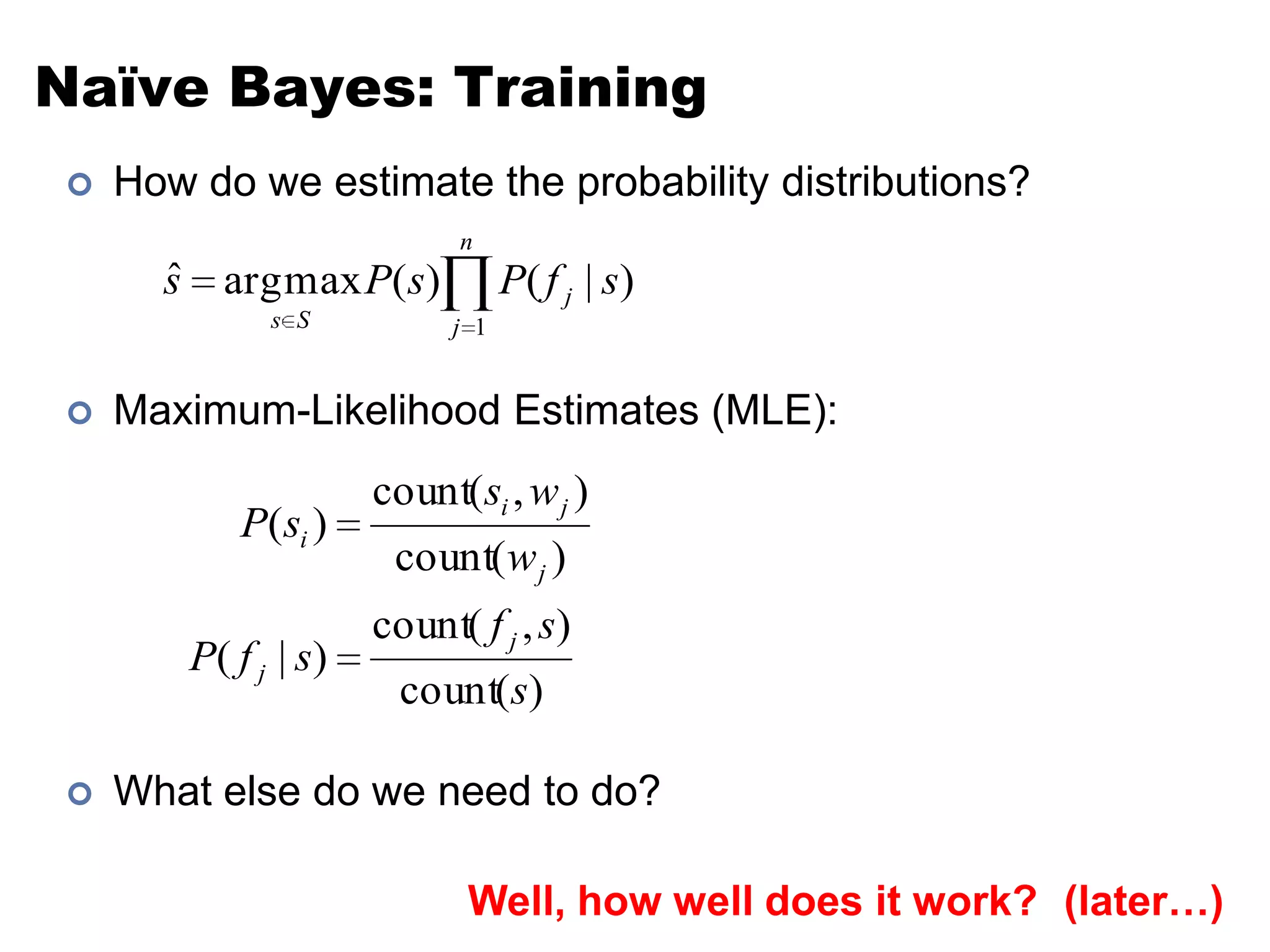
Naïve Bayes: TrainingHow do we estimate the probability distributions?Maximum-Likelihood Estimates (MLE):What else do we need to do?Well, how well does it work?(later…)
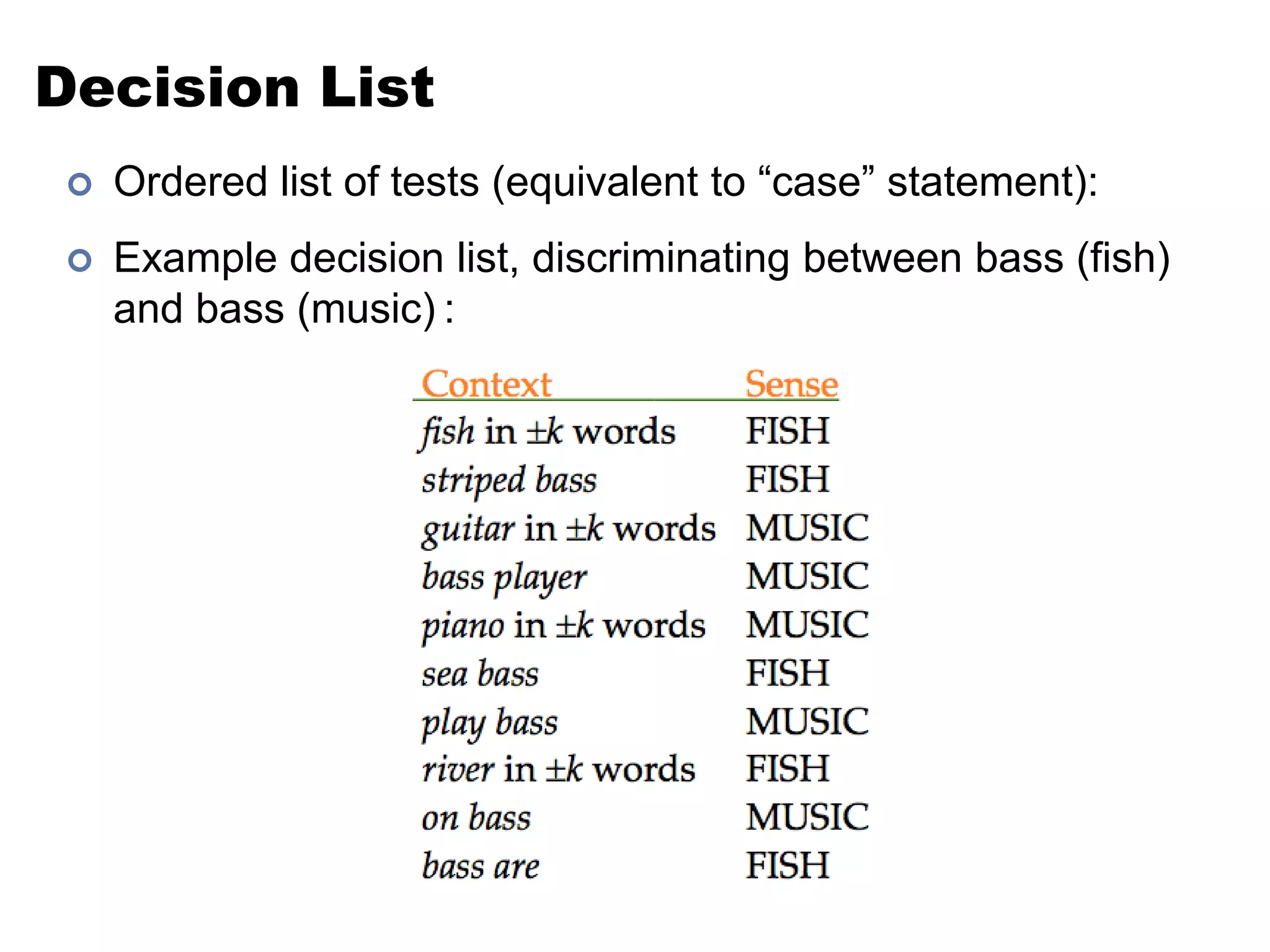
Decision ListOrdered list of tests (equivalent to “case” statement):Example decision list, discriminating between bass (fish) and bass (music):
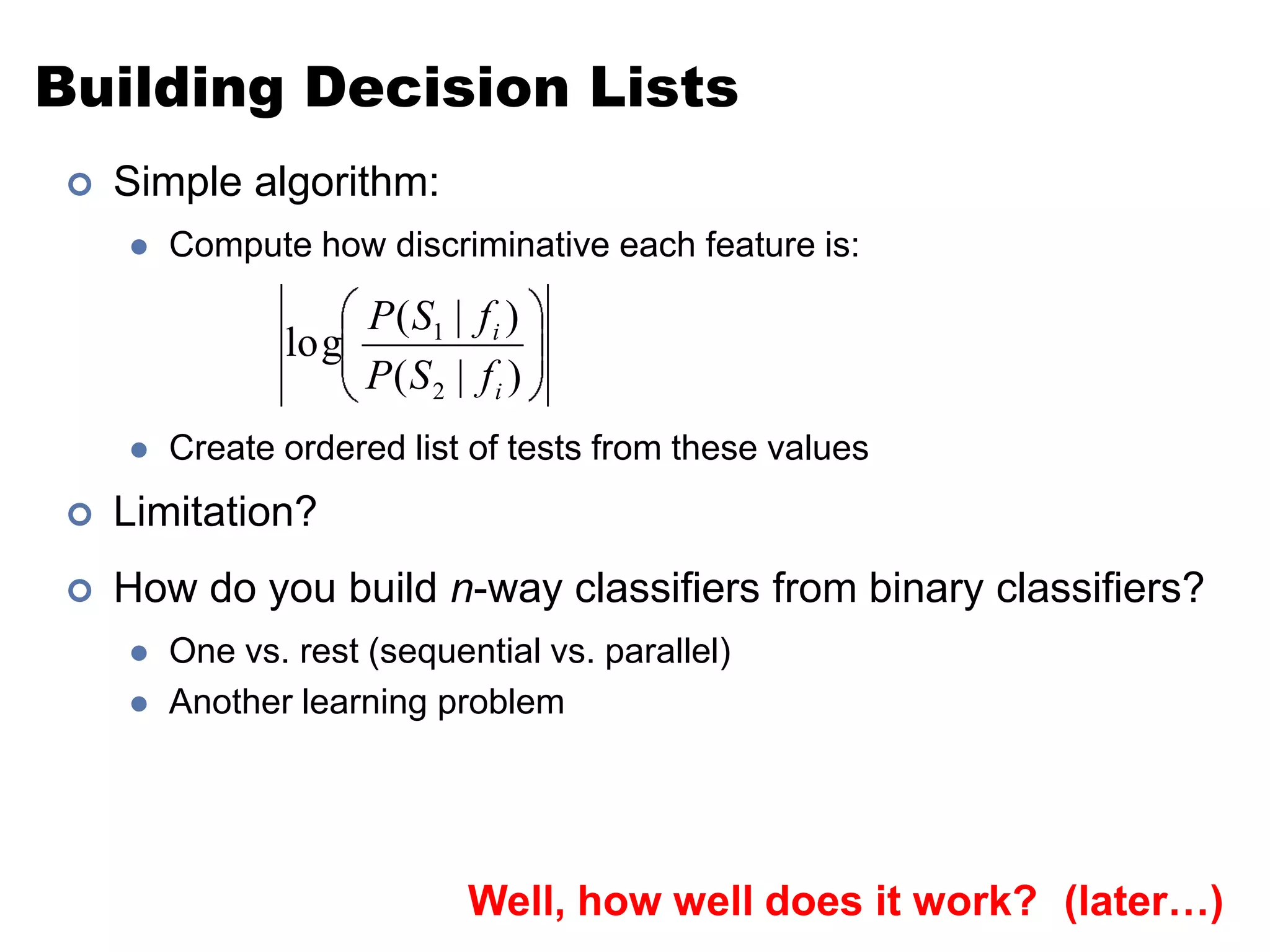
Building Decision ListsSimple algorithm:Compute how discriminative each feature is:Create ordered list of tests from these valuesLimitation?How do you build n-way classifiers from binary classifiers?One vs. rest (sequential vs. parallel)Another learning problemWell, how well does it work?(later…)
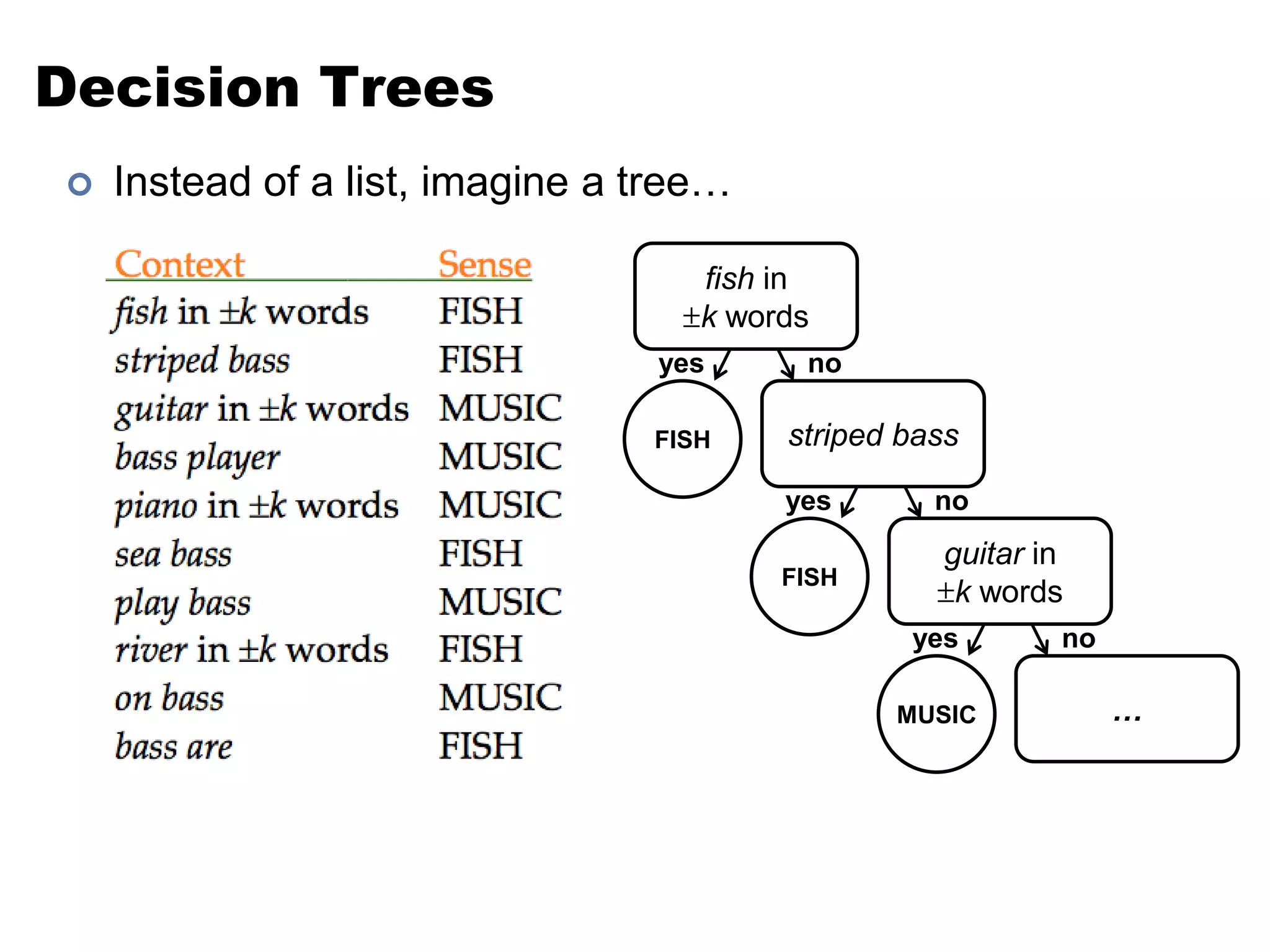
Decision TreesInstead of a list, imagine a tree…fish in k wordsnoyesstriped bassFISHnoyesguitar in k wordsFISHnoyesMUSIC…
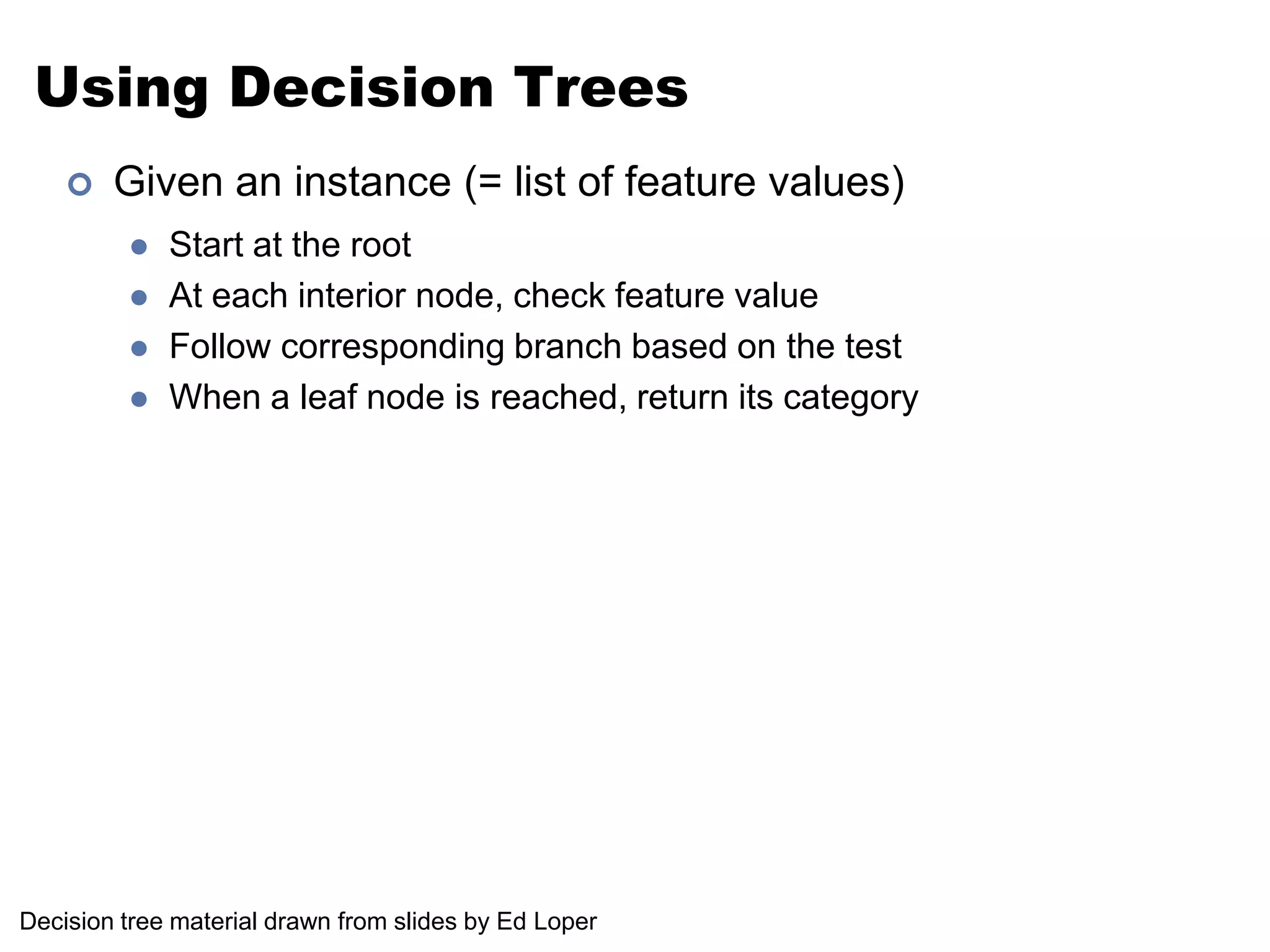
Using Decision TreesGiven an instance (= list of feature values)Start at the rootAt each interior node, check feature valueFollow corresponding branch based on the testWhen a leaf node is reached, return its categoryDecision tree material drawn from slides by Ed Loper
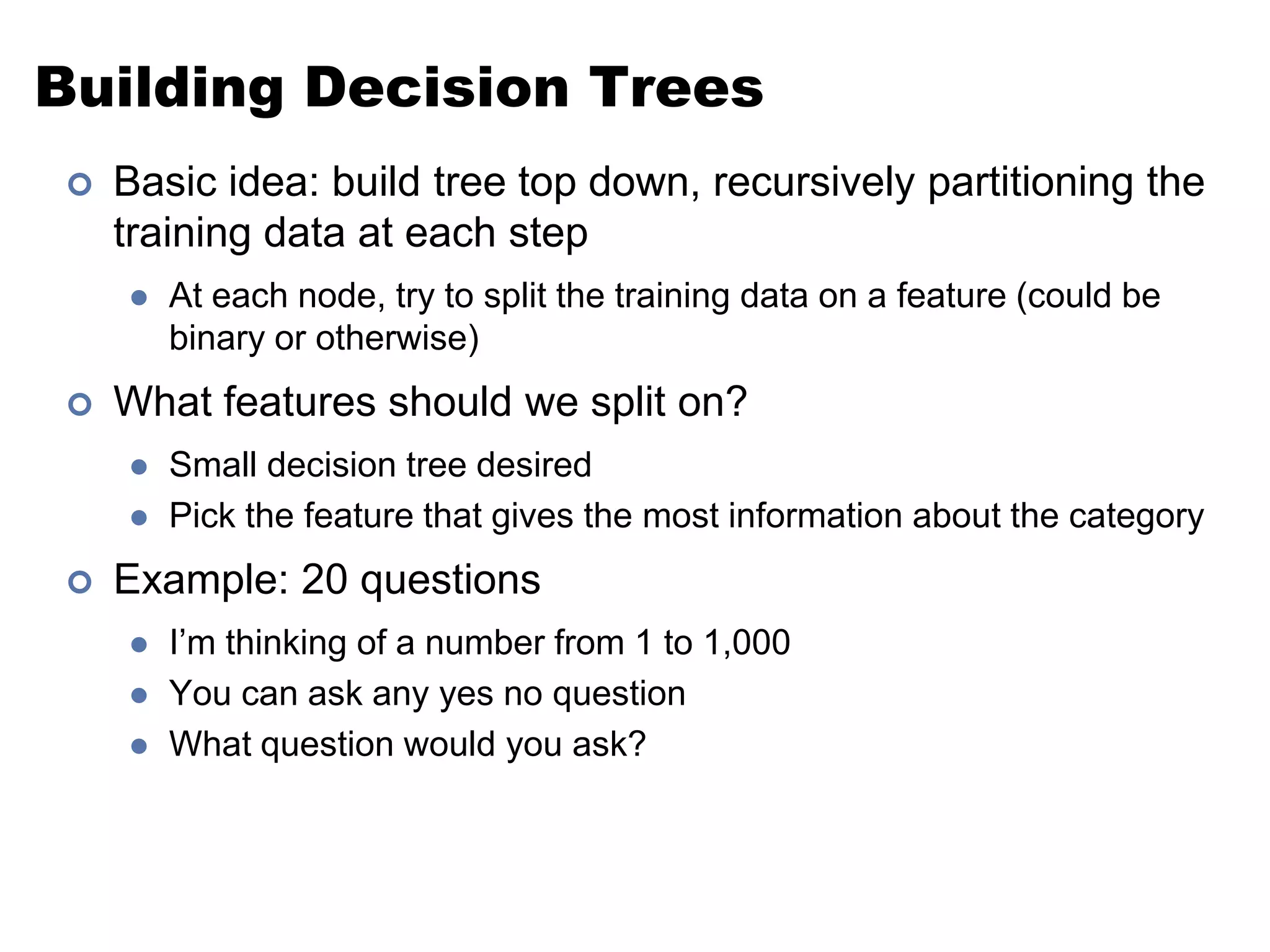
Building Decision TreesBasic idea: build tree top down, recursively partitioning the training data at each stepAt each node, try to split the training data on a feature (could be binary or otherwise)What features should we split on?Small decision tree desiredPick the feature that gives the most information about the categoryExample: 20 questionsI’m thinking of a number from 1 to 1,000You can ask any yes no questionWhat question would you ask?
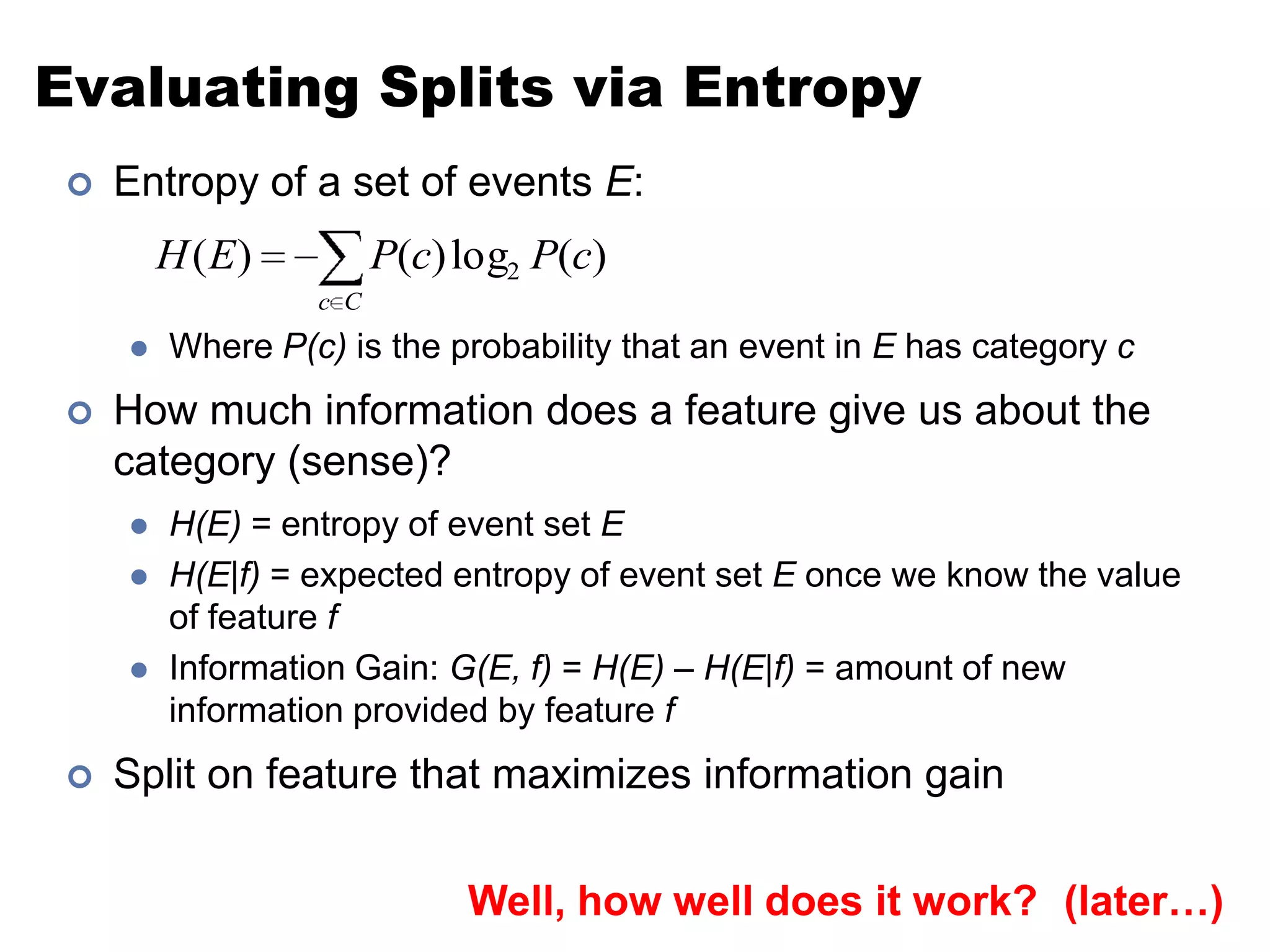
Evaluating Splits via EntropyEntropy of a set of events E:Where P(c) is the probability that an event in E has category cHow much information does a feature give us about the category (sense)?H(E) = entropy of event set EH(E|f) = expected entropy of event set E once we know the value of feature fInformation Gain: G(E, f) = H(E) – H(E|f) = amount of new information provided by feature fSplit on feature that maximizes information gainWell, how well does it work?(later…)
WSD AccuracyGenerally:Naïve Bayes provides a reasonable baseline: ~70%Decision lists and decision trees slightly lowerState of the art is slightly higherHowever:Accuracy depends on actual word, sense inventory, amount of training data, number of features, etc.Remember caveat about baseline and upper bound
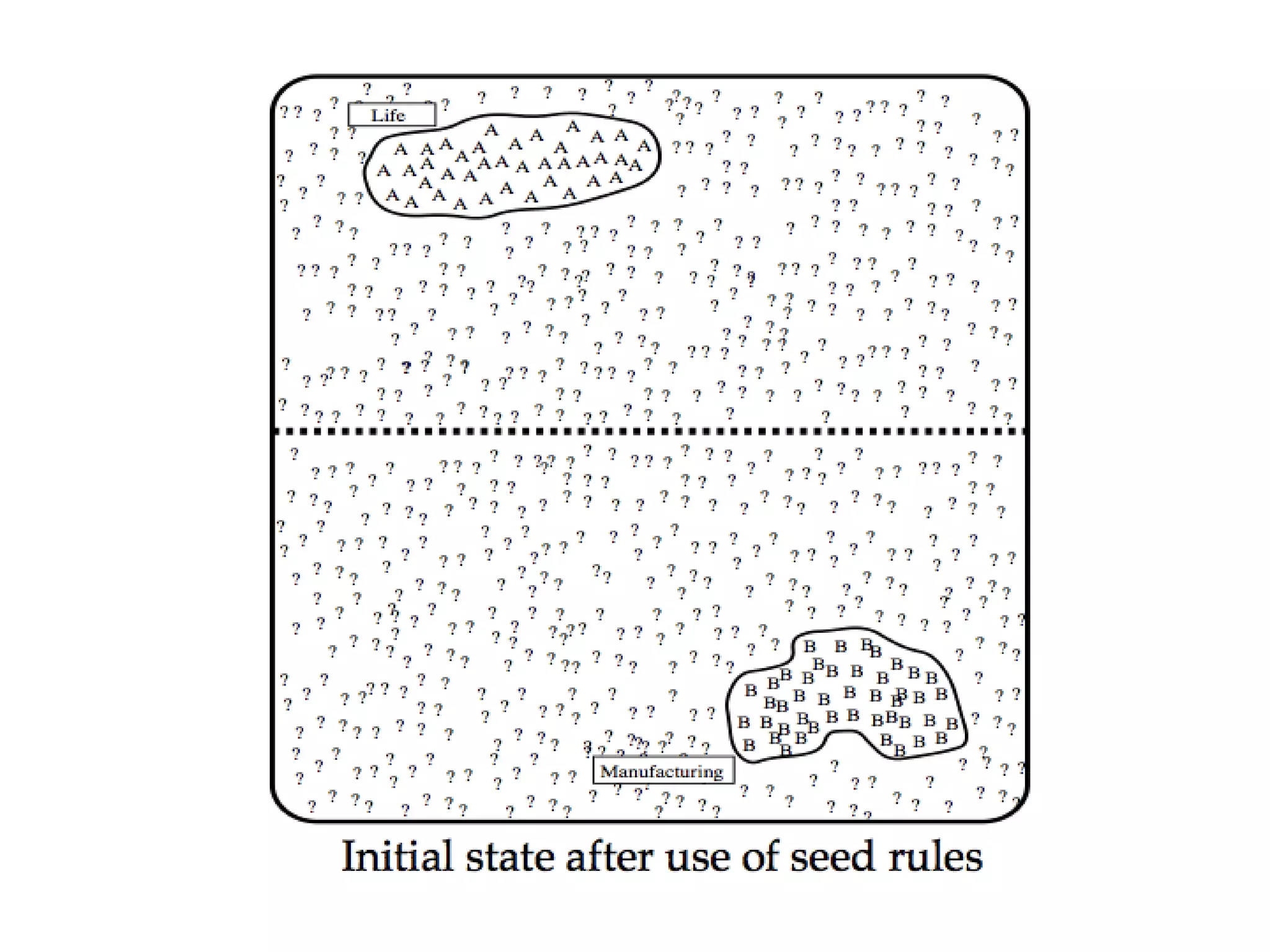
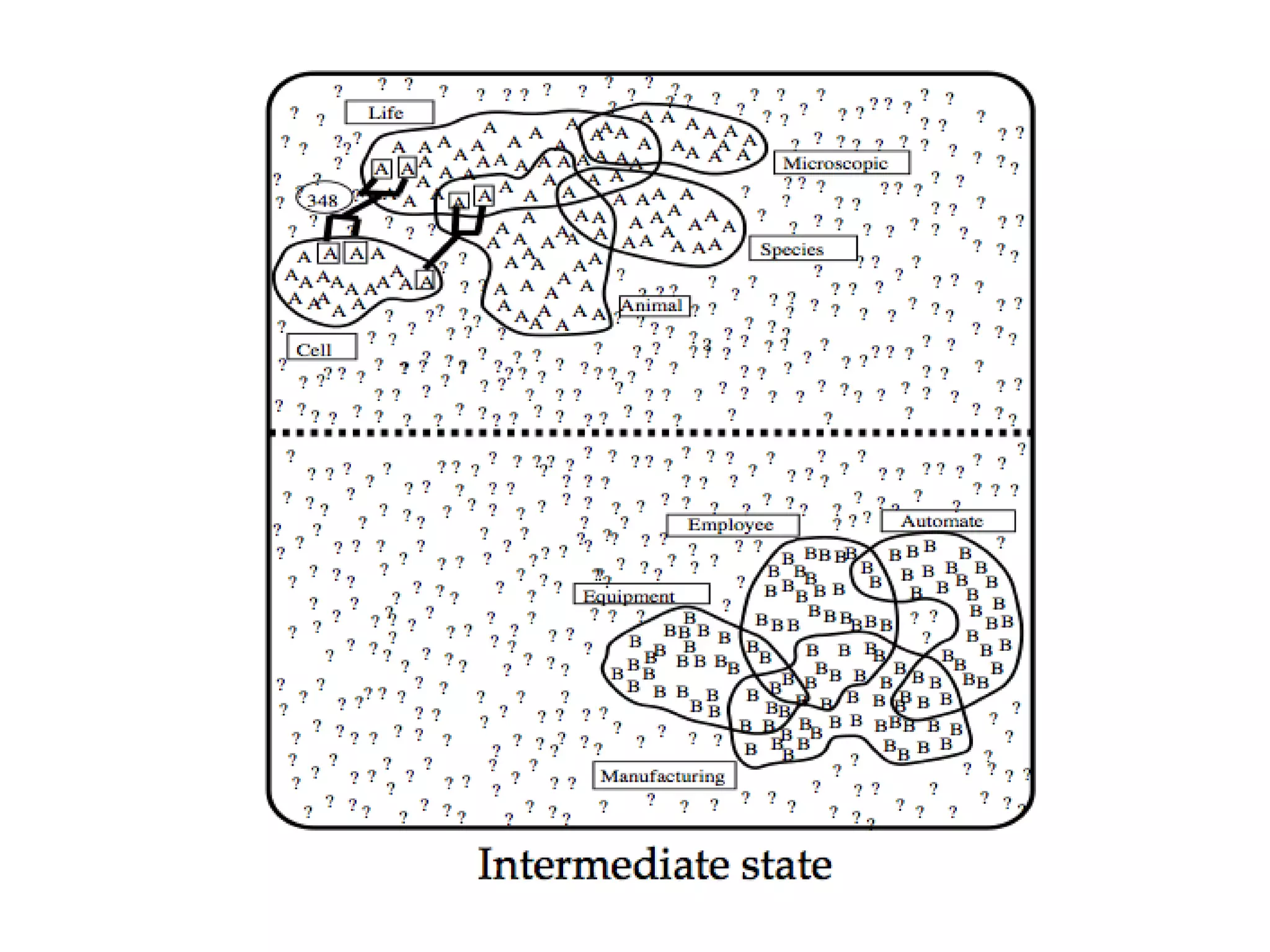
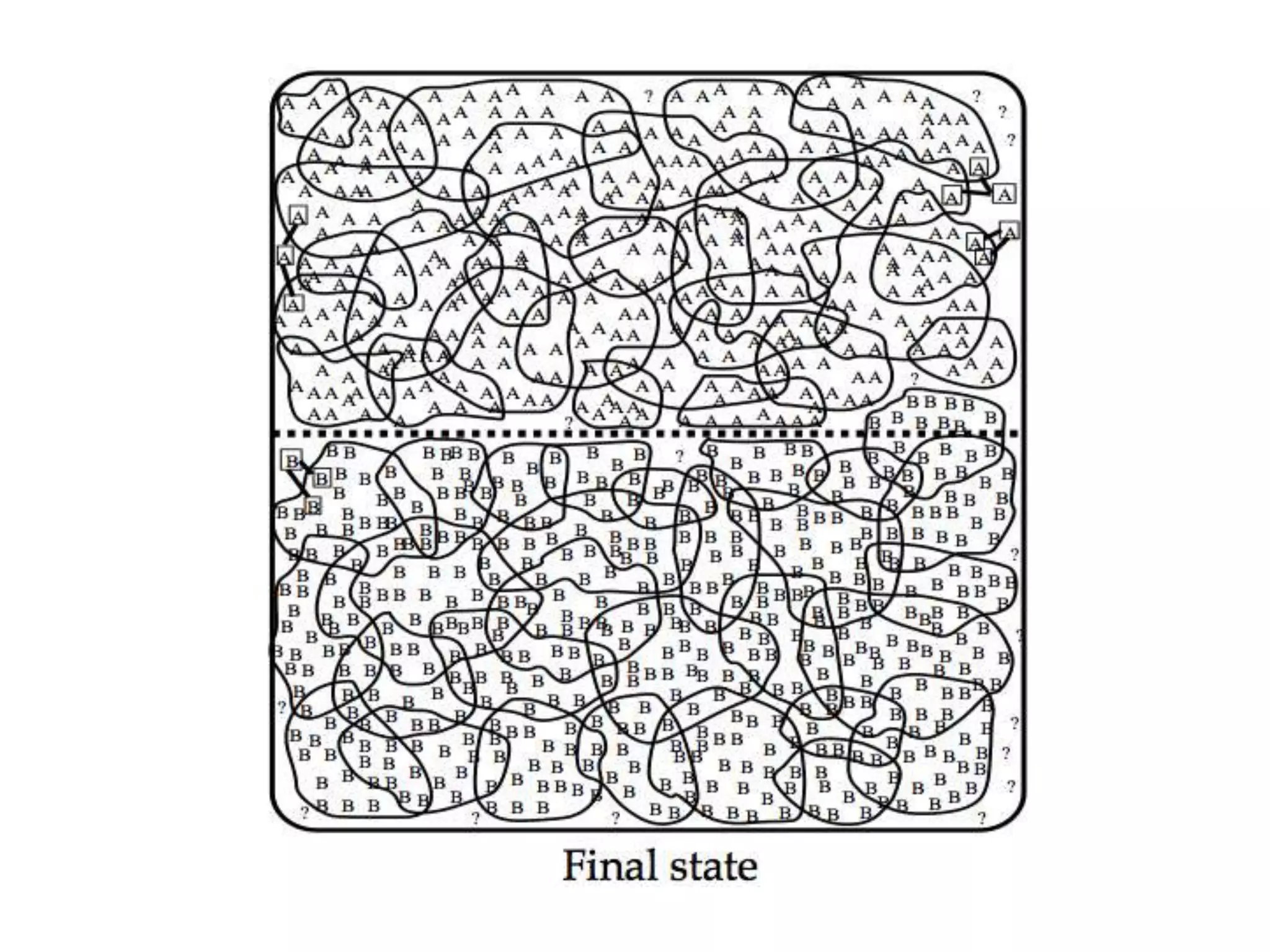
Minimally Supervised WSDBut annotations are expensive!“Bootstrapping” or co-training (Yarowsky 1995)Start with (small) seed, learn decision listUse decision list to label rest of corpusRetain “confident” labels, treat as annotated data to learn new decision listRepeat…Heuristics (derived from observation):One sense per discourseOne sense per collocation
One Sense per DiscourseA word tends to preserve its meaning across all its occurrences in a  given discourseEvaluation: 8 words with two-way ambiguity, e.g. plant, crane, etc.98% of the two-word occurrences in the same discourse carry the same meaningThe grain of salt: accuracy depends on granularityPerformance of “one sense per discourse” measured on SemCor is approximately 70%Slide by Mihalcea and Pedersen
One Sense per CollocationA word tends to preserve its meaning when used in the same collocationStrong for adjacent collocationsWeaker as the distance between words increasesEvaluation:97% precision on words with two-way ambiguityAgain, accuracy depends on granularity:70% precision on SemCor wordsSlide by Mihalcea and Pedersen
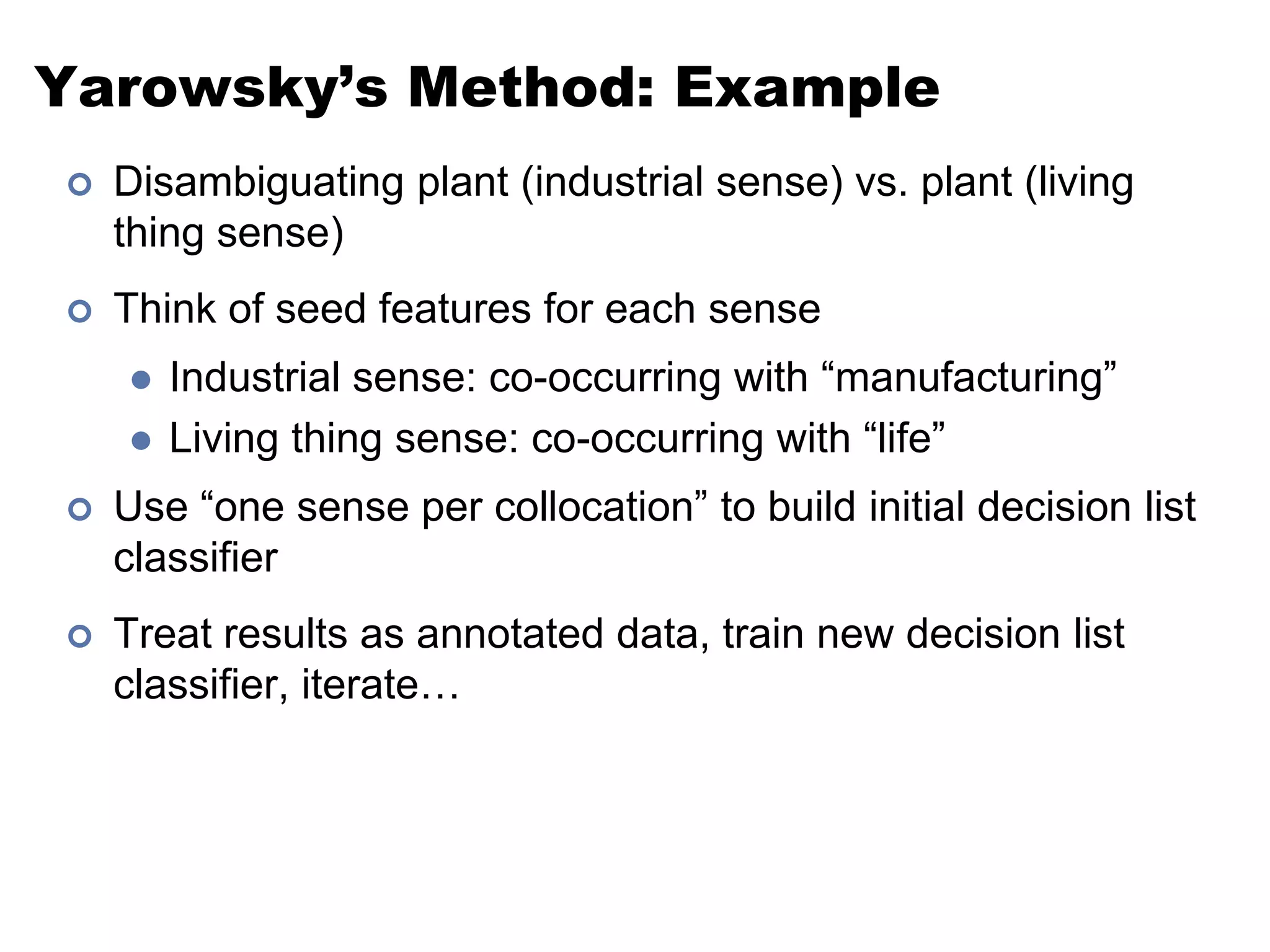
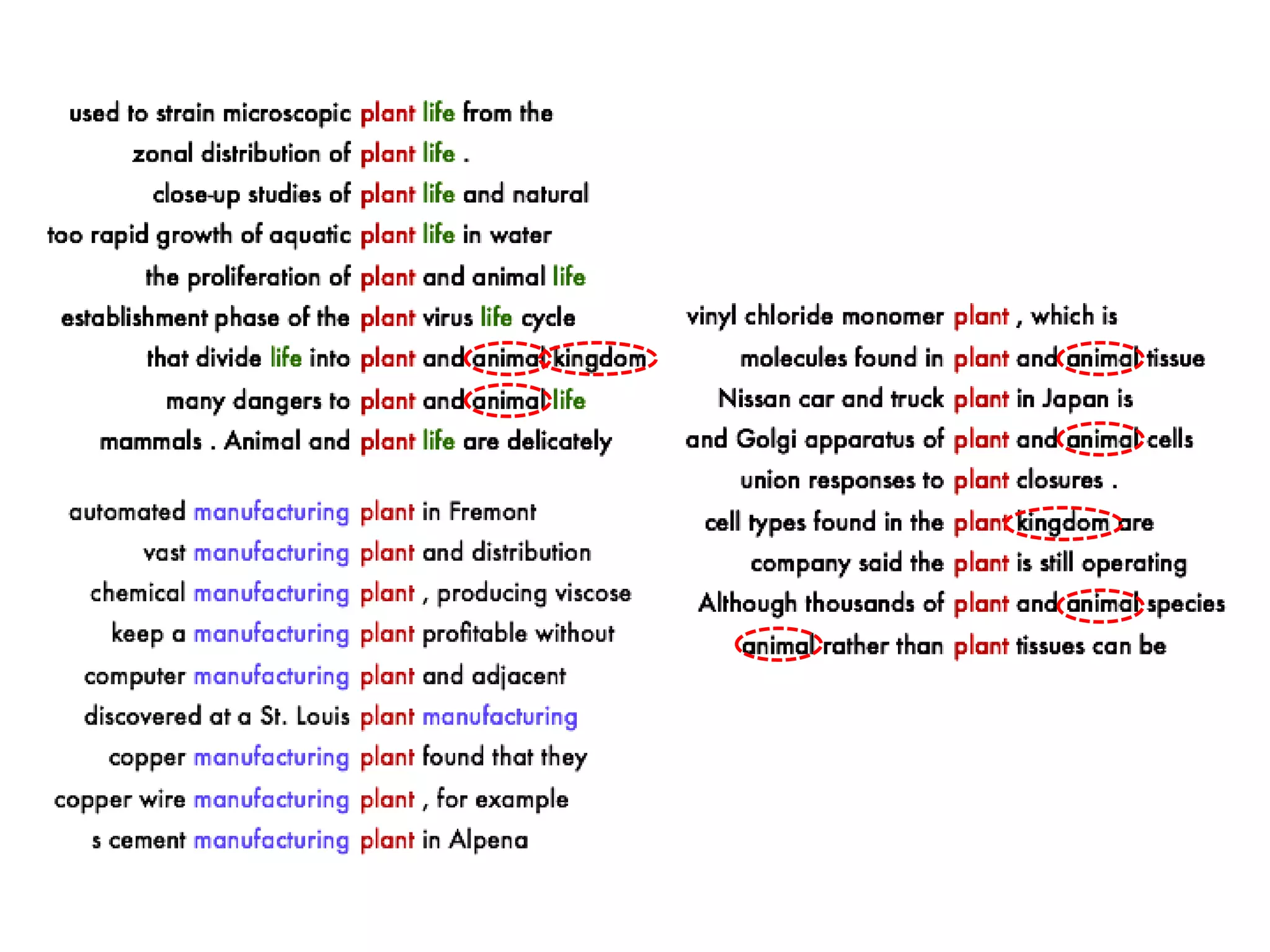
Yarowsky’s Method: ExampleDisambiguating plant (industrial sense) vs. plant (living thing sense)Think of seed features for each senseIndustrial sense: co-occurring with “manufacturing”Living thing sense: co-occurring with “life”Use “one sense per collocation” to build initial decision list classifierTreat results as annotated data, train new decision list classifier, iterate…
Yarowsky’s Method: StoppingStop when: Error on training data is less than a thresholdNo more training data is coveredUse final decision list for WSD
Yarowsky’s Method: DiscussionAdvantages: Accuracy is about as good as a supervised algorithmBootstrapping: far less manual effortDisadvantages: Seeds may be tricky to constructWorks only for coarse-grained sense distinctionsSnowballing error with co-trainingRecent extension: now apply this to the web!
WSD with Parallel TextBut annotations are expensive!What’s the “proper” sense inventory?How fine or coarse grained?Application specific?Observation: multiple senses translate to different words in other languages!A “bill” in English may be a “pico” (bird jaw) in or a “cuenta” (invoice) in SpanishUse the foreign language as the sense inventory!Added bonus: annotations for free! (Byproduct of word-alignment process in machine translation)
Beyond Lexical Semantics
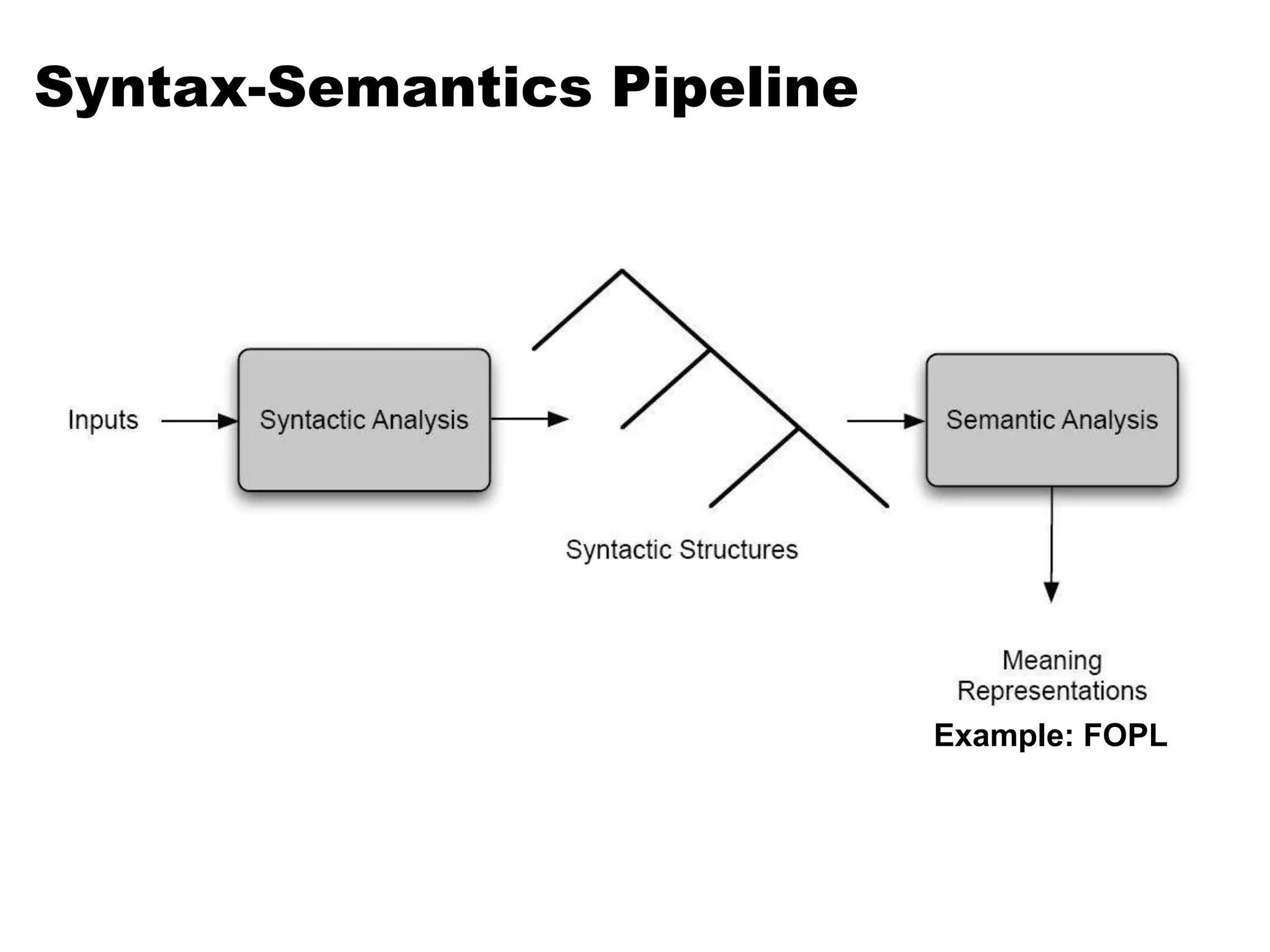
Syntax-Semantics PipelineExample: FOPL
Semantic AttachmentsBasic idea:Associate -expressions with lexical itemsAt branching node, apply semantics of one child to another (based on synctatic rule)Refresher in -calculus…
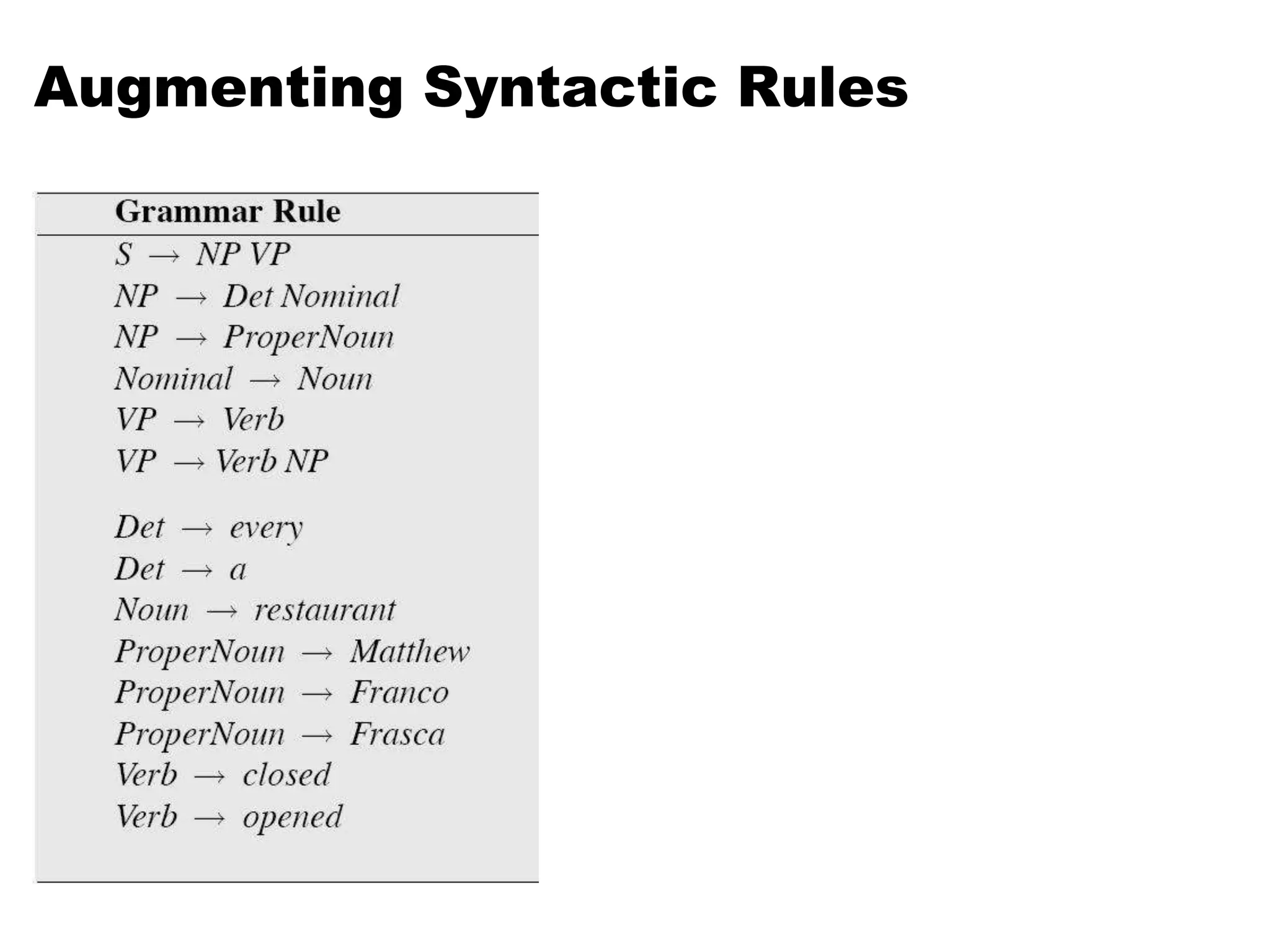
Augmenting Syntactic Rules
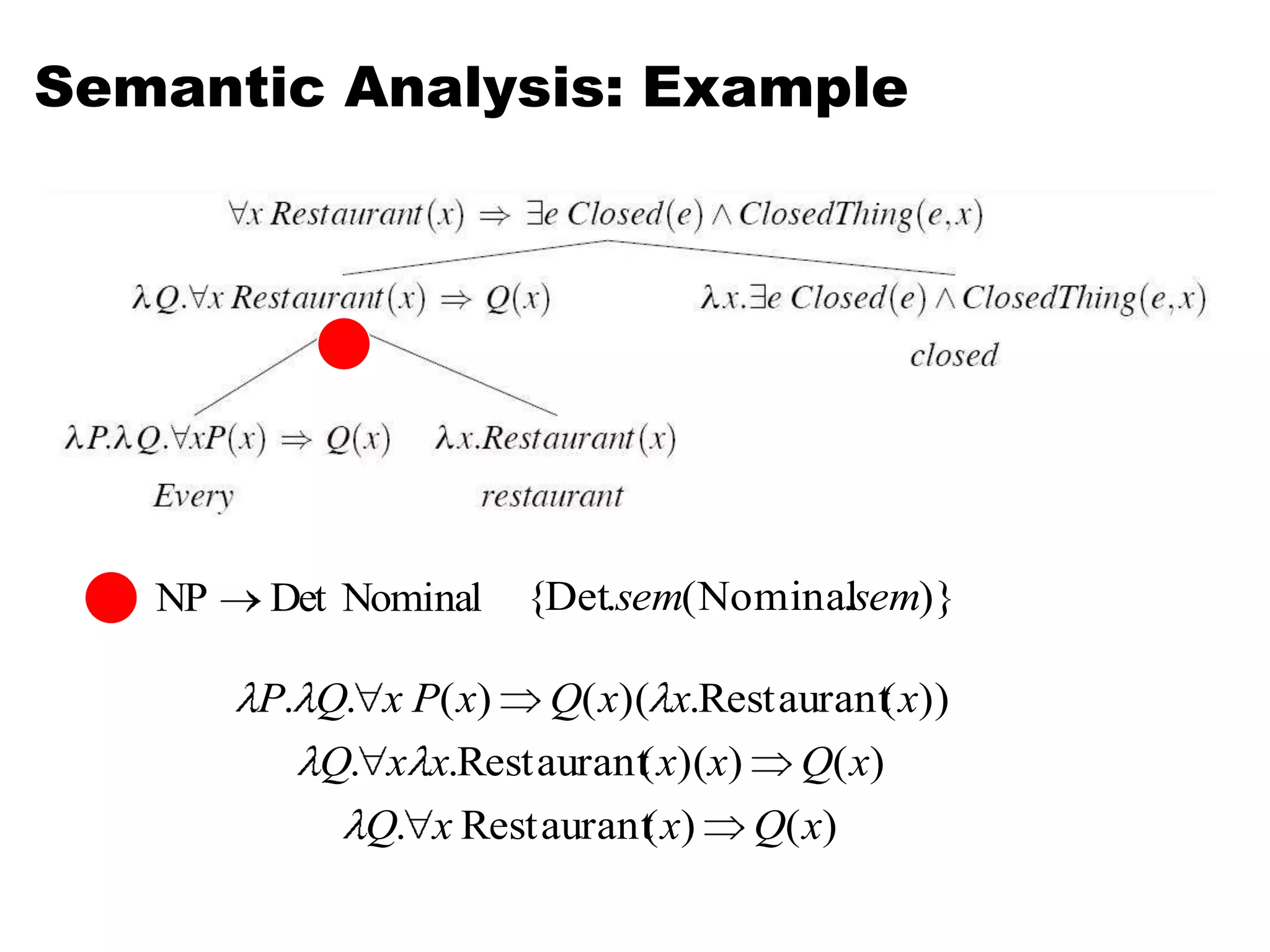
Semantic Analysis: Example
ComplexitiesOh, there are many…Classic problem: quantifier scopingEvery restaurant has a menuIssues with this style of semantic analysis?
Semantics in NLP TodayCan be characterized as “shallow semantics”Verbs denote eventsRepresent as “frames”Nouns (in general) participate in eventsTypes of event participants = “slots” or “roles”Event participants themselves = “slot fillers”Depending on the linguistic theory, roles may have special names: agent, theme, etc.Semantic analysis: semantic role labelingAutomatically identify the event type (i.e., frame)Automatically identify event participants and the role that each plays (i.e., label the semantic role)
What works in NLP?POS-annotated corporaTree-annotated corpora: Penn TreebankRole-annotated corpora: Proposition Bank (PropBank)
PropBank: Two Examplesagree.01Arg0: AgreerArg1: PropositionArg2: Other entity agreeingExample: [Arg0 John] agrees [Arg2 with Mary] [Arg1 on everything]fall.01Arg1: Logical subject, patient, thing fallingArg2: Extent, amount fallenArg3: Start pointArg4: End pointExample: [Arg1 Sales] fell [Arg4 to $251.2 million] [Arg3 from $278.7 million]
How do we do it?Short answer: supervised machine learningOne approach: classification of each tree constituentFeatures can be words, phrase type, linear position, tree position, etc.Apply standard machine learning algorithms
Recap of Today’s TopicsWord sense disambiguationBeyond lexical semanticsSemantic attachments to syntaxShallow semantics: PropBank
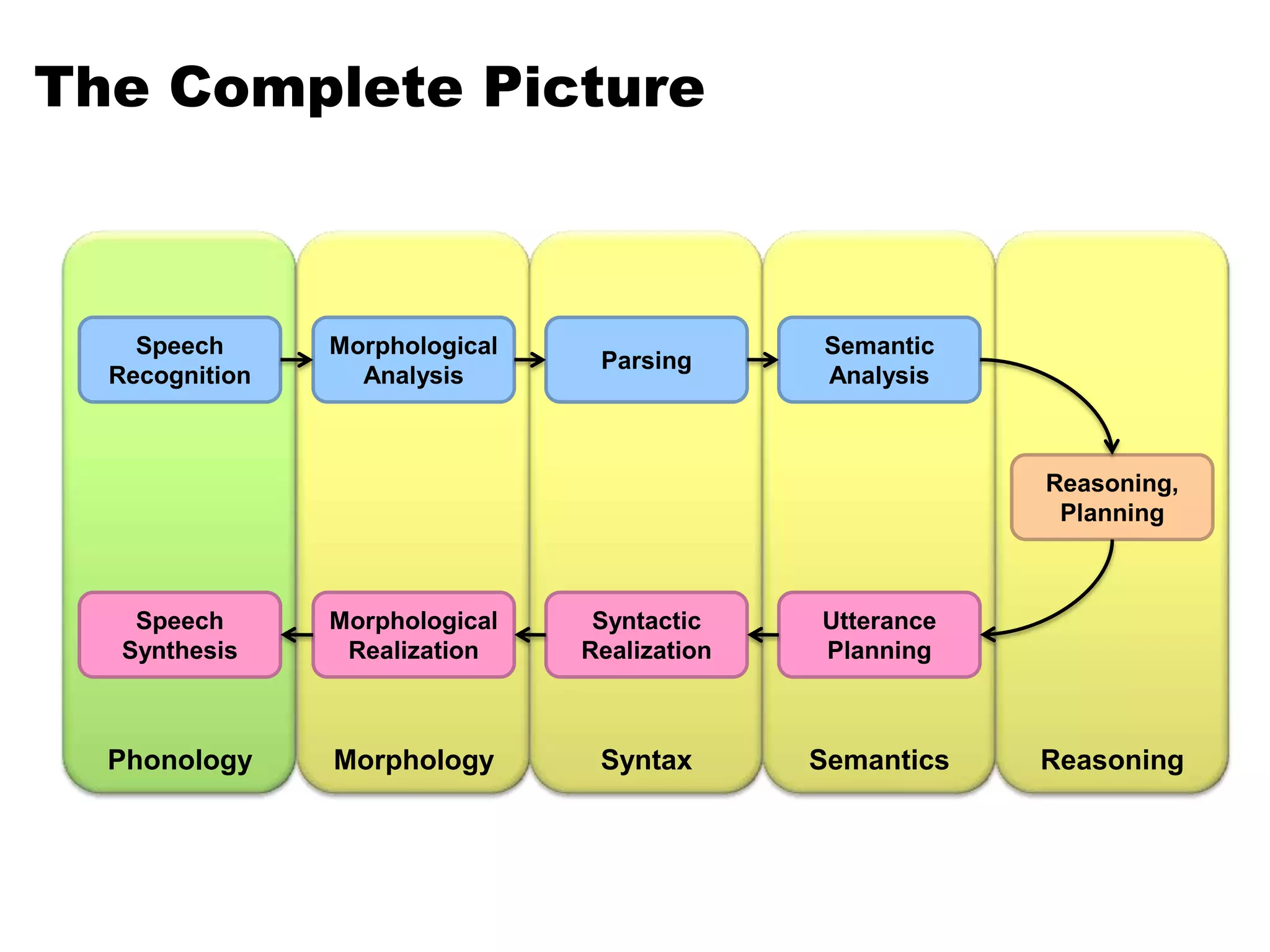
The Complete PicturePhonologyMorphologySyntaxSemanticsReasoningSpeech RecognitionMorphological AnalysisParsingSemantic AnalysisReasoning, PlanningSpeech SynthesisMorphological RealizationSyntactic RealizationUtterance Planning
The Home StretchNext week: MapReduce and large-data processingNo classes Thanksgiving week!December: two guest lectures by Ken Church

CMSC 723: Computational Linguistics I

  • 1.
    Word Sense DisambiguationCMSC723: Computational Linguistics I ― Session #11Jimmy LinThe iSchoolUniversity of MarylandWednesday, November 11, 2009Material drawn from slides by Saif Mohammad and Bonnie Dorr
  • 2.
    Progression of theCourseWordsFinite-state morphologyPart-of-speech tagging (TBL + HMM)StructureCFGs + parsing (CKY, Earley)N-gram language modelsMeaning!
  • 3.
    Today’s AgendaWord sensedisambiguationBeyond lexical semanticsSemantic attachments to syntaxShallow semantics: PropBank
  • 4.
  • 5.
    Recap: Word SenseFromWordNet:Noun{pipe, tobacco pipe} (a tube with a small bowl at one end; used for smoking tobacco) {pipe, pipage, piping} (a long tube made of metal or plastic that is used to carry water or oil or gas etc.) {pipe, tube} (a hollow cylindrical shape) {pipe} (a tubular wind instrument) {organ pipe, pipe, pipework} (the flues and stops on a pipe organ) Verb{shriek, shrill, pipe up, pipe} (utter a shrill cry) {pipe} (transport by pipeline) “pipe oil, water, and gas into the desert”{pipe} (play on a pipe) “pipe a tune”{pipe} (trim with piping) “pipe the skirt”
  • 6.
    Word Sense DisambiguationTask:automatically select the correct sense of a wordLexical sampleAll-wordsTheoretically useful for many applications:Semantic similarity (remember from last time?)Information retrievalMachine translation…Solution in search of a problem? Why?
  • 7.
    How big isthe problem?Most words in English have only one sense62% in Longman’s Dictionary of Contemporary English79% in WordNetBut the others tend to have several sensesAverage of 3.83 in LDOCEAverage of 2.96 in WordNetAmbiguous words are more frequently usedIn the British National Corpus, 84% of instances have more than one senseSome senses are more frequent than others
  • 8.
    Ground TruthWhich senseinventory do we use?Issues there?Application specificity?
  • 9.
    CorporaLexical sampleline-hard-serve corpus(4k sense-tagged examples)interest corpus (2,369 sense-tagged examples)… All-wordsSemCor (234k words, subset of Brown Corpus)Senseval-3 (2081 tagged content words from 5k total words)…Observations about the size?
  • 10.
    EvaluationIntrinsicMeasure accuracy ofsense selection wrt ground truthExtrinsicIntegrate WSD as part of a bigger end-to-end system, e.g., machine translation or information retrievalCompare WSD
  • 11.
    Baseline + UpperBoundBaseline: most frequent senseEquivalent to “take first sense” in WordNetDoes surprisingly well!Upper bound:Fine-grained WordNet sense: 75-80% human agreementCoarser-grained inventories: 90% human agreement possibleWhat does this mean?62% accuracy in this case!
  • 12.
    WSD ApproachesDepending onuse of manually created knowledge sourcesKnowledge-leanKnowledge-richDepending on use of labeled dataSupervisedSemi- or minimally supervisedUnsupervised
  • 13.
    Lesk’s AlgorithmIntuition: noteword overlap between context and dictionary entriesUnsupervised, but knowledge richThe bank can guarantee deposits will eventually cover future tuition costs because it invests in adjustable-rate mortgage securities. WordNet
  • 14.
    Lesk’s AlgorithmSimplest implementation:Countoverlapping content words between glosses and contextLots of variants:Include the examples in dictionary definitionsInclude hypernyms and hyponymsGive more weight to larger overlaps (e.g., bigrams)Give extra weight to infrequent words (e.g., idf weighting)…Works reasonably well!
  • 15.
    Supervised WSD: NLPmeets MLWSD as a supervised classification taskTrain a separate classifier for each wordThree components of a machine learning problem:Training data (corpora)Representations (features)Learning method (algorithm, model)
  • 16.
    Supervised ClassificationTrainingTestingtraining dataunlabeleddocument?label1label2label3label4Representation Functionlabel1?label2?Classifiersupervised machine learning algorithmlabel3?label4?
  • 17.
    Three Laws ofMachine LearningThou shalt not mingle training data with test dataThou shalt not mingle training data with test dataThou shalt not mingle training data with test dataBut what do you do if you need more test data?
  • 18.
    FeaturesPossible featuresPOS andsurface form of the word itselfSurrounding words and POS tagPositional information of surrounding words and POS tagsSame as above, but with n-gramsGrammatical information…Richness of the features?Richer features = ML algorithm does less of the workMore impoverished features = ML algorithm does more of the work
  • 19.
    ClassifiersOnce we castthe WSD problem as supervised classification, many learning techniques are possible:Naïve Bayes (the thing to try first)Decision listsDecision treesMaxEntSupport vector machinesNearest neighbor methods…
  • 20.
    Classifiers TradeoffsWhich classifiershould I use?It depends:Number of featuresTypes of featuresNumber of possible values for a featureNoise…General advice:Start with Naïve BayesUse decision trees/lists if you want to understand what the classifier is doingSVMs often give state of the art performanceMaxEnt methods also work well
  • 21.
    Naïve BayesPick thesense that is most probable given the contextContext represented by feature vectorBy Bayes’ Theorem:Problem: data sparsity!We can ignore this term… why?
  • 22.
    The “Naïve” PartFeaturevectors are too sparse to estimate directly:So… assume features are conditionally independent given the word senseThis is naïve because?Putting everything together:
  • 23.
    Naïve Bayes: TrainingHowdo we estimate the probability distributions?Maximum-Likelihood Estimates (MLE):What else do we need to do?Well, how well does it work?(later…)
  • 24.
    Decision ListOrdered listof tests (equivalent to “case” statement):Example decision list, discriminating between bass (fish) and bass (music):
  • 25.
    Building Decision ListsSimplealgorithm:Compute how discriminative each feature is:Create ordered list of tests from these valuesLimitation?How do you build n-way classifiers from binary classifiers?One vs. rest (sequential vs. parallel)Another learning problemWell, how well does it work?(later…)
  • 26.
    Decision TreesInstead ofa list, imagine a tree…fish in k wordsnoyesstriped bassFISHnoyesguitar in k wordsFISHnoyesMUSIC…
  • 27.
    Using Decision TreesGivenan instance (= list of feature values)Start at the rootAt each interior node, check feature valueFollow corresponding branch based on the testWhen a leaf node is reached, return its categoryDecision tree material drawn from slides by Ed Loper
  • 28.
    Building Decision TreesBasicidea: build tree top down, recursively partitioning the training data at each stepAt each node, try to split the training data on a feature (could be binary or otherwise)What features should we split on?Small decision tree desiredPick the feature that gives the most information about the categoryExample: 20 questionsI’m thinking of a number from 1 to 1,000You can ask any yes no questionWhat question would you ask?
  • 29.
    Evaluating Splits viaEntropyEntropy of a set of events E:Where P(c) is the probability that an event in E has category cHow much information does a feature give us about the category (sense)?H(E) = entropy of event set EH(E|f) = expected entropy of event set E once we know the value of feature fInformation Gain: G(E, f) = H(E) – H(E|f) = amount of new information provided by feature fSplit on feature that maximizes information gainWell, how well does it work?(later…)
  • 30.
    WSD AccuracyGenerally:Naïve Bayesprovides a reasonable baseline: ~70%Decision lists and decision trees slightly lowerState of the art is slightly higherHowever:Accuracy depends on actual word, sense inventory, amount of training data, number of features, etc.Remember caveat about baseline and upper bound
  • 31.
    Minimally Supervised WSDButannotations are expensive!“Bootstrapping” or co-training (Yarowsky 1995)Start with (small) seed, learn decision listUse decision list to label rest of corpusRetain “confident” labels, treat as annotated data to learn new decision listRepeat…Heuristics (derived from observation):One sense per discourseOne sense per collocation
  • 32.
    One Sense perDiscourseA word tends to preserve its meaning across all its occurrences in a given discourseEvaluation: 8 words with two-way ambiguity, e.g. plant, crane, etc.98% of the two-word occurrences in the same discourse carry the same meaningThe grain of salt: accuracy depends on granularityPerformance of “one sense per discourse” measured on SemCor is approximately 70%Slide by Mihalcea and Pedersen
  • 33.
    One Sense perCollocationA word tends to preserve its meaning when used in the same collocationStrong for adjacent collocationsWeaker as the distance between words increasesEvaluation:97% precision on words with two-way ambiguityAgain, accuracy depends on granularity:70% precision on SemCor wordsSlide by Mihalcea and Pedersen
  • 34.
    Yarowsky’s Method: ExampleDisambiguatingplant (industrial sense) vs. plant (living thing sense)Think of seed features for each senseIndustrial sense: co-occurring with “manufacturing”Living thing sense: co-occurring with “life”Use “one sense per collocation” to build initial decision list classifierTreat results as annotated data, train new decision list classifier, iterate…
  • 39.
    Yarowsky’s Method: StoppingStopwhen: Error on training data is less than a thresholdNo more training data is coveredUse final decision list for WSD
  • 40.
    Yarowsky’s Method: DiscussionAdvantages:Accuracy is about as good as a supervised algorithmBootstrapping: far less manual effortDisadvantages: Seeds may be tricky to constructWorks only for coarse-grained sense distinctionsSnowballing error with co-trainingRecent extension: now apply this to the web!
  • 41.
    WSD with ParallelTextBut annotations are expensive!What’s the “proper” sense inventory?How fine or coarse grained?Application specific?Observation: multiple senses translate to different words in other languages!A “bill” in English may be a “pico” (bird jaw) in or a “cuenta” (invoice) in SpanishUse the foreign language as the sense inventory!Added bonus: annotations for free! (Byproduct of word-alignment process in machine translation)
  • 42.
  • 43.
  • 44.
    Semantic AttachmentsBasic idea:Associate-expressions with lexical itemsAt branching node, apply semantics of one child to another (based on synctatic rule)Refresher in -calculus…
  • 45.
  • 46.
  • 47.
    ComplexitiesOh, there aremany…Classic problem: quantifier scopingEvery restaurant has a menuIssues with this style of semantic analysis?
  • 48.
    Semantics in NLPTodayCan be characterized as “shallow semantics”Verbs denote eventsRepresent as “frames”Nouns (in general) participate in eventsTypes of event participants = “slots” or “roles”Event participants themselves = “slot fillers”Depending on the linguistic theory, roles may have special names: agent, theme, etc.Semantic analysis: semantic role labelingAutomatically identify the event type (i.e., frame)Automatically identify event participants and the role that each plays (i.e., label the semantic role)
  • 49.
    What works inNLP?POS-annotated corporaTree-annotated corpora: Penn TreebankRole-annotated corpora: Proposition Bank (PropBank)
  • 50.
    PropBank: Two Examplesagree.01Arg0:AgreerArg1: PropositionArg2: Other entity agreeingExample: [Arg0 John] agrees [Arg2 with Mary] [Arg1 on everything]fall.01Arg1: Logical subject, patient, thing fallingArg2: Extent, amount fallenArg3: Start pointArg4: End pointExample: [Arg1 Sales] fell [Arg4 to $251.2 million] [Arg3 from $278.7 million]
  • 51.
    How do wedo it?Short answer: supervised machine learningOne approach: classification of each tree constituentFeatures can be words, phrase type, linear position, tree position, etc.Apply standard machine learning algorithms
  • 52.
    Recap of Today’sTopicsWord sense disambiguationBeyond lexical semanticsSemantic attachments to syntaxShallow semantics: PropBank
  • 53.
    The Complete PicturePhonologyMorphologySyntaxSemanticsReasoningSpeechRecognitionMorphological AnalysisParsingSemantic AnalysisReasoning, PlanningSpeech SynthesisMorphological RealizationSyntactic RealizationUtterance Planning
  • 54.
    The Home StretchNextweek: MapReduce and large-data processingNo classes Thanksgiving week!December: two guest lectures by Ken Church