Lexical Semantics & Word Sense Disambiguation CMSC 35100 Natural Language Processing May 15, 2003
Roadmap Lexical Semantics Emergent Meaning Thematic roles, Frames, & Primitives Word Sense Disambiguation Selectional Restriction-based  approaches Limitations Robust Approaches Supervised Learning Approaches Naïve Bayes Bootstrapping Approaches One sense per discourse/collocation Unsupervised Approaches Schutze’s word space Resource-based Approaches Dictionary parsing, WordNet Distance Why they work Why they don’t
Word-internal Structure Thematic roles: Characterize verbs by their arguments E.g. transport: agent, theme, source, destination They transported grain from the fields to the silo. Deep structure: passive / active: same roles Thematic hierarchy  E.g. agent > theme > source, dest Provide default surface positions Tie to semantics (e.g. Levin): Interlinguas Cluster verb meanings by set of syntactic alternations Limitations: only NP,PP: other arguments predicates less
Selectional Restrictions Semantic constraints on filling of roles E.g. Bill ate chicken Eat: Agent: animate; Theme: Edible Associate with sense  Most commonly of verb/event; possibly adj, noun… Specifying constraints: Add a term to semantics, e.g. Isa(x,Ediblething) Tie to position in WordNet All hyponyms inherit
Primitive Decompositions Jackendoff(1990), Dorr(1999), McCawley (1968) Word meaning constructed from primitives Fixed small set of basic primitives E.g. cause, go, become, kill=cause X to become Y Augment with open-ended “manner” Y = not alive E.g. walk vs run Fixed primitives/Infinite descriptors
Word Sense Disambiguation Application of lexical semantics Goal: Given a word  in context,  identify the appropriate sense E.g.  plants  and animals in the rainforest Crucial for real syntactic & semantic analysis Correct sense can determine Available syntactic structure Available thematic roles, correct meaning,..
Selectional Restriction Approaches Integrate sense selection in parsing and semantic analysis – e.g. with Montague Concept: Predicate selects sense Washing dishes vs stir-frying dishes Stir-fry: patient: food => dish~food Serve Denver vs serve breakfast Serve vegetarian dishes Serve1: patient: loc; serve1: patient: food => dishes~food: only valid variant Integrate in rule-to-rule: test e.g. in WN
Selectional Restrictions: Limitations Problem 1: Predicates too general Recommend, like, hit…. Problem 2: Language too flexible “ The circus performer ate fire and swallowed swords” Unlikely but doable Also metaphor Strong restrictions would block all analysis Some approaches generalize up hierarchy Can over-accept truly weird things
Robust Disambiguation More to semantics than P-A structure Select sense where predicates underconstrain Learning approaches Supervised, Bootstrapped, Unsupervised Knowledge-based approaches Dictionaries, Taxonomies Widen notion of context for sense selection Words within window (2,50,discourse) Narrow cooccurrence - collocations
Disambiguation Features Key: What are the features? Part of speech  Of word and neighbors Morphologically simplified form Words in neighborhood Question: How big a neighborhood? Is there a single optimal size? Why? (Possibly shallow) Syntactic analysis E.g. predicate-argument relations, modification, phrases Collocation vs co-occurrence features Collocation: words in specific relation: p-a, 1 word +/- Co-occurrence: bag of words..
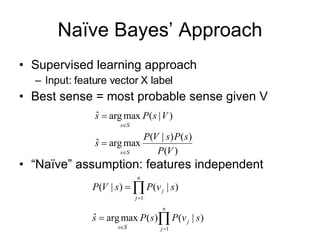
Naïve Bayes’ Approach Supervised learning approach Input: feature vector X label  Best sense = most probable sense given V “ Naïve” assumption: features independent
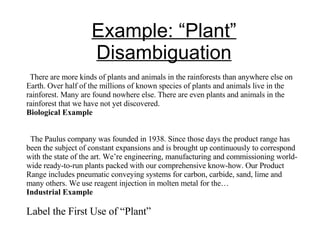
Example: “Plant” Disambiguation There are more kinds of plants and animals in the rainforests than anywhere else on Earth. Over half of the millions of known species of plants and animals live in the rainforest. Many are found nowhere else. There are even plants and animals in the rainforest that we have not yet discovered. Biological Example The Paulus company was founded in 1938. Since those days the product range has been the subject of constant expansions and is brought up continuously to correspond with the state of the art. We’re engineering, manufacturing and commissioning world- wide ready-to-run plants packed with our comprehensive know-how. Our Product Range includes pneumatic conveying systems for carbon, carbide, sand, lime and many others. We use reagent injection in molten metal for the… Industrial Example Label the First Use of “Plant”
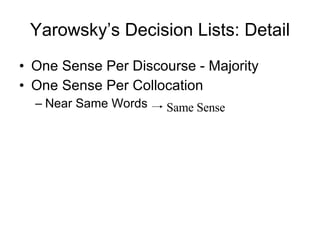
Yarowsky’s Decision Lists: Detail One Sense Per Discourse - Majority One Sense Per Collocation Near Same Words Same Sense
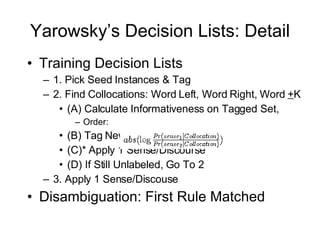
Yarowsky’s Decision Lists: Detail Training Decision Lists 1. Pick Seed Instances & Tag 2. Find Collocations: Word Left, Word Right, Word  + K (A) Calculate Informativeness on Tagged Set,  Order: (B) Tag New Instances with Rules (C)* Apply 1 Sense/Discourse (D) If Still Unlabeled, Go To 2 3. Apply 1 Sense/Discouse Disambiguation: First Rule Matched
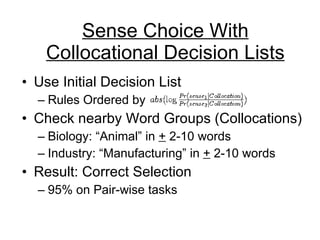
Sense Choice With Collocational Decision Lists Use Initial Decision List Rules Ordered by  Check nearby Word Groups (Collocations) Biology: “Animal” in  +  2-10 words Industry: “Manufacturing” in  +  2-10 words Result: Correct Selection 95% on Pair-wise tasks
Semantic Ambiguity “ Plant” ambiguity Botanical vs Manufacturing senses Two types of context Local: 1-2 words away Global: several sentence window  Two observations (Yarowsky 1995) One sense per collocation (local) One sense per discourse (global)
Schutze’s Vector Space: Detail Build a co-occurrence matrix Restrict Vocabulary to 4 letter sequences Exclude Very Frequent - Articles, Affixes Entries in 5000-5000 Matrix Word Context 4grams within 1001 Characters Sum & Normalize Vectors for each 4gram Distances between Vectors by dot product  97 Real Values
Schutze’s Vector Space: continued Word Sense Disambiguation Context Vectors of All Instances of Word Automatically Cluster Context Vectors Hand-label Clusters with Sense Tag Tag New Instance with Nearest Cluster
Sense Selection in “Word Space” Build a Context Vector 1,001 character window - Whole Article Compare Vector Distances to Sense Clusters Only 3 Content Words in Common Distant Context Vectors Clusters - Build Automatically, Label Manually Result: 2 Different, Correct Senses 92% on Pair-wise tasks
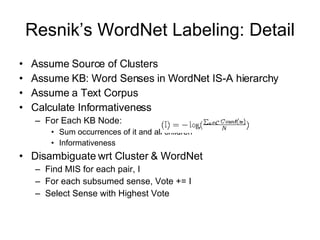
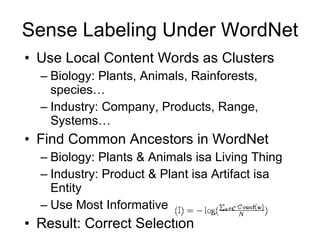
Resnik’s WordNet Labeling: Detail Assume Source of Clusters Assume KB: Word Senses in WordNet IS-A hierarchy Assume a Text Corpus Calculate Informativeness For Each KB Node: Sum occurrences of it and all children Informativeness  Disambiguate wrt Cluster & WordNet Find MIS for each pair, I For each subsumed sense, Vote += I Select Sense with Highest Vote
Sense Labeling Under WordNet Use Local Content Words as Clusters Biology: Plants, Animals, Rainforests, species… Industry: Company, Products, Range, Systems… Find Common Ancestors in WordNet Biology: Plants & Animals isa Living Thing Industry: Product & Plant isa Artifact isa Entity Use Most Informative  Result: Correct Selection
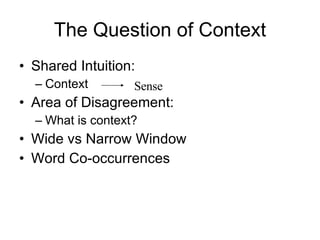
The Question of Context Shared Intuition: Context Area of Disagreement: What is context? Wide vs Narrow Window Word Co-occurrences Sense
Taxonomy of Contextual Information Topical Content Word Associations Syntactic Constraints Selectional Preferences World Knowledge & Inference
A Trivial Definition of Context All Words within X words of Target Many words: Schutze - 1000 characters, several sentences Unordered “Bag of Words” Information Captured: Topic & Word Association Limits on Applicability Nouns vs. Verbs & Adjectives Schutze: Nouns - 92%, “Train” -Verb, 69%
Limits of Wide Context Comparison of Wide-Context Techniques (LTV ‘93) Neural Net, Context Vector, Bayesian Classifier, Simulated Annealing Results: 2 Senses - 90+%;  3+ senses ~ 70% People: Sentences ~100%;  Bag of Words: ~70% Inadequate Context Need Narrow Context Local Constraints Override Retain Order, Adjacency
Surface Regularities = Useful Disambiguators Not Necessarily! “ Scratching her nose” vs “Kicking the bucket”  (deMarcken 1995) Right for the Wrong Reason Burglar Rob… Thieves Stray Crate Chase Lookout Learning the Corpus, not the Sense The “Ste.” Cluster: Dry Oyster Whisky Hot Float Ice Learning Nothing Useful, Wrong Question Keeping: Bring Hoping Wiping Could Should Some Them Rest
Interactions Below the Surface Constraints Not All Created Equal “ The Astronomer Married the Star” Selectional Restrictions Override Topic No Surface Regularities “ The emigration/immigration bill guaranteed passports to all Soviet citizens No Substitute for Understanding
What is Similar Ad-hoc Definitions of Sense Cluster in “word space”, WordNet Sense, “Seed Sense”: Circular Schutze: Vector Distance in Word Space Resnik: Informativeness of WordNet Subsumer + Cluster Relation in Cluster not WordNet is-a hierarchy Yarowsky: No Similarity, Only Difference Decision Lists - 1/Pair Find Discriminants

Class14

  • 1.
    Lexical Semantics &Word Sense Disambiguation CMSC 35100 Natural Language Processing May 15, 2003
  • 2.
    Roadmap Lexical SemanticsEmergent Meaning Thematic roles, Frames, & Primitives Word Sense Disambiguation Selectional Restriction-based approaches Limitations Robust Approaches Supervised Learning Approaches Naïve Bayes Bootstrapping Approaches One sense per discourse/collocation Unsupervised Approaches Schutze’s word space Resource-based Approaches Dictionary parsing, WordNet Distance Why they work Why they don’t
  • 3.
    Word-internal Structure Thematicroles: Characterize verbs by their arguments E.g. transport: agent, theme, source, destination They transported grain from the fields to the silo. Deep structure: passive / active: same roles Thematic hierarchy E.g. agent > theme > source, dest Provide default surface positions Tie to semantics (e.g. Levin): Interlinguas Cluster verb meanings by set of syntactic alternations Limitations: only NP,PP: other arguments predicates less
  • 4.
    Selectional Restrictions Semanticconstraints on filling of roles E.g. Bill ate chicken Eat: Agent: animate; Theme: Edible Associate with sense Most commonly of verb/event; possibly adj, noun… Specifying constraints: Add a term to semantics, e.g. Isa(x,Ediblething) Tie to position in WordNet All hyponyms inherit
  • 5.
    Primitive Decompositions Jackendoff(1990),Dorr(1999), McCawley (1968) Word meaning constructed from primitives Fixed small set of basic primitives E.g. cause, go, become, kill=cause X to become Y Augment with open-ended “manner” Y = not alive E.g. walk vs run Fixed primitives/Infinite descriptors
  • 6.
    Word Sense DisambiguationApplication of lexical semantics Goal: Given a word in context, identify the appropriate sense E.g. plants and animals in the rainforest Crucial for real syntactic & semantic analysis Correct sense can determine Available syntactic structure Available thematic roles, correct meaning,..
  • 7.
    Selectional Restriction ApproachesIntegrate sense selection in parsing and semantic analysis – e.g. with Montague Concept: Predicate selects sense Washing dishes vs stir-frying dishes Stir-fry: patient: food => dish~food Serve Denver vs serve breakfast Serve vegetarian dishes Serve1: patient: loc; serve1: patient: food => dishes~food: only valid variant Integrate in rule-to-rule: test e.g. in WN
  • 8.
    Selectional Restrictions: LimitationsProblem 1: Predicates too general Recommend, like, hit…. Problem 2: Language too flexible “ The circus performer ate fire and swallowed swords” Unlikely but doable Also metaphor Strong restrictions would block all analysis Some approaches generalize up hierarchy Can over-accept truly weird things
  • 9.
    Robust Disambiguation Moreto semantics than P-A structure Select sense where predicates underconstrain Learning approaches Supervised, Bootstrapped, Unsupervised Knowledge-based approaches Dictionaries, Taxonomies Widen notion of context for sense selection Words within window (2,50,discourse) Narrow cooccurrence - collocations
  • 10.
    Disambiguation Features Key:What are the features? Part of speech Of word and neighbors Morphologically simplified form Words in neighborhood Question: How big a neighborhood? Is there a single optimal size? Why? (Possibly shallow) Syntactic analysis E.g. predicate-argument relations, modification, phrases Collocation vs co-occurrence features Collocation: words in specific relation: p-a, 1 word +/- Co-occurrence: bag of words..
  • 11.
    Naïve Bayes’ ApproachSupervised learning approach Input: feature vector X label Best sense = most probable sense given V “ Naïve” assumption: features independent
  • 12.
    Example: “Plant” DisambiguationThere are more kinds of plants and animals in the rainforests than anywhere else on Earth. Over half of the millions of known species of plants and animals live in the rainforest. Many are found nowhere else. There are even plants and animals in the rainforest that we have not yet discovered. Biological Example The Paulus company was founded in 1938. Since those days the product range has been the subject of constant expansions and is brought up continuously to correspond with the state of the art. We’re engineering, manufacturing and commissioning world- wide ready-to-run plants packed with our comprehensive know-how. Our Product Range includes pneumatic conveying systems for carbon, carbide, sand, lime and many others. We use reagent injection in molten metal for the… Industrial Example Label the First Use of “Plant”
  • 13.
    Yarowsky’s Decision Lists:Detail One Sense Per Discourse - Majority One Sense Per Collocation Near Same Words Same Sense
  • 14.
    Yarowsky’s Decision Lists:Detail Training Decision Lists 1. Pick Seed Instances & Tag 2. Find Collocations: Word Left, Word Right, Word + K (A) Calculate Informativeness on Tagged Set, Order: (B) Tag New Instances with Rules (C)* Apply 1 Sense/Discourse (D) If Still Unlabeled, Go To 2 3. Apply 1 Sense/Discouse Disambiguation: First Rule Matched
  • 15.
    Sense Choice WithCollocational Decision Lists Use Initial Decision List Rules Ordered by Check nearby Word Groups (Collocations) Biology: “Animal” in + 2-10 words Industry: “Manufacturing” in + 2-10 words Result: Correct Selection 95% on Pair-wise tasks
  • 16.
    Semantic Ambiguity “Plant” ambiguity Botanical vs Manufacturing senses Two types of context Local: 1-2 words away Global: several sentence window Two observations (Yarowsky 1995) One sense per collocation (local) One sense per discourse (global)
  • 17.
    Schutze’s Vector Space:Detail Build a co-occurrence matrix Restrict Vocabulary to 4 letter sequences Exclude Very Frequent - Articles, Affixes Entries in 5000-5000 Matrix Word Context 4grams within 1001 Characters Sum & Normalize Vectors for each 4gram Distances between Vectors by dot product 97 Real Values
  • 18.
    Schutze’s Vector Space:continued Word Sense Disambiguation Context Vectors of All Instances of Word Automatically Cluster Context Vectors Hand-label Clusters with Sense Tag Tag New Instance with Nearest Cluster
  • 19.
    Sense Selection in“Word Space” Build a Context Vector 1,001 character window - Whole Article Compare Vector Distances to Sense Clusters Only 3 Content Words in Common Distant Context Vectors Clusters - Build Automatically, Label Manually Result: 2 Different, Correct Senses 92% on Pair-wise tasks
  • 20.
    Resnik’s WordNet Labeling:Detail Assume Source of Clusters Assume KB: Word Senses in WordNet IS-A hierarchy Assume a Text Corpus Calculate Informativeness For Each KB Node: Sum occurrences of it and all children Informativeness Disambiguate wrt Cluster & WordNet Find MIS for each pair, I For each subsumed sense, Vote += I Select Sense with Highest Vote
  • 21.
    Sense Labeling UnderWordNet Use Local Content Words as Clusters Biology: Plants, Animals, Rainforests, species… Industry: Company, Products, Range, Systems… Find Common Ancestors in WordNet Biology: Plants & Animals isa Living Thing Industry: Product & Plant isa Artifact isa Entity Use Most Informative Result: Correct Selection
  • 22.
    The Question ofContext Shared Intuition: Context Area of Disagreement: What is context? Wide vs Narrow Window Word Co-occurrences Sense
  • 23.
    Taxonomy of ContextualInformation Topical Content Word Associations Syntactic Constraints Selectional Preferences World Knowledge & Inference
  • 24.
    A Trivial Definitionof Context All Words within X words of Target Many words: Schutze - 1000 characters, several sentences Unordered “Bag of Words” Information Captured: Topic & Word Association Limits on Applicability Nouns vs. Verbs & Adjectives Schutze: Nouns - 92%, “Train” -Verb, 69%
  • 25.
    Limits of WideContext Comparison of Wide-Context Techniques (LTV ‘93) Neural Net, Context Vector, Bayesian Classifier, Simulated Annealing Results: 2 Senses - 90+%; 3+ senses ~ 70% People: Sentences ~100%; Bag of Words: ~70% Inadequate Context Need Narrow Context Local Constraints Override Retain Order, Adjacency
  • 26.
    Surface Regularities =Useful Disambiguators Not Necessarily! “ Scratching her nose” vs “Kicking the bucket” (deMarcken 1995) Right for the Wrong Reason Burglar Rob… Thieves Stray Crate Chase Lookout Learning the Corpus, not the Sense The “Ste.” Cluster: Dry Oyster Whisky Hot Float Ice Learning Nothing Useful, Wrong Question Keeping: Bring Hoping Wiping Could Should Some Them Rest
  • 27.
    Interactions Below theSurface Constraints Not All Created Equal “ The Astronomer Married the Star” Selectional Restrictions Override Topic No Surface Regularities “ The emigration/immigration bill guaranteed passports to all Soviet citizens No Substitute for Understanding
  • 28.
    What is SimilarAd-hoc Definitions of Sense Cluster in “word space”, WordNet Sense, “Seed Sense”: Circular Schutze: Vector Distance in Word Space Resnik: Informativeness of WordNet Subsumer + Cluster Relation in Cluster not WordNet is-a hierarchy Yarowsky: No Similarity, Only Difference Decision Lists - 1/Pair Find Discriminants