Induction Project
September 2021
By Aidan Jones
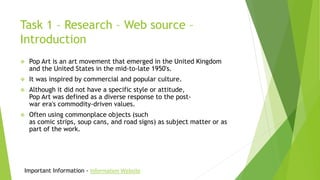
Task 1 – Research – Web source –
Introduction
 Pop Art is an art movement that emerged in the United Kingdom
and the United States in the mid-to-late 1950's.
 It was inspired by commercial and popular culture.
 Although it did not have a specific style or attitude,
Pop Art was defined as a diverse response to the post-
war era's commodity-driven values.
 Often using commonplace objects (such
as comic strips, soup cans, and road signs) as subject matter or as
part of the work.
Important Information - Information Website
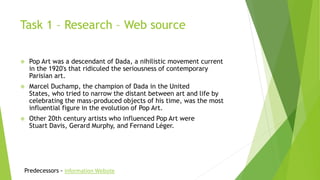
Task 1 – Research – Web source
 Pop Art was a descendant of Dada, a nihilistic movement current
in the 1920's that ridiculed the seriousness of contemporary
Parisian art.
 Marcel Duchamp, the champion of Dada in the United
States, who tried to narrow the distant between art and life by
celebrating the mass-produced objects of his time, was the most
influential figure in the evolution of Pop Art.
 Other 20th century artists who influenced Pop Art were
Stuart Davis, Gerard Murphy, and Fernand Léger.
Predecessors - Information Website
Task 1 – Research – Web source -
Pop Art In Britain
 The Pop Art movement began as a form of academic inquiry. In 1952-
55 a group of artists, architects, and design historians met regularly
at the Institute of Contemporary Art in London to
discuss contrasting topics such as car styling or pulp magazines.
 The Independent Group, as they called themselves, were
committed to developing a broad-based understanding of culture from
its supposedly high forms to its popular ones.
 This philosophy informed the cerebral works of their main
artist member, Richard Hamilton. Hence, in a work such as $he (1958-
61) he combined allusions to
fine art (recalling Duchamp) with esoteric references to American tele
vision advertising aimed at women.
Pop Art In Britain - Information Website
Task 1 – Research – Web source -
Pop Art In The United States
 If British Pop possessed a rather intellectual cast, Pop as it
developed in the United States about 1962-64 was much brasher in its
overall ethos.
 Its coming had been announced by the assemblages of Robert
Rauschenberg and Jasper Johns and by a brief vogue of Happenings –
elaborately staged environmental events devised by artists such as
Allan Kaprow that aimed at bombarding their audiences with sensory
stimulation.
 American Pop Art iconography – taken from television, comic
books, movie magazines, and all forms of advertising – was
presented emphatically and objectively, without praise or
condemnation but with overwhelming immediacy.
Pop Art In The United States - Information Website
Task 1 – Research – Web source -
Famous Pop Artist Quotes
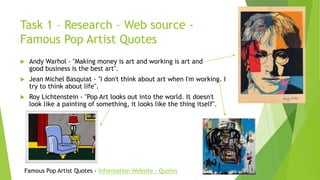
 Andy Warhol - "Making money is art and working is art and
good business is the best art".
 Jean Michel Basquiat - "I don't think about art when I'm working. I
try to think about life".
 Roy Lichtenstein - "Pop Art looks out into the world. It doesn't
look like a painting of something, it looks like the thing itself".
Famous Pop Artist Quotes - Information Website - Quotes
Photoshop tasks
AidanJ – 14/09/2021
Photoshop tasks
AidanJ – 14/09/2021
Photoshop tasks
AidanJ – 14/09/2021
Photoshop tasks
AidanJ -
Task 2a – Idea Generation [individual]
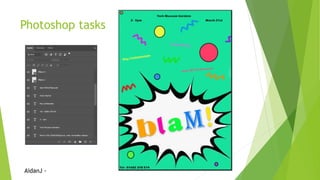
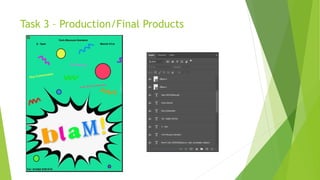
 I decided that I wanted my title to stand out the most. I used different layers,
colours, and fonts for each letter in the word 'blam!'. I also made them pretty
big.
 I then added an announcement bubble around the title (blam!) to make it
stand out even more.
 The background colour also helps to grab attention, since it is a blue-green.
 I added some squiggly lines for a random pop art sort-of effect.
 Next, I thought that it needed a bit more creativity so I added in a few cirlces
– different sizes and colours.
 I added some information about the event at the top and bottom of the
poster.
 And then, in all the craziness, I added a few names of famous pop art artists –
different colours and angles.
Task 2a – Idea Generation [group]
 Collectively we shared and used a PowerPoint. We came to agreement on the
name 'blam!' because it is a form of onomatopoeia, just like the word pop in
Pop Art.
 We also decided to use a lot of bright and varied colours. This would be
important because it catches the viewers' attention easier and fits with main
features of the Pop Art style.
Task 3 – Production/Final Products
 Include a version of your print product/screenshots
 Include a link to your blog where you have posted this PP and your final
products – the post on your blog should be titled ‘Induction Week Project’
Task 3 – Production/Final Products
Task 4 – Evaluation – Production
 Describe three strengths of your final pieces.
 1. It catches the viewers' attention very well – stands out.
 2. Gives the viewers all of the information needed.
 3. It fits the theme of Pop Art.
Task 4 – Evaluation – Problem Solving
 Describe three problems you faced in your project and how you solved these
 1. I didn't add any information regarding price for entry.
 2. It would have been helpful if I added some pictures of Pop Art to show what
would be expected.
 3.
Task 4 – Evaluation – Working with others
 Choose three aspects of your production where you worked well with your
team and this benefited the project
 1. We all communicated well with each other.
 2. We shared a PowerPoint together and added information in to help each
other.
 3. We all contributed in some way.
 4. We mostly agreed. And if not, we discussed something new.
Task 4 – Evaluation - Feedback
 Discuss the feedback you received from your tutor during the project and how
you used this to improve the project
 I future I should work hard all the time, so that I am not rushing the
evaluation at the end.

CMP Induction Project 2021 Pro Forma

  • 1.
  • 2.
    Task 1 –Research – Web source – Introduction  Pop Art is an art movement that emerged in the United Kingdom and the United States in the mid-to-late 1950's.  It was inspired by commercial and popular culture.  Although it did not have a specific style or attitude, Pop Art was defined as a diverse response to the post- war era's commodity-driven values.  Often using commonplace objects (such as comic strips, soup cans, and road signs) as subject matter or as part of the work. Important Information - Information Website
  • 3.
    Task 1 –Research – Web source  Pop Art was a descendant of Dada, a nihilistic movement current in the 1920's that ridiculed the seriousness of contemporary Parisian art.  Marcel Duchamp, the champion of Dada in the United States, who tried to narrow the distant between art and life by celebrating the mass-produced objects of his time, was the most influential figure in the evolution of Pop Art.  Other 20th century artists who influenced Pop Art were Stuart Davis, Gerard Murphy, and Fernand Léger. Predecessors - Information Website
  • 4.
    Task 1 –Research – Web source - Pop Art In Britain  The Pop Art movement began as a form of academic inquiry. In 1952- 55 a group of artists, architects, and design historians met regularly at the Institute of Contemporary Art in London to discuss contrasting topics such as car styling or pulp magazines.  The Independent Group, as they called themselves, were committed to developing a broad-based understanding of culture from its supposedly high forms to its popular ones.  This philosophy informed the cerebral works of their main artist member, Richard Hamilton. Hence, in a work such as $he (1958- 61) he combined allusions to fine art (recalling Duchamp) with esoteric references to American tele vision advertising aimed at women. Pop Art In Britain - Information Website
  • 5.
    Task 1 –Research – Web source - Pop Art In The United States  If British Pop possessed a rather intellectual cast, Pop as it developed in the United States about 1962-64 was much brasher in its overall ethos.  Its coming had been announced by the assemblages of Robert Rauschenberg and Jasper Johns and by a brief vogue of Happenings – elaborately staged environmental events devised by artists such as Allan Kaprow that aimed at bombarding their audiences with sensory stimulation.  American Pop Art iconography – taken from television, comic books, movie magazines, and all forms of advertising – was presented emphatically and objectively, without praise or condemnation but with overwhelming immediacy. Pop Art In The United States - Information Website
  • 6.
    Task 1 –Research – Web source - Famous Pop Artist Quotes  Andy Warhol - "Making money is art and working is art and good business is the best art".  Jean Michel Basquiat - "I don't think about art when I'm working. I try to think about life".  Roy Lichtenstein - "Pop Art looks out into the world. It doesn't look like a painting of something, it looks like the thing itself". Famous Pop Artist Quotes - Information Website - Quotes
  • 7.
  • 8.
  • 9.
  • 10.
  • 11.
    Task 2a –Idea Generation [individual]  I decided that I wanted my title to stand out the most. I used different layers, colours, and fonts for each letter in the word 'blam!'. I also made them pretty big.  I then added an announcement bubble around the title (blam!) to make it stand out even more.  The background colour also helps to grab attention, since it is a blue-green.  I added some squiggly lines for a random pop art sort-of effect.  Next, I thought that it needed a bit more creativity so I added in a few cirlces – different sizes and colours.  I added some information about the event at the top and bottom of the poster.  And then, in all the craziness, I added a few names of famous pop art artists – different colours and angles.
  • 12.
    Task 2a –Idea Generation [group]  Collectively we shared and used a PowerPoint. We came to agreement on the name 'blam!' because it is a form of onomatopoeia, just like the word pop in Pop Art.  We also decided to use a lot of bright and varied colours. This would be important because it catches the viewers' attention easier and fits with main features of the Pop Art style.
  • 13.
    Task 3 –Production/Final Products  Include a version of your print product/screenshots  Include a link to your blog where you have posted this PP and your final products – the post on your blog should be titled ‘Induction Week Project’
  • 14.
    Task 3 –Production/Final Products
  • 15.
    Task 4 –Evaluation – Production  Describe three strengths of your final pieces.  1. It catches the viewers' attention very well – stands out.  2. Gives the viewers all of the information needed.  3. It fits the theme of Pop Art.
  • 16.
    Task 4 –Evaluation – Problem Solving  Describe three problems you faced in your project and how you solved these  1. I didn't add any information regarding price for entry.  2. It would have been helpful if I added some pictures of Pop Art to show what would be expected.  3.
  • 17.
    Task 4 –Evaluation – Working with others  Choose three aspects of your production where you worked well with your team and this benefited the project  1. We all communicated well with each other.  2. We shared a PowerPoint together and added information in to help each other.  3. We all contributed in some way.  4. We mostly agreed. And if not, we discussed something new.
  • 18.
    Task 4 –Evaluation - Feedback  Discuss the feedback you received from your tutor during the project and how you used this to improve the project  I future I should work hard all the time, so that I am not rushing the evaluation at the end.