Induction Project
September 2019
CERTA L2 Developing Study Skills
Task 1 - Research
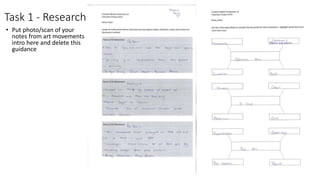
• Put photo/scan of your
notes from art movements
intro here and delete this
guidance
2.4
Task 1 – Research – Web source
What is Pop Art?
Pop Art is art made from commercial items and cultural icons such as product labels, advertisements, and
movies stars, such Marilyn Monroe. Pop Art is meant to be fun, and represents the contemporary art years of
its emergence, the mid 1950’s.
What are the characteristics?
Pop Art uses images and icons that are popular in the modern world. This includes famous celebrities like
movie stars and rock stars. Commercial objects such as soup cans and soft drinks, comic books and other
popular items.
Famous Pop Art Artists Include:
• Keith Haring- Cartoon like outlined pictures of people doing different things.
• Andy Warhol- Most famous pop artist, and played a major role in making the art movement popular. His
painting of Campbell’s Soup cans pushed Pop Art to the front of the art scene.
Ducksters/https://www.ducksters.com/history/art/pop_art.php/Date accessed: 9/09/2019
2.2
2.3
Task 1 – Research – Web source
American Pop vs British Pop
Although they were inspired by similar subject matters, British Pop is often seen as distinctive from
American Pop.
British Pop
Early Pop Art in Britain was fuelled by American popular culture viewed from a distance. In Britain, the
movement was more academic in its approach. While employing irony and parody, it focused more on
what American popular imagery represented, and its power manipulating peoples lifestyles.
American Pop
In the US, pop style was a return to representational art, and the use of hard edges and distinct forms
after the painterly looseness of abstract expressionism. By using impersonal, mundane imagery, pop
artists also wanted to move away from the emphasis on personal feelings and personal symbolism that
characterised abstract expressionism.
2.2
2.3
AmericanPop vs British Pop/https://www.tate.org.uk/art/art-terms/p/pop-art/Date accessed: 9/09/2019
Task 1 – Research – Book source
Pop Art/ Tilman Osterwold + Library location: 2nd Floor, Art
2.2
2.3
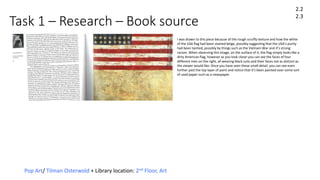
I was drawn to this piece because of the rough scruffy texture and how the white
of the USA flag had been stained beige, possibly suggesting that the USA’s purity
had been tainted, possibly by things such as the Vietnam War and it’s strong
racism. When observing this image, on the surface of it, the flag simply looks like a
dirty American flag, however as you look closer you can see the faces of four
different men on the right, all wearing black suits and their faces not as distinct as
the viewer would like. Once you have seen these small detail, you can see even
further past the top layer of paint and notice that it’s been painted over some sort
of used paper such as a newspaper.
Task 1 – Research – Book source
2.2
2.3
Pop Art Book/Black Dog Publishing's + Library location: 2nd Floor Art
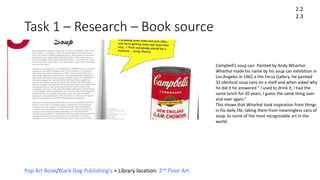
Campbell’s soup can- Painted by Andy Wharhol.
Wharhol made his name by his soup can exhibition in
Los Angeles in 1962 a the Ferus Gallery. He painted
32 identical soup cans on a shelf and when asked why
he did it he answered “ I used to drink it, I had the
same lunch for 20 years, I guess the same thing over
and over again.”
This shows that Wharhol took inspiration from things
in his daily life, taking them from meaningless cans of
soup, to some of the most recognizable art in the
world.
Task 2a – Idea Generation [group]
• Nieki- Latvian-Pop
• Vivace- Italian – Vibrant
• Harmonia – Harmony –Portuguese.
• We both agreed to use a coke bottle, or something that can be
related to it, in our poster, as it is something commercial and
ordinary. Such objects can be seen through many pieces of pop art, as
a statement of everyday, normal life.
Task 2a – Idea Generation [individual]
Idea: Similar to coke
advert but replace “Coca
Cola” with “Vivace”. Also
replace the coke bottle
with a picture of a paint
brush and edit it to make
it look more to the style.
Task 2b – Action Plan/Schedule
Session Activity Who is responsibile
1
2
3
4
5
6
7
3.1
Task 2b – Action Plan/Schedule
3.1
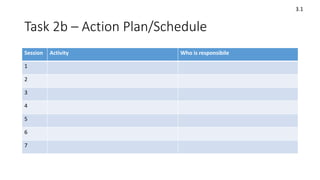
• On Monday we started research, and looking at examples of Pop Art and
exploring the artists that made them.
• We then decided to plan in the group some of the ideas that we had, exploring
titles for our magazine, and experimenting with significant details we could both
use in our individual poster. We did this throughout Monday and Tuesday.
• For my final individual planning, I collected lots of images of Pop Art that I liked,
and I could possibly take inspiration from whilst planning and creating my final
piece. I also drew out a very rough idea, so that when it came to creating I had a
base to go from.
• On Wednesday I started creating my poster, but decided to switch some things
around from my initial plan. Many of the original ideas still remained, however I
changed the layout, and added extra pieces to fit the “non-digital aspect” in the
brief.
Task 4 – Production/Final Products
• Include a version of your print product/screenshots of any video work
here then delete this guidance
• Include a link to your blog where you have posted this PP and your
final products – the post on your blog should be titled ‘Induction
Week Project’
3.2
3.4
Task 5 – Evaluation – Problem Solving
• Describe three problems you faced in your project and how you solved these
• 1-I struggled with copying and pasting certain images onto separate Photoshop pieces, so I asked
for help and learnt how to do it.
• 2-I struggled with deciding where to put my text and how to lay it out in the best way, so I
researched and asked for advise, and overcame it.
• 3-I struggled slightly whilst creating my non-digital aspect, as I’d never used a technique like this
before, but I used some of my pieces for a practice run and then used the other pieces as the real
thing.
3.3
Task 5 – Evaluation – Working with others
• Choose three aspects of your production where you worked well with
your team and this benefited the project
• 1- We worked well and listened to each others ideas whilst deciding
on a title for the poster.
• 2-We helped each other scan items and find things from the books.
• 3-We gave each other constructive criticism and pointers on how to
improve our individual posters.
1.2b
Task 5 – Evaluation - Feedback
• My tutor helped by encouraging me to experiment and mix up my
ideas and layouts to create different versions of my poster to
eventually create the best one according to brief and purpose.
3.5
Task 5 – Evaluation – Active Engagement
• We were given a rough brief with a few restrictions and requirements,
and actively engaged by:
• Bouncing ideas of each other.
• Doing our own individual research and planning.
• Executed that planning and research by using our skills in photoshop and non-
digitally by hand.
1.2a
Task 5 – Evaluation
Accessing and storing information
• Explain where the books/resources are for your area in the LC.
• The books used for my research are located on the second floor learning
centre at the back with the media and art books.
• Explain how to take a book/resource out of the LC.
• You choose your book and give it to the person at the desk, and give them
your ID card to record you have taken the book out.
2.1
Task 5 – Evaluation
Accessing and storing information
• Explain where to store electronic information on the college network.
• You can store your work on the computer you are working on, on the York
College H drive, or your own personal One Drive, so you can transfer work
from one computer to another.
• Explain where you upload work when it is completed.
• Upload it to your blogger account.
2.1
Task 6 - How do you learn best?
• Explain some of the ways you think you learn best [refer to the VAK
questionnaire results in tutorial]:
• I learn best by being visual, making diagrams, highlighting ect.
1.1
Task 6 - How do you learn best?
• What makes it hard for you to study?
• Distractions such as my phone and other people around my house
being disruptive.
• What strategies do you think would benefit your studies?
• Diagrams, mind maps, turning phone notifications off.
1.1

Induction Project

  • 1.
    Induction Project September 2019 CERTAL2 Developing Study Skills
  • 2.
    Task 1 -Research • Put photo/scan of your notes from art movements intro here and delete this guidance 2.4
  • 3.
    Task 1 –Research – Web source What is Pop Art? Pop Art is art made from commercial items and cultural icons such as product labels, advertisements, and movies stars, such Marilyn Monroe. Pop Art is meant to be fun, and represents the contemporary art years of its emergence, the mid 1950’s. What are the characteristics? Pop Art uses images and icons that are popular in the modern world. This includes famous celebrities like movie stars and rock stars. Commercial objects such as soup cans and soft drinks, comic books and other popular items. Famous Pop Art Artists Include: • Keith Haring- Cartoon like outlined pictures of people doing different things. • Andy Warhol- Most famous pop artist, and played a major role in making the art movement popular. His painting of Campbell’s Soup cans pushed Pop Art to the front of the art scene. Ducksters/https://www.ducksters.com/history/art/pop_art.php/Date accessed: 9/09/2019 2.2 2.3
  • 4.
    Task 1 –Research – Web source American Pop vs British Pop Although they were inspired by similar subject matters, British Pop is often seen as distinctive from American Pop. British Pop Early Pop Art in Britain was fuelled by American popular culture viewed from a distance. In Britain, the movement was more academic in its approach. While employing irony and parody, it focused more on what American popular imagery represented, and its power manipulating peoples lifestyles. American Pop In the US, pop style was a return to representational art, and the use of hard edges and distinct forms after the painterly looseness of abstract expressionism. By using impersonal, mundane imagery, pop artists also wanted to move away from the emphasis on personal feelings and personal symbolism that characterised abstract expressionism. 2.2 2.3 AmericanPop vs British Pop/https://www.tate.org.uk/art/art-terms/p/pop-art/Date accessed: 9/09/2019
  • 5.
    Task 1 –Research – Book source Pop Art/ Tilman Osterwold + Library location: 2nd Floor, Art 2.2 2.3 I was drawn to this piece because of the rough scruffy texture and how the white of the USA flag had been stained beige, possibly suggesting that the USA’s purity had been tainted, possibly by things such as the Vietnam War and it’s strong racism. When observing this image, on the surface of it, the flag simply looks like a dirty American flag, however as you look closer you can see the faces of four different men on the right, all wearing black suits and their faces not as distinct as the viewer would like. Once you have seen these small detail, you can see even further past the top layer of paint and notice that it’s been painted over some sort of used paper such as a newspaper.
  • 6.
    Task 1 –Research – Book source 2.2 2.3 Pop Art Book/Black Dog Publishing's + Library location: 2nd Floor Art Campbell’s soup can- Painted by Andy Wharhol. Wharhol made his name by his soup can exhibition in Los Angeles in 1962 a the Ferus Gallery. He painted 32 identical soup cans on a shelf and when asked why he did it he answered “ I used to drink it, I had the same lunch for 20 years, I guess the same thing over and over again.” This shows that Wharhol took inspiration from things in his daily life, taking them from meaningless cans of soup, to some of the most recognizable art in the world.
  • 7.
    Task 2a –Idea Generation [group] • Nieki- Latvian-Pop • Vivace- Italian – Vibrant • Harmonia – Harmony –Portuguese. • We both agreed to use a coke bottle, or something that can be related to it, in our poster, as it is something commercial and ordinary. Such objects can be seen through many pieces of pop art, as a statement of everyday, normal life.
  • 8.
    Task 2a –Idea Generation [individual] Idea: Similar to coke advert but replace “Coca Cola” with “Vivace”. Also replace the coke bottle with a picture of a paint brush and edit it to make it look more to the style.
  • 9.
    Task 2b –Action Plan/Schedule Session Activity Who is responsibile 1 2 3 4 5 6 7 3.1
  • 10.
    Task 2b –Action Plan/Schedule 3.1 • On Monday we started research, and looking at examples of Pop Art and exploring the artists that made them. • We then decided to plan in the group some of the ideas that we had, exploring titles for our magazine, and experimenting with significant details we could both use in our individual poster. We did this throughout Monday and Tuesday. • For my final individual planning, I collected lots of images of Pop Art that I liked, and I could possibly take inspiration from whilst planning and creating my final piece. I also drew out a very rough idea, so that when it came to creating I had a base to go from. • On Wednesday I started creating my poster, but decided to switch some things around from my initial plan. Many of the original ideas still remained, however I changed the layout, and added extra pieces to fit the “non-digital aspect” in the brief.
  • 11.
    Task 4 –Production/Final Products • Include a version of your print product/screenshots of any video work here then delete this guidance • Include a link to your blog where you have posted this PP and your final products – the post on your blog should be titled ‘Induction Week Project’ 3.2 3.4
  • 12.
    Task 5 –Evaluation – Problem Solving • Describe three problems you faced in your project and how you solved these • 1-I struggled with copying and pasting certain images onto separate Photoshop pieces, so I asked for help and learnt how to do it. • 2-I struggled with deciding where to put my text and how to lay it out in the best way, so I researched and asked for advise, and overcame it. • 3-I struggled slightly whilst creating my non-digital aspect, as I’d never used a technique like this before, but I used some of my pieces for a practice run and then used the other pieces as the real thing. 3.3
  • 13.
    Task 5 –Evaluation – Working with others • Choose three aspects of your production where you worked well with your team and this benefited the project • 1- We worked well and listened to each others ideas whilst deciding on a title for the poster. • 2-We helped each other scan items and find things from the books. • 3-We gave each other constructive criticism and pointers on how to improve our individual posters. 1.2b
  • 14.
    Task 5 –Evaluation - Feedback • My tutor helped by encouraging me to experiment and mix up my ideas and layouts to create different versions of my poster to eventually create the best one according to brief and purpose. 3.5
  • 15.
    Task 5 –Evaluation – Active Engagement • We were given a rough brief with a few restrictions and requirements, and actively engaged by: • Bouncing ideas of each other. • Doing our own individual research and planning. • Executed that planning and research by using our skills in photoshop and non- digitally by hand. 1.2a
  • 16.
    Task 5 –Evaluation Accessing and storing information • Explain where the books/resources are for your area in the LC. • The books used for my research are located on the second floor learning centre at the back with the media and art books. • Explain how to take a book/resource out of the LC. • You choose your book and give it to the person at the desk, and give them your ID card to record you have taken the book out. 2.1
  • 17.
    Task 5 –Evaluation Accessing and storing information • Explain where to store electronic information on the college network. • You can store your work on the computer you are working on, on the York College H drive, or your own personal One Drive, so you can transfer work from one computer to another. • Explain where you upload work when it is completed. • Upload it to your blogger account. 2.1
  • 18.
    Task 6 -How do you learn best? • Explain some of the ways you think you learn best [refer to the VAK questionnaire results in tutorial]: • I learn best by being visual, making diagrams, highlighting ect. 1.1
  • 19.
    Task 6 -How do you learn best? • What makes it hard for you to study? • Distractions such as my phone and other people around my house being disruptive. • What strategies do you think would benefit your studies? • Diagrams, mind maps, turning phone notifications off. 1.1