Aaron Bimbrahw
December 2023
Precision Unleashed: Navigating
the World of CMM Probes,
Cutting-edge CMM Technology,
and the Art of Probe Calibration
1
2
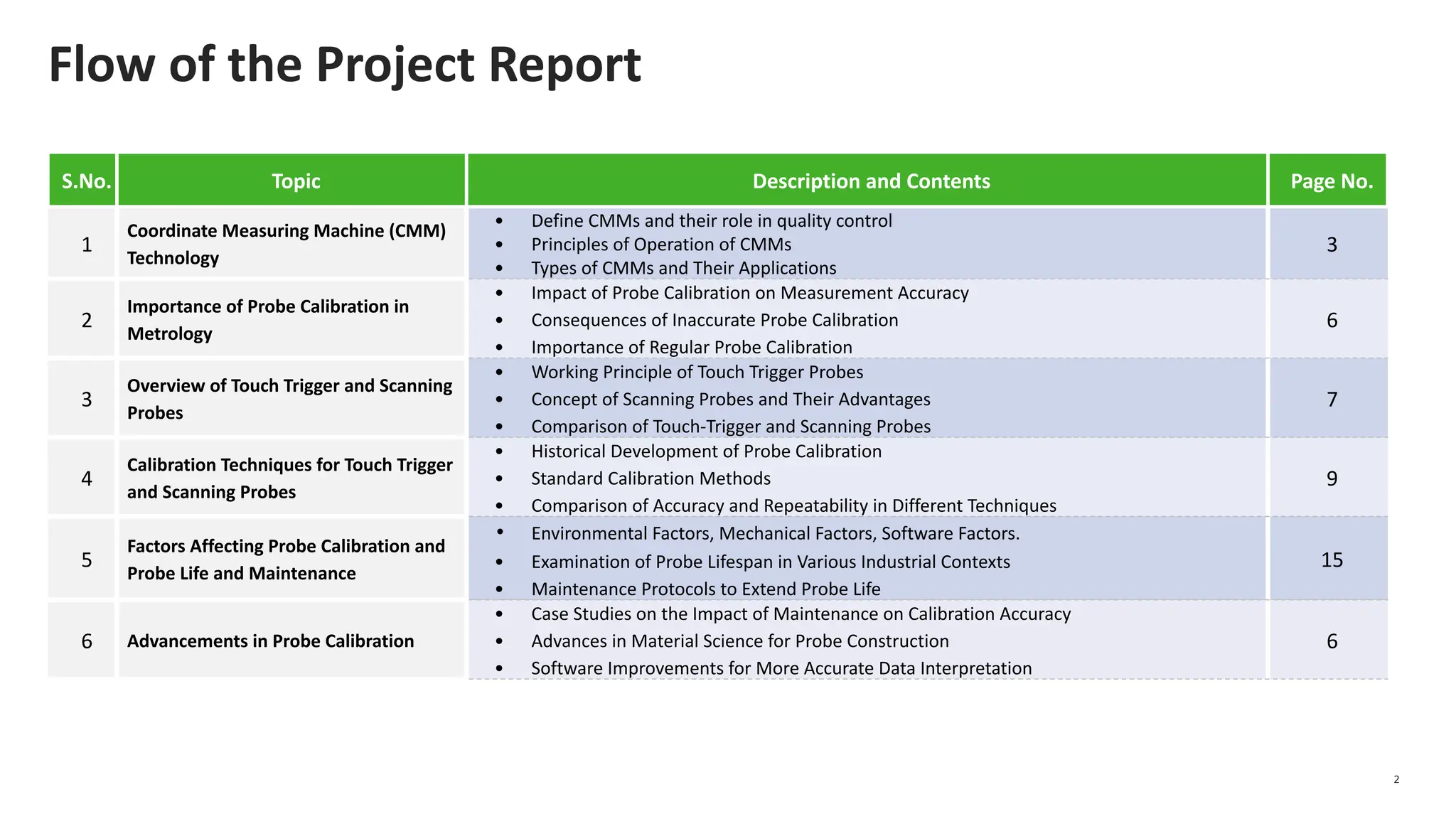
Flow of the Project Report
S.No. Topic Description and Contents Page No.
1
Coordinate Measuring Machine (CMM)
Technology
• Define CMMs and their role in quality control
• Principles of Operation of CMMs
• Types of CMMs and Their Applications
3
2
Importance of Probe Calibration in
Metrology
• Impact of Probe Calibration on Measurement Accuracy
• Consequences of Inaccurate Probe Calibration
• Importance of Regular Probe Calibration
6
3
Overview of Touch Trigger and Scanning
Probes
• Working Principle of Touch Trigger Probes
• Concept of Scanning Probes and Their Advantages
• Comparison of Touch-Trigger and Scanning Probes
7
4
Calibration Techniques for Touch Trigger
and Scanning Probes
• Historical Development of Probe Calibration
• Standard Calibration Methods
• Comparison of Accuracy and Repeatability in Different Techniques
9
5
Factors Affecting Probe Calibration and
Probe Life and Maintenance
• Environmental Factors, Mechanical Factors, Software Factors.
• Examination of Probe Lifespan in Various Industrial Contexts
• Maintenance Protocols to Extend Probe Life
15
6 Advancements in Probe Calibration
• Case Studies on the Impact of Maintenance on Calibration Accuracy
• Advances in Material Science for Probe Construction
• Software Improvements for More Accurate Data Interpretation
6
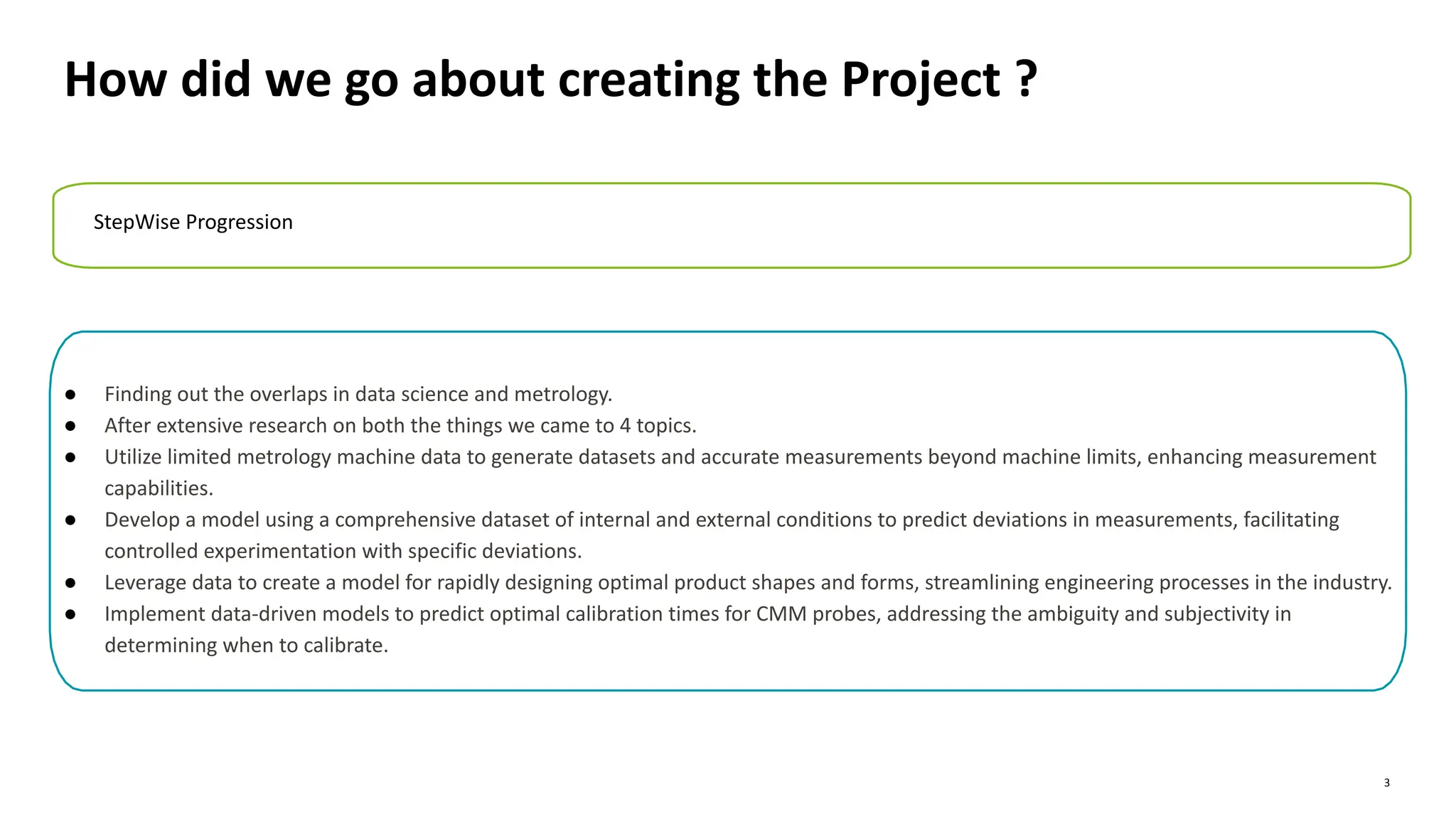
How did we go about creating the Project ?
● Finding out the overlaps in data science and metrology.
● After extensive research on both the things we came to 4 topics.
● Utilize limited metrology machine data to generate datasets and accurate measurements beyond machine limits, enhancing measurement
capabilities.
● Develop a model using a comprehensive dataset of internal and external conditions to predict deviations in measurements, facilitating
controlled experimentation with specific deviations.
● Leverage data to create a model for rapidly designing optimal product shapes and forms, streamlining engineering processes in the industry.
● Implement data-driven models to predict optimal calibration times for CMM probes, addressing the ambiguity and subjectivity in
determining when to calibrate.
3
StepWise Progression
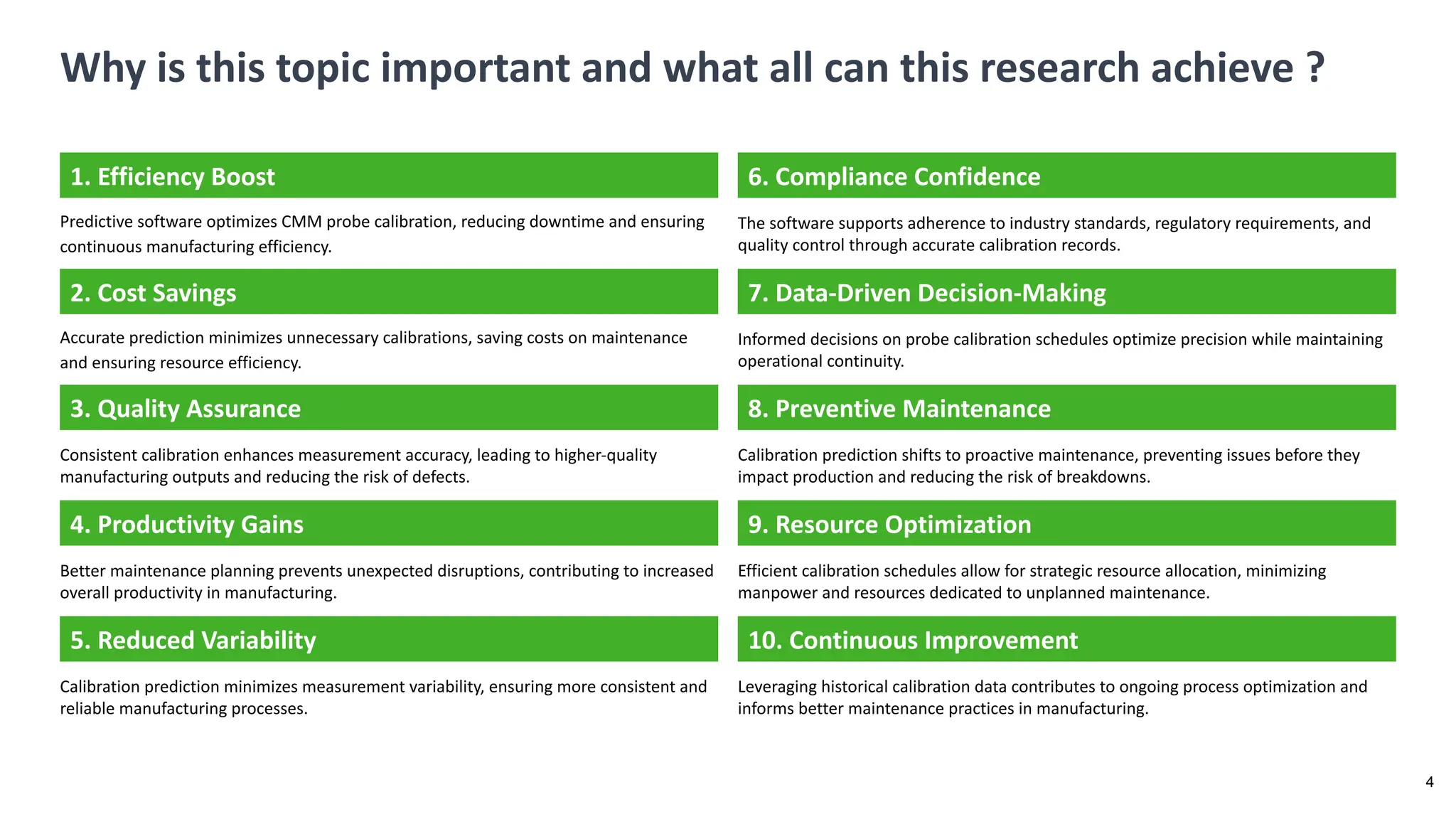
Why is this topic important and what all can this research achieve ?
3. Quality Assurance
4. Productivity Gains
5. Reduced Variability
2. Cost Savings
1. Efficiency Boost
8. Preventive Maintenance
9. Resource Optimization
10. Continuous Improvement
7. Data-Driven Decision-Making
6. Compliance Confidence
Predictive software optimizes CMM probe calibration, reducing downtime and ensuring
continuous manufacturing efficiency.
The software supports adherence to industry standards, regulatory requirements, and
quality control through accurate calibration records.
Calibration prediction minimizes measurement variability, ensuring more consistent and
reliable manufacturing processes.
Leveraging historical calibration data contributes to ongoing process optimization and
informs better maintenance practices in manufacturing.
Accurate prediction minimizes unnecessary calibrations, saving costs on maintenance
and ensuring resource efficiency.
Informed decisions on probe calibration schedules optimize precision while maintaining
operational continuity.
Consistent calibration enhances measurement accuracy, leading to higher-quality
manufacturing outputs and reducing the risk of defects.
Calibration prediction shifts to proactive maintenance, preventing issues before they
impact production and reducing the risk of breakdowns.
Better maintenance planning prevents unexpected disruptions, contributing to increased
overall productivity in manufacturing.
Efficient calibration schedules allow for strategic resource allocation, minimizing
manpower and resources dedicated to unplanned maintenance.
4
5
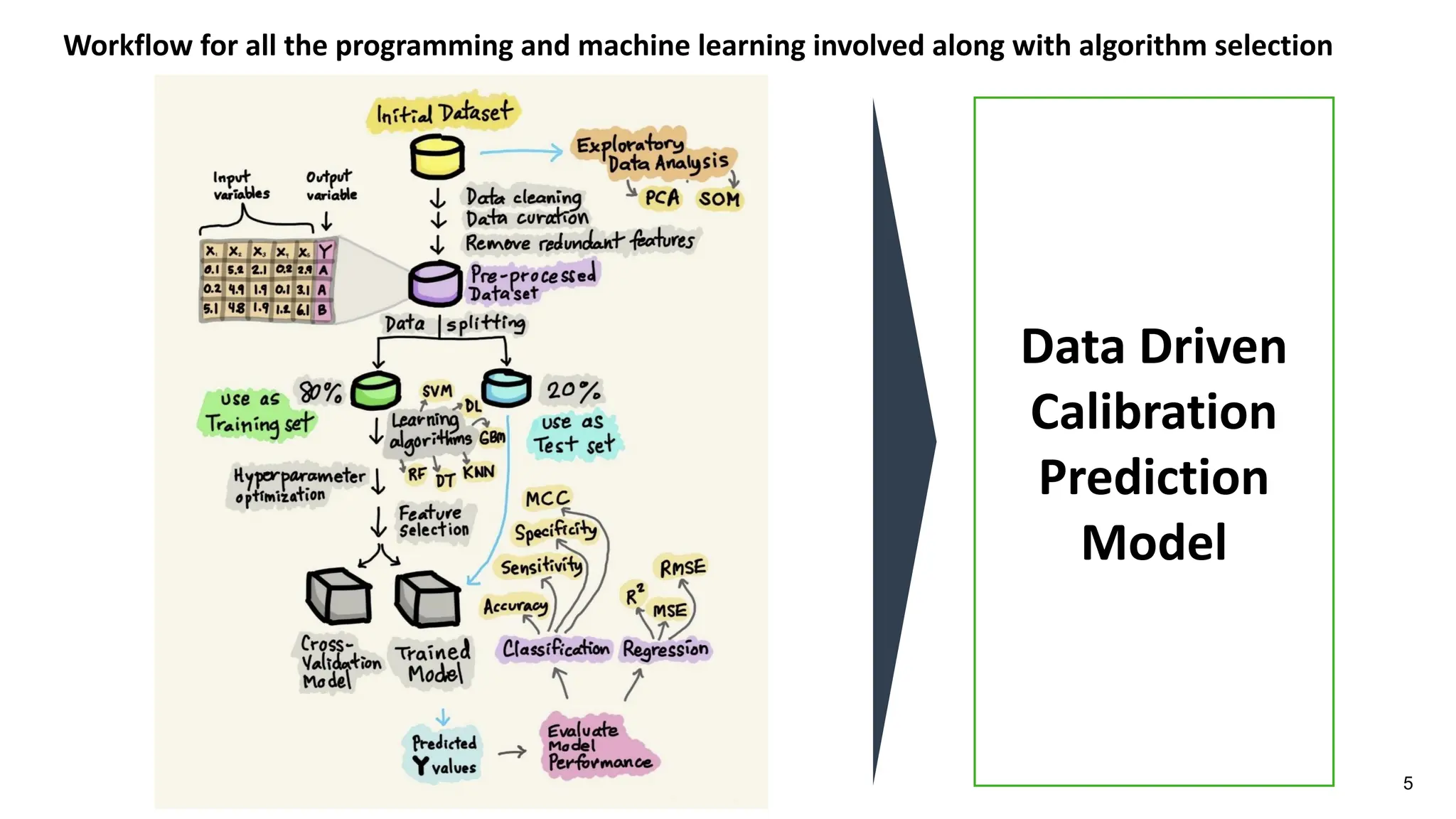
Workflow for all the programming and machine learning involved along with algorithm selection
5
Data Driven
Calibration
Prediction
Model
6
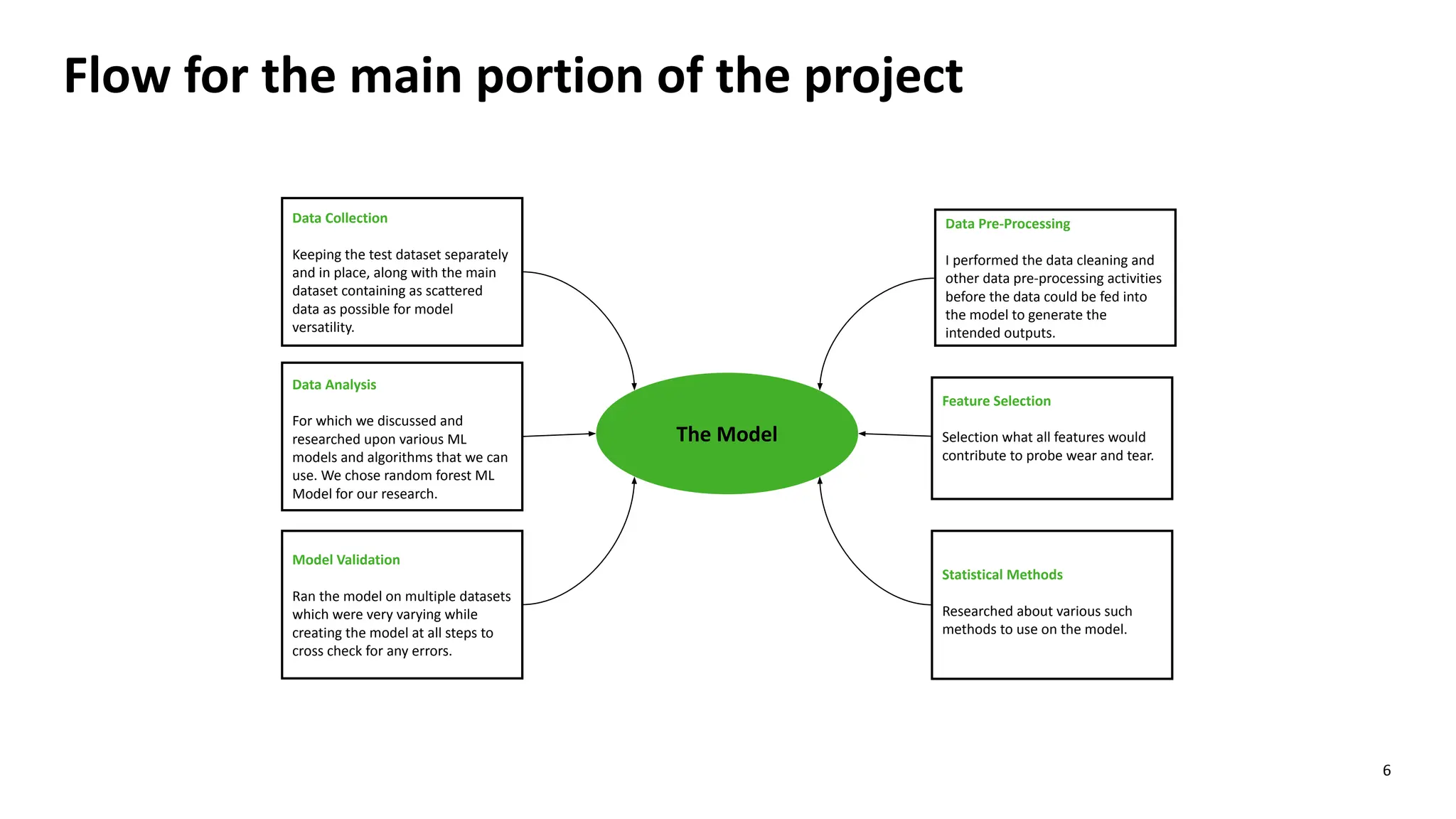
Flow for the main portion of the project
The Model
Feature Selection
Selection what all features would
contribute to probe wear and tear.
Model Validation
Ran the model on multiple datasets
which were very varying while
creating the model at all steps to
cross check for any errors.
Statistical Methods
Researched about various such
methods to use on the model.
Data Analysis
For which we discussed and
researched upon various ML
models and algorithms that we can
use. We chose random forest ML
Model for our research.
Data Collection
Keeping the test dataset separately
and in place, along with the main
dataset containing as scattered
data as possible for model
versatility.
Data Pre-Processing
I performed the data cleaning and
other data pre-processing activities
before the data could be fed into
the model to generate the
intended outputs.
6
Last Few Steps to Project Completion
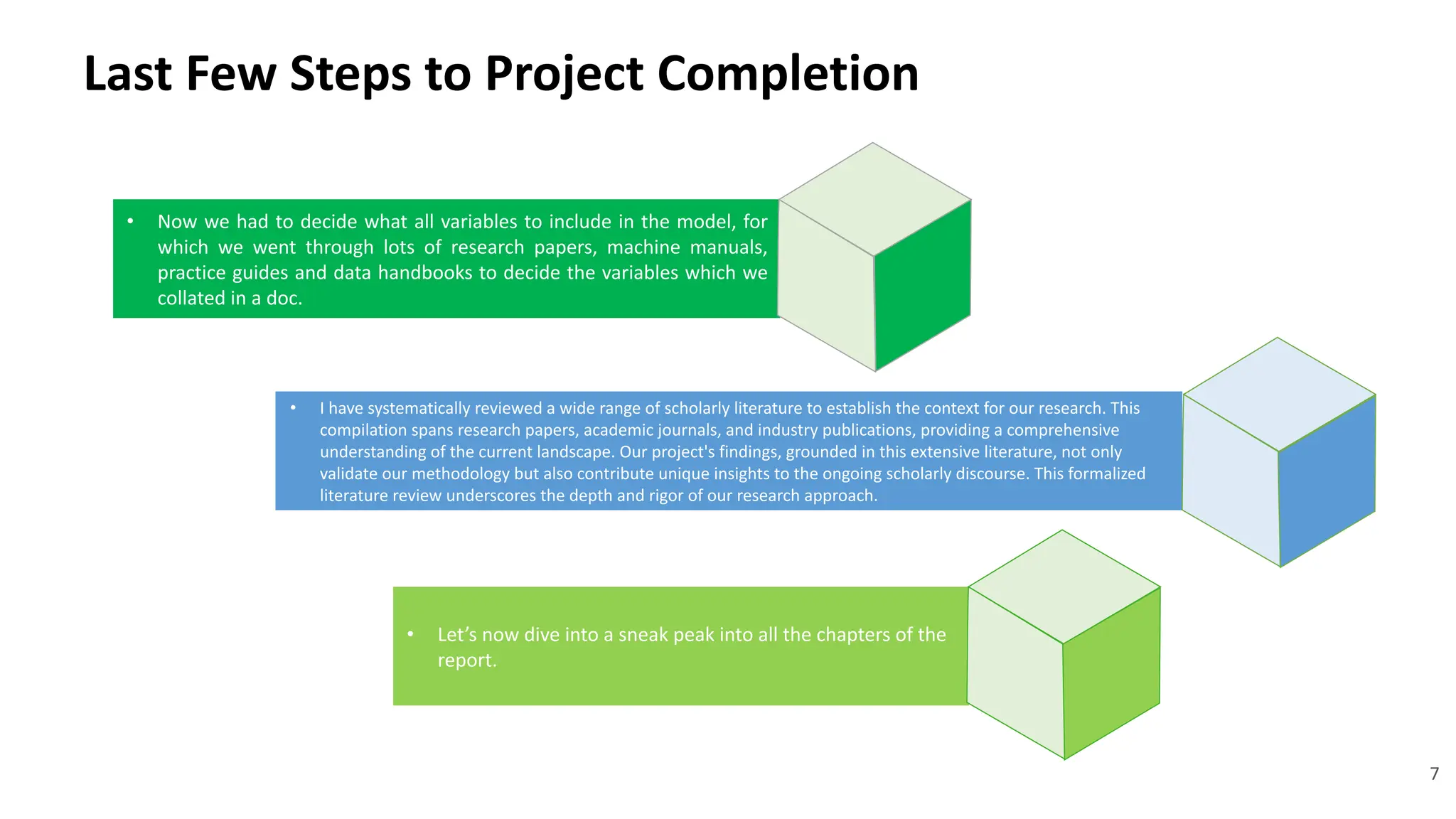
• I have systematically reviewed a wide range of scholarly literature to establish the context for our research. This
compilation spans research papers, academic journals, and industry publications, providing a comprehensive
understanding of the current landscape. Our project's findings, grounded in this extensive literature, not only
validate our methodology but also contribute unique insights to the ongoing scholarly discourse. This formalized
literature review underscores the depth and rigor of our research approach.
• Let’s now dive into a sneak peak into all the chapters of the
report.
• Now we had to decide what all variables to include in the model, for
which we went through lots of research papers, machine manuals,
practice guides and data handbooks to decide the variables which we
collated in a doc.
7
Chapter 1: Coordinate Measuring Machine (CMM) Technology
Introduction to Precision:
• Precision is crucial in manufacturing.
• CMMs ensure quality control through
accurate dimensional measurements.
Versatility of CMMs:
• Utilize probing mechanisms for precise
measurements.
• Applicable across industries, including
aerospace, medical, and diverse product
categories.
Role in Quality Control:
• Cornerstone instruments for verifying
dimensional accuracy.
• Detect errors, monitor consistency, and
optimize processes for cost reduction.
Impact on Quality Assurance:
• Revolutionize manufacturing, reducing
costs and ensuring compliance.
• Future integration into Industry 4.0 for
enhanced precision.
CMM Components:
• Measuring probe, head, machine
structure, and controller with
software.
Measuring Process:
• Step-by-step guide includes
alignment, probe selection,
calibration, programming, and
data processing.
Applications Across Industries:
• Versatile usage in automotive,
aerospace, medical devices,
electronics, and heavy machinery.
Types of CMMs:
• Bridge, Cantilever, Gantry,
Horizontal-Arm, and Portable
CMMs cater to diverse
measurement needs.
Specialized CMMs:
• Vision CMMs for non-contact
inspection, CT Scanning CMMs for
three-dimensional images, and
Robotic CMMs for automated
measurement.
Automotive:
• Critical for measuring engine blocks,
transmission components, and parts
adherence to design tolerances.
Aerospace:
• Verify aircraft component dimensions
for structural integrity and safety.
Medical Devices:
• Measure implants, surgical
instruments, and precision
components for accuracy.
Electronics:
• Assure dimensional accuracy for
printed circuit boards, semiconductor
components, and electronic
assemblies.
Heavy Machinery Manufacturing:
• Measure large-scale components like
machine frames, gears, and turbines
for precision and functionality.
8
CMMs in Quality Control Principles of Operation Diverse Applications of CMMs Applications Across Industries
9
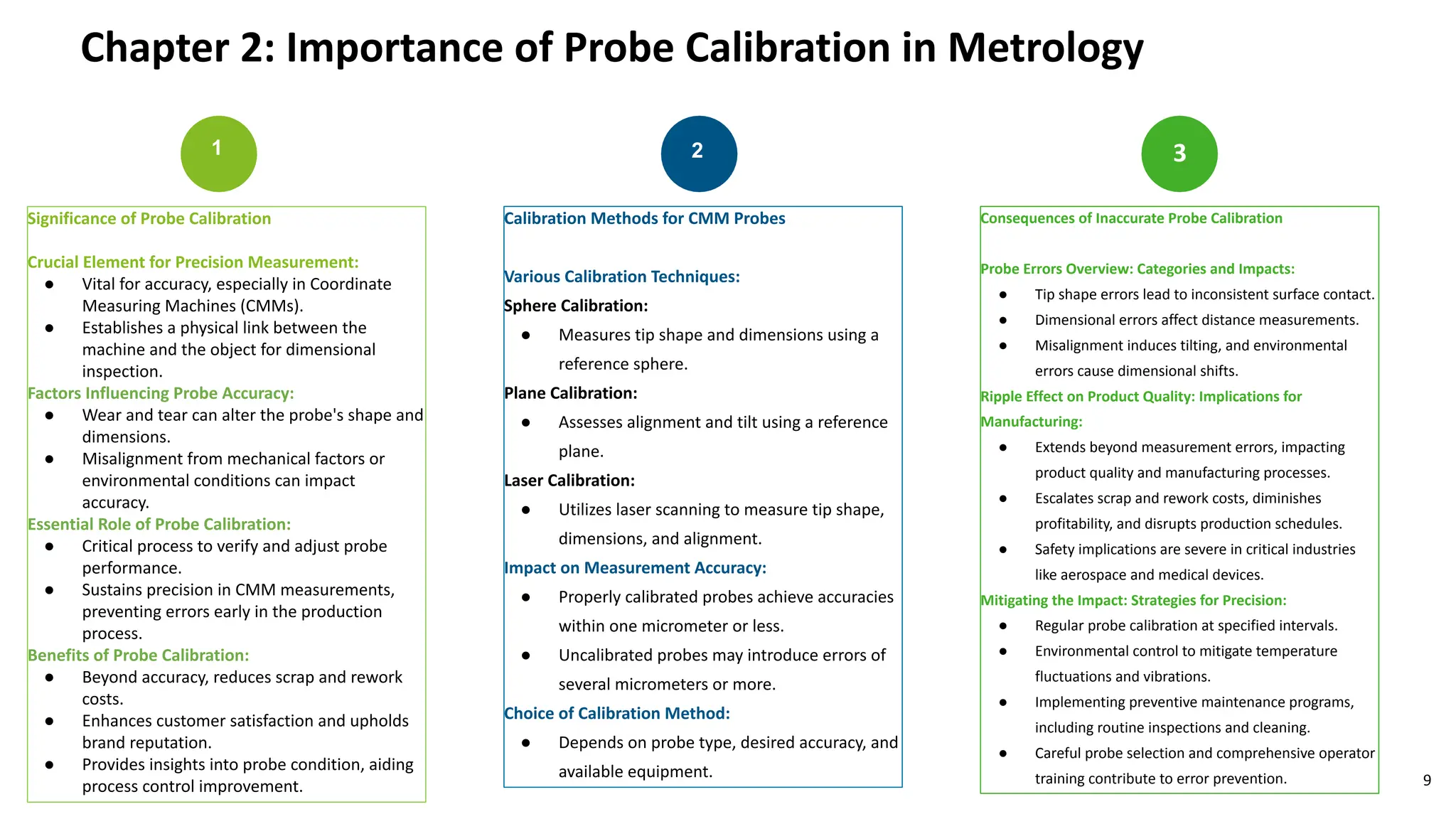
Chapter 2: Importance of Probe Calibration in Metrology
Calibration Methods for CMM Probes
Various Calibration Techniques:
Sphere Calibration:
● Measures tip shape and dimensions using a
reference sphere.
Plane Calibration:
● Assesses alignment and tilt using a reference
plane.
Laser Calibration:
● Utilizes laser scanning to measure tip shape,
dimensions, and alignment.
Impact on Measurement Accuracy:
● Properly calibrated probes achieve accuracies
within one micrometer or less.
● Uncalibrated probes may introduce errors of
several micrometers or more.
Choice of Calibration Method:
● Depends on probe type, desired accuracy, and
available equipment.
3
Consequences of Inaccurate Probe Calibration
Probe Errors Overview: Categories and Impacts:
● Tip shape errors lead to inconsistent surface contact.
● Dimensional errors affect distance measurements.
● Misalignment induces tilting, and environmental
errors cause dimensional shifts.
Ripple Effect on Product Quality: Implications for
Manufacturing:
● Extends beyond measurement errors, impacting
product quality and manufacturing processes.
● Escalates scrap and rework costs, diminishes
profitability, and disrupts production schedules.
● Safety implications are severe in critical industries
like aerospace and medical devices.
Mitigating the Impact: Strategies for Precision:
● Regular probe calibration at specified intervals.
● Environmental control to mitigate temperature
fluctuations and vibrations.
● Implementing preventive maintenance programs,
including routine inspections and cleaning.
● Careful probe selection and comprehensive operator
training contribute to error prevention.
Significance of Probe Calibration
Crucial Element for Precision Measurement:
● Vital for accuracy, especially in Coordinate
Measuring Machines (CMMs).
● Establishes a physical link between the
machine and the object for dimensional
inspection.
Factors Influencing Probe Accuracy:
● Wear and tear can alter the probe's shape and
dimensions.
● Misalignment from mechanical factors or
environmental conditions can impact
accuracy.
Essential Role of Probe Calibration:
● Critical process to verify and adjust probe
performance.
● Sustains precision in CMM measurements,
preventing errors early in the production
process.
Benefits of Probe Calibration:
● Beyond accuracy, reduces scrap and rework
costs.
● Enhances customer satisfaction and upholds
brand reputation.
● Provides insights into probe condition, aiding
process control improvement.
2
1
10
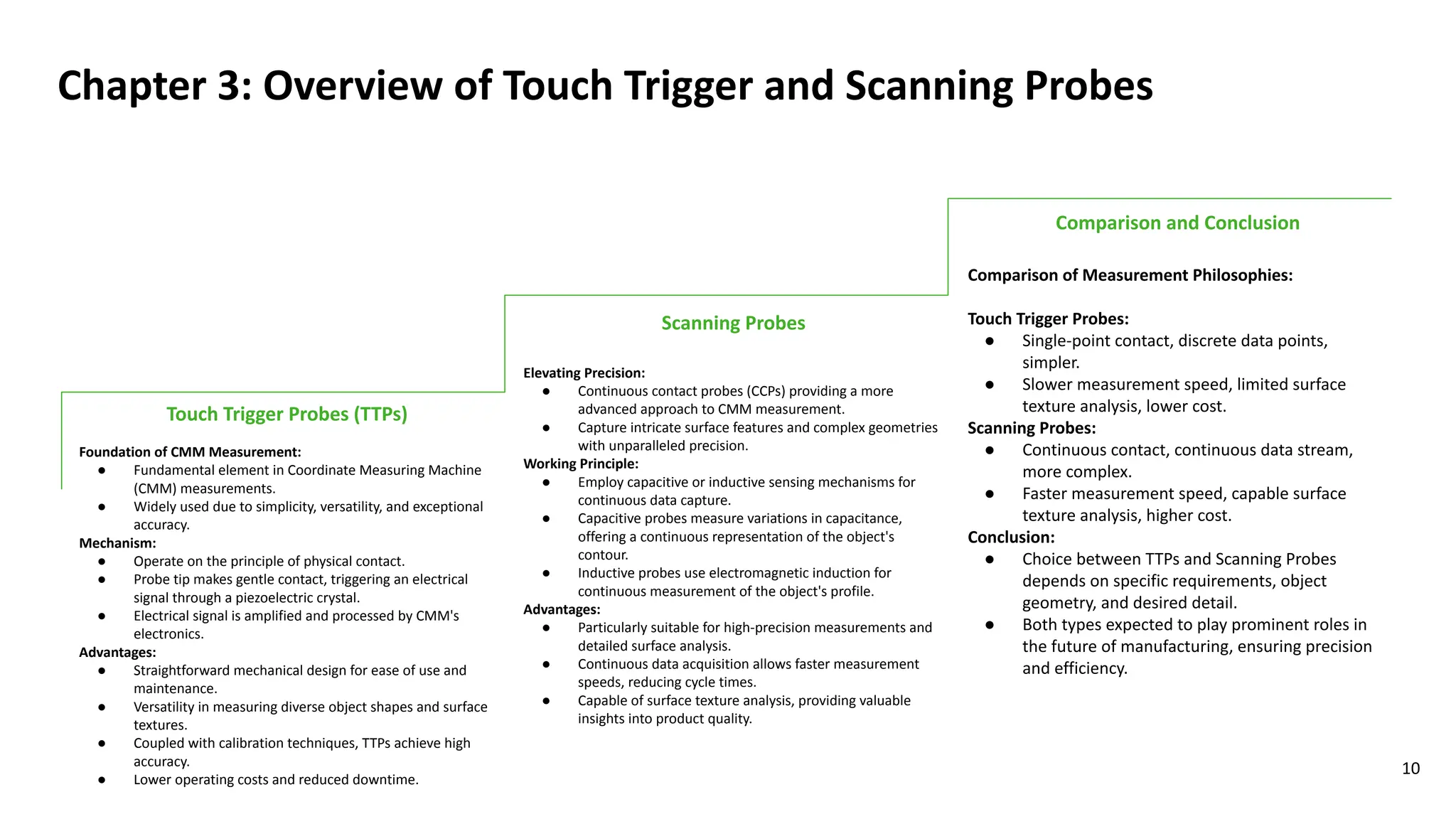
Chapter 3: Overview of Touch Trigger and Scanning Probes
Foundation of CMM Measurement:
● Fundamental element in Coordinate Measuring Machine
(CMM) measurements.
● Widely used due to simplicity, versatility, and exceptional
accuracy.
Mechanism:
● Operate on the principle of physical contact.
● Probe tip makes gentle contact, triggering an electrical
signal through a piezoelectric crystal.
● Electrical signal is amplified and processed by CMM's
electronics.
Advantages:
● Straightforward mechanical design for ease of use and
maintenance.
● Versatility in measuring diverse object shapes and surface
textures.
● Coupled with calibration techniques, TTPs achieve high
accuracy.
● Lower operating costs and reduced downtime.
Touch Trigger Probes (TTPs)
Scanning Probes
Comparison and Conclusion
Elevating Precision:
● Continuous contact probes (CCPs) providing a more
advanced approach to CMM measurement.
● Capture intricate surface features and complex geometries
with unparalleled precision.
Working Principle:
● Employ capacitive or inductive sensing mechanisms for
continuous data capture.
● Capacitive probes measure variations in capacitance,
offering a continuous representation of the object's
contour.
● Inductive probes use electromagnetic induction for
continuous measurement of the object's profile.
Advantages:
● Particularly suitable for high-precision measurements and
detailed surface analysis.
● Continuous data acquisition allows faster measurement
speeds, reducing cycle times.
● Capable of surface texture analysis, providing valuable
insights into product quality.
Comparison of Measurement Philosophies:
Touch Trigger Probes:
● Single-point contact, discrete data points,
simpler.
● Slower measurement speed, limited surface
texture analysis, lower cost.
Scanning Probes:
● Continuous contact, continuous data stream,
more complex.
● Faster measurement speed, capable surface
texture analysis, higher cost.
Conclusion:
● Choice between TTPs and Scanning Probes
depends on specific requirements, object
geometry, and desired detail.
● Both types expected to play prominent roles in
the future of manufacturing, ensuring precision
and efficiency.
10
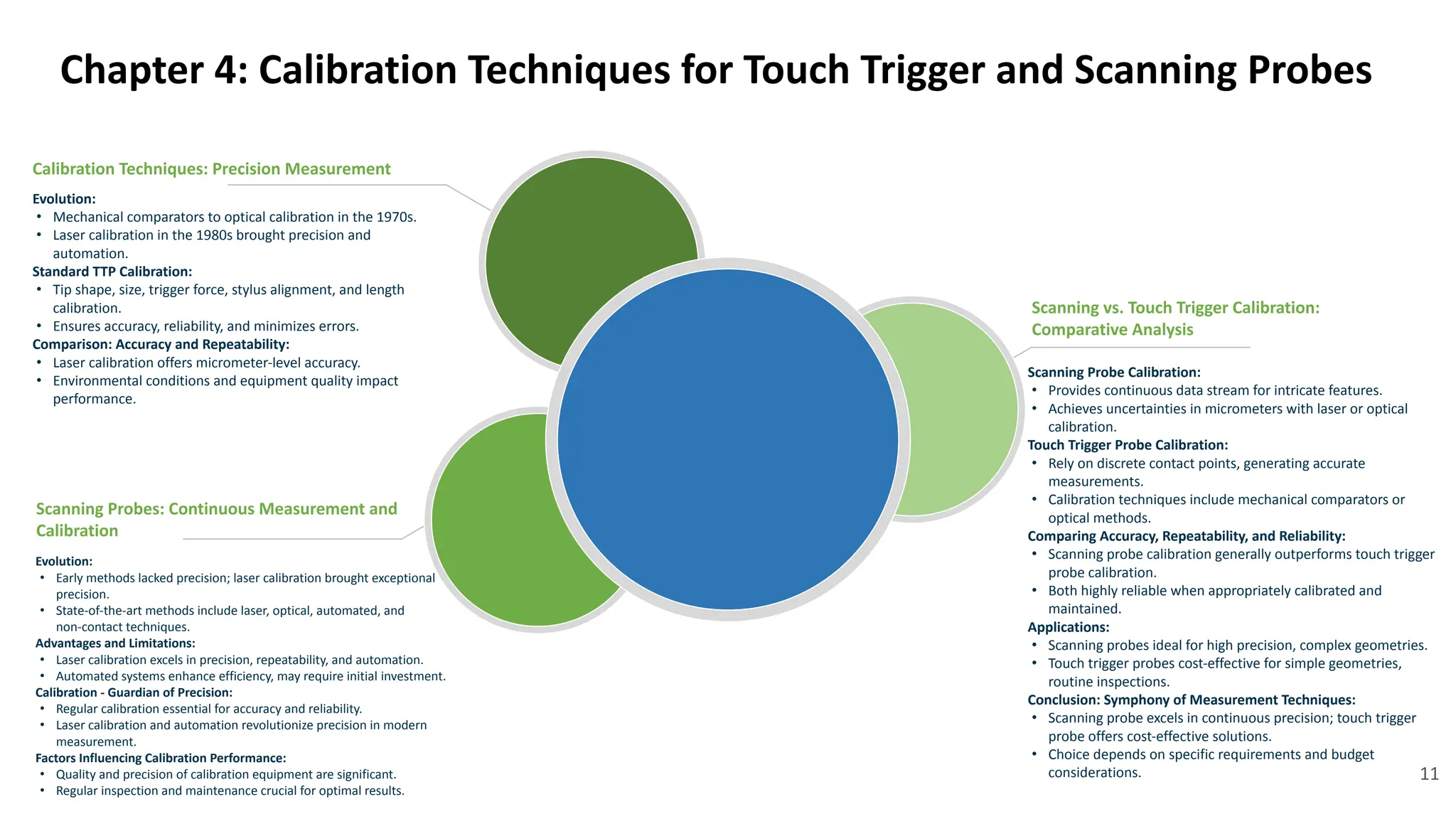
Chapter 4: Calibration Techniques for Touch Trigger and Scanning Probes
Evolution:
• Mechanical comparators to optical calibration in the 1970s.
• Laser calibration in the 1980s brought precision and
automation.
Standard TTP Calibration:
• Tip shape, size, trigger force, stylus alignment, and length
calibration.
• Ensures accuracy, reliability, and minimizes errors.
Comparison: Accuracy and Repeatability:
• Laser calibration offers micrometer-level accuracy.
• Environmental conditions and equipment quality impact
performance.
Calibration Techniques: Precision Measurement
Scanning Probe Calibration:
• Provides continuous data stream for intricate features.
• Achieves uncertainties in micrometers with laser or optical
calibration.
Touch Trigger Probe Calibration:
• Rely on discrete contact points, generating accurate
measurements.
• Calibration techniques include mechanical comparators or
optical methods.
Comparing Accuracy, Repeatability, and Reliability:
• Scanning probe calibration generally outperforms touch trigger
probe calibration.
• Both highly reliable when appropriately calibrated and
maintained.
Applications:
• Scanning probes ideal for high precision, complex geometries.
• Touch trigger probes cost-effective for simple geometries,
routine inspections.
Conclusion: Symphony of Measurement Techniques:
• Scanning probe excels in continuous precision; touch trigger
probe offers cost-effective solutions.
• Choice depends on specific requirements and budget
considerations.
Scanning vs. Touch Trigger Calibration:
Comparative Analysis
Evolution:
• Early methods lacked precision; laser calibration brought exceptional
precision.
• State-of-the-art methods include laser, optical, automated, and
non-contact techniques.
Advantages and Limitations:
• Laser calibration excels in precision, repeatability, and automation.
• Automated systems enhance efficiency, may require initial investment.
Calibration - Guardian of Precision:
• Regular calibration essential for accuracy and reliability.
• Laser calibration and automation revolutionize precision in modern
measurement.
Factors Influencing Calibration Performance:
• Quality and precision of calibration equipment are significant.
• Regular inspection and maintenance crucial for optimal results.
Scanning Probes: Continuous Measurement and
Calibration
11
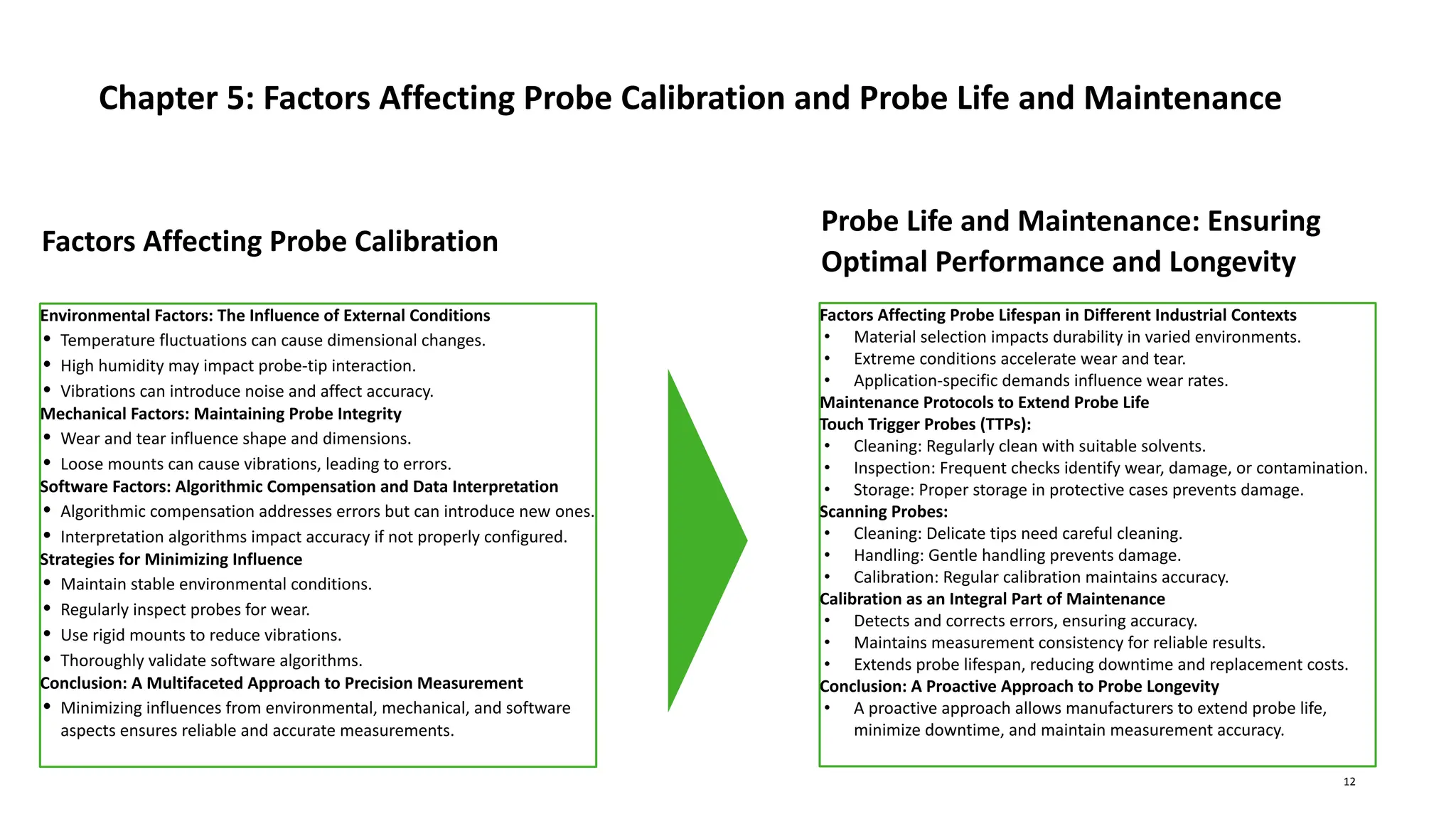
Chapter 5: Factors Affecting Probe Calibration and Probe Life and Maintenance
Factors Affecting Probe Calibration
Factors Affecting Probe Lifespan in Different Industrial Contexts
• Material selection impacts durability in varied environments.
• Extreme conditions accelerate wear and tear.
• Application-specific demands influence wear rates.
Maintenance Protocols to Extend Probe Life
Touch Trigger Probes (TTPs):
• Cleaning: Regularly clean with suitable solvents.
• Inspection: Frequent checks identify wear, damage, or contamination.
• Storage: Proper storage in protective cases prevents damage.
Scanning Probes:
• Cleaning: Delicate tips need careful cleaning.
• Handling: Gentle handling prevents damage.
• Calibration: Regular calibration maintains accuracy.
Calibration as an Integral Part of Maintenance
• Detects and corrects errors, ensuring accuracy.
• Maintains measurement consistency for reliable results.
• Extends probe lifespan, reducing downtime and replacement costs.
Conclusion: A Proactive Approach to Probe Longevity
• A proactive approach allows manufacturers to extend probe life,
minimize downtime, and maintain measurement accuracy.
Environmental Factors: The Influence of External Conditions
• Temperature fluctuations can cause dimensional changes.
• High humidity may impact probe-tip interaction.
• Vibrations can introduce noise and affect accuracy.
Mechanical Factors: Maintaining Probe Integrity
• Wear and tear influence shape and dimensions.
• Loose mounts can cause vibrations, leading to errors.
Software Factors: Algorithmic Compensation and Data Interpretation
• Algorithmic compensation addresses errors but can introduce new ones.
• Interpretation algorithms impact accuracy if not properly configured.
Strategies for Minimizing Influence
• Maintain stable environmental conditions.
• Regularly inspect probes for wear.
• Use rigid mounts to reduce vibrations.
• Thoroughly validate software algorithms.
Conclusion: A Multifaceted Approach to Precision Measurement
• Minimizing influences from environmental, mechanical, and software
aspects ensures reliable and accurate measurements.
12
Probe Life and Maintenance: Ensuring
Optimal Performance and Longevity
Chapter 6: Advancements in Probe Calibration
Impactful Maintenance: Calibration
Accuracy Case Studies
Probe Calibration Innovations
1. Automotive Manufacturing:
• Issue: Inconsistent CMM measurements.
• Solution: Proactive maintenance (cleaning, inspection, calibration).
• Result: 20% reduction in measurement uncertainty, fewer defects.
2. Medical Device Manufacturing:
• Issue: Inconsistent results with scanning probes.
• Solution: Quarterly calibration schedule.
• Result: 30% reduction in measurement uncertainty, maintaining quality.
Quantifying Improvements:
• Measure changes in uncertainty and consistency.
• Justify maintenance investment.
• Demonstrate ROI of proactive maintenance.
1. Automated Techniques:
• Benefits: Time reduction, improved consistency.
• Limitations: Initial investment, complexity.
2. Material Advancements:
• Innovations: Diamond coatings, advanced ceramics, composites.
• Impacts: Reduced wear, improved accuracy, broader applications.
• Future: Self-lubricating materials, nanomaterials, sensor integration.
3. Software Improvements:
• Advancements: Algorithmic compensation, precise data interpretation.
• Impacts: Reduced uncertainty, enhanced surface analysis, automated error detection.
• Future: Machine learning, real-time correction, CMM system integration.
Conclusion: Symphony of Probe Calibration Innovation
• Collective innovation enhances probe calibration for precise CMM measurements.
• Proactive maintenance and technological advancements ensure accuracy and reliability.
14

Metrology Project PresentationPresentation

  • 1.
    Aaron Bimbrahw December 2023 PrecisionUnleashed: Navigating the World of CMM Probes, Cutting-edge CMM Technology, and the Art of Probe Calibration 1
  • 2.
    2 Flow of theProject Report S.No. Topic Description and Contents Page No. 1 Coordinate Measuring Machine (CMM) Technology • Define CMMs and their role in quality control • Principles of Operation of CMMs • Types of CMMs and Their Applications 3 2 Importance of Probe Calibration in Metrology • Impact of Probe Calibration on Measurement Accuracy • Consequences of Inaccurate Probe Calibration • Importance of Regular Probe Calibration 6 3 Overview of Touch Trigger and Scanning Probes • Working Principle of Touch Trigger Probes • Concept of Scanning Probes and Their Advantages • Comparison of Touch-Trigger and Scanning Probes 7 4 Calibration Techniques for Touch Trigger and Scanning Probes • Historical Development of Probe Calibration • Standard Calibration Methods • Comparison of Accuracy and Repeatability in Different Techniques 9 5 Factors Affecting Probe Calibration and Probe Life and Maintenance • Environmental Factors, Mechanical Factors, Software Factors. • Examination of Probe Lifespan in Various Industrial Contexts • Maintenance Protocols to Extend Probe Life 15 6 Advancements in Probe Calibration • Case Studies on the Impact of Maintenance on Calibration Accuracy • Advances in Material Science for Probe Construction • Software Improvements for More Accurate Data Interpretation 6
  • 3.
    How did wego about creating the Project ? ● Finding out the overlaps in data science and metrology. ● After extensive research on both the things we came to 4 topics. ● Utilize limited metrology machine data to generate datasets and accurate measurements beyond machine limits, enhancing measurement capabilities. ● Develop a model using a comprehensive dataset of internal and external conditions to predict deviations in measurements, facilitating controlled experimentation with specific deviations. ● Leverage data to create a model for rapidly designing optimal product shapes and forms, streamlining engineering processes in the industry. ● Implement data-driven models to predict optimal calibration times for CMM probes, addressing the ambiguity and subjectivity in determining when to calibrate. 3 StepWise Progression
  • 4.
    Why is thistopic important and what all can this research achieve ? 3. Quality Assurance 4. Productivity Gains 5. Reduced Variability 2. Cost Savings 1. Efficiency Boost 8. Preventive Maintenance 9. Resource Optimization 10. Continuous Improvement 7. Data-Driven Decision-Making 6. Compliance Confidence Predictive software optimizes CMM probe calibration, reducing downtime and ensuring continuous manufacturing efficiency. The software supports adherence to industry standards, regulatory requirements, and quality control through accurate calibration records. Calibration prediction minimizes measurement variability, ensuring more consistent and reliable manufacturing processes. Leveraging historical calibration data contributes to ongoing process optimization and informs better maintenance practices in manufacturing. Accurate prediction minimizes unnecessary calibrations, saving costs on maintenance and ensuring resource efficiency. Informed decisions on probe calibration schedules optimize precision while maintaining operational continuity. Consistent calibration enhances measurement accuracy, leading to higher-quality manufacturing outputs and reducing the risk of defects. Calibration prediction shifts to proactive maintenance, preventing issues before they impact production and reducing the risk of breakdowns. Better maintenance planning prevents unexpected disruptions, contributing to increased overall productivity in manufacturing. Efficient calibration schedules allow for strategic resource allocation, minimizing manpower and resources dedicated to unplanned maintenance. 4
  • 5.
    5 Workflow for allthe programming and machine learning involved along with algorithm selection 5 Data Driven Calibration Prediction Model
  • 6.
    6 Flow for themain portion of the project The Model Feature Selection Selection what all features would contribute to probe wear and tear. Model Validation Ran the model on multiple datasets which were very varying while creating the model at all steps to cross check for any errors. Statistical Methods Researched about various such methods to use on the model. Data Analysis For which we discussed and researched upon various ML models and algorithms that we can use. We chose random forest ML Model for our research. Data Collection Keeping the test dataset separately and in place, along with the main dataset containing as scattered data as possible for model versatility. Data Pre-Processing I performed the data cleaning and other data pre-processing activities before the data could be fed into the model to generate the intended outputs. 6
  • 7.
    Last Few Stepsto Project Completion • I have systematically reviewed a wide range of scholarly literature to establish the context for our research. This compilation spans research papers, academic journals, and industry publications, providing a comprehensive understanding of the current landscape. Our project's findings, grounded in this extensive literature, not only validate our methodology but also contribute unique insights to the ongoing scholarly discourse. This formalized literature review underscores the depth and rigor of our research approach. • Let’s now dive into a sneak peak into all the chapters of the report. • Now we had to decide what all variables to include in the model, for which we went through lots of research papers, machine manuals, practice guides and data handbooks to decide the variables which we collated in a doc. 7
  • 8.
    Chapter 1: CoordinateMeasuring Machine (CMM) Technology Introduction to Precision: • Precision is crucial in manufacturing. • CMMs ensure quality control through accurate dimensional measurements. Versatility of CMMs: • Utilize probing mechanisms for precise measurements. • Applicable across industries, including aerospace, medical, and diverse product categories. Role in Quality Control: • Cornerstone instruments for verifying dimensional accuracy. • Detect errors, monitor consistency, and optimize processes for cost reduction. Impact on Quality Assurance: • Revolutionize manufacturing, reducing costs and ensuring compliance. • Future integration into Industry 4.0 for enhanced precision. CMM Components: • Measuring probe, head, machine structure, and controller with software. Measuring Process: • Step-by-step guide includes alignment, probe selection, calibration, programming, and data processing. Applications Across Industries: • Versatile usage in automotive, aerospace, medical devices, electronics, and heavy machinery. Types of CMMs: • Bridge, Cantilever, Gantry, Horizontal-Arm, and Portable CMMs cater to diverse measurement needs. Specialized CMMs: • Vision CMMs for non-contact inspection, CT Scanning CMMs for three-dimensional images, and Robotic CMMs for automated measurement. Automotive: • Critical for measuring engine blocks, transmission components, and parts adherence to design tolerances. Aerospace: • Verify aircraft component dimensions for structural integrity and safety. Medical Devices: • Measure implants, surgical instruments, and precision components for accuracy. Electronics: • Assure dimensional accuracy for printed circuit boards, semiconductor components, and electronic assemblies. Heavy Machinery Manufacturing: • Measure large-scale components like machine frames, gears, and turbines for precision and functionality. 8 CMMs in Quality Control Principles of Operation Diverse Applications of CMMs Applications Across Industries
  • 9.
    9 Chapter 2: Importanceof Probe Calibration in Metrology Calibration Methods for CMM Probes Various Calibration Techniques: Sphere Calibration: ● Measures tip shape and dimensions using a reference sphere. Plane Calibration: ● Assesses alignment and tilt using a reference plane. Laser Calibration: ● Utilizes laser scanning to measure tip shape, dimensions, and alignment. Impact on Measurement Accuracy: ● Properly calibrated probes achieve accuracies within one micrometer or less. ● Uncalibrated probes may introduce errors of several micrometers or more. Choice of Calibration Method: ● Depends on probe type, desired accuracy, and available equipment. 3 Consequences of Inaccurate Probe Calibration Probe Errors Overview: Categories and Impacts: ● Tip shape errors lead to inconsistent surface contact. ● Dimensional errors affect distance measurements. ● Misalignment induces tilting, and environmental errors cause dimensional shifts. Ripple Effect on Product Quality: Implications for Manufacturing: ● Extends beyond measurement errors, impacting product quality and manufacturing processes. ● Escalates scrap and rework costs, diminishes profitability, and disrupts production schedules. ● Safety implications are severe in critical industries like aerospace and medical devices. Mitigating the Impact: Strategies for Precision: ● Regular probe calibration at specified intervals. ● Environmental control to mitigate temperature fluctuations and vibrations. ● Implementing preventive maintenance programs, including routine inspections and cleaning. ● Careful probe selection and comprehensive operator training contribute to error prevention. Significance of Probe Calibration Crucial Element for Precision Measurement: ● Vital for accuracy, especially in Coordinate Measuring Machines (CMMs). ● Establishes a physical link between the machine and the object for dimensional inspection. Factors Influencing Probe Accuracy: ● Wear and tear can alter the probe's shape and dimensions. ● Misalignment from mechanical factors or environmental conditions can impact accuracy. Essential Role of Probe Calibration: ● Critical process to verify and adjust probe performance. ● Sustains precision in CMM measurements, preventing errors early in the production process. Benefits of Probe Calibration: ● Beyond accuracy, reduces scrap and rework costs. ● Enhances customer satisfaction and upholds brand reputation. ● Provides insights into probe condition, aiding process control improvement. 2 1
  • 10.
    10 Chapter 3: Overviewof Touch Trigger and Scanning Probes Foundation of CMM Measurement: ● Fundamental element in Coordinate Measuring Machine (CMM) measurements. ● Widely used due to simplicity, versatility, and exceptional accuracy. Mechanism: ● Operate on the principle of physical contact. ● Probe tip makes gentle contact, triggering an electrical signal through a piezoelectric crystal. ● Electrical signal is amplified and processed by CMM's electronics. Advantages: ● Straightforward mechanical design for ease of use and maintenance. ● Versatility in measuring diverse object shapes and surface textures. ● Coupled with calibration techniques, TTPs achieve high accuracy. ● Lower operating costs and reduced downtime. Touch Trigger Probes (TTPs) Scanning Probes Comparison and Conclusion Elevating Precision: ● Continuous contact probes (CCPs) providing a more advanced approach to CMM measurement. ● Capture intricate surface features and complex geometries with unparalleled precision. Working Principle: ● Employ capacitive or inductive sensing mechanisms for continuous data capture. ● Capacitive probes measure variations in capacitance, offering a continuous representation of the object's contour. ● Inductive probes use electromagnetic induction for continuous measurement of the object's profile. Advantages: ● Particularly suitable for high-precision measurements and detailed surface analysis. ● Continuous data acquisition allows faster measurement speeds, reducing cycle times. ● Capable of surface texture analysis, providing valuable insights into product quality. Comparison of Measurement Philosophies: Touch Trigger Probes: ● Single-point contact, discrete data points, simpler. ● Slower measurement speed, limited surface texture analysis, lower cost. Scanning Probes: ● Continuous contact, continuous data stream, more complex. ● Faster measurement speed, capable surface texture analysis, higher cost. Conclusion: ● Choice between TTPs and Scanning Probes depends on specific requirements, object geometry, and desired detail. ● Both types expected to play prominent roles in the future of manufacturing, ensuring precision and efficiency. 10
  • 11.
    Chapter 4: CalibrationTechniques for Touch Trigger and Scanning Probes Evolution: • Mechanical comparators to optical calibration in the 1970s. • Laser calibration in the 1980s brought precision and automation. Standard TTP Calibration: • Tip shape, size, trigger force, stylus alignment, and length calibration. • Ensures accuracy, reliability, and minimizes errors. Comparison: Accuracy and Repeatability: • Laser calibration offers micrometer-level accuracy. • Environmental conditions and equipment quality impact performance. Calibration Techniques: Precision Measurement Scanning Probe Calibration: • Provides continuous data stream for intricate features. • Achieves uncertainties in micrometers with laser or optical calibration. Touch Trigger Probe Calibration: • Rely on discrete contact points, generating accurate measurements. • Calibration techniques include mechanical comparators or optical methods. Comparing Accuracy, Repeatability, and Reliability: • Scanning probe calibration generally outperforms touch trigger probe calibration. • Both highly reliable when appropriately calibrated and maintained. Applications: • Scanning probes ideal for high precision, complex geometries. • Touch trigger probes cost-effective for simple geometries, routine inspections. Conclusion: Symphony of Measurement Techniques: • Scanning probe excels in continuous precision; touch trigger probe offers cost-effective solutions. • Choice depends on specific requirements and budget considerations. Scanning vs. Touch Trigger Calibration: Comparative Analysis Evolution: • Early methods lacked precision; laser calibration brought exceptional precision. • State-of-the-art methods include laser, optical, automated, and non-contact techniques. Advantages and Limitations: • Laser calibration excels in precision, repeatability, and automation. • Automated systems enhance efficiency, may require initial investment. Calibration - Guardian of Precision: • Regular calibration essential for accuracy and reliability. • Laser calibration and automation revolutionize precision in modern measurement. Factors Influencing Calibration Performance: • Quality and precision of calibration equipment are significant. • Regular inspection and maintenance crucial for optimal results. Scanning Probes: Continuous Measurement and Calibration 11
  • 12.
    Chapter 5: FactorsAffecting Probe Calibration and Probe Life and Maintenance Factors Affecting Probe Calibration Factors Affecting Probe Lifespan in Different Industrial Contexts • Material selection impacts durability in varied environments. • Extreme conditions accelerate wear and tear. • Application-specific demands influence wear rates. Maintenance Protocols to Extend Probe Life Touch Trigger Probes (TTPs): • Cleaning: Regularly clean with suitable solvents. • Inspection: Frequent checks identify wear, damage, or contamination. • Storage: Proper storage in protective cases prevents damage. Scanning Probes: • Cleaning: Delicate tips need careful cleaning. • Handling: Gentle handling prevents damage. • Calibration: Regular calibration maintains accuracy. Calibration as an Integral Part of Maintenance • Detects and corrects errors, ensuring accuracy. • Maintains measurement consistency for reliable results. • Extends probe lifespan, reducing downtime and replacement costs. Conclusion: A Proactive Approach to Probe Longevity • A proactive approach allows manufacturers to extend probe life, minimize downtime, and maintain measurement accuracy. Environmental Factors: The Influence of External Conditions • Temperature fluctuations can cause dimensional changes. • High humidity may impact probe-tip interaction. • Vibrations can introduce noise and affect accuracy. Mechanical Factors: Maintaining Probe Integrity • Wear and tear influence shape and dimensions. • Loose mounts can cause vibrations, leading to errors. Software Factors: Algorithmic Compensation and Data Interpretation • Algorithmic compensation addresses errors but can introduce new ones. • Interpretation algorithms impact accuracy if not properly configured. Strategies for Minimizing Influence • Maintain stable environmental conditions. • Regularly inspect probes for wear. • Use rigid mounts to reduce vibrations. • Thoroughly validate software algorithms. Conclusion: A Multifaceted Approach to Precision Measurement • Minimizing influences from environmental, mechanical, and software aspects ensures reliable and accurate measurements. 12 Probe Life and Maintenance: Ensuring Optimal Performance and Longevity
  • 13.
    Chapter 6: Advancementsin Probe Calibration Impactful Maintenance: Calibration Accuracy Case Studies Probe Calibration Innovations 1. Automotive Manufacturing: • Issue: Inconsistent CMM measurements. • Solution: Proactive maintenance (cleaning, inspection, calibration). • Result: 20% reduction in measurement uncertainty, fewer defects. 2. Medical Device Manufacturing: • Issue: Inconsistent results with scanning probes. • Solution: Quarterly calibration schedule. • Result: 30% reduction in measurement uncertainty, maintaining quality. Quantifying Improvements: • Measure changes in uncertainty and consistency. • Justify maintenance investment. • Demonstrate ROI of proactive maintenance. 1. Automated Techniques: • Benefits: Time reduction, improved consistency. • Limitations: Initial investment, complexity. 2. Material Advancements: • Innovations: Diamond coatings, advanced ceramics, composites. • Impacts: Reduced wear, improved accuracy, broader applications. • Future: Self-lubricating materials, nanomaterials, sensor integration. 3. Software Improvements: • Advancements: Algorithmic compensation, precise data interpretation. • Impacts: Reduced uncertainty, enhanced surface analysis, automated error detection. • Future: Machine learning, real-time correction, CMM system integration. Conclusion: Symphony of Probe Calibration Innovation • Collective innovation enhances probe calibration for precise CMM measurements. • Proactive maintenance and technological advancements ensure accuracy and reliability.
  • 14.