Covariance Matrix Adaptation Evolution
Strategy (CMA-ES)
BY:
OSAMA SALAH ELDIN
UNDER SUPERVISION:
PROF. MAGDA B. FAYEK
6/3/2016 CAIRO UNIVERSITY - COMPUTER ENGINEERING - 2015
Outline
oWhat is Optimization?
oWhat is an Evolution Strategy?
oStep-size Adaptation
oCumulative step-size adaptation
oCovariance Matrix Adaptation
oApplication - Modeling
6/3/2016 CAIRO UNIVERSITY - COMPUTER ENGINEERING - 2015 2
What is optimization?
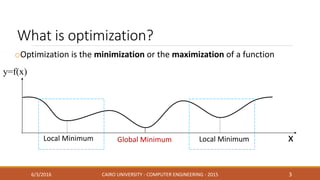
oOptimization is the minimization or the maximization of a function
6/3/2016 CAIRO UNIVERSITY - COMPUTER ENGINEERING - 2015 3
y=f(x)
Global MinimumLocal Minimum xLocal Minimum
What is optimization?
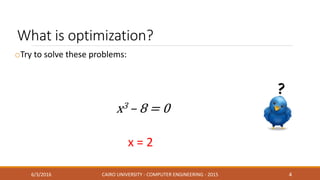
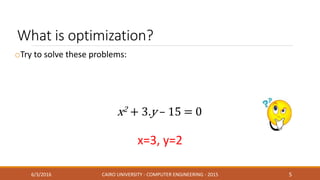
oTry to solve these problems:
6/3/2016 CAIRO UNIVERSITY - COMPUTER ENGINEERING - 2015 4
x = 2
x3 – 8 = 0
What is optimization?
oTry to solve these problems:
6/3/2016 CAIRO UNIVERSITY - COMPUTER ENGINEERING - 2015 5
x=3, y=2
x2 + 3.y – 15 = 0
What is optimization?
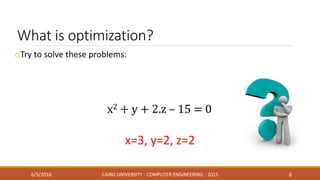
oTry to solve these problems:
6/3/2016 CAIRO UNIVERSITY - COMPUTER ENGINEERING - 2015 6
x=3, y=2, z=2
x2 + y + 2.z – 15 = 0
What is optimization?
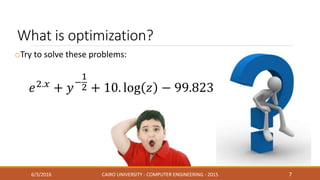
oTry to solve these problems:
6/3/2016 CAIRO UNIVERSITY - COMPUTER ENGINEERING - 2015 7
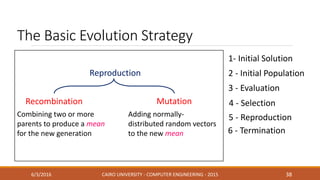
What is optimization?
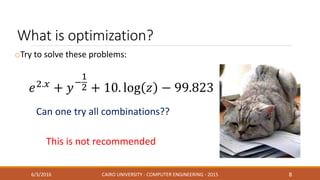
oTry to solve these problems:
6/3/2016 CAIRO UNIVERSITY - COMPUTER ENGINEERING - 2015 8
Can one try all combinations??
This is not recommended
What is optimization?
6/3/2016 CAIRO UNIVERSITY - COMPUTER ENGINEERING - 2015 9
Use an evolution strategy
Outline
oWhat is Optimization?
oWhat is an Evolution Strategy?
oStep-size Adaptation
oCumulative step-size adaptation
oCovariance Matrix Adaptation
oApplication - Modeling
6/3/2016 CAIRO UNIVERSITY - COMPUTER ENGINEERING - 2015 10
6/3/2016 CAIRO UNIVERSITY - COMPUTER ENGINEERING - 2015 11
What is an Evolution Strategy?
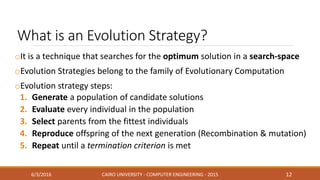
oIt is a technique that searches for the optimum solution in a search-space
oEvolution Strategies belong to the family of Evolutionary Computation
oEvolution strategy steps:
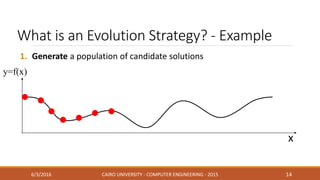
1. Generate a population of candidate solutions
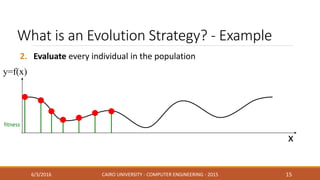
2. Evaluate every individual in the population
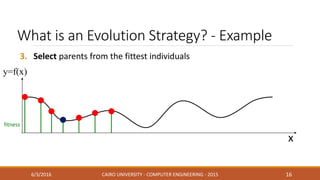
3. Select parents from the fittest individuals
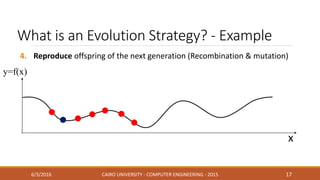
4. Reproduce offspring of the next generation (Recombination & mutation)
5. Repeat until a termination criterion is met
6/3/2016 CAIRO UNIVERSITY - COMPUTER ENGINEERING - 2015 12
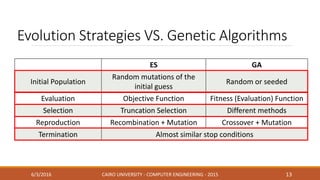
Evolution Strategies VS. Genetic Algorithms
ES GA
Initial Population
Random mutations of the
initial guess
Random or seeded
Evaluation Objective Function Fitness (Evaluation) Function
Selection Truncation Selection Different methods
Reproduction Recombination + Mutation Crossover + Mutation
Termination Almost similar stop conditions
6/3/2016 CAIRO UNIVERSITY - COMPUTER ENGINEERING - 2015 13
What is an Evolution Strategy? - Example
1. Generate a population of candidate solutions
6/3/2016 CAIRO UNIVERSITY - COMPUTER ENGINEERING - 2015 14
y=f(x)
x
fitness
What is an Evolution Strategy? - Example
2. Evaluate every individual in the population
6/3/2016 CAIRO UNIVERSITY - COMPUTER ENGINEERING - 2015 15
y=f(x)
x
fitness
What is an Evolution Strategy? - Example
3. Select parents from the fittest individuals
6/3/2016 CAIRO UNIVERSITY - COMPUTER ENGINEERING - 2015 16
y=f(x)
x
What is an Evolution Strategy? - Example
4. Reproduce offspring of the next generation (Recombination & mutation)
6/3/2016 CAIRO UNIVERSITY - COMPUTER ENGINEERING - 2015 17
y=f(x)
x
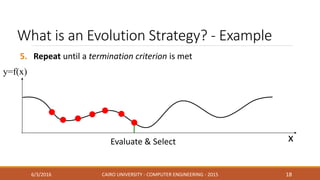
What is an Evolution Strategy? - Example
5. Repeat until a termination criterion is met
6/3/2016 CAIRO UNIVERSITY - COMPUTER ENGINEERING - 2015 18
y=f(x)
xEvaluate & Select
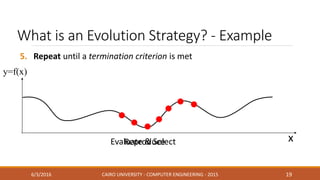
What is an Evolution Strategy? - Example
5. Repeat until a termination criterion is met
6/3/2016 CAIRO UNIVERSITY - COMPUTER ENGINEERING - 2015 19
y=f(x)
xEvaluate & SelectReproduce
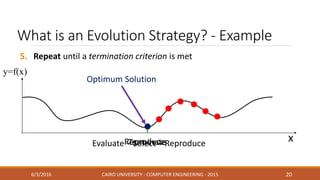
What is an Evolution Strategy? - Example
5. Repeat until a termination criterion is met
6/3/2016 CAIRO UNIVERSITY - COMPUTER ENGINEERING - 2015 20
y=f(x)
x
Optimum Solution
Evaluate – Select – ReproduceReproduceTerminate
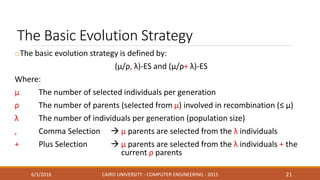
The Basic Evolution Strategy
oThe basic evolution strategy is defined by:
(µ/ρ, λ)-ES and (µ/ρ+ λ)-ES
Where:
µ The number of selected individuals per generation
ρ The number of parents (selected from µ) involved in recombination (≤ µ)
λ The number of individuals per generation (population size)
, Comma Selection  µ parents are selected from the λ individuals
+ Plus Selection  µ parents are selected from the λ individuals + the
current ρ parents
6/3/2016 CAIRO UNIVERSITY - COMPUTER ENGINEERING - 2015 21
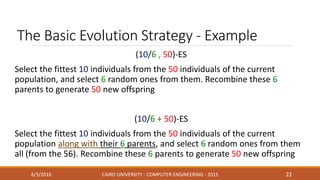
The Basic Evolution Strategy - Example
(10/6 , 50)-ES
Select the fittest 10 individuals from the 50 individuals of the current
population, and select 6 random ones from them. Recombine these 6
parents to generate 50 new offspring
(10/6 + 50)-ES
Select the fittest 10 individuals from the 50 individuals of the current
population along with their 6 parents, and select 6 random ones from them
all (from the 56). Recombine these 6 parents to generate 50 new offspring
6/3/2016 CAIRO UNIVERSITY - COMPUTER ENGINEERING - 2015 22
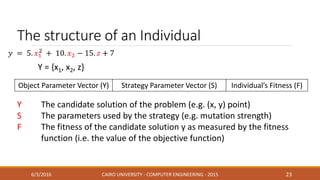
The structure of an Individual
Object Parameter Vector (Y) Strategy Parameter Vector (S) Individual’s Fitness (F)
6/3/2016 CAIRO UNIVERSITY - COMPUTER ENGINEERING - 2015 23
Y The candidate solution of the problem (e.g. (x, y) point)
S The parameters used by the strategy (e.g. mutation strength)
F The fitness of the candidate solution y as measured by the fitness
function (i.e. the value of the objective function)
Y = {x1, x2, z}
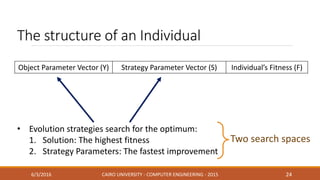
The structure of an Individual
Object Parameter Vector (Y) Strategy Parameter Vector (S) Individual’s Fitness (F)
6/3/2016 CAIRO UNIVERSITY - COMPUTER ENGINEERING - 2015 24
• Evolution strategies search for the optimum:
1. Solution: The highest fitness
2. Strategy Parameters: The fastest improvement
Two search spaces
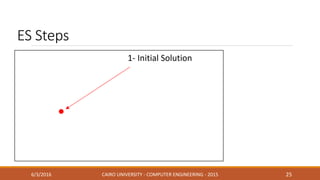
ES Steps
6/3/2016 CAIRO UNIVERSITY - COMPUTER ENGINEERING - 2015 25
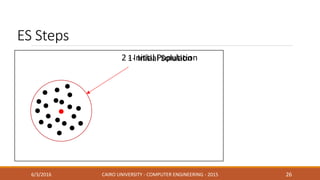
1- Initial Solution
2 - Initial Population
ES Steps
6/3/2016 CAIRO UNIVERSITY - COMPUTER ENGINEERING - 2015 26
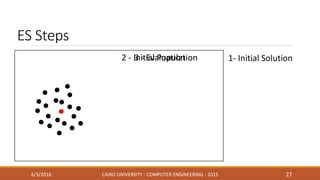
1- Initial Solution
2 - Initial Population
ES Steps
6/3/2016 CAIRO UNIVERSITY - COMPUTER ENGINEERING - 2015 27
3 - Evaluation 1- Initial Solution
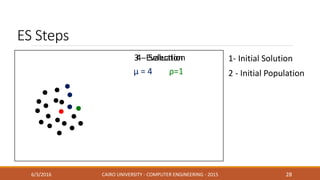
3 - Evaluation4 - Selection
ES Steps
6/3/2016 CAIRO UNIVERSITY - COMPUTER ENGINEERING - 2015 28
µ = 4 ρ=1 2 - Initial Population
1- Initial Solution
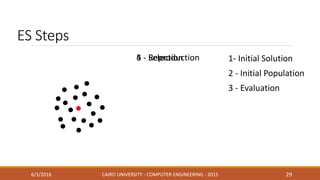
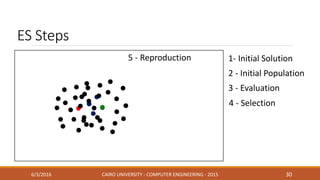
5 - Reproduction
ES Steps
6/3/2016 CAIRO UNIVERSITY - COMPUTER ENGINEERING - 2015 29
2 - Initial Population
1- Initial Solution
3 - Evaluation
4 - Selection
5 - Reproduction
ES Steps
6/3/2016 CAIRO UNIVERSITY - COMPUTER ENGINEERING - 2015 30
2 - Initial Population
1- Initial Solution
3 - Evaluation
4 - Selection
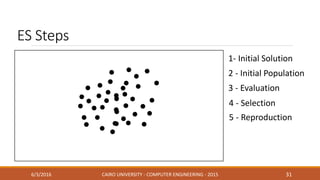
ES Steps
6/3/2016 CAIRO UNIVERSITY - COMPUTER ENGINEERING - 2015 31
2 - Initial Population
1- Initial Solution
3 - Evaluation
4 - Selection
5 - Reproduction
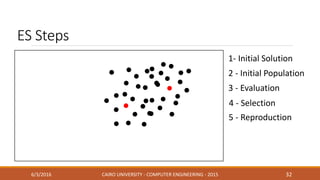
ES Steps
6/3/2016 CAIRO UNIVERSITY - COMPUTER ENGINEERING - 2015 32
2 - Initial Population
1- Initial Solution
3 - Evaluation
4 - Selection
5 - Reproduction
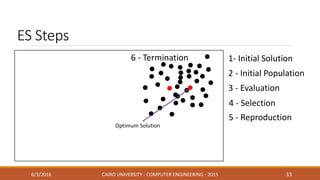
6 - Termination
ES Steps
6/3/2016 CAIRO UNIVERSITY - COMPUTER ENGINEERING - 2015 33
2 - Initial Population
1- Initial Solution
3 - Evaluation
4 - Selection
Optimum Solution
5 - Reproduction
The Basic Evolution Strategy
6/3/2016 CAIRO UNIVERSITY - COMPUTER ENGINEERING - 2015 34
2 - Initial Population
1- Initial Solution
3 - Evaluation
4 - Selection
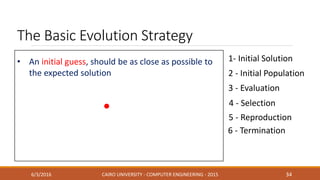
• An initial guess, should be as close as possible to
the expected solution
6 - Termination
5 - Reproduction
The Basic Evolution Strategy
6/3/2016 CAIRO UNIVERSITY - COMPUTER ENGINEERING - 2015 35
2 - Initial Population
1- Initial Solution
3 - Evaluation
4 - Selection
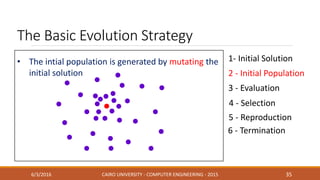
• The intial population is generated by mutating the
initial solution
6 - Termination
5 - Reproduction
The Basic Evolution Strategy
6/3/2016 CAIRO UNIVERSITY - COMPUTER ENGINEERING - 2015 36
2 - Initial Population
1- Initial Solution
3 - Evaluation
4 - Selection
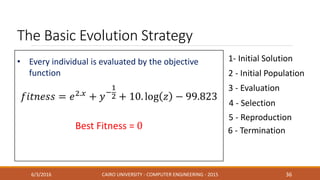
• Every individual is evaluated by the objective
function
6 - TerminationBest Fitness = 0
5 - Reproduction
The Basic Evolution Strategy
6/3/2016 CAIRO UNIVERSITY - COMPUTER ENGINEERING - 2015 37
2 - Initial Population
1- Initial Solution
3 - Evaluation
4 - Selection
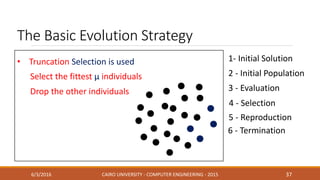
• Truncation Selection is used
6 - Termination
5 - Reproduction
Select the fittest µ individuals
Drop the other individuals
The Basic Evolution Strategy
6/3/2016 CAIRO UNIVERSITY - COMPUTER ENGINEERING - 2015 38
2 - Initial Population
1- Initial Solution
3 - Evaluation
4 - Selection
5 - Reproduction
6 - Termination
Recombination
Reproduction
Mutation
Combining two or more
parents to produce a mean
for the new generation
Adding normally-
distributed random vectors
to the new mean
The Basic Evolution Strategy
6/3/2016 CAIRO UNIVERSITY - COMPUTER ENGINEERING - 2015 39
2 - Initial Population
1- Initial Solution
3 - Evaluation
4 - Selection
5 - Reproduction
6 - Termination
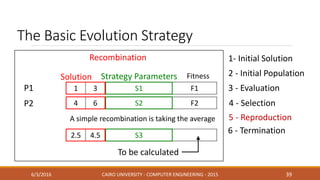
Recombination
S1 F11 3
S2 F24 6
Solution Strategy Parameters
S32.5 4.5
A simple recombination is taking the average
P1
P2
Fitness
To be calculated
The Basic Evolution Strategy
6/3/2016 CAIRO UNIVERSITY - COMPUTER ENGINEERING - 2015 40
2 - Initial Population
1- Initial Solution
3 - Evaluation
4 - Selection
5 - Reproduction
6 - Termination
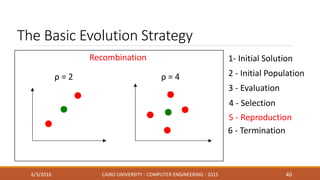
Recombination
ρ = 2 ρ = 4
The Basic Evolution Strategy
6/3/2016 CAIRO UNIVERSITY - COMPUTER ENGINEERING - 2015 41
2 - Initial Population
1- Initial Solution
3 - Evaluation
4 - Selection
5 - Reproduction
6 - Termination
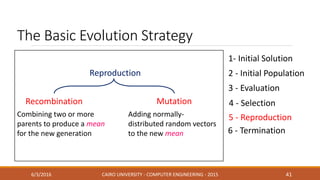
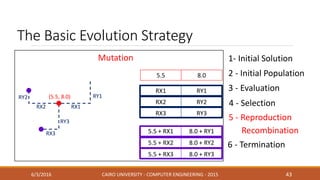
Recombination Mutation
Reproduction
Combining two or more
parents to produce a mean
for the new generation
Adding normally-
distributed random vectors
to the new mean
The Basic Evolution Strategy
6/3/2016 CAIRO UNIVERSITY - COMPUTER ENGINEERING - 2015 42
2 - Initial Population
1- Initial Solution
3 - Evaluation
4 - Selection
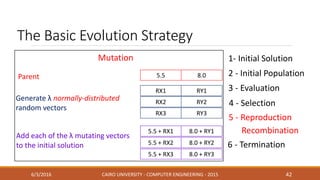
5.5 8.0Parent
RX1 RY1
Generate λ normally-distributed
random vectors
RX2 RY2
RX3 RY3
5.5 + RX1 8.0 + RY1
5.5 + RX2 8.0 + RY2
5.5 + RX3 8.0 + RY3
Add each of the λ mutating vectors
to the initial solution 6 - Termination
5 - Reproduction
Mutation
Recombination
The Basic Evolution Strategy
6/3/2016 CAIRO UNIVERSITY - COMPUTER ENGINEERING - 2015 43
2 - Initial Population
1- Initial Solution
3 - Evaluation
4 - Selection
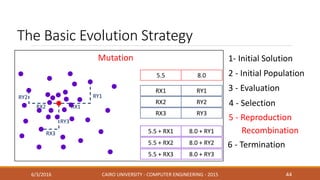
5.5 8.0
RX1 RY1
RX2 RY2
RX3 RY3
RX1
RY1
5.5 + RX1 8.0 + RY1
5.5 + RX2 8.0 + RY2
5.5 + RX3 8.0 + RY3
RX2
RY2
RX3
RY3
5 - Reproduction
Mutation
6 - Termination
Recombination
(5.5, 8.0)
The Basic Evolution Strategy
6/3/2016 CAIRO UNIVERSITY - COMPUTER ENGINEERING - 2015 44
2 - Initial Population
1- Initial Solution
3 - Evaluation
4 - Selection
5.5 8.0
RX1 RY1
RX2 RY2
RX3 RY3
5.5 + RX1 8.0 + RY1
5.5 + RX2 8.0 + RY2
5.5 + RX3 8.0 + RY3
RX1
RY1
RX2
RY2
RX3
RY3
5 - Reproduction
6 - Termination
Recombination
Mutation
6 - Termination
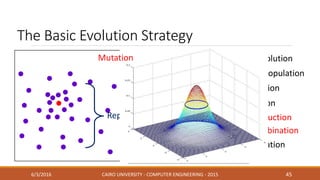
Mutation vectors are
normally – distributed
around their parent
Recombination
5 - Reproduction
The Basic Evolution Strategy
6/3/2016 CAIRO UNIVERSITY - COMPUTER ENGINEERING - 2015 45
2 - Initial Population
1- Initial Solution
3 - Evaluation
4 - Selection
Repeat
Mutation
Outline
oWhat is Optimization?
oWhat is an Evolution Strategy?
oStep-size Adaptation
oCumulative step-size adaptation
oCovariance Matrix Adaptation
oApplication - Modeling
6/3/2016 CAIRO UNIVERSITY - COMPUTER ENGINEERING - 2015 46
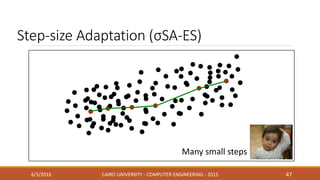
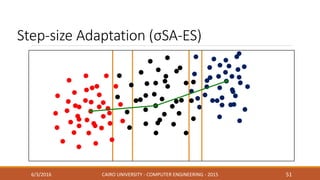
Step-size Adaptation (σSA-ES)
6/3/2016 CAIRO UNIVERSITY - COMPUTER ENGINEERING - 2015 47
Many small steps
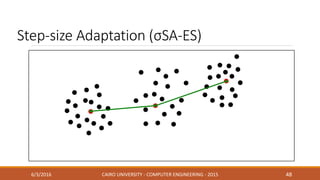
Step-size Adaptation (σSA-ES)
6/3/2016 CAIRO UNIVERSITY - COMPUTER ENGINEERING - 2015 48
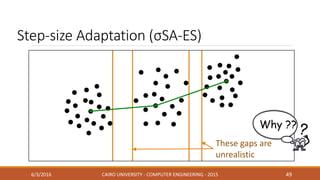
Step-size Adaptation (σSA-ES)
6/3/2016 CAIRO UNIVERSITY - COMPUTER ENGINEERING - 2015 49
These gaps are
unrealistic
Why ??
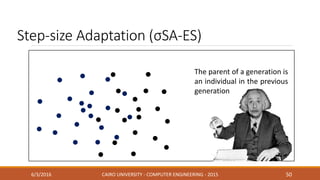
Step-size Adaptation (σSA-ES)
6/3/2016 CAIRO UNIVERSITY - COMPUTER ENGINEERING - 2015 50
The parent of a generation is
an individual in the previous
generation
Step-size Adaptation (σSA-ES)
6/3/2016 CAIRO UNIVERSITY - COMPUTER ENGINEERING - 2015 51
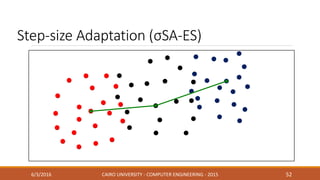
Step-size Adaptation (σSA-ES)
6/3/2016 CAIRO UNIVERSITY - COMPUTER ENGINEERING - 2015 52
6 - Termination
Recombination
5 - Reproduction
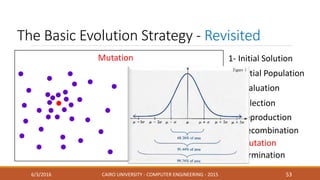
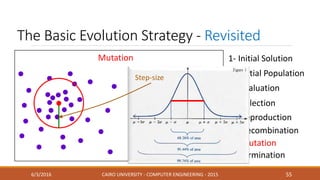
The Basic Evolution Strategy - Revisited
6/3/2016 CAIRO UNIVERSITY - COMPUTER ENGINEERING - 2015 53
2 - Initial Population
1- Initial Solution
3 - Evaluation
4 - Selection
Mutation
Mutation
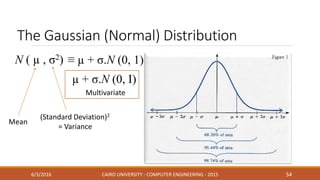
The Gaussian (Normal) Distribution
6/3/2016 CAIRO UNIVERSITY - COMPUTER ENGINEERING - 2015 54
N ( µ , σ2)
Mean
(Standard Deviation)2
= Variance
≡ µ + σ.N (0, 1)
µ + σ.N (0, I)
Multivariate
6 - Termination
Recombination
5 - Reproduction
The Basic Evolution Strategy - Revisited
6/3/2016 CAIRO UNIVERSITY - COMPUTER ENGINEERING - 2015 55
2 - Initial Population
1- Initial Solution
3 - Evaluation
4 - Selection
Mutation
Mutation
Step-size
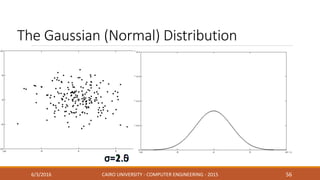
The Gaussian (Normal) Distribution
6/3/2016 CAIRO UNIVERSITY - COMPUTER ENGINEERING - 2015 56
σ=1.0σ=1.5σ=2.0σ=2.5
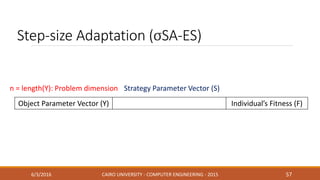
Step-size Adaptation (σSA-ES)
6/3/2016 CAIRO UNIVERSITY - COMPUTER ENGINEERING - 2015 57
Object Parameter Vector (Y) Individual’s Fitness (F)
Strategy Parameter Vector (S)
σ
n = length(Y): Problem dimension
Outline
oWhat is Optimization?
oWhat is an Evolution Strategy?
oStep-size Adaptation
oCumulative step-size adaptation
oCovariance Matrix Adaptation
oApplication - Modeling
6/3/2016 CAIRO UNIVERSITY - COMPUTER ENGINEERING - 2015 58
Cumulative Step-size Adaptation (CSA)
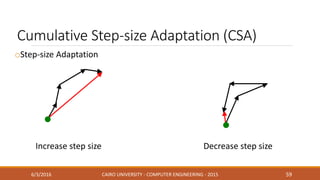
oStep-size Adaptation
6/3/2016 CAIRO UNIVERSITY - COMPUTER ENGINEERING - 2015 59
Increase step size Decrease step size
Cumulative Step-size Adaptation (CSA)
6/3/2016 CAIRO UNIVERSITY - COMPUTER ENGINEERING - 2015 60
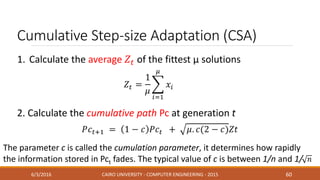
1. Calculate the average 𝑍𝑡 of the fittest µ solutions
2. Calculate the cumulative path Pc at generation t
The parameter c is called the cumulation parameter, it determines how rapidly
the information stored in Pct fades. The typical value of c is between 1/n and 1/
Cumulative Step-size Adaptation (CSA)
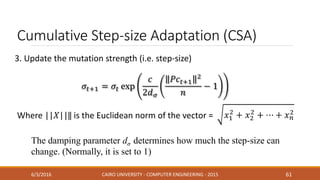
3. Update the mutation strength (i.e. step-size)
6/3/2016 CAIRO UNIVERSITY - COMPUTER ENGINEERING - 2015 61
The damping parameter dσ determines how much the step-size can
change. (Normally, it is set to 1)
Where ||𝑋||‖ is the Euclidean norm of the vector =
Cumulative Step-size Adaptation (CSA)
6/3/2016 CAIRO UNIVERSITY - COMPUTER ENGINEERING - 2015 62
Object Parameter Vector (Y) σ Individual’s Fitness (F)
Outline
oWhat is Optimization?
oWhat is an Evolution Strategy?
oStep-size Adaptation
oCumulative step-size adaptation
oCovariance Matrix Adaptation
oApplication - Modeling
6/3/2016 CAIRO UNIVERSITY - COMPUTER ENGINEERING - 2015 63
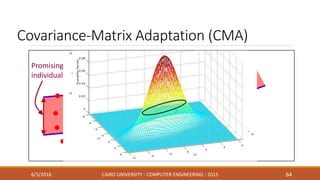
Promising
individuals
Covariance-Matrix Adaptation (CMA)
6/3/2016 CAIRO UNIVERSITY - COMPUTER ENGINEERING - 2015 64
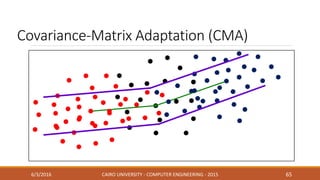
Covariance-Matrix Adaptation (CMA)
6/3/2016 CAIRO UNIVERSITY - COMPUTER ENGINEERING - 2015 65
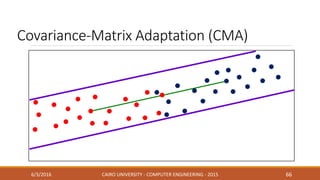
Covariance-Matrix Adaptation (CMA)
6/3/2016 CAIRO UNIVERSITY - COMPUTER ENGINEERING - 2015 66
Covariance-Matrix Adaptation (CMA)
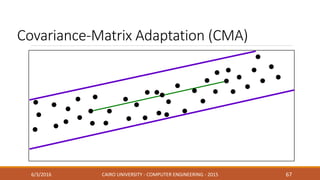
6/3/2016 CAIRO UNIVERSITY - COMPUTER ENGINEERING - 2015 67
Covariance-Matrix Adaptation (CMA)
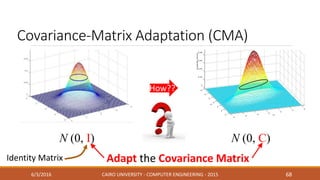
6/3/2016 CAIRO UNIVERSITY - COMPUTER ENGINEERING - 2015 68
N (0, I) N (0, C)
How??
Adapt the Covariance MatrixIdentity Matrix
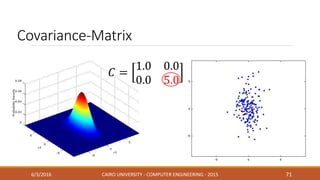
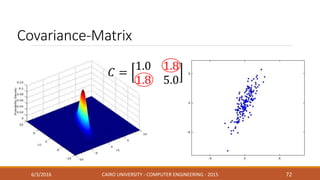
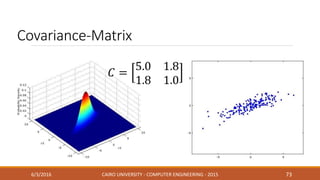
Covariance-Matrix
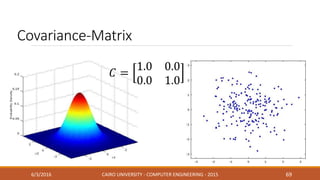
6/3/2016 CAIRO UNIVERSITY - COMPUTER ENGINEERING - 2015 69
Covariance-Matrix
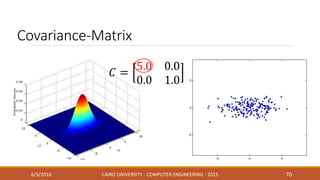
6/3/2016 CAIRO UNIVERSITY - COMPUTER ENGINEERING - 2015 70
Covariance-Matrix
6/3/2016 CAIRO UNIVERSITY - COMPUTER ENGINEERING - 2015 71
Covariance-Matrix
6/3/2016 CAIRO UNIVERSITY - COMPUTER ENGINEERING - 2015 72
Covariance-Matrix
6/3/2016 CAIRO UNIVERSITY - COMPUTER ENGINEERING - 2015 73
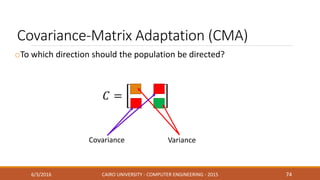
Covariance-Matrix Adaptation (CMA)
oTo which direction should the population be directed?
6/3/2016 CAIRO UNIVERSITY - COMPUTER ENGINEERING - 2015 74
VarianceCovariance
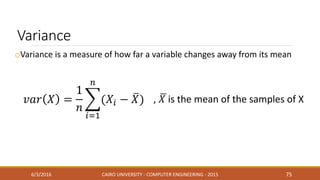
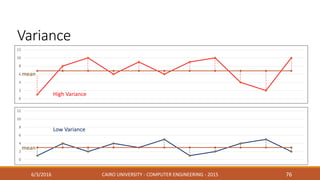
oVariance is a measure of how far a variable changes away from its mean
Variance
6/3/2016 CAIRO UNIVERSITY - COMPUTER ENGINEERING - 2015 75
, 𝑋 is the mean of the samples of X
0
2
4
6
8
10
12
0
2
4
6
8
10
12
Variance
6/3/2016 CAIRO UNIVERSITY - COMPUTER ENGINEERING - 2015 76
High Variance
Low Variance
mean
mean
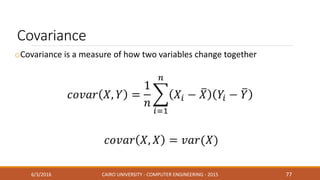
oCovariance is a measure of how two variables change together
Covariance
6/3/2016 CAIRO UNIVERSITY - COMPUTER ENGINEERING - 2015 77
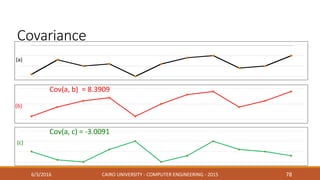
Covariance
6/3/2016 CAIRO UNIVERSITY - COMPUTER ENGINEERING - 2015 78
(a)
(c)
Cov(a, c) = -3.0091
(b)
Cov(a, b) = 8.3909
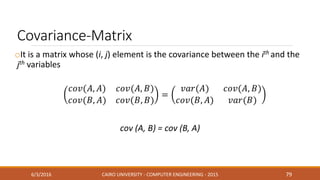
Covariance-Matrix
oIt is a matrix whose (i, j) element is the covariance between the ith and the
jth variables
6/3/2016 CAIRO UNIVERSITY - COMPUTER ENGINEERING - 2015 79
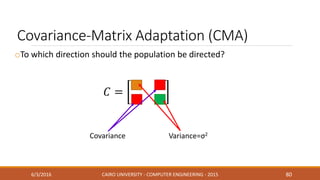
Covariance-Matrix Adaptation (CMA)
oTo which direction should the population be directed?
6/3/2016 CAIRO UNIVERSITY - COMPUTER ENGINEERING - 2015 80
Variance=σ2Covariance
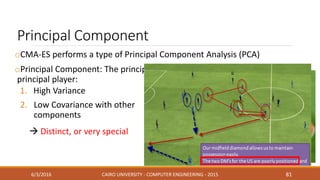
Principal Component
6/3/2016 CAIRO UNIVERSITY - COMPUTER ENGINEERING - 2015 81
oCMA-ES performs a type of Principal Component Analysis (PCA)
oPrincipal Component: The principal variable (component) is equivalent to the
principal player:
1. High Variance
2. Low Covariance with other
components
 Distinct, or very special
Covariance-Matrix Adaptation (CMA)
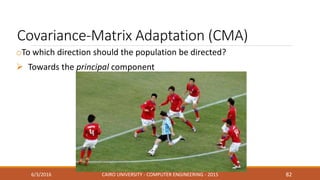
6/3/2016 CAIRO UNIVERSITY - COMPUTER ENGINEERING - 2015 82
oTo which direction should the population be directed?
 Towards the principal component
Covariance-Matrix Adaptation (CMA)
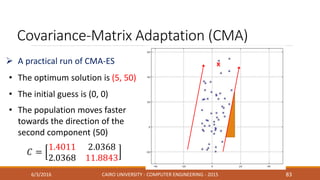
6/3/2016 CAIRO UNIVERSITY - COMPUTER ENGINEERING - 2015 83
• The optimum solution is (5, 50)
 A practical run of CMA-ES x
• The population moves faster
towards the direction of the
second component (50)
• The initial guess is (0, 0)
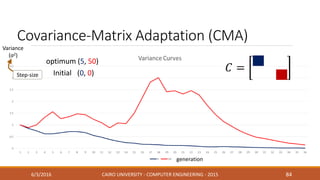
Covariance-Matrix Adaptation (CMA)
6/3/2016 CAIRO UNIVERSITY - COMPUTER ENGINEERING - 2015 84
optimum (5, 50)
Initial (0, 0)
generation
Variance
(σ2)
Step-size
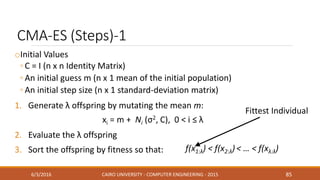
CMA-ES (Steps)-1
oInitial Values
◦ C = I (n x n Identity Matrix)
◦ An initial guess m (n x 1 mean of the initial population)
◦ An initial step size (n x 1 standard-deviation matrix)
1. Generate λ offspring by mutating the mean m:
2. Evaluate the λ offspring
3. Sort the offspring by fitness so that:
6/3/2016 CAIRO UNIVERSITY - COMPUTER ENGINEERING - 2015 85
Fittest Individual
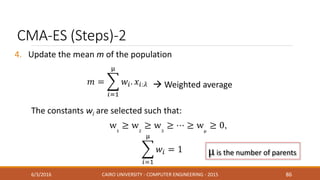
CMA-ES (Steps)-2
4. Update the mean m of the population
6/3/2016 CAIRO UNIVERSITY - COMPUTER ENGINEERING - 2015 86
 Weighted average
The constants wi are selected such that:
µ is the number of parents
CMA-ES (Steps)-3
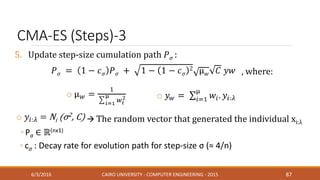
5. Update step-size cumulation path 𝑃 𝜎 :
, where:
 The random vector that generated the individual xi:λ
◦ cσ : Decay rate for evolution path for step-size σ (≈ 4/n)
6/3/2016 CAIRO UNIVERSITY - COMPUTER ENGINEERING - 2015 87
CMA-ES (Steps)-4
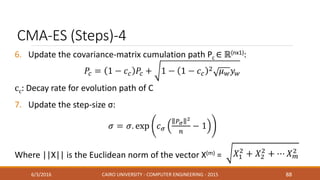
6. Update the covariance-matrix cumulation path Pc ∈ ℝ(nx1):
cc: Decay rate for evolution path of C
7. Update the step-size σ:
Where ||X|| is the Euclidean norm of the vector X(m) =
6/3/2016 CAIRO UNIVERSITY - COMPUTER ENGINEERING - 2015 88
CMA-ES (Steps)-5
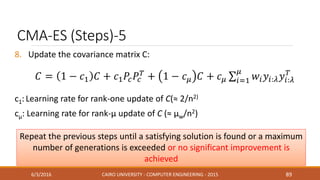
8. Update the covariance matrix C:
c1: Learning rate for rank-one update of C(≈ 2/n2)
cµ: Learning rate for rank-µ update of C (≈ µw/n2)
6/3/2016 CAIRO UNIVERSITY - COMPUTER ENGINEERING - 2015 89
Repeat the previous steps until a satisfying solution is found or a maximum
number of generations is exceeded or no significant improvement is
achieved
Advantages of CMA-ES
oCMA-ES can outperform other strategies in the following cases:
◦ Non-separable problems (the parameters of the objective function are
dependent)
◦ The derivative of the objective function is not available
◦ High dimension problems (n is large)
◦ Very large search spaces
6/3/2016 CAIRO UNIVERSITY - COMPUTER ENGINEERING - 2015 90
CMA-ES Limitations
oCMA-ES can be outperformed by other strategies in the following cases:
◦ Partly separable problems (i.e. optimization of n-dimension objective
function can be divided into a series of n optimizations of every single
parameter)
◦ The derivative of the objective function is easily available (Gradient
Descend / Ascend)
◦ Small dimension problems
◦ Problems that can be solved using a relatively small number of function
evaluations (e.g. < 10n evaluations)
6/3/2016 CAIRO UNIVERSITY - COMPUTER ENGINEERING - 2015 91
Outline
oWhat is Optimization?
oWhat is an Evolution Strategy?
oStep-size Adaptation
oCumulative step-size adaptation
oCovariance Matrix Adaptation
oApplication - Modeling
6/3/2016 CAIRO UNIVERSITY - COMPUTER ENGINEERING - 2015 92
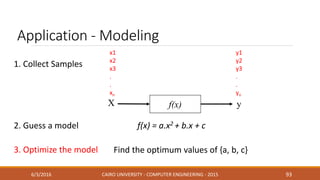
Application - Modeling
6/3/2016 CAIRO UNIVERSITY - COMPUTER ENGINEERING - 2015 93
f(x)X y
2. Guess a model f(x) = a.x2 + b.x + c
1. Collect Samples
x1
x2
x3
.
.
xn
y1
y2
y3
.
.
yn
3. Optimize the model Find the optimum values of {a, b, c}
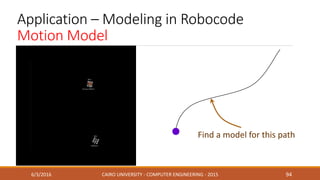
Application – Modeling in Robocode
Motion Model
6/3/2016 CAIRO UNIVERSITY - COMPUTER ENGINEERING - 2015 94
Find a model for this path
Application – Modeling in Robocode
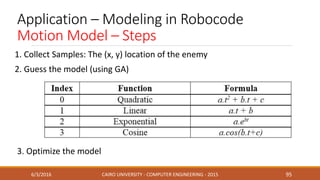
Motion Model – Steps
1. Collect Samples: The (x, y) location of the enemy
2. Guess the model (using GA)
6/3/2016 CAIRO UNIVERSITY - COMPUTER ENGINEERING - 2015 95
3. Optimize the model
Application – Modeling in Robocode
Motion Model – Observations
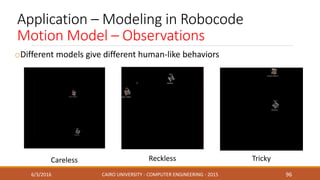
oDifferent models give different human-like behaviors
6/3/2016 CAIRO UNIVERSITY - COMPUTER ENGINEERING - 2015 96
Careless Reckless Tricky
Using the Source Code
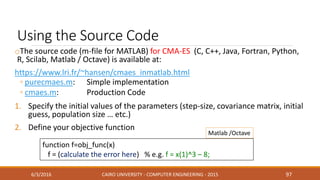
oThe source code (m-file for MATLAB) for CMA-ES (C, C++, Java, Fortran, Python,
R, Scilab, Matlab / Octave) is available at:
https://www.lri.fr/~hansen/cmaes_inmatlab.html
◦ purecmaes.m: Simple implementation
◦ cmaes.m: Production Code
1. Specify the initial values of the parameters (step-size, covariance matrix, initial
guess, population size … etc.)
2. Define your objective function
6/3/2016 CAIRO UNIVERSITY - COMPUTER ENGINEERING - 2015 97
function f=obj_func(x)
f = (calculate the error here) % e.g. f = x(1)^3 – 8;
Matlab /Octave
3. Call the function Matlab /Octave
Using the Source Code
6/3/2016 CAIRO UNIVERSITY - COMPUTER ENGINEERING - 2015 98
>> function_mfile( parameters)
Questions
6/3/2016 CAIRO UNIVERSITY - COMPUTER ENGINEERING - 2015 99
osama.salah.eg@ieee.org
Thanks
6/3/2016 CAIRO UNIVERSITY - COMPUTER ENGINEERING - 2015 100

Covariance Matrix Adaptation Evolution Strategy - CMA-ES

  • 1.
    Covariance Matrix AdaptationEvolution Strategy (CMA-ES) BY: OSAMA SALAH ELDIN UNDER SUPERVISION: PROF. MAGDA B. FAYEK 6/3/2016 CAIRO UNIVERSITY - COMPUTER ENGINEERING - 2015
  • 2.
    Outline oWhat is Optimization? oWhatis an Evolution Strategy? oStep-size Adaptation oCumulative step-size adaptation oCovariance Matrix Adaptation oApplication - Modeling 6/3/2016 CAIRO UNIVERSITY - COMPUTER ENGINEERING - 2015 2
  • 3.
    What is optimization? oOptimizationis the minimization or the maximization of a function 6/3/2016 CAIRO UNIVERSITY - COMPUTER ENGINEERING - 2015 3 y=f(x) Global MinimumLocal Minimum xLocal Minimum
  • 4.
    What is optimization? oTryto solve these problems: 6/3/2016 CAIRO UNIVERSITY - COMPUTER ENGINEERING - 2015 4 x = 2 x3 – 8 = 0
  • 5.
    What is optimization? oTryto solve these problems: 6/3/2016 CAIRO UNIVERSITY - COMPUTER ENGINEERING - 2015 5 x=3, y=2 x2 + 3.y – 15 = 0
  • 6.
    What is optimization? oTryto solve these problems: 6/3/2016 CAIRO UNIVERSITY - COMPUTER ENGINEERING - 2015 6 x=3, y=2, z=2 x2 + y + 2.z – 15 = 0
  • 7.
    What is optimization? oTryto solve these problems: 6/3/2016 CAIRO UNIVERSITY - COMPUTER ENGINEERING - 2015 7
  • 8.
    What is optimization? oTryto solve these problems: 6/3/2016 CAIRO UNIVERSITY - COMPUTER ENGINEERING - 2015 8 Can one try all combinations?? This is not recommended
  • 9.
    What is optimization? 6/3/2016CAIRO UNIVERSITY - COMPUTER ENGINEERING - 2015 9 Use an evolution strategy
  • 10.
    Outline oWhat is Optimization? oWhatis an Evolution Strategy? oStep-size Adaptation oCumulative step-size adaptation oCovariance Matrix Adaptation oApplication - Modeling 6/3/2016 CAIRO UNIVERSITY - COMPUTER ENGINEERING - 2015 10
  • 11.
    6/3/2016 CAIRO UNIVERSITY- COMPUTER ENGINEERING - 2015 11 What is an Evolution Strategy?
  • 12.
    What is anEvolution Strategy? oIt is a technique that searches for the optimum solution in a search-space oEvolution Strategies belong to the family of Evolutionary Computation oEvolution strategy steps: 1. Generate a population of candidate solutions 2. Evaluate every individual in the population 3. Select parents from the fittest individuals 4. Reproduce offspring of the next generation (Recombination & mutation) 5. Repeat until a termination criterion is met 6/3/2016 CAIRO UNIVERSITY - COMPUTER ENGINEERING - 2015 12
  • 13.
    Evolution Strategies VS.Genetic Algorithms ES GA Initial Population Random mutations of the initial guess Random or seeded Evaluation Objective Function Fitness (Evaluation) Function Selection Truncation Selection Different methods Reproduction Recombination + Mutation Crossover + Mutation Termination Almost similar stop conditions 6/3/2016 CAIRO UNIVERSITY - COMPUTER ENGINEERING - 2015 13
  • 14.
    What is anEvolution Strategy? - Example 1. Generate a population of candidate solutions 6/3/2016 CAIRO UNIVERSITY - COMPUTER ENGINEERING - 2015 14 y=f(x) x
  • 15.
    fitness What is anEvolution Strategy? - Example 2. Evaluate every individual in the population 6/3/2016 CAIRO UNIVERSITY - COMPUTER ENGINEERING - 2015 15 y=f(x) x
  • 16.
    fitness What is anEvolution Strategy? - Example 3. Select parents from the fittest individuals 6/3/2016 CAIRO UNIVERSITY - COMPUTER ENGINEERING - 2015 16 y=f(x) x
  • 17.
    What is anEvolution Strategy? - Example 4. Reproduce offspring of the next generation (Recombination & mutation) 6/3/2016 CAIRO UNIVERSITY - COMPUTER ENGINEERING - 2015 17 y=f(x) x
  • 18.
    What is anEvolution Strategy? - Example 5. Repeat until a termination criterion is met 6/3/2016 CAIRO UNIVERSITY - COMPUTER ENGINEERING - 2015 18 y=f(x) xEvaluate & Select
  • 19.
    What is anEvolution Strategy? - Example 5. Repeat until a termination criterion is met 6/3/2016 CAIRO UNIVERSITY - COMPUTER ENGINEERING - 2015 19 y=f(x) xEvaluate & SelectReproduce
  • 20.
    What is anEvolution Strategy? - Example 5. Repeat until a termination criterion is met 6/3/2016 CAIRO UNIVERSITY - COMPUTER ENGINEERING - 2015 20 y=f(x) x Optimum Solution Evaluate – Select – ReproduceReproduceTerminate
  • 21.
    The Basic EvolutionStrategy oThe basic evolution strategy is defined by: (µ/ρ, λ)-ES and (µ/ρ+ λ)-ES Where: µ The number of selected individuals per generation ρ The number of parents (selected from µ) involved in recombination (≤ µ) λ The number of individuals per generation (population size) , Comma Selection  µ parents are selected from the λ individuals + Plus Selection  µ parents are selected from the λ individuals + the current ρ parents 6/3/2016 CAIRO UNIVERSITY - COMPUTER ENGINEERING - 2015 21
  • 22.
    The Basic EvolutionStrategy - Example (10/6 , 50)-ES Select the fittest 10 individuals from the 50 individuals of the current population, and select 6 random ones from them. Recombine these 6 parents to generate 50 new offspring (10/6 + 50)-ES Select the fittest 10 individuals from the 50 individuals of the current population along with their 6 parents, and select 6 random ones from them all (from the 56). Recombine these 6 parents to generate 50 new offspring 6/3/2016 CAIRO UNIVERSITY - COMPUTER ENGINEERING - 2015 22
  • 23.
    The structure ofan Individual Object Parameter Vector (Y) Strategy Parameter Vector (S) Individual’s Fitness (F) 6/3/2016 CAIRO UNIVERSITY - COMPUTER ENGINEERING - 2015 23 Y The candidate solution of the problem (e.g. (x, y) point) S The parameters used by the strategy (e.g. mutation strength) F The fitness of the candidate solution y as measured by the fitness function (i.e. the value of the objective function) Y = {x1, x2, z}
  • 24.
    The structure ofan Individual Object Parameter Vector (Y) Strategy Parameter Vector (S) Individual’s Fitness (F) 6/3/2016 CAIRO UNIVERSITY - COMPUTER ENGINEERING - 2015 24 • Evolution strategies search for the optimum: 1. Solution: The highest fitness 2. Strategy Parameters: The fastest improvement Two search spaces
  • 25.
    ES Steps 6/3/2016 CAIROUNIVERSITY - COMPUTER ENGINEERING - 2015 25 1- Initial Solution
  • 26.
    2 - InitialPopulation ES Steps 6/3/2016 CAIRO UNIVERSITY - COMPUTER ENGINEERING - 2015 26 1- Initial Solution
  • 27.
    2 - InitialPopulation ES Steps 6/3/2016 CAIRO UNIVERSITY - COMPUTER ENGINEERING - 2015 27 3 - Evaluation 1- Initial Solution
  • 28.
    3 - Evaluation4- Selection ES Steps 6/3/2016 CAIRO UNIVERSITY - COMPUTER ENGINEERING - 2015 28 µ = 4 ρ=1 2 - Initial Population 1- Initial Solution
  • 29.
    5 - Reproduction ESSteps 6/3/2016 CAIRO UNIVERSITY - COMPUTER ENGINEERING - 2015 29 2 - Initial Population 1- Initial Solution 3 - Evaluation 4 - Selection
  • 30.
    5 - Reproduction ESSteps 6/3/2016 CAIRO UNIVERSITY - COMPUTER ENGINEERING - 2015 30 2 - Initial Population 1- Initial Solution 3 - Evaluation 4 - Selection
  • 31.
    ES Steps 6/3/2016 CAIROUNIVERSITY - COMPUTER ENGINEERING - 2015 31 2 - Initial Population 1- Initial Solution 3 - Evaluation 4 - Selection 5 - Reproduction
  • 32.
    ES Steps 6/3/2016 CAIROUNIVERSITY - COMPUTER ENGINEERING - 2015 32 2 - Initial Population 1- Initial Solution 3 - Evaluation 4 - Selection 5 - Reproduction
  • 33.
    6 - Termination ESSteps 6/3/2016 CAIRO UNIVERSITY - COMPUTER ENGINEERING - 2015 33 2 - Initial Population 1- Initial Solution 3 - Evaluation 4 - Selection Optimum Solution 5 - Reproduction
  • 34.
    The Basic EvolutionStrategy 6/3/2016 CAIRO UNIVERSITY - COMPUTER ENGINEERING - 2015 34 2 - Initial Population 1- Initial Solution 3 - Evaluation 4 - Selection • An initial guess, should be as close as possible to the expected solution 6 - Termination 5 - Reproduction
  • 35.
    The Basic EvolutionStrategy 6/3/2016 CAIRO UNIVERSITY - COMPUTER ENGINEERING - 2015 35 2 - Initial Population 1- Initial Solution 3 - Evaluation 4 - Selection • The intial population is generated by mutating the initial solution 6 - Termination 5 - Reproduction
  • 36.
    The Basic EvolutionStrategy 6/3/2016 CAIRO UNIVERSITY - COMPUTER ENGINEERING - 2015 36 2 - Initial Population 1- Initial Solution 3 - Evaluation 4 - Selection • Every individual is evaluated by the objective function 6 - TerminationBest Fitness = 0 5 - Reproduction
  • 37.
    The Basic EvolutionStrategy 6/3/2016 CAIRO UNIVERSITY - COMPUTER ENGINEERING - 2015 37 2 - Initial Population 1- Initial Solution 3 - Evaluation 4 - Selection • Truncation Selection is used 6 - Termination 5 - Reproduction Select the fittest µ individuals Drop the other individuals
  • 38.
    The Basic EvolutionStrategy 6/3/2016 CAIRO UNIVERSITY - COMPUTER ENGINEERING - 2015 38 2 - Initial Population 1- Initial Solution 3 - Evaluation 4 - Selection 5 - Reproduction 6 - Termination Recombination Reproduction Mutation Combining two or more parents to produce a mean for the new generation Adding normally- distributed random vectors to the new mean
  • 39.
    The Basic EvolutionStrategy 6/3/2016 CAIRO UNIVERSITY - COMPUTER ENGINEERING - 2015 39 2 - Initial Population 1- Initial Solution 3 - Evaluation 4 - Selection 5 - Reproduction 6 - Termination Recombination S1 F11 3 S2 F24 6 Solution Strategy Parameters S32.5 4.5 A simple recombination is taking the average P1 P2 Fitness To be calculated
  • 40.
    The Basic EvolutionStrategy 6/3/2016 CAIRO UNIVERSITY - COMPUTER ENGINEERING - 2015 40 2 - Initial Population 1- Initial Solution 3 - Evaluation 4 - Selection 5 - Reproduction 6 - Termination Recombination ρ = 2 ρ = 4
  • 41.
    The Basic EvolutionStrategy 6/3/2016 CAIRO UNIVERSITY - COMPUTER ENGINEERING - 2015 41 2 - Initial Population 1- Initial Solution 3 - Evaluation 4 - Selection 5 - Reproduction 6 - Termination Recombination Mutation Reproduction Combining two or more parents to produce a mean for the new generation Adding normally- distributed random vectors to the new mean
  • 42.
    The Basic EvolutionStrategy 6/3/2016 CAIRO UNIVERSITY - COMPUTER ENGINEERING - 2015 42 2 - Initial Population 1- Initial Solution 3 - Evaluation 4 - Selection 5.5 8.0Parent RX1 RY1 Generate λ normally-distributed random vectors RX2 RY2 RX3 RY3 5.5 + RX1 8.0 + RY1 5.5 + RX2 8.0 + RY2 5.5 + RX3 8.0 + RY3 Add each of the λ mutating vectors to the initial solution 6 - Termination 5 - Reproduction Mutation Recombination
  • 43.
    The Basic EvolutionStrategy 6/3/2016 CAIRO UNIVERSITY - COMPUTER ENGINEERING - 2015 43 2 - Initial Population 1- Initial Solution 3 - Evaluation 4 - Selection 5.5 8.0 RX1 RY1 RX2 RY2 RX3 RY3 RX1 RY1 5.5 + RX1 8.0 + RY1 5.5 + RX2 8.0 + RY2 5.5 + RX3 8.0 + RY3 RX2 RY2 RX3 RY3 5 - Reproduction Mutation 6 - Termination Recombination (5.5, 8.0)
  • 44.
    The Basic EvolutionStrategy 6/3/2016 CAIRO UNIVERSITY - COMPUTER ENGINEERING - 2015 44 2 - Initial Population 1- Initial Solution 3 - Evaluation 4 - Selection 5.5 8.0 RX1 RY1 RX2 RY2 RX3 RY3 5.5 + RX1 8.0 + RY1 5.5 + RX2 8.0 + RY2 5.5 + RX3 8.0 + RY3 RX1 RY1 RX2 RY2 RX3 RY3 5 - Reproduction 6 - Termination Recombination Mutation
  • 45.
    6 - Termination Mutationvectors are normally – distributed around their parent Recombination 5 - Reproduction The Basic Evolution Strategy 6/3/2016 CAIRO UNIVERSITY - COMPUTER ENGINEERING - 2015 45 2 - Initial Population 1- Initial Solution 3 - Evaluation 4 - Selection Repeat Mutation
  • 46.
    Outline oWhat is Optimization? oWhatis an Evolution Strategy? oStep-size Adaptation oCumulative step-size adaptation oCovariance Matrix Adaptation oApplication - Modeling 6/3/2016 CAIRO UNIVERSITY - COMPUTER ENGINEERING - 2015 46
  • 47.
    Step-size Adaptation (σSA-ES) 6/3/2016CAIRO UNIVERSITY - COMPUTER ENGINEERING - 2015 47 Many small steps
  • 48.
    Step-size Adaptation (σSA-ES) 6/3/2016CAIRO UNIVERSITY - COMPUTER ENGINEERING - 2015 48
  • 49.
    Step-size Adaptation (σSA-ES) 6/3/2016CAIRO UNIVERSITY - COMPUTER ENGINEERING - 2015 49 These gaps are unrealistic Why ??
  • 50.
    Step-size Adaptation (σSA-ES) 6/3/2016CAIRO UNIVERSITY - COMPUTER ENGINEERING - 2015 50 The parent of a generation is an individual in the previous generation
  • 51.
    Step-size Adaptation (σSA-ES) 6/3/2016CAIRO UNIVERSITY - COMPUTER ENGINEERING - 2015 51
  • 52.
    Step-size Adaptation (σSA-ES) 6/3/2016CAIRO UNIVERSITY - COMPUTER ENGINEERING - 2015 52
  • 53.
    6 - Termination Recombination 5- Reproduction The Basic Evolution Strategy - Revisited 6/3/2016 CAIRO UNIVERSITY - COMPUTER ENGINEERING - 2015 53 2 - Initial Population 1- Initial Solution 3 - Evaluation 4 - Selection Mutation Mutation
  • 54.
    The Gaussian (Normal)Distribution 6/3/2016 CAIRO UNIVERSITY - COMPUTER ENGINEERING - 2015 54 N ( µ , σ2) Mean (Standard Deviation)2 = Variance ≡ µ + σ.N (0, 1) µ + σ.N (0, I) Multivariate
  • 55.
    6 - Termination Recombination 5- Reproduction The Basic Evolution Strategy - Revisited 6/3/2016 CAIRO UNIVERSITY - COMPUTER ENGINEERING - 2015 55 2 - Initial Population 1- Initial Solution 3 - Evaluation 4 - Selection Mutation Mutation Step-size
  • 56.
    The Gaussian (Normal)Distribution 6/3/2016 CAIRO UNIVERSITY - COMPUTER ENGINEERING - 2015 56 σ=1.0σ=1.5σ=2.0σ=2.5
  • 57.
    Step-size Adaptation (σSA-ES) 6/3/2016CAIRO UNIVERSITY - COMPUTER ENGINEERING - 2015 57 Object Parameter Vector (Y) Individual’s Fitness (F) Strategy Parameter Vector (S) σ n = length(Y): Problem dimension
  • 58.
    Outline oWhat is Optimization? oWhatis an Evolution Strategy? oStep-size Adaptation oCumulative step-size adaptation oCovariance Matrix Adaptation oApplication - Modeling 6/3/2016 CAIRO UNIVERSITY - COMPUTER ENGINEERING - 2015 58
  • 59.
    Cumulative Step-size Adaptation(CSA) oStep-size Adaptation 6/3/2016 CAIRO UNIVERSITY - COMPUTER ENGINEERING - 2015 59 Increase step size Decrease step size
  • 60.
    Cumulative Step-size Adaptation(CSA) 6/3/2016 CAIRO UNIVERSITY - COMPUTER ENGINEERING - 2015 60 1. Calculate the average 𝑍𝑡 of the fittest µ solutions 2. Calculate the cumulative path Pc at generation t The parameter c is called the cumulation parameter, it determines how rapidly the information stored in Pct fades. The typical value of c is between 1/n and 1/
  • 61.
    Cumulative Step-size Adaptation(CSA) 3. Update the mutation strength (i.e. step-size) 6/3/2016 CAIRO UNIVERSITY - COMPUTER ENGINEERING - 2015 61 The damping parameter dσ determines how much the step-size can change. (Normally, it is set to 1) Where ||𝑋||‖ is the Euclidean norm of the vector =
  • 62.
    Cumulative Step-size Adaptation(CSA) 6/3/2016 CAIRO UNIVERSITY - COMPUTER ENGINEERING - 2015 62 Object Parameter Vector (Y) σ Individual’s Fitness (F)
  • 63.
    Outline oWhat is Optimization? oWhatis an Evolution Strategy? oStep-size Adaptation oCumulative step-size adaptation oCovariance Matrix Adaptation oApplication - Modeling 6/3/2016 CAIRO UNIVERSITY - COMPUTER ENGINEERING - 2015 63
  • 64.
    Promising individuals Covariance-Matrix Adaptation (CMA) 6/3/2016CAIRO UNIVERSITY - COMPUTER ENGINEERING - 2015 64
  • 65.
    Covariance-Matrix Adaptation (CMA) 6/3/2016CAIRO UNIVERSITY - COMPUTER ENGINEERING - 2015 65
  • 66.
    Covariance-Matrix Adaptation (CMA) 6/3/2016CAIRO UNIVERSITY - COMPUTER ENGINEERING - 2015 66
  • 67.
    Covariance-Matrix Adaptation (CMA) 6/3/2016CAIRO UNIVERSITY - COMPUTER ENGINEERING - 2015 67
  • 68.
    Covariance-Matrix Adaptation (CMA) 6/3/2016CAIRO UNIVERSITY - COMPUTER ENGINEERING - 2015 68 N (0, I) N (0, C) How?? Adapt the Covariance MatrixIdentity Matrix
  • 69.
    Covariance-Matrix 6/3/2016 CAIRO UNIVERSITY- COMPUTER ENGINEERING - 2015 69
  • 70.
    Covariance-Matrix 6/3/2016 CAIRO UNIVERSITY- COMPUTER ENGINEERING - 2015 70
  • 71.
    Covariance-Matrix 6/3/2016 CAIRO UNIVERSITY- COMPUTER ENGINEERING - 2015 71
  • 72.
    Covariance-Matrix 6/3/2016 CAIRO UNIVERSITY- COMPUTER ENGINEERING - 2015 72
  • 73.
    Covariance-Matrix 6/3/2016 CAIRO UNIVERSITY- COMPUTER ENGINEERING - 2015 73
  • 74.
    Covariance-Matrix Adaptation (CMA) oTowhich direction should the population be directed? 6/3/2016 CAIRO UNIVERSITY - COMPUTER ENGINEERING - 2015 74 VarianceCovariance
  • 75.
    oVariance is ameasure of how far a variable changes away from its mean Variance 6/3/2016 CAIRO UNIVERSITY - COMPUTER ENGINEERING - 2015 75 , 𝑋 is the mean of the samples of X
  • 76.
    0 2 4 6 8 10 12 0 2 4 6 8 10 12 Variance 6/3/2016 CAIRO UNIVERSITY- COMPUTER ENGINEERING - 2015 76 High Variance Low Variance mean mean
  • 77.
    oCovariance is ameasure of how two variables change together Covariance 6/3/2016 CAIRO UNIVERSITY - COMPUTER ENGINEERING - 2015 77
  • 78.
    Covariance 6/3/2016 CAIRO UNIVERSITY- COMPUTER ENGINEERING - 2015 78 (a) (c) Cov(a, c) = -3.0091 (b) Cov(a, b) = 8.3909
  • 79.
    Covariance-Matrix oIt is amatrix whose (i, j) element is the covariance between the ith and the jth variables 6/3/2016 CAIRO UNIVERSITY - COMPUTER ENGINEERING - 2015 79
  • 80.
    Covariance-Matrix Adaptation (CMA) oTowhich direction should the population be directed? 6/3/2016 CAIRO UNIVERSITY - COMPUTER ENGINEERING - 2015 80 Variance=σ2Covariance
  • 81.
    Principal Component 6/3/2016 CAIROUNIVERSITY - COMPUTER ENGINEERING - 2015 81 oCMA-ES performs a type of Principal Component Analysis (PCA) oPrincipal Component: The principal variable (component) is equivalent to the principal player: 1. High Variance 2. Low Covariance with other components  Distinct, or very special
  • 82.
    Covariance-Matrix Adaptation (CMA) 6/3/2016CAIRO UNIVERSITY - COMPUTER ENGINEERING - 2015 82 oTo which direction should the population be directed?  Towards the principal component
  • 83.
    Covariance-Matrix Adaptation (CMA) 6/3/2016CAIRO UNIVERSITY - COMPUTER ENGINEERING - 2015 83 • The optimum solution is (5, 50)  A practical run of CMA-ES x • The population moves faster towards the direction of the second component (50) • The initial guess is (0, 0)
  • 84.
    Covariance-Matrix Adaptation (CMA) 6/3/2016CAIRO UNIVERSITY - COMPUTER ENGINEERING - 2015 84 optimum (5, 50) Initial (0, 0) generation Variance (σ2) Step-size
  • 85.
    CMA-ES (Steps)-1 oInitial Values ◦C = I (n x n Identity Matrix) ◦ An initial guess m (n x 1 mean of the initial population) ◦ An initial step size (n x 1 standard-deviation matrix) 1. Generate λ offspring by mutating the mean m: 2. Evaluate the λ offspring 3. Sort the offspring by fitness so that: 6/3/2016 CAIRO UNIVERSITY - COMPUTER ENGINEERING - 2015 85 Fittest Individual
  • 86.
    CMA-ES (Steps)-2 4. Updatethe mean m of the population 6/3/2016 CAIRO UNIVERSITY - COMPUTER ENGINEERING - 2015 86  Weighted average The constants wi are selected such that: µ is the number of parents
  • 87.
    CMA-ES (Steps)-3 5. Updatestep-size cumulation path 𝑃 𝜎 : , where:  The random vector that generated the individual xi:λ ◦ cσ : Decay rate for evolution path for step-size σ (≈ 4/n) 6/3/2016 CAIRO UNIVERSITY - COMPUTER ENGINEERING - 2015 87
  • 88.
    CMA-ES (Steps)-4 6. Updatethe covariance-matrix cumulation path Pc ∈ ℝ(nx1): cc: Decay rate for evolution path of C 7. Update the step-size σ: Where ||X|| is the Euclidean norm of the vector X(m) = 6/3/2016 CAIRO UNIVERSITY - COMPUTER ENGINEERING - 2015 88
  • 89.
    CMA-ES (Steps)-5 8. Updatethe covariance matrix C: c1: Learning rate for rank-one update of C(≈ 2/n2) cµ: Learning rate for rank-µ update of C (≈ µw/n2) 6/3/2016 CAIRO UNIVERSITY - COMPUTER ENGINEERING - 2015 89 Repeat the previous steps until a satisfying solution is found or a maximum number of generations is exceeded or no significant improvement is achieved
  • 90.
    Advantages of CMA-ES oCMA-EScan outperform other strategies in the following cases: ◦ Non-separable problems (the parameters of the objective function are dependent) ◦ The derivative of the objective function is not available ◦ High dimension problems (n is large) ◦ Very large search spaces 6/3/2016 CAIRO UNIVERSITY - COMPUTER ENGINEERING - 2015 90
  • 91.
    CMA-ES Limitations oCMA-ES canbe outperformed by other strategies in the following cases: ◦ Partly separable problems (i.e. optimization of n-dimension objective function can be divided into a series of n optimizations of every single parameter) ◦ The derivative of the objective function is easily available (Gradient Descend / Ascend) ◦ Small dimension problems ◦ Problems that can be solved using a relatively small number of function evaluations (e.g. < 10n evaluations) 6/3/2016 CAIRO UNIVERSITY - COMPUTER ENGINEERING - 2015 91
  • 92.
    Outline oWhat is Optimization? oWhatis an Evolution Strategy? oStep-size Adaptation oCumulative step-size adaptation oCovariance Matrix Adaptation oApplication - Modeling 6/3/2016 CAIRO UNIVERSITY - COMPUTER ENGINEERING - 2015 92
  • 93.
    Application - Modeling 6/3/2016CAIRO UNIVERSITY - COMPUTER ENGINEERING - 2015 93 f(x)X y 2. Guess a model f(x) = a.x2 + b.x + c 1. Collect Samples x1 x2 x3 . . xn y1 y2 y3 . . yn 3. Optimize the model Find the optimum values of {a, b, c}
  • 94.
    Application – Modelingin Robocode Motion Model 6/3/2016 CAIRO UNIVERSITY - COMPUTER ENGINEERING - 2015 94 Find a model for this path
  • 95.
    Application – Modelingin Robocode Motion Model – Steps 1. Collect Samples: The (x, y) location of the enemy 2. Guess the model (using GA) 6/3/2016 CAIRO UNIVERSITY - COMPUTER ENGINEERING - 2015 95 3. Optimize the model
  • 96.
    Application – Modelingin Robocode Motion Model – Observations oDifferent models give different human-like behaviors 6/3/2016 CAIRO UNIVERSITY - COMPUTER ENGINEERING - 2015 96 Careless Reckless Tricky
  • 97.
    Using the SourceCode oThe source code (m-file for MATLAB) for CMA-ES (C, C++, Java, Fortran, Python, R, Scilab, Matlab / Octave) is available at: https://www.lri.fr/~hansen/cmaes_inmatlab.html ◦ purecmaes.m: Simple implementation ◦ cmaes.m: Production Code 1. Specify the initial values of the parameters (step-size, covariance matrix, initial guess, population size … etc.) 2. Define your objective function 6/3/2016 CAIRO UNIVERSITY - COMPUTER ENGINEERING - 2015 97 function f=obj_func(x) f = (calculate the error here) % e.g. f = x(1)^3 – 8; Matlab /Octave
  • 98.
    3. Call thefunction Matlab /Octave Using the Source Code 6/3/2016 CAIRO UNIVERSITY - COMPUTER ENGINEERING - 2015 98 >> function_mfile( parameters)
  • 99.
    Questions 6/3/2016 CAIRO UNIVERSITY- COMPUTER ENGINEERING - 2015 99 osama.salah.eg@ieee.org
  • 100.
    Thanks 6/3/2016 CAIRO UNIVERSITY- COMPUTER ENGINEERING - 2015 100