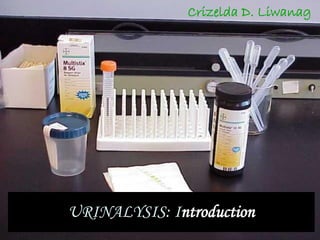
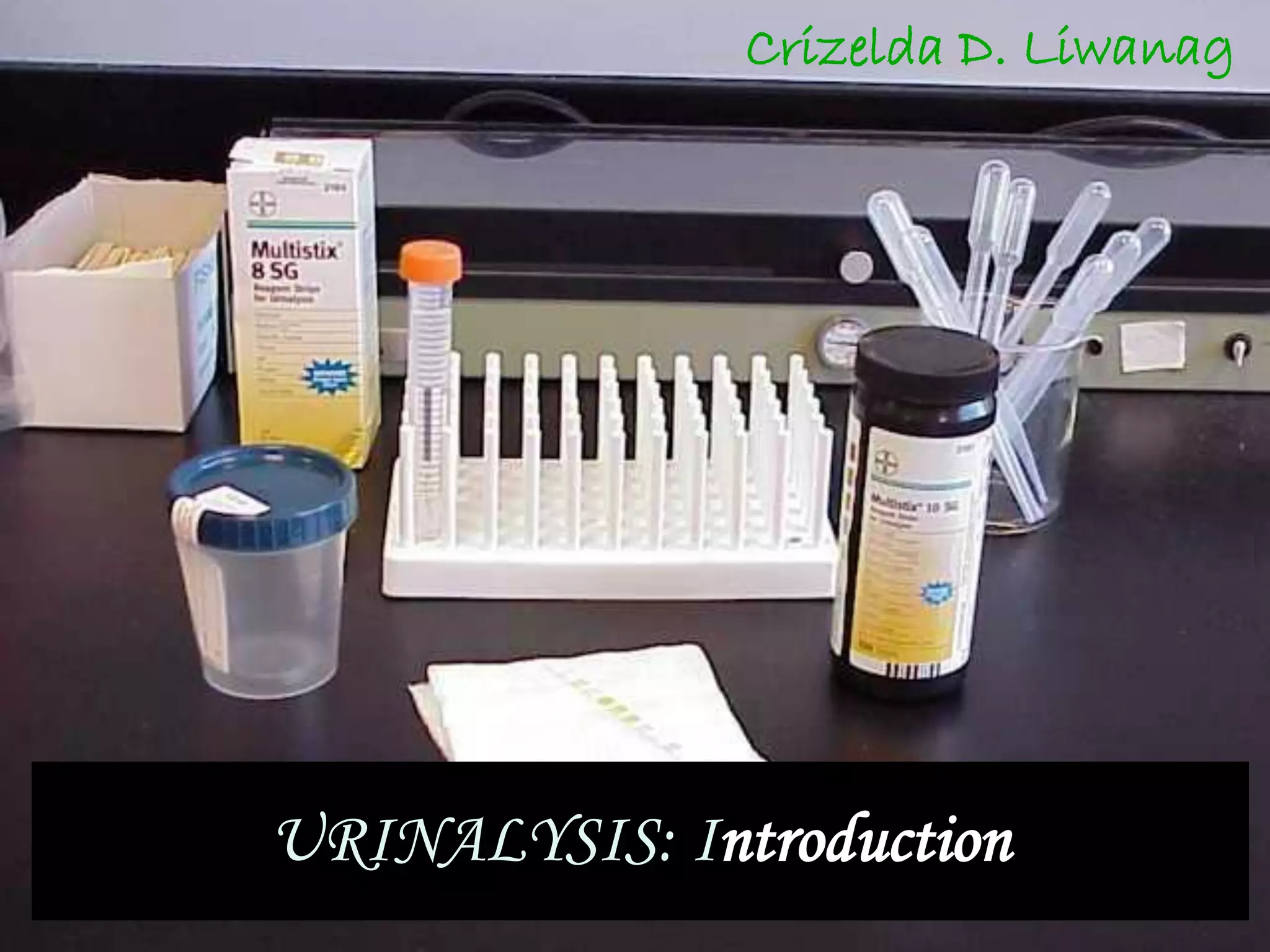
URINALYSIS: Introduction
Crizelda D. Liwanag
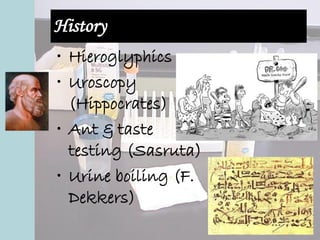
History
• Hieroglyphics
• Uroscopy
(Hippocrates)
• Ant & taste
testing (Sasruta)
• Urine boiling (F.
Dekkers)
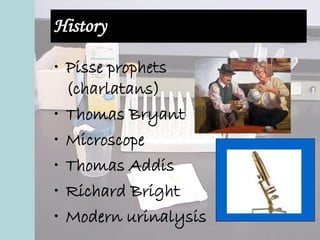
History
• Pisse prophets
(charlatans)
• Thomas Bryant
• Microscope
• Thomas Addis
• Richard Bright
• Modern urinalysis
Rationale of Urine testing
• (Relatively) readily collected
and easily available specimen
• Contains information about the
body’s major metabolic fxns
• inexpensive
Rationale of Urine testing
? Disease conditions
? Hormonal activity
? Ruling out, ruling in,
screening & prognosis
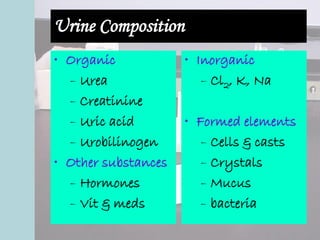
Urine Composition
• How do the ff. affect composition:
–Dietary intake
–Physical activity
–Body metabolism
–Endocrine functions
–Body position
Urine Composition
• Substances readily reabsorbed
–GANaCaKUP
• Substances readily excreted
–UCUA
Urine Composition
• Organic
– Urea
– Creatinine
– Uric acid
– Urobilinogen
• Other substances
– Hormones
– Vit & meds
• Inorganic
– Cl2, K, Na
• Formed elements
– Cells & casts
– Crystals
– Mucus
– bacteria
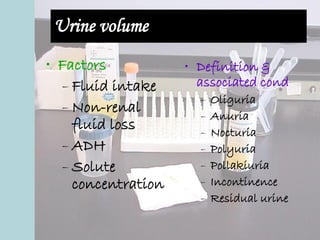
Urine volume
• Factors
– Fluid intake
– Non-renal
fluid loss
– ADH
– Solute
concentration
• Definition &
associated cond
– Oliguria
– Anuria
– Nocturia
– Polyuria
– Pollakiuria
– Incontinence
– Residual urine
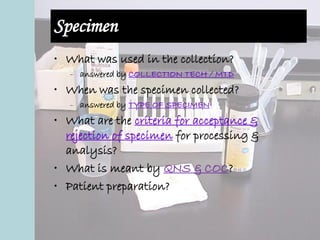
Specimen
• What was used in the collection?
– answered by COLLECTION TECH / MTD
• When was the specimen collected?
– answered by TYPE OF SPECIMEN
• What are the criteria for acceptance &
rejection of specimen for processing &
analysis?
• What is meant by QNS & COC?
• Patient preparation?
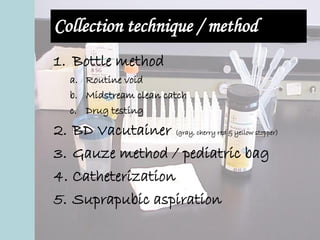
Collection technique / method
1. Bottle method
a. Routine void
b. Midstream clean catch
c. Drug testing
2. BD Vacutainer (gray, cherry red & yellow stopper)
3. Gauze method / pediatric bag
4. Catheterization
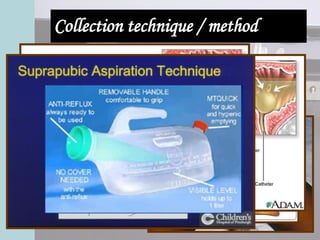
5. Suprapubic aspiration
Collection technique / method
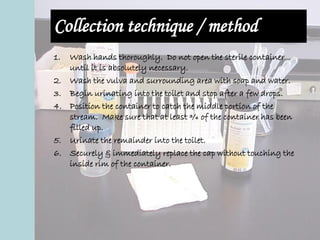
1. Wash hands thoroughly. Do not open the sterile container
until it is absolutely necessary.
2. Wash the vulva and surrounding area with soap and water.
3. Begin urinating into the toilet and stop after a few drops.
4. Position the container to catch the middle portion of the
stream. Make sure that at least ¾ of the container has been
filled up.
5. Urinate the remainder into the toilet.
6. Securely & immediately replace the cap without touching the
inside rim of the container.
Collection technique / method
Types of Specimen
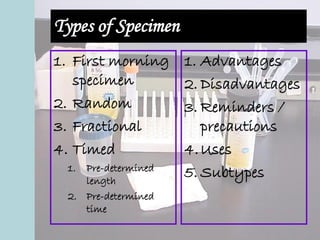
1. First morning
specimen
2. Random
3. Fractional
4. Timed
1. Pre-determined
length
2. Pre-determined
time
1. Advantages
2. Disadvantages
3. Reminders /
precautions
4.Uses
5. Subtypes
Specimen handling
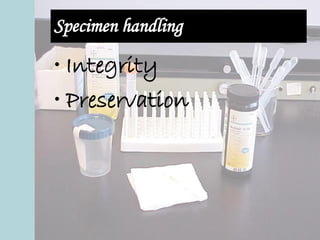
• Integrity
• Preservation
Physical changes
Color
• Due to oxidation or reduction of substances
Clarity
• Falsely decreased
• Due to bacterial proliferation, solute ppt’n
Odor
• Falsely increased
• Due to bacterial proliferation
Chemical Changes
pH
• Falsely increased
• Due to bacterial decomposition of urea to
ammonia
• Falsely decreased
• Due to bacterial or yeast conversion of glucose
to form acids
Chemical Changes
glucose
• Falsely decreased
• Due to cellular or bacterial hydrolysis
ketones
• Falsely decreased
• Due to bacterial metabolism of acetoacetate to
acetone
• volatilization of acetone
Chemical Changes
bilirubin
• Falsely decreased
• Due to photo-oxidation to biliverdin and
hydrolysis to free bilirubin
urobilinogen
• Falsely decreased
• Due to oxidation to urobilin
Chemical Changes
Nitrite
• Falsely increased
• Due to bacterial production following spx
collection
• Falsely decreased
• Due to conversion to nitrogen
Microscopic Changes
RBC, WBC, casts
• Falsely decreased
• Disintegration of cellular & formed elements,
esp in dilute alkaline urine
Bacteria
• Falsely increased
• Due to bacterial proliferation ff spx collection
Preservation
WHY IS IT NECESSARY TO:
• Maintain the pH?
• Avoid bacterial contamination?
• Avoid conversion of urea to ammonia?
HOW DO YOU ACCOMPLISH THE
AFOREMENTIONED STEPS?
Preservation
A. Physical
Methods
PRINCIPLE ?
A&D?
1. Refrigeration
2. Dry Ice
B. Chemical
Methods
PRINCIPLE ?
A&D?
1. Toluol
2. Thymol
3. Formalin
4. Chloroform
5. NaF
Preservation
B. Chemical
Methods
6. Benzoic acid
7. Phenol /
tricresol
8. 6N Hcl
9. Boric Acid
10. H2SO4
11. Na carbonate
12. Acetic Acid
13. Saccomanno’s
fixative

Cm6 ua intro

  • 1.
  • 2.
    History • Hieroglyphics • Uroscopy (Hippocrates) •Ant & taste testing (Sasruta) • Urine boiling (F. Dekkers)
  • 3.
    History • Pisse prophets (charlatans) •Thomas Bryant • Microscope • Thomas Addis • Richard Bright • Modern urinalysis
  • 4.
    Rationale of Urinetesting • (Relatively) readily collected and easily available specimen • Contains information about the body’s major metabolic fxns • inexpensive
  • 5.
    Rationale of Urinetesting ? Disease conditions ? Hormonal activity ? Ruling out, ruling in, screening & prognosis
  • 6.
    Urine Composition • Howdo the ff. affect composition: –Dietary intake –Physical activity –Body metabolism –Endocrine functions –Body position
  • 7.
    Urine Composition • Substancesreadily reabsorbed –GANaCaKUP • Substances readily excreted –UCUA
  • 8.
    Urine Composition • Organic –Urea – Creatinine – Uric acid – Urobilinogen • Other substances – Hormones – Vit & meds • Inorganic – Cl2, K, Na • Formed elements – Cells & casts – Crystals – Mucus – bacteria
  • 9.
    Urine volume • Factors –Fluid intake – Non-renal fluid loss – ADH – Solute concentration • Definition & associated cond – Oliguria – Anuria – Nocturia – Polyuria – Pollakiuria – Incontinence – Residual urine
  • 10.
    Specimen • What wasused in the collection? – answered by COLLECTION TECH / MTD • When was the specimen collected? – answered by TYPE OF SPECIMEN • What are the criteria for acceptance & rejection of specimen for processing & analysis? • What is meant by QNS & COC? • Patient preparation?
  • 11.
    Collection technique /method 1. Bottle method a. Routine void b. Midstream clean catch c. Drug testing 2. BD Vacutainer (gray, cherry red & yellow stopper) 3. Gauze method / pediatric bag 4. Catheterization 5. Suprapubic aspiration
  • 12.
    Collection technique /method 1. Wash hands thoroughly. Do not open the sterile container until it is absolutely necessary. 2. Wash the vulva and surrounding area with soap and water. 3. Begin urinating into the toilet and stop after a few drops. 4. Position the container to catch the middle portion of the stream. Make sure that at least ¾ of the container has been filled up. 5. Urinate the remainder into the toilet. 6. Securely & immediately replace the cap without touching the inside rim of the container.
  • 13.
  • 14.
    Types of Specimen 1.First morning specimen 2. Random 3. Fractional 4. Timed 1. Pre-determined length 2. Pre-determined time 1. Advantages 2. Disadvantages 3. Reminders / precautions 4.Uses 5. Subtypes
  • 15.
  • 16.
    Physical changes Color • Dueto oxidation or reduction of substances Clarity • Falsely decreased • Due to bacterial proliferation, solute ppt’n Odor • Falsely increased • Due to bacterial proliferation
  • 17.
    Chemical Changes pH • Falselyincreased • Due to bacterial decomposition of urea to ammonia • Falsely decreased • Due to bacterial or yeast conversion of glucose to form acids
  • 18.
    Chemical Changes glucose • Falselydecreased • Due to cellular or bacterial hydrolysis ketones • Falsely decreased • Due to bacterial metabolism of acetoacetate to acetone • volatilization of acetone
  • 19.
    Chemical Changes bilirubin • Falselydecreased • Due to photo-oxidation to biliverdin and hydrolysis to free bilirubin urobilinogen • Falsely decreased • Due to oxidation to urobilin
  • 20.
    Chemical Changes Nitrite • Falselyincreased • Due to bacterial production following spx collection • Falsely decreased • Due to conversion to nitrogen
  • 21.
    Microscopic Changes RBC, WBC,casts • Falsely decreased • Disintegration of cellular & formed elements, esp in dilute alkaline urine Bacteria • Falsely increased • Due to bacterial proliferation ff spx collection
  • 22.
    Preservation WHY IS ITNECESSARY TO: • Maintain the pH? • Avoid bacterial contamination? • Avoid conversion of urea to ammonia? HOW DO YOU ACCOMPLISH THE AFOREMENTIONED STEPS?
  • 23.
    Preservation A. Physical Methods PRINCIPLE ? A&D? 1.Refrigeration 2. Dry Ice B. Chemical Methods PRINCIPLE ? A&D? 1. Toluol 2. Thymol 3. Formalin 4. Chloroform 5. NaF
  • 24.
    Preservation B. Chemical Methods 6. Benzoicacid 7. Phenol / tricresol 8. 6N Hcl 9. Boric Acid 10. H2SO4 11. Na carbonate 12. Acetic Acid 13. Saccomanno’s fixative