Rohin Khanna
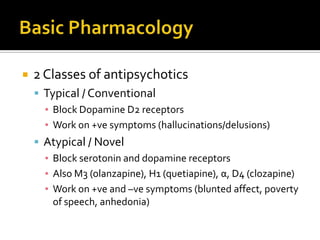
   2 Classes of antipsychotics
     Typical / Conventional
      ▪ Block Dopamine D2 receptors
      ▪ Work on +ve symptoms (hallucinations/delusions)
     Atypical / Novel
      ▪ Block serotonin and dopamine receptors
      ▪ Also M3 (olanzapine), H1 (quetiapine), α, D4 (clozapine)
      ▪ Work on +ve and –ve symptoms (blunted affect, poverty
        of speech, anhedonia)
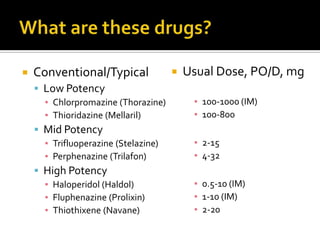
   Conventional/Typical                 Usual Dose, PO/D, mg
     Low Potency
      ▪ Chlorpromazine (Thorazine)         ▪ 100-1000 (IM)
      ▪ Thioridazine (Mellaril)            ▪ 100-800
     Mid Potency
      ▪ Trifluoperazine (Stelazine)        ▪ 2-15
      ▪ Perphenazine (Trilafon)            ▪ 4-32
     High Potency
      ▪ Haloperidol (Haldol)               ▪ 0.5-10 (IM)
      ▪ Fluphenazine (Prolixin)            ▪ 1-10 (IM)
      ▪ Thiothixene (Navane)               ▪ 2-20
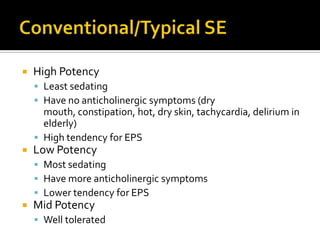
   High Potency
     Least sedating
     Have no anticholinergic symptoms (dry
      mouth, constipation, hot, dry skin, tachycardia, delirium in
      elderly)
     High tendency for EPS
   Low Potency
     Most sedating
     Have more anticholinergic symptoms
     Lower tendency for EPS
   Mid Potency
     Well tolerated
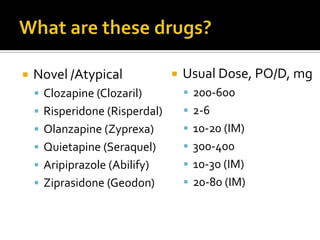
   Novel /Atypical                Usual Dose, PO/D, mg
     Clozapine (Clozaril)           200-600
     Risperidone (Risperdal)        2-6
     Olanzapine (Zyprexa)           10-20 (IM)
     Quietapine (Seraquel)          300-400
     Aripiprazole (Abilify)         10-30 (IM)
     Ziprasidone (Geodon)           20-80 (IM)
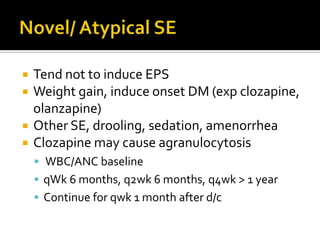
   Tend not to induce EPS
   Weight gain, induce onset DM (exp clozapine,
    olanzapine)
   Other SE, drooling, sedation, amenorrhea
   Clozapine may cause agranulocytosis
     WBC/ANC baseline
     qWk 6 months, q2wk 6 months, q4wk > 1 year
     Continue for qwk 1 month after d/c
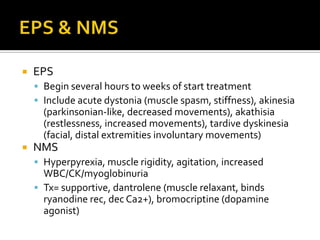
   EPS
     Begin several hours to weeks of start treatment
     Include acute dystonia (muscle spasm, stiffness), akinesia
      (parkinsonian-like, decreased movements), akathisia
      (restlessness, increased movements), tardive dyskinesia
      (facial, distal extremities involuntary movements)
   NMS
     Hyperpyrexia, muscle rigidity, agitation, increased
      WBC/CK/myoglobinuria
     Tx= supportive, dantrolene (muscle relaxant, binds
      ryanodine rec, dec Ca2+), bromocriptine (dopamine
      agonist)
   Braunwald, E., et al. (2002). Harrison’s manual of medicine.
    International Edition: McGraw Hill.
   Bhushan, V., Le, T. (2011). First Aid for the USMLE Step 1
    2011: A Student to student guide. McGraw Hill.
   Jann MW, Grimsley SR, Gray EC, Chang WH.
    Pharmacokinetics and pharmacodynamics of clozapine. Clin
    Pharmacokinet 1993; 24:161.

Anitpsychotic medications

  • 1.
  • 2.
    2 Classes of antipsychotics  Typical / Conventional ▪ Block Dopamine D2 receptors ▪ Work on +ve symptoms (hallucinations/delusions)  Atypical / Novel ▪ Block serotonin and dopamine receptors ▪ Also M3 (olanzapine), H1 (quetiapine), α, D4 (clozapine) ▪ Work on +ve and –ve symptoms (blunted affect, poverty of speech, anhedonia)
  • 3.
    Conventional/Typical  Usual Dose, PO/D, mg  Low Potency ▪ Chlorpromazine (Thorazine) ▪ 100-1000 (IM) ▪ Thioridazine (Mellaril) ▪ 100-800  Mid Potency ▪ Trifluoperazine (Stelazine) ▪ 2-15 ▪ Perphenazine (Trilafon) ▪ 4-32  High Potency ▪ Haloperidol (Haldol) ▪ 0.5-10 (IM) ▪ Fluphenazine (Prolixin) ▪ 1-10 (IM) ▪ Thiothixene (Navane) ▪ 2-20
  • 4.
    High Potency  Least sedating  Have no anticholinergic symptoms (dry mouth, constipation, hot, dry skin, tachycardia, delirium in elderly)  High tendency for EPS  Low Potency  Most sedating  Have more anticholinergic symptoms  Lower tendency for EPS  Mid Potency  Well tolerated
  • 5.
    Novel /Atypical  Usual Dose, PO/D, mg  Clozapine (Clozaril)  200-600  Risperidone (Risperdal)  2-6  Olanzapine (Zyprexa)  10-20 (IM)  Quietapine (Seraquel)  300-400  Aripiprazole (Abilify)  10-30 (IM)  Ziprasidone (Geodon)  20-80 (IM)
  • 6.
    Tend not to induce EPS  Weight gain, induce onset DM (exp clozapine, olanzapine)  Other SE, drooling, sedation, amenorrhea  Clozapine may cause agranulocytosis  WBC/ANC baseline  qWk 6 months, q2wk 6 months, q4wk > 1 year  Continue for qwk 1 month after d/c
  • 7.
    EPS  Begin several hours to weeks of start treatment  Include acute dystonia (muscle spasm, stiffness), akinesia (parkinsonian-like, decreased movements), akathisia (restlessness, increased movements), tardive dyskinesia (facial, distal extremities involuntary movements)  NMS  Hyperpyrexia, muscle rigidity, agitation, increased WBC/CK/myoglobinuria  Tx= supportive, dantrolene (muscle relaxant, binds ryanodine rec, dec Ca2+), bromocriptine (dopamine agonist)
  • 8.
    Braunwald, E., et al. (2002). Harrison’s manual of medicine. International Edition: McGraw Hill.  Bhushan, V., Le, T. (2011). First Aid for the USMLE Step 1 2011: A Student to student guide. McGraw Hill.  Jann MW, Grimsley SR, Gray EC, Chang WH. Pharmacokinetics and pharmacodynamics of clozapine. Clin Pharmacokinet 1993; 24:161.

Editor's Notes

  • #7 Agran- wbc count below 2000cells/mm3 blood (<5% of normal)