











Cloud Computing & Windows AzureLessius Hogeschool, MechelenMaarten Balliauw – RealDolmenE-mail: maarten.balliauw@realdolmen.comBlog: http://blog.maartenballiauw.beTwitter: @maartenballiauw
Who am I?Maarten BalliauwAntwerp, Belgiumwww.realdolmen.comTechnology Specialist Windows AzureCo-founder of AZUGFocus on webASP.NET, ASP.NET MVC, PHP, Azure, …MVP ASP.NEThttp://blog.maartenballiauw.be@maartenballiauw
AgendaCloud ComputingMicrosoft Cloud & Windows AzureSome examplesA Payroll CompanyChronoraceConclusion
Cloud ComputingWhat is cloud computing?
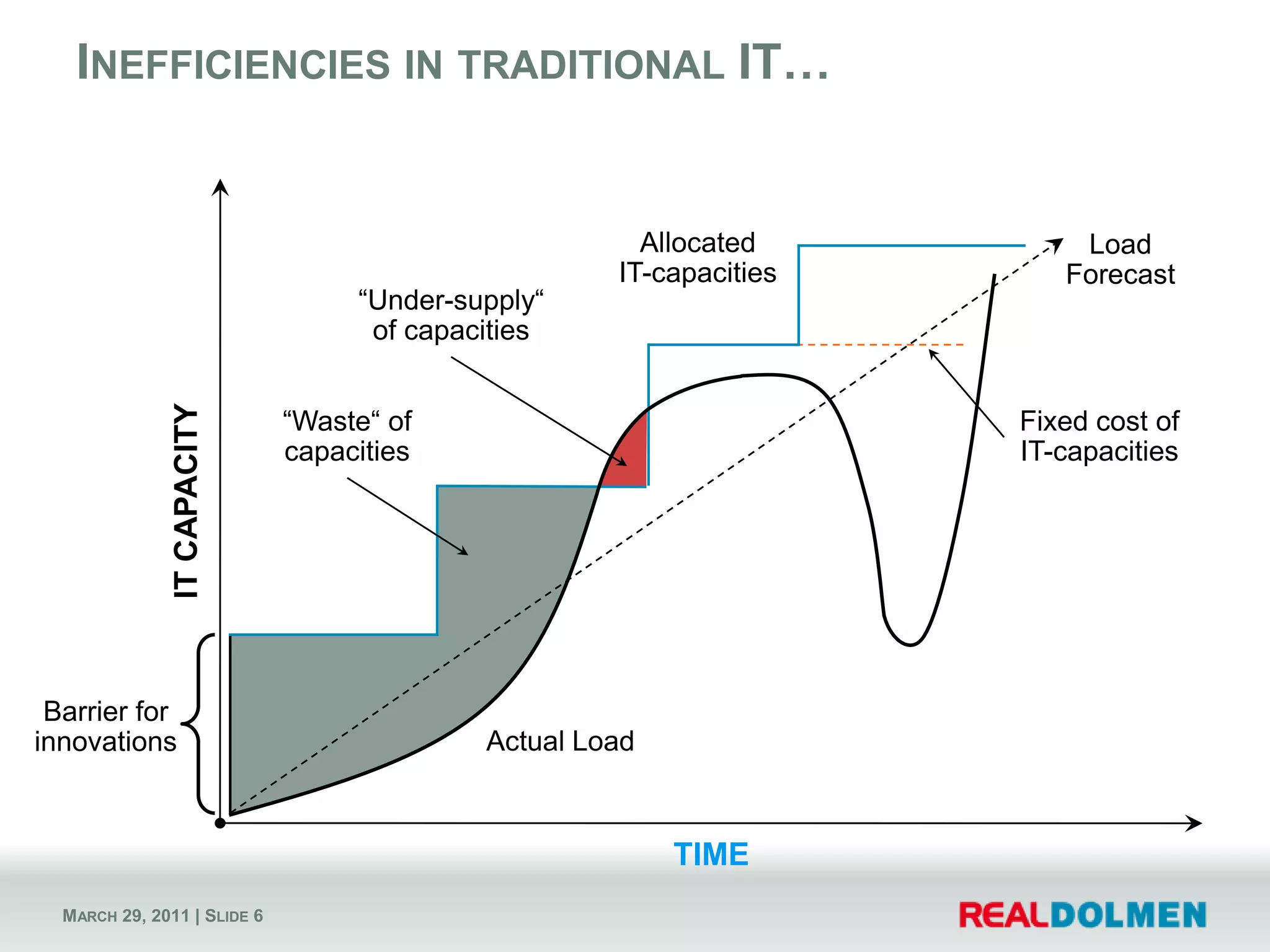
Inefficiencies in traditional IT…Allocated IT-capacitiesLoad Forecast“Under-supply“ of capacities“Waste“ of capacitiesFixed cost of IT-capacitiesIT CAPACITYBarrier forinnovationsActualLoadTIME
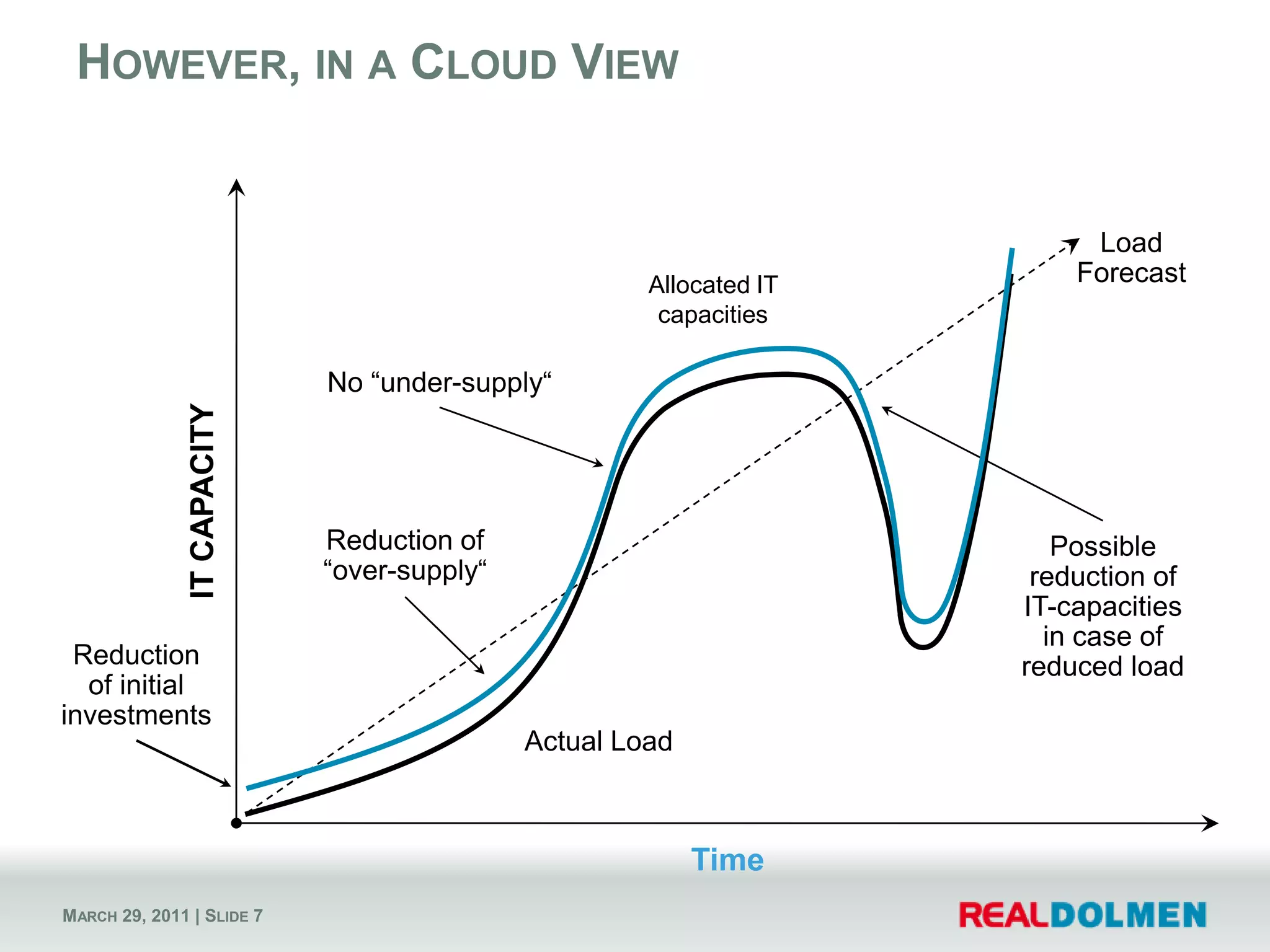
However, in a Cloud ViewLoad ForecastAllocated IT capacitiesNo “under-supply“IT CAPACITYReduction of “over-supply“Possible reduction of IT-capacities in case of reduced loadReduction of initial investmentsActualLoadTime
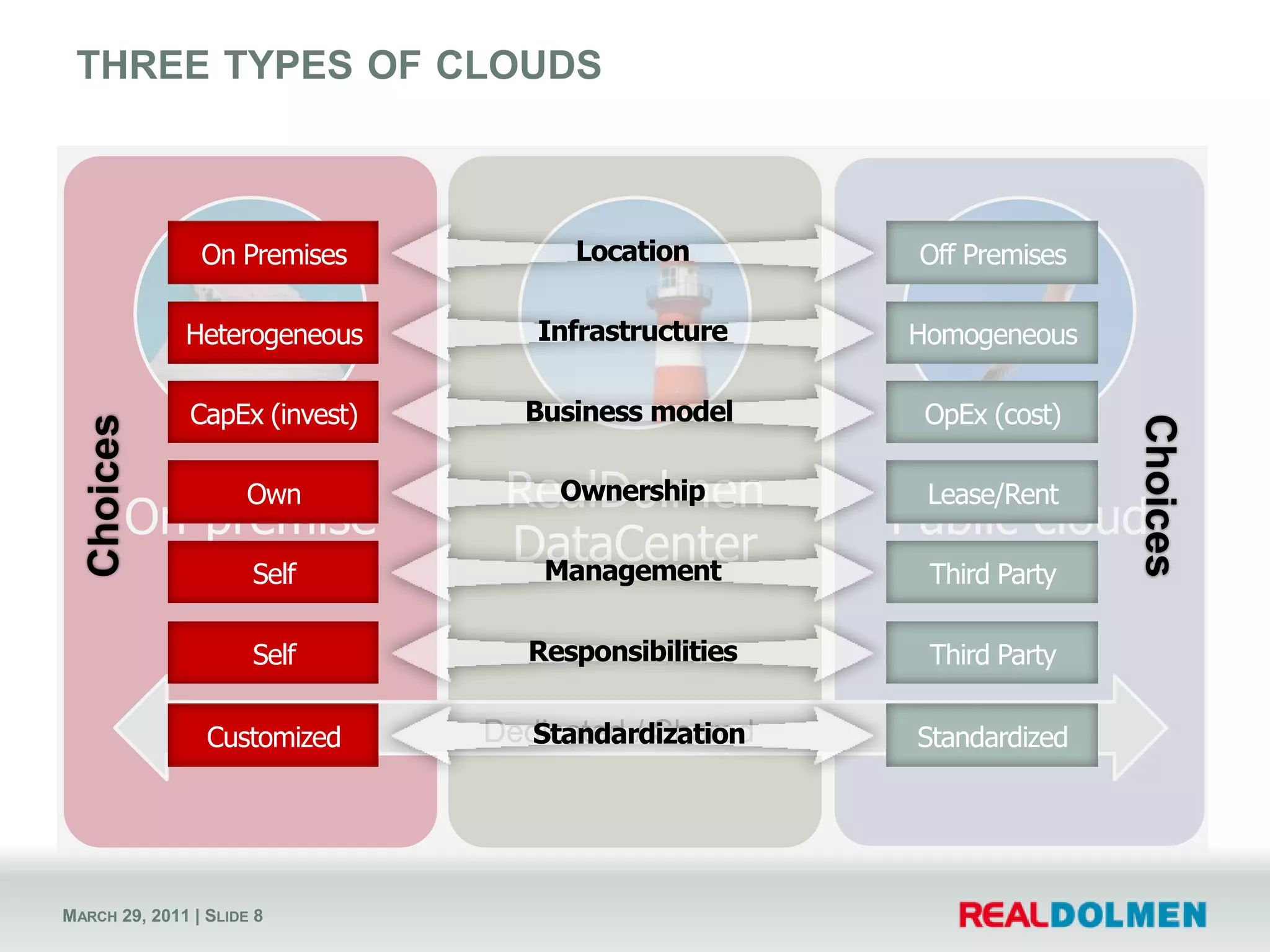
three types of cloudsOff PremisesOn PremisesLocationHomogeneousHeterogeneousInfrastructureChoicesChoicesCapEx (invest)OpEx (cost)Business modelOwnLease/RentOwnershipSelfThird PartyManagementSelfThird PartyResponsibilitiesCustomizedStandardizedStandardizationPrivate	                  Dedicated / Shared		 SharedPrivate			Dedicated / Shared		Shared
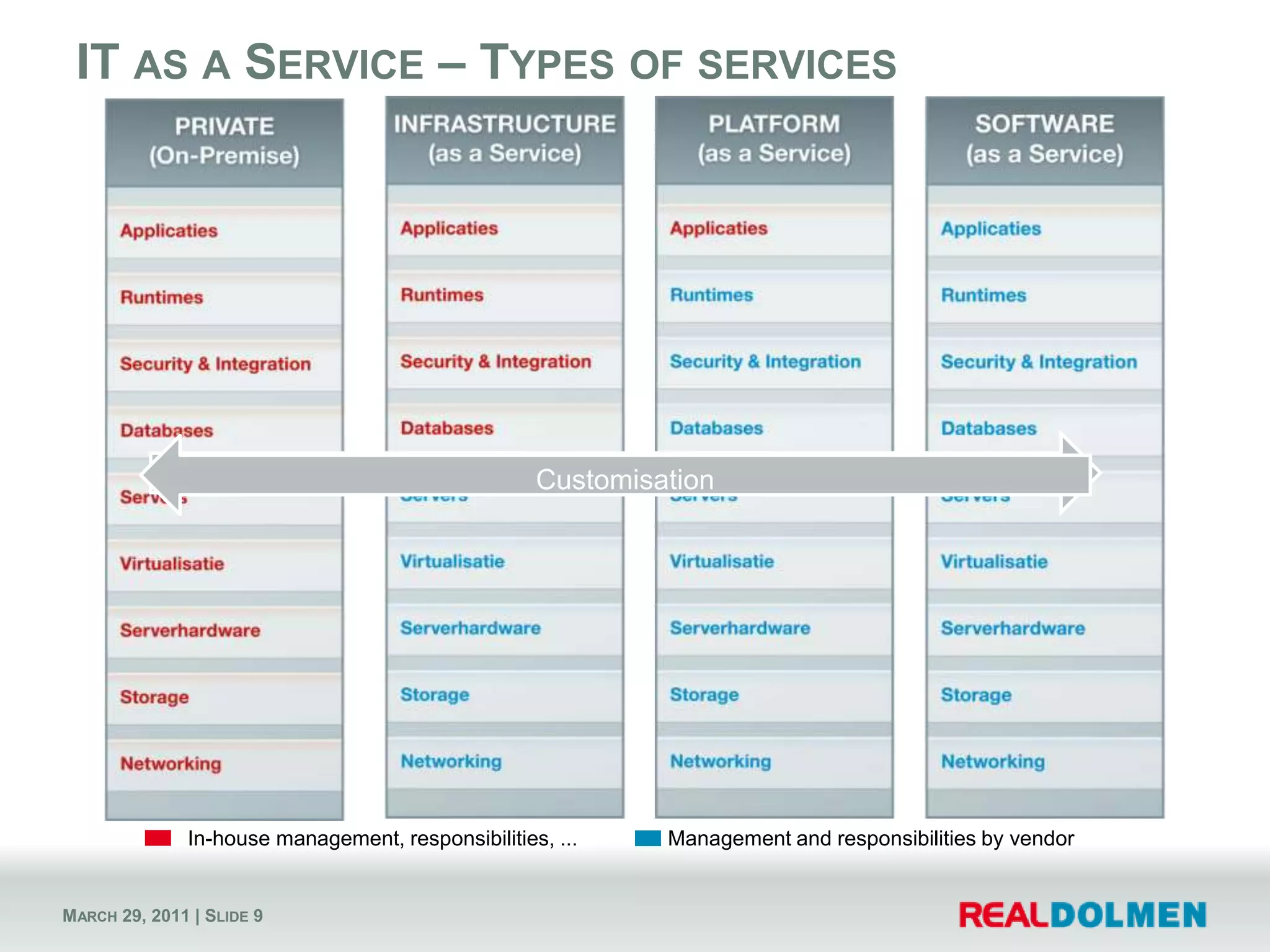
IT as a Service – Types of servicesScalabilityCustomisationManagement and responsibilities by vendorIn-house management, responsibilities, ...
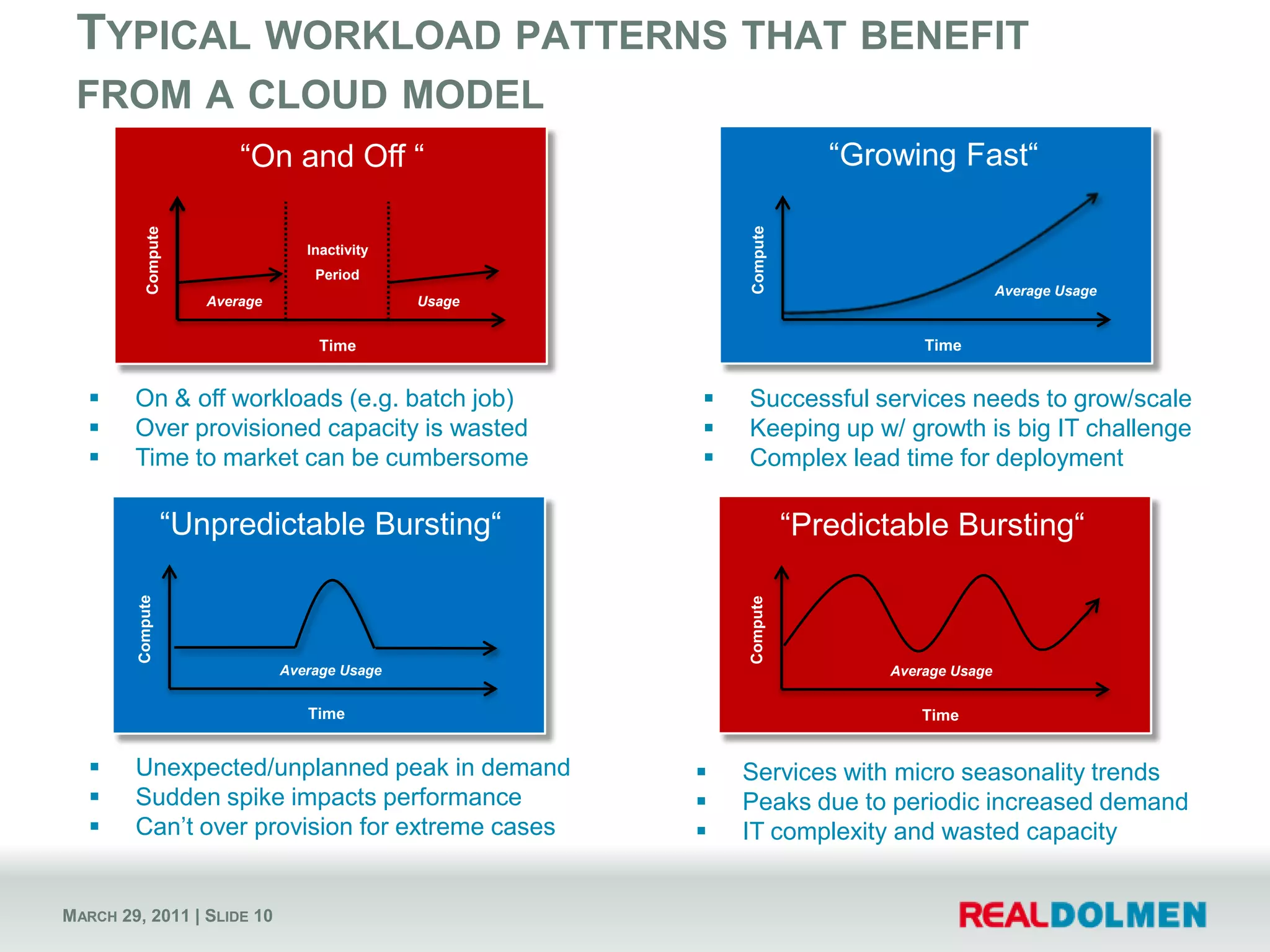
“Growing Fast“  “On and Off “  InactivityPeriod Compute Compute Average UsageUsageAverageTime Time On & off workloads (e.g. batch job)
Over provisioned capacity is wasted
Time to market can be cumbersome
Successful services needs to grow/scale
Keeping up w/ growth is big IT challenge
Complex lead time for deployment“Unpredictable Bursting“  “Predictable Bursting“  Compute Compute Average Usage Average Usage Time Time Unexpected/unplanned peak in demand
Sudden spike impacts performance
Can’t over provision for extreme cases
Services with micro seasonality trends
Peaks due to periodic increased demand
IT complexity and wasted capacity   Typical workload patterns that benefitfrom a cloud model
And of course one more...
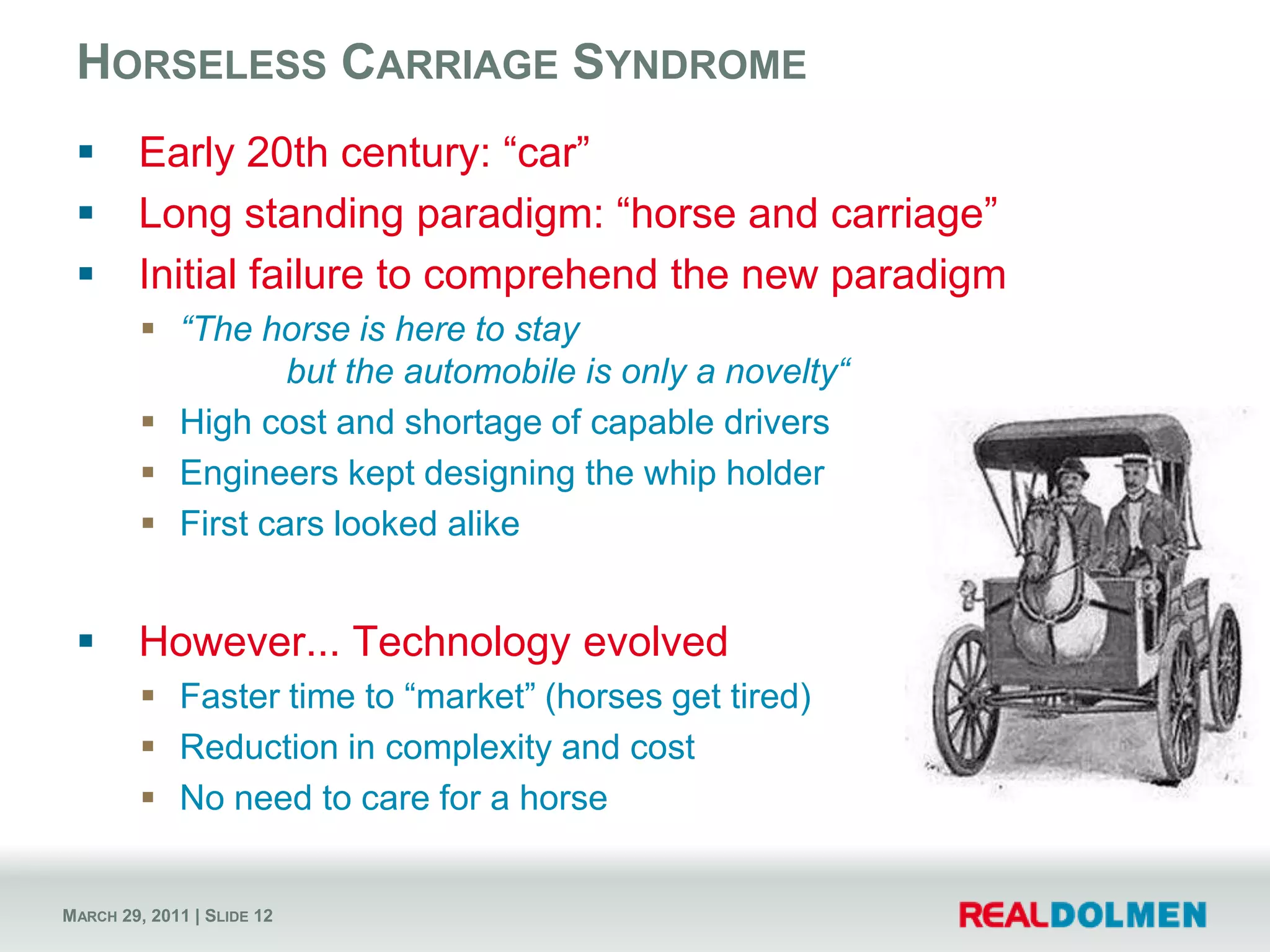
Horseless Carriage SyndromeEarly 20th century: “car”Long standing paradigm: “horse and carriage”Initial failure to comprehend the new paradigm“The horse is here to stay           but the automobile is only a novelty“High cost and shortage of capable driversEngineers kept designing the whip holderFirst cars looked alikeHowever... Technology evolvedFaster time to “market” (horses get tired)Reduction in complexity and costNo need to care for a horse
Mindswitches – Business perspectiveInvestments become costsCapEx vs. OpExDifficult to work with fixed budgets*Cloud is cheap in many casesYou rent capacity, not serversManagement is automatedIT staff will have other work to doMore innovationIT department can be bypassed for quick PoCsLow entry costs = lower barrier for innovationNew ways of generating revenue
Mindswitches – IT staffYour job will look different (a little)No more server re-imaging*Less server managementMonitoring of applications, not serversArchitecture of IT becomes far more interestingOn-premises servers and machinesVirtual machines somewhere in the cloud but also domain joinedSecurityLAN/WAN capacity / interconnectivityProvisioning
Mindswitches – DevelopersArchitecture becomes far more interesingStorage can be different depending on your needsDatabases can be different depending on your needsLoosely coupled applicationsThink bigIt’s a Windows worldProof of conceptsWhy not bypass IT for PoCs if you can just fire up a new subscription?
Microsoft CloudOverview of all platform components
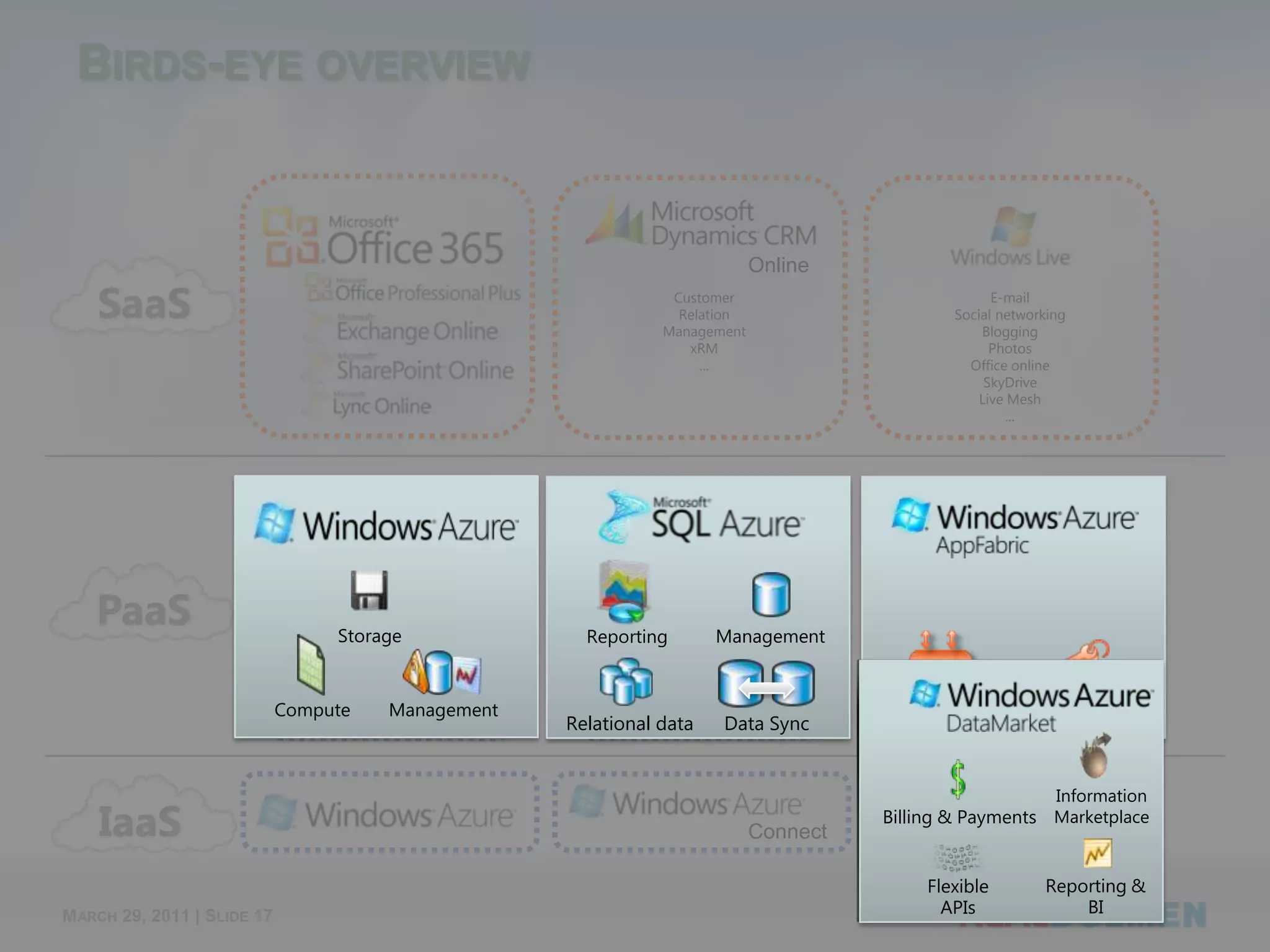
Birds-eye overviewOnlineSaaSPaaSIaaSCustomerRelationManagementxRM...E-mail Social networkingBloggingPhotosOffice onlineSkyDriveLive Mesh...ReportingConnectivityAccess controlComputeStorageManagementContent Delivery NetworkRelational DatabaseReportingSynchronizationConnectivityService busAuthenticationFederationRelational dataManagementComputeStorageFlexible APIsFlexible APIsManagementInformation MarketplaceInformation MarketplaceReporting & BIConnectBilling & PaymentsData Sync
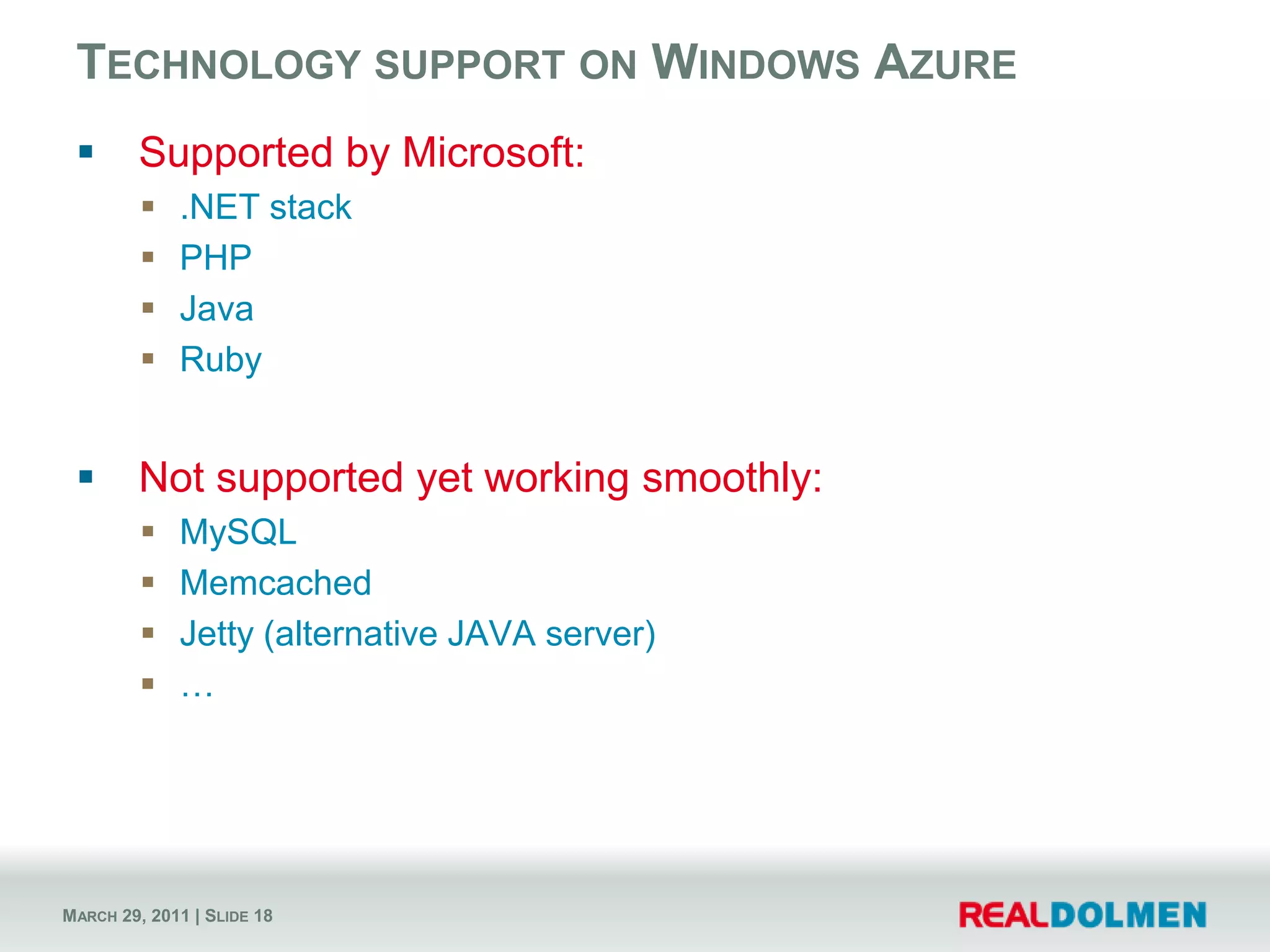
Technology support on Windows AzureSupported by Microsoft:.NET stackPHPJavaRubyNot supported yet working smoothly:MySQLMemcachedJetty (alternative JAVA server)…
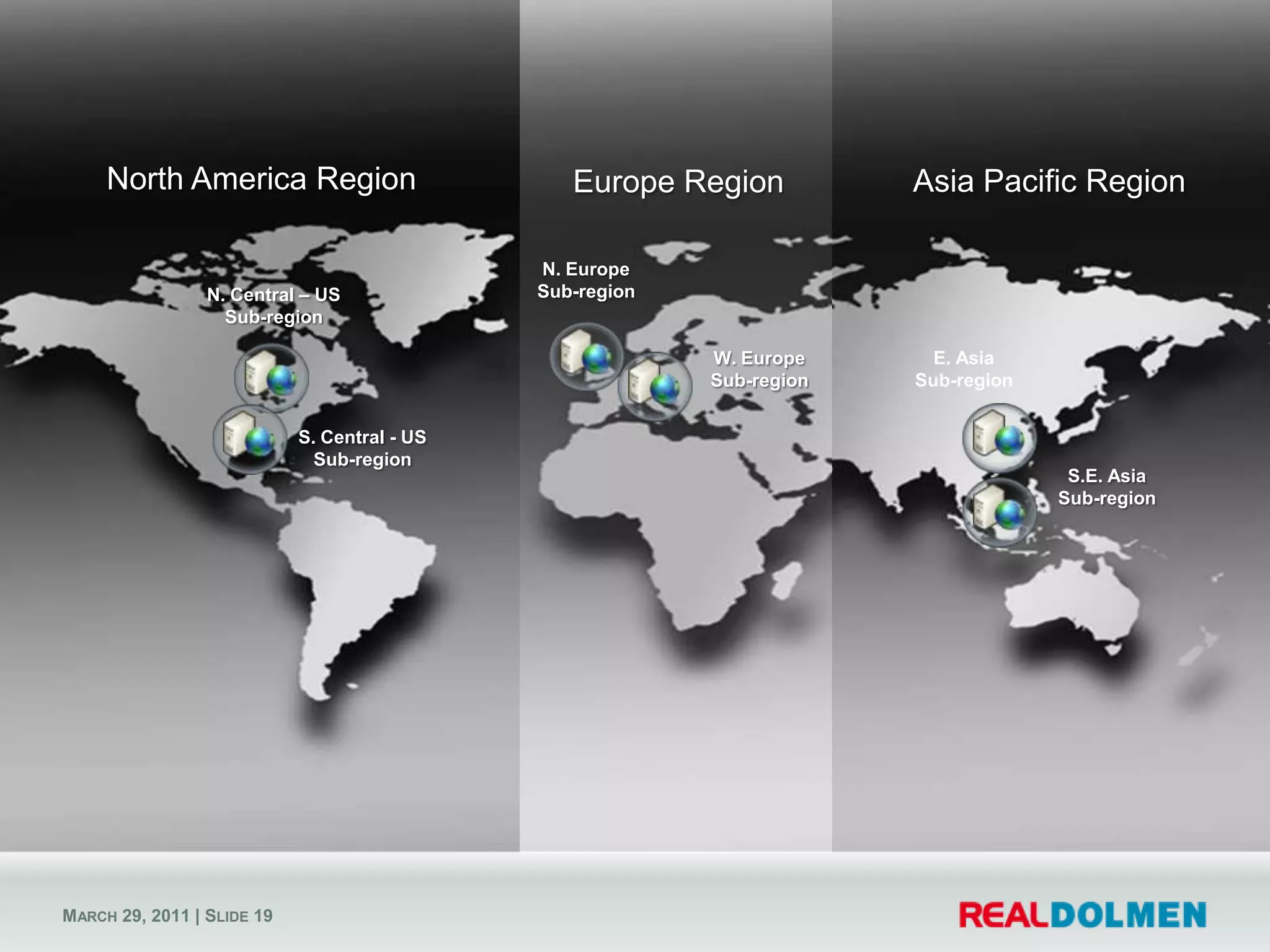
North America Region  Asia Pacific RegionEurope RegionN. Europe Sub-region  N. Central – US  Sub-region  E. AsiaSub-region W. Europe Sub-region S. Central - US Sub-regionS.E. AsiaSub-region
EXAMPLE CASESSome example cases
A PayRoll CompanyAn example...
A Payroll CompanyDelivering payroll services to other companiesGeneral payroll services, staffing, tax, legal, ...Many processes not automatedContinuously on the look to automate processes and interaction with clients and their employees
Their project: Compensations à la CarteAllow customers to use their softwareAllow customers to plug in different servicesAllow employees of customers to select their compensations
What’s in the cloud?The problem…Compensations à la Carte
Some issues...Will it work?What will it cost with 1 customer and 50 employees?What will it cost with 100 customers and 1000 employees?What if all customers sign up and we have 100.000 employees?And what about the interaction with other services?Uncertainty!Development costs will be fixedInfrastructure costs... Maybe low, maybe high?
Cloud allows innovation!Development costs will be thereInfrastructure costs will increase when revenue increasesCloud is a perfect fit to drive innovation!
ChronoRaceAn example...FirstWindows Azure implementation in Belgium!
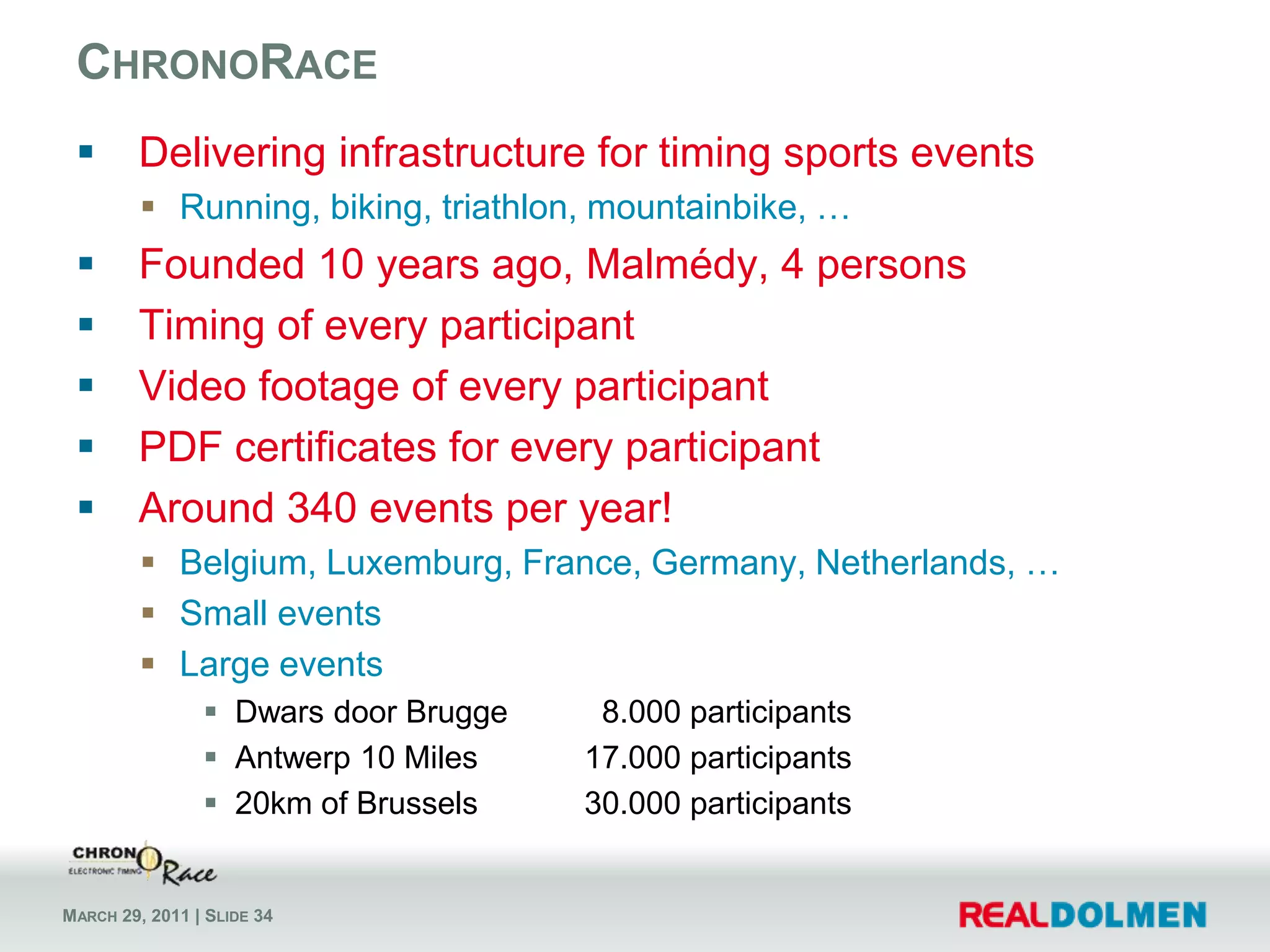
ChronoRaceDelivering infrastructure for timing sports eventsRunning, biking, triathlon, mountainbike, …Founded 10 years ago, Malmédy, 4 personsTiming of every participantVideo footage of every participantPDF certificates for every participantAround 340 events per year!Belgium, Luxemburg, France, Germany, Netherlands, …Small eventsLarge eventsDwars door Brugge	  8.000 participantsAntwerp 10 Miles	17.000 participants20km of Brussels	30.000 participants
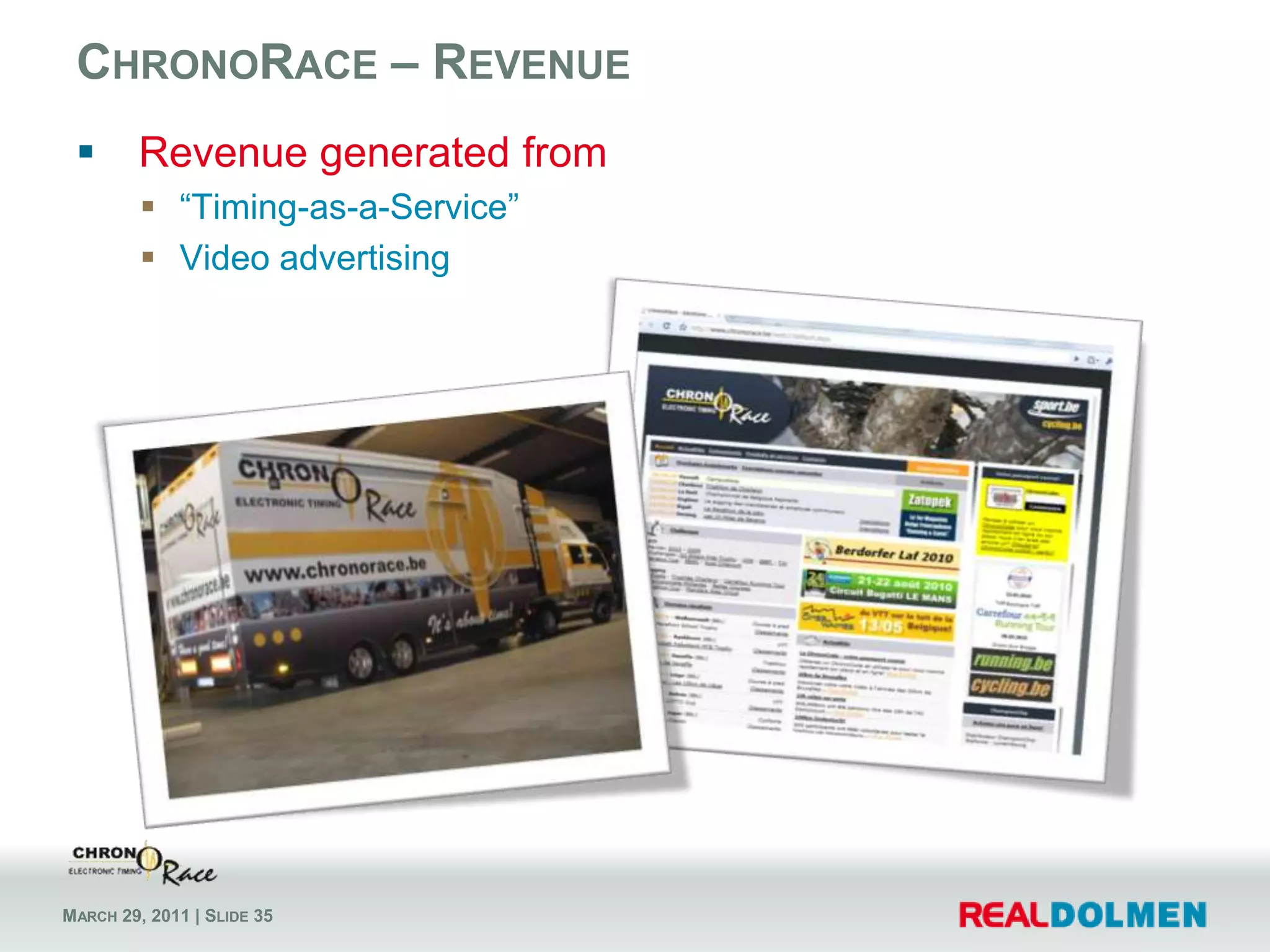
ChronoRace – Revenue Revenue generated from“Timing-as-a-Service”Video advertising
What’s in the cloud?The problem…Big events are fun, but also
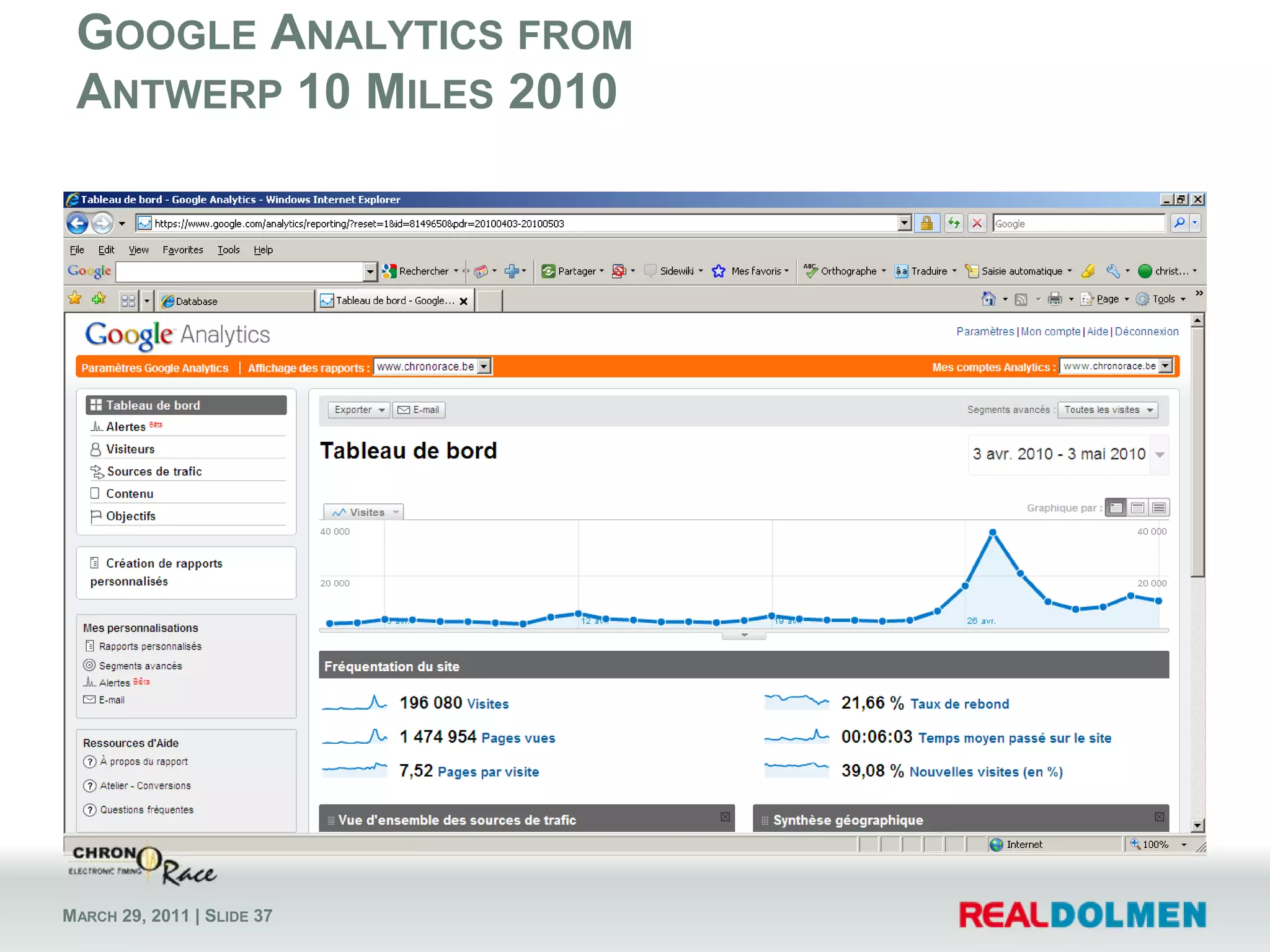
Google Analytics fromAntwerp 10 Miles 2010
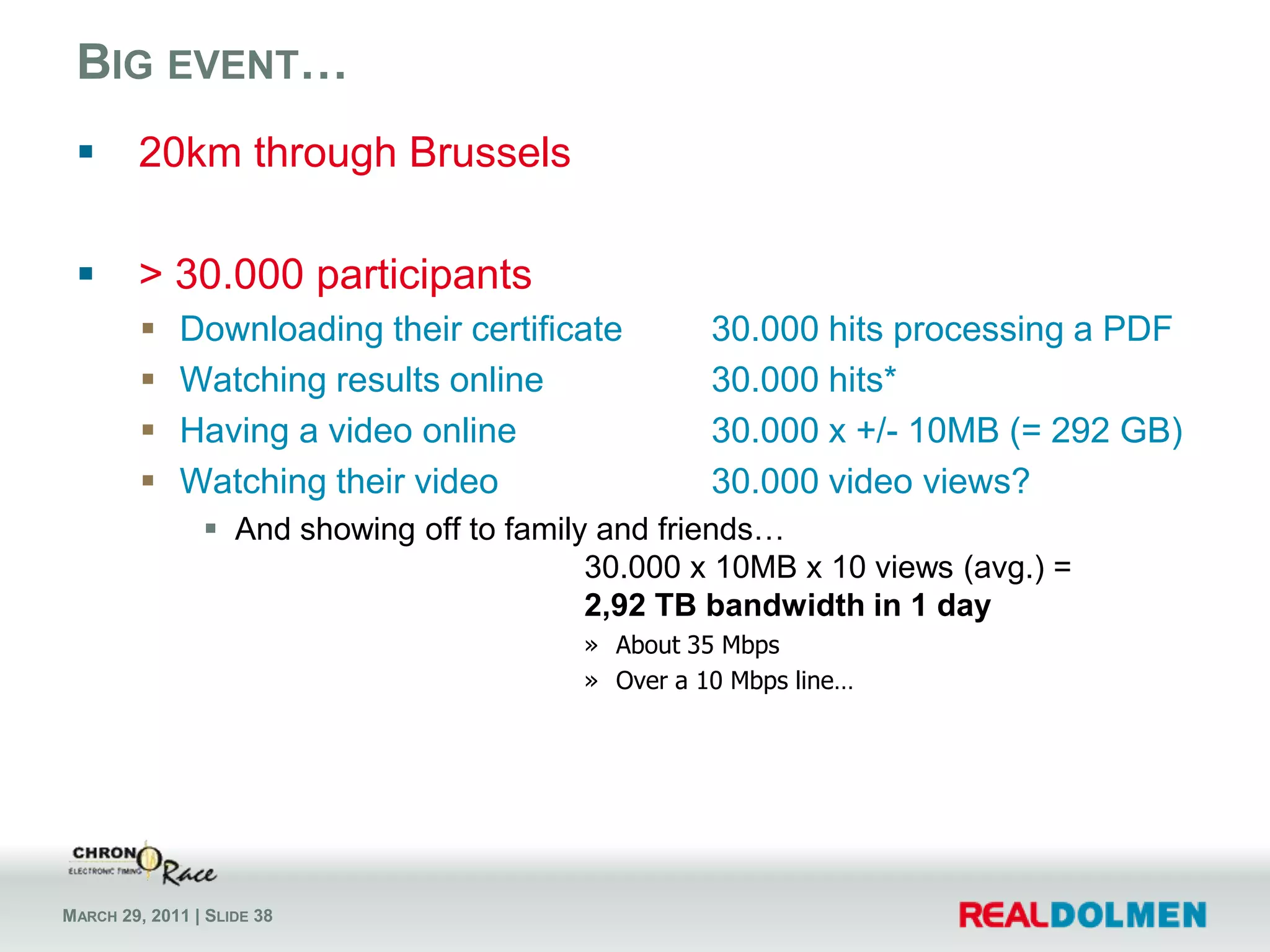
Big event…20km through Brussels> 30.000 participantsDownloading their certificate	30.000 hits processing a PDFWatching results online		30.000 hits*Having a video online		30.000 x +/- 10MB (= 292 GB)Watching their video		30.000 video views?And showing off to family and friends…			30.000 x 10MB x 10 views (avg.) =			2,92 TB bandwidth in 1 dayAbout 35 MbpsOver a 10 Mbps line…
What’s in the cloud?Possible solutionsWhat are the options?
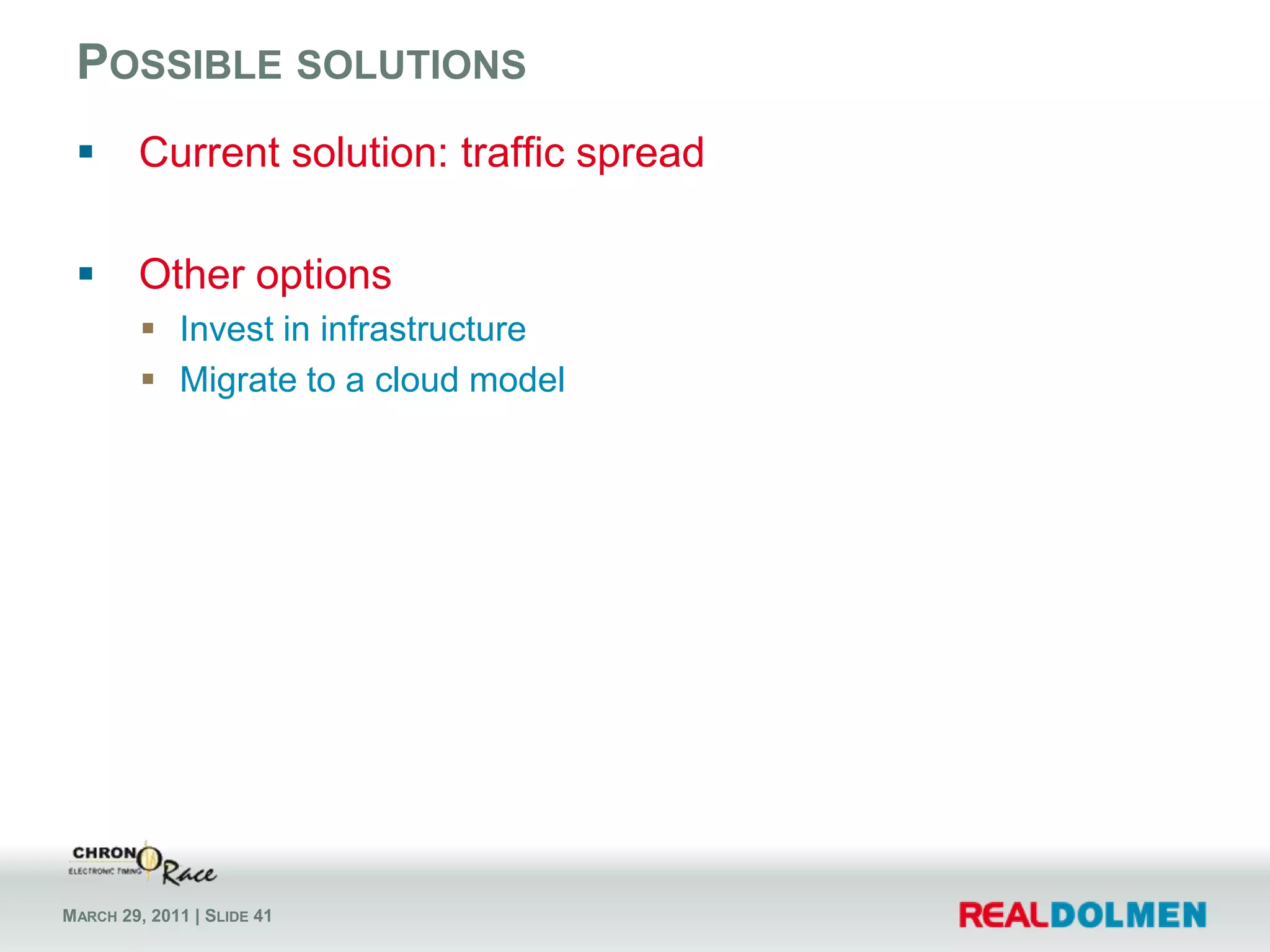
Possible solutionsCurrent solution: traffic spreadOther optionsInvest in infrastructureMigrate to a cloud model
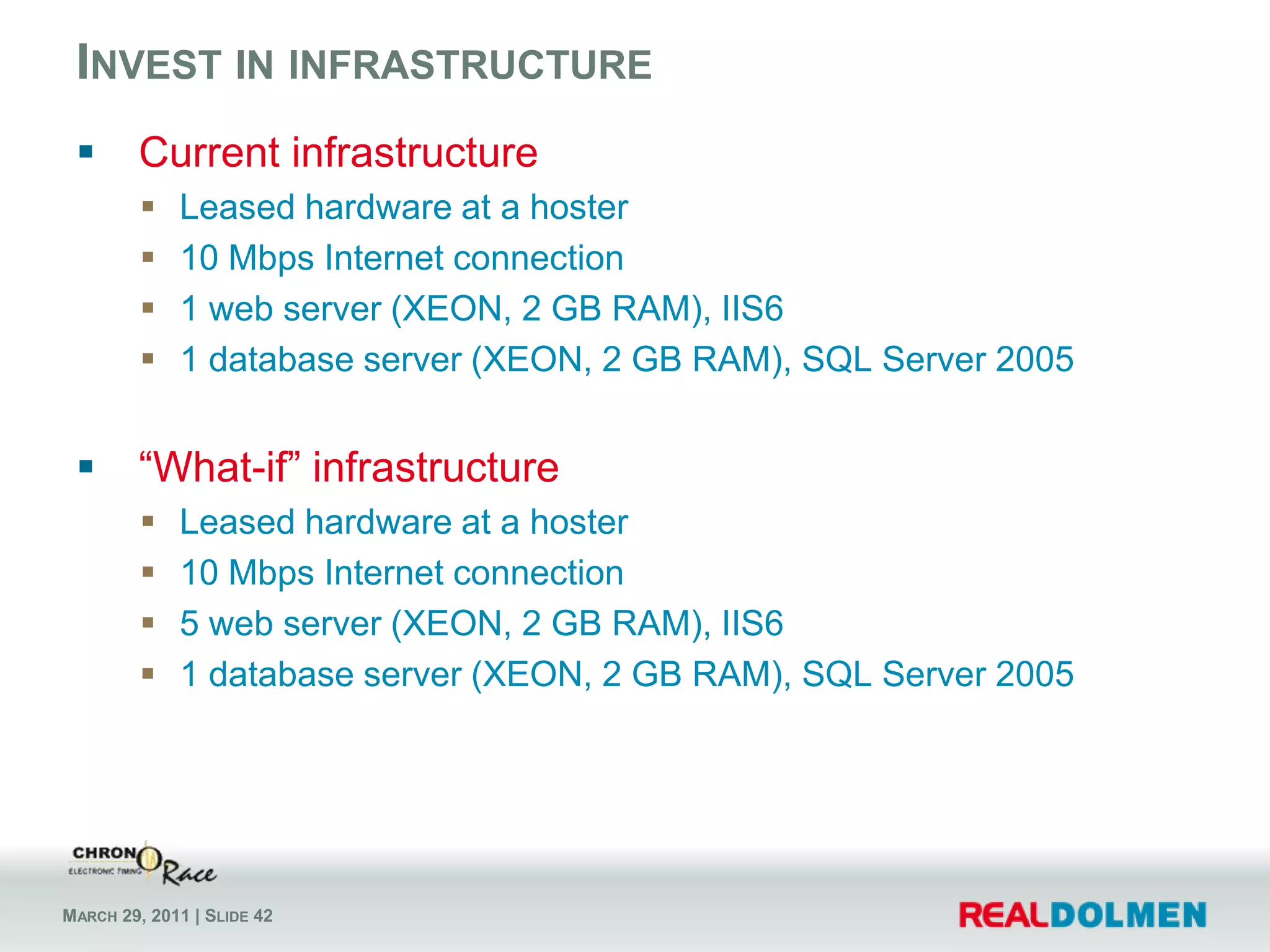
Invest in infrastructureCurrent infrastructureLeased hardware at a hoster10 Mbps Internet connection1 web server (XEON, 2 GB RAM), IIS61 database server (XEON, 2 GB RAM), SQL Server 2005“What-if” infrastructureLeased hardware at a hoster10 Mbps Internet connection5 web server (XEON, 2 GB RAM), IIS61 database server (XEON, 2 GB RAM), SQL Server 2005
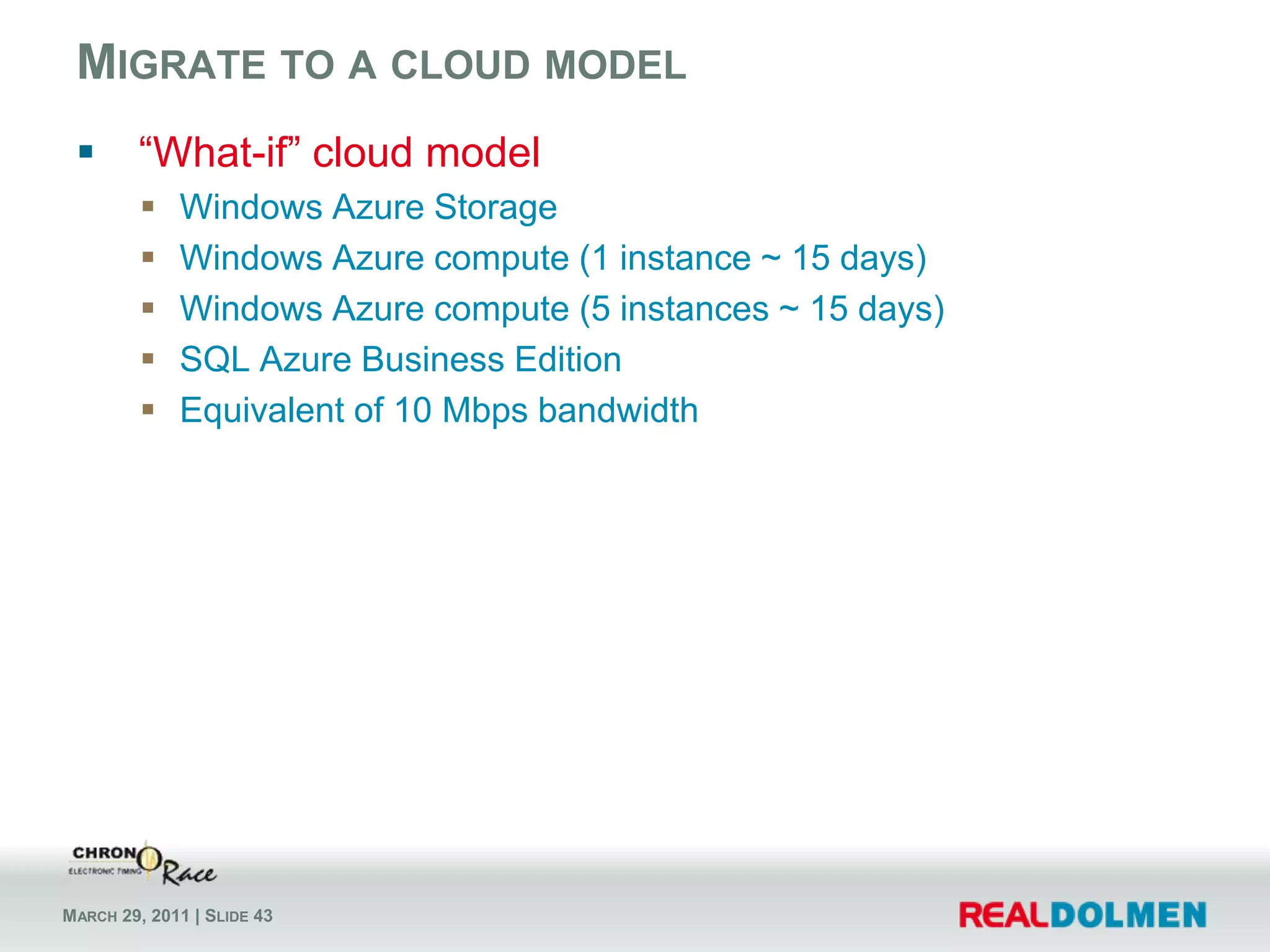
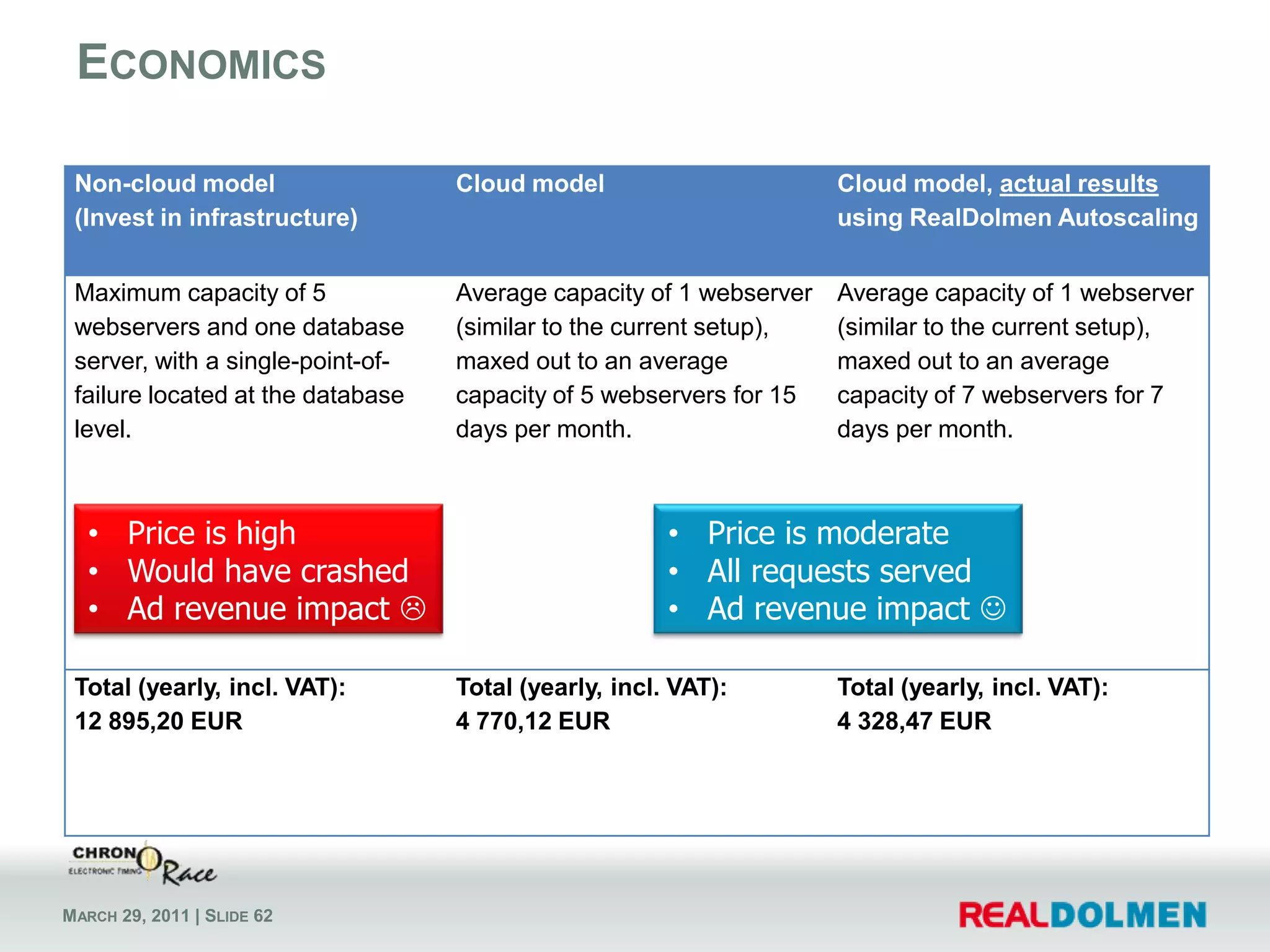
Migrate to a cloud model“What-if” cloud modelWindows Azure StorageWindows Azure compute (1 instance ~ 15 days)Windows Azure compute (5 instances ~ 15 days)SQL Azure Business EditionEquivalent of 10 Mbps bandwidth
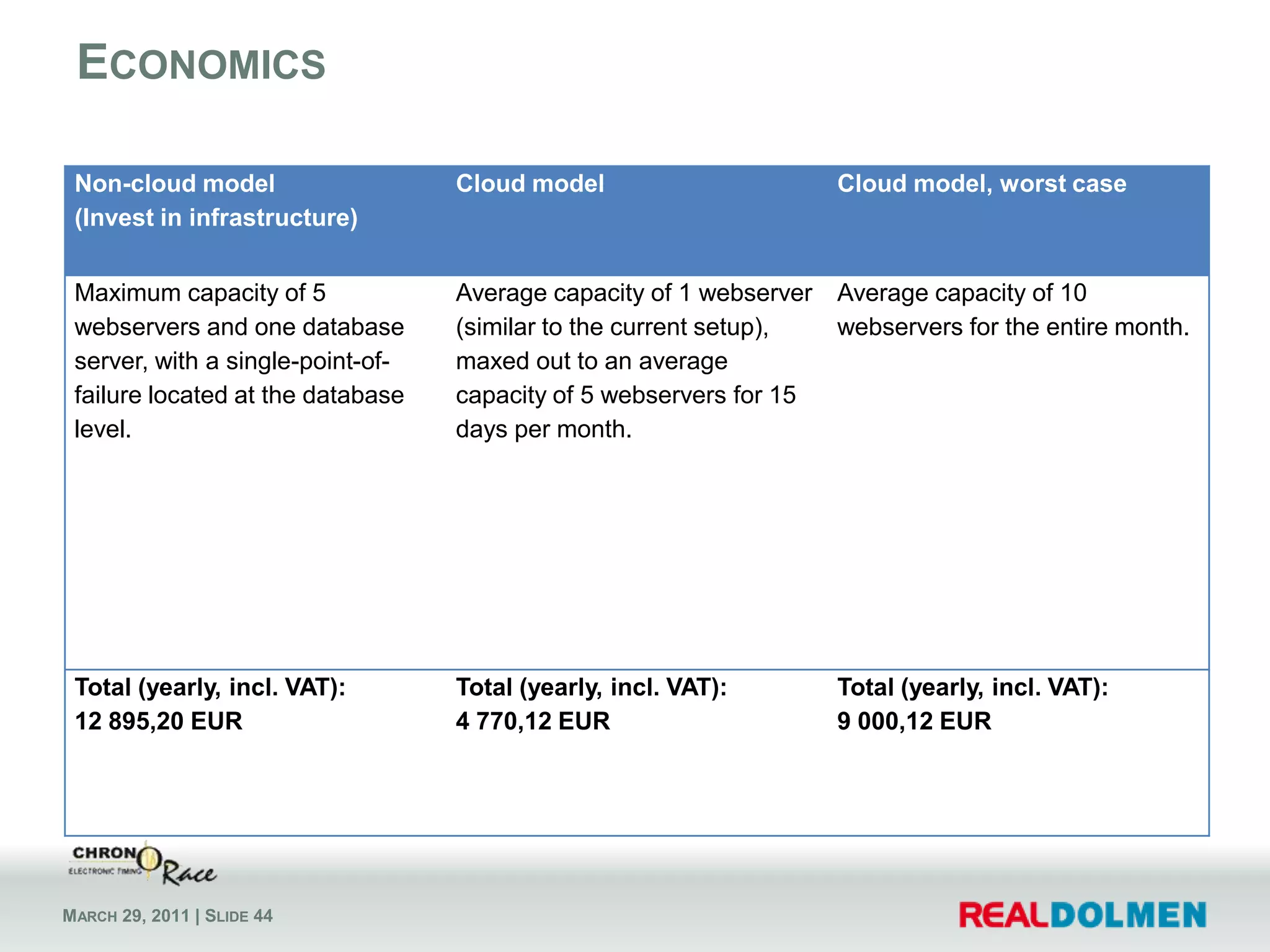
Economics
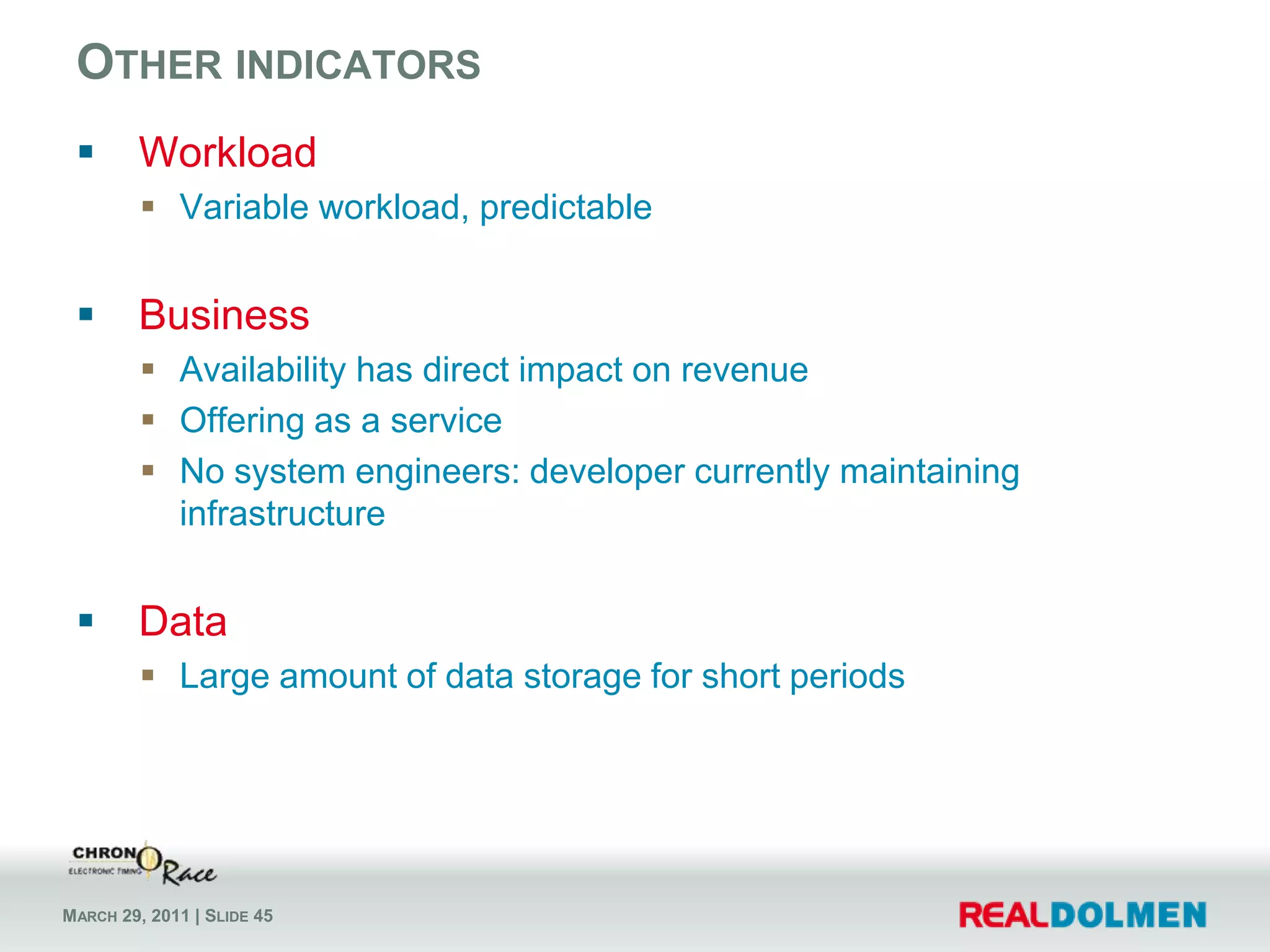
Other indicatorsWorkloadVariable workload, predictableBusinessAvailability has direct impact on revenueOffering as a serviceNo system engineers: developer currently maintaininginfrastructureDataLarge amount of data storage for short periods
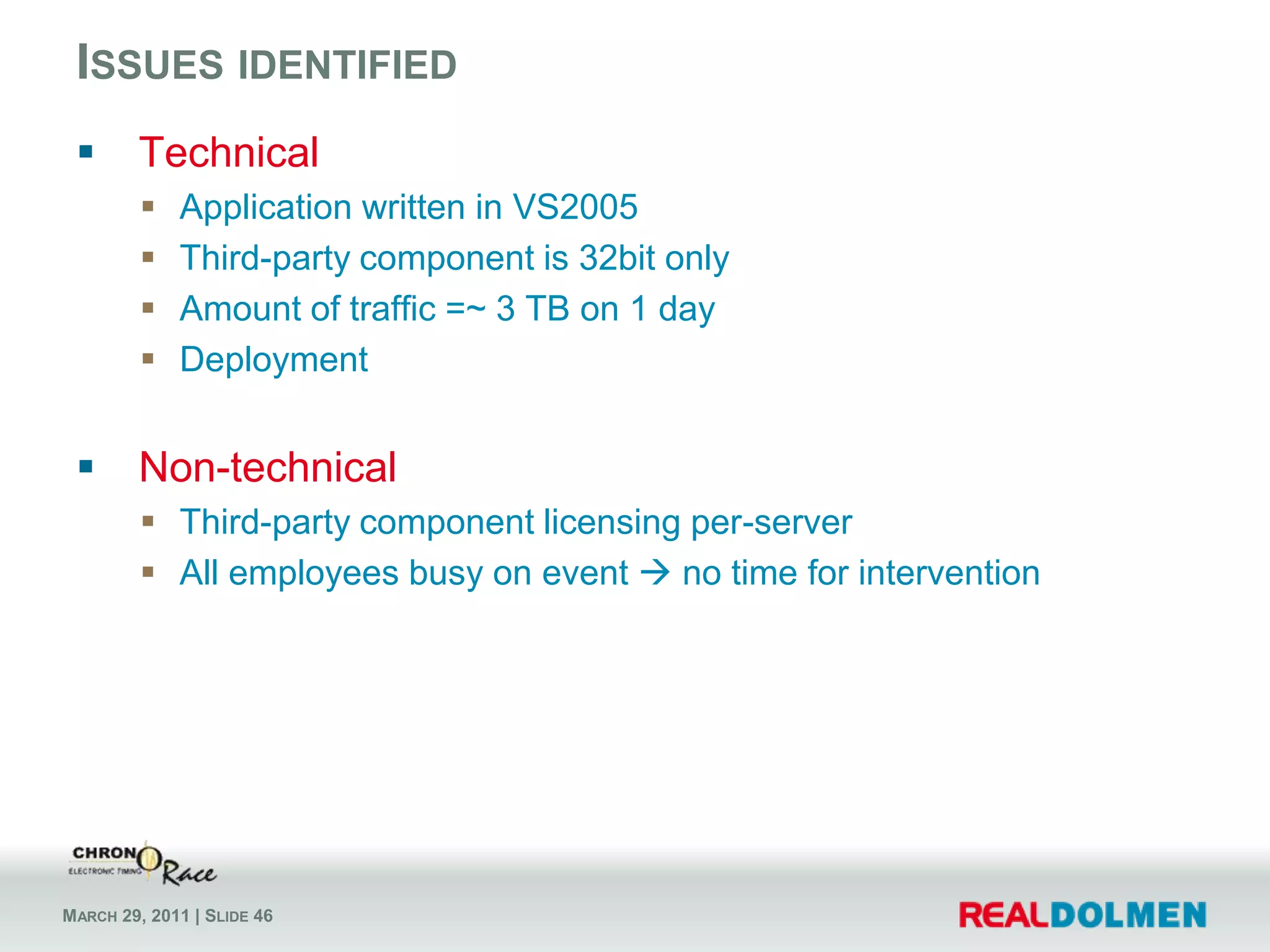
Issues identifiedTechnicalApplication written in VS2005Third-party component is 32bit onlyAmount of traffic =~ 3 TB on 1 dayDeploymentNon-technicalThird-party component licensing per-serverAll employees busy on event  no time for intervention
ConclusionLarge economic benefitLess costs, more capacity ~ more revenueClear indicators for cloud modelSome minor issues detectedAn almost perfect cloud fit
What’s in the cloud?Implementing the SolutionLet’s go Windows Azure!
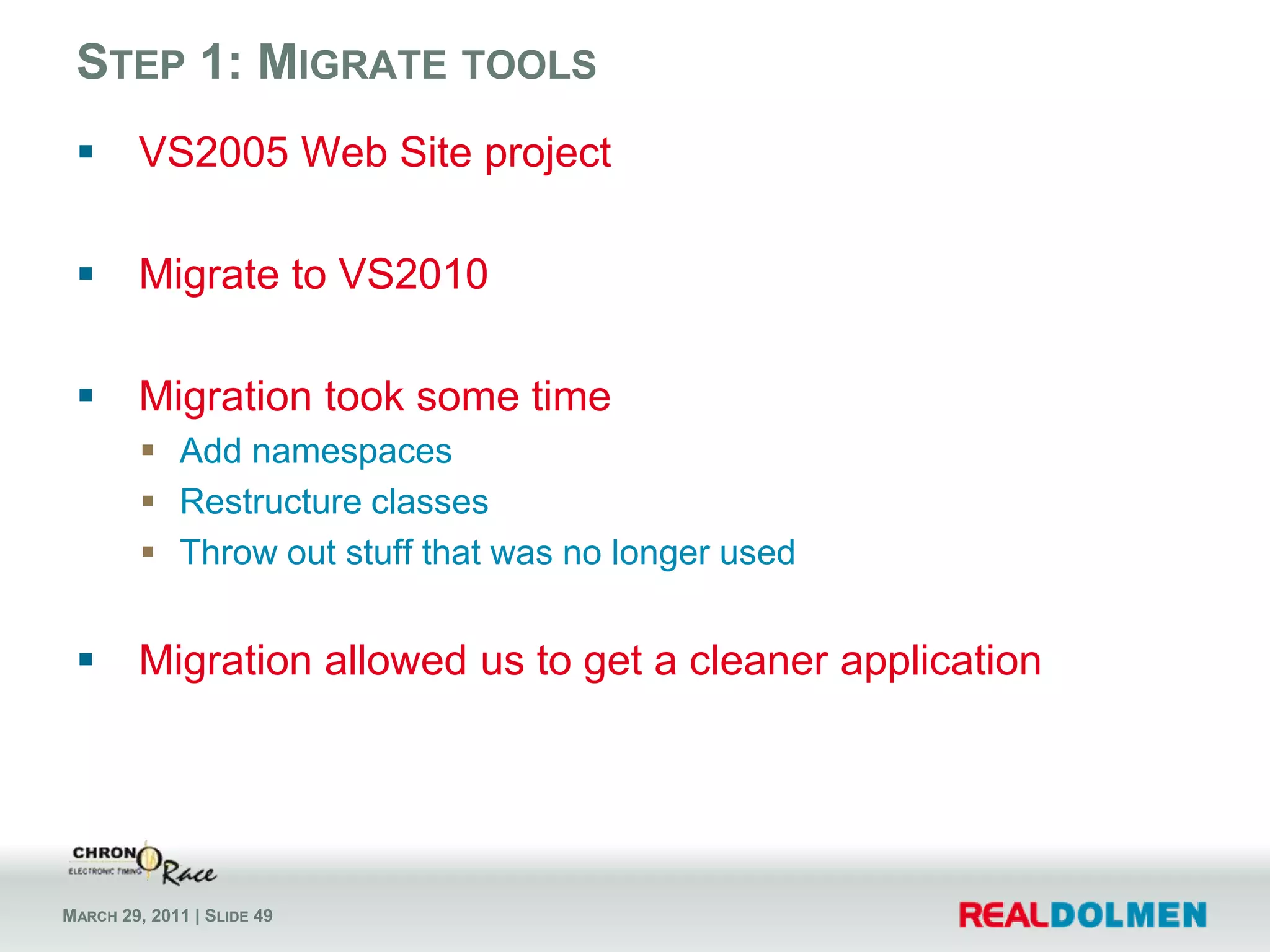
Step 1: Migrate toolsVS2005 Web Site projectMigrate to VS2010Migration took some timeAdd namespacesRestructure classesThrow out stuff that was no longer usedMigration allowed us to get a cleaner application
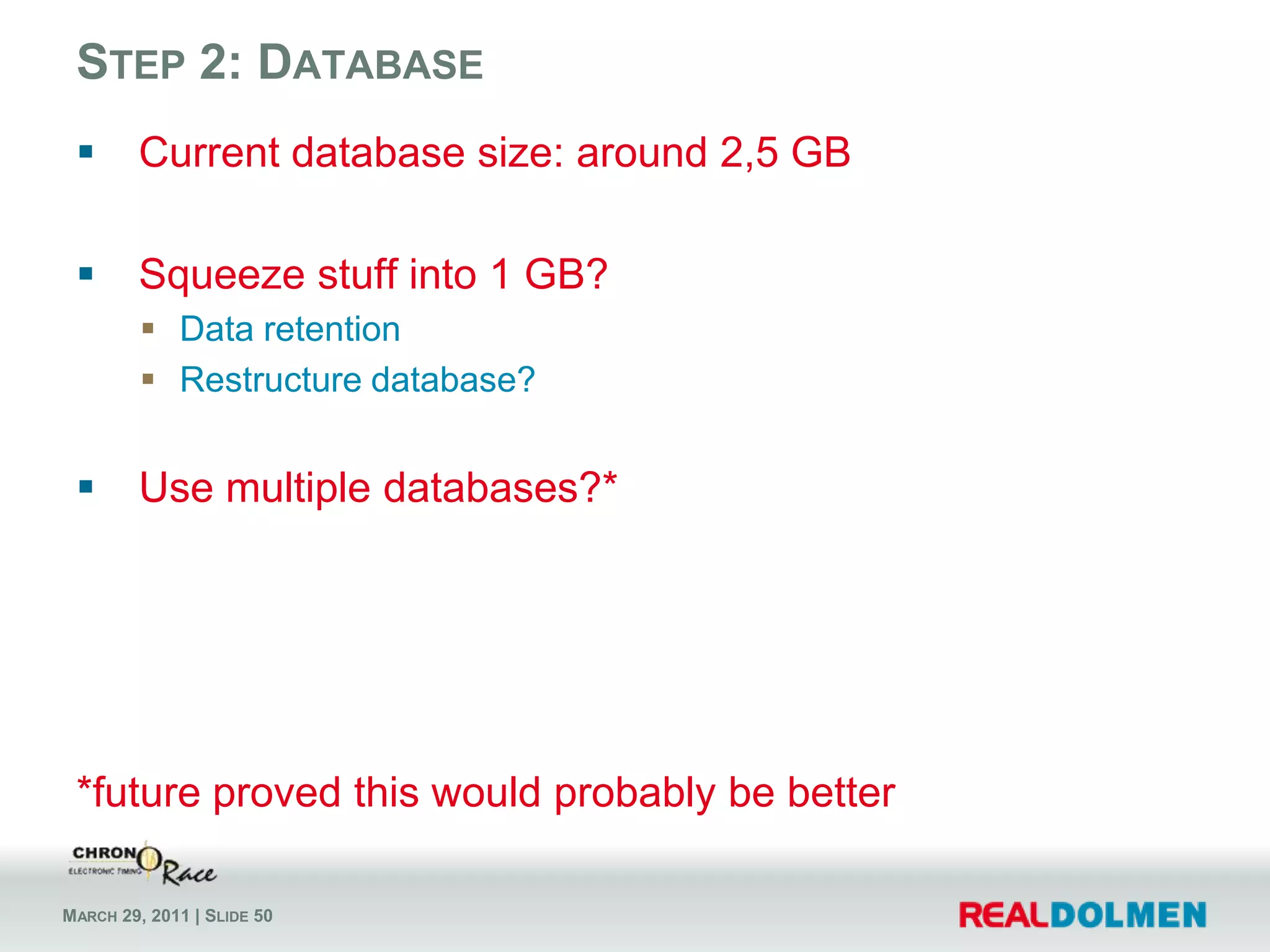
Step 2: DatabaseCurrent database size: around 2,5 GBSqueeze stuff into 1 GB?Data retentionRestructure database?Use multiple databases?**future proved this would probably be better
Step 2: DatabaseDecided to go for 10 GB versionMigrationUsing open source: SQL Azure Migration Wizardhttp://sqlazuremw.codeplex.comWorked surprisingly good!2 stored procedures could not be migrated
Step 2: Database1 week after project startCurrent website at www.chronorace.be with SQL Azure backendAs easy as changing the connection string!Cloud is not all-or-nothing
Step 3: StreamingCurrently a Flash playerDownloads chunks of +/- 1 MBShould work on blob storage!Cheap storageCheap trafficCDN supportAPI supports downloading chunks
Step 3: StreamingGetting a specific chunck was variable in response timeDecided to cache the video to compute web rolesDuring the advert that is shownNext view of the video is instant!Option for the future: Silverlight & IIS Smooth Streaming
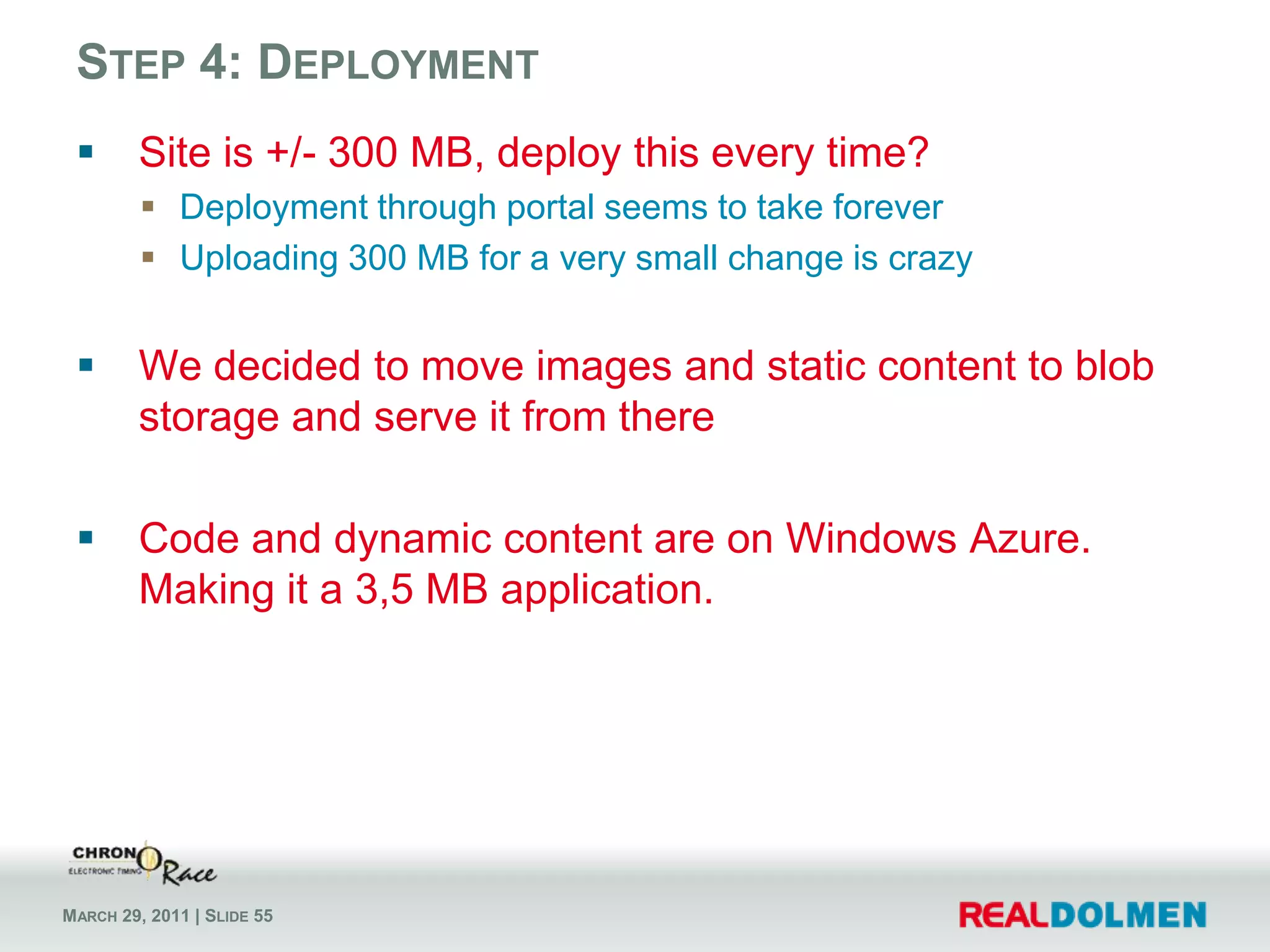
Step 4: DeploymentSite is +/- 300 MB, deploy this every time?Deployment through portal seems to take foreverUploading 300 MB for a very small change is crazyWe decided to move images and static content to blob storage and serve it fromthereCode and dynamic content are on Windows Azure. Making it a 3,5 MB application.
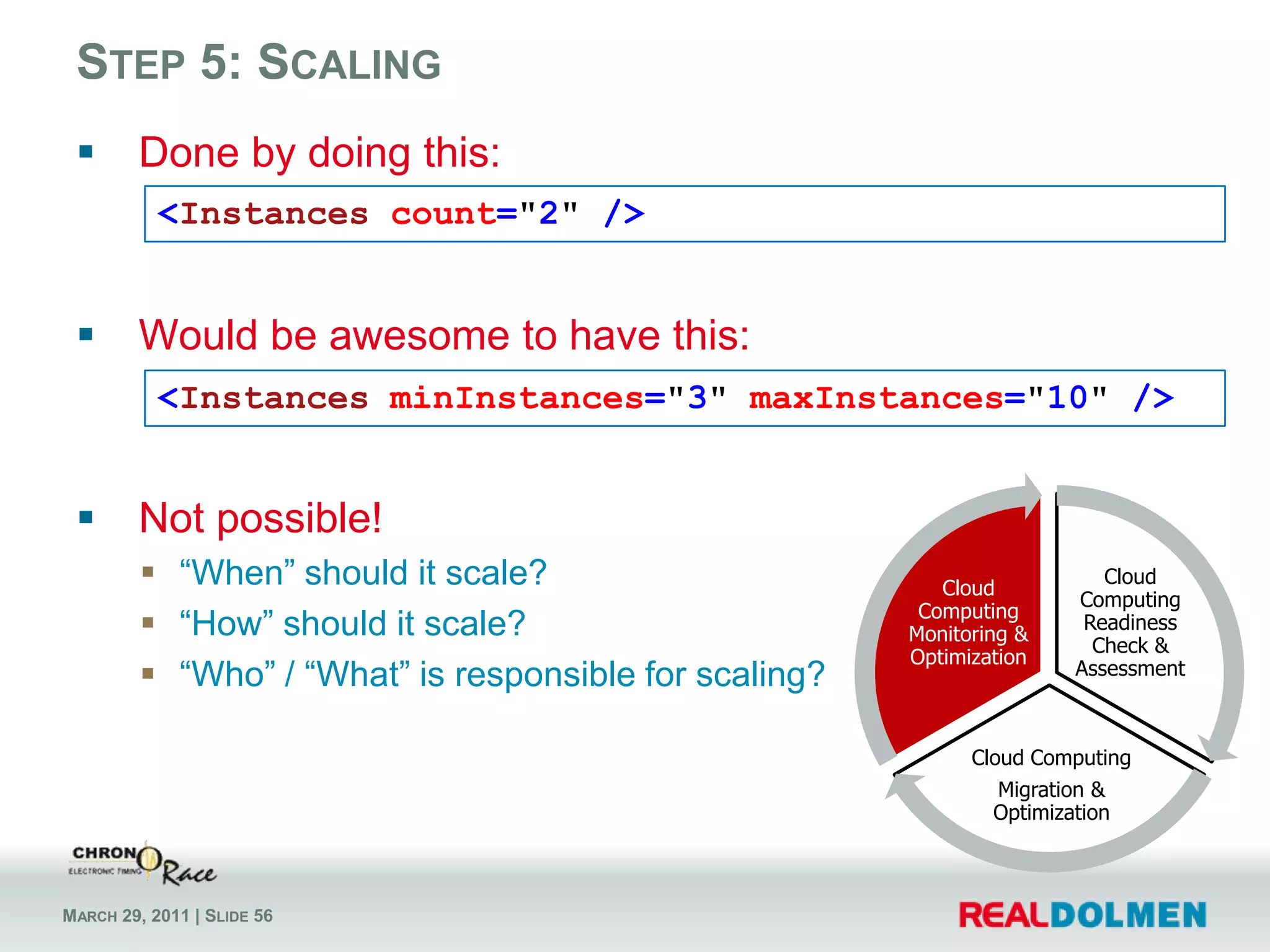
Step 5: ScalingDone by doing this:Would be awesome to have this:Not possible!“When” should it scale?“How” should it scale?“Who” / “What” is responsible for scaling?<Instancescount="2" /><InstancesminInstances="3" maxInstances="10" />
Step 5: Auto ScalingAuto scaling would be a big benefitDuring events all 4 people are busyIt is the cloud after all? The scale-up/down thing?Application should be able to monitor itselfRealDolmen auto scaling component
Auto Scaling – Scaling logicScaling logic provider uses sensor data to suggest an action (up/fast-up/down/stable)To implement per applicationJust a suggestion!Scaling logic provider uses sensor data to suggest an action (up/fast-up/down/stable)To implement per applicationJust a suggestion!

Cloud & Windows Azure - Lessius

  • 2.
    Cloud Computing &Windows AzureLessius Hogeschool, MechelenMaarten Balliauw – RealDolmenE-mail: maarten.balliauw@realdolmen.comBlog: http://blog.maartenballiauw.beTwitter: @maartenballiauw
  • 3.
    Who am I?MaartenBalliauwAntwerp, Belgiumwww.realdolmen.comTechnology Specialist Windows AzureCo-founder of AZUGFocus on webASP.NET, ASP.NET MVC, PHP, Azure, …MVP ASP.NEThttp://blog.maartenballiauw.be@maartenballiauw
  • 4.
    AgendaCloud ComputingMicrosoft Cloud& Windows AzureSome examplesA Payroll CompanyChronoraceConclusion
  • 5.
    Cloud ComputingWhat iscloud computing?
  • 6.
    Inefficiencies in traditionalIT…Allocated IT-capacitiesLoad Forecast“Under-supply“ of capacities“Waste“ of capacitiesFixed cost of IT-capacitiesIT CAPACITYBarrier forinnovationsActualLoadTIME
  • 7.
    However, in aCloud ViewLoad ForecastAllocated IT capacitiesNo “under-supply“IT CAPACITYReduction of “over-supply“Possible reduction of IT-capacities in case of reduced loadReduction of initial investmentsActualLoadTime
  • 8.
    three types ofcloudsOff PremisesOn PremisesLocationHomogeneousHeterogeneousInfrastructureChoicesChoicesCapEx (invest)OpEx (cost)Business modelOwnLease/RentOwnershipSelfThird PartyManagementSelfThird PartyResponsibilitiesCustomizedStandardizedStandardizationPrivate Dedicated / Shared SharedPrivate Dedicated / Shared Shared
  • 9.
    IT as aService – Types of servicesScalabilityCustomisationManagement and responsibilities by vendorIn-house management, responsibilities, ...
  • 10.
    “Growing Fast“ “On and Off “ InactivityPeriod Compute Compute Average UsageUsageAverageTime Time On & off workloads (e.g. batch job)
  • 11.
  • 12.
    Time to marketcan be cumbersome
  • 13.
  • 14.
    Keeping up w/growth is big IT challenge
  • 15.
    Complex lead timefor deployment“Unpredictable Bursting“ “Predictable Bursting“ Compute Compute Average Usage Average Usage Time Time Unexpected/unplanned peak in demand
  • 16.
  • 17.
    Can’t over provisionfor extreme cases
  • 18.
    Services with microseasonality trends
  • 19.
    Peaks due toperiodic increased demand
  • 20.
    IT complexity andwasted capacity Typical workload patterns that benefitfrom a cloud model
  • 21.
    And of courseone more...
  • 22.
    Horseless Carriage SyndromeEarly20th century: “car”Long standing paradigm: “horse and carriage”Initial failure to comprehend the new paradigm“The horse is here to stay but the automobile is only a novelty“High cost and shortage of capable driversEngineers kept designing the whip holderFirst cars looked alikeHowever... Technology evolvedFaster time to “market” (horses get tired)Reduction in complexity and costNo need to care for a horse
  • 23.
    Mindswitches – BusinessperspectiveInvestments become costsCapEx vs. OpExDifficult to work with fixed budgets*Cloud is cheap in many casesYou rent capacity, not serversManagement is automatedIT staff will have other work to doMore innovationIT department can be bypassed for quick PoCsLow entry costs = lower barrier for innovationNew ways of generating revenue
  • 24.
    Mindswitches – ITstaffYour job will look different (a little)No more server re-imaging*Less server managementMonitoring of applications, not serversArchitecture of IT becomes far more interestingOn-premises servers and machinesVirtual machines somewhere in the cloud but also domain joinedSecurityLAN/WAN capacity / interconnectivityProvisioning
  • 25.
    Mindswitches – DevelopersArchitecturebecomes far more interesingStorage can be different depending on your needsDatabases can be different depending on your needsLoosely coupled applicationsThink bigIt’s a Windows worldProof of conceptsWhy not bypass IT for PoCs if you can just fire up a new subscription?
  • 26.
    Microsoft CloudOverview ofall platform components
  • 27.
    Birds-eye overviewOnlineSaaSPaaSIaaSCustomerRelationManagementxRM...E-mail SocialnetworkingBloggingPhotosOffice onlineSkyDriveLive Mesh...ReportingConnectivityAccess controlComputeStorageManagementContent Delivery NetworkRelational DatabaseReportingSynchronizationConnectivityService busAuthenticationFederationRelational dataManagementComputeStorageFlexible APIsFlexible APIsManagementInformation MarketplaceInformation MarketplaceReporting & BIConnectBilling & PaymentsData Sync
  • 28.
    Technology support onWindows AzureSupported by Microsoft:.NET stackPHPJavaRubyNot supported yet working smoothly:MySQLMemcachedJetty (alternative JAVA server)…
  • 29.
    North America Region Asia Pacific RegionEurope RegionN. Europe Sub-region N. Central – US Sub-region E. AsiaSub-region W. Europe Sub-region S. Central - US Sub-regionS.E. AsiaSub-region
  • 36.
  • 37.
  • 38.
    A Payroll CompanyDeliveringpayroll services to other companiesGeneral payroll services, staffing, tax, legal, ...Many processes not automatedContinuously on the look to automate processes and interaction with clients and their employees
  • 39.
    Their project: Compensationsà la CarteAllow customers to use their softwareAllow customers to plug in different servicesAllow employees of customers to select their compensations
  • 40.
    What’s in thecloud?The problem…Compensations à la Carte
  • 41.
    Some issues...Will itwork?What will it cost with 1 customer and 50 employees?What will it cost with 100 customers and 1000 employees?What if all customers sign up and we have 100.000 employees?And what about the interaction with other services?Uncertainty!Development costs will be fixedInfrastructure costs... Maybe low, maybe high?
  • 42.
    Cloud allows innovation!Developmentcosts will be thereInfrastructure costs will increase when revenue increasesCloud is a perfect fit to drive innovation!
  • 43.
  • 44.
    ChronoRaceDelivering infrastructure fortiming sports eventsRunning, biking, triathlon, mountainbike, …Founded 10 years ago, Malmédy, 4 personsTiming of every participantVideo footage of every participantPDF certificates for every participantAround 340 events per year!Belgium, Luxemburg, France, Germany, Netherlands, …Small eventsLarge eventsDwars door Brugge 8.000 participantsAntwerp 10 Miles 17.000 participants20km of Brussels 30.000 participants
  • 45.
    ChronoRace – RevenueRevenue generated from“Timing-as-a-Service”Video advertising
  • 46.
    What’s in thecloud?The problem…Big events are fun, but also
  • 47.
  • 48.
    Big event…20km throughBrussels> 30.000 participantsDownloading their certificate 30.000 hits processing a PDFWatching results online 30.000 hits*Having a video online 30.000 x +/- 10MB (= 292 GB)Watching their video 30.000 video views?And showing off to family and friends… 30.000 x 10MB x 10 views (avg.) = 2,92 TB bandwidth in 1 dayAbout 35 MbpsOver a 10 Mbps line…
  • 50.
    What’s in thecloud?Possible solutionsWhat are the options?
  • 51.
    Possible solutionsCurrent solution:traffic spreadOther optionsInvest in infrastructureMigrate to a cloud model
  • 52.
    Invest in infrastructureCurrentinfrastructureLeased hardware at a hoster10 Mbps Internet connection1 web server (XEON, 2 GB RAM), IIS61 database server (XEON, 2 GB RAM), SQL Server 2005“What-if” infrastructureLeased hardware at a hoster10 Mbps Internet connection5 web server (XEON, 2 GB RAM), IIS61 database server (XEON, 2 GB RAM), SQL Server 2005
  • 53.
    Migrate to acloud model“What-if” cloud modelWindows Azure StorageWindows Azure compute (1 instance ~ 15 days)Windows Azure compute (5 instances ~ 15 days)SQL Azure Business EditionEquivalent of 10 Mbps bandwidth
  • 54.
  • 55.
    Other indicatorsWorkloadVariable workload,predictableBusinessAvailability has direct impact on revenueOffering as a serviceNo system engineers: developer currently maintaininginfrastructureDataLarge amount of data storage for short periods
  • 56.
    Issues identifiedTechnicalApplication writtenin VS2005Third-party component is 32bit onlyAmount of traffic =~ 3 TB on 1 dayDeploymentNon-technicalThird-party component licensing per-serverAll employees busy on event  no time for intervention
  • 57.
    ConclusionLarge economic benefitLesscosts, more capacity ~ more revenueClear indicators for cloud modelSome minor issues detectedAn almost perfect cloud fit
  • 58.
    What’s in thecloud?Implementing the SolutionLet’s go Windows Azure!
  • 59.
    Step 1: MigratetoolsVS2005 Web Site projectMigrate to VS2010Migration took some timeAdd namespacesRestructure classesThrow out stuff that was no longer usedMigration allowed us to get a cleaner application
  • 60.
    Step 2: DatabaseCurrentdatabase size: around 2,5 GBSqueeze stuff into 1 GB?Data retentionRestructure database?Use multiple databases?**future proved this would probably be better
  • 61.
    Step 2: DatabaseDecidedto go for 10 GB versionMigrationUsing open source: SQL Azure Migration Wizardhttp://sqlazuremw.codeplex.comWorked surprisingly good!2 stored procedures could not be migrated
  • 62.
    Step 2: Database1week after project startCurrent website at www.chronorace.be with SQL Azure backendAs easy as changing the connection string!Cloud is not all-or-nothing
  • 63.
    Step 3: StreamingCurrentlya Flash playerDownloads chunks of +/- 1 MBShould work on blob storage!Cheap storageCheap trafficCDN supportAPI supports downloading chunks
  • 64.
    Step 3: StreamingGettinga specific chunck was variable in response timeDecided to cache the video to compute web rolesDuring the advert that is shownNext view of the video is instant!Option for the future: Silverlight & IIS Smooth Streaming
  • 65.
    Step 4: DeploymentSiteis +/- 300 MB, deploy this every time?Deployment through portal seems to take foreverUploading 300 MB for a very small change is crazyWe decided to move images and static content to blob storage and serve it fromthereCode and dynamic content are on Windows Azure. Making it a 3,5 MB application.
  • 66.
    Step 5: ScalingDoneby doing this:Would be awesome to have this:Not possible!“When” should it scale?“How” should it scale?“Who” / “What” is responsible for scaling?<Instancescount="2" /><InstancesminInstances="3" maxInstances="10" />
  • 67.
    Step 5: AutoScalingAuto scaling would be a big benefitDuring events all 4 people are busyIt is the cloud after all? The scale-up/down thing?Application should be able to monitor itselfRealDolmen auto scaling component
  • 68.
    Auto Scaling –Scaling logicScaling logic provider uses sensor data to suggest an action (up/fast-up/down/stable)To implement per applicationJust a suggestion!Scaling logic provider uses sensor data to suggest an action (up/fast-up/down/stable)To implement per applicationJust a suggestion!
  • 69.
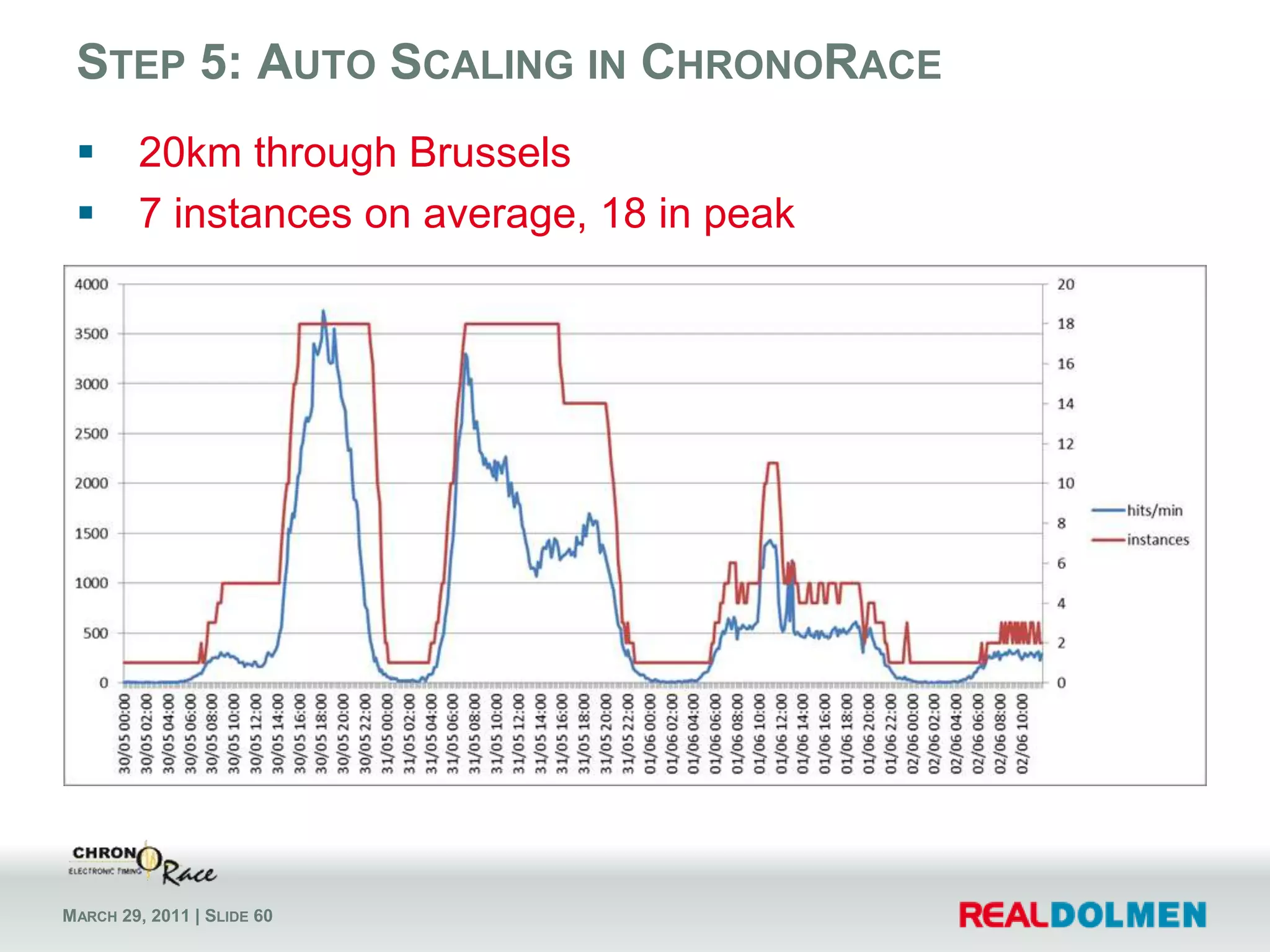
    Step 5: AutoScaling in ChronoRaceSensor based on concurrent video streamsScales between 2 and 20 instances automaticallyHard to verify! The Windows Azure portal is not willing to disclose the number of instances during scale.MMC Snap-In does give useful info!http://code.msdn.microsoft.com/windowsazuremmc
  • 70.
    Step 5: AutoScaling in ChronoRace20km through Brussels7 instances on average, 18 in peak
  • 71.
    What’s in thecloud?ConclusionWas it a good move?
  • 72.
  • 73.
  • 74.
  • 75.
  • 76.
  • 77.
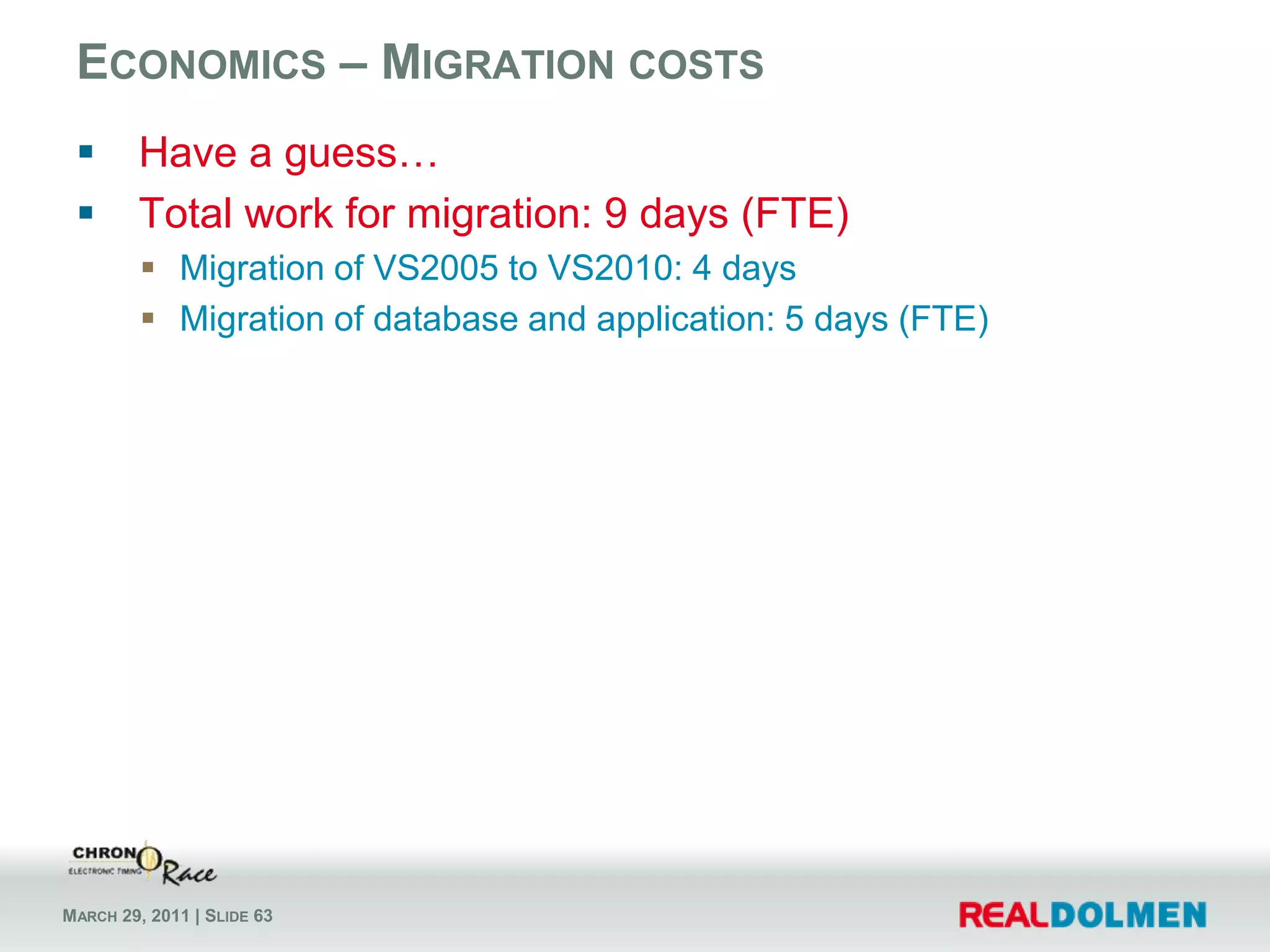
    Ad revenue impactEconomics – Migration costsHave a guess…Total work for migration: 9 days (FTE)Migration of VS2005 to VS2010: 4 daysMigration of database and application: 5 days (FTE)
  • 78.
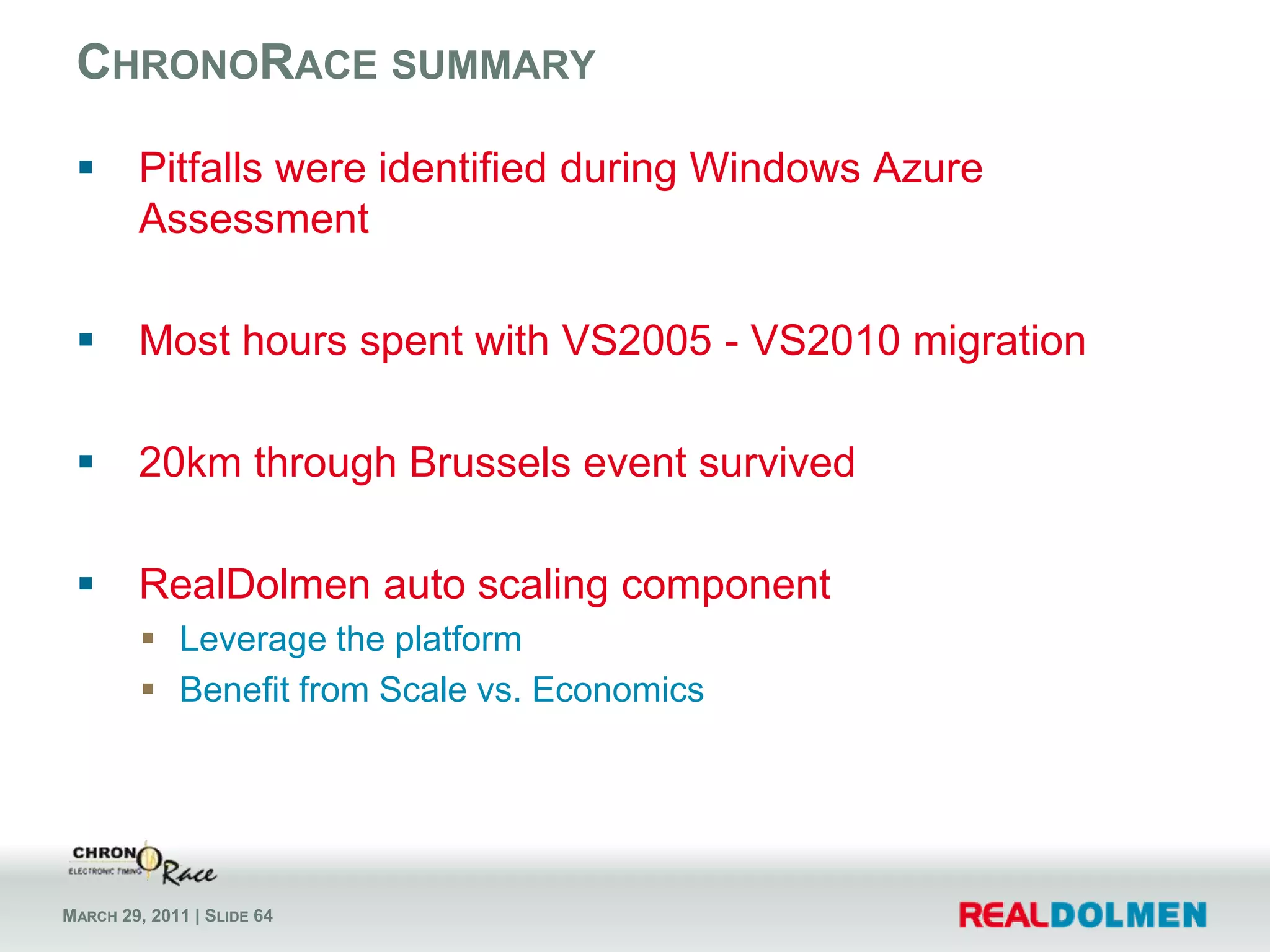
    ChronoRace summaryPitfalls wereidentified during Windows Azure AssessmentMost hours spent with VS2005 - VS2010 migration20km through Brussels event survivedRealDolmen auto scaling componentLeverage the platformBenefit from Scale vs. Economics
  • 79.
  • 80.
    What to remember?Cloudis not all-or-nothingWindows Azure isOperating system (computing & storage)SQL AzureAppFabric (= integration)Cloud is notall-or-nothingQuick winsOn and OffScale fast, fail fastPeak scenarios
  • 81.
    AZUG.BE – AzureUser Group BelgiumFocus on the Azure Services PlatformCommunity drivenFocus on architectureAnd developmentAnd the business value of Azure
  • 82.
    Thankyou …… foryourattention!… for the invitation !Maarten Balliauwhttp://blog.maartenballiauw.be

Editor's Notes

  • #3 Deze sessie geeft een duidelijk beeld over een nieuwe stroming in de IT-wereld: Cloud Computing. Beginnen doen we met een globaal beeld van wat deze nieuwe technologie te bieden heeft en hoe deze zich verhoudt tot “traditionele” infrastructuur en ontwikkeling. Daarna wordt de focus verlegd naar Microsoft’s implementatie van Cloud Computing: Windows Azure. Gecombineerd met een aantal praktijkvoorbeelden zal deze sessie de mist rond Cloud Computing uitklaren.
  • #7 To build an application or solution in a legacy world, you have to think about network, OS, storage, and scale. But they have little to do with what you really want to build, an application.But what if there were a different way.
  • #9 Vanuit de portfolio van RealDolmen gaan wij onze CloudSolutions structureren volgens 3 types. De 2 algemeen bekende Private en Public. En dan de derde “Flavour” die we kunnen stellen meer Dedicated “customerspecific en customerorientated” is en wordt aangeboden vanuit het RealDolmen Datacenter.Either services hostedonyour data center – privatecloud (Onpremises)Schaalbare en elastische IT mogelijkheden bieden als dienst aan interne klanten, gebruik makend van internet technologie; het beheer gebeurt op één controleomgeving die beheerd wordt door de klant. Klant bepaalt de controle, beveiligings en communicatie systemen; materiaal van klant.OronRealDolmen’s datacenter. Tussen private en public zagen wij voor onszelf een plaats weggelegd. En waarbij we optimaal rekening houden met de issues/bedenkingen die er zijn.Dedicatedcloud services (CustomerSpecific)OP RealDolmen infrastructuur.Oron a public cloud: De cloud services aangeboden door de vendors zoals Microsoft en anderen, die IT tot op het hoogste niveau standaardiseren. De meest extreme vorm van cloud oplossingenverzameling van alle cloud diensten die over het internet worden aangebodenInfrastructuur eigendom van degene die de public cloud diensten aanbiedt
  • #10 Goed, zetten we nu de verschillende datacenter oplossingen op een rijtje, dan zien we idd dat RD u op verschillende vlakken kan verder helpen, en dat we diverse vormen van cloudservcies kunnen aanbieden. Belangrijk hierbij dat in elk van die vormen de standaard karakteristieken terug te vinden zijn in meer of mindere mata.De 2 belangrijkste elementen die we hier nog eens willen vermelden zijn enerzijds schaalbaarheid. Hoe meer we …En anderzijds csutomisatie …
  • #11 On and Off: batch processing, monthly loan calculations, … Things that require a lot of capacity for a specified period and do nothing for the rest.Growing fast: Twitter, Facebook, the insurance calculation mentioned, … Unexpected growth is hard to tackle with classic IT but easier with cloud.Unpredictable bursting: you are a newspaper and it’s 9/11… Lots of visitors, unexpected!Predictable bursting: I expect a lot of ticket sales for Rock Werchter once the site opens. After a week, load becomes more stable and the site can be scaled down.
  • #14 *unless you use stuff like development accellerator, but then again it’s only fixed for a limited time
  • #15 *unless you use VM role for some stuff
  • #16 *unless you use VM role for some stuff
  • #18 TFS a-a-S vermelden
  • #20 Datacenter pairing!
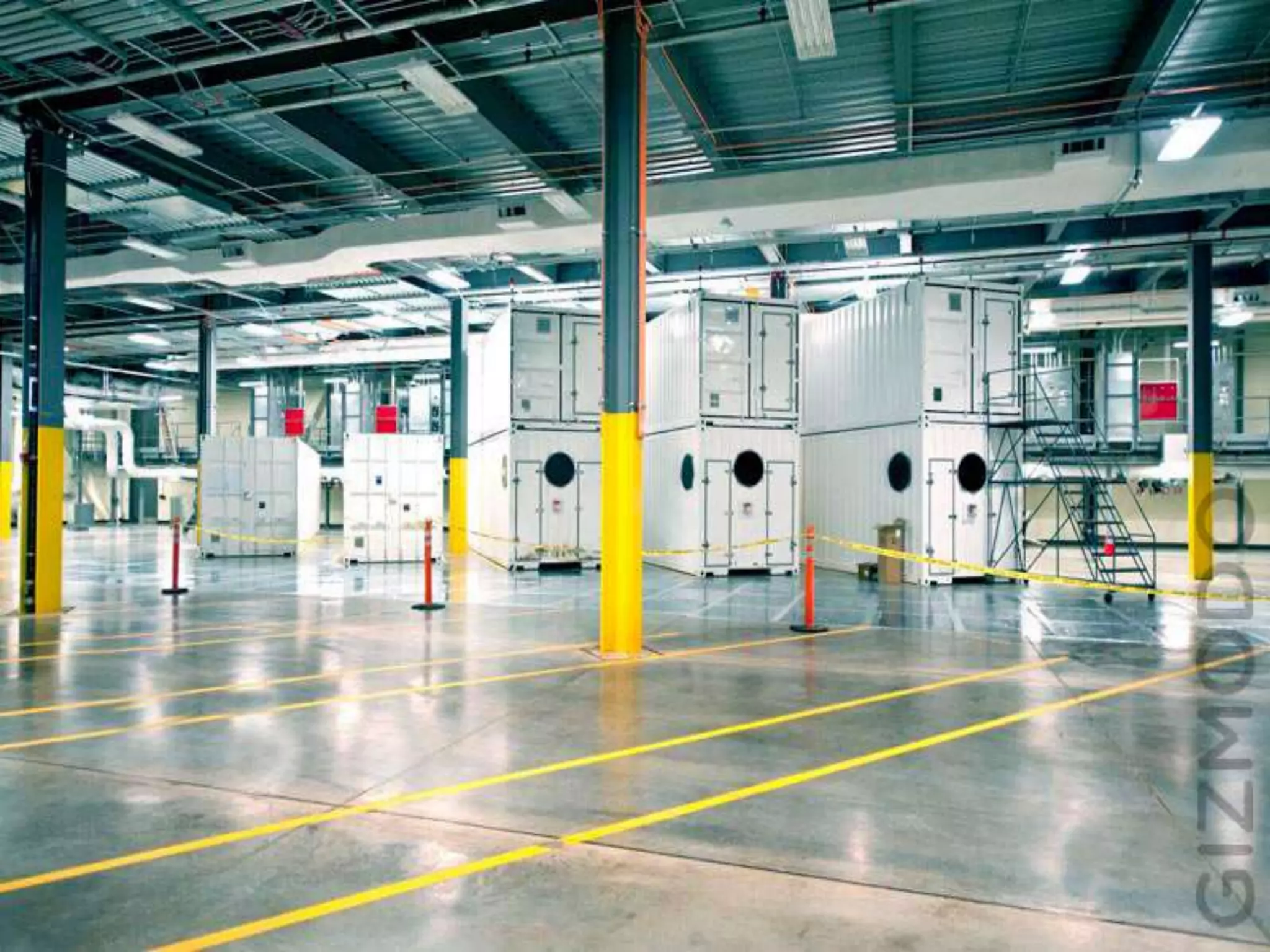
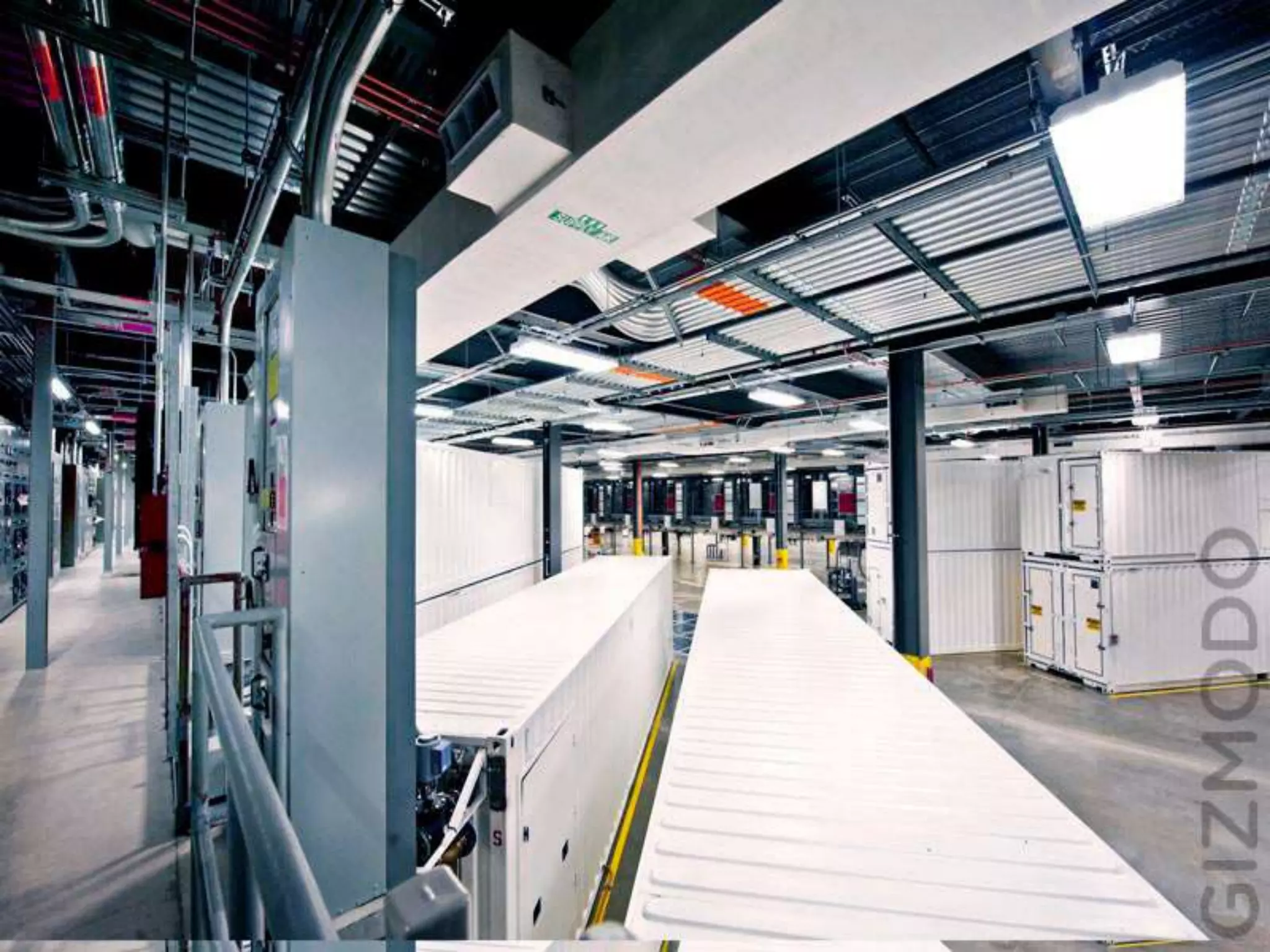
  • #26 Video of IT Preassembled Components - http://www.microsoft.com/showcase/en/us/details/84f44749-1343-4467-8012-9c70ef77981cGen4 Vision - http://www.microsoft.com/showcase/en/us/details/36db4da6-8777-431e-aefb-316ccbb63e4e
  • #42 BiRoe:beeld wat vergroot.
  • #43 Note that a risk of not being able to handle all traffic still exists due to the bottleneck of 10 Mbps network connection and the fact that the maximum capacity for handling requests will be 5 web servers.Also, a single-point-of-failure exists at the database level.Note: what-if probably only used for 1 month per year.
  • #44 Note that with cloud computing, this is only an estimate due to the nature of the pay-per-use model. A fixed fee is not possible, pricing will vary according to the effective usage of resources.
  • #63 We were between cloud and worst-case cloudManaged to serve ALL requests smoothlyRevenue of video ads all-time highIf we had the non-cloud model with extra infrastructure, it wouldCost more than the cloud modelServe LESS requestsHave less ad revenue
  • #64 We were between cloud and worst-case cloudManaged to serve ALL requests smoothlyRevenue of video ads all-time highIf we had the non-cloud model with extra infrastructure, it wouldCost more than the cloud modelServe LESS requestsHave less ad revenue