CLOUD ECONOMICS
THE ECONOMICS OF CLOUD COMPUTING
PEDRO ALEXANDER ROMERO
Cloud Computing
Cloud Computing
Agenda
- Cloud Computing – Economics value
- 80 – 20 Rule
- Opportunity Cost
- OpEX - CapEx
- Total Cost of Ownership
- Cloud Economics Laws
Cloud Computing
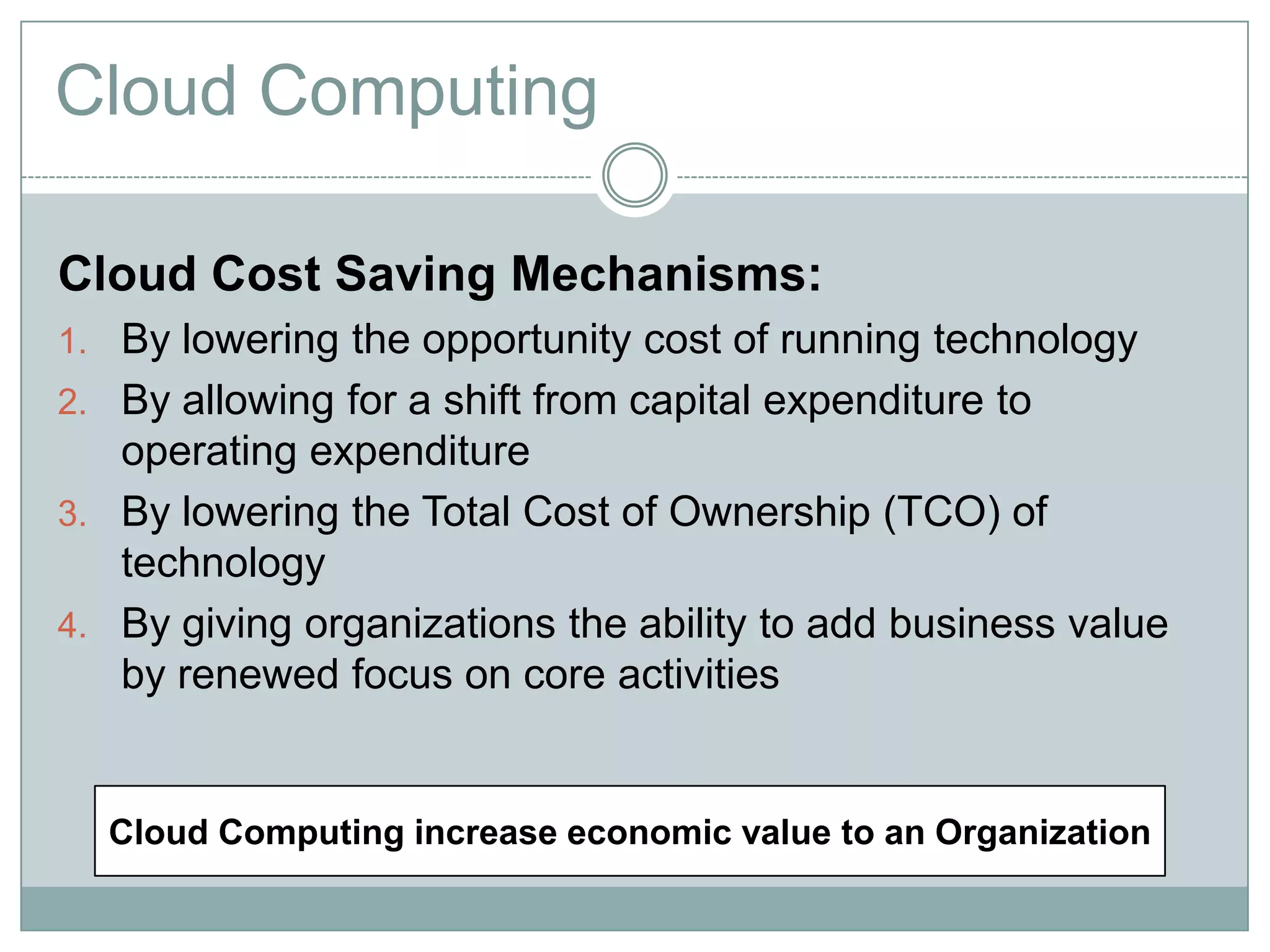
Cloud Cost Saving Mechanisms:
1. By lowering the opportunity cost of running technology
2. By allowing for a shift from capital expenditure to
operating expenditure
3. By lowering the Total Cost of Ownership (TCO) of
technology
4. By giving organizations the ability to add business value
by renewed focus on core activities
Cloud Computing increase economic value to an Organization
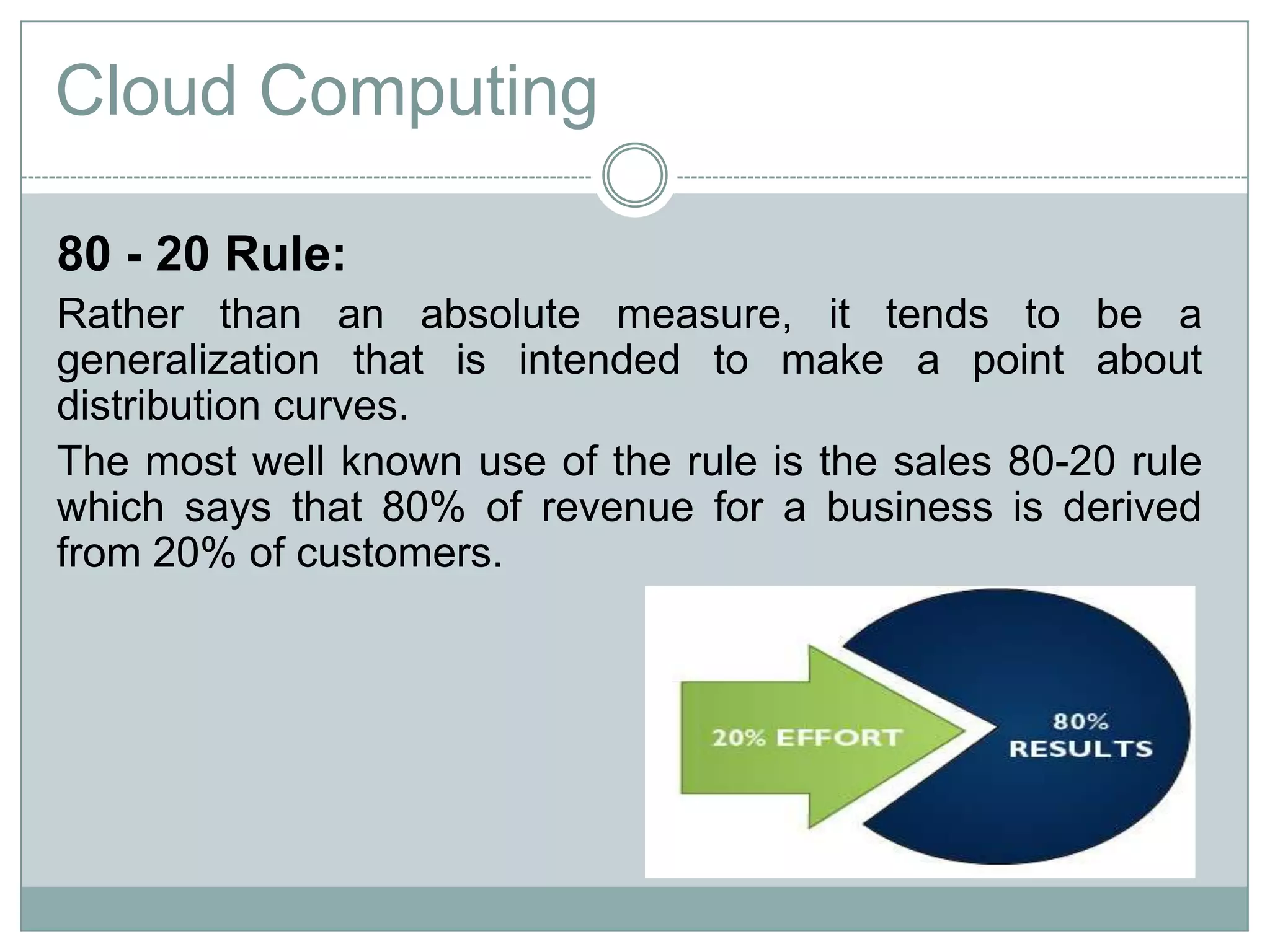
80 - 20 Rule:
Rather than an absolute measure, it tends to be a
generalization that is intended to make a point about
distribution curves.
The most well known use of the rule is the sales 80-20 rule
which says that 80% of revenue for a business is derived
from 20% of customers.
Cloud Computing
Cloud Computing
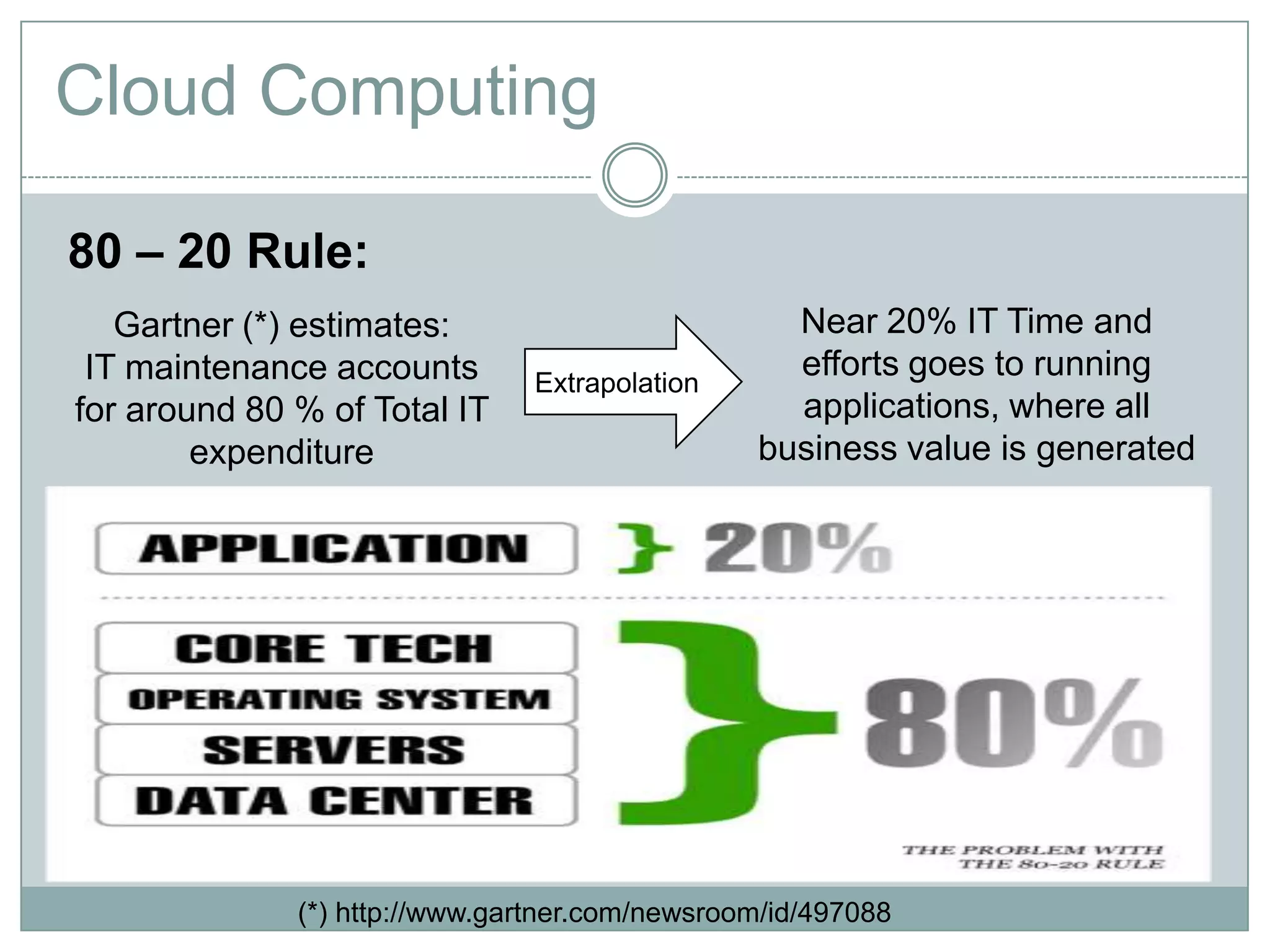
Gartner (*) estimates:
IT maintenance accounts
for around 80 % of Total IT
expenditure
80 – 20 Rule:
(*) http://www.gartner.com/newsroom/id/497088
Extrapolation
Near 20% IT Time and
efforts goes to running
applications, where all
business value is generated
Cloud Computing
80 – 20 Rule:
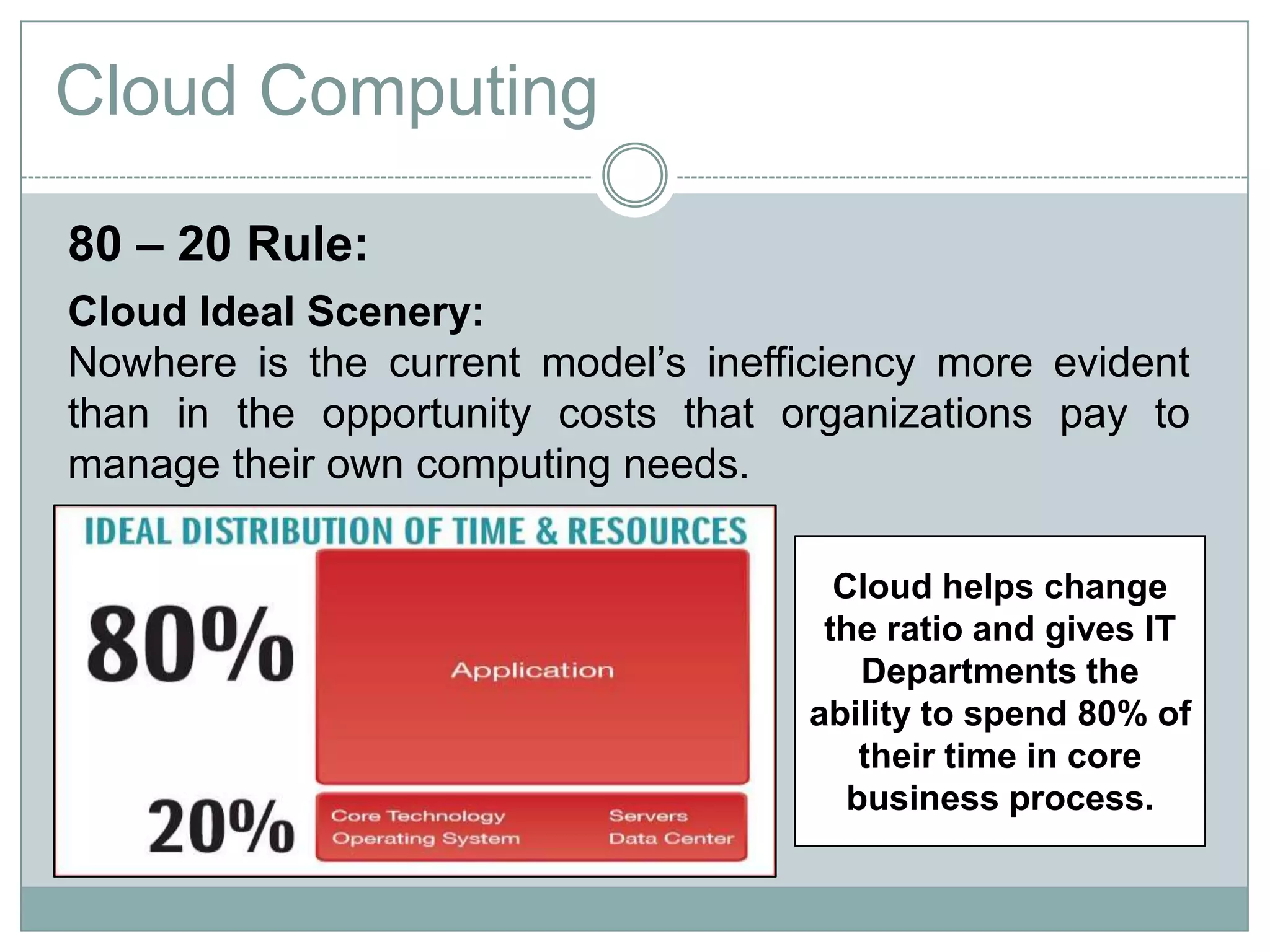
Cloud Ideal Scenery:
Nowhere is the current model’s inefficiency more evident
than in the opportunity costs that organizations pay to
manage their own computing needs.
Cloud helps change
the ratio and gives IT
Departments the
ability to spend 80% of
their time in core
business process.
Cloud Computing
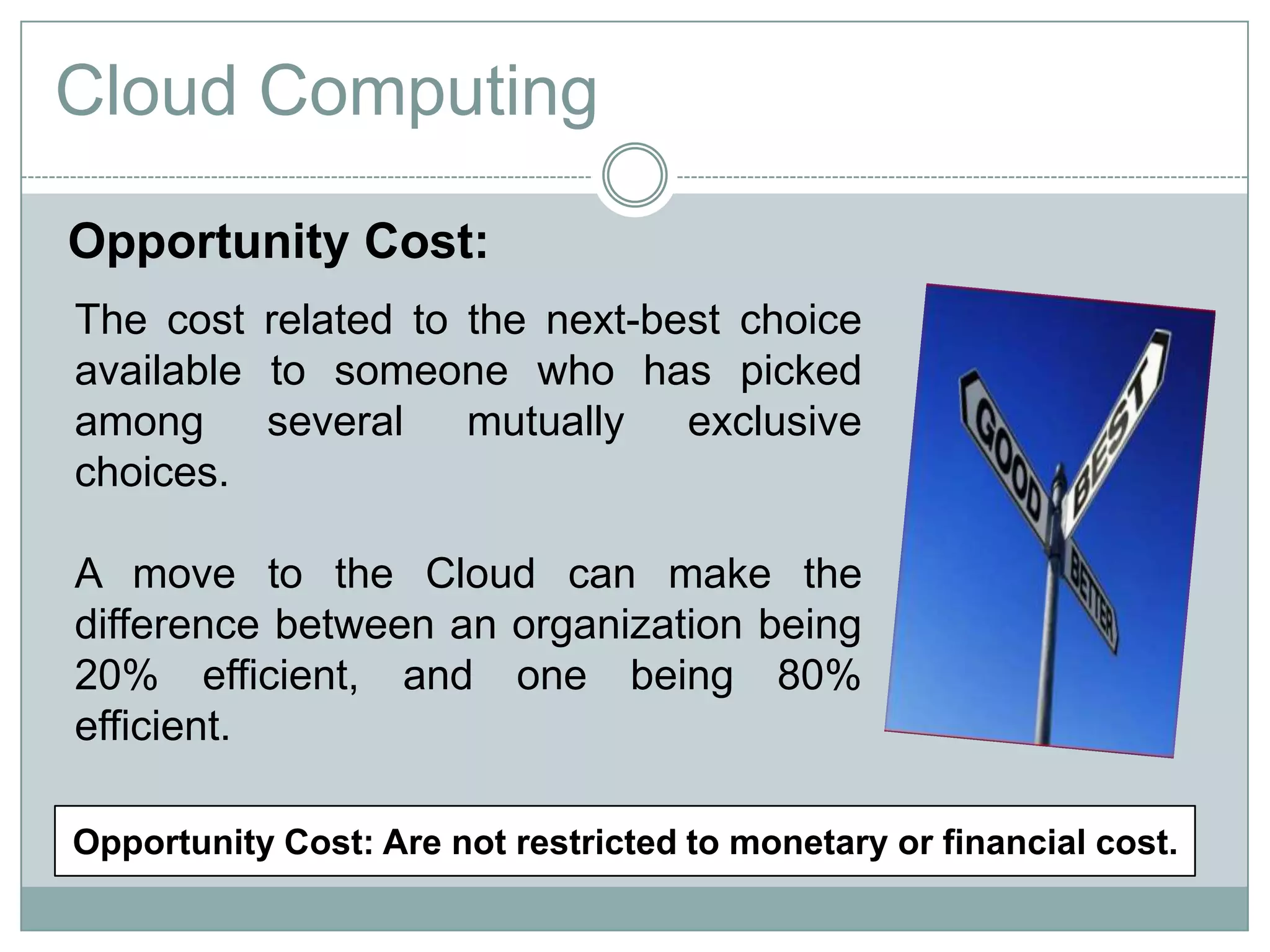
The cost related to the next-best choice
available to someone who has picked
among several mutually exclusive
choices.
A move to the Cloud can make the
difference between an organization being
20% efficient, and one being 80%
efficient.
Opportunity Cost:
Opportunity Cost: Are not restricted to monetary or financial cost.
Cloud Computing
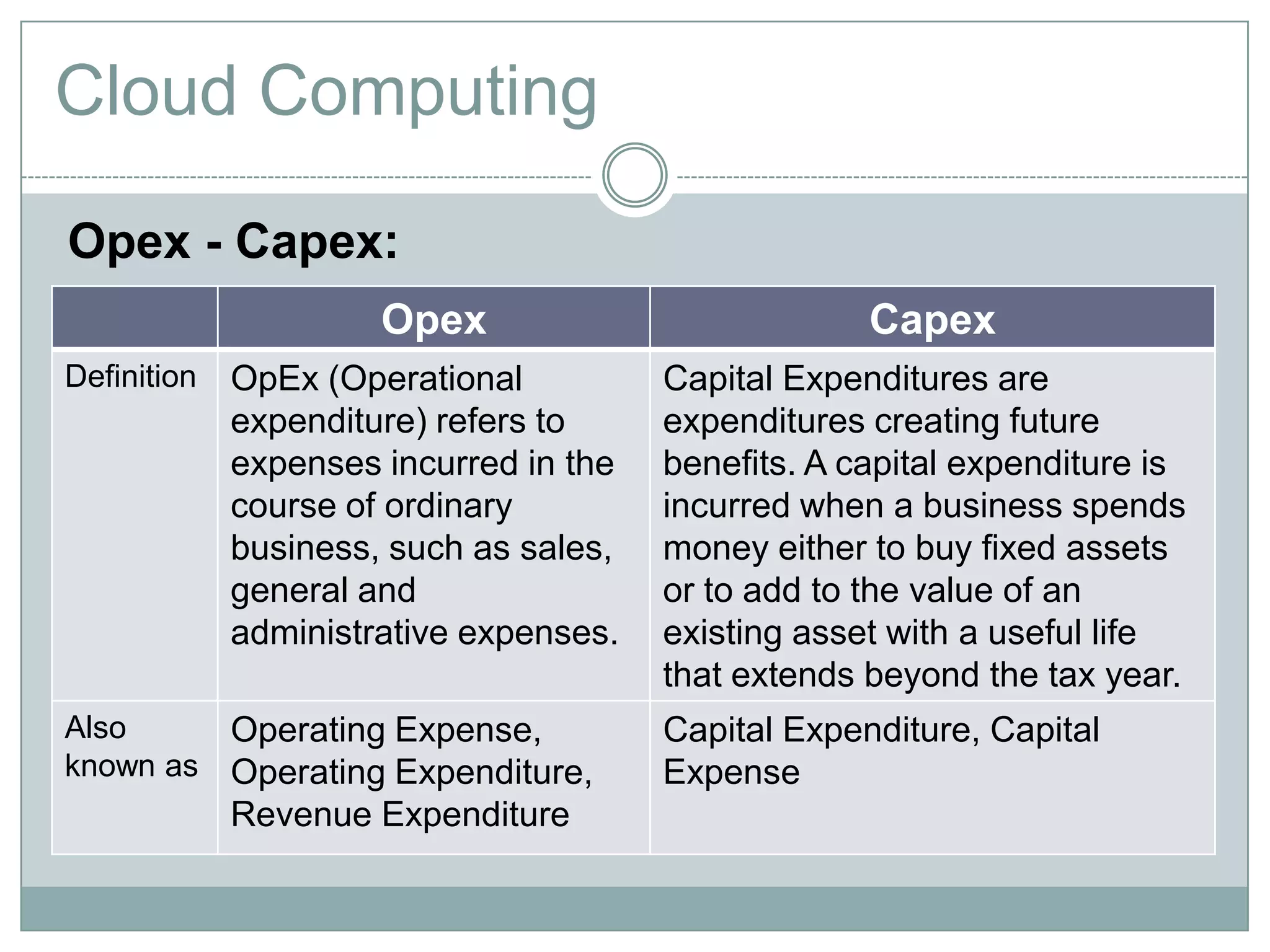
Opex Capex
Definition OpEx (Operational
expenditure) refers to
expenses incurred in the
course of ordinary
business, such as sales,
general and
administrative expenses.
Capital Expenditures are
expenditures creating future
benefits. A capital expenditure is
incurred when a business spends
money either to buy fixed assets
or to add to the value of an
existing asset with a useful life
that extends beyond the tax year.
Also
known as
Operating Expense,
Operating Expenditure,
Revenue Expenditure
Capital Expenditure, Capital
Expense
Opex - Capex:
Cloud Computing
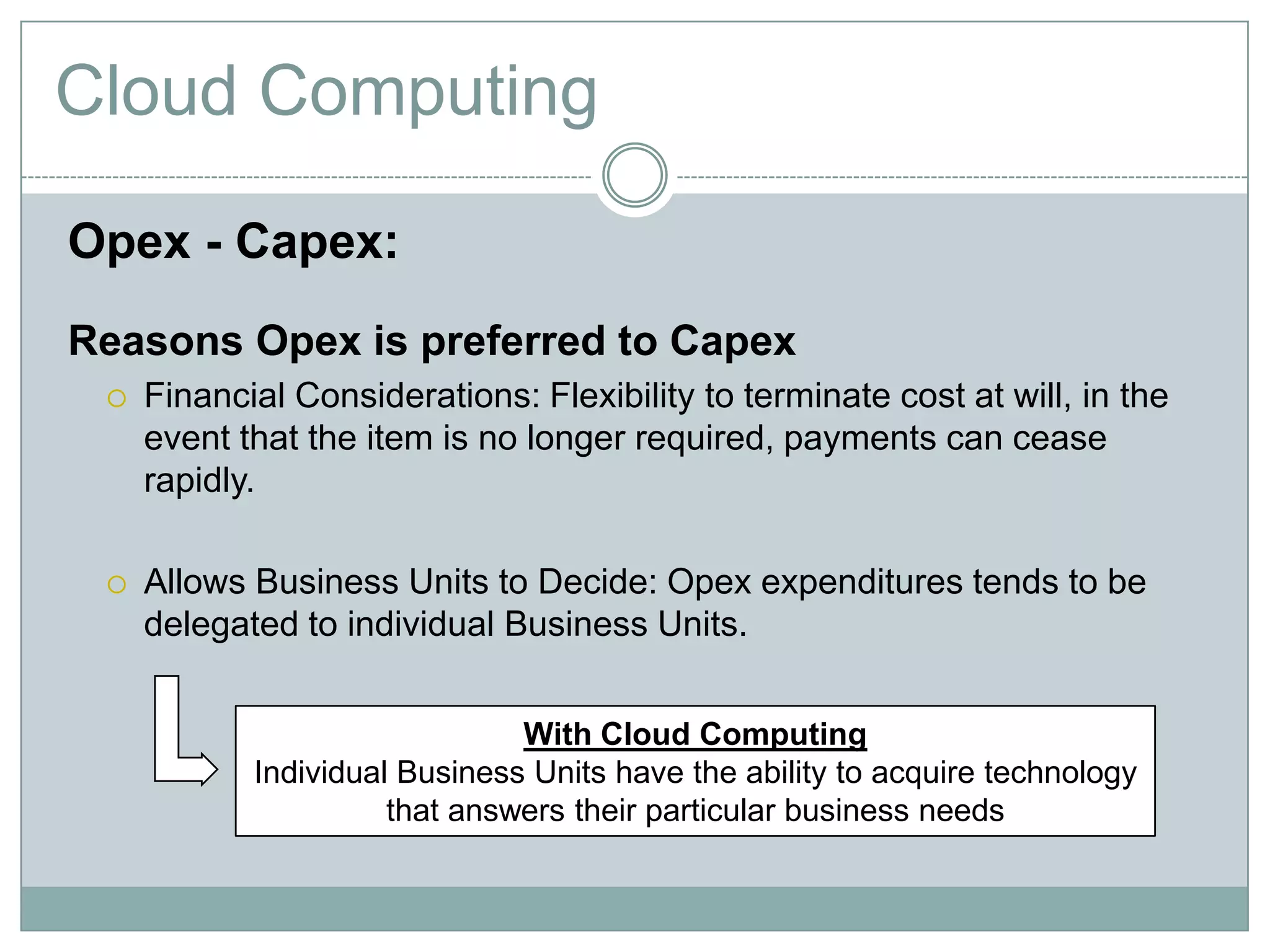
Opex - Capex:
Reasons Opex is preferred to Capex
 Financial Considerations: Flexibility to terminate cost at will, in the
event that the item is no longer required, payments can cease
rapidly.
 Allows Business Units to Decide: Opex expenditures tends to be
delegated to individual Business Units.
With Cloud Computing
Individual Business Units have the ability to acquire technology
that answers their particular business needs
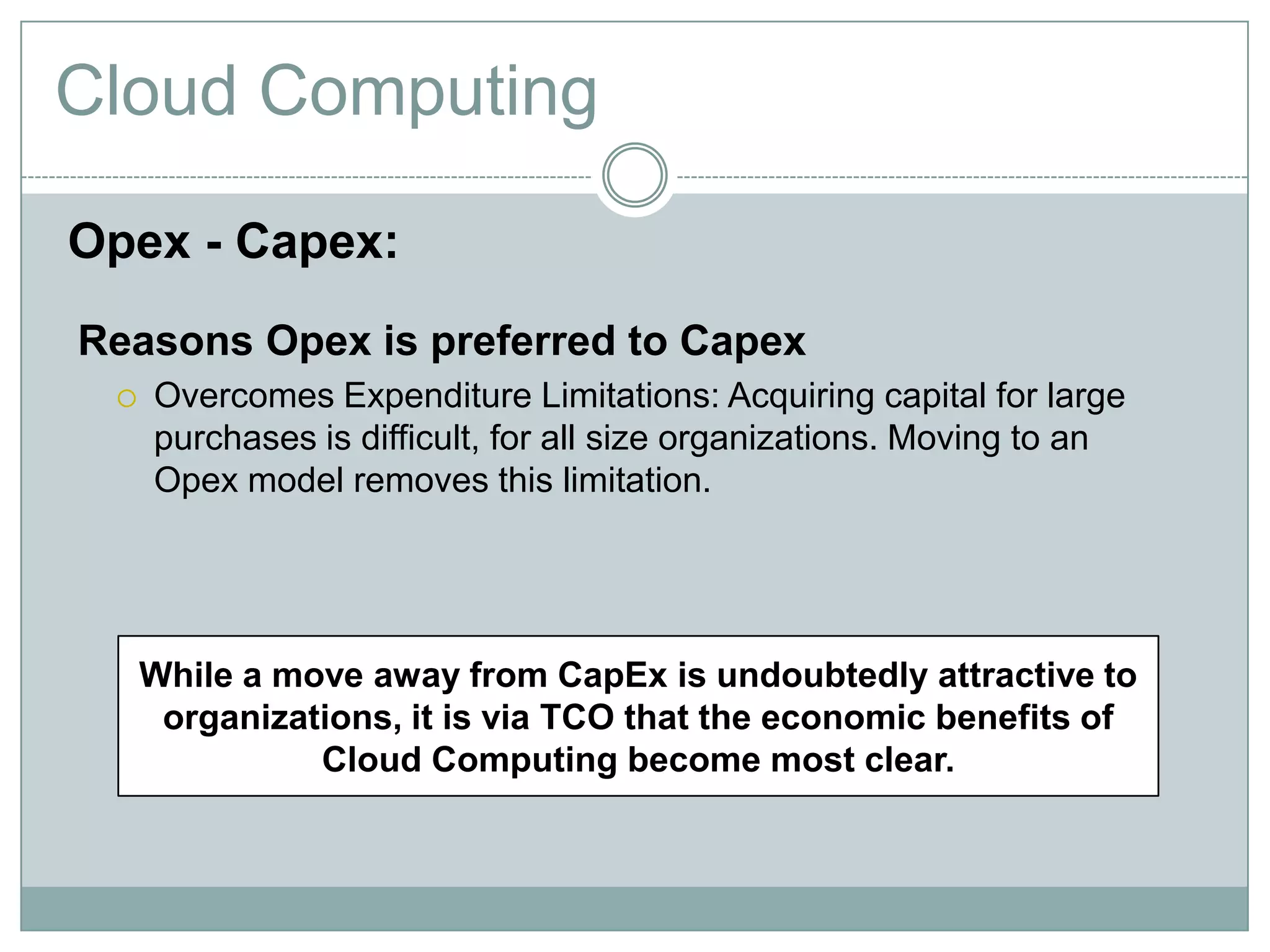
Cloud Computing
Opex - Capex:
Reasons Opex is preferred to Capex
 Overcomes Expenditure Limitations: Acquiring capital for large
purchases is difficult, for all size organizations. Moving to an
Opex model removes this limitation.
While a move away from CapEx is undoubtedly attractive to
organizations, it is via TCO that the economic benefits of
Cloud Computing become most clear.
Cloud Computing
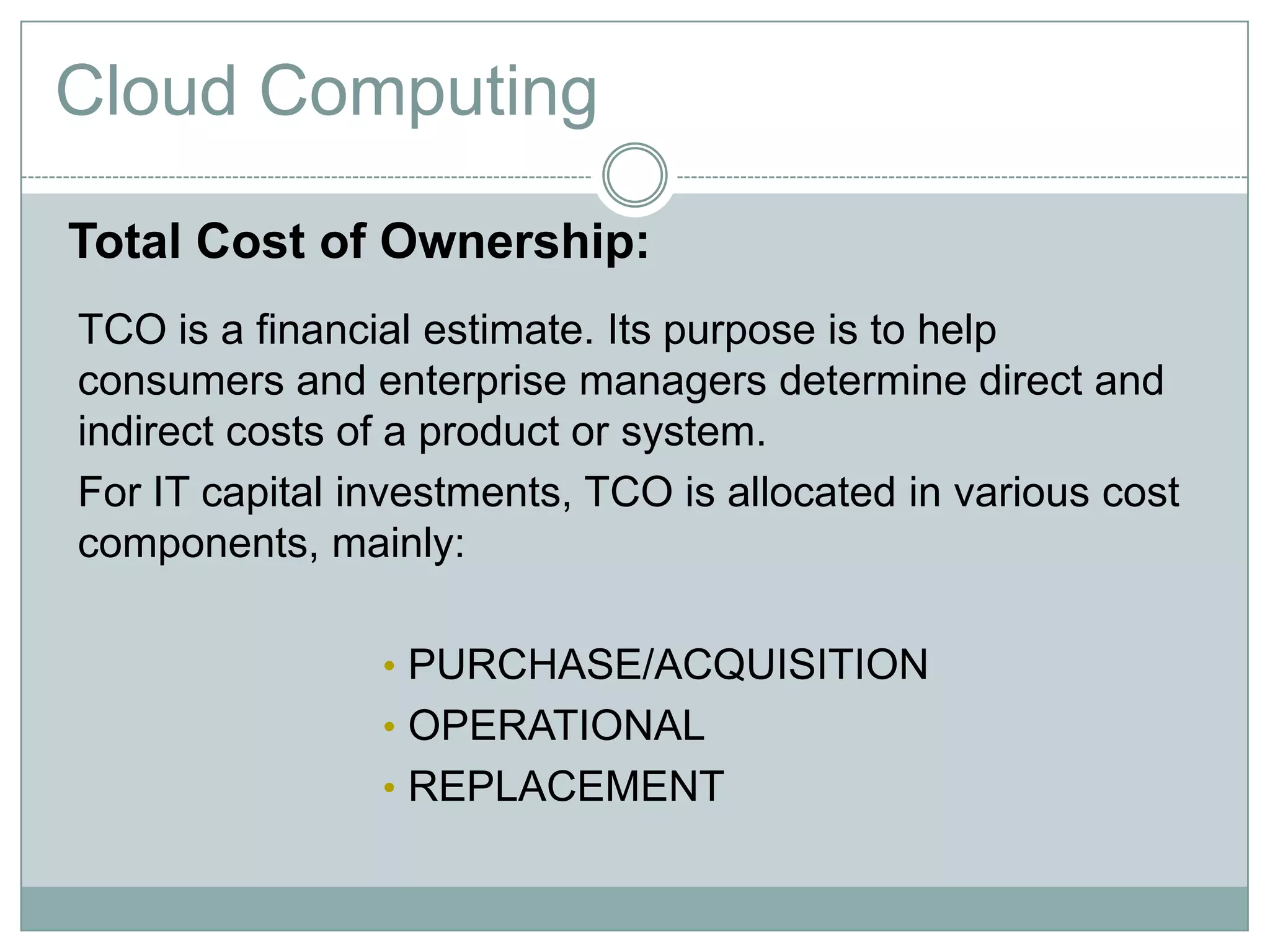
Total Cost of Ownership:
TCO is a financial estimate. Its purpose is to help
consumers and enterprise managers determine direct and
indirect costs of a product or system.
For IT capital investments, TCO is allocated in various cost
components, mainly:
• PURCHASE/ACQUISITION
• OPERATIONAL
• REPLACEMENT
Cloud Computing
Total Cost of Ownership:
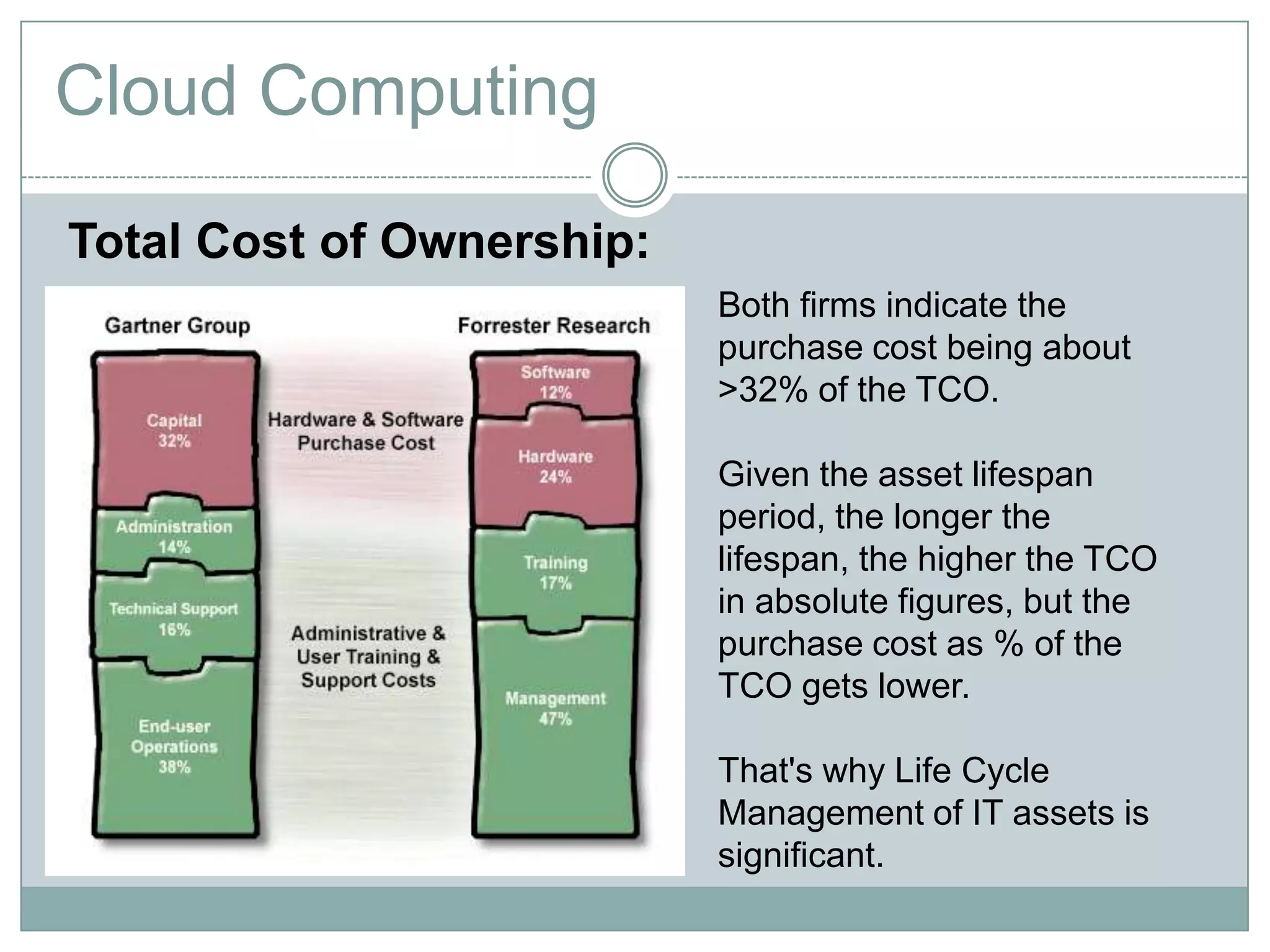
Both firms indicate the
purchase cost being about
>32% of the TCO.
Given the asset lifespan
period, the longer the
lifespan, the higher the TCO
in absolute figures, but the
purchase cost as % of the
TCO gets lower.
That's why Life Cycle
Management of IT assets is
significant.
Cloud Computing
Total Cost of Ownership:
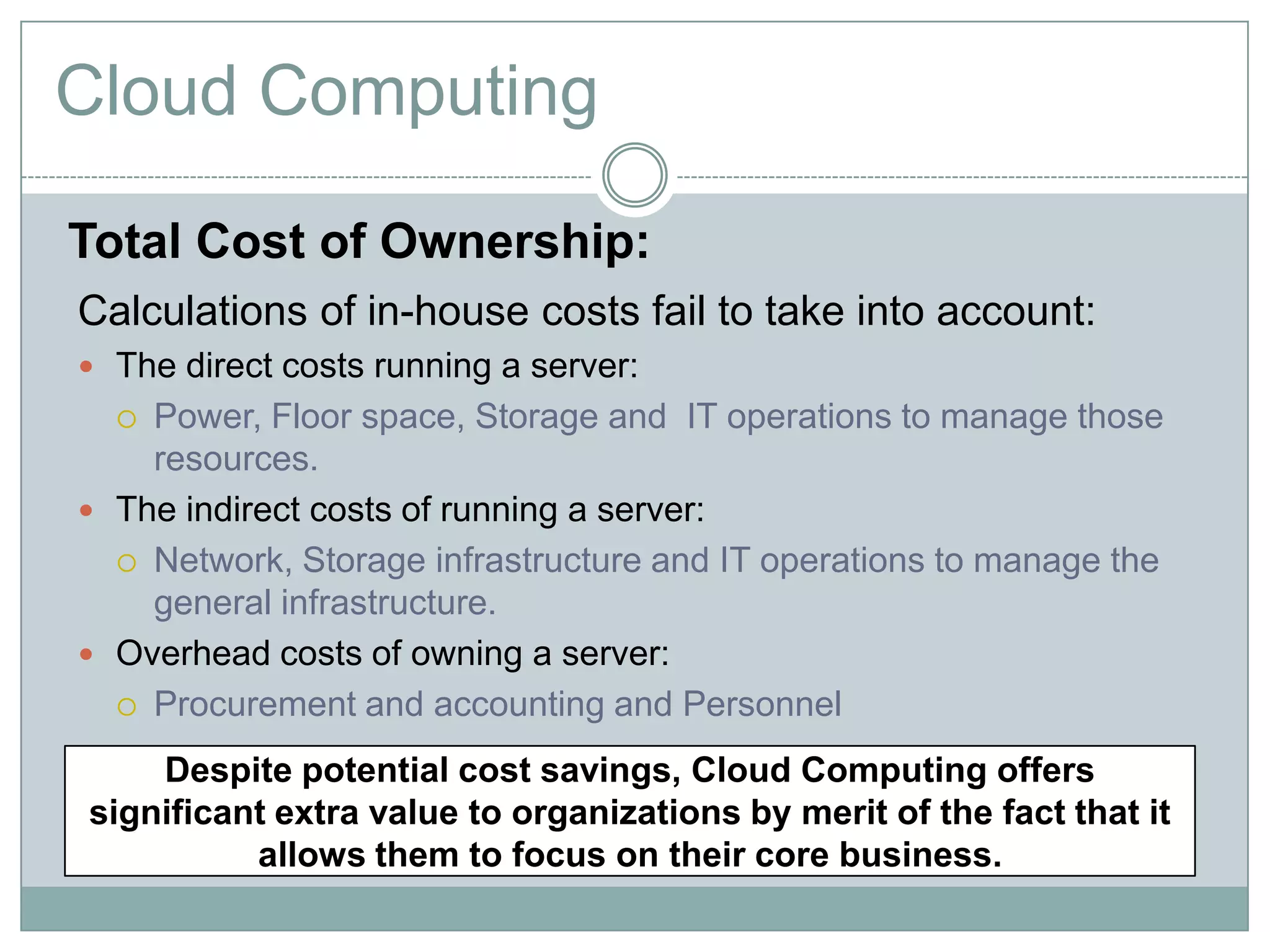
Calculations of in-house costs fail to take into account:
 The direct costs running a server:
 Power, Floor space, Storage and IT operations to manage those
resources.
 The indirect costs of running a server:
 Network, Storage infrastructure and IT operations to manage the
general infrastructure.
 Overhead costs of owning a server:
 Procurement and accounting and Personnel
Despite potential cost savings, Cloud Computing offers
significant extra value to organizations by merit of the fact that it
allows them to focus on their core business.
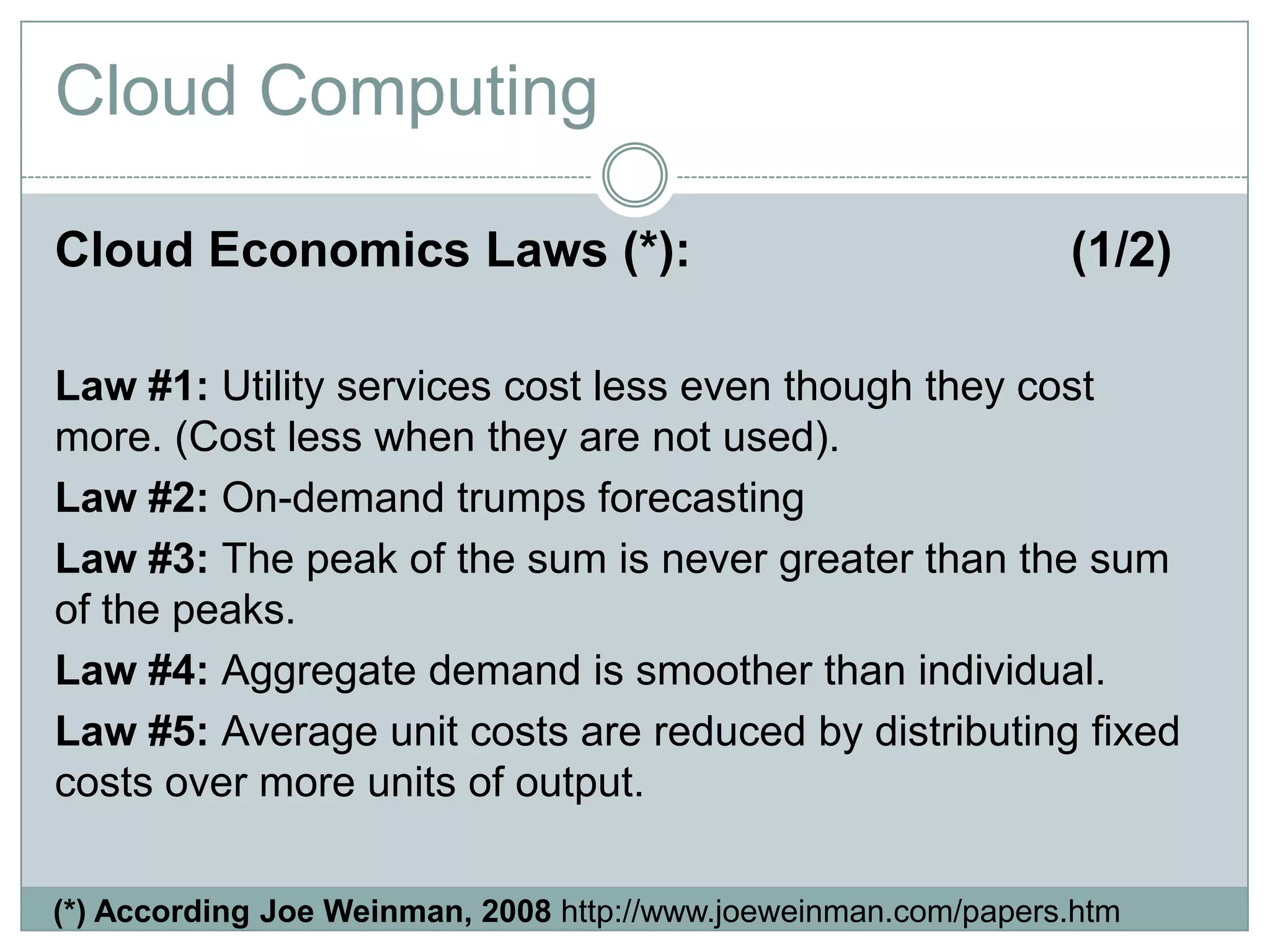
Cloud Economics Laws (*): (1/2)
Law #1: Utility services cost less even though they cost
more. (Cost less when they are not used).
Law #2: On-demand trumps forecasting
Law #3: The peak of the sum is never greater than the sum
of the peaks.
Law #4: Aggregate demand is smoother than individual.
Law #5: Average unit costs are reduced by distributing fixed
costs over more units of output.
Cloud Computing
(*) According Joe Weinman, 2008 http://www.joeweinman.com/papers.htm
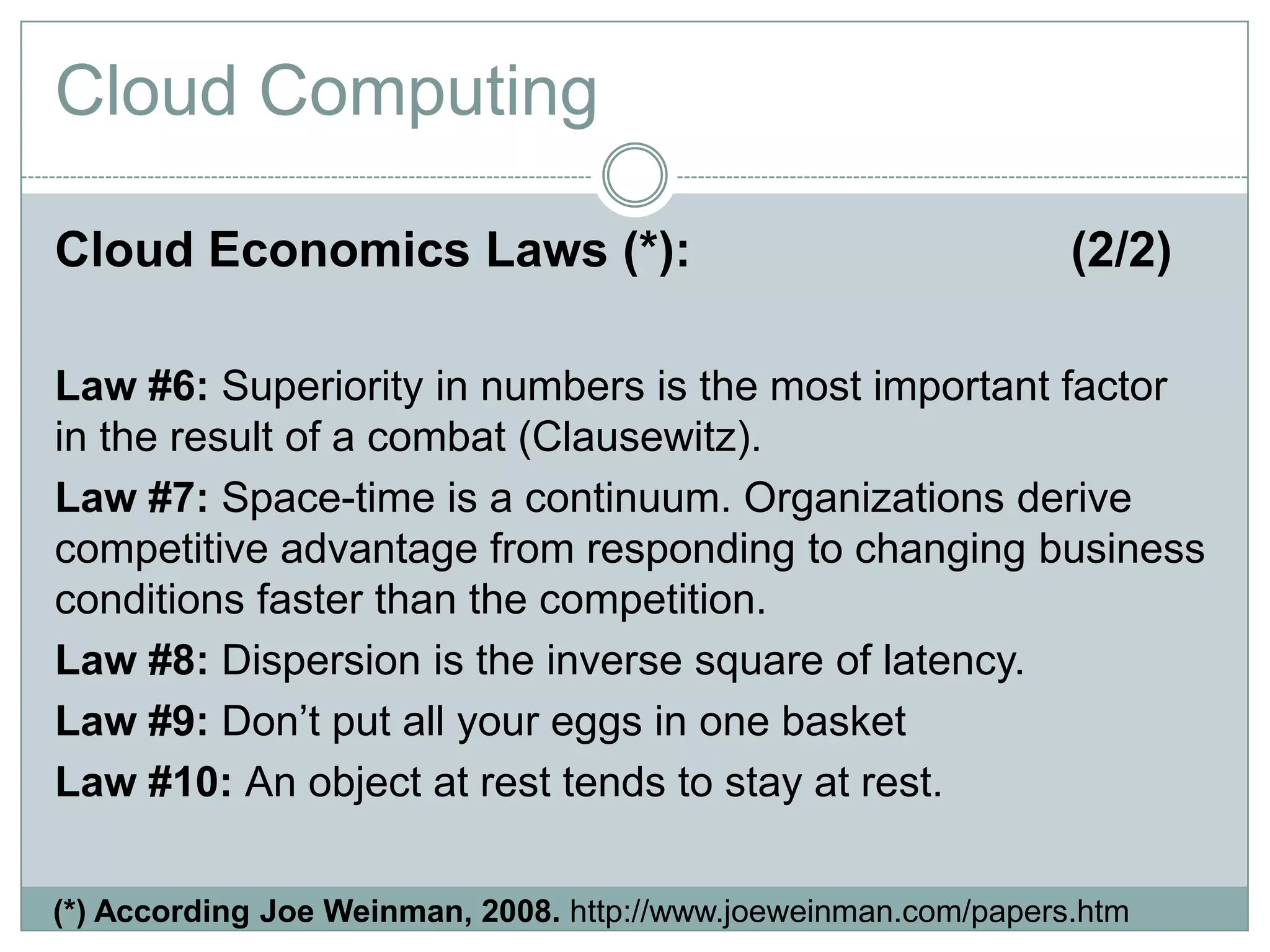
Cloud Economics Laws (*): (2/2)
Law #6: Superiority in numbers is the most important factor
in the result of a combat (Clausewitz).
Law #7: Space-time is a continuum. Organizations derive
competitive advantage from responding to changing business
conditions faster than the competition.
Law #8: Dispersion is the inverse square of latency.
Law #9: Don’t put all your eggs in one basket
Law #10: An object at rest tends to stay at rest.
Cloud Computing
(*) According Joe Weinman, 2008. http://www.joeweinman.com/papers.htm

Cloud Computing - Economics

  • 1.
    CLOUD ECONOMICS THE ECONOMICSOF CLOUD COMPUTING PEDRO ALEXANDER ROMERO Cloud Computing
  • 2.
    Cloud Computing Agenda - CloudComputing – Economics value - 80 – 20 Rule - Opportunity Cost - OpEX - CapEx - Total Cost of Ownership - Cloud Economics Laws
  • 3.
    Cloud Computing Cloud CostSaving Mechanisms: 1. By lowering the opportunity cost of running technology 2. By allowing for a shift from capital expenditure to operating expenditure 3. By lowering the Total Cost of Ownership (TCO) of technology 4. By giving organizations the ability to add business value by renewed focus on core activities Cloud Computing increase economic value to an Organization
  • 4.
    80 - 20Rule: Rather than an absolute measure, it tends to be a generalization that is intended to make a point about distribution curves. The most well known use of the rule is the sales 80-20 rule which says that 80% of revenue for a business is derived from 20% of customers. Cloud Computing
  • 5.
    Cloud Computing Gartner (*)estimates: IT maintenance accounts for around 80 % of Total IT expenditure 80 – 20 Rule: (*) http://www.gartner.com/newsroom/id/497088 Extrapolation Near 20% IT Time and efforts goes to running applications, where all business value is generated
  • 6.
    Cloud Computing 80 –20 Rule: Cloud Ideal Scenery: Nowhere is the current model’s inefficiency more evident than in the opportunity costs that organizations pay to manage their own computing needs. Cloud helps change the ratio and gives IT Departments the ability to spend 80% of their time in core business process.
  • 7.
    Cloud Computing The costrelated to the next-best choice available to someone who has picked among several mutually exclusive choices. A move to the Cloud can make the difference between an organization being 20% efficient, and one being 80% efficient. Opportunity Cost: Opportunity Cost: Are not restricted to monetary or financial cost.
  • 8.
    Cloud Computing Opex Capex DefinitionOpEx (Operational expenditure) refers to expenses incurred in the course of ordinary business, such as sales, general and administrative expenses. Capital Expenditures are expenditures creating future benefits. A capital expenditure is incurred when a business spends money either to buy fixed assets or to add to the value of an existing asset with a useful life that extends beyond the tax year. Also known as Operating Expense, Operating Expenditure, Revenue Expenditure Capital Expenditure, Capital Expense Opex - Capex:
  • 9.
    Cloud Computing Opex -Capex: Reasons Opex is preferred to Capex  Financial Considerations: Flexibility to terminate cost at will, in the event that the item is no longer required, payments can cease rapidly.  Allows Business Units to Decide: Opex expenditures tends to be delegated to individual Business Units. With Cloud Computing Individual Business Units have the ability to acquire technology that answers their particular business needs
  • 10.
    Cloud Computing Opex -Capex: Reasons Opex is preferred to Capex  Overcomes Expenditure Limitations: Acquiring capital for large purchases is difficult, for all size organizations. Moving to an Opex model removes this limitation. While a move away from CapEx is undoubtedly attractive to organizations, it is via TCO that the economic benefits of Cloud Computing become most clear.
  • 11.
    Cloud Computing Total Costof Ownership: TCO is a financial estimate. Its purpose is to help consumers and enterprise managers determine direct and indirect costs of a product or system. For IT capital investments, TCO is allocated in various cost components, mainly: • PURCHASE/ACQUISITION • OPERATIONAL • REPLACEMENT
  • 12.
    Cloud Computing Total Costof Ownership: Both firms indicate the purchase cost being about >32% of the TCO. Given the asset lifespan period, the longer the lifespan, the higher the TCO in absolute figures, but the purchase cost as % of the TCO gets lower. That's why Life Cycle Management of IT assets is significant.
  • 13.
    Cloud Computing Total Costof Ownership: Calculations of in-house costs fail to take into account:  The direct costs running a server:  Power, Floor space, Storage and IT operations to manage those resources.  The indirect costs of running a server:  Network, Storage infrastructure and IT operations to manage the general infrastructure.  Overhead costs of owning a server:  Procurement and accounting and Personnel Despite potential cost savings, Cloud Computing offers significant extra value to organizations by merit of the fact that it allows them to focus on their core business.
  • 14.
    Cloud Economics Laws(*): (1/2) Law #1: Utility services cost less even though they cost more. (Cost less when they are not used). Law #2: On-demand trumps forecasting Law #3: The peak of the sum is never greater than the sum of the peaks. Law #4: Aggregate demand is smoother than individual. Law #5: Average unit costs are reduced by distributing fixed costs over more units of output. Cloud Computing (*) According Joe Weinman, 2008 http://www.joeweinman.com/papers.htm
  • 15.
    Cloud Economics Laws(*): (2/2) Law #6: Superiority in numbers is the most important factor in the result of a combat (Clausewitz). Law #7: Space-time is a continuum. Organizations derive competitive advantage from responding to changing business conditions faster than the competition. Law #8: Dispersion is the inverse square of latency. Law #9: Don’t put all your eggs in one basket Law #10: An object at rest tends to stay at rest. Cloud Computing (*) According Joe Weinman, 2008. http://www.joeweinman.com/papers.htm