Cloud Security
Presented by: Rashmi Agale Guided by: D M Ujalambkar
Department of Computer Engineering
AISSMS COE,Pune-01
11/22/16Cloud security 1
 Cloud security risks
 Insider and outsider attack
 Privacy and Trust
 Operating system security
 Security of virtualization
 Security risks posed by shared images
 Security risks posed by a management OS
 Xoar and its components
 Trusted virtual machine monitor
Overview
11/22/16Cloud security 2
 Increasing usage of cloud services in non-traditional sectors
 Growing adoption of cloud services in government departments
 Rise in cloud service specific attacks
 Growing usage of cloud services for critical data storage
 Rise in employee mobility
 Standards, regulations, and laws governing the activities of cloud service
provider have yet to be adopted.
 Service Level Agreements (SLAs) do not provide adequate legal protection
for cloud users, often left to deal with events beyond their control.
 Many issues related to privacy, security, and trust in cloud computing are far
from being settled
Why cloud security is important ?
11/22/16Cloud security 3
 Secure data transfer : secure channel(https)
 Secure software interfaces : APIs and interfaces
 Secure stored data : encrypted
 User access control : level of access to data
 Data separation : attacks on shared technology inside cloud
Cloud security risks
11/22/16Cloud security 4
 At client
 Learn passwords/authentication information
 Gain control of the VMs
 At CSP
 Log client communication
 Can read unencrypted data
 Can possibly peek into VMs, or make copies of VMs
 Can monitor network communication, application patterns
 Why?
 Gain information about client data and
 Sell the information or use itself
Insider attack
11/22/165Cloud security
 What?
 Listen to network traffic
 Insert malicious traffic
 Launch Daniel of Service (Dos)
Outsider attack
11/22/166Cloud security
 Consumer’s loss of control
 Data, applications, resources are located with provider
 User identity management is handled by the cloud
 User access control rules, security policies and enforcement are managed by
the cloud provider
 Multi-tenancy
 Multiple independent users share the same physical infrastructure
 Thus an attacker can legitimately be in the same physical machine as the
target
 Will the sensitive data stored on a cloud remain confidential?
 Will cloud compromises leak confidential client data
 Will the cloud provider itself be honest and won’t peek into the data?
Privacy
11/22/167Cloud security
 Lack of trust
 Trusting a third party requires taking risks
 Trust and risk are opposite sides of the same coin
 Cloud now stores data from a lot of clients, and can run data mining
algorithms to get large amounts of information on clients
 Cloud provider employees can be phished
Trust
11/22/168Cloud security
 Malicious attacks: Unauthorized access to a privileged information,
tempering with executable code, and spoofing
 Elements of the mandatory OS security
 Access control : mechanisms to control the access to system objects
 Authentication usage : mechanisms to authenticate a principal.
 Cryptographic usage policies : mechanisms used to protect the data .
 Trusted applications only be allowed the lowest level of privileges required to
perform their functions.
 Existence of trusted paths mechanisms supporting user interaction with
trusted software.
Operating system security
11/22/169Cloud security
 Just as an OS attack is possible, a hacker can take control of a hypervisor.
 If hacker gets control of hypervisor, he gains control of everything.
 Firewalls in virtual environment is a little more complicated than in normal
network because some virtual servers are outside a firewall
 Manipulating the available resources into mounting a large-scale botnet
attack.
 Virtualization sprawling
 Use of backdoor VMs that leak sensitive information and can destroy data
privacy.
 Taking a snapshot or illegal copy of the whole system is easy.
 Infection of VMs may last indefinitely
Security of virtualization
11/22/1610Cloud security
 Image sharing is critical for the IaaS cloud delivery model. For example, a
user of AWS has the option to choose between
 Amazon Machine Images (AMIs) accessible through the Quick Start.
 Community AMI menus of the EC2 service.
 Many of the images analyzed by a recent report allowed a user to undelete
files, recover private keys, or other type of sensitive information with little
effort and using standard tools.
 A software vulnerability audit revealed that 98% of the Windows AMIs and
58% of Linux AMIs audited had critical vulnerabilities.
 Security risks:
 Backdoors and leftover credentials.
 Unsolicited connections.
Security risks posed by shared
images
11/22/1611Cloud security
 Hypervisor is considerably smaller than an operating system
e.g. the Xen VMM has 60,000 lines of code
 The Trusted Computer Base (TCB) of a cloud computing environment
includes not only the hypervisor but also the management OS.
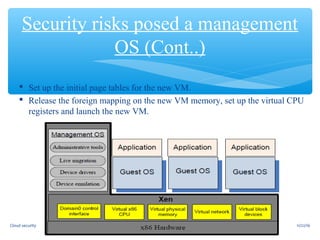
 The management OS supports administrative tools, live migration, device
drivers, and device emulators.
 In Xen the management operating system runs in Dom0; it manages the
building of all user domains, a process consisting of several steps:
 Allocate memory in the Dom0 address space and load the kernel of the guest
operating system from the secondary storage.
 Allocate memory for the new VM
Security risks posed a management
OS
11/22/1612Cloud security
 Set up the initial page tables for the new VM.
 Release the foreign mapping on the new VM memory, set up the virtual CPU
registers and launch the new VM.
Security risks posed a management
OS (Cont..)
11/22/1613Cloud security
 Security risks at the time it creates a DomU:
 Refuse to carry out the steps necessary to start the new VM.
 Modify the kernel of the guest OS to allow a third party to monitor and
control the execution of applications running under the new VM.
 Undermine the integrity of the new VM by setting the wrong page tables
and/or setup wrong virtual CPU registers.
 Refuse to release the foreign mapping and access the memory while the new
VM is running.
Security risks posed a management
OS (Cont..)
11/22/1614Cloud security
 Xoar - breaking the monolithic design of TCB
 Xoar is a version of Xen designed to boost system security
 The design goals are:
 Maintain the functionality provided by Xen.
 Ensure transparency with existing management and VM interfaces.
 Tight control of privileges, each component should only have the privileges
required by its function.
 Minimize the interfaces of all components to reduce the possibility that a
component can be used by an attacker.
Xoar
11/22/1615Cloud security
 Eliminate sharing. Make sharing explicit whenever it cannot be eliminated to
allow meaningful logging and auditing.
 Reduce the opportunity of an attack targeting a system component by limiting
the time window when the component runs.
Xoar (Cont..)
11/22/1616Cloud security
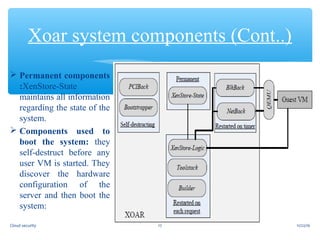
 Permanent components
:XenStore-State
maintains all information
regarding the state of the
system.
 Components used to
boot the system: they
self-destruct before any
user VM is started. They
discover the hardware
configuration of the
server and then boot the
system:
Xoar system components (Cont..)
11/22/1617Cloud security
 Components restarted on each request:
 Toolstack - handles VM management requests, e.g., it requests the Builder to
create a new guest VM in response to a user request.
 Builder - initiates user VMs.
 Components restarted on a timer:
 Blk-Back - exports physical storage device drivers
 NetBack - exports the physical network driver.
Xoar system components (Cont..)
11/22/1618Cloud security
 Noval ideas:
 Do not allow the contents of the system to be either manipulated or inspected
by the cloud service provider
 An application should be allowed to build its software stack based on its
needs. Applications requiring a very high level of security should run under a
very thin OS supporting only the functionality required by the application and
the ability to boot.
 Provide trusted paths from a user to an application. Such a path allows a
human user to determine with certainty the identity of the VM it is interacting
with and allows the VM to verify the identity of the human user.
 Deny the cloud service provider the root access.
Trusted virtual machine monitor
11/22/1619Cloud security
 Dan C. Marinescu , “Cloud Computing: Theory and Practice ”
References
11/22/16Cloud security 20
THANK YOU
11/22/16Cloud security 21

Cloud Security

  • 1.
    Cloud Security Presented by:Rashmi Agale Guided by: D M Ujalambkar Department of Computer Engineering AISSMS COE,Pune-01 11/22/16Cloud security 1
  • 2.
     Cloud securityrisks  Insider and outsider attack  Privacy and Trust  Operating system security  Security of virtualization  Security risks posed by shared images  Security risks posed by a management OS  Xoar and its components  Trusted virtual machine monitor Overview 11/22/16Cloud security 2
  • 3.
     Increasing usageof cloud services in non-traditional sectors  Growing adoption of cloud services in government departments  Rise in cloud service specific attacks  Growing usage of cloud services for critical data storage  Rise in employee mobility  Standards, regulations, and laws governing the activities of cloud service provider have yet to be adopted.  Service Level Agreements (SLAs) do not provide adequate legal protection for cloud users, often left to deal with events beyond their control.  Many issues related to privacy, security, and trust in cloud computing are far from being settled Why cloud security is important ? 11/22/16Cloud security 3
  • 4.
     Secure datatransfer : secure channel(https)  Secure software interfaces : APIs and interfaces  Secure stored data : encrypted  User access control : level of access to data  Data separation : attacks on shared technology inside cloud Cloud security risks 11/22/16Cloud security 4
  • 5.
     At client Learn passwords/authentication information  Gain control of the VMs  At CSP  Log client communication  Can read unencrypted data  Can possibly peek into VMs, or make copies of VMs  Can monitor network communication, application patterns  Why?  Gain information about client data and  Sell the information or use itself Insider attack 11/22/165Cloud security
  • 6.
     What?  Listento network traffic  Insert malicious traffic  Launch Daniel of Service (Dos) Outsider attack 11/22/166Cloud security
  • 7.
     Consumer’s lossof control  Data, applications, resources are located with provider  User identity management is handled by the cloud  User access control rules, security policies and enforcement are managed by the cloud provider  Multi-tenancy  Multiple independent users share the same physical infrastructure  Thus an attacker can legitimately be in the same physical machine as the target  Will the sensitive data stored on a cloud remain confidential?  Will cloud compromises leak confidential client data  Will the cloud provider itself be honest and won’t peek into the data? Privacy 11/22/167Cloud security
  • 8.
     Lack oftrust  Trusting a third party requires taking risks  Trust and risk are opposite sides of the same coin  Cloud now stores data from a lot of clients, and can run data mining algorithms to get large amounts of information on clients  Cloud provider employees can be phished Trust 11/22/168Cloud security
  • 9.
     Malicious attacks:Unauthorized access to a privileged information, tempering with executable code, and spoofing  Elements of the mandatory OS security  Access control : mechanisms to control the access to system objects  Authentication usage : mechanisms to authenticate a principal.  Cryptographic usage policies : mechanisms used to protect the data .  Trusted applications only be allowed the lowest level of privileges required to perform their functions.  Existence of trusted paths mechanisms supporting user interaction with trusted software. Operating system security 11/22/169Cloud security
  • 10.
     Just asan OS attack is possible, a hacker can take control of a hypervisor.  If hacker gets control of hypervisor, he gains control of everything.  Firewalls in virtual environment is a little more complicated than in normal network because some virtual servers are outside a firewall  Manipulating the available resources into mounting a large-scale botnet attack.  Virtualization sprawling  Use of backdoor VMs that leak sensitive information and can destroy data privacy.  Taking a snapshot or illegal copy of the whole system is easy.  Infection of VMs may last indefinitely Security of virtualization 11/22/1610Cloud security
  • 11.
     Image sharingis critical for the IaaS cloud delivery model. For example, a user of AWS has the option to choose between  Amazon Machine Images (AMIs) accessible through the Quick Start.  Community AMI menus of the EC2 service.  Many of the images analyzed by a recent report allowed a user to undelete files, recover private keys, or other type of sensitive information with little effort and using standard tools.  A software vulnerability audit revealed that 98% of the Windows AMIs and 58% of Linux AMIs audited had critical vulnerabilities.  Security risks:  Backdoors and leftover credentials.  Unsolicited connections. Security risks posed by shared images 11/22/1611Cloud security
  • 12.
     Hypervisor isconsiderably smaller than an operating system e.g. the Xen VMM has 60,000 lines of code  The Trusted Computer Base (TCB) of a cloud computing environment includes not only the hypervisor but also the management OS.  The management OS supports administrative tools, live migration, device drivers, and device emulators.  In Xen the management operating system runs in Dom0; it manages the building of all user domains, a process consisting of several steps:  Allocate memory in the Dom0 address space and load the kernel of the guest operating system from the secondary storage.  Allocate memory for the new VM Security risks posed a management OS 11/22/1612Cloud security
  • 13.
     Set upthe initial page tables for the new VM.  Release the foreign mapping on the new VM memory, set up the virtual CPU registers and launch the new VM. Security risks posed a management OS (Cont..) 11/22/1613Cloud security
  • 14.
     Security risksat the time it creates a DomU:  Refuse to carry out the steps necessary to start the new VM.  Modify the kernel of the guest OS to allow a third party to monitor and control the execution of applications running under the new VM.  Undermine the integrity of the new VM by setting the wrong page tables and/or setup wrong virtual CPU registers.  Refuse to release the foreign mapping and access the memory while the new VM is running. Security risks posed a management OS (Cont..) 11/22/1614Cloud security
  • 15.
     Xoar -breaking the monolithic design of TCB  Xoar is a version of Xen designed to boost system security  The design goals are:  Maintain the functionality provided by Xen.  Ensure transparency with existing management and VM interfaces.  Tight control of privileges, each component should only have the privileges required by its function.  Minimize the interfaces of all components to reduce the possibility that a component can be used by an attacker. Xoar 11/22/1615Cloud security
  • 16.
     Eliminate sharing.Make sharing explicit whenever it cannot be eliminated to allow meaningful logging and auditing.  Reduce the opportunity of an attack targeting a system component by limiting the time window when the component runs. Xoar (Cont..) 11/22/1616Cloud security
  • 17.
     Permanent components :XenStore-State maintainsall information regarding the state of the system.  Components used to boot the system: they self-destruct before any user VM is started. They discover the hardware configuration of the server and then boot the system: Xoar system components (Cont..) 11/22/1617Cloud security
  • 18.
     Components restartedon each request:  Toolstack - handles VM management requests, e.g., it requests the Builder to create a new guest VM in response to a user request.  Builder - initiates user VMs.  Components restarted on a timer:  Blk-Back - exports physical storage device drivers  NetBack - exports the physical network driver. Xoar system components (Cont..) 11/22/1618Cloud security
  • 19.
     Noval ideas: Do not allow the contents of the system to be either manipulated or inspected by the cloud service provider  An application should be allowed to build its software stack based on its needs. Applications requiring a very high level of security should run under a very thin OS supporting only the functionality required by the application and the ability to boot.  Provide trusted paths from a user to an application. Such a path allows a human user to determine with certainty the identity of the VM it is interacting with and allows the VM to verify the identity of the human user.  Deny the cloud service provider the root access. Trusted virtual machine monitor 11/22/1619Cloud security
  • 20.
     Dan C.Marinescu , “Cloud Computing: Theory and Practice ” References 11/22/16Cloud security 20
  • 21.

Editor's Notes

  • #10 Finanicial application can A critical function of an OS is to protect applications against a wide range of malicious attacks, e.g., unauthorized access to privileged information, tempering with executable code, and spoofing not determine whether a request comes from an authorized user or from a malicious program;
  • #11 3) There kind of attacks target cloud service provider 4)creation of a new virtual machine is not a difficult task, and thus, creating roughe VMs and allocating huge spaces for them can lead to a Denial of service attack for serviceproviders when they opt to create new VM on the cloud 5) That pertains to a firewall within a VM, and it specifically addresses loging into VM via alternative method
  • #12 Elastic compute cloud
  • #14 A guest operating system and applications running under management OS reside in a DomU.
  • #15 A guest operating system and applications running under management OS reside in a DomU.
  • #17 A guest operating system and applications running under management OS reside in a DomU.
  • #18 A guest operating system and applications running under management OS reside in a DomU. Xoar has nine classes of components of four types: permanent, self-destructing, restarted upon request, and restarted on timer. A guest VM is started using the by the Builder using the Toolstack; it is controlled by the XenStore-Logic. The devices used by the guest VM are emulated by the Qemu component. Qemu is responsible for device emulation
  • #19 A guest operating system and applications running under management OS reside in a DomU.